“I am still right here”

Well, it’s Wednesday, and in the American ordering of date numbers, the date is 12-3, (which means “December 3rd”, not “9”).  That’s mildly fun, since it has 1, 2, and 3 in order.  In 20 years, we’ll have 12-3-45, which is also kind of fun.  But we’re ignoring the century number, which ruins everything:  12-3-2045 if you “spell” it out.  See what I mean?  I guess in 2542 years we’ll have 12-3-4567.  That’s much more amusing, but odds are good that by that time, we’ll have different ways of representing the date, so it probably won’t work.

Oh, well.  Life is indeed unsatisfactoriness, or dukkha as you might say.  

I’ve been trying to find something interesting to read, but neither fiction nor nonfiction seems able to grab my attention.  I’ve tried reading books about computer science/machine learning, and about the nature of mathematics in general, and about political philosophy, and about physics, and so on.  I can’t seem to summon the energy to focus or get into any of them.

I did listen to the song Like A Stone by Audioslave* for the first time during the last several days.  I got the chords for it and everything.  I’ve played the video over and over (as I do) and practiced singing it and playing it myself.  It’s got a lot of barre chords, so it’s good exercise for my left hand (which can get very sore) but otherwise it’s fairly simple.

It’s a good song.  Even so, I can only distract myself with that for a short while at a time, and the whole thing is already losing interest for me.  But then again, so is Radiohead, and the Beatles, and Bowie, and Pink Floyd, and all those other people whose songs I play and sing for myself.  It’s all just been done, and it’s just me trying to amuse myself, like when I used to play tabletop RPGs alone as a teenager, rolling random encounters and making stories up based on those as I went along.

I almost wish I still had my old role-playing games, like Gamma World and DragonQuest and Villains and Vigilantes (and even D&D) as well as some dice and hex paper, so I could play again.  But probably, if I had them, I would find them boring, too.

I am not interested in online RPGs, especially not the MMORPG things, especially the ones with graphics.  I have no interest in playing role-playing games with strangers.  That’s an almost horrifying thought.

The problem is clearly with me in all of this.  I got spun off years ago from having any kind of the close and consistent social interaction (outside work and my interlude of prison) which had previously served to keep me more like a human.  Since then I’ve gotten, or felt, more and more…different.  I’ve always known I was weird, really, but in the past I had family and friends around to keep me from going off the rails too much.

It’s a bit like a neutron.  As you probably know, neutrons in a nucleus, where they interact with surrounding nucleons via the strong force, are stable effectively forever.  However, a neutron outside the nucleus decays with a half life of only about ten minutes.  That means that after an hour, only one in 64 such neutrons will not have yet decayed.  After two hours, that would be only one in 4096.  They will all decay eventually.

That’s just an analogy, but it’s apt, I think.  I am a free neutron (and cheap at twice the price!) and must decay before long.

I think I just don’t have any capacity actually to connect to any other beings, anymore.  I don’t feel as though there’s anyone whose interests even complement mine, let alone match up to any reasonable degree.  And when I try to interact with people at a more personal level, it tends before long to be the case that we are both awkward and uncomfortable (but especially me).

Oh, well, again.  I have no reason to expect things to be otherwise, nor to expect to find any “kindred spirit(s)” out there.  I’m way past tired of trying to change myself to fit in with other people, to try to make them happy.  I tried to do that in the past, really pretty much all the time; it slowly but surely wore me down and wore me out.  It never ended up working, anyway; at some point or other, everyone I love has, consciously or unconsciously, found me not worth the effort of being around.

And what have I become, my sweetest friend?  I’m a neutron, a sustained interaction between the up quark field, the down quark field, and the gluon field(s), and I will decay into a proton, an electron, and an electron-antineutrino.

Okay, I’m pushing that metaphor way too far, sorry.  Bottom line, I know I’m weird and unpleasant, and I am not worth the trouble even for myself, let alone anyone else.  If someone wanted to help me or save me, I couldn’t encourage them, not if I were being honest and kind, anyway.  I’m not a good pony, and I don’t recommend betting on me.  “I will let you down; I will make you hurt.”


*Quick Chris Cornell-centered “dad joke”:  Where does an Audioslave work?  In the Soundgarden behind the Temple of the Dog.

“These our actors…are melted into air, into thin air.”

Well, it’s Tuesday, and for reasons (or, rather, causes) that are unclear to me, I had a particularly poor sleep last night.  I just didn’t feel sleepy.  Even this morning, when I told myself I needed to buckle down and get some shut-eye at least, I was only “out” for a few moments.  I even felt, or worried, that I had overslept somehow, if that’s believable.  But when my eyes snapped inevitably open, I saw that maybe 15 minutes had passed.

Eventually, even someone as stubborn as I must give way to the brute facts of reality, so I gave up and got up.  Of course, even if one doesn’t decide to “give way”, it doesn’t change anything.  Reality doesn’t depend upon the approval or acquiescence of conscious beings, however they might like to flatter themselves that it does.  It simply is whatever it is.  That’s what makes it reality.

This is a good thing, of course.  If reality could simply be changed by the power of a mind‒for instance, my mind‒there would be many, many people who failed to signal or otherwise drove badly who would simply disappear, never again to be heard from by their friends and loved ones*.

In reality, though, if one wants to disintegrate someone, it’s a somewhat laborious and messy process.  As far as I can tell, there is no way to make something like a phaser from Star Trek that can just scatter someone into particles, or whatever it is that phasers do.  Trust me, I’ve thought about potential designs on and off over the course of decades.

You can’t shoot a beam of gluons because they self-interact and are not found outside the nucleus (or a quark-gluon plasma), which is why the strong force has such relatively short range despite having a massless force-carrying boson (i.e., the gluon).

One also cannot shoot W or Z particles, perhaps hoping to initiate some form of decay.  Those bosons interact with the Higgs field, and so they have mass‒quite a sizeable mass for force-carrying particles.  And the W bosons even have electric charges.  So they don’t have a range much longer than the size of a nucleon, if that.

One could accelerate neutrons; or rather, one could accelerate parallel and matched electrons and protons and set them to collide with each other and continue in their initial trajectory as newly formed neutrons (plus some neutrinos).  Depending on their speed, they might just break apart some larger nuclei (or raise the atomic numbers of some others, à la the S process and R process nucleogenesis such as occurs in supernovae and neutron star collisions).

This could do some damage, I guess.  One might even be able to make it lethal if it were strong enough; and it might be a delayed death, which could be useful for assassins of one kind or another, I guess.  But if you wanted to disintegrate someone, you’d have to cause a very large explosion, which would not treat you kindly if you were anywhere near.

If you could generate a beam of antimatter‒positrons or, worse, antiprotons or antineutrons‒you could certainly obliterate someone if you had enough.  But it would be an even worse explosion than the neutrons would give.  A person’s mass, annihilating with an equivalent amount of antimatter, would yield far greater explosive force than any nuclear weapon ever detonated (even the Tsar Bomba, which only involved the conversion of about 5 pounds of matter into energy, much smaller than any adult human).

So, yeah, instant disintegration by a ray gun (or a beam from the eyes like in comic books) using anything we currently understand is unworkable for various reasons.  Whether dark matter particles (if they exist) or even neutrinos (which do exist and do have quite peculiar properties) could be made to disintegrate someone is far from clear or promising.  In any case, they would be likely to lead to some manner of explosion such as mentioned above.

You wouldn’t want to do that in traffic.  The whole point is to delete people who needlessly make driving less safe for those around them!  You would cause more harm than good, by quite some margin, if you obliterated them, however satisfying it might be to turn an inattentive driver (and their car if they are alone**) into a small but very powerful explosive.

Wow.  I guess this is the sort of stuff that goes through my mind when I sleep very poorly, huh?  It makes me feel a bit like writing some on HELIOS.  I could explain why but that would give potential spoilers for the book, in case I ever write it.

Oh, well.  I hope you all have a very good day.  But do use your signals when you drive, for goodness’s sake.


*I know, I’m being unreasonably generous.  Of course, people who don’t signal properly when they drive don’t have friends, and it’s all but certain that no one loves them.  Whether they are, themselves, capable of love is open to debate.

**If they are not alone in their car, or on the road, it would be too dangerous to obliterate them in situ, in terms of collateral damage.  Perhaps the neutron beam that is only lethal after a delay would be useful for that after all, doing damage that only has its full effect over time.  One could similarly use X-rays or even gamma rays for that, but their penetrating power makes it much harder to avoid hitting innocent people.

“Turning and turning in the widening gyre…”

Well, isn’t this a surprise?

I’m writing a blog post on a Saturday for the first time in quite a while, because at the last minute, the boss sprang on us the notion that he needs us to start coming in on Saturdays again.  Things have been a bit slow the last few weeks, and a company with whom we had made a recent contract has apparently stiffed us a bit.  This is hardly our fault, of course—we had no input in the decision-making process—but we are going to be bearing the brunt of it.

Unfortunately, the coworker with whom I used to alternate Saturdays has already been picking up some shifts at his bartending job on Saturdays, so he cannot work, at least for the foreseeable relatively near future.  So, I’m going to be coming in on Saturdays, it seems.  Because, of course, he has a wife and young daughter to care for and with whom to spend time, whereas I have absolutely no one, so I am expendable.

I admit that I don’t do very much on weekends at the house, but if there was one good thing, it was that on Friday nights I could at least take some Benadryl and force myself to sleep in a little bit on Saturdays.  It’s not ideal rest, of course, if it’s achieved via well-known side-effects of antihistamines.  But it was the best I’ve been able to do, and that extra rest, however far from ideal, did me some good.

I can’t sleep in on Sundays, because I need to do my laundry on Sunday mornings, and I don’t want to have to go traipsing through the other parts of the house while the other renters are up and about.  That’s more stressful than getting up early.

I swear, there are times when I suspect that my boss wants me to kill myself.  If so, I wish he would just say so.  I’m amenable to the idea, especially if I could get some help to make it go easier.

This has not been a very good birthday week for me.  In fact, I don’t think I exaggerate by saying that the birthdays that passed while I was in PRISON were better than this week.  At least then, I could hold on to the delusional idea that, once I got out, life would be better.

Ha ha ha ha ha ha ha ha ha!!

I think more and more often—or, well, it feels as though that’s the case—that I ought just to embrace my innate nature as a destroyer and commit myself to the destruction of the entire human race.  We have no business contaminating the rest of the universe with our presence, or with the presence of our emissaries, if we create some AI-based self-replicating robots or whatever to send out.  We can’t even manage the minor issues of our current “civilization”; what business have we trying to colonize the galaxy, let alone the universe?

We could wipe out everyone—and probably lots of other species—with another mass extinction, and then nature has plenty of time to develop another technological civilization if it’s so inclined before the sun goes red giant.  Of course, whatever they might be could be no better than humans are.  There’s no reason, for instance, to imagine that any kind of animal currently alive on Earth would manage things better if they were suddenly granted the capacity to have a technological civilization.  But at least it would be out of our hands.  We would be laid to sleep like the children in the nursery rhyme prayer, dying before we wake.

We certainly are not awake now.  Look around you.  The most powerful nations (ever) on Earth are in the hands of collections of moral imbeciles.  As always, as Yeats pointed out, “The best lack all conviction, while the worst / are full of passionate intensity.”  There are logical, causal reasons for this fact, but they do not make it easier to stomach.

I hate this fucking planet.  I hate this fucking species.  In fact, I’m not fond of the universe overall, at the moment.  If I could imagine a way to trigger a vacuum collapse that would wipe out everything, I would consider doing it.  But that’s at best a hypothetical possibility.

I guess I have to start somewhat smaller.

Contrary to popular imagining, there is no danger in creating, for instance, a small black hole in a particle accelerator, even if we had an accelerator with that capability.  Small black holes disappear almost instantly, vanishing in flashes of Hawking radiation.  Even if they didn’t, a miniature black hole would almost certainly just sink to the center of gravity of the Earth and perhaps do a bit of extra heating of the core.

Black holes don’t magically suck things into themselves, they merely gravitate just like anything else of equivalent mass (which would be tiny indeed for one produced from a particle accelerator).  Yes, anything that passes the event horizon cannot escape, but for a subatomic black hole, that horizon would be unimaginably tiny.  Even a black hole with the mass of the whole Earth would only be the (outer) size of a pea.

One could and can, of course, create thermonuclear reactions without requiring a fission explosion (which requires rarer materials) to trigger it.  A network of lasers triggering local fusion in appropriately placed samples could direct that energy toward a lithium deuteride* core and generate enough heat to trigger a growing chain of explosions.  But such a “bomb” would need to be large and stationary.

Still, one could set up a dummy corporation with branches in numerous large cities throughout the world and build those bombs, maybe also setting them up in “research outposts” in Antarctica and/or the Arctic, to melt the polar ice caps.  Possibly putting some similar “research facilities” near the thin-points of various volcanoes and super volcanoes would also enhance the outcome.

Alternatively, one could use a particle accelerator to generate anti-matter and store it.  Now this would be quite a technical challenge, since one cannot store neutral antimatter easily—it annihilates if it touches any normal matter, and so it is generally stored in electrically charged forms such as positrons and antiprotons, in evacuated chambers, contained by powerful magnetic fields.  It’s not an efficient way to do things, but one could, possibly, store enough of it that, once one released the magnetic containment, one could unleash an explosion that would make the Tsar Bomba look like one of those little paper poppers we used to play with when we were kids.

There are other ways, of course, to do things.  I’ve mentioned before that it wouldn’t be all that hard to use rockets to redirect the orbits of large asteroids so they were more likely to collide with the Earth.  Or one could genetically engineer and mass-produce a more hardy and virulent form of anthrax (for instance) and disperse it aerially over major cities.

I guess the point is I’m not in a good mood, and it would probably be better for all of humanity, as well as for me, if I were to cease to exist.  I’m so tired of everything.

I hope you’re having a nice weekend.


*Although, for the lithium to be converted to tritium most efficiently, on needs a source of neutrons, which are handily provided by primary fission explosions in usual thermonuclear weapons.  I suspect one could arrange alternate sources with only minimal effort.

If the vacuum collapses, everything gets messy

It’s Wednesday morning now, and I feel slightly better than I did yesterday, which should probably be no surprise.  I went back to the house last night, and I had a decent sleep‒for me, anyway‒and no major evening issues.  Now I am working my way toward the office.  It’s payroll day, so it should be at least mildly more hectic than most other days, but it shouldn’t be too unbearable.

Well, it shouldn’t be unbearable at all.  I mean, the state of being unbearable or not is a purely binary thing, isn’t it?  Either something is bearable or it is not.  If something is unbearable, then it cannot be borne.  So, saying something is not “too unbearable” is probably almost always nonsensical.  I suppose one could imagine something being only just unbearable, so that one could almost be able to bear it…but not quite, and one would finally be forced to succumb to whatever outcome that entailed, despite one’s possibly heroic struggles.

In some ways that sounds like it could be worse than something being thoroughly and unequivocally unbearable.  If one can see that something is truly unbearable, one will probably be less likely even to try to bear it.  One would not bother attempting to style out the brunt of a supernova; if one could not get far enough away, one would presumably just close one’s eyes and grit one’s teeth and take what comfort one could in knowing that the explosion will probably happen and obliterate one faster than any nerve impulse could propagate.

That’s one of the (tiny) comforts about the possibility of there being a “vacuum collapse” of the universe, in which the present “dark energy” vacuum state could, hypothetically, quantum tunnel down to a lower, truer vacuum state than the present one*, releasing that potential energy drop in such a way that wipes out all currently existing particles/fields.

This would erase everything in our visible universe (the “visible” part is deliberate and crucial; do you see why?**) in a sort of wave of collapse that starts at the site of the first state change, like the propagation of ice crystals forming in hitherto supercooled water.  But though it would be a shame, from our point of view, it would be one we would never experience, since the bubble of state change would expand at the speed of light.  It would thus be literally impossible to see it coming, because once you could see it, it would already be there, and you would be wiped away before you could possibly be aware that it was happening.

By the way, this possibility is “only” hypothetical; we aren’t even sure it could happen, not least because we’re not sure whether the vacuum state of the universe is as low as it can go or not, among other things.  But don’t worry:  if the vacuum collapse of the cosmos doesn’t kill you, something else will.

Even my truly immortal vampires in Mark Red might be wiped out by vacuum collapse.  I suspect they would, which might be a comfort to many of them, so to speak.  Of course, that would depend very much on how the “supernatural” forces in that book’s universe interact with the vacuum state and other quantum fields.  It’s not inconceivable that they might survive even that.  How’s that for horrifying?

These are odd thoughts for a Wednesday morning, aren’t they?  I mean, on a Thursday they wouldn’t be that odd, and even less so on a Friday.  On a Saturday they would be almost boringly predictable.  But on a Wednesday morning?  That’s just, well…odd, as I said.

I’m being silly.  My apologies.

I guess it’s more uplifting than is the prospect of universal Armageddon***.  Though, really, the Tao te Ching (in the version with which I am familiar) encourages us to embrace death with our whole hearts because that will help us to be prepared for most everything else we can encounter.

It does not encourage us to love death or to seek it; quite the contrary.  We are merely encouraged to accept it, not just intellectually but viscerally, to internalize***** it.  This is one of those curious circumstances in which the Tao to Ching and the movie Fight Club give the same advice, which is no indictment of that advice in either direction.

I try not to indulge in the vice of advice, but I will express my hope that every one of you who reads this post today or any of my other posts has a particularly good day, today and every day hereafter.

You’ve suffered enough already.


*This is analogous to what is thought to have happened when the “inflaton” field dropped down to a much lower energy level about 13.8 billion years ago, releasing the differential energy as the very hot soup of elementary particles that eventually became the universe we see.

**Okay, fine, I’ll explain.  It’s not just that the wave is expanding at the speed of light and so one would “see” it only as it hits.  But, given the current, accelerating expansion of the universe, the wave of change could never, even in principle, reach areas of the cosmos that are outside our cosmic horizon, because those places are receding from us faster than the speed of light/causality.  There is no causal influence from us that can ever reach them, or vice versa (assuming no wormholes or warp drives or similar).  Likewise, someplace beyond our horizon****** could be collapsing already, but we need never worry, because that collapse is not going to reach us (unless it changes the rate of overall cosmic expansion or even reverses it, which is not inconceivable.  We might then find ourselves in (or near) an anti-deSitter space, in which case, well…yeah).

***Not to be confused with the often misused**** term “apocalypse” which is basically just synonymous with “revelation”.  It’s become associated with the end of the world (and with lesser catastrophes) because one of the alternative titles of the book of Revelation is “The Apocalypse of Saint John the Divine” or whatever they called that nut bar.

****That rhymed, and it had a good rhythm too, both quite by accident.  I did that in yesterday’s or Monday’s post as well, but I didn’t call attention to it.  Can you find it now?

*****I would love to be able to use the term to grok it as in Heinlein’s Stranger in a Strange Land, but much as when Fuckerberg stole the term “metaverse” from me, likewise Elon Musk and the would-be tech boys who idolize him have arrogated the term “grok” and made it embarrassing to use.  Don’t even get me started on the disgusting theft of the word Palantir by Peter Thiel.  He deserves to be tortured interminably for the unmitigated gall he has shown in daring to use that term, but I would accept his immediate, painless disintegration and that of his company.

******Speaking of horizons, it is interesting to wonder what a vacuum state collapse would do to currently existing black holes.  I suspect they would basically be impervious to it, since the vacuum state is something that exists within spacetime, with the gravitational field as the backdrop of other quantum fields, but we don’t necessarily know enough about quantum gravity to feel very sure, as far as I know.  I suspect it might change the specifics of Hawking radiation at the level of the event horizon, and thus change the specific rate of black hole decay.  Also, I think in the first rush of particles generated by such a vacuum decay, most black holes would grow briefly with the influx of newly released energy all around them that had previously been bound up in the vacuum energy.  But that’s just my initial intuition.

I’ll have blogs more relative than this

Hello and good morning.

It’s Thursday again, if you can believe it.  It feels like it was just seven or eight days ago that it was Thursday last time, and here it is again.  I don’t know how this keeps happening.  Weirdly enough, though, from within, this week has felt as though it’s moving very slowly, and yet, it also feels as though Thursday has come again sooner than I expected.

The mind’s time sense is clearly not entirely objective and consistent.  Then again, why would it be?  Extremely precise long-term time-keeping would not have been a particular evolutionary advantage in the ancestral environment, certainly not one worth the inescapable biological (metabolic) cost of maintaining such a thing.

In any case, now we have incredibly precise time-keeping mechanisms which rely on some fundamental and consistent physical laws.  And though time does pass (so to speak) at different rates depending upon one’s relative velocity and the local curvature of spacetime (i.e., gravity), thanks to Einstein, we know how to adjust our disparate measurements of time with enough precision that we can maintain contact with a bunch of satellites in orbit, and they with each other, and use them to “triangulate” our precise position on the surface of the Earth to within a few meters (there’s generally more than one such triangle, thus the scare quotes—there is probably something more like a tetrahedron).

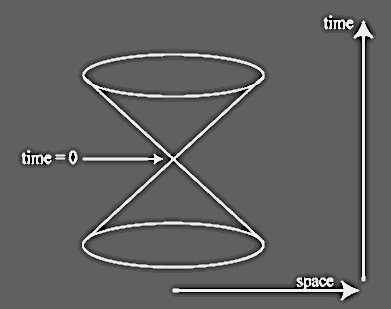
Of course, we don’t quite know completely just what time is, or at least, we don’t know for sure whether it’s fundamental or emergent from a deeper underlying set of physical laws.  We do know, based on General Relativity alone, that time would be in many ways “an illusion”, because simultaneity is not a consistent thing, and what counts as “now” relative to you depends very much on the direction and speed of your travel compared to other people.

From that point of view, all of spacetime in a sense “already” exists, and our experience of change is an illusion produced by the fact that we are within the block of spacetime.  Like characters and events in a movie on a DVD (or in any other stored medium) the events of the future are already laid out for us, and the end of the movie is as real and as permanent as the beginning, even when we watch the movie for the first time and don’t know what’s going to happen.

I think I talked a bit about this phenomenon in a post on Iterations of Zero called “Playing with spacetime blocks”.  If you want a better introduction to the ideas than anything I could give you, Brian Greene described it really nicely in either The Fabric of the Cosmos or The Hidden Reality.  I’m sorry that I don’t recall for certain which of the two books it is, but they’re both really great and are well worth your time.

Now, as it often does, quantum mechanics puts a bit of an onion in the ointment of fixed 4-D spacetime blocks, and the questions it raises depend—or so it seems to me—on which “interpretation” of quantum mechanics one applies.  In the standard version(s), in which there is such a thing as the collapse of the wavefunction when a quantum interaction occurs that leads to decoherence, there is a fundamental unpredictability to the outcome of such interactions when “measured”.

But if the permanence of spacetime as a whole that appears to be implied by General Relativity is correct, even those seemingly unpredictable events, countless numbers of which happen every second of every day in Dorset alone, are actually fixed and unchangeable.  This implies a mechanism of sorts for “superdeterminism”, or so it seems to me.

Of course, the Everettian “many worlds” version of quantum mechanics—which doesn’t require a deus ex machina wavefunction “collapse” that has to be added “by hand” to the calculations—seems to imply that, if spacetime is fixed in the GR sense then the state of being so fixed includes a fixed set of every outcome of every quantum interaction that would lead to so-called branching of the wavefunction of the universe.  That can be put into the works of GR, and it would give spacetime an added dimensionality of sorts—the dimension in which those “branched” paths exist.

But it would leave in the reality that we ourselves could not say which future “we” would experience, because every possible one actually happens; we just experience one at a time, so to speak*.  It would still be deterministic, just not as a “local” experience for those within spacetime.  Reality would be more like a “choose your own adventure” story than a fixed, scripted movie, but as with those books, all outcomes of any path are still fixed ahead of time.

I think I’ve rehashed a lot of the stuff I discussed in that blog post from IoZ, though I haven’t the will and patience right now to go check.  The specifics of my take on things are probably different this time; certainly, I think I understand all of the pertinent subject matter better than I did when I wrote about it before.  So, hopefully, this has given you at least something new.

Whatever the case, I cannot have done any differently than I have—unless I cannot help but do every possible different thing, but each branch of me, being a branch, only experiences its subset of the universe.  Even if, in a sense, you go both left and right at every metaphorical turn, you still only experience one direction.  It’s just that there is more than one of you, in a sense, experiencing each direction itself but unable to experience the other(s).

It’s really wild and cool stuff, isn’t it?  Science is amazing and awesome and fun.  Thomas Dolby sang that She Blinded Me With Science, but it’s really a way of removing blinders, of wiping the lenses of one’s glasses (and eyes) and focusing more precisely and rigorously on what’s really there, i.e., what’s happening whether anyone believes it or is there to experience it or not.

That’s probably enough for now.  I hope every possible version of you—even if there is only one—has a wonderful day today.

TTFN


*Please don’t make the mistake of thinking that it is human (or other creatures’) choices that determine the branching points of Everettian many-worlds, as seems to be implied by the movie Sliding Doors among other things.  It is quantum interactions resulting in decoherence that lead to the “splitting” of the wavefunction, and they are rarely the result of human choices, at least outside of places where experimental physics is done.

Gravid questions of time and gravity (and labor)

It’s Monday, the first of September, which was “originally” the seventh month, but which is now pushed back to the ninth by the two “caesarean” months.  Speaking of such things, it’s also Labor Day in the US (I’m not sure about other countries) a day on which we celebrate labor by giving most people the day off.  This isn’t quite as perverse as it might sound.  After all, what woman would want to work while in labor?

Ha ha.

Anyway, my workplace is open today, though only for half a day.  It has become more and more common for nearly everything to be open even on huge holidays like New Years and so on, let alone “ordinary” federal holidays.  The reasons are fairly straightforward, and they have nothing to do with any kind of formal, deliberate, corporate conspiracy such as is imagined by so many naïve people on social media.

It’s just the same problem‒or situation‒that leads trees to grow tall when it would make much more sense for them all to stay closer to the ground and not waste so many resources on trunks and xylem and phloem, on getting water and nutrients from the ground up to their highest leaves*.  The trouble is, if all the trees were low but then one variant appeared that was slightly higher, it would have a significant advantage over its species-mates (and other species), so it would be more effective at reproduction, ceteris paribus.  Its offspring would come to dominate, unless and until yet other variants occurred that tended to grow even higher.  And thus the “arms race” would begin.

So in the human world:  if everyone else worked four days a week, but one worker was willing/able to work more days or longer days, especially if for the same or only slightly higher pay, then that worker would have a job advantage, (again, ceteris paribus).  And so competition leads at least some workers to strive to outdo each other to the extent they can, and so on, working for local, individual advantage that inexorably leads to less pleasant outcomes for everyone.  It’s just game theory applied to economics.

Anyway, that wasn’t what I wanted to discuss this morning.  I wanted to discuss two physics-related ideas I’ve had in the last few days.  The later one is just a bit of silly fun, but the other is more interesting to me.

The second one happened this morning (at about 2 am, when I was awake, because of course I was).  I put on a YouTube video of Star Talk in which a string theorist was the guest, and Professor Tyson asked her about the possibility of more than one dimension of time, and she said most such theoretical possibilities fall afoul of paradoxes and trouble with causality.

But it occurred to me, if there were a situation with time travel involving, for instance, the “grandfather paradox”, maybe the fact that preventing one’s grandparents from meeting makes one no longer there to prevent the meeting doesn’t necessarily unravel the universe, but maybe the paths and events correct and change each other in a closed, repetitive loop of time, interfering with each other** until only one, complete resonant spacetime line is there.

It’s analogous to a plucked string*** in which all sorts of vibrations and waves go back and forth between the fixed ends, but most waves/vibrations end up canceling each other out except the ones that fit an even number of times within the confines of the fixed string.  So maybe the actual events of reality could thus only be the ones that are resonant within that spacetime…whatever the hell that might mean.

Anyway, that’s the frivolous question; though it’s a bit fun, it probably doesn’t really have anything to do with our actual world (though it could…remember my thought a bit ago about forces traveling backward and forward in time and interfering until only a fixed number of outcomes resonate****?).

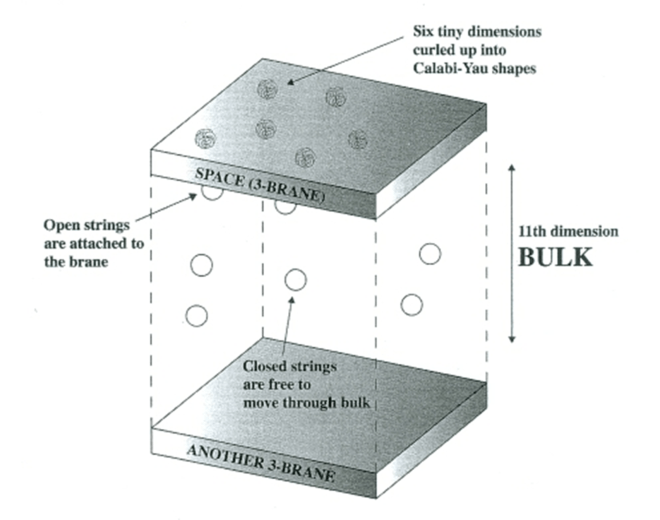
More interesting to me, really, was a question that occurred to me while I was reading Lisa Randall’s Warped Passages, a physics book (of course) and a particularly good one.  It was not really discussing the question that popped into my mind, other than that Professor Randall was reviewing the particles in the Standard Model.

We know that fermions cannot pile up one on another (cannot share quantum states), and that bosons can (e.g., in lasers).  We also know that massless force-carrying bosons such as gluons and photons travel at c, the “speed of light”.  The W+ and W- and Z bosons of the weak force do not because they interact with the Higgs field and so have “rest mass”.

Anyway, that’s not really the point.  The point is that gravitons, the hypothetical force-carrying particle of the gravitational field, are also massless bosons, and gravity travels at the speed of light*****.  But something popped into my head that had never occurred to me before and I’m not sure why:  do gravitons come in different frequencies?

We know that light has a limitless number of possible frequencies, across a very wide range, and that higher frequencies/shorter wavelengths are associated with higher energies per photon.  We also know that all matter radiates photons at a spectrum of frequencies that depends on temperature‒the so-called black body radiation.  Well, we also know that all matter “radiates” gravitons, or at the very least it all interacts with the gravitational field.  What if matter gives out gravitons in a spectrum that depends on total mass?

What would it mean for a graviton to have higher frequency or lower frequency?  Would that entail a stronger (and weaker) gravity?  Or would it correspond to something else entirely?

Of course, I know that gravitational waves are of varying frequencies depending upon the source‒that frequency and intensity (amplitude) increase as, for instance, two mutually orbiting black holes get closer and closer, orbiting faster and faster, before they coalesce.  Is that analogous to them producing large numbers of gravitons of those increasing frequencies?  Or are gravitational waves different types of things than “ordinary” gravitons?  Is ordinary gravity propagated by “virtual gravitons” much as the electromagnetic force is carried by “virtual photons”, which are really just mathematical shorthand for perturbations in the quantum field of electromagnetism?

I suspect that, because we don’t really have anything like a good quantum theory of gravity, there would be few clear answers to my questions about gravitons, but there may be constraints based on what we already know that would make my questions answerable or moot.

I mean, I know that “we” know that gravitons would be spin-2 particles, meaning that to rotate them 180 degrees would leave them unchanged******.  I don’t know how this or other aspects of gravitons would affect possible frequencies, though.  Also, can gravitons be polarized in a manner analogous to light?  I’m not sure whether my graviton questions are sensible or pertinent or utterly off the mark.  If anyone out there is a physicist specializing in such things, please, if you can spare a moment, let me know?

This post has gone on for a long time, I know.  I could meander around much longer on these subjects, probably for pages and pages and pages, but that would be a bit much for a daily blog post, if it isn’t already.  Maybe because it’s a holiday, at least some of you will have the time and interest in reading such thoughts, but I don’t want to push my luck.

However, I welcome any comments on the above subjects if you have an interest, and especially if you have relevant expertise (though I welcome all interested thoughts).

In any case, please try to have a good day.


*A fascinating physical process that’s only possible because continuous liquids can actually have negative pressures.

**Not in any inappropriate way, just that they interact and waves can cancel out.

***Not a “superstring” or heterotic string or what have you, just for instance a guitar string or a cello string.

****This is not unlike Feynman’s path integral/sum over histories notion, really.

*****We know this is so because there was a neutron star merger detected by LIGO and VIRGO that was quickly looked at using “light” telescopes as well, and the timing matched up (As a silly aside, since gravitons are bosons and could thus in principle share quantum states, one might, in principle, be able to create a coherent beam of them…a GRASER or GASER if you will).

******Spin-1 particles basically return to their identical state if you rotate them 360 degrees.  And for spin ½ particles, you need to rotate them 720 degrees (!) for them to return to their prior configuration.  Once you’ve rotated them 360 degrees they’re kind of the opposite of their prior configuration.  If that’s hard to think about, just imagine traversing a Mobius strip laid out in a “circle”:  once you’ve gone 360 degrees, you’re on the opposite “side” of the strip than that on which you began, and you have to go another 360 degrees (so to speak) to get back where you started.  Neat, huh?

Oblivion is cold comfort, but it’s all the comfort I have to offer

Well, it’s Monday.  Meet the new week‒same as the old week.  There is nothing new or interesting happening, as far as I can see.  Nothing is new in my personal interactions with the world, and nothing is new in the world at large.  There may seem to be new things, and there are probably some details that are unique.  But then again, every snowflake is supposedly unique, but they’re all just flakes of snow, airborne ice crystals, and the overall behavior is nothing different despite all the trivially new specific flakes.  The phenomenon of snowfall is still just overall the same.

“So in the world,” as Shakespeare’s Julius Caesar said.  “‘Tis furnished well with men.  And men are flesh and blood, and apprehensive.”  He goes on the claim that he is unique in the next sentence, but immediately thereafter, Brutus, Cassius, et al, demonstrate that he too is merely flesh and blood like all the rest.

All the heroes, all the villains, all the ordinary people‒they are all functionally identical, despite all their trivial differences.  What percentage of the people who have ever lived are remembered at all?  A smattering, a handful, if that‒not even a rounding error compared to the total of all people who have lived.  And many of those we do remember are probably highly fictionalized and may not have actually existed at all.

What are the odds that Gilgamesh and Enkidu were real people?  How about Achilles and Hector?  For crying out loud, we know that even Richard III, presented as Shakespeare’s most thoroughgoing villain (perhaps matched by Iago) and deformed as well, was pretty much nothing of either sort in real life (or that’s what the historical evidence suggests).  He was simply defeated and then vilified by those who had defeated him, presumably to help justify their own actions.

And, by the way, who remembers them?

This sort of fact is part of why I sometimes refer to people (and other lifeforms) as virtual particles.  They pop into existence, persist for an infinitesimal period of time, and then literally vanish again, without a proverbial trace.

Well, actually, as with all virtual particles (which are not actually a thing but are merely mathematical and pedagogical tools) the collective effects of us virtual particles‒aka living things‒can have impacts on the world as a whole.  It’s even conceivable that, in just the right circumstances, as with the “real” virtual particles*, a virtual personicle can become actual.  I’m not sure what that would mean in the real world, though, and I’m not convinced that it has ever yet happened.

All this is part of why I have no patience for people who become fanatical about their particular ideologies and such.  They’re all just equivalent to some fanciful imaginary imaginings by a group of photons or neutrinos or what have you.

Don’t get me wrong, it’s perfectly reasonable for someone to approach their current affairs and ideas as “important” in their local** transient bailiwick, for some things to be important to them.  But it would be silly in a pronounced (but unfortunately not funny) sense for anyone to imagine that they had access to some final, consequential knowledge about the nature of the world and particularly about how people should behave.  If someone had such knowledge, I suspect it would be obvious to any intellectually honest person, including intelligent but disinterested aliens.

Humans and their dogmas are transient and transitory and ephemeral (and other synonyms as well) as are all other specific forms of life and ways of life.  Life overall is transient; as far as we can tell, it cannot even in principle go on forever.  That’s not just referring to individual lives, but to life as a phenomenon.  We could be wrong about this; there is much we don’t know, and in principle, our descendants could discover ways around the Second Law of Thermodynamics.  But that’s quite a big “if”, as it were.

Sorry to be such a downer; it’s just my nature, apparently.  Look not for comfort from me, as the ghost of Marley said.  It comes from other regions and is delivered by other ministers to other sorts of people.  Though, in this case, I’m not sure about what sorts of ministers and people would be involved, let alone what “regions” might produce such comfort.

In any case, I have no comfort, so I can offer none to anyone else; I cannot give what I do not have and what I do not even hope to have.  The best I can offer is to say that, well, oblivion seems to be the only viable alternative to discomfort offered by this universe.  It’s not much to offer, I admit, but it’s the best I have.  And, as pointed out above, as far as we can tell, it’s waiting for us all, eventually.

I won’t say that I look forward to it, because that really doesn’t make much sense.  But I am tired of trying to continue despite having almost no good reason to do so.

I hope you, the average reader, feel better than I do.  Batman help you if you feel worse.


*There’s an oxymoron.

**That “local” can, in principle, include the entire planet.  The point is merely that it is quite finite and limited.

Neither jot nor tittle, but just a title

It is Friday.  Friday it is.  I do not, though, plan to eat any green eggs and ham, nor do I intend to train Jedi.  I merely like to fiddle around with words.  I have also even been known to write and speak about cellos and violins and violas and basses‒wording around with fiddles, that is.

Anyway, this should be the end of the work week for me, so don’t expect a blog post tomorrow.  I’m not saying that there definitely won’t be one; it’s an outcome with a low probability, but it’s not zero.  In principle, the probability of any physically possible event happening is never zero.  But the odds can be so vanishingly small as to be zero for all practical purposes.

For instance, it’s physically possible for the entire Earth (the Moon included) to quantum tunnel to the Andromeda Galaxy, but I wouldn’t hold your breath.  I suspect that the odds of it happening are so low that the time scale between now and the evaporation of the largest black holes due to Hawking radiation (roughly a googol* years) would not even begin to make it likely to happen, even if it weren’t for the fact that the Earth and the Moon will have been so dead and so disintegrated by then that even the memory of their memory’s memories would have been long since lost to any mind that might still exist at that time…probably.

So, you can treat that Earth-Moon Andromeda tunneling as “impossible” for all practical purposes, but in principle, it could happen…

…right…

…NOW!

Okay, well, as far as I can tell, it hasn’t happened.  The sky is too hazy for me to see if the stars have changed, but I don’t think they have.  It would be quite something to experience the local stars of a different galaxy, but of course, if we tunneled into Andromeda, we might be in a relative star desert, or we might be in a place with too many stars for our long-term safety.  Also, if our solar system’s net momentum persisted, we would be unlikely to arrive in any kind of stable orbit of the center of that galaxy.

And, of course, I did not say the sun would come with us‒that would make the whole thing even more vanishingly unlikely‒so we’d all freeze in fairly short order, apart from organisms that use geothermal sources as the base of their food chains and energy cycles.  Those might survive for eons.

Anyway, it’s vastly more likely that I’ll work and write a blog post tomorrow than that we will quantum tunnel to Andromeda**, but it is still a very small likelihood***.  It may be less than one percent, I don’t know.  But it’s quite unlikely.

So, though it might be worth a quick glance to check in come the morning, especially if you were going to do that sort of thing anyway, I would not go out of your way, and I certainly wouldn’t recommend holding your breath.  I don’t think even a sperm whale could hold its breath that long, and I think they have the longest breath-holding record of any mammal (if anyone knows otherwise, please let me know).

In other news‒not that I’ve really given you any news so far‒my keyboard arrived safe and sound (so to speak) yesterday afternoon, so hopefully this morning I’ll be able to finalize the chords to Native Alien.  Then, maybe this weekend, I’ll record a little guitar-chord and voice demo so I don’t lose track of the song.

Then, next week, I can start working on a song based on the trigger “humility”.  I still have no clear conscious notion of an idea for such a song, but I’m not worried about that.  I know I can produce something (not the Beatles song).

I have to keep reminding myself that I don’t need to produce anything great as far as lyrics go‒I think the lyrics I have for Native Alien, which I shared the other day, are okay but not terrific‒I just need to get some words down.  I can always edit and alter things as the process evolves, just as the first draft of a story (or to a lesser degree a blog post) is just the beginning.

I’m also continuing with the circuit course on Brilliant, and I’m alternating reading that book Vector and The Lord of the Rings (yet again) and my own book, The Chasm and the Collision (also yet again, though LotR still holds the 2nd place record for my number of reads, well ahead of CatC and only bested in number of readings by The Chronicles of Thomas Covenant the Unbeliever).

All these are things that I can do alone, of course.  If there’s something to do that would require someone else’s participation, well, I’m shit out of luck.

I think that’s a phrase that applies fairly well to me, come to think of it.  And the word “alone” might as well have my picture next to it in the dictionary.  Though that might be confusing, since I can think of other words that would merit my picture even more than “alone” would‒words that would do their part to explicate just why I am alone, no doubt.

Batman knows I don’t want to hang around with me.

Anyway, I hope you all have a nice weekend, and if anything truly improbable happens to you, I hope it’s a very good improbable thing.


*That’s 10 to the 100th power, or a 1 followed by 100 zeros, in case you’ve forgotten whence the software company cribbed their name.

**Quantum tunneling is not rare on small enough scales, though.  It happens countless times every second in the heart of the sun, for instance.  If it did not, there would not be enough heat and pressure to overcome the coulomb barrier to fusion, and the sun would be some very large equivalent of a brown dwarf…or maybe it would contract more and get hot enough for fusion to take place without tunneling, but then I think the sun would be hotter and brighter and more short-lived, and I think it’s unlikely that the Earth would have produced any life, let alone humans.

***Think about it:  if you took something with odds of ten to the minus 120‒that’s 119 zeroes between the decimal point and the first non-zero digit‒and then made it a billion times more likely than it is, you’d still have odds of 10 to the negative 111th power, or 0.000000000000000000000000000000000000000000000000000000000000000000000000000000000000000000000000000000000000001.  This is a good reminder that relative risk (or probability) is not the same as absolute risk (or probability).

Chords in music and in time

It’s Monday again, the start of another work week‒that is, if your work week begins on Monday.  In the modern world‒and indeed, perhaps always‒there are many people whose work weeks start on days other than Monday.  I suspect, though, that the majority of people still work their week starting on Monday, at least in the West, though it may not be a large majority.  If anyone out there has easy access to any rigorous statistics on the matter, I would be interested to learn.  On the other hand, I’m not going to seek the information on my own, so it’s not a tragedy if no readers have it.  I like trivia, but this is definitely quite trivial, at least from my point of view.

I hope you all had a good weekend.  My own was not very interesting, and I felt tired, but then again, I did have a cold starting in the middle of last week, so I guess I was still recovering.  I feel as though that particular infirmity is reasonably well on its way.

I worked a little on the chords of last week’s song, Native Alien, though not very much.  At least at the house I have my keyboard, so I can play melody and chords at once to confirm which chords sound best to me.  Interestingly, it seems that the chord to start the song (at least the melody) will be a C major chord, which is the V chord of the key of F major (though if the song could be considered to be in D minor, it would be the VII chord).  This is not unusual, of course, nor particularly noteworthy.  It’s just interesting for me to recognize specific facts to which I didn’t pay attention when I wrote earlier songs, because I’ve thought more about music theory since then, probably because of the guitar.  It’s a curiosity for me.

Speaking of songs, today I plan to do another round of flipping coins to pick a basic topic, or subject, or trigger‒whatever might be the better term‒for another song (lyrics) for this week.  Of course, last week’s word, Earth, didn’t really become the subject of the song, just a takeoff point, but that’s fine.  The idea was just to give me some way to give myself a start.

In other news, I had a weird thought last night after watching one of Sabine Hossenfelder’s latest videos.  I wrote an email to myself about the thought so I wouldn’t forget it, and I’ll include that text here, so you‒yes, you‒can see what you think (I have edited this text for clarity and to correct typos):

“If the overall arrow of time is caused by the tendency toward increase in entropy from a lower to a higher entropy state (“Big Bang” to heat death, at the cosmic level), that could behave analogously to a current (like in the ocean, not a wire).  Meanwhile, locally*, we know that the laws of physics don’t appear to have any directionality time-wise.  So perhaps locally, matter and wave interferences in the sense of quantum wavefunctions can happen not just in space but in time itself and the future can feedback on the past, just not in such a large way that it would overwhelm the overall tendency (though maybe even that is not impossible).  The effect of such a temporally retrograde wave wouldn’t flow backwards so fast that it would override the current itself (probably).  However, that wave could still affect its predecessor, creating standing interference patterns in time and things along those lines that might be the source of so-called super determinism.  Think about this a little bit.”

That last injunction was intended for me, but if any of you want to think about it, you’re welcome to do so (it’s not as though I could stop you even if I wished to stop you, which I don’t).  Of course, if I’m going to really explore this notion, I’m going to need to bone up on my mathematical physics in a serious way, and it’s always hard to find the time.  That’s always been a bit of a weakness of mine:  I get very interested in something and develop skills in it because of my interest, then something else catches my attention, and soon all my energy goes there.  I don’t tend to forget the things I learned previously, at least, and sometimes when I return to them, I even find that I’m better than I was before (e.g., after not playing guitar for quite a while, when I picked it up again, certain songs or chords with which I had trouble before had become much easier).

Also, of course, the fact that I have to work for a living is another distraction.  I really do need some ultra-wealthy patron out there to provide me with living and intellectual resources so that I can devote my time to my wonderful pursuits without having to earn my living.  I also want world peace, world freedom…and a unicorn.

I guess in the meantime I should probably go back to using Brilliant dot org to spruce myself up in terms of mathematics and physics (and computer science in the meantime, why not?).  I have an annual subscription (supporting Sabine Hossenfelder, whom I mentioned earlier), so I might as well use it.  It’s a better use for my spare time than diddling around on social media.

Okay, well, I hope you all have a very good day, and that it is the beginning of a very good week for you.


*I’m using the colloquial meaning of “locally” her not the strict physics definition of locality.

The stochasticity of quantum interactions and the names of days of the week

It’s Wednesday today.  That’s a weird way to spell a day, and a weird way to spell a version of the name of the god Wotan or Odin, after whom the day is named (unless I am quite, quite mistaken).

Our days are peculiarly and seemingly haphazardly named here in the English-speaking West.  We’re not the only ones with inconsistent weekday names, but ours are certainly a strange hodgepodge.  Sunday and Monday are relatively straightforward:  they’re named for the sun and the moon.  Then, weirdly, we suddenly switch to Norse (!) mythology and name the next four days after four of the old Scandinavian deities.  Then, abruptly, we switch to a Roman god, Saturn, for Saturday.

This “names of the days of the week” thing was clearly not planned out.  It just sort of happened.  But that’s the way so many things occur in the real world—indeed, perhaps everything just sort of happens, and at multiple levels—not randomly but nevertheless stochastically and in a way that is functionally unpredictable, at least in its details.

The various quantum fields just sort of interact in ways that, at their lowest stable energy levels, give us quarks and gluons and electrons and photons and W and Z bosons and various neutrinos and a nonzero Higgs field that interacts with some (but not all) of the other fields.  The quarks and gluons just happen to form up stably into protons (and some neutrons, but neutrons are only stable within an atomic nucleus—they decay with a half-life of about ten minutes when existing freely).  And the protons happen to interact, via the electromagnetic field, with the electron field, and they stably pair up, and neutrons come into play “afterwards”, stabilizing larger atomic nuclei (though that’s not all they do).

Then, on large scales, the graviton field (if there indeed is such a thing, which is suspected but not certain) interacts with all the other fields, and where the density of stuff is slightly higher it pulls that stuff in towards itself, and where it is less, that rarefied stuff gets thinned out further as its components are pulled by neighboring stronger areas of gravity.

This process undergoes positive feedback—as stuff gets denser, its gravity gets more prominent, and that in turn tends to make the stuff get denser still.  And if there is any net angular momentum to larger collections of the stuff—and there almost always is some net angular momentum, since there’s only one way to have zero angular momentum, and there is a functionally limitless number of ways for it to be nonzero*—the stuff starts to rotate around a net common axis.

And then, of course, we get galaxies, and in those galaxies, we get stars, in which the interactions of the various quantum fields and gravity lead the protons and neutrons to get together into bigger clumps, some of which are quite stable (and the ones that aren’t stable simply don’t endure but transform into other states until they find ones that are stable).

Then stars run out of fuel, and the various field interactions and gravity produce various kinds of spectacular deaths, most of which involve scattering at least some heavier elements** out into the reaches of the galaxies.  Then we get next generations of stars, which (by the way) clump and develop angular momentum in a smaller but similar way to the galaxies.  And now, with heavier elements, we get planets, some of which are largely solid.

I think you know the broad strokes of the rest of the story.  If not, let me know.

Of course, this is a very general sketch of how stuff just came together to form the universe in which we exist, and there’s no indication that that is anything more than just small things—or esoteric things, really, such as quantum fields and their local perturbations—interacting with each other and making patterns on larger scales, much as water molecules can clump into fantastic patterns in the frost on windows or in snowflakes when they get cool enough.  Simple (well, relatively simple) rules at small scales can come together to produce surprising things at larger scales when they all interact at secondary, tertiary, quaternary and higher levels.

If you want to see how remarkable that tendency can be even in two dimensions, find a website that lets you play “John Conway’s Game of Life” and see how stable and active and interactive shapes can arise from even truly simple rules.

What was my point?  Sorry, I got distracted there for a minute.  Oh, right, I just meant to say that the things that happen and that all seem very real and important and even inevitable and fundamental are largely the products of stochastic processes interacting in ways that ultimately are far from being representable by any kind of linear equation.

It’s entirely possible and plausible that, if the rules of the quantum fields—or the specific types of quantum fields*** involved—were different, and thus interacted with each other differently, they might still accumulate into structures and functions on higher levels, and though they might produce a universe that would be all but incomprehensible to us, and in which we could not survive for an instant, they might nevertheless form structures and processes that could become what would have to be called “alive” and even “aware” and “intelligent”.

But in how many such universes would there be creatures that name the days of whatever passes for their weeks after various astronomical bodies (or whatever they have that is comparable) and random mythological figures from different places and times?

I leave it to the reader to speculate.


*There’s only so fast anything can be spinning, since no part of the spinning thing can exceed the speed of light.  Even black holes have a maximum angular velocity.  Nevertheless, both the angular velocity and the net axis of rotation can be more or less continuously variable.  If we can apply the real numbers—which ironically may not be possible in the real world—there is an uncountably infinite number of possible ways for angular momentum to be nonzero.  That makes zero really unlikely and unstable.

**Astronomers call any element but Hydrogen and Helium a “metal”, which is a very loose use of the term if you ask me.  I think many astronomers would agree, and sometimes I think I detect more than a tiny amount of embarrassment when they tell people that astronomical definition.

***Or the configurations of strings and branes if superstring/M theory turns out to be correct.