Even the bus route isn’t a prime number

Well, it’s Monday morning, the second Monday of 2023.  I’m probably going to stop keeping count of such things pretty soon, so if you’re interested, you’ll need to keep track for yourself.

I hope you all had an excellent first weekend after New Year’s.  I myself did not.

I won’t get into the specifics, but remember how I said that I was considering changing my daily schedule so that I would take the bus to the train to work and then back again?  Well, that change has been forced upon me by various circumstances, mainly related to my own mental fatigue.  It turns out that I wasn’t feeling as rested on Saturday as I thought I was‒that was apparently an illusion brought about by the fact that I was so chronically fatigued that a slight increase in sleep duration‒brought about by having taken half a Benadryl, in this case‒gave me a foolish sense of false well-being.

So here I am at the bus stop now, waiting for the first bus of the day.  Unfortunately, it arrives about half an hour later than my memory of its schedule, but it’s been a long time since I took it, so I guess I shouldn’t feel too bad about that.  I’m waiting for the southbound bus.  I think it must have been the northbound bus I was thinking about when I thought it arrived half an hour earlier*.  In any case, I’m quite a bit early even for that, because I woke up and left the house at my usual time.  It looks like I won’t even be close to catching the first or even the second train this morning.

I had been thinking about buying a new bicycle, and if I took such a means to get to my usual train station, I might make the second train of the day, but then I would be lugging a bike around, and I would also get quite sweaty from riding.  That’s not the worst thing in the world, but it’s slightly annoying.  Still, it would be faster than the bus in the long run.

Of course, I could just plan to get up later in the morning, and come to the bus stop closer to the appropriate time, but sleeping late enough in the morning is not something at which I’m that skilled or gifted.

As for writing…well, at least I am probably going to finish this blog post in plenty of time.  I may well finish the first draft before the bus comes (I did).  But I don’t think I’m going to be trying to work on any fiction after that, even fiction that I had already begun.  I don’t think I could completely finish a new novel and have it ready for publication before October of this year.  I certainly wouldn’t want to work on The Dark Fairy and the Desperado, because that’s supposed to be the first of a series, so even finishing it by October would be rather beside the point.  Only Outlaw’s Mind has any chance of being done, but that’s far from certain.

And once October comes, my age will no longer be a prime number, though the latter portion of the year still will be for a few more months after that.  And I don’t want to be past my prime yet again if I can help it, because the next time I and the year will be in my prime is far too long from now to contemplate.

It’s not that riding the bus to the train and then back again is such a big deal.  Hell, I did it for a long time after getting out of work release**, and though I was tired a lot, I was thinner and more fit, certainly.

It’s amazing how things that would have been minor to moderate inconveniences way back when one had family and friends around, as well as a (misguided) sense of purpose, become just overwhelming when one has no one around from day to day, and no ability to connect with anyone, and when one is already teetering on the edge of collapse***.  Setbacks feel like mortal crises, and in a way, they are, because they really do push one to the brink of literal self-destruction, and that brink itself is not a stable platform.  It’s a cliff ledge over an abyss, and it’s riddled with cracks, more and more all the time, and it could give way any second, at the slightest perturbation.

Ugh, all this heavy-handed use of metaphor is galling.  I feel as if I’m trying to be evasive or something, as though I can’t say clearly what I mean without making things worse.  I guess my point is merely that I have nothing to which to look forward, I am achieving nothing and contributing nothing, I have lost almost everything that mattered to me, as well as pretty much all the skill I’d ever had at connecting to other people, and so I have no local, day-to-day emotional support nor any ability or clue about how to achieve it.

Even when people try to reach out to me, I react defensively; I find such situations stressful and even frightening at some level, like a feral cat that can’t be approached even when someone is giving it food.  It’s difficult to trust other people after a certain point.  If nothing else, prison can do that to you.  I even tend to say now that I don’t trust anyone, and even that I don’t believe in trust, I just take calculated risks.  I’m not lying when I say that; it’s really the way I think.

It’s all just so tiring and thoroughly unfulfilling.  And it’s not as though my chronic pain has stopped, even though I don’t write about it often.  It’s been going on for twenty years already; why would it suddenly stop?  That’s just now how significant biological damage works, especially neurological damage.

Anyway, the point is, I’m getting fed up and worn out, and things are more or less entirely pointless to me, as I suppose they have been for a long time.  I’m 53 and the year is ’23, which are both prime numbers.  Today isn’t a prime number day of the month, but there are 7 more such days left in January…and seven is a prime number itself!  That’s nice.

I’m just about out of gas.

But like I said, I hope you’re all feeling much better than I am.  If not, the world is even worse than I thought it was, and that’s saying something.


*I was correct in his assessment.  The northbound bus arrived at the time I had been expecting, incorrectly, to catch the southbound one.  The situation makes sense.  The intersection at which I was waiting was near the south end of the bus route, so it was near the beginning for the northbound, but near the end for the southbound.

**In fact, I feel almost as though I’m regressing back to my earlier state.  Maybe I should just arrange to do something so that I go back to prison.  But that is a pain.  There are good things about prison, but the inconvenience is irritating.

***It’s funny, on Saturday my brother texted just to ask how I was doing, and I replied that I was metastable at least‒an unusually effusive report for me, but more accurate than I knew.  Those of you familiar things like energy diagrams for quantum fields and for chemical reactions and for other similar systems will recognize that something that is metastable is a system that will stay in its current state if undisturbed‒it’s on or near some plateau of the energy function‒but if nudged at all will fall down the slope of the energy curve.  Imagine a pencil perfectly balanced on it’s tip.  If nothing disturbs it in any way, it could stay that way forever.  But if even a slight breeze comes along, it will topple.  I feel that, if I’m not indeed already toppled, or toppling, then I’ve barely been able to retain my balance on my pencil point.  I don’t think I can keep it up much longer.

Some thoughts (on an article) about Alzheimer’s

I woke up very early today‒way too early, really.  At least I was able to go to bed relatively early last night, having taken half a Benadryl to make sure I fell asleep.  But I’m writing this on my phone because I had to leave the office late yesterday, thanks to the hijinks of the usual individual who delays things on numerous occasions after everyone else has gone for the day.  I was too tired and frustrated to deal with carrying my laptop around with me when I left the office, so I didn’t.

I’m not going to get into too much depth on the subject, but I found an interesting article or two yesterday regarding Alzheimer’s disease.  As you may know, one of the big risk factors for Alzheimer’s is the gene for ApoE4, a particular subtype of the apolipoprotein gene (the healthier version is ApoE3).  People with one copy of the ApoE4 gene have a single-digit multiple of the baseline, overall risk rate for the disease, and people with 2 copies have a many-fold (around 80) times increased risk.

It’s important to note that these are multiples of a “baseline risk” that is relatively small.  This is a point often neglected when discussing the relative risks of a disease affected by particular risk factors when such information is conveyed to the general public.  If the baseline risk for a disease were one in a billion (or less), then a four-times risk and an eighty-times risk might be roughly equivalent in the degree of concern they should raise.  Eighty out of a billion is still less than a one in ten million chance for a disease; some other process would be much more likely to cause one’s deterioration and demise rather than the entity in question.

However, if the baseline risk were 1%‒a small but still real concern‒then a fourfold multiplier would increase the risk to one in 25.  This is still fairly improbable, but certainly worth noting.  An eighty-fold increase in risk would make the disease far more likely than not, and might well make it the single most important concern of the individual’s life.

Alzheimer’s risk in the general population lies between these two extremes, of course, and that baseline varies in different populations of people.  Some of that variation itself may well be due to the varying frequency of the ApoE4 gene and related risk factors in the largely untested population, so it’s tricky to define these baselines, and it can even be misleading, giving rise to false security in some cases and inordinate fear in others.  This is one example of how complex such diseases are from an epidemiological point of view, and highlight just how much we have yet to learn about Alzheimer’s specifically and the development and function of the nervous system in general.

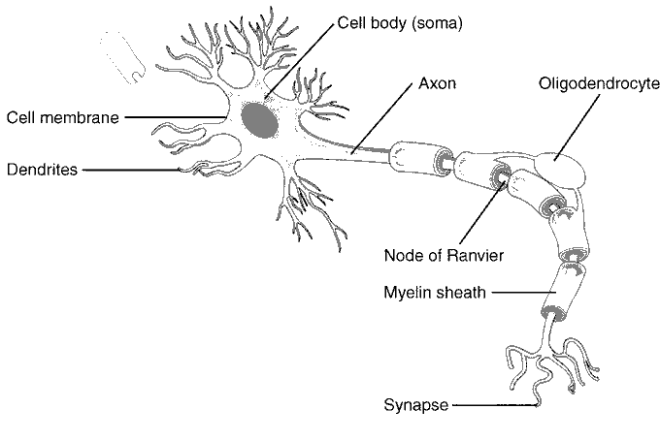
Still, the article in question (I don’t have the link, I’m sorry to say) concerned one of the functions of the ApoE gene (or rather, its products) in general, which involve cholesterol transport in and around nerve cells.  Cholesterol is a key component of cell membranes in animals, and this is particularly pertinent in this case because the myelin in nerves is formed from the sort of “wrapped up” membranes of a type of neural support cell*.

cns myelin

This particular study found that the cells of those with ApoE4 produced less or poorer myelin around nerve cells in the brain, presumably because of that faulty cholesterol transport, and that the myelin also deteriorated over time.

Now, the function of myelin is to allow the rapid progression of nerve impulses along relatively long axons, with impulses sort of jumping from one space (a “Node of Ranvier”) between myelin sheath and another rather than having to travel all the way down the nerve, which a much slower process, seen mostly in autonomic nerves in the periphery.  When normally myelinated nerves lose their myelin, transmission of impulses is not merely slowed down, but becomes erratic and often effectively non-existent.

myelin in general

The researchers found that a particular pharmaceutical can correct for at least some of the faulty cholesterol transport and can thereby support better myelin survival.  Though this does not necessarily point toward a cure or even a serious disease-altering treatment over the long term, it’s certainly interesting and encouraging.

But of course, we know Alzheimer’s to be a complex disease, and it may ultimately entail many processes.  For instance, it’s unclear (to me at least) how this finding relates to the deposition of amyloid plaques, which are also related to ApoE, and are extracellular findings in Alzheimer’s.  Are these plaques the degradation products of imperfect myelin, making them more a sign than a cause of dysfunction, or are they part of the process in and of themselves?

Also, it doesn’t address the question of neurofibrillary tangles, which are defects found within the nerve cells, and appear to be formed from aggregates of microtubule-associated proteins (called tau protein) that are atypically folded and in consequence tend to aggregate and not to function and to interfere with other cellular processes, making them somewhat similar to prions**.  It’s not entirely clear (again, at least to me) which is primary, the plaques or the tangles, or if they are both a consequence of other underlying pathology, but they both seem to contribute to the dysfunction that is Alzheimer’s disease.

So, although potential for a treatment that improves cholesterol transport and supports the ongoing health of the myelin in the central nervous systems of those at risk for Alzheimer’s is certainly promising, it does not yet presage a possible cure (or a perfect prevention) for the disease.  More research needs to be done, at all levels.

Of course, that research is being undertaken, in many places around the world.  But there is little doubt that, if more resources were to be put into the study and research of such diseases, understanding and progress would proceed much more quickly.

The AIDS epidemic that started in the 1980s was a demonstration of the fact that, when society is strongly motivated to put resources into a problem, thus bringing many minds and much money to the work, progress can occur at an astonishing rate.  The Apollo moon landings were another example of such rapid progress.  Such cases of relative success can lead one to wonder just how much farther, how much faster, and how much better our understanding of the universe‒that which is outside us and that which is within us‒could advance if we were able to evoke the motivation that people have to put their resources into, for instance, the World Cup or fast food or celebrity gossip.

I suppose it’s a lot to expect from a large aggregate of upright, largely fur-less apes only one step away from hunting and gathering around sub-Saharan Africa that they collectively allocate resources into things that would, in short order, make life better and more satisfying for the vast majority of them.  All creatures‒and indeed, all entities, down to the level of subatomic particles and up to the level of galaxies‒act in response to local forces.  It’s hard to get humans to see beyond the momentary impulses that drive them, and this shouldn’t be surprising.  But it is disheartening.  That, however, is a subject for other blog posts.

I’ll try to have more to say about Alzheimer’s as I encounter more information.  Just as an example, in closing, another article I found on the same day dealt with the inflammatory cells and mediators in the central nervous system, and how they can initially protect against and later worsen the problem.  We should not be too surprised, I suppose, that a disease that leads to the insidious degeneration of the most complex system in the known universe‒the human brain‒should be complicated and multifactorial in its causation and in its expression.  This should not discourage us too much, though.  The most complicated puzzles are, all else being equal, the most satisfying ones to solve.


*The cell type that creates myelin in the peripheral nervous system (called Schwann cells) is different than the type that makes it in the central nervous system (oligodendrocytes), and this may be part of why Alzheimer’s affects the central nervous system mainly, whereas diseases like ALS (aka Lou Gehrig’s Disease), for instance, primarily affect the nervous system outside the brain.

**The overall shape of a protein in the body is a product of the ordering of its amino acids and how their side chains interact with the cellular environment‒how acidic or basic, how aqueous or fatty, how many of what ions, etc.‒and with other parts of the protein itself.  Some proteins can fold in more than one possible way, and indeed this variability is crucial to the function of proteins as catalysts for highly specific chemical reactions in a cell.  However, some proteins can fold into more than one, relatively stable form, one of which is nonfunctional.  In some cases, these non-functional proteins interact with other proteins of their type (or others) to encourage other copies of the protein to likewise fold into the non-functional shape, and can form polymers of the protein, which can aggregate within the cell and resist breakdown, sometimes forming large conglomerations.  These are the types of proteins that cause prion diseases such as “mad cow disease”, and they appear also to be the source of neurofibrillary tangles in people with Alzheimer’s disease.

You’ve got some nerve!

It’s Saturday, the 19th of November in 2022, and I’m going in to the office today, so I’m writing a blog post as well.  I’m using my laptop to do it, and that’s nice—it lets me write a bit faster and with less pain at the base of my right thumb, which has some degenerative joint disease, mainly from years of writing a lot using pen and paper.

The other day I started responding to StephenB’s question about the next big medical cure I might expect, and he offered the three examples of cancer, Alzheimer’s and Parkinson’s Disease.  I addressed cancer—more or less—in that first blog post, which ended up being very long.  So, today I’d like to at least start addressing the latter two diseases.

I’ll group them together because they are both diseases of the central nervous system, but they are certainly quite different in character and nature.  This discussion can also be used to address some of what I think is a dearth of public understanding of the nature of the nervous system and just how difficult it can be to treat, let along cure, the diseases from which it can suffer.

A quick disclaimer at the beginning:  I haven’t been closely reading the literature on either disease for quite some time, though I do notice related stories in reliable science-reporting sites, and I’ll try to do a quick review of any subjects about which I have important uncertainties.  But if I’m out of date on anything specific, feel free to correct me, and try to be patient.

First a quick rundown of the two disorders.

Alzheimer’s is a degenerative disease of the structure and function of mainly the higher central nervous system.  It primarily affects the nerves themselves, in contrast to neurologic diseases that interfere with supporting cells in the brain*.  It is still, I believe, the number one cause of dementia** among older adults, certainly in America.  It’s still unclear what the precise cause of Alzheimer’s is, but it is associated with the development of “cellular atypia made of what are called “neurofibrillary tangles” within the cell bodies of neurons, and these seem to interfere with normal cellular function.  To the best of my knowledge, we do not know for certain whether the plaques are what directly and primarily cause most of the disease’s signs and symptoms, or if they are just one part of the disease.  Alzheimer’s  is associated with gradual and steadily worsening loss of memory and cognitive ability, potentially leading to loss of one’s ability to function and care for oneself, loss of personal identity, and even inability to recognize one’s closest loved ones.  It is degenerative and progressive, and there is no known cure and there are few effective treatments that are not primarily supportive.

Parkinson’s Disease (the “formal” disease as opposed to “Parkinsonism”, which can have many causes, perhaps most notably the long-term treatment of psychiatric disorders with certain anti-psychotic medicines), is a disorder in which there is loss/destruction of cells in the substantia nigra***, a region in the “basal ganglia” in the lower part of the brain, near the takeoff point of the brainstem and spinal cord.  It is dense with the bodies of dopaminergic neurons, which there seem to modulate and refine motor control of the body.  The loss of these nerve cells over time is associated with gradual but progressive movement disorders, including the classic “pill-rolling” tremor, shuffling gait, blank, mask-like facial expression, and incoordination with tendency to lose one’s balance.  There are more subtle and diffuse problems associated with it, including dementia and depression, and like Alzheimer’s it is generally progressive and degenerative, and there is no known “cure”, though there are treatments.

Let me take a bit of a side-track now and address something that has been a pet peeve of mine, and which contributes to a general misunderstanding of how the nervous system and neurotransmitters work, and how complex the nature and treatment of diseases of the central nervous system can be.  This may end up causing this blog post to require at least two parts, but I think it’s worth the diversion.

I mentioned above that the cells of the substantia nigra are mainly dopaminergic cells.  This means that they are nerve cells that transmit their “messages” to other cells mainly (or entirely) using the neurotransmitter dopamine.  The term “dopaminergic” is a combination word, its root obviously enough being “dopamine” and its latter half, “ergic” relating to the Greek word “ergon” which means to do work.  So “dopaminergic” means those cells do their work using dopamine, and—for instance—“serotonergic” refers to cells that do their work using serotonin.  That’s simple enough.

But the general public seems to have been badly educated about what neurotransmitters are and do; what nerve impulses are and do; and what the nature of disorders, like for instance depression, that involve so-called “chemical imbalances” really entails.

I personally hate the term chemical imbalance.  It seems to imply that the brain is some kind of vat of solution, perhaps undergoing some large and complex chemical reaction that acquires some mythical state of equilibrium when it’s working properly, but when, say, some particular reactant or catalyst is present in too great or too small a quantity, doesn’t function correctly.  This is a thoroughly misleading notion.  The brain is an incredibly complex “machine” with hundreds of billions of cells interacting in extremely complicated and sophisticated ways, not a chemical reaction with too many or too few moles on one side or another.

People have generally heard of dopamine, serotonin, epinephrine, norepinephrine, and the like, and I think many people think of them as related to specific brain functions—for instance, serotonin is seen as a sort of “feel good” neurotransmitter, dopamine as a “reward” neurotransmitter, epinephrine and norepinephrine as “fight or flight” neurotransmitters, and so on.

I want to try to make it very clear:  there’s nothing inherently “feel good” about serotonin, there’s nothing inherently “rewarding” about dopamine, and—even though epinephrine is a hormone as well as a neurotransmitter, and so can have more global effects—there’s nothing inherently “fight or flight” about the “catecholamines” epinephrine and norepinephrine.

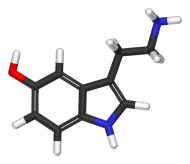
All neurotransmitters—and hormones, for that matter—are just complex molecules that have particular shapes and configurations and chemical side chains that make them better or worse fits for receptors on or in certain cells of the body.  The receptors are basically proteins, often combined with special types of “sugars” and “fats”.  They have sites in their structures into which certain neurotransmitters will tend to bind—thus triggering the receptor to carry out some function—and to which other neurotransmitters don’t bind, though, as you may be able to guess from looking at their somewhat similar structures, there can be some overlap.

dopamine

Dopamine

serotonin

Serotonin

epinephrine

Epinephrine

Neurotransmitters are effectively rather like keys, and their functions—what they do in the nervous system—are not in any way inherent in the neurotransmitter itself, but in the types of processes that get activated when they bind to receptors.

There is nothing inherently “rewarding” about dopamine, any more than there is anything inherently “front door-ish” to the key you use to unlock the front door of your house, or “car-ish” to the keys that one uses to open and turn on cars.  It’s not the key or the lock that has inherent nature, it’s whatever function is initiated when that key is put into that lock, and that function depends entirely on the nature of the target.  The same key used to open your door or start your car could, in principle, be used to turn on the Christmas lights in Rockefeller Center or to launch a nuclear missile.

Dopamine is associated with areas of the nervous system that function to reward—or more precisely, to motivate—certain behaviors, but it is not special to that function.  As we see in Parkinson’s Disease, it is also used in regions of the nervous system involved in modulating motor control of the body.  The substantia nigra doesn’t originate the impulses for muscles to move, but it acts as a sort of damper or fine tuner on those motor impulses.

Neurotransmitters work within the nervous system by being released into very narrow and tightly closed spaces between two nerve cells (a synapse), in amounts regulated by the rate of impulses arriving at the bulb of the axon.  Contrary to popular descriptions, these impulses are not literally “electrical signals” but are pulses of depolarization and repolarization of the nerve cell membrane, involving “voltage-triggered gates****” and the control of the concentration of potassium and sodium ions inside and outside the cell.

synapse

A highly stylized synapse

The receptors then either increase or decrease the activity of the receiving neuron (or other cell) depending on what their local function is.  It’s possible, in principle, for any given neurotransmitter to have any given action, depending on what functions the receptors trigger in the receiving cell and what those receiving cells then do.  However, there is a fairly well-conserved and demarcated association between particular neurotransmitters and general classes of functions of the nervous system, due largely to accidents of evolutionary history, so it’s understandable that people come to think of particular neurotransmitters as having that nature in and of themselves…but it is not accurate.

Okay, well, I’ve really gone off on my tangents and haven’t gotten much into the pathology, the pathophysiology, or the potential (and already existing) treatments either for Parkinson’s or Alzheimer’s.  I apologize if it was tedious, but I think it’s best to understand things in a non-misleading way if one is to grasp why it can be so difficult to treat and/or cure disorders of the nervous system.  It’s a different kind of problem from the difficulties treating cancer, but it is at least as complex.

This should come as no surprise, given that human nervous systems (well…some of them, anyway) are the most complicated things we know of in the universe.  There are roughly as many nerve cells in a typical human brain as there are stars in the Milky Way galaxy, and each one connects with a thousand to ten thousand others (when everything is functioning optimally, anyway).  So, the number of nerve connections in a human brain can be on the order of a hundred trillion to a quadrillion—and these are not simple switching elements, like the AND, OR, NOT, NAND, and NOR gates for bits in a digital computer, but are in many ways continuously and complexly variable even at the single synapse level.

When you have a hundred trillion to a quadrillion more or less analog switching elements, connecting cells each of which is an extraordinarily complex machine, it shouldn’t be surprising that many things can go wrong, and that figuring out what exactly is going wrong and how to fix it can be extremely difficult.

It may be (and I strongly suspect it is the case) that no functioning brain of any nature can ever be complex enough to understand itself completely, since the complexity required for such understanding increases the amount and difficulty of what needs to be understood*****.  But that’s okay; it’s useful enough to understand the principles as well as we can, and many minds can work together to understand the workings of one single mind completely—though of course the conglomeration of many minds likewise will become something so complex as likely to be beyond full understanding by that conglomeration.  That just means there will always be more to learn and more to know, and more reasons to try to get smarter and smarter.  That’s a positive thing for those who like to learn and to understand.

Anyway, I’m going to have to continue this discussion in my next blog post, since this one is already over 2100 words long.  Sorry for first the delay and then the length of this post, but I hope it will be worth your while.  Have a good weekend.


*For instance, Multiple Sclerosis attacks white matter in the brain, which is mainly long tracts of myelinated axons—myelin being the cellular wraparound material that greatly speeds up transmission of impulses in nerve cells with longish axons.  The destruction of myelin effectively arrests nerve transmission through those previously myelinated tracts.

**“Dementia” is not just some vague term for being “crazy” as one might think from popular use of the word.  It is a technical term referring to the loss (de-) of one’s previously existing mental capacity (-mentia), particularly one’s cognitive faculties, including memory and reasoning.

***Literally, black substance.

****These are proteins similar to the receptors for neurotransmitters in a way, but triggered by local voltage gradients in the cell membrane to open or close, allowing sodium and/or potassium ions to flow into and out of the cell, thereby generating more voltage gradients that trigger more gates to open, in a wave that flows down the length of the axon, initially triggered usually at the body of the nerve cell.  They are not really in any way analogous to an electric current in a wire.

*****You can call that Elessar’s Conjecture if you want (or Elessar’s Theorem if you want to get ahead of yourself), I won’t complain.