What are the odds that I’ll get out of this tunnel?

Well, it’s now Saturday‒the first Saturday of official summer in the northern hemisphere, (and of winter, in the southern).  I hope you readers out there have something fun planned with your families today and/or tomorrow.  You might as well.  If you can find an excuse to celebrate together, you should do it.

I am writing this post‒the first draft, at least‒on my smartphone, because I didn’t bring my laptop computer to the house with me.  Instead, I brought my hardcover copy of Quantum Field Theory, As Simply As Possible.  It was an odd decision, I think.  Recent history has not shown me prone to reading real books at the house when I’m off work.

I think maybe it’s wishful thinking.  I guess I figure that, if I want to read any of it at the office during my down time, I can fire up the desktop version of the Kindle App* and read it there.  Since it’s basically a pdf, the limitations of the desktop app won’t matter much, and it should be big enough to see and read on the desktop screen (though I haven’t tried yet).

If that doesn’t work‒assuming I even try it‒I can always just bring the book back.

Anyway, that’s not really what I want to write about today, but I’m not sure how much I should write about what I feel like discussing, because I worry about the possible reaction.  I also, oddly, worry about a lack of reaction.  Maybe part of me is hoping to raise an alarm.  Maybe this is yet another of my hundreds of cries for help, this one a bit more strident, since the others haven’t worked.  My mind is in a peculiar state, even for me.

Anyway, that thing I briefly mentioned near the end of the post yesterday…well, I decided to do some minor trial runs of it, with slightly live ammo, so to speak.  At moments when something particularly stressed me out, I just quietly did that little thing.

I won’t get into details.  It’s nothing very dramatic, really.  If it were a game of Russian Roulette (which it isn’t, at least not literally), it would be one using a single loaded chamber in a revolver with, I don’t know, maybe a hundred chambers in the cylinder.  Probably more, maybe slightly less, it’s hard to say.  But the risk involved right now isn’t very high.  Still, it accumulates, as risk does, when iterations are independent.

If the chance of something happening on the first try is 1%, or .01 (or 1-.99, which is the chance of it not happening) then if you spin the cylinder twice, the total chance of the thing happening is 1-(the cumulative chance of it not happening), or 1-(.99 x .99), or 1-.9801, or .0199.  That’s close to 2%, but it’s not quite there, and the new, added increments get smaller and smaller.  Otherwise, after a hundred goes you’d be certain to have something happen, and with independently randomized iterations, that isn’t the way it works.  After a hundred random tries at something in which each attempt gives a 1% chance of the event, your actual likelihood of the event happening once is about 63%, if my figuring is correct.  Someone please check my math**.

Now, if one is playing traditional Russian Roulette without spinning the barrel between each trigger pull, then by the end of six pulls, the odds are essentially certain‒barring misfires‒that someone will “win”.  Whereas if you spin the cylinder (randomly and fairly) each time, the odds are, let me see…about 66.5% after 6 tries.

The point I’m making is that it’s not a high chance, but it gives me some sense of control and possible “escape” each time, and I think that helped calm me a bit yesterday.  I even think I might have slept a bit better last night.  That might be just because I was feeling physically a little improved since the previous day, though.

I did wake up quite a number of times throughout the night, each time filled with frankly absurd anxiety about something, but I have no idea what.  That’s just what usually happens, though.  I also woke up once coughing my brains out from a reflux/regurgitation event, but I think I know the dietary indiscretion behind that, and I don’t mean to repeat it.  That’s a horrible feeling.

Anyway, I think I feel slightly more level…though it’s still very early in the day, and just thinking about it while (now) waiting for the train seems to belie that possibility, as I feel tension and anxiety building rather quickly.

It’s so frustrating.  I just can’t ever seem to feel in any way at ease or relaxed or at home.  I really do feel sometimes like I don’t belong on this planet, or even in this universe, like there’s been some meta-cosmic mix-up.  You would think that one would get more used to the world after one had been in it for a longer period of time, but that doesn’t seem to be the case.

Possibly at least some of my former ability to handle it was due to the presence of my family and friends, who could provide good examples and smooth out rough edges and act as allies who helped when I was at a loss.  When needing to rely solely my own resources, I think I just get worn down.  It also doesn’t help that, despite my having worked quite hard all my life to succeed and thrive in this place, and having achieved quite a lot, it just wasn’t enough, and everything all went to shit, largely due to me just not seeming to get other people and what they meant or needed or intended or what.

Maybe I was just unlucky.  My back injury and chronic consequent pain really set the boulder rolling downhill.  Without that, maybe I would have been fine.

That boulder has been rolling for a long time, now.  I’m on more level-ish ground than I was, but only because it’s nearing the bottom of the valley; most of its prior, impressive height has long since been lost.  If this were a metaphor for energy states of quantum fields, I’d say it’s approaching the vacuum state, or at least a pseudo-vacuum; I can’t see the shape of the whole curve.  Maybe at this point I’m effectively already in the vacuum state, and any seeming movement is just quantum jitters.

Sorry, I’m skipping from metaphor to metaphor like a grade-schooler playing metaphor hopscotch.  How’s that for a meta-metaphor***?  

Anyway, I’m not getting anywhere with this right now, except heading toward the office.  But maybe, just maybe, I’ve put in motion things that will give me a higher chance of quantum-tunneling to a lower, true ground state, where I can rest, or at least stop being constantly in pain and anxious and depressed and lonely and futile.  Or maybe‒there’s always that foolish hope‒someone will help me.  Though it’s hard to blame anyone for not doing so.  I’m a rotten person who isn’t really worth the effort.  I know I don’t like me.

Anyway, that’s enough of that.  I hope, again, that you all have a nice first weekend of summer.  Or winter.  Either way, if you have friends and/or family with whom to spend your time, please make the most of your opportunity.


*Which, by the way, sucks compared to the smartphone/tablet version, and is very frustrating.  If any of you out there are on the development team at Amazon for this, or have access to those who are, please let them know that they need to improve their product relative to the other versions.

**Don’t bother accounting for the possibilities of more than one occasion of the outcome happening.  We’re talking about Russian Roulette‒if one “event” happens, there will be no more spins.

***Since I used the word “like” I guess it’s technically a simile about metaphors.  That’s not as much fun, though.

Blog Post for June 20, 2023 (AD) – Tuesday

It’s Tuesday morning, and I’m beginning this post at the train station rather than on the train, because this time I timed things so that I arrived a few minutes after the 6:10 train passed.  That way, I didn’t feel the urge to chase after it, like what I described the other day.

This was somewhat deliberate, but it also had a lot to do with just how tired I already am.  I don’t talk about my insomnia all that often, probably for the same reason most of you don’t talk about breathing very often.  It’s just always there.  But last night was worse than many; starting at a bit before two, I “woke up” every five to ten minutes, looking up at the clock, as if I were worried that I might have overslept.  I don’t know what I’m worried about in such situations, honestly‒it’s not as though there would be any objective, dire consequences if I were late.  But, of course, the real problem is that I would be distressed and upset if I were to miss my schedule.  And because of that, I can’t seem to sleep.

So, this morning, I already feel fatigued and mentally worn down, and the day is just getting started.  Of course, yesterday by noon or so I was already mentally crashing at the office, and that was Monday after a full, two-day weekend!  The crash was acutely due to my usual frustration with the nominal rules of the way we do things in the office being ignored when convenient in the short term, but it’s really all a cumulative and complex process.  By the end of each day I’m worn down more than I was at the beginning, and by the next morning I haven’t really gotten quite back up to the level I was at the start of the previous day, perhaps partly due to my insomnia.

It’s not a precise, smooth curve, of course; there are day to day fluctuations, and even I am not always in my worst state of mind.  But overall, the trend is downward, and I think it’s fair to say that I am now palpably lower than I have been in a very long time, if not ever.

It’s a good thing that I can at least talk to my sister on the phone for an hour or so once a week.  But I’m so annoyingly stressed by social interactions that, even with my sister‒whom I’ve literally known all my life, and with whom I get along as well as pretty much anyone‒I have to schedule and plan the phone conversations ahead of time, and generally on weekend days when I’ve at least had a mental break.

It’s ridiculous and pathetic, I know.  I can’t give it any kind of noble or even sympathetic spin.  I’m disgusted by myself…but then, that’s my general attitude toward myself, anyway.  Not to say that there’s nothing about myself that I like, of course.  I like that I’m very curious, and that I can understand science and math and all that stuff rather well, and that I have a good memory, and that I can learn things well and more easily than many other people seem to be able to do.

Even when very depressed and moriphilious* I’ll find myself inescapably driven toward ordering‒or at least to consider ordering‒some book or audio book, perhaps by someone I’ve heard speaking on a science and/or philosophy podcast, or similar.  Also, as I think I mentioned yesterday that I was considering, I did order the hardcover copy of Quantum Field Theory as Simply as Possible.  I almost ordered the author’s textbook (especially when I saw that, among many other places, Cornell uses it), but I decided I would start with the bird’s eye view before going deeper, partly because I’m not sure I have the mathematics expertise really to grasp the deeper stuff in a strict fashion.

I may.  I’m pretty good at stuff like that, and I can build on my prior understanding with more ease than some can, because I don’t tend to learn things by rote.  I learn by a sort of model-building in my head, which means it can take me longer to prepare for a test, for instance, but once I understand something, I don’t tend to lose that understanding very quickly, and can apply it elsewhere and merge it with other matters.  So, if I can get the concepts of some physical theory, and the concepts of the pertinent mathematics, then the nitty-gritty, nuts and bolts of it is much easier then to master.  That’s nice.  I do like that about myself.

But I don’t really have anyone around with whom to talk about the things in which I’m interested at any very deep level.  And it’s hard to contemplate even seeking out such people.  I would be stressed out worrying that dealing with other, new, and potentially frustrating people would be too much effort, but also‒perhaps more so‒that I myself am an irritating person, and I can’t quite bring myself readily to inflict myself on other people.

Also, I would probably have to go through some online community‒perhaps some form of “discord” or whatever that app/system is, or some Facebook or Twitter group or some** such.  I’ve never been interested in trying to get into Reddit communities, and most of the other social media meetup type things are anathema to me.  I don’t even like gaming with strangers online.

Early on, back in the day, I got on a Yahoo! based depression support chat group, but mostly I just lurked, though I did make a very good online friend in one, who (among other things) introduced me to both Sailor Moon and Radiohead, so that was a tremendously lucky and great meeting.  I cannot thank that person enough, and we are still in occasional contact to this day.

But even things like that Yahoo! group have changed and no longer appeal to me.  And I have changed since then, too, of course.  I’ve been to prison, for one thing.  That’ll change you a bit.  Probably even a cushy minimum security Federal Prison changes people, and FSP West is most assuredly not such a place.

Anyway, enough nonsense for today.  Tomorrow is the Summer/Winter Solstice, for what it’s worth, so I’ll probably mention it then, unless I’m lucky enough to have something happen that makes me unable to write my blog post or anything else.  Or unless someone swoops in and rescues me from the verge of the event horizon.

That’s not gonna happen, is it?

Oh, well.  Have a good day.


*I just made that word up, I’m not sure if it really works.

**Here’s a mildly amusing typo:  I originally typed that as “sum such”.

Aleph naughts, alphabets, infinite libraries, decks of cards, and monkeys

It’s Tuesday, the thirteenth day of the month of June.

I was going to try to avoid any commentary about the number two today—it gets to be two much, sometimes—but I do just want to start by saying that, if you subtract the digits in today’s date, the difference is two.

You could also, if you’re leaving out the first two digits of the year, look at 6-13-23 and say, “To get six, first you take one three, then a second three, and there you have six”.  I know, depending on how you read it (e.g. one three plus two threes), you might actually come out with nine, but that’s the risk you take with numerological interpretations.

This should hopefully alert any who might be susceptible that they should not to give credence to numerology or any other similar detected “codes” in unrelated things, like the old Bible code nonsense and so on.  The fact is, if you’re looking for patterns, especially if you’re not too picky about what patterns you seek, you can almost always find some.  It can be fun, but don’t fool yourself into thinking that there actually was some hidden message in the text or the number in the first place.  It’s all, almost certainly, in the eye (and mind) of the beholder.

Don’t feel too bad if you have occasionally fallen for such things.  No less than Isaac Newton himself, among the mightiest of minds the planet has yet known, got sucked into the whole notion of looking for hidden messages in the Bible.

Now, admittedly, he didn’t have the background of genius predecessors that we have nowadays from whom to learn lessons about signal and noise.  And though he worked out far better ways to calculate pi (than Archimedes’s method of exhaustion) and similar matters using infinite series, it may not have occurred to him that, since pi was an infinite, non-repeating number, if one looked far enough, long enough, one could find any given finite sequence of numbers one might want within it.  And that, of course, can be converted into any given sequence of letters, or whatever, using whatever translational code or cypher one might want.

I’m pretty sure I’m correct about that, but please correct me if there’s a flaw in my reasoning.  There’s certainly a ceiling*.

It’s a bit like the wonderful “Library of Babel”, based on a short story by Jorge Luis Borges, in which the algorithm can generate every possible string of letters in the modern version of the Latin alphabet, (AKA the English alphabet).  Using the program, you can search for any expression possible in the library.  In principle, it encodes everything that could ever be written (up to a certain length), though they are not generated until you search.  In other words, every paragraph (or at least subparagraph) in this blog post is already, at least implicitly, written there.

Of course, the vast majority of what’s in there is utter gibberish, mere random collections of letters and spaces and so on that would mean nothing to anyone.  But it’s sobering to think sometimes that, in potential, everything that could possibly be written could be generated somewhere in that computer code.  Does that mean that it is, in a sense, already written?  I suppose if one is a mathematical Platonist, one would probably be forced to say that it is there, in a real, albeit fuzzy-ish, sense.

This is nothing new.  It’s like the old notion of an infinite number of monkeys writing on an infinite number of typewriters.  Eventually, not only will they produce the works of Shakespeare, but they will produce every possible work that could be produced by typing in this alphabet and associated characters.  Indeed, if there really is an infinite number of monkeys and typewriters, they will produce each possible work an infinite number of times—in fact, they already will have done so, and will continue to do so, over and over again (usually in different places by different monkeys) forever.

Still, the vast majority of what they produce will be gibberish.  You’d have to look for a long time to find a bit of writing that is even arguably coherent, and much longer if you sought something specific.

It’s a bit like the “level one multiverse” implicit in a spatially infinite universe in which in any given region there are only a finite (however large) number of possible quantum states:  everything possible will be instantiated not just somewhere, but an infinite number of times.

To think about such things in “smaller” terms:  if you have an infinite number of decks of cards (no jokers), and they are all shuffled—each random sorting being one of 52! (approximately 8.06581752 x 1067) possible orderings—there will still be only a finite number of ways to order them.  It’s a big number!  Don’t, get, me, wrong!  It’s BIG!  It’s so big you can know to a mathematical confidence much more than secure enough that you could comfortably bet your life on it** that if you shuffle a deck thoroughly it will be in an order that has never existed before in the world.

But the number of possible orderings of shuffled decks is no closer to infinity than is the number one.  So in an infinite collection of shuffled decks, every possible sorting will appear an infinite number of times.

In fact, if you think about it, every possible ordering will somewhere be sitting next to multiple iterations of identical orderings, somewhere in that infinite selection (say if you had your decks all floating in some 3-D matrix).  Depending on how many duplicates you want to find you may need to “look” farther and farther, but even if you want a huge number of duplicate shufflings next to each other, if the space of shuffles is infinite, and is sorted randomly, you will be able to find that group somewhere.

It may even be the case—and here I’m not on completely certain ground, so any mathematicians out there please give me some feedback—that you can find a “region” in which there are an infinite number of repeated shufflings “next to” each other.  How could this be possible, when the set of decks itself is only infinite?  Well, infinity is weird, and strange things happen when you’re contemplating it***.

Perhaps thinking of a similar but more straightforward notion might help.

Of all the integers, only every tenth one is a multiple of ten, so there should be only one out of ten integers that meet that criterion of being a multiple of ten, if you’re looking for them.  Yet, the number of multiples of ten is equal to the number of integers in total!  If you don’t believe me, just knock the final “zero” off each multiple of ten and take a look.  You will have reconstructed the original integers!  So in any infinity, you may be able to find an infinite subset—say all on one row if your infinity is grouped in rows and columns and levels—that meets any given criterion or criteria, depending on how you sort it.

This fact is part of what gives rise to the so-called “measure problem”, which I won’t address just now, but to which I have linked.

I could go on and on about this—almost by definition—but I don’t have any intention of writing an infinite blog post, even if such a thing were possible in a universe in which entropy is always increasing.  But it can be fun to think about arrangements of letters and numbers, and information, and signals versus noise.

Unfortunately, after thinking about it, one can sometimes find the ordinary bits of everyday life rather silly and pointless and even worthy of despair—“the pale deaths that men miscall their lives”.  Maybe that’s part of why some great mathematicians were psychologically troubled.  Gödel, for instance, starved to death because he wouldn’t eat any food not prepared by his wife; he feared being poisoned, and eventually she either got sick or died (I don’t recall which).

His logic doesn’t seem very good—if you’re avoiding dying by poison but thereby inevitably die of starvation when your wife can no longer cook for you, you’re clearly not protecting yourself, except perhaps from a painful poisoning death, instead gaining a comparatively peaceful death by starvation.

Anyway, they say genius and madness are related.  They would say that, wouldn’t they, since they understand neither state.  But you lot are much smarter than they are.  And therefore, I hope you have a good, albeit finite, day.


*Ba-dump-bump.

**And you bet your life on MUCH riskier things every day, numerous times per day, make no mistake about that.

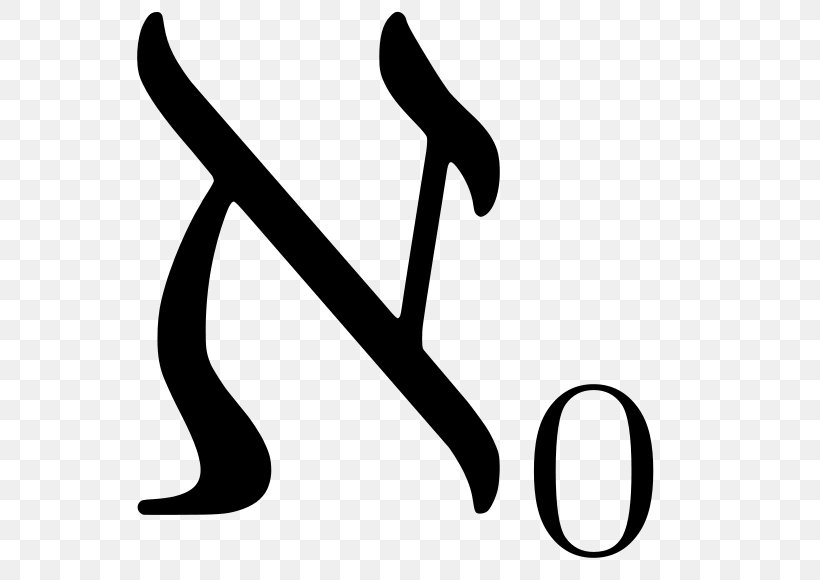
***And we’re just discussing the “smallest” infinity, Aleph Number Alef 0 Cardinality Mathematics Infinity, PNG, 565x580px ... AKA “Aleph nought” or “Aleph zero” or “Aleph null”.  It’s the so-called “countable” infinity, meaning not that you really could count the whole thing, but you could at least get started and make progress, as in “1, 2, 3, 4,…”.  When you turn to, for instance, the infinity of “real” numbers, you can’t even start counting, because between any two non-identical, arbitrarily chosen real numbers, no matter how close they are to each other, there is an uncountable infinity of real numbers between them!

When we shall hear the rain and wind blog dark December?

Hello and good morning, everyone.

It’s not only Thursday—and thus time for my “weekly” blog post, which goes back to when I was writing this blog only one day of the week and working on fiction every other morning.  It’s also the first day of June in 2023 (and thus, inescapably, also the first Thursday of June).  So, we begin a new month.

Before the end of this month, we will have the Solstice—the summer one in the northern hemisphere and the winter one in the southern hemisphere.  After that, officially, the season either of summer or of winter will begin, and the days, having reached either a maximum or minimum of the sine curve of their “daylight” length, will begin to head in the other direction.

Of course, the change will be very gradual at first, since the derivative of a sine curve—its rate of change—is a cosine curve, and where a sine is either at a maximum or a minimum, the cosine is at zero, albeit only instantaneously.  It’s at the equinox that the rate of change hits a maximum (or, technically it could also be a minimum, but when we’re discussing absolute rates of change, a minimum and a maximum are interchangeable, |x| being a positive number at any time, and all).  Anyway, that’s enough of that minimal review of the rates of change of seasons and the nature of sine curves and cosine curves.

Sines and cosines are well-behaved curves, at least.  Tangents and secants and so on are not so well-behaved, at least if by “well-behaved” you mean, “staying between a specified range of the y-axis instead of tending towards infinity in multiple places on that axis”.  Of course, a sine or cosine do go to infinity in both directions on the x-axis, come to think of it.  I don’t think I’ve considered it quite the way ever before.

Wow, talk about going off on a tangent*.

Anyway, not much else is new currently, not that I was just discussing anything new other than my new way of looking at the infinities of sine curves and, of course, the new month, which isn’t really all that new when you get right down to it.  Is June named for Jupiter (i.e. Juno)?  I should look that up.

…Okay, I did, and reminded myself that Juno was the Roman name for the goddess equivalent to Hera, the wife of Zeus/Jupiter, so it’s indirectly related to Jupiter, not directly.  That was an embarrassing mix-up of names and ideas in my head.  Good thing I didn’t write it down and publish it for everyone to see!

Of course, July and August are named after Julius Caesar and Caesar Augustus (née Octavian).  Then we have months that used to be named for their ordinal place in the calendar:  September (7), October (8), November (9), December (10), but I guess they all got shifted over two spaces at some point after they were originally named, though I don’t recall quite when and why that happened, and that isn’t something in which I’m interested enough right now to look it up.

I don’t know why I’m writing about this sort of stuff today.  I’m just following whatever random—or at least stochastic—impulse occurs based on the preceding thought or statement or whatever.  It’s not as though there’s any reason for me to do anything different.

I had a brief moment or two of “inspiration” yesterday evening, during which, on the train heading back to the house, I wrote a poem/song lyrics on the notepad function of my smartphone.  Having been written by me, it’s a very gloomy sort of poem/song, and I don’t have even an inkling of a melody for it.  I just felt a bit of a dip in my mood, even relative to baseline, and decided to express that the way I sometimes used to do.  That’s how I wrote what turned into the lyrics of my song Come Back Again, and something related to it was responsible for Catechism and Breaking Me Down, though the latter two were semi-deliberately written as song lyrics from the start.

A little later, I was watching someone on YouTube reacting to the “unplugged” performance of a few Nirvana songs, and I decided to look up the chords to Come As You Are; I downloaded a PDF of those.  It’s not a very complicated song, but it sounds quite good.  Kurt Cobain had a way of writing melodies that were unlike anything just about anyone else ever wrote.  Though, I also like his/their performance of The Man Who Sold The World, which is originally a David Bowie song.  I don’t think I’ve ever heard Bowie’s version of it, though.  I should have looked up the chords to that; maybe I will today.

But, of course, the odds of me ever doing anything with such chords, let alone writing a tune to and making a new song of my own seem vanishingly small.  Right now—by which I mean “now in general” not “now this very moment”—I’m just meandering through each day rather thoughtlessly, certainly pointlessly, with no goal or aspiration or anything of the sort.  There isn’t any point to anything I do.

I do really miss my kids.  I miss everyone else, too—my old friends, my immediate and more distant family, living and dead, all those people—but especially my kids.  I’m very lonely, but I’m also very socially withdrawn and incapable/incompetent.  I don’t think it’s at all possible for me to seek out and meet with or connect with anyone, new or old, in the world—except for my kids.

If they wanted to meet with me, I would do it.  I don’t even think it would be a struggle.  As far as everyone and everything else goes, though…well, I’ve lost my communication/connection hardware and software or whatever, or maybe I just didn’t get the updates, and so my system is hopelessly outdated, and when I even think about such things, the application crashes.

That’s a pretty weird couple of metaphors.

Anyway, I’m not capable of reaching out to people, other than through here, even when I want to do it.  I’m also not capable of trying to take care of myself (medically, psychologically, whatever), or take care of any other proactive business of life.  Life isn’t my domain anymore, I think.  Nevertheless, I can’t be darkly cool and quote the Bhagavad Gita like Oppenheimer:  “I am become Death, the destroyer of worlds.”  It would probably be more appropriate for me to say something like, “I am become Drizzle, the dampener of spirits.”

That was sort of the subject of the poem/song I wrote yesterday.  But most people don’t like to drink watered-down spirits—though I do, sometimes.  I also like watered down soda, I’ve come to realize.  Go figure.

Anyway, that’s enough of all that.  I think it’s time to head off to go to the train, thence to the office.  If I get there early enough, maybe I’ll play some guitar.  I doubt it.

TTFN

sine and cosinetwistedanddistorted


*Ba-dump-bump.

Can one exaggerate the dangers of “mental health”?

Well, here I am again, writing a blog post on my phone, because I didn’t feel like toting my mini* laptop around.

It was really rather pleasant not to have to carry it at all yesterday.  Even after I picked up a seltzer and some minor dinner items at a convenience store between two buses on the way back to the house last night, the load was minor.  Despite my light burden, however, I didn’t walk from the train station, as should be obvious from the fact that I mentioned two buses; it was simply too late in the evening.  As it was, I didn’t get back to the house until just before nine.

It’s a glitzy, glamorous life I lead, I know, but don’t envy it.  You don’t see the struggles I face when out of the limelight.

Actually, I guess you do “see” a lot about them if you read my blog regularly.  You don’t see all of them, of course.  Even I am not quite so indiscreet as all that.  But you certainly know about some of my difficulties with depression.

With that in mind, I must (and do) apologize to StephenB for my extra-gloomy reply to his comment yesterday.  I think he was trying to perk me up with a little good-natured humor, playing on my words in a way that skillfully echoed how I played on them, but I just doubled down on the doom and gloom.  That’s one of my greatest skills.  It might be innate enough for me to consider it a talent, or even a fundamental attribute of my being.  Maybe it’s just my nature, my design (or design flaw) always to feel self-hateful.  I don’t know.

I do wonder what it would feel like to love myself.  Much is made in literature and spiritual inquiry and religious teaching about the danger of self-love**.  Certainly, in public discourse we see frequent reminders of the perils of narcissism.  The generally believed notion seems to be that everyone loves his or her own person more than they do anyone else.

But the Judeo-Christian admonition to love one’s neighbor as oneself is very bad advice for me.  I’ve always tended to feel more positive and generous in spirit toward other people than toward myself.  Cat forbid I should view other people as dimly and darkly as I view myself.

I’m reminded of a line from a Monty Python sketch in which some TV criminologist, played (if memory serves) by Graham Chapman, says, “After all, a murderer is only an extroverted suicide.”  It would be very bad, or at least not very positive, for my “neighbors” if I started to “love” them as I do myself.  I have become more prone to misanthropy over the years, and even edge toward pro-mortalism, but I recognize this as probably irrational and born of my mental illness, as it were.

Incidentally, I’m puzzled by a recent apparent shift toward referring not to mental illness but rather to using “mental health” when one is actually referring to what would previously have been called “mental illness”.  We live in a world in which people say things along the lines of “we have a growing problem of mental health” or “if you’re troubled with mental health…”*** or similar phrases.  I wish I could think of a specific example.  But it’s weird because mental health is not a problem, it’s the lack thereof.

Tiptoeing around words to avoid upsetting people by naming the fact that an illness is an illness and a problem does not seem like a healthy thing to do, as far as I can see.  If you’re afraid of words, how are going to deal with actual illness, actual pain, actual, physical danger?  Not too well, I would guess.

Speaking of actual pain, I’m at least somewhat pleased to note that my thumb pain doesn’t seem to have been too badly exacerbated by writing my post on my phone yesterday.  This obviously influenced my decision to do it again today.  I may come to regret this choice, but my future selves often get pissed at my past selves.  My past selves don’t really have to trouble with that fact, though, because they aren’t around to have to face the consequences of their actions.

Bastards.

I guess I’ll just have to wait to find out if I have troubles from doing this.  Some form of trouble will always come, of course; that’s the nature of the universe.  But I may or may not avoid this specific one.

Meanwhile, I’m having a hard time staying motivated or disciplined even to go to work.  I won’t just slack off, because I don’t want to cause unnecessary trouble for the people at the office, and for my boss, and so on.  I’ve never been any good at doing things for me, really, but I do find it distasteful to be rude to other people or to let them down.

I’ve always tried to live for other people in some sense, but it’s left me prone to real problems when either other people get fed up with me‒which tends to happen‒or when other people take advantage of me because I like to work hard and be productive and be appreciated, and try to relieve suffering when I can.  Sometimes that ends up landing me in prison, while people who took advantage stay free and clear and go on about their lives.  Certainly I was the one who bore the brunt of that situation, the one to which I am not-so-obliquely referring.  I still am bearing it.

Apparently, this sort of thing happens to people with ASD with some frequency.  This is another clue that’s caused me to sneak myself toward the suspicion that I might be “on the spectrum”.  I doubt that I’ll ever get an official diagnoses****‒the process is expensive and not easily entered by adults, especially ones who are, on paper, successful, or who at least have been in the past.

Also, frankly, there doesn’t seem to be much benefit in America, certainly in Florida, to receiving a diagnosis of ASD as an adult.  It’s not as if I’d be able to get disability benefits, and even if I could, such benefits are laughably inadequate.  So, what would be the point?  Better our nation should spend its cultural energy arguing about what terms are harmful and should be avoided at universities or should never be mentioned in a public school or whatever, right?

That was sarcasm, just to be clear.  Yes, my self-hatred is beginning to leak out onto my “neighbors”.  Should it ever fully escape containment, that would be a direr catastrophe than Fukushima and Chernobyl combined.

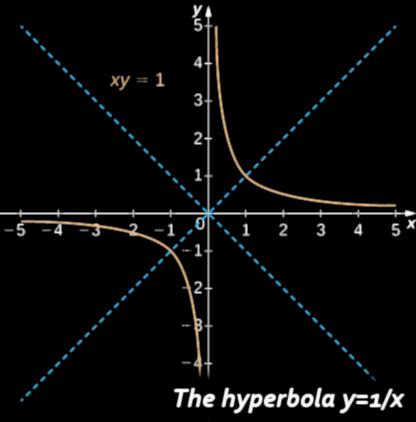
Okay, that was wildly hyperbolic, I admit it.  But who doesn’t appreciate equations like y=1/x?

And with that very bad, very nerdy joke, I’ll begin to end this blog post.  If I’m still alive and still able to do it, I’ll write more tomorrow.  Don’t get your hopes up: I probably won’t die today.  More’s the pity, right?

hyperbolic speech

This is the most important diagram of all time in the entire universe.


*This has nothing to do with the Mini Cooper or Cooper Mini car, or whatever the proper way to name it is.  Although, I think it would be rather cool if they made a small laptop with their logo and design or something, as a promotional thing.  Though that would probably have a very limited market.

**People even used to think it could make you go blind or grow hair on your palms.  Ha.  Ha.

***I’m quite sure I’ve literally heard that phrase.  “Troubled with mental health”?  I wish I were so troubled.  I’m troubled by a lack of mental health.

****Though I do carry “official” diagnoses of depression and dysthymia, from more than once source.

No less than Moore’s Law

I’m writing today’s post on the train and on my laptop*, though I doubt that’s obvious to anyone at first glance**.  Yesterday’s voice-to-text experiment was not a complete failure, but neither was it a success, at least from my point of view.  Also, correcting the weirdness created by the voice-to-text process exacerbated the arthropathy in the base of my thumbs, and I’ve been fumbling and nearly dropping more things than usual since then.  Also, writing on various paperwork at the office has been more painful than usual.  So, I don’t think I’m going to be doing that again any time soon—at least until the technology improves significantly.

Not that I ought to besmirch that technology too much.  It’s a bit like the old bit about the dog that walks on its hind legs (or talks, in an alternate version):  it’s not that it does it well, it’s that it does it at all that should impress you.

I can still remember when my Dad—who worked with computers his entire career, going back to when they were huge, gym-room-sized megaliths—got our family an Apple II+.  We were the first people I knew who had a computer at home (I grew up in a factory town, after all).  I remember my friend Andy saying he was so “ennnvious” of me.  He said it with a grin, though***, and he and I would soon spend many hours learning to program in Basic and writing games to generate characters for Gamma World, for instance, or calculating the conversion of mass to energy via E=mc2 or getting on BBS services with our 600 or 1200 baud modems.

That computer, which was state-of-the-art for home machines, had the expansion to 64K of RAM!  That was a big deal back then.  As far as I know, there wasn’t a home computer with more RAM than that, though I could be wrong.

By comparison, the little mini-laptop on which I’m writing this has RAM that’s just shy of a hundred thousand times larger.  It almost certainly cost a LOT less, even in non-adjusted dollars.  I don’t know what my Dad paid for our Apple, but I’m pretty sure it cost more than $30, which is about what the one I’m working on would cost in roughly-calibrated 1980ish dollars, assuming a constant annual inflation rate of 5%.

The hard drive in this device—and it is far from the state of the art—is a million times larger than the RAM was on that Apple II+, though comparing RAM with a disk drive isn’t really a legitimate comparison.  It’s like comparing Apples and Verbatims.

Speaking of drives, I’m often kind of blown away by some other effects of Moore’s Law.  I sometimes call people’s attention—when I am able to keep them from falling asleep—to the fact that, when I had finished undergrad in 1992, my then-wife and I had a Mac SE, and we bought an external hard drive for it.  She was going to law school and I was doing post-bacc work to get my med school requirements (having decided to go to med school at the last minute, so to speak), and working at the same time, and it was handy not to have juggle all those old, not-so-floppy 3.5” floppy drives.  It cost us a few hundred dollars, if I remember correctly, and it had its own plug for a power supply, and it had a capacity of—wait for it—one megabyte!  And it was amazing!  I still think fondly of it.

Yet now, I can get on Amazon—or go to an appropriate shop, even sometimes a convenience store, certainly many drug stores—and for twenty to forty dollars buy something that has 256,000 times as much memory as that plug-in device that was as big as the base of the computer—and the working portion of the modern memory device is as small as a fingernail.  Also, its memory is much more durable.

And, of course, for well under a hundred dollars—in modern money—I got an external SD drive for the office that has the memory of my old desktop hard drive squared.  A million million bytes (not square bytes, so I was being a little sloppy there), or a terabyte****.  And let’s not even get into processing speed.

Seriously, let’s not.  At least, I really shouldn’t.  I don’t know that subject well enough to have a very good discussion of it.  I know that FLOP is a “floating point operation”.  Also, apparently the Apple II+ could reach processor speeds of up to 8 Megahertz, whereas my current processor is 1.1 Gigahertz, so about 125,000 times faster.  Again, I’m sure there is nuance here, by it’s the rough idea with which I’m dealing.

The point I’m making, overall, is that I shouldn’t be too dismissive or disrespectful of the failings of voice-to-text technology.  It didn’t exist, as such, even ten or so years ago, at least not in any commercially available form.  Now it’s an automatic, included thing in texting and writing functions on the smartphone in my pocket—which is far from top of the line, but is vastly more powerful than even my Mac SE, let alone the Apple II+.

It’s also not an Apple, because I’ve long since become disenchanted with Apple as a company, though their products are surely still good ones.

Nevertheless, typing is still a more effective way to write a blog post, and that’s what I have done and am doing today.  Oh, and by the way, I did in fact record a little five-minute audio tidbit yesterday after finishing my first draft of the “written” post, before someone else arrived at the bus stop and it became a bit too awkward to keep talking out loud to myself in a way that—to me at least—was obviously not a phone conversation.

However, when I went to edit the audio, the traffic noise was just too intrusive.  It was still possible to hear and understand me, mostly, since I was much closer to the microphone, but the noise of cars and the occasional truck was just too much.  I did my best to reduce that noise using various functions of the program, but to make it tolerable, at least to me, led to my voice sounding as though I were speaking through a tight respiratory mask made of cardboard and papier-mâché.

It wouldn’t have made good listening, even though it was only five minutes long, and I certainly didn’t say anything profound enough to make it worth anyone’s while to muscle through it.  So, I don’t plan to upload that.  If I’m going to do audio blogs—or podcasts, if you will—I’ll do them indoors, or in an outdoor setting where I’m away from the noises of traffic and from passers-by who might hear me talking.

With that meandering, weird, tangential bit of fluff, I’ll call today’s blog post to a close.  I hope you all have a good day and a good remainder of the week.  Take care of yourselves, and if you’re fortunate enough to be sharing your lives with people who love you and whom you love, make the most of that.  I don’t seem to be very good at such things over the long term.  Being bad at and awkward and uncomfortable about connecting with people and keeping relationships working doesn’t mean someone doesn’t want to do so, of course—though there probably are such people.  But for those who do want to but are abysmally poor at the process, it can be very unpleasant.  So, if that doesn’t describe you, try to enjoy it.


*I’m sitting on a seat in the train and I’m using my laptop, to be more precise.  I’m not sitting on my laptop, though in the original meaning, a lap is sometimes an appropriate place on which, or in which, to sit.  Still, how could I sit atop my own lap?  Nor am I sitting atop the train, though I understand there are (or have been) places in India where that happens.

**Which is why I’m telling you.

***And it wasn’t terribly long before his family got an Apple III, if I recall, which was also great.

****A terabyte is a trillion bytes, and a trillion (1,000,000,000,000) is a million time a million.  Just count the zeroes.  Now, I’m sure that there are fine points to the comparison, and the literal multiples are not exactly correct, and I’m sure some computer scientist out there could point out the subtleties, and that would be welcome, of course—learning is always a good thing.  But it wouldn’t really change my point.

How would you pronounce an infinite sentence?

Well, it’s Saturday, April 1st, 2023, AD or CE, and I am writing a blog post today because I am working today.  You can’t say I didn’t warn you.

Well, you can say it, but it wouldn’t be true.  You can say almost anything, really.  There is a functionally limitless number of sentences that you can utter, and not all of them will be true.  It’s a vaguely interesting question whether the number of truthful sentences that can be uttered is as limitless as the number of sentences one can utter.  At first glance, it seems, one being a subset of the other, that it should not be the case, but when dealing with infinities, one has to be cautious—initial intuitions can be misleading.

If one restricts oneself to existing words or compound words, and one restricts oneself to sentences that follow standard grammatical rules, one can build a functionally limitless number of sentences simply by including compound sentences or nested phrases, like, “He knew that she knew that he knew that she knew that he was a pedantic idiot.”  That feels a bit like a cheat to me, but logically speaking, it can be done.

Of course, even if, in principle, the number of such possible sentences is infinite, there is a practical limit to the number of them one could possibly construct before the heat death of the universe—or, if the universe “ends” in some other way, before that happens.  This is part of why I wonder whether the number of truthful statements potentially constructible is actually as large—in practice, even if not in principle—as the total number of possible statements.

One could, in principle, construct sentences describing, to the degree possible, the quantum state of every describable aspect of all of accessible reality.  Of course, one could also just make up descriptions of quantum states that have nothing to do with our reality, but if Everett was right, or if the String landscape is right, or what have you, they might all be true somewhere, depending on how you define “some” and “where”.

But, of course, it’s trivially easier to describe quantum states in ways that are physically nonsensical, e.g. “The quantum state of that electron is blue with purple polka dots and smells like ripe bleu cheese”.  Or one can make impossible statements using more formal terminology, such as, “The precise location and momentum of this particular ‘particle’ are, at this precise moment: x and y, with no rounding of digits anywhere.”  As far as we know, that’s physically impossible.

It’s not as exciting as the physically impossible tale, “Bob accelerated his ordinary human body instantly from a standstill to the speed of light, at which speed he stayed long enough to go to the sun and back.  It was an incredible sixteen minutes, and everyone who watched him do it was amazed and thrilled.”

We know that can’t be true because, for one thing, nothing with “rest mass” can reach the speed of light at all—that would require an infinite amount of energy.  Also, if you’re going the speed of light, you can’t experience it, because for you, time ceases to pass.  Also, it’s questionable whether anyone could “see” you moving at that speed, and not just because you would become a black hole before you could ever achieve light speed.

Or would you?  I’ve tried to ask people who should know what would happen if a spaceship (for instance) was accelerated to close enough to the speed of light that, given length contraction and “relativistic mass” it compressed to a front-back length that was shorter than its Schwarzschild radius*, but I haven’t seen or received a reply about it.

This is one of the reasons I bought no fewer than two big textbooks on General Relativity; if I couldn’t get someone to give me the answer, I wanted to try to work it out.  I suspect that the fact that the length contraction is along one axis might make it a complicated situation for any large-scale object; maybe no one has done the mathematics on such questions, but that feels unlikely.

It also feels unlikely that I’ll find the time and discipline to work my way through the appropriate textbooks before I die.  There is background mathematics involved that I would need to master if I were to be able to apply the theory properly.

I don’t doubt that I’m capable of it; it’s not like playing professional basketball, where there are fundamental, physical limits to what someone my height (and age and athletic ability) could accomplish.  But there are so many things that interfere, and my time (and my will) is burned up daily upon matters of even more trivial character than all the pointless things I’ve already done in my life.

At least I’m gaining back some time thanks to my new bicycle.  I am now troubled, though (as I always am when I have some structure outside of myself upon which I have chosen to rely) with worries about maintenance, such as:  What will happen if the tires go flat while I’m en route to the train station?  It’s not that such a thing would be an unsolvable problem; I’ve dealt with such occurrences before.  But I don’t want to deal with them.  Even having to think about them constitutes one more straw piled on the camel’s back, and I’ve been carrying too much straw for too long.  I’m tired.  I want to lie down and just stay that way.

At least I’m getting good exercise.  And now that the seat is fixed, the bicycle seems to be operating well.  I may need to edit (slightly) my scathing review of it on Amazon.  We’ll see.  I’m going to watch and wait a bit longer for any other problems that may arise before I do that.

In closing, I’ll grudgingly acknowledge the fact that it’s “April Fool’s Day” just to remind you that you are all fools…but that I am a fool as well.  So were Einstein and Newton and Socrates and Marcus Aurelius and the Buddha and Lao Tzu and Confucius and, well, everybody else.  As Einstein is credited with saying**, “There are two things that are infinite:  the universe and human stupidity.  And I’m not sure about the universe.”

Depending on what you mean by stupidity, that can be trivially true in the mathematical sense, i.e., the number of unknown things in the universe is infinite.  There are other uses of the word stupidity about which the statement might not be true.  For instance, there are those who define stupidity as doing something in ways that are less efficient than randomness, such as trying to get to the airport by repeatedly driving around the block from your house until your car wears out.  Moving randomly could at least eventually get you to the airport, whereas going in “circles” will never get you there, even with a car that lasts forever.

Enough!  I wrote “in closing” and I haven’t closed yet, so I’ll do that now.  Have a nice remainder of your weekend***.  I’ll be back writing on Monday, barring the unexpected.

einstein_sticks_his_tongue_1951


*According to outside observers, that is.  For those on the spaceship, it would be the outside world that would constrict into an ever-narrower “tunnel” in the direction of travel.

**I think this attribution is a correct one, which is not reliably so with many quotes attributed to Einstein online.

***What’s the modulus of a weekend?

It’s inspiring stuff for an otherwise mundane journey.

I’m starting this blog post a bit later than I usually do—roughly an hour later—because, as I planned yesterday, I have walked from the house to the train station, which is about 4.8 miles, it turns out.  It took me almost exactly an hour and a half, which I guess is a decent pace, though I used to walk more quickly.

I suppose with enough training I shall improve.

Now I’m at the train station (not the one to which I take the bus, but the one from which I always used to set off), waiting for the very train I would have caught had I taken the bus to the train this morning.  So I won’t be arriving at the office any later than usual, but I may be tardy in my posting of this blog entry.

While I walked, I listened to The Fellowship of the Ring on Audible.  It’s a brilliant book to which to listen while walking any distance, because the characters are walking, themselves.  When I started, they were in the Prancing Pony, first meeting Strider (my namesake)*, and by the time I’d gotten to the train station, Frodo had just been stabbed on Weathertop and they were getting ready to repack the pony and head off the following morning.

It’s inspiring stuff for an otherwise mundane journey.

I’m not wearing my Timberland boots today.  I fear that part of the issue with them is that they don’t fit my feet quite snugly enough, and so I slide around a bit in them, and of course, that can lead to blistering.  I’m not sure why the fit is overlarge, though.  I’ve looked at the various reviews and whatnot of those boots, and people generally say that they are true to size, or else a bit small.

Whereas, for instance, the Under Armor shoes I had are actually a bit snug at my usual size, and a pair a half size up seem a more comfortable a fit around my toes.  New Balance walking shoes, such as the ones I’m wearing today, and more or less just right.

I’m leery of trying a pair of Timberlands a half size smaller, not least because they are not cheap.  Though, of course, Amazon does have a try-it-on thing you can do, but if you don’t want to keep a pair you have to send it back, and that’s annoying.  I can’t deal with crap like that anymore; it involves interacting with humans I don’t know and changing my schedule and my routines and all that other stuff, and it’s just not worth the effort.

Maybe I’ll figure something out.  Possibly just the walking itself will strengthen my feet, or alternatively will make them swell enough that they fit the boots snugly.  I will admit, after wearing the boots yesterday, they already feel much more comfortable than they did before, but I did not walk more than about three and a half miles yesterday, total.

I’d like to find something out that is more or less ideal, but there may be no such thing in the real world.  Reality is extremely complex, with all sorts of high order equations interacting with other high order equations all over the place.  It may well be that the possibility of finding something ideally suited in all aspects for any given purpose is functionally impossible.

This is one reason I dislike it when people use the word “perfect”, because in most cases it’s a notion that isn’t even well defined, let alone achievable.  Unless one sets clear and specific and precise criteria, judging anything or anyone to be perfect is just rhetoric, it’s not reason.  Powerful rhetoric can be enjoyable, like watching a boxing match or a martial arts movie, but it absolutely should not be allowed to sway one in important matters that bear on facts of reality or choices of morality.

Should we really let our politics, let alone our judgments of the facts of reality, be shaped by the words of someone who is—effectively—the best name-caller on the playground?  The difference between juvenile remarks—“Neener-neener,” “Your mama,” and “I’m rubber, you’re glue” for instance—and the words in most political discourse and debate is one of degree, not of type.

Imagine if Wiles’s proof of Fermat’s Last Theorem*** had consisted of him saying, “It’s true ‘cause I said it’s true, now what are you gonna do about it?  My grandma knows number theory better than you do.”  Or perhaps he could have invoked the seemingly more mature arguments:  “Of course, my political opponent would be skeptical of my proof, even though it’s obvious to anyone of intelligence that it’s correct.  The members of that party don’t want you to have the freedom brought by knowing that no three positive integers a, b, and c satisfy the equation an + bn = cn for any integer value of n greater than 2.  That’s because it threatens their power structure, and their special interest groups and wealthy lobbyists.  My proof may, like Fermat’s, be too big to fit in the margins of a letter, but believe me, my opponent’s brains, together with his genitals, are more than small enough to fit in such a space.”

Would that be a convincing mathematical argument?  Would it have anything at all to do with the truth of any proposition whatsoever?

Why do people both use and fall for such manipulations?  I know, I know, they’re just a bunch of tailless, nearly-hairless monkeys; why would you expect them to be more reasonable than baboons?  But it’s so frustrating mainly because nearly all of them appear to have the capacity to be rational, contrary to popular belief.

The very use of language itself requires syntax, grammar, logic, all applied at quite a sophisticated and often abstract level.  Almost all humans are capable of language starting at a young age.  They have the wherewithal to be truly reasonable and sharp-minded, almost all of them, with but a bit of effort.  This makes it all the more irritating when they don’t do so.

One doesn’t get angry at a starfish for having no curiosity about astronomy (despite what we call it), or a worm for not grasping quantum mechanics****.  And what does a sea squirt need with philosophy, especially once it’s achieved tenure?  But humans nearly all have the capacity for exceptional achievements.

Though I suppose “exceptional” wouldn’t be the right word if everyone did it.

How did I get on this subject?  I don’t remember.  Anyway, that’s more than enough of a post for today, and as I write this last sentence, having arrived finally at the office (and having now walked just shy of six miles already), I still need to do my editing.  So I’ll call it good.  I don’t think I’m going to be working tomorrow.  It would be good, after my first day of longer walking, to have a day of relative rest.  Then, next week, I shall do my walking, about 12 miles, every day.  That’s not too bad for a start, but not as much as my eventual hope.

We’ll see what happens.


*That’s Aragorn, of course, but for those of you who have only seen the movies, you may not know that his name as king of Gondor, in the fullness of time, was Elessar Telcontar.  Elessar means “elfstone” and refers to the green gem given to Aragorn by Galadriel, whereas Telcontar means, more or less, “strider”**.

**If ever I were to assume a supervillain name of some kind, I might replace my current last name with “Melkor”, because it would lead to possibly the most egotistical concatenation of name meanings ever.  My first name, Robert, apparently means “bright fame” or “bright glory”.  My middle name, Eugene, of course means “true born” or “well born”, as in “eugenics”.  And my counterfactual last name, Melkor, would mean “He who arises in might”.  That’s a heckuva collection of names.  And, of course, I’m a doctor by training and by degree, so that just makes it all even mightier.  “I’m Robert Eugene Melkor, MD.  You can call me Dr. Melkor.  Bwa ha ha ha haaaa!”

***Which, to be fair, should be called Wiles’s Theorem.

****Though they are good at tunneling.  Ha ha.

This is yesterday’s blog post

It’s Tuesday morning, and I’m back waiting at the bus stop, which in many ways is preferable to the way things were yesterday, and so many days before, though I won’t get into the specifics.  I had a rather significant exacerbation of my insomnia last night/this morning, by which I mean I woke up extremely early, even for me—and I’m writing this at 5 am, so “extremely” early is early indeed.

I came very close to just getting up when I couldn’t sleep and walking the five miles to the train station (rather than waiting for the bus to go the other one) and getting the first train of the day.  The only thing that really stopped me is that I didn’t want to start the day all sweaty*.  It’s not so bad to end the day that way—there’s no one to whom I’m coming home who has to deal with my sweatiness, and I can just doff my clothes and get a shower and get ready for “bed” when I get back to the house.

Other than that, there’s not much going on in my life.  As you all know, I’m not writing fiction anymore**, and I’m not writing any new music, nor learning any new songs.  I think the last thing I did that was “new” on the guitar was figuring out the tune to Baker Street, especially the sax riff.  That might have been before New Year, though, so it’s been a while.  It didn’t take very long, though it was quite satisfying for a moment.  That sax riff is amazing, and almost everybody recognizes it when they hear it.

Otherwise, everything is mainly empty, and it’s harder and harder for me to distract myself.  I wish I could just go catatonic or something.  But I don’t think my psychopathology is of that type.

Everything is also very noisy, and that’s irritating.  I don’t wish I were deaf—or deafer than I already am—but I do wish everything were quieter.  I particularly wish people did less loud talking, and especially less loud talking about nothing at all.

I started trying to read and work through problem sets—at least all the odd numbered problems, so I could check the answers after doing them—in my old, used copy of Thomas & Finney’s Calculus text, which was the one I used in my undergrad days.  I’ve completed one problem set, very early in the book.

It’s easy stuff, of course, at that point in the text, but I figure reviewing and practicing isn’t going to hurt.  I knew someone in college who literally did every odd-numbered problem in the textbook so he could master the material, and when test times came, he got terrifically high scores on exams that everyone else found difficult.

Obviously he’s inherently very smart—that made him fun, because it’s nice to be around someone smarter than yourself, so you can learn things—but as with many people who are very smart, he also worked quite hard.

I think it would be nice to try to master some more mathematics so that I could actually do some of the calculations related to General Relativity and Quantum Mechanics at more than a rudimentary level.  I’ve also tried to restart reading Sean Carroll’s Spacetime and Geometry, which was really good as far as I had gotten before, but which I stopped partly due to limitations on my mathematical skills.

I think I should probably just try to muscle through things this time, and just file away the bits I don’t understand yet—mostly mathematical formalisms, since the concepts aren’t that difficult—and maybe then get them more and more as I come back to things later.

Of course, all this is really just a fantasy, an idea of me trying to “recapture my lost youth” by attempting to complete some version of a Physics degree on my own.  It’s a pipe dream.  I don’t think I have the will to carry it through, because I really don’t have the will to do much.  The only advantage the idea has is that all the other things I do for fun are steadily losing their charm, so maybe I’ll be able to focus on it by default.  I doubt that will be enough, but who knows?

I suspect it won’t be, though.  I feel like everything is coming to an end for me.  That’s all right, I guess.  It’s not as though I’ve really brought much joy or happiness to anyone in the world, and the people I love don’t tend to find me tolerable over the long term.  I think I’m probably a net loss to the world, and the loss of me would not be a net loss.

I would like to go out in a unique and semi-dramatic fashion, though, as long as it doesn’t cause too much unnecessary inconvenience for other people.  It can be slow and drawn out, and may even, in the process, lead me to some new personal insight or adjustment or revelation.  I don’t know.

That’s all probably a fantasy, too.  I’m not sure exactly what I’m thinking or what I’m getting at.

I’ve just passed 800 words or so, and someone once told me that about 800 words is the best length for a blog post if you want people to want to read it.

I’m sorry, I don’t think this has been very coherent at all.  I’m not feeling well in general, in case it’s not obvious; I’m having some GI** trouble, the cause of which is uncertain.  I’ve taken medicine for it, and that’s obviously done at least some good—after all, I’m waiting for the bus so I can head into the office—but it’s not completely taking care of it, and I feel the temptation to just head back to the house.

The trouble with that is, it’s too easy to fall into the trap of just not going in at all, and not doing anything at all, and just withering away.  Which, I guess is not necessarily that bad.  But, as always, I don’t want to inconvenience people.  Heaven forbid that anyone should be inconvenienced by me.  I already hate myself; I’d like not to add too much fuel to that fire.

However, my belly pain is actually starting to increase somewhat, and I think I’m going to have to go back.  The last thing I want to do is have a “crisis” on the bus or the train and have to make my way back from there.

Further bulletins as events warrant, I guess.


*It turned out that I had some form of enteritis, also, including a low-grade fever, so it was probably just as well that I didn’t even try that walk.  Perhaps the developing issue contributed to my worsening insomnia, now that I look back at it.

**Which I guess is no loss, since no one seems to care about the fact.

***That’s gastrointestinal, nothing to do with the military.

Some musings on brane-worlds, “dark matter”, and even “dark energy”, with apologies

I told you yesterday  that I would be writing another post today, since I’m going into the office, and here I am, writing another post.  You were given fair warning—or at least, you were given adequate disclosure.

Yesterday (and into today) I was listening to an episode of Sean Carroll’s Mindscape in which he spoke with Adam Riess, one of the discoverers in the late 1190s of the increasing rate of cosmic expansion—the single most exciting scientific discovery I recall happening in my lifetime.  In the podcast, the two physicists spoke, of course, of “dark energy” and “dark matter” and the “Hubble tension” between two different ways of predicting and/or calculating the Hubble constant*, and that all reminded me of something that I’d thought of more than twenty years before.

If M-theory (an overall theoretical structure that subsumes “string theory”) were to be right, and we are merely living in a 3-brane embedded in a higher-dimensional “bulk”, then perhaps the explanation for “dark matter” could be simply the gravitational effects of matter in a nearby, parallel 3-brane, or perhaps even more than one (since, if more than one, why not more than two?).  I had first tried to give myself a very simplified model on which to do some calculations about the possibility just for fun, way back in a lunch break during my first year in private medical practice, but I didn’t get very far.  My schedule was rather busy, and I had many good and interesting things going on in my life that drew my attention.  That last part, at least, has changed almost completely.

Despite all the theoretical and proposed notions for what dark matter particles might be (WIMPS, Axions, lots of primordial black holes, etc.) there has not been a single detection of any of them.  There hadn’t been any twenty years ago, and there haven’t been any as of this writing, unless they’re keeping it under their hats, which is unlikely for something of such importance.  Nobel Prizes will be won by those who discover convincing evidence of any dark matter particles!

The evidence for dark matter in general. though, is tremendous and all but unassailable, coming from multiple fronts in astronomy/cosmology/astrophysics, but its specific nature is still not known.

So, yesterday morning, I decided to retry the notion I’d had twenty-odd years ago, just for fun.  I don’t expect to make any particularly interesting breakthrough here, obviously, but it was just my way of seeing if my notion has any modicum of worth at all, or if it’s totally self-contradictory.

As before, I needed to set up a highly simplified situation, just so that it would be within the wheelhouse of my very limited mathematical skills, which are rusty to say the least, and which were never nearly advanced enough for any serious work in GR or M theory (I often consider trying to work my way up to better, more useful such skills, but I don’t know whether that will ever happen).

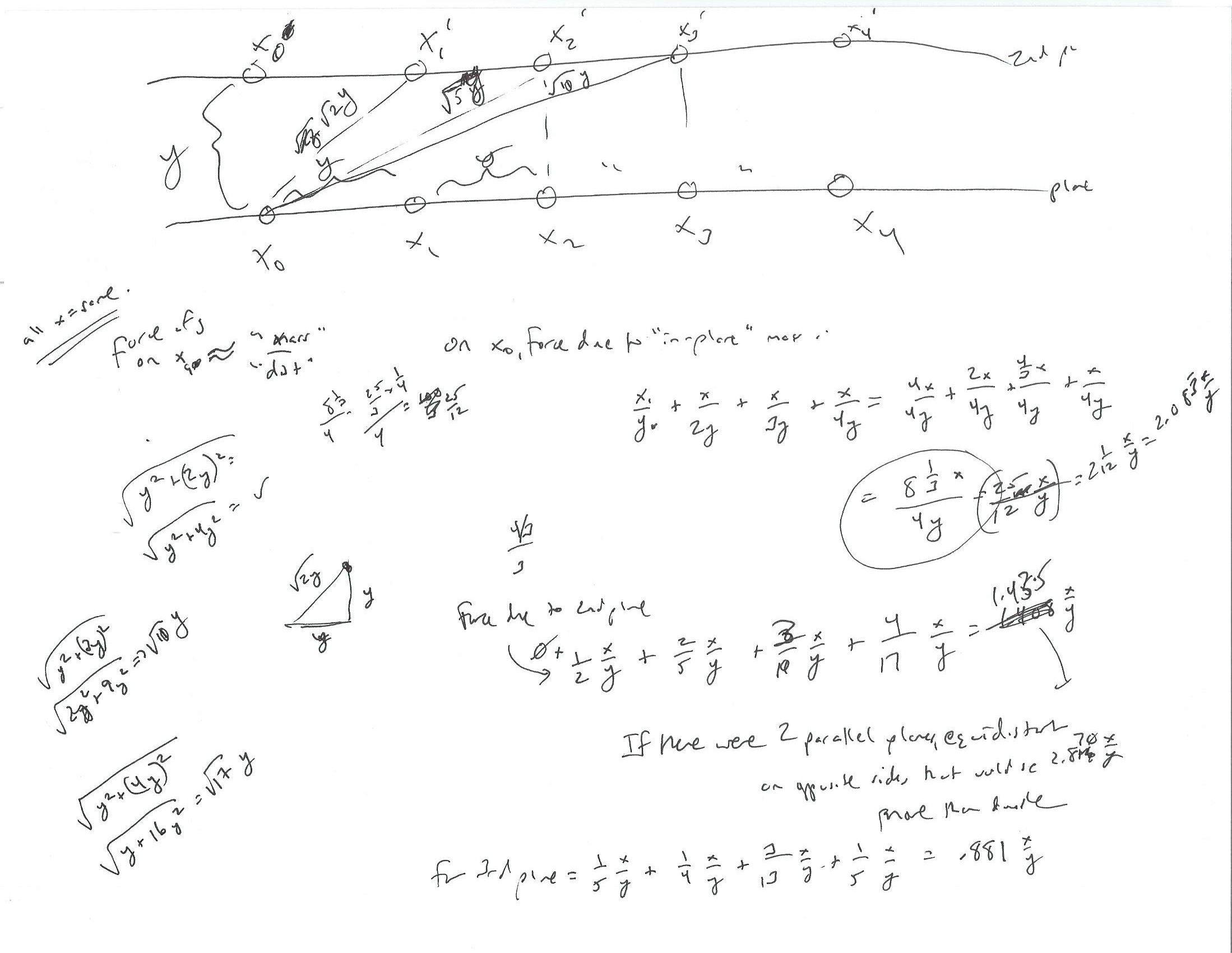
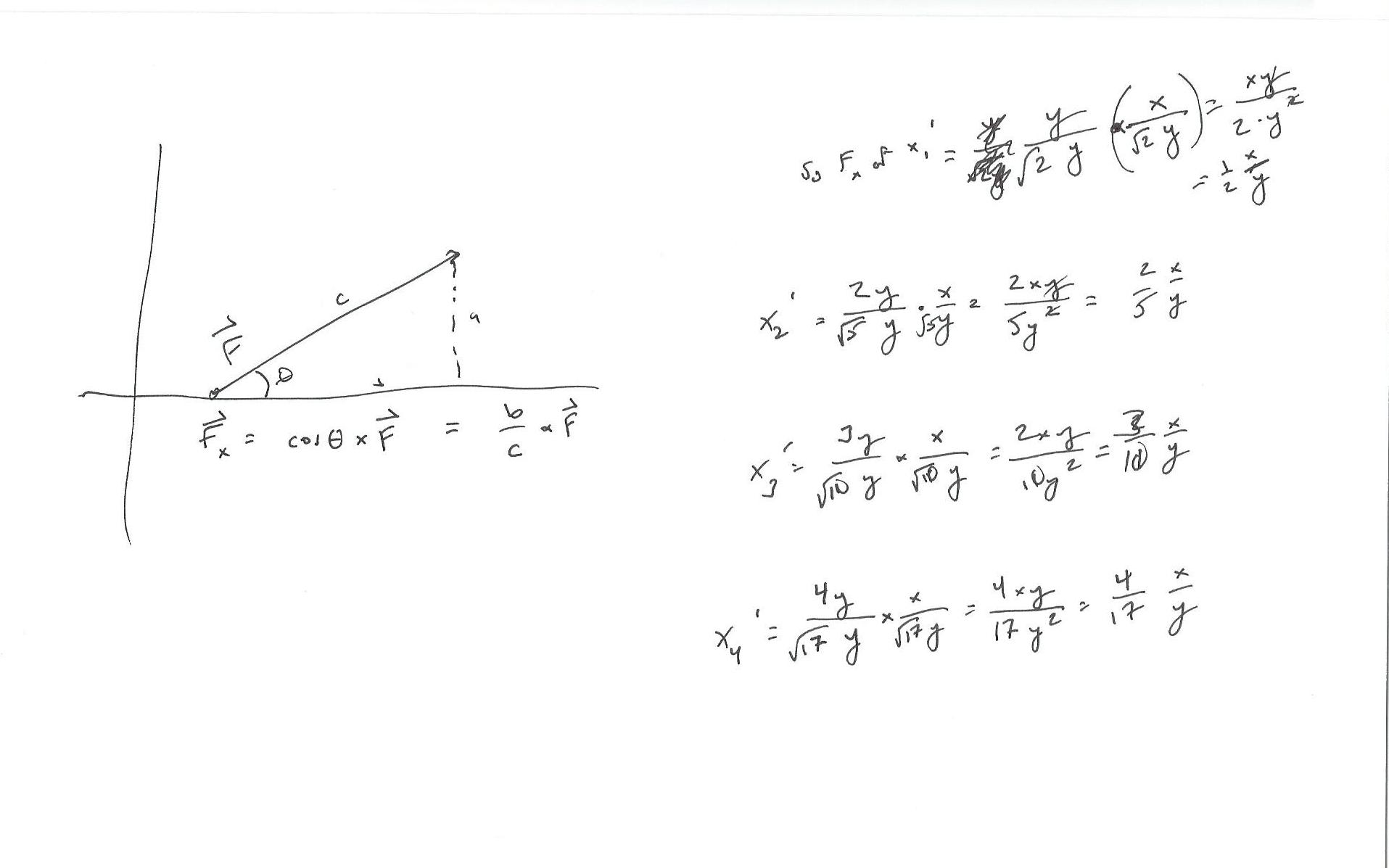
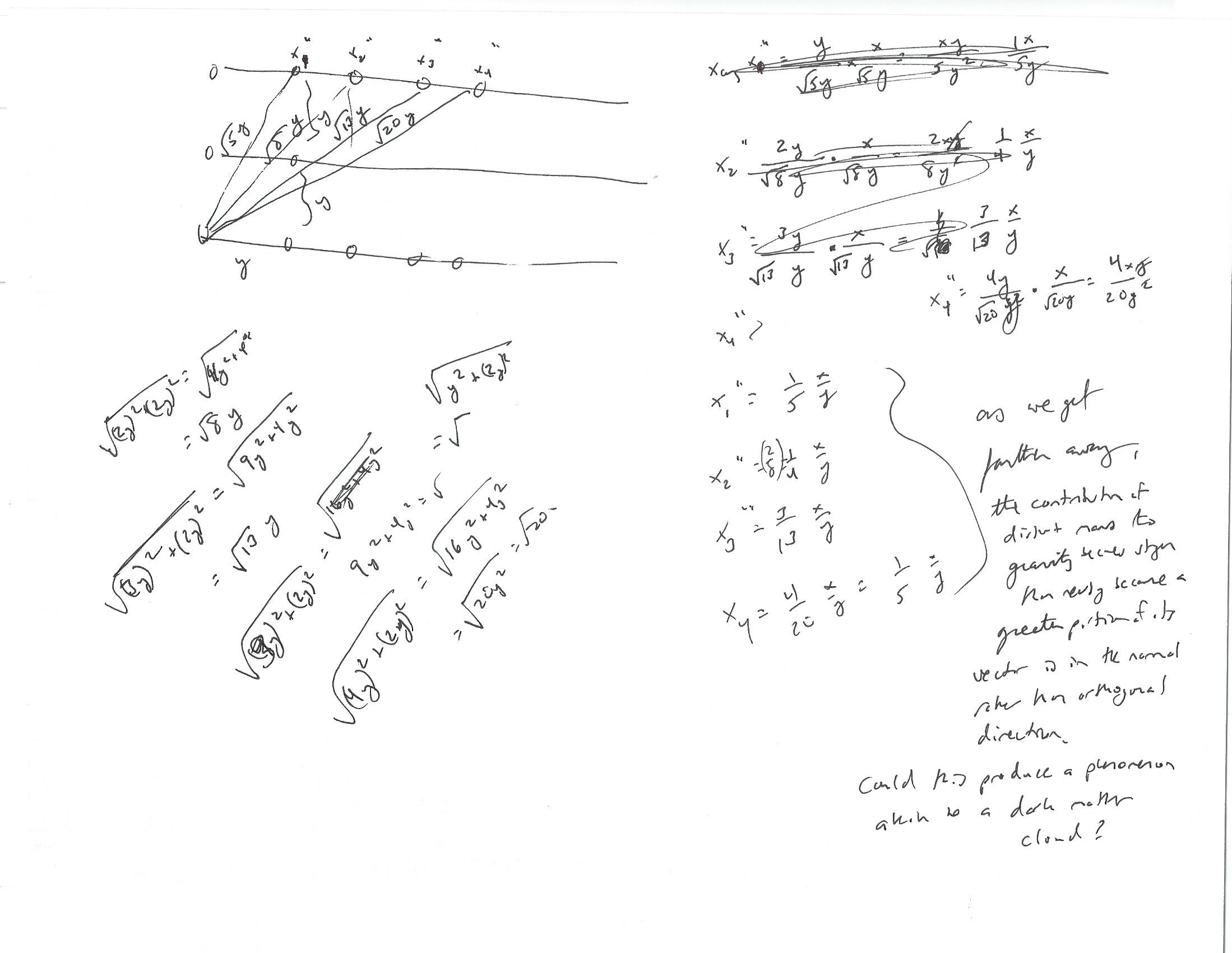
So, I took my model down to being just a plane rather than a space, which makes the strength of gravity fall off linearly with distance, rather than as distance squared.  Then I just took a line of identical masses, x, (x0, x1, x2 etc.) all separated by an even distance, which I called y, and so the gravitational force on my x0 mass due to any other was just proportional to x over some multiple of y.  I made my gravitational “constant” just 1, so the force would literally be x/y or x/2y, and so on.

Really, in the first universe, though it was in principle two-dimensional, I only had to deal with one dimension of additive forces.  This will make my model not terribly useful with respect to the actual universe, but I wanted just to get a feel for things.  You’ve gotta crawl before you can walk or run or fly.

Then I took my “parallel” brane to be also y distance away—to keep applications of the Pythagorean Theorem and such simple—but obviously in a direction that’s orthogonal to every direction within the original brane.

According to the ideas in M-theory/string theory, most particles—photons, electrons, quarks, gluons, neutrinos, etc.—are described as “open” strings, with free ends, and as such, they cannot leave the brane in which they exist (apparently their ends are “sticky”)***.  But gravitons, as proposed in string theory (they were one of the main things that first led people to take string theory seriously as a potential theory of quantum gravity) are closed strings, and they can go between branes and into the “bulk”, the larger, overarching spacetime in which lower-dimensional branes could be embedded.  Thus, one brane can gravitate with respect to another, and this tendency of gravity not to be confined within a brane could explain the relative weakness of gravity compared to the other forces of nature.

Okay, so I did my best to try to work out the situation relating the additional strength of gravity felt by my initial, single particle due to the added gravity from masses in the parallel brane—and then two parallel branes or so, just to see.  I made some mathematical errors that I caught, and I’m sure I made others than I didn’t catch, so I’ll include my—utterly chaotic and not really annotated—worksheets here below, in case anyone is masochistic enough to want to look through them.

I don’t think I produced any startling insights, of course, but one thing that became more obvious on working it through is that, as parallel masses get farther away as measured in the plane of the original universe, their gravitational effects become more like that of the masses within the original brane.  This makes sense, because the farther away they are, the less the effect of the separation of their branes has relative to that distance; so the angle of that force relative to the plane of the first universe is smaller, and its within-brane component is larger****.  The “nearer” masses would have gravity that was barely felt, or not felt at all, within the original brane (or universe), but the farther out the masses go, the more they would be felt as if they were mere additional mass within the original brane/universe.

Could a situation analogous to this but in higher dimensions explain why dark matter acts as though it is a halo going through and around galaxies, and doesn’t seem to clump together?  And could such a description, in the absence of any detectable particles of dark matter, constitute a test of the notoriously difficult-to-test M-theory in the real world?  At least, the longer we go on being unable to find a direct dark matter candidate particle interaction, the more the Bayesian prior for a string/M-theory explanation might go up.

I don’t know.  I’m way too out of my depth.  But it is an interesting thought, and I invite any readers who have actual expertise in such matters please to give me their reactions.  I don’t think my thoughts are anything that’s useful for anyone, but it is kind of cool.  I think.

For those of you who aren’t interested in such things, I apologize.  It is a Saturday post, so you can consider it a weekend indulgence (though I did the figuring on Friday morning, really).  It’s the sort of thing I think I previously would have confined to Iterations of Zero, and I’ve skirted the topic in the past there and here.

I have to have things like this to do from time to time.  If I weren’t able to think about such things to distract myself from my own awfulness, I would already have killed myself a long time ago.

Maybe that would have been better for everyone.  But the past cannot be changed without making a completely new universe that wouldn’t benefit anyone in this one.  So, it is what it is.

Have a good weekend.

my dark matter m theory scribbles_0001

my dark matter m theory scribbles_0002

my dark matter m theory scribbles_0003


*It’s either roughly 67 or roughly 73 kilometers per second per megaparsec**, which is the overall rate of expansion of the universe.  These values do not have overlapping error-bars, and they both have become tighter over time, so something is being missed.  It’s not a huge difference, but there should be no difference at all if the models are correct in all aspects.

**The parsec is not a measure of time, of course, but of distance, and a mighty big distance at that.  A parsec is a little over three light-years (which is about 30 trillion kilometers), so a megaparsec is roughly 3 million light-years.  Big!  With this measure of the Hubbles constant,  you can see why, at close distances, attractive gravity vastly supersedes expansion; the expansion tendency doesn’t become very large—indeed, expansion doesn’t even happen—until distances become truly cosmic in scale.  The Andromeda galaxy is less than one megaparsec away (not by much), and its net movement toward “us” is about 110 kilometers per second.  I suppose that implies that if it were not for the Hubble expansion, it might be coming toward us at about 180 kilometers per second, and might “collide” with the Milky Way in only two or three billion years instead of four or five.  Oh, well, we’ll just have to wait.

***The thought just occurred to me that branes, like strings, are thought to be composed of some form of “energy”, admittedly a nebulous term and a place-holder—there’s always more to learn.  But uniform energy creates a negative pressure, which in General Relativity produces repulsive gravity…the very cosmological term/constant Einstein proposed and discarded, but which has come back into its own as a descriptor of “dark energy” and even cosmic inflation.  On the scale of individual strings, say, even though the energy density would be high, the Lambda term would be too small to lead something the size of a typical string to expand at all, but in a brane—2 dimensional, 3-dimension, or more—if it’s large enough, the very energy that constitutes the brane might be enough to explain the existence of repulsive gravity, from inflation to the current “dark energy”.  Or am I totally off-base here?

****The vector component of their gravitational force that can be felt within the first brane should be the cosine of the angle between the second-brane mass and its analog in the original times the total gravitational force it would exert on the first.  Any other component would be felt between the branes.  Such possible inter-universe gravitation is in the source of the threatening catastrophe in my book The Chasm and the Collision.  Don’t worry, the book doesn’t dwell much on any technical aspects of this.