Monday, Monday, heavy as a ton day (why is there no Qunday?)

It’s another Monday morning at the train station, and I’m waiting for my morning train.  I don’t feel much like writing today. but I don’t feel like passing my time doing nothing, either.  Similarly, I really don’t have any wish to go to the office, but I likewise have no desire to stay at the house.  I have very little desire for anything.

I have not yet turned either of my two previous “audio blogs” into “video audio blogs” yet.  Perhaps I’ll do that today.  Probably not.

I do sometimes (as I’ve noted before) get irked by the terrible waste of storage space necessary for audio and especially for video, given that written language is such a storage-efficient means of communication once mastered*.  Also, one doesn’t need a microphone or a camera if one chooses to write.  I suppose it may be easier to convey emotions in some sense through audio and video, but I don’t seem to be very good at conveying my emotions in any format, even in person; hell, I often don’t recognize them, myself.

I admit that writing on my phone, as I am doing now, is not nearly as satisfying as doing so on my laptop computer; it is also slower.  Additionally, I make far more typos, since the keys are so small, and the autocorrect is often wildly and stupidly incorrect in its suggestions.  Using the phone likewise exacerbates whatever arthropathy I have at the base of my thumbs.  But I’m always in pain, anyway, so that doesn’t matter very much.

I’ve been thinking lately that maybe I ought to get a new bicycle (a mountain bike style one) to try once again to do my morning and evening train station runs on the bike.  I never did fix the previous one’s front tire, but that was partly because riding it hurt my back.  In fact, I put that one out for the large trash pickup day last week, and it was gone within an hour.  This is something that makes me glad.  I hope whoever picked it up makes good use of it.

I’ve had mountain bikes before and they didn’t seem to hurt my back.  Maybe that style of bike would just work better for me.  Plus, they come in a wide range of prices.  The thing that keeps bringing it back up in my mind is that it would give me greater mobility in more reasonable time than walking gives me.  But bikes are frustrating because they require maintenance, and I’m not great with that sort of thing.  I can readily enough do the work once I start it‒it’s nothing terribly arcane, after all.  But I simply have no motivation to do so.

In unrelated news, I got a calculus problem and solution review book that was free through Kindle unlimited last week, and on Saturday I worked through the problems in the first chapter.  There weren’t very many, and they were pretty easy‒it is chapter one‒but it was also rather unsatisfying to do problems though a Kindle book on a Samsung tablet (I used pencil and paper to do the problems); I just find a physical text more satisfying, probably because that’s the way I did such things throughout my life before.  I don’t know if I’ll do any more of them, though.

Everything seems almost completely dreary and uninteresting, and I feel rotten to the core‒by which I don’t mean that I feel sick**, but that I feel that I am a horrible, horrible person, who tends to bring pain and heartache to the people closest to him, to those about whom he cares the most.  And so, because of that, I am alone.  Which really sucks, but is at least appropriate.

On the way back from work on Saturday, I stopped in at the Yellow Green Farmers Market, which I’ve been meaning to visit, and it was indeed all that I expected:  a lovely place full of stalls and stands and local musicians, just the sort of thing I would really have loved if I had someone with whom to share the experience.  By myself, although it was interesting, it was also rather hollow and depressing.  I didn’t stay for long, and I didn’t buy anything.

I’ve gradually come to realize that things like movies and TV shows and farmers markets and malls and so on are all things that, at least partly, I’ve enjoyed because they let me connect with other people.  I don’t know how to connect directly, but even work and school and reading were and are conduits through which I could actually have friends and be able to interact because there was something about which to interact.  Without such conduits, I seem to tend to involute and wither away.

Even now, once I’ve watched an episode of Doctor Who, which is the only new show I’ve enjoyed since The Big Bang Theory (though that got boring after a few seasons), what I like to do after is just watch other people’s “reaction videos” to Doctor Who episodes.  It’s almost like having friends with whom you’re sharing an interest in something, except there’s no actual back and forth.

Anyway, that’s enough about nothing.  I’m already tired and I’ve just barely started on the way to the office.  Every day is more pointless than the previous one, if such a thing is possible.  The most interesting thing that I’ve done lately is that yesterday I made a makeshift “flame-squirter” as I call it.  It’s pretty neat, but it’s not as intimidating to raccoons as you might expect, and I’m not ready actually to use it on them.  They would probably make a really annoying amount of noise.  And then, of course, they might join the Guardians of the Galaxy or something, I don’t know.  Anyway, the cats I try to feed are hanging around less often these days‒maybe they’re finding food that they prefer somewhere else, and seeing me is certainly not a good enough reason to come to the yard.  If I had any choice in the matter, I wouldn’t even see myself.  So, let the raccoons eat a bit.

Oh, well.  Try to have a good day.


*This despite the fact that the English language is a quite redundant code.  For instance, you will almost never see a “q” that is not immediately followed by a “u”.  When it does happen, you will probably be inclined to notice it, precisely because it is so rare, and so, a q without a u is probably even less common than you imagine it is.

**Apart from in the head.  I feel quite sick in the head, honestly, but I haven’t been able to find any way to treat that.

And the mazèd blog, by their increase, now knows not which is which.

Hello and good morning.

I’m writing today’s blog post on my smartphone, because I walked to the train this morning.  That’s not quite the non sequitur it might seem to be.  Given the new train schedule, I arrived here only a few minutes before the 6:20 train is due to arrive, whereas on the old schedule, I would have just missed the 6:10 and sat down to wait for the 6:30.  Of course, I could simply let the 6:20 pass and wait for the 6:50 and pull out my laptop to write my post while I wait.  Perhaps, in the future, I will do that.  Today, though, I don’t want to push back my departure any further.

I’m now on (actually, in) the train, and I was surprised to find my preferred, relatively isolated seat on the older style car free.  Combined with the feeling of achievement from already having walked about five miles today, that’s pretty nice.

Today is the Winter Solstice, at least for those of us in the northern hemisphere, meaning it’s the day of longest night, if you will.  Going forward, now, the nights will become shorter, though the change will be hard to notice at first, since, near their maxima and minima, the derivative of sine and cosine curves (well, any smooth curve, really) is around zero, meaning the rate of change of the function is very small.  For one brief instant‒one infinitesimal moment of time‒during this 24-hour period, that rate of change will be exactly zero.

But, of course, the rate of change itself is constantly changing.  This isn’t true of all functions, obviously.  The rate of change in a linear function is a constant, and the rate of change of a constant is zero.  That’s why it’s called a “constant”.  And the rate of change of zero is still zero, no matter how many times you would like to take that derivative.

Sine waves, however, are cyclical, and their derivatives are also cyclical.  The derivative (i.e., the rate of change) of a sine is a cosine…and the derivative of a cosine is a sine (inverted, I think, if memory serves, but that changes nothing fundamental).  So, even the derivatives of such cyclical functions are eternally cyclical.  There’s something very pleasing about that, at least to me.

Oh, by the way, it is the Summer Solstice today for those who live in the southern hemisphere.  This has been a smaller number of people than live in the northern hemisphere for as long as human civilization has existed, I think, largely because there simply is more land in the northern hemisphere.  Nevertheless, there are now many millions of people south of the equator, and so there are oodles of those for whom Christmas and New Year’s are summer holidays.

Summer ought to be slightly warmer for those in the southern hemisphere than for those in the north, since technically the Earth is at its closest approach to the sun in January.  However, the Earth’s orbit is very nearly circular, so the difference between aphelion and perihelion is tiny, fortunately for us.  Also, there is much less land in the south, and land heats up much more rapidly and noticeably than water, so that may completely swamp the effects of slightly different nearness to the sun.  I’m not sure.  If anyone out there has that information, please let me know.

It’s a bit interesting to think of those people who have grown up in the southern hemisphere, seeing all the movies and shows (and before that, books and legends) that associate snow and cold and the like with Christmas time and New Year’s.  Of course, the reasons would not be a mystery, but it still might feel peculiar, just as it might feel rather alien for a northerner to hear of someone going to the beach to celebrate Christmas.

Instead of building a snowman, maybe such people might build a sandman.  Actually, given the old horror short story about the Sandman‒not to be mistaken for Neil Gaiman’s admittedly also quite dark creation‒it might not be great to make a sandman as part of a joyous celebration.

Although, being rather dark myself, I consider the notion somewhat amusing.  Maybe there could be a kids’ story called Gritty the Sandman, instead of Frosty the Snowman (Anakin Skywalker would hate that).  But Gritty would be much harder to destroy than Frosty.  It takes serious heat to cause sand to melt, and even then it just becomes glass.  Imagine that:  they try to kill Gritty with heat and fire, and he just turns into a misshapen blob of living glass, with razor sharp shards for fingers‒more deadly even than he was before!

Wait, that was supposed to be a kids’ story, wasn’t it?  Sorry, I got distracted.  Still it would be fun to hear a song with the lyric, “There must have been some madness in that old silk hat they found.  For when they placed it on his head, he began to…”

…who knows what?

Anyway, I’ve reached the office now.  My pedometer seems to have accidentally reset while I was on the train, as it’s only showing one mile of walking, which is the distance between the station and the office.  That’s a bit frustrating, but I know that the distance to the station from the house is almost exactly five miles, so I’ve walked six miles so far, and I’ve now reset the little bastard, so we’ll see what I’ll do for the rest of the day.  Maybe I’ll have the gumption to walk back to the house from the train in the evening.  I feel okay now, from my walk, but I don’t want to overdo things and set myself back.

I’ll sign off for the moment.  Have a lovely solstice if you can, be it your summer or your winter.  But if you’re in the south, and you make a sandman, try not to bring it to life.  Quite apart from it having the nefarious power to put you to sleep at will, remember that sand is basically just ground glass, and that can have dreadful effects on bare skin or on your mucus membranes.  And you certainly don’t want it in your eyes!

I think I’m imagining a new kind of horror story here, albeit a spoofy more than spooky one.  We’ll see what comes of it.

TTFN

stonehenge solstice merged

It’s all a matter of degrees

It’s Tuesday morning, and I’m waiting for the second train of the day, the one I caught yesterday.  I slept a bit better last night than Sunday night.  That’s not saying much, but beggars can’t be choosers, as the saying goes.  It still feels a bit better, at least.  You know you’re in some weirdness when four or five hours of heavily broken-up sleep feels fairly restful, and you don’t even really consider bothering to go and catch the 4:20 train.

It’s relatively cool here in south Florida, by which I mean the current temperature is 57 degrees* according to my weather app.  This is, rather amusingly, lower than the app’s statement of what the low temperature overnight is supposed to have been.  Anyone paying attention might be excused for feeling that the app, in contradicting itself so flagrantly, should not be considered reliable.

Of course, it’s obvious that the app, or service, or whatever it is, simply doesn’t bother to update its “printed” overnight low prediction just for local minutiae.  It’s not meant to be too precise, and in any case, local temperatures can vary quite a bit.  The predicted low was 60, so it’s only off by 3 degrees.

Those who have not been thoroughly enough educated might think this is a five percent error—small, but not negligible.  That is not correct.  Both Fahrenheit and Centigrade are relative temperature scales, based around the freezing and boiling points of water, which is a useful, but provincial, set of benchmarks.

No, to get the correct error estimate we must work with the absolute temperature scale, or Kelvin, which begins at “absolute zero” the coldest “possible” temperature and goes up to whatever the maximum possible temperature is**.  So, the error in absolute degrees (which are the same size as degrees in Centigrade, by convention) would be 3 degrees times 5/9, or 15/9 degrees Kelvin.

Now, to get the predicted temperature in Kelvin, we first convert to Centigrade—by taking (60-32) x 5/9, or (28 x 5)/9, or 140/9, or about 15 and a half—then add 273 (which is what zero degrees Centigrade is in Kelvin, ignoring the digits after the decimal point).  So, the predicted temperature, in Kelvin, was about 288 degrees.  15/9 is one and two thirds degrees, so 1.67 degrees (taking 3 significant figures).  As a percentage of 288, that’s pretty tiny.

Here, I’m going to go to the calculator program on my laptop, and it gives me…roughly 0.58%.  That’s just over half a percent error.  Not too bad, when you think about it.  How often are your own estimates that accurate?  If you could pick stocks that well, you could rapidly become a billionaire, I would think.

Here’s a funny little aside:  the southbound train just pulled in across the tracks, and I’ve apparently used the Wi-Fi on that specific train before, because my laptop just prompted me to sign in.  The train is pulling away now, and it’s too late, but it must have a pretty good Wi-Fi signal.

Okay, on to other matters, none of which seem nearly as interesting to me.

I think I’m going to try to use the same person who helped my coworker (the one who had a stroke) get new health insurance at what appears to have been a very good rate to sign up for some for me.  I don’t even want to try to use Medicaid or Obamacare if I can help it.

I don’t trust the human government, anymore—as Radiohead sang, “they don’t…they don’t work for us”.  It’s not that I think the government overall is malicious or evil or whatnot.  It’s just that everyone in it is very small and parochial, working for their own local self-interest under local pressures and incentives.  It’s astonishing that they ever accomplish anything useful at all.

Ants and bees (and termites) do a much more impressive job when they build their hills and hives and mounds, but then again, they are individually less self-serving in many ways.  That’s not to their particular credit—it’s the just way nature has shaped them for their lifestyle and reproductive strategies—but it’s true, nevertheless.

Human governments, meanwhile, are made up of individually motivated creatures whose reproductive processes (and thus their drives and fears) are not much different from any other mammals’, but who try to work in ultrasocial settings as if they were some close relatives of Hymenoptera.  It’s a testament to the incredible power of language (particularly written language) that they accomplish anything at all.

When it has dealt with me specifically, “the” government has done far more harm than good, and most unjustly***.  The less I have to do with any level of their power—I will not grant them the word “authority”—the more comfortable I will feel.  I have a learned aversion and probably some form of complex trauma associated with such things.

I don’t see any reason to overcome that aversion, because I don’t see how it would make my life any better.  It certainly would not make local or state or national governments any less likely to grind me—or anyone else who isn’t massively wealthy and unscrupulous, which probably includes you—into bone meal.

With that, I’ll start to wrap things up for today.  It’s the fifth day of Hanukkah, so enjoy it.  Also, there are only a lucky 13 days left until the annual celebration of Newton’s birthday (they also celebrate some other guy’s birth on that day as well, and though he seems to have been a good sort of guy overall, he really wasn’t born on anything like December 25th).

Christmas was, of course, grafted on to a pre-existing solstice festival, and why not?  Heck, Newton’s birthday was only on December 25th according to the Julian calendar, so it’s at least a week or two out from the Gregorian “date of his birth”.  I could figure out the correct Gregorian date, but I can’t be arsed.  It’s a question with no gravity, no momentum, not even any real significant potential energy.  One might say it is of infinitesimal importance.

Have a nice day.


*Fahrenheit, of course.  If it were 57 degrees Centigrade, global warming would indeed have taken an abrupt turn for the very much worse, and we would all be in the express lane to extinction, unless it were a very transient phenomenon.  And, of course, if it were 57 degrees Kelvin, we would all already be frozen to death quite nicely, since even the nitrogen in the atmosphere freezes below 63 Kelvin, and oxygen is a liquid below 90 K (both of these numbers are at “normal” pressures, which would not prevail in these circumstances).  I don’t know quite what it would mean to be at a 57 degree angle outside—would that simply mean that everything in the universe had been rotated by slightly less than a sixth of a full circle?  Given the rotational symmetry of the laws of physics, from which comes the conservation of angular momentum, I don’t think anyone would even notice.  And, of course, the Earth rotates locally 360 degrees a day, by definition.

**If memory serves, it’s called the Planck temperature.  Anyway, this would be the temperature at which each local point in spacetime would be so hot that the local energy would make a black hole, and in any case, the usual laws of physics would break down.  However, of course, if that energy is uniformly spread out, as presumably it would have been in the very early universe, any local spacetime curvature might be entirely effaced, so there would be no such black holes, as all the universe would be full of such energy.  I think inflationary cosmology would imply that there never really was an era of such intense local energy, unless that would be the “inflaton field” itself, but I may be misremembering this.  Anyway, that’s getting well into speculative physics.

***I am, of course, inescapably biased in this assessment, and I honestly could in principle be convinced by argument and evidence that I am wrong.  Nevertheless, I don’t think I’m incorrect in considering that statement to be accurate and true, with a fairly high credence—certainly well into the mid to high 90 percent range.  In other words, if I considered about a hundred assessments in which I was comparably confident as I am to this one, I would expect to be wrong about only a handful of them.

“A hideous throng rush out forever, and laugh—but smile no more.”

It’s Wednesday morning—quite a bit before five o’clock and well before when the day “begins”, at least if the day begins at sunrise.  That will come…let’s see…at 6:49 am.  So says the weather app on my smartphone.  I’m at the train station today even earlier than yesterday because I woke up even earlier than yesterday and the day before.

I occasionally entertain the whimsical—and clearly untrue—notion that a person’s lifespan is limited by the time they spend awake, and so I expect to die quite a bit earlier than most other people (on average) because I’ve spent more of my time not asleep than most people have.  I’d say I get on average at least two fewer hours of sleep a night than most people I know.

Many nights, it’s quite a bit worse than that.

In a year, that’s 730.5 hours (roughly, ha ha) of sleep deficit, which is just over 30 days.  Although, come to think of it, if we’re counting awake time as a day, and the “usual” waking day is about sixteen hours, it’s more like 45 days—which makes sense, since 24 is one and a half times 16, and 45 is one and a half times 30.

Yes, I did that figuring in my head.  It’s terribly impressive, I know*.  I did not, however, calculate the sunrise on my own, as I noted.  I don’t really know how to go about that.  I’m sure it could be done, but probably not with the data available to me this morning at the train station.  Clearly, when people started tracking and plotting the days and seasons and sunrise and sunset and all that stuff, they did not have smartphones or the internet.  Those were days even before Commodore 64s and TRS-80s!

Anyway, the point I was making is that with all those matters taken into account, if I average only two hours dearth of sleep (a conservative amount, since the deficit is often larger), given my notion of a fixed amount of time awake determining the length of a life, I’m chewing a month and half extra off my life every year.  That’s one eighth of a year per year.  Which would mean that, just since I was in my teens, when I already slept less than the other people in my family and the other people I knew, I’ve lost five or more years of my life.  And every year that I get older in real time, my ultimate lifespan shrinks another eighth of a year.  Eventually, those time fronts will collide, and that will be the end.

This raises an interesting coincidence**:  Autistic individuals are known to have a much higher incidence of sleep disturbance than the general population, and recent studies found that, in the UK specifically, the average lifespan of an autistic male is about 8 years shorter than that of the general male population.  That’s in the UK, where they have a National Health System and actual programs and support services in place to help people with autism, imperfect though those systems are.  I shudder to think what the expected lifespan reduction is in the United States; I think I have encountered estimates of ten and more years’ reduction in healthy lifespan.

Still, it would be silly (and foolish) to attribute that decreased lifespan to number of hours of sleep loss.  There are many ways in which people on the autism spectrum have difficulty optimizing their health, even when they are otherwise “high functioning”, as the term goes.

If you don’t think those difficulties really matter, consider my circumstance (and I’m not even sure that I have ASD; it’s very difficult for me even to seek out, let alone avail myself of, resources to get evaluated).

I have strengths and talents of various kinds, but I’m living in a single, modest room in an old, cinderblock house in south Florida where I sleep on the floor on a futon and eat only microwave or order-in food; I work as a sort of office manager/record keeper/verifier in a phone sales office; I don’t have a driver’s license or any of that stuff anymore, nor do I do anything socially or spend any time with friends or family.  I supposedly have an IQ in the low 160s, I graduated with honors*** from an Ivy League university (which I attended on a full scholarship), I won a National Council of Teachers of English Award in high school, I went to medical school almost as an afterthought, became a doctor and did that job pretty well while I was doing it (though the record keeping and management functions were anathema to me).

But I could not thrive in the human world for long.  My back injury and chronic pain contributed to my specific failure, but I’d already had many instances in which depression and difficulty with certain kinds of administrative and record-keeping tasks caused me to land in personal crises.

I’ve written six novels and (self) published five, as well as several “short” stories (published individually and/or in two collections).  I’ve recorded and released four original songs (poorly produced, by me, on free software and with cheap, cheap recording equipment), and have written and shared a few others.  I can draw (and paint a bit), I can sculpt (with clay), I play piano and cello and guitar, I can sing, and I can even act reasonably well (how else do you think I pretended to be human for such long periods of time?  I even fooled myself).

All these abilities just make me even more of a failure, don’t they?  “How the mighty have fallen!”

Enough.  I’m almost at my stop (the train arrived just as I mentioned the TRS-80, which sounds like an omen…but an omen of what?), so I’ll wrap it up.  I guess I’ll write another post tomorrow, for what it’s worth.  Have a good day.

1427235137816


*I know, I know, it’s not actually impressive.  It’s easy enough to figure with multiples of 2, and 2 hours a day times 365.25 days per year is simply enough 730.5.  I left the extra digit just to be silly; it’s not significant, especially since, in the very next operation, I needed to divide that number by 24 hours in a day.  Since 3 times 24 is 72, I know that 730.5 hours is just ten and a half hours more than 30 days.  I could then simply have applied the 24 = 1.5 x 16 to do the next calculation, but that only occurred to me afterwards.  Anyway, it’s more fun to note that since 9 time 8 is 72, 16 goes into 72 four and a half times, and then multiply by ten, since 730 is ten times 73.  The remainder there is the same as with twenty-four—ten hours and a half—but that’s a bigger fraction of a sixteen hour day than a twenty-four hour day.  All this silliness at least can serve to remind us that the Phoenicians or Babylonians (I forget which) were not foolish to do things in 60s and 24s and 360s and so on—all these numbers are so readily divisible into fractions that they’re terribly useful.

**And yes, it is all coincidence.  Please don’t take my “lifespan limited by time awake” notion seriously.  Though it is certain that chronic sleep loss diminishes one’s health and can reduce one’s lifespan, it is not a simple arithmetic process, and there’s not the slightest reason to think that human lifespans are determined specifically by number of hours awake.  That’s even sillier than the notion of a lifespan being determined by the number of heartbeats one has.  I’ve had sinus tachycardia all my life; I would have been dead years ago if a lifespan were determined by numbers of heartbeats.

***I wrote my 50-page honors thesis in one weekend after it was revealed to me that I had misremembered the due date as being a month later than it was, and having been grudgingly given that one weekend extension to get it done if I wanted to get honors.  It turned out decently, because even then I could write very quickly tolerably well under pressure, and I knew my subject.  But this demonstrates all the more how, despite having talents (and some skills), I am rotten at navigating the ins and outs of human society (I’ve only gotten worse since then, because I’m just more and more worn out).  It wasn’t even my idea to try for honors; that was my then-fiancée’s idea.  It was something that looked good on resumes and applications.  Such thoughts, about self-promotion and seeking advancement in that fashion, have never been natural to me.  They are, if anything, worse now that I am on my own.

Roaches and live-streams and lightning, oh my!

I did not have nearly as good a sleep last night as I did the previous two nights.  I don’t know if that means I’m getting worse—with respect to my current respiratory illness—or that I’m getting better.  I certainly don’t feel better, and indeed, I am wearing a mask today because I’m coughing quite a bit still, and there’s no need to spread illness to other people in a petty way.

It would be one thing if I were doing it on purpose; I can imagine myself doing that in certain circumstances.  There are occasions in which I feel that there are simply too many humans for anyone’s good, including their own.  This has nothing to do with any silly, movie-Thanos concept of environmental correction or anything stupid like that.  It’s much more a spiteful, hateful, vindictive kind of thought, rather like the way one feels when one steps on a cockroach that has wandered into the kitchen when one was trying to have a nice meal or snack.

One is not really expecting to make any overall global gains by doing this, and one certainly doesn’t consider oneself to be aiding the cockroach population’s well-being by doing so.  Nevertheless, it is momentarily satisfying to act on that feeling of disgust and revulsion and just to crush out of existence that little, annoying thing that bothers you.  There’s no need to dress it up and give oneself “excuses”.  This is just how living things sometimes behave.

Incidentally, I actually think roaches are quite impressive creatures in all their many species.  They are obviously extremely adaptable, their “design” is simple and consistent, and in one form or another they have been on this planet for about three hundred million years.  Some of them can even have a kind of sleek aesthetic appeal, when they’re not encroaching (no pun intended) upon my personal environment.  Nevertheless, if they intrude on my living space, I will kill them.

I’m working tomorrow, so I’ll be writing another post tomorrow, unless the unexpected occurs in some fashion.  Perhaps some giant cockroach will step on me, or my illness will progress significantly, and I simply will not be able to go to work.  Maybe I’ll die.  But unless something drastic happens, I’ll be going to work.  If I were to switch weekends, it would mean that I would have to work the next two weekends in a row, and I really, really, really don’t want to do that.

I wish I had just left on September 23rd, like I’d hoped to do.  If I had done that, I would almost certainly been most of the way to my destination by now.  That would be 48 days at this point, and even at a very modest walking rate, I could have gone a thousand miles in that time.  I would have been able to see the changing colors of the leaves of deciduous trees in person again.

Or I would be dead, of course, in which case I would be at my destination, albeit in a different sense.  That was one possible point of the venture.  Now, even if I were to leave today, I probably would already have missed most of the changing leaves by the time I reached an environment in which they actually change.  Instead I’m stuck here, where it’s still muggy at five o’clock in the morning.

I was thinking yesterday of trying out live-streaming to YouTube, so I opened up the app on my phone to look into the process.  But, apparently, to live-stream from one’s phone, one has to have at least 50 YouTube followers.  YouTube suggested that I make and share some “shorts” to grow my audience—apparently because that tends to grow one’s audience—but when I started practicing a bit of video, I was reminded of the fact that I do not like my face.  That partly informed my decision to wear a mask today (though not as much as did my cough).  A mask and glasses improve my visage, and frankly, they feel more like me than does my actual face anymore.

So, I may soon be doing YouTube “shorts” and similar things, and if I do, I’ll possibly embed them here.  I’m not the hugest fan of such things, but at least they don’t hide or disguise the fact that they’re made on phone cameras.

It would be nice to get to the point where I could live-stream things onto YouTube from my phone, because there are things I sometimes consider doing that might be worthy of live-streaming—though the terminology could become amusingly ironic.  But, of course, one doesn’t need 50 followers or more to live-stream from a computer, and I do have a portable laptop computer.  I’m writing this blog post using it, and I have been using it for such writing all week.

Technically, the computer needs to have a Wi-Fi connection of some variety to be able to upload, but my smartphone can be used as a mobile hotspot.  I’ve tried it before, and it’s been quite effective.  The phone gets literally hot before too long—the processing of information does produce waste heat and increase local entropy, after all—but that wouldn’t be too big a concern.

Anyway, further bulletins about all that as events warrant.

In the meantime, I hope most of you don’t have to work tomorrow, and that you have families and/or friends with whom you can spend the weekend doing things that are at least somewhat enjoyable.  I’m unlikely to be lucky enough to be gone or incapacitated or otherwise prevented from doing whatever it is I do by tomorrow, but over a long enough time, even the vanishingly improbable becomes almost inevitable.

For instance, if you had a 1% chance of being struck by lightning in any given day*, your chance of being hit by lightning by tomorrow would be, of course, 1%.  After a week, though, your chances of being hit on some day would be about 6.79%**.  After 30 days, your likelihood of having been struck by lightning at  least once*** would be 26.03%.

After 100 days, your odds of having been hit by lightning would not be 100%, of course, but they would be high:  about 63.40%, if my calculations are correct.  And after a full (non-leap) year, your chances of having been hit by lightning would be…97.45%.

They never will truly reach 100%, no matter how long you try—that’s just the way probability works.

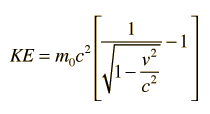
It’s a bit like trying to get a massive particle to go the speed of light.  No matter how small the mass, even though you can get closer and closer, to reach the speed of light would require infinite energy.  This is related to the fact that the ratio of 1 over the square root of (1 minus (the square of the velocity of the particle over the square of the speed of light)) goes to infinity as the velocity goes to c, the speed of light.

energy

That’s not why probabilities never reach 100%, but it is mathematically reminiscent.  One has to wait an infinite time for a low probability event to become, effectively, certain.  But for practical purposes, it can quickly become so likely as to make other considerations irrelevant.

And now, I’m at the station before my destination—not metaphorically, alas, but literally.  So I’ll sign off for today.  I hope you have a good one.


*Because, apparently, you live in a ridiculously lightning-prone area and enjoy playing golf in thunderstorms using iron golf clubs.

**NOT 7%.  Odds of independently occurring, repeated chances do not add in a simple way.  If they did, then after 101 days, one would have 101% chance of having something happen, which makes no sense mathematically or logically.

***And when it happens once, you’re unlikely to get a chance to go for a second hit, so I’m leaving that possibility out of the equation.

Urchins shall forth at vast of night that they may blog all exercise on thee.

Hello and good morning.  It’s Thursday again, that day with which DentArthurDent always had so much trouble.  It’s the first Thursday in November, which means that (in the US) Thanksgiving will fall on the 23rd of November, since it’s celebrated on the 4th Thursday in November, which is always going to be 21 days after the 1st Thursday in November.

Further bulletins as events warrant.

I’m at the train station, and I was early even for the 610 train today.  I’m not going to get on the 610 train, because I still want to cool down* and begin this blog post, and it looks like the 630 is running on time.  I got here early partly because I got up early this morning…but really, that was only about 5 minutes earlier than usual, and it had little relation to when I first woke up.  The main reason, I believe, for my comparative earliness is that, as I mentioned yesterday, I tried to jog a bit this morning.

After getting to the end of my block and turning, I jogged 40 paces, as I had said I was going to do.  That was so comparatively easy and bracing that, at my next 90 degree turn, I did another 40 paces (each pace being 2 steps, at least the way I define the terms).  Then again at the next 90 degree turn, then at the last one.  So, I jogged a total of 160 paces, and walked the rest, and the jogging didn’t make me feel breathless or sore (so far) because it is such a limited amount.

It’s rather curious and amusing to note that my pedometer reads as if I’ve gone slightly less far than I usually do, because of course, jogging steps are quite a bit longer than walking steps, but the pedometer still just reads them as steps.

It’s a nice feeling to have done even that very little bit of running.  It’s a good way to start a day, to have accomplished that little bit of a goal, as part of a general pattern of exercise.  It is the first time (I think) that I’ve tried jogging while wearing a backpack.  That turns out not to have been a noticeable problem.

It’s quite windy today‒which is rather pleasant‒and there was a bit of rain on and off while I walked, though it’s really been negligible.  I got my umbrella out at one point, but even if I hadn’t used it, I don’t know that I would have gotten unpleasantly wet.

I decided last night to revisit the “mantra” notion I mentioned earlier this week, but with a slight downgrade or alteration from my previous idea to make it more workable.  If you’ll recall, I had started with the plan just to say “I love myself” as a form of auto-suggestion, then expanded it to “I love the world and I love myself”.  Anyway, I found that, upon awakening the next morning, I could not even make my mind’s voice speak the words.  They simply felt too utterly at odds with my thinking.

However, only one of those phrases was really the problem.  So, starting last night, I’ve tried to repeat to myself the mantra “I love the world” when I’m not otherwise engaged.  This seems to work much better.

I have a hard time even saying that I love myself, but the world…well, I’ve always loved nearly all branches of science, and they are all about understanding and exploring the world.  And I like mathematics and philosophy, and I even like history.

It can be easy to get discouraged by the way people behave at any given moment, and certainly humans say and do some ridiculous and destructive things.  But loving something doesn’t require it to be perfect.  In most cases, the concept of “perfect” isn’t even coherent.  Indeed, loving something can entail wanting to help it get better than it already is.  If you hate something (or someone) there’s no sense of trying to improve anything.  Wanting something (or someone) to improve is a positive, beneficent emotion.

To clarify, when I say “the world” in this context, I don’t just mean “the Earth”, I mean “the Universe”, to whatever level of multiverse and/or higher dimensionality might exist‒everything, all time, all possible stuff.  And let’s be honest, when you start thinking about things like that, while they can be daunting‒since, compared to infinities, anything finite is vanishingly small‒they’re still just mind-blowingly cool.  Don’t even get me started on the uncountable infinities of the “real” numbers and “complex numbers” and functions that are discontinuous at every point**, or infinite-dimensional Hilbert spaces!

So, anyway, when I woke up this morning, I was easily able to start thinking “I love the world” to myself, and that was a pleasant surprise.  Hopefully, I can keep it up.  At the very least, it would help make other things easier to tolerate, even if it doesn’t help me like myself.

Would that be a peculiar kind of dualism?  Possibly, but it’s not a formal distinction of type or substance; it would just leave me as an exception to a general tendency.

Anyway, that’s about it for now.  My coworker who had a stroke is apparently stable, and no clot was discovered, so I’m still puzzled, but I don’t have much information.  Hopefully we’ll find out more soon.

And, hopefully, you all have a good Thursday.  Thank you for reading.

TTFN

urchins on kelp


*I keep accidentally writing “cook down” when I try to write “cool down”.  It’s not a nonsense phrase, but it probably never would apply to me.

**There’s a term for this, but I’m dipped if I can recall it‒something like “continuously discontinuous functions”*** but I don’t think that’s quite right.  I know next to nothing about the subject, but just the notion of a function that is non-differentiable at every point is astounding.

***Though I heard at least one mathematician refer to them as “infinitely kinky functions” in a tongue-in-cheek fashion.

What are the odds that this is worth reading?

It’s Monday, October 23rd in the year 2023 (A.D. or C.E., depending on your preferred terminology) and I’m writing this blog post on my laptop computer.  I took the computer with me when I left the office on Wednesday, expecting not to bring it back, but here I am.

It’s really quite stupid.  But it is more pleasant to write these posts on the laptop computer—quite a lot more pleasant—than it is to write them on the smartphone.  Though more compact and portable, the latter is just awkward and irritating, and it still causes the bases of my thumbs to get sore sometimes.  Well, really, the soreness is at the carpo-metacarpal joints more than it is at the metacarpophalangeal joint, but basically it just feels like my thumbs are sore, and it becomes more difficult to grip things as it continues.

That’s probably about all the news I have for today.  At least, it’s probably the only news I have that’s even arguably worth sharing on this blog, though the arguability of the shareworthiness of even that news would probably involve a lot of distracting rhetoric and sophistry, neither of which is a form of “argument” for which I have much respect.  They’re about as good as taking the word of someone you’ve just met about some matter involving significant (but not life-changing) amounts of money because they “promise” you can trust them.

“Give me 1% of your trust, and I’ll earn the other 99%” is an expression sometimes used in sales.  I guess it works on some people, but I can’t see it ever working on me.  First of all, it’s not really a sensible way to put something.  What is 1% of someone’s trust?  How does one quantify such a thing as if it were a substance or population?

I could see asking for 1% of someone’s trust fund.  That might be worth a bit, depending (obviously) on the size of the trust fund.  But 1% of my trust, however one might reasonably measure trust, is some number so vanishingly close to zero that it might as well be used to calculate derivatives and integrals.  This is largely because I don’t actually believe in or endorse “trust” as a generally good idea, though that certainly depends on one’s definitions.  I think trust is a mostly vacuous concept.

I used to say that I trusted my mother and my father, and with everyone else I took calculated risks.  But of course, that was really just me trying to be clever.  In reality, it’s all calculated risks*.  It’s just a Bayesian prior estimate of the credence we give that, for instance, this person in question will behave as they say they will behave.  Then we will update our future estimate depending on how things turn out this time, using a sort of loosey-goosey, intuitive version of Bayes’s Theorem.

If we started off without a particular preference for “trust or not trust” for someone, our prior would be something like 50%.  If we thought someone was a metaphorical weasel by nature, it might be much lower, though if we’re being good Bayesians, it can never be truly zero.  I trusted my parents—by the time I was fully an adult, anyway—at a level close enough to 100% that it was rarely worth thinking about much.

I honestly don’t know how I get onto these subjects.  I know it’s probably boring as Hell**.  I’ll just close that topic by noting that my Bayesian prior for trusting myself is way lower than my prior was for my parents.  It’s not that I don’t think I’m reliable or anything; I’m probably reasonably reliable as a general tendency.  I just don’t like myself, and I’m almost always disappointed in myself, so it’s reasonable to predict that I’ll probably let myself down in any given circumstance.

For instance, I’ve let myself down already by even doing this blog post, because I’m on my way to work, because I didn’t use this last weekend as a good starting point for the process of my dreamed-of trial by fire and ice (to be ludicrously melodramatic).  That “trial” is basically a notion of a means by which to put oneself at a not-insignificant risk of death—knowingly—without it being anything that could lead one to be forcibly locked up.  There are things that a person can do that will lead to a significant chance of mortality*** if carried on long enough, but which are otherwise entirely unremarkable.  Even water can kill you if you just keep on drinking and drinking and drinking.  In fact, it takes less water than you might think.

That’s not my specific thought, however.  I wouldn’t want to do that because I think I would spend just too much time in the effing bathroom, and it would be a terribly annoying way to pass**** one’s final hours.  But there are things that I could stand doing that, if things go right or wrong (depending on one’s mood or viewpoint) could kill me.  That’s the general idea.

Anyway, that’s enough blather about nothing (and potential nothingness) for today.  I don’t know what’s going to happen from here, but I’ll try to keep you posted if it’s not too much trouble.


*So to speak.  We rarely actually calculate the risk, but rather do a  quick estimate.

**That’s a weird thing to say, isn’t it?  It’s hard to imagine that Hell, as described in most religions, could be considered boring.  Demons and fire and brimstone and torture are things that at the very least don’t seem dull—though I suppose one might be tortured with a dull knife.  But as anyone who has suffered from depression probably would soon realize, “boredom” of a sort (i.e., anhedonia) is a major form of torture.  That’s one of the reasons I always found the apparently more modern notion (reputedly in Catholicism) of Hell as “being removed from God’s presence” a more interesting and subtle and less cartoonish notion of Hell than one gets in many evangelical forms of Christianity.

***If you were an immortal being, and you liked being immortal, taking any chance of mortality—i.e. of becoming mortal—would be something akin to Pascal’s wager, where the potential loss (of an infinite lifespan) would be so vast as to make the most miniscule possibility thereof essentially an intolerable risk.

****No pun intended, but nevertheless, not edited out.

“Who knows? Not me.”

I didn’t walk the full five miles from the train to the house yesterday afternoon‒I walked about three or three and a half‒because I didn’t want to give myself any blisters or abrasions from walking too far for the first time in a new pair of boots.  But I seem to have stopped well in time for that, since there are no blisters or even sore spots on my feet now, and my ankles and right Achilles tendon appear to be in good nick.  Also, and most importantly, though I had a bit of tension in my right side along my back upon returning to the house, that went away nicely with a bit of stretching and replenishment, so that’s pretty good.

Anyway, lesson learned:  it matters if the boots you wear are even a little bit oversized if you’re going to be walking any very long distances in them.  It looks like these new, half-downsized ones will work well.

It’s been sloppy and wet here in south Florida these last several days, but there does seem to be a slight increase in morning breeziness.  And, of course, since Saturday, the time of darkness has been slightly greater than the time of daylight, and its dominance is increasing at the most rapid pace at which that will happen.  This is because, for a sinusoidal curve, the fastest rate of change is when it crosses the x-axis (at the equinoxes in this case), and the slowest rates of change are at the peak and at the nadir (the solstices in this case).  So, for a little while now, the nighttime will be growing rapidly before it settles out, steadily and gradually, as we barrel toward the end of the year.

After mentioning the fact that I don’t play the guitar in the morning anymore, yesterday I decided to fire up the axe for a bit.  Remarkably, it was still almost perfectly in tune!  Probably it helps that the office is kept pretty much at a constant temperature.  Also, I had left the capo on the fourth fret the last time I played.  That was for playing the chords and stuff from the Nirvana version of The Man Who Sold the World.  I didn’t start with that yesterday, instead playing through a few iterations of Nothing Compares 2 UIt’s a lovely song.  I like the Chris Cornell version best.  Of course, now Prince (the songwriter and original performer) and Chris Cornell and Sinead O’Conner (who had a big hit with her cover of it) are all dead.

Then I did play some of The Man Who Sold the World, and then Ashes to Ashes, both Bowie tunes, at least originally.  And, of course, Bowie and Kobain are also both dead, though they died under very different circumstances.  Then I got my guitar book out and played a little Just the Way You Are, and Sorry Seems To Be the Hardest Word, and Here, There, and Everywhere, by Billy Joel, Elton John, and Paul McCartney‒all of whom are still alive!  That’s just weird, isn’t it?  Imagine that!

Of course, the latter song is credited to Lennon and McCartney, but that was a formality according to their agreement for all Beatles songs they wrote.  It was a McCartney song, and it was apparently the only song of his for which Lennon directly complimented him.

Considering the quality of Sir Paul’s work overall, that’s a hell of a statement, in more than one way.  First off, it must have really impressed John (rightly so) for him to make a point of telling Paul that it was a good song.  But it seems harsh that John never complimented any others, at least to Paul’s face.

Then again, he was British, and emotional expressiveness (other than through song and theater and literature) is a major national deficit by most accounts.  Maybe that’s why they do so much good music and poetry and drama and comedy and the like.  I often get the feeling that part of the reason Thom Yorke’s singing is so powerful and conveys and evokes such emotion in the listener is that this is Thom’s only real way of expressing himself deeply.  And, of course, he does seem almost possessed when he’s performing.

As a YouTube reactor (I cannot recall which one, for which I apologize) said of his singing, “He’s feelin’ it when he’s singing…and he makes you feel it, too!”

Now, John Lennon did compliment Paul to other people‒during interviews, for instance.  Though even then, he was far from effusive.  That was just his way, I think.  He had a very troubled childhood, and emotional expression was probably difficult for him, even for a Brit.

Then again, he wrote some incredibly expressive songs, from If I Fell to In My Life to Julia to Across the Universe, all the way up to Starting Over and Woman, with scads of others thrown in for good measure.  If being closed off and repressed helped lead to the creation of those truly great works of art, the world at least can hardly feel too horrible about it.  Though it would be nice if a person could be well-adjusted and have the ability to express and receive affection easily and still produce great art (and ideally, of course, not be murdered by a slimy little worm of a creature who claimed to be a fan).

Alas, though it seems possible in principle, it doesn’t seem to happen often, if at all, in practice*.  Shakespeare supposedly wrote Hamlet, and some of his other great tragedies, partly in response to the death of his son, Hamnet.  And of course, I, his much later and far inferior admirer, only really started to write and publish stories that have always been in my head once my life, my family, and my career had been wrecked, and I was in prison.

We can be thankful, if saddened, for the great art that was born of Shakespeare’s sorrow, and of Lennon’s.  In my case, on the other hand, it was almost certainly not worth it, particularly for me.  But I can’t change any of that stuff, either.

Life’s like that, I suppose‒to quite the end of one of my own short stories, possibly the darkest one I’ve ever written…which, weirdly enough, first came out of me years ago, while I was happily passing the time keeping my then-friend and soon-to-be fiancée company while she did some overnight work for a summer job.  I don’t know where it came from, except that I did often like to play solitaire (with real cards).

Anyway, that’s enough for now.  Have a good Wednesday.


*As Einstein is reputed to have said, “In principle, principle and practice should be the same, but in practice, they often are not”, or something like that.  He was a clever fellow.

Wayward versus prodigal suns, negative integrals, and mildew

Well, it’s Tuesday now, and I’m sitting at the train and writing this blog post on my laptop.  Apparently, the last time I wrote using it was August 21st, but it feels as if it were longer ago than that.  I brought the laptop back to the house with me last night because I knew I wasn’t going to walk back from the train in the evening, having already walked to the train (and then some) in the morning.  And I knew I wasn’t going to walk to the train this morning, because I plan to walk back from the train this evening.  I figured that made it a good evening to carry the computer.

It’s curious how heavy this little thing feels when it’s in the backpack, compared to what I usually keep in there.  When I pick up the laptop in my hands, it feels almost miraculously light, given that I know what it is and what it does, and I know how much computers used to weigh and all that trivia.  But then after I put it in the backpack and later go to pick up and sling the backpack, it’s just so much heavier, subjectively speaking, than it ought to feel.

It’s quite annoying.  I dislike being subject to such subjective impressions from the world.  It’s inescapable, I suppose, since certainly this body was never shaped by nature accurately to assess the weight of a backpack with or without a laptop in it.  I guess the fact that our impressions are so inexact and inconsistent can be useful as a way to keep from feeling overconfident in our assessments of various facts and opinions about the world.

But then again, I tend to hold my judgments and opinions and abilities to be extremely unreliable, anyway.  I think the most common thing I say to myself is, “Robert, you fucking moron!”  That happens at least several times a day, pretty much every day (and I make that estimate without any willful exaggeration).  Just ask some of my coworkers if you don’t believe me*.  I really hold myself in contempt; I hate how weak and pathetic and idiotic I am so much of the time.  Trust me, if you were inside my head, you’d probably feel the same way.

Speaking of me being an idiot, I had slight passing thoughts on and off yesterday of trying to start writing a story I had considered writing before.  It involves a character I invented waaaaay long ago, back when I was maybe about 10 years old.  It was intended then as a comic book.  I even drew the beginnings of one or two comics about the character, one featuring the origin of his arch-enemy and all that.

Then, years later, I started thinking of an idea for a manga featuring the character, but with a much less comic-book style origin and story.  Indeed, it would become a tale about a teenager (not a grown-up, unlike the original notion) who has gone through some form of trauma and has lost his memories and whatnot, but discovers that—apparently as part of the thing that caused him the trauma and memory loss—he has developed incredible powers.

These powers are not psychic abilities or anything, but entail the ability to convert his own matter, and the matter around him directly into energy, which obviously means a lot of energy, given E=mc2  and all that.  It’s a silly-ish story, one for which I’ve drawn a picture or two, and it’s called HELIOS, with a rather silly and whimsical subtitle, “the wayward sun”.  Although maybe it should be “the prodigal sun” or something along those lines.

MS Word has underlined the word “sun” in that last sentence.  Apparently, it’s able to recognize the original phrase well enough to think that the word following “prodigal” should be “son”, not “sun”.  Curiously, it did not underline the word “sun” after “wayward”.  Apparently the song by Kansas isn’t as ubiquitous as the term from that horrible, perverse parable in the gospels.  Who would’ve thought it?  Admittedly, the one from the New Testament has a two millennia head start, so I guess we can cut Kansas a little bit of slack.

Anyway, obviously I know the whole back story regarding HELIOS, and of course there is a reason the title is spelled in capital letters.  I think it could be a decent light-novel type story.  It might even be worth trying to write it on the smartphone, just to see how well I can write stories like that using that tool.

But this is all a pipe dream, of course.  I don’t think anyone would be interested in reading it, even if I were able to force myself to start writing fiction again and do it.  It’s just my little personal fantasy (about writing another science fiction story**).  I doubt that I’d be able to summon the energy to write about that character (which is mildly ironic), but even if I did, there would be no point.

I don’t think I’m going to be able to summon the energy for much of anything, anymore.  I mean, obviously, I’m currently still writing this blog, and I’m sometimes walking to and/or from the train station, and of course I’m working at work.  But there’s no percentage in any of it.  I’m just slowly eroding whatever’s left of me.  I don’t really, honestly expect to make it to the end of this month, not without some major catastrophe or departure or whatever.

Maybe it’s just that I don’t want to make it to the end of this month.  It’s an annoying version of the old notion of “feeling that you can’t go on”.  Unfortunately, I know that I can go on, in the sense that I’m at least physically capable of doing it.  I just don’t want to go on.  I see no good reason to do it.  I want to escape.

Also, even though I didn’t walk to the train today, and the only walking I did so far was up to the end of the station to sit down, I’m already sweaty and my shirt and I smell like mildew!  I doubt anyone else can smell it, but I can, and it’s disgusting.  I just washed this shirt, and did so thoroughly, and dried my clothes thoroughly afterwards.  I don’t know how much Lysol I’m going to have to spray on it and me to kill that horrible smell, but unfortunately, I don’t have a change of shirt with me, and believe me, no one wants to see me topless!

It’s a minor frustration, I know—hardly a tragedy.  But there are so few, if any, compensatory joys in the world anymore.  Even if the function’s y-output isn’t terribly negative, if it just is negative at all, overall, then as time goes on, the integral, the area under the curve (or, well, over the curve) is going to be negative, and that negative integral will only get more and more negative as long as the function continues.  Better just to return the thing to zero and cut one’s losses.

That’s a bit of an obscure metaphor, I suppose, but hopefully it makes sense to people who know a little calculus.

I’m just so tired and worn out.  I feel angry all the time, but the vast majority of that anger is always directed at myself, and rightly so.  I need to escape.  But I probably can’t do it on my own.  At least, I only see one general way to do so on my own.

Oh, well, what are you gonna do?  The universe is a horrible place.  No wonder every little bit of spacetime is trying to push away from every other little bit.  Maybe so-called Dark Energy is just an expression of cosmic self-disgust.

Intergalactic space would certainly not be too distant a place for someone to want me to be from them.  I wish I could be so far away from myself a lot of the time.  But I don’t want to be someone else, either.  That’s another conundrum.

All right, this has gotten too long.  Have a good day, please, and thank you for reading.

helios sharper

[P.S.  Upon looking up this old drawing, it appears that I did think of making the subtitle “the prodigal sun”.  Now I like “wayward” better.  Maybe I’m just being perverse.]


*I don’t know how you might go about that, though, and I don’t really expect you to try.

**It would not be hard sci fi in any way, since of course it leans toward the comic book style of things, but the idea behind some of it is based in a bit of real science, including particle physics, especially relating to the Higgs field (where the H in HELIOS comes from), all that kind of stuff.  But I never thought of it as a serious science fiction thing, like Son of Man.

Le Démon de Laplace, ce n’est pas moi

Happy Labor Day, to those of my readers who live in the United States.  It’s not a terribly big holiday, in a certain sense, but when I was growing up, it was almost always the occasion for a big family get-together, usually with some cooking out on the grill and, when I was little, playing outdoors.  It was a sort of celebration of the end of the summer, if you will, or perhaps rather a last hurrah‒a final weekend of enjoyment before the waning of the seasons.  Anyway, I don’t have the day off today, so I’m at the train station now, waiting for the train (they are running only once an hour due to holiday scheduling).

I walked to the station this morning, and in fact, I went roughly a half a mile (total) out of my way to get something to drink at a Race Track gas station that’s not quite on the route.  I almost badly mis-estimated the time it would take!  I expected to be waiting for quite a while here at the station, but I actually arrived a mere ten minutes before the train.  It’s a good thing I didn’t do that on a regular day, or I would have had to take a later train than that to which I am used, and that would have caused me significant stress.  Actually, just screwing up my schedule would have been what really would have caused me stress and distress.  I get very angry at myself for stupid mistakes.

Anyway, I’m on the train now, and I’m headed in to work, and it’s all very (un)exciting.  I wish we didn’t have work today, honestly.  That’s not because I’m averse to working‒I’m certainly not‒but because I honestly don’t feel like I want to do anything, anymore, as I think you all know.  I keep moving and acting mainly just out of habit and duty and guilt‒mainly preemptive guilt‒but not out of any positive, proactive, beneficent desire.  Well, maybe not wanting to make a certain few people feel sad is a somewhat beneficent impulse, but it’s not all that impressive.

We had a terrible day at the office on Saturday, unfortunately, at least as far as business goes.  We did none, to be specific.  It’s one of those frustrating situations in which, if you knew ahead of time that you were not going to make any sales, you could just have everybody stay home for the day.  But of course, you cannot know ahead of time that you will not do business on any given day.  And if you don’t work on a particular day because you think you might not do any business, it might be that, on that day, you would have done a great deal of business.  So, since we are uncertain about the future, we have to hedge our bets, and sometimes waste effort that would have, in hindsight, been better to conserve.

“Laplace’s Demon” would know when to go and when not to go to the office, but then again, it’s hard to imagine such an all-knowing entity needing to have a regular job.  In fact, a Laplace’s Demon that lived within the reality in which it knew the positions and momenta of all particles (so to speak) would know itself and its own future just as completely and inevitably as it does everything else.  It could not take any action in response to that knowledge though, or so I think, because that would change what it knows about the future.  And if it were a victim of being unable to change its actions in response to its knowledge, it might even be difficult for it to know that its knowledge was correct.  Maybe that’s incorrect; I haven’t thought it through very carefully.

Of course, it could simply be that the Laplace’s Demon can know itself and everything else in a predictive fashion, an “if…then” sort of situation.  Then it might well know what action to take, exactly, to ensure a desired outcome.  This doesn’t avoid the problem of how a mind can know itself completely and entirely, in all aspects.  Is it even possible?  As I’ve conjectured in the past, for a mind to know all of its own workings in full detail would require an exponential, possibly infinite, expansion of that mind.  The capacity to understand everything about, say, a human brain,  would require something much larger and more complex, overall, than that human brain…and then to understand everything about that larger brain, in full detail, would require a larger brain, still*.

Of course, it’s possible to understand the gist of the workings of a brain, and just to say, in a sense, “more of this same kind of thing is added”, but that’s very nonspecific and I don’t think it’s what Laplace had in mind when he imagined his all-knowing entity.

I think he was sort of imagining a being outside of the universe, looking in, though I could be wrong.  At least that would obviate the problem of the recursive acts of its thought and actions on the universe and thence back upon itself.  Such a being might well not have a full, internal understanding of itself in all details, but might be able to understand completely everything happening within the realm it was observing‒like a spectator looking down upon flatland from a three-dimensional perspective.

Anyway, that’s enough stochastic nonsense for today, going from walking to the train to the desire not to do anything, to the fact that work was bad, to the notion of not being able to know a bad day ahead of time, and so on to Laplace’s Demon.  I hope you all have a good day, whether it’s a holiday for you or not, whether you’re working or not.  Thank you for reading.


*This may mean that no so-called deep learning system can ever really know how it makes its decisions and what it understands, just as we don’t know about our own deep systems in precise detail.