“Sleep”, writing, and studying physics–report for June 5, 2024 AD/CE

Well, I got almost 4 hours of uninterrupted sleep last night, plus 20 minutes or so of on and off dozing.  While that sucks big-time, it’s better than it’s been lately.  At least I’m not seeing bugs on the walls out the corners of my eyes right now–though I still keep briefly thinking there’s a cat waiting by any door that I open, until I look down and see that there isn’t.

What can you do?  Not much right now, it seems.

Anyway, I produced a decent amount of work this morning.  I wrote 1,373 “block” words and 1,388 “net” words, with a difference then of just barely over 1% no matter which number you take as your denominator.  The total word count of this would-be short story is now 54,327 words, and it is 83 pages long in the format I described yesterday (I think).  It’s definitely more of a novella.

I’ve been doing a bit of reading these last few days, skipping between Sean Carroll’s two Biggest Ideas in the Universe books and the first volume of Feynman’s lectures and Jordan Ellenberg’s Shape*.  As you know, I’ve been trying to teach myself more of the physics on which I missed out by switching majors after my heart surgery, especially General Relativity and Quantum Mechanics/Quantum Field Theory.  Sean Carroll’s** “Biggest Ideas” books are focused on explaining those things for interested laypersons without avoiding the mathematics, but not practicing teaching/practicing how to do the math, so it’s a good beginning.  Of course, in a perfect world, I intend to beyond the overviews and actually to get comfortable with using the mathematics, particularly because I want to understand the cosmological constant at the level of the mathematics of General Relativity, because that’s the only part that I don’t quite get intuitively.  But really, I want to understand and be able to use all of it, and to be able to read all the papers on arXiv and understand them at the level of a professional, like I can with medrXiv and bioRxiv.

I doubt that I will live that long.  But, in the meantime, at least I’m learning new things.

Tomorrow is Thursday, so of course, I will be doing my more standard Thursday blog.  It’s silly to call it a “weekly” blog, since I’ve been writing these reports almost every day; once I’ve started a habit it’s hard for me to deviate from it.  But I don’t plan to write any fiction tomorrow, but instead will just focus on the blog post.  I’ll see you then (so to speak).


*I’ve not yet encountered a better teacher of mathematics than Professor Ellenberg.  He captures and conveys the fun and beauty of math as well as anyone I’ve encountered and better than the vast majority.  He narrates his own audio book versions, too.  If you want to review general mathematical ideas and then general geometric ideas (and their surprising applications) in an accessible and enjoyable way, you could not do much better than reading (and/or listening to) his books.

**Professor Carroll is another great teacher, though he deals with slightly more high-falutin’ stuff than Professor Ellenberg in his books, so the subject matter can be denser.

Writing report and some talk of the peaks and drop-offs of June, and of me

Report on today’s fiction writing:

Block words: 1,103

Net Words:  1,140

So there was a difference of roughly 3.3% between the two, which is consistent with the first couple of checks I did, and less of a difference than there was on Wednesday.  It is consistent with my experience today, because I know I added a few sentences to my previous writing to clarify some moments and make the flow of a conversation feel more natural.  That happens all the time when rereading/editing, of course, but I guess it doesn’t generally end up making more than a few percent difference in total writing for the day, based on what I’ve measured so far.

This all probably doesn’t matter in the slightest to anyone but me, but once I’ve started paying attention to such a thing, it’s very difficult for me not to note it.  I doubt that it adds any significant insight even for me, but who knows?  More knowledge is usually at least not detrimental, and can often be beneficial, unless the cost of obtaining the knowledge it a loss of energy or knowledge or some opportunity cost in some other area that produces a greater detriment than the new knowledge is a benefit.

Anyway…

June begins tomorrow, as I noted previously.  It’s a month that begins with a good and important event, for me and my family, so that’s a double-plus-good, to steal a term from Newspeak.

After that, things get much more dicey.

Of course, the summer solstice (June 20th this year) is when the days reach their peak length (in the northern hemisphere, anyway) and then begin getting shorter, so if the winter solstice is a time for celebration as days begin to lengthen, one would imagine the summer one would be a day of mourning.  This doesn’t seem, generally, to be the case, but it’s definitely the harbinger of increasing heat and humidity here in south Florida, which is not great and is apparently getting worse as the years pass.  To paraphrase Porgy and Bess, it’s summertime, and the living is…oozy.

June is also the month of both Father’s Day and my former wedding anniversary.  These are melancholy commemorations for me.  This year would have been my 33rd wedding anniversary, but I now will have been divorced 3 years longer than I was married.  I’ve also now been away from both my children–physically away, neither having been in their presence nor seen them directly–for as many or more years than they were old when last I was truly a part of their lives.

I’ve always been able to do some things quite a bit more easily than most other people seem able to do.  But all those things are trivial, and none of them have ever come to much of anything, anyway.  At almost all of the things which have been most important to me, I am an abject and abysmal failure.

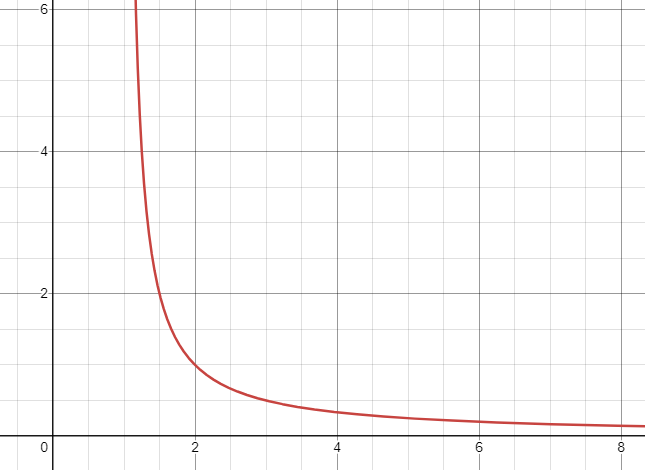
I have apparently been at least a decent brother, so I didn’t fuck that up too royally.  Not yet, anyway.  I think I was a pretty good doctor; my patients always said so.  But I have been a failure as a son, and as a husband, and as a father, the roles which have mattered by far the most to me, in increasing order.  So, June starts on a very high peak, but it goes downhill rapidly, like the graph of 1 over (x-1):

graph of 1 over x minus

Probably there’s some other, more elaborate formula that would describe things better, but you get the idea, I think.  Actually, I should probably make it ((1/(1-x))-x or something similar.  But it’s not that important.  Nothing I do is important, except in a negative sense, which is the whole point.

I’ll work tomorrow, barring the unforeseen, so I’ll be writing some fiction and giving a report (also barring the unforeseen).  I hope you all have a good weekend.

Brief Tuesday Report (4-30-2024)

I didn’t go quite as wild with writing today as I did yesterday, but I still did write another 1,550 words.  My “short story” is already almost 30,000 words long, which is roughly as many words as are in Of Mice and Men, so I guess it counts as a novella.  A lot of my “short stories” turn out that way.  I’m not even sure how long Outlaw’s Mind is, so far, and that was intended to be a short story*.

Of course, as I said, I mean to pare it down quite a bit, but there’s only so much I’ll be able to do, and the story isn’t finished yet.

I also played guitar and sang a little bit.  I don’t know how well my playing is going–my thumbs are still painful.  But my voice is getting into better shape, at least, I can tell that much.  It’s not really worth anything to anyone but me, but it’s still a positive, I guess.

I’ve also recently started taking the Calculus course on Brilliant, since I recently decided to download the app to my phone as something to do in spare time.  I don’t necessarily think it’s a good way for me to study physics, but it’s a good way to review, and then maybe to learn, some mathematics.  It’s good to start with the basics, which I’ve already long since studied, because it feels quite easy, and that’s a nice way to build up.  I mean to work on the linear algebra stuff and further materials, because I’ll need that if I want to really understand General Relativity, so I can truly get why uniform energy in spacetime leads to repulsive gravity.  All the rest of it makes intuitive sense to me, but I need to wrap my head around that clearly and precisely, or I won’t be satisfied.

Anyway, that’s it for today.  I hope you have a good one.


*Chortles of derision are understandable.

And simple truth miscall’d simplicity, And captive blog attending captain ill

Hello and good morning.  It’s Thursday again, and so it’s time for a more fully fledged blog post for the week, in the manner in which I used to write them when I was writing fiction the rest of the week (and playing some guitar in the time between writing and starting work most days).

I’ve been rather sick almost every day since last week’s post, except for Friday.  I don’t think it’s a virus of any kind, though that may be incorrect.  It’s mainly upper GI, and it’s taken a lot of the wind out of my sails.

I haven’t played guitar at all since last Friday.  I’ve also only written new fiction on a few of the days—Friday, Monday, and Wednesday, I think—since the last major post.  Still, on the days I wrote, I got a surprisingly good amount of work done, I guess.  It seems as though Extra Body is taking longer than it really ought to take, but once it’s done, I’m going to try to pare it down more than I have previous works, since my stuff tends to grow so rapidly.

I’ve been trying to get into doing more studying and “stuff” to correct the fact that I didn’t realize my plans to go into Physics when I started university.  I had good reasons for this non-realization, of course, the main one being the temporary cognitive impairment brought about by heart-lung bypass when I had open heart surgery when I was eighteen.

I’m pretty sure I’ve written about that before, but I didn’t know about it then, and I didn’t learn about it until I did the review paper I wrote for my fourth-year research project in medical school.  I just felt discouraged and stupid, though I consoled myself by studying some truly wonderful works of literature as an English major, including once taking two Shakespeare courses at the same time.  That was great!

It’s always nice to learn about things, all other things being equal.  I don’t think there are pieces of true information about the world that it is better not to know.  Our response to learning some intimidating truth about the greater cosmos may not be good, but the fault then lies not with the stars but with ourselves.  If you truly can’t handle the truth, then the problem is with you, not with the truth.

Of course, knowing what is true is generally not simple, except about simple things, and often not even about those.  This is the heart of epistemology, the philosophical branch that deals with how we know what we know when we know it, so to speak.  The subject may seem dry at times, especially when it gets weighed down by jargon that serves mainly just to keep lay people from chiming in on things—at least as far as I can see—but it is important and interesting at its root.

Not but what there can’t be good reasons for creating and using specific and precise and unique terms, such as to make sure that one knows exactly what is meant and doesn’t fall into the trap of linguistic fuzziness which often leads to misunderstanding and miscommunication.  That’s part of the reason most serious Physics involves mathematical formalism; one wants to deal with things precisely and algorithmically in ways that one can make testable and rigorous predictions.

Physicists will sometimes say that they can’t really convey some aspect of physics using ordinary language, that you have to use the math(s), but that can’t be true in any simplistic sense, or no one would ever be able to learn it in the first place.  Even the mathematics has to be taught via language, after all.  It’s just more cumbersome to try to work through the plain—or not so plain—language to get the precise and accurate concepts across.

And, of course, sometimes the person tasked with presenting an idea to someone else doesn’t really understand it in a way that would allow them to convey it in ordinary language.  This is not necessarily an insult to that person.  Richard Feynman apparently used to hold the opinion that if you truly understand some subject in Physics, you should be able to produce a freshman-level lecture about it that doesn’t require prior knowledge, but he admitted freely when he couldn’t do so, and was known to say that this indicated that we—or at least he—just didn’t understand the subject well enough yet.

I don’t know how I got to this point in this blog post, or indeed what point I’m trying to make, if there is any point to anything at all (I suppose a lot of that would depend on one’s point of view).  I think I got into it by saying that I was trying to catch up on Physics, so I can deal with it at a full level, because there are things I want to understand and be able to contemplate rigorously.

I particularly want to try to get all the way into General Relativity (also Quantum Field Theory), and the mathematics of that is stuff that I never learned specifically, and it is intricate—matrices and tensors and non-Euclidean geometry and similar stuff.  It’s all tremendously interesting, of course, but it requires effort, which requires time and energy.

And once other people have come into the office and the “music” has started, it’s very hard for me to maintain the required focus and the energy even in my down time, though I have many textbooks and pre-textbook level works available right there at my desk.  I’ve started, and I’m making progress, but it is very slow because of the drains on my energy and attention.

If anyone out there wants to sponsor my search for knowledge, so I wouldn’t have to do anything but study and write, I’d welcome the patronage.

But I’m not good at self-promotion, nor at asking for help in any serious way.  I tend to take the general attitude that I deserve neither health nor comfort in life, and I certainly don’t expect any of it.  I’m not my own biggest fan, probably not by a long shot.  In fact, it’s probably accurate to say that I am my own greatest enemy.

Unfortunately, I’m probably the only person who could reliably thwart me.  I’m sure I’m not unique in this.  Probably very few people have literal enemies out there in the world, but plenty of people—maybe nearly everyone—has an enemy or enemies within.  This is one of the things that happens to beings without one single, solitary terminal goal or drive or utility function, but rather with numerous ones, the strengths of which vary with time and with internal and external events.

I’ve said before that I see the motivations and drives of the mind as a vector sum in very much higher-dimensional phase space, but with input vectors that vary in response to outcomes of the immediately preceding sum perhaps even more than they do with inputs from the environment.  I don’t think there will ever be a strong way fully to describe the system algorithmically, though perhaps it may be modeled adequately and even reproduced.  This is the nature of “Elessar’s First Conjecture”:  No mind can ever be complex enough to understand itself fully and in detail*.

A combination of minds may understand it though—conceivably.  Biologists have mapped the entire nervous system of C elegans, a worm with a precisely defined nervous system with an exact number of neurons, and of course, progress is constantly being made on more advanced things.  But even individual neurons are not perfectly understood, even in worms, and the interactions between those nerves and the other cells of the body is a complex Rube Goldberg machine thrown together from pieces that were just laying around in the shed.

Complexity theory is still a very young science.

And the public at large spends its energy doing things like making and then countering “deep fakes” and arguing partisan politics with all the fervor that no doubt the ancient Egyptians and Greeks and Romans and the ancient Chinese and Japanese and Celts and Huns and Iroquois and Inca and Aztecs and Mayans and everyone else in ancient, vanished, or changed, civilizations did.  They all surely imagined that their daily politics were supremely important, that the world, the very universe, pivoted on the specifics of their little, petty disagreements and plans and paranoias**.

And so often so many of them, especially the young “revolutionaries”, whose frontal lobes were far from fully developed, were willing to spill the blood of others (and were occasionally even willing to sacrifice themselves) in pursuit of their utopian*** imaginings.  This is true from the French Revolution to the Bolsheviks to the Maoists and the Killing Fields, and before them all the way back to the Puritans of Salem, and the Inquisition, and the Athenians who executed Socrates, and the killers of Pythagoras****, and the millions of perpetrators of no-longer-known atrocities in no-longer-known cultures and civilizations.

And then, of course, we have the current gaggle of fashionably ideological, privileged youth, who decry the very things that brought them all that they take for granted, and who will follow in the blood-soaked footsteps of those I mentioned above—l’dor v’dor, ad suf kul hadoroth, a-mayn.

In the meantime, I’ll try to keep writing my stories, and try to keep learning things, and if I’m able to develop an adequate (by my standards) understanding of General Relativity and Quantum Field Theory, it’s just remotely possible that I might even make legitimate contributions to the field(s).  But more likely I’ll self-destruct, literally, well before any of that happens.

I’ve probably gone on too long already, as has this blog post.  I thank you for your patience with my meanderings.  Please try to have a good day, and I hope those of you who celebrate it are having a good Passover.

TTFN


*This implies that Laplace’s Demon could not be within the universe about which it knows the position and momentum of every particle and the strength of every force.  It needs to be instantiated elsewhere.

**Should that be “paranoiae”?  It feels like that ought to be the formal way of putting it, but Word thinks it’s misspelled.

***Not to be confused with “eutopian”.  Utopia means “no place”, whereas Eutopia would mean “good place” or “pleasant place” or “well place”.

****He was caught despite a head start, so I’ve heard, because he refused to cross a bean field, believing that beans were evil.  He was a weird guy.  It’s apparently from his followers that the term “irrational”—which originally just meant a number that cannot be expressed as the ratio of two whole numbers—developed its connotation as “crazy” or “insane”.  They didn’t like the fact that irrational numbers even existed.  Too bad for them; there are vastly more irrational numbers than rational ones…an uncountable infinity versus a “countable” infinity.  It’s not even close.

Squaring away a queasy stomach

It’s Tuesday morning, and I’m not writing any fiction today, because I don’t feel terribly well.  I took a lot of pain medicine yesterday, of more than one kind, and I think it upset my stomach.

Indeed, I woke up very early this morning feeling nauseated.  I wasn’t queasy enough to throw up, which is in some ways disappointing, since that always brings at least a bit of relief, but I was certainly unable to rest.  I decided, finally, just to get up and get an Uber in to the office, since I knew if I waited too long I might choose to stay “home” for the day, and that wouldn’t make me feel any better.

So I showered and then ordered an Uber; today the prices were reasonable, even for a ride all the way in to the office, which helped cement my decision.  It’s frivolous, of course, in that it’s an unnecessary expense, and I really need to avoid doing it too often.  But it ended up being interesting.

I decided, while en route, not to do any writing in the car, either on my phone or on my laptop computer, since I was worried about car-sickness.  Instead, I eventually started playing with the notion of the standard Uber tip buttons.  I thought, to myself, if I were to give a 25% tip (the maximum automatic one), that fact would increase the total amount paid, and so the net tip would be less than 25% of the new total.  So, if I added 25% of the extra, that would increase the total even more, but it would then still be less than 25% of the new total, so I would need to add more, and eventually it would converge on a final number.  As I did a quick bit of figuring, I realized that the final amount I was approaching was 33% more than the original amount.

I realized—this is not a terribly impressive mathematical insight, I know, but I was and am queasy and so it was an interesting distraction—that this process effectively entailed an infinite series, in the form of 1 + 1/n + 1/n2 + 1/n3 +… and so on.  The first little ad hoc trial I had done made me realize that, at least that series had taken n as 4, and iterated it, giving a final number that was 1 and 1/3.  That seemed interesting.

I wondered if this was a general pattern.  So, using a calculator this time, I took one then added a fifth, then added 1 over 5 squared, then one of 5 cubed and so on, and pretty clearly arrived at a final total that was one and a quarter.  A few other numbers made it clear that this was general, and it makes sense if you work it backwards.  25 (one quarter) added to 100 gives you 125, and 25 out of 125 is always going to be on fifth of the new total , or 20%.  33 and a third (or a third) added to 100 gives you 133 and a third, and 33 and a third out of 133 and a third will always be a quarter of the total.

And then, of course, there’s the old mathematics joke about an infinite number of mathematicians going into a bar, with the first one ordering a pint of beer, the second ordering a half pint, the third ordering half as much as the second, the fourth ordering half as much as the third and so on, until finally the bartender holds up a hand and says, “Gentlemen!  Know your limits!” before drawing two pints of beer and putting them out on the table.  This is because 1 + ½ + ¼ + … goes to 2 in the limit as iterations go to infinity.

So, the series 1 + 1/n + 1/n2 + 1/n3 +…converges to 1 + 1/(n-1), which is (n-1)/(n-1) + 1/(n-1), which is n-1+1/(n-1) or just n/(n-1).  I’ve tried to start working the algebra of the infinite series to produce this result (just for fun), but didn’t put much time into it, and it’s not really necessary, since I can see the result clearly by working backwards.

Of course, looking at my result, I know this is really basic stuff, and at some level I already “knew” it, at least formally.  But there’s nothing like working out a thing for yourself to make it sink in and make true sense to you.

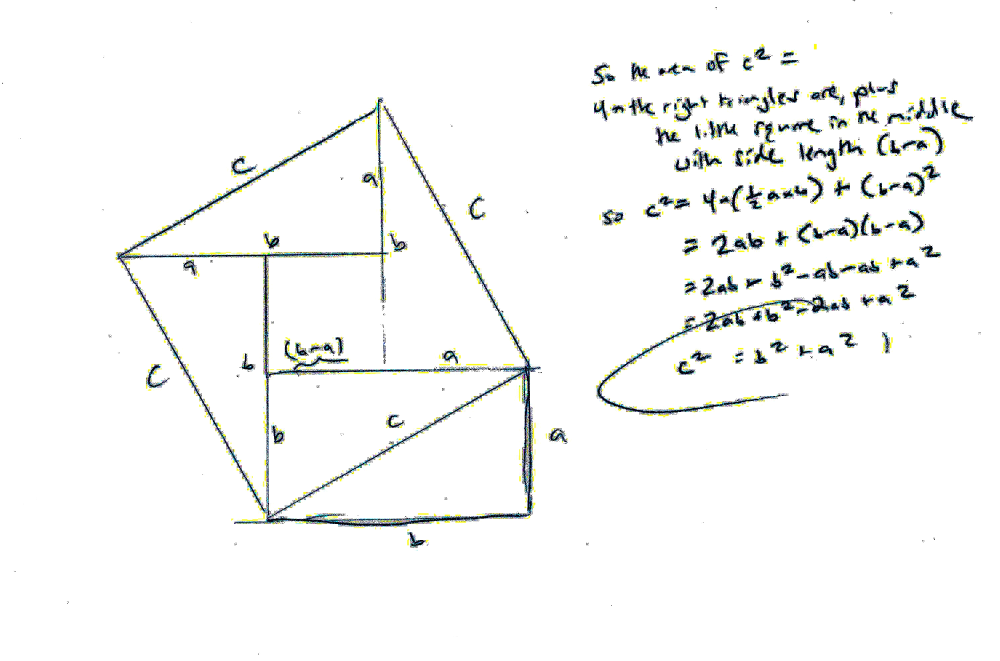
This is a bit like something I did when I was in the Education Department at FSP West during my involuntary vacation with the Florida DOC.  I was helping inmates try to get their GEDs, which was rewarding work given the circumstances.  But at one point it occurred to me that I didn’t think I’d ever seen the Pythagorean Theorem proven*.  So, I set out to prove it for myself, just for a laugh.  It looked something like this:

pytho

I didn’t use any of the standard, purely geometrical proofs that one often sees, but instead applied a combination of geometry and algebra that I kind of fiddled together on the spot.  I don’t know if what I did was perfectly rigorous; probably not.  Nevertheless, after I’d worked things through and simplified my algebra and indeed came out with c2 = b2 + a2, I was more convinced than ever before that the Pythagorean Theorem was not merely a well-supported hypothesis, but was indeed a theorem, and that given Euclidean geometry and so on, it was absolutely true.

All this is frivolous, or trivial, or whatever the term you might want to apply.  It certainly has little bearing on my day to day life.  But it is reassuring to think that, contrary to popular belief, it is possible to have new insights into fundamental ideas and things, however basic they might be, even at an older age (in my forties and fifties in these cases).  The human brain does not stop “growing” or improving after one reaches one’s twenties or thirties or after one has left one’s teens (or at least, whatever kind of brain I have doesn’t stop).  Even old dogs can be taught new tricks; and how much more amenable to teaching are naked house apes!

I’ve often been frustrated when people complain that they learned things like the Pythagorean Theorem in high school (or whenever) and had never had to use them at any point in their lives.  That may well be true in a simple sense, though I think the usefulness of that theorem might surprise people (it appears often in the workings of advanced physics, for instance, including in the Lorentz transformations in Special Relativity, and also in calculating the probabilities of outcomes from the magnitudes of the wave equation when makings measurements of a quantum system).

But ultimately, I feel like asking such complainers, “Do you do push-ups in order to become better at doing push-ups?  Do you do bench presses and squats to become competitive squatters and pressers of benches?  Do you jog to become professional joggers?  Do you do yoga to become a champion yogi?  No, the vast majority of people who do such things do them to make themselves fitter overall, stronger, with better endurance and flexibility, to be better able to do the many things in the world for which it will be an advantage for them to improve their strength and their flexibility and their endurance, and to be healthier overall!”

So it is with exercise of the mind, except the mind is far more plastic, far more able to be improved and trained, than the structures and strengths of the muscles and bones and ligaments and cardiovascular system.  Learning some of the methods of geometry and algebra and calculus, learning basic physics, including Newtonian physics and thermodynamics, learning some Boolean logic, some probability and statistics, some basic biology and chemistry…all these things are both inherently useful, and also give you skills and tools and abilities that are adaptable to hitherto unguessed situations and problems in the world, and give you insight into how much commonality there is to the structure of reality.

Understanding a bit about Chaos and Complexity theory can help you recognize why the specifics of the weather are fundamentally unpredictable but nevertheless the climate can be amendable to explanation and broad prediction.  Understanding a bit about Bayesian reasoning can give you the comfort of knowing that, even if you have a positive mammogram, and that test has an 80% sensitivity, you probably have nothing like an 80% chance of having cancer.  Indeed, you could be an order of magnitude or so less likely than that, depending on base rates and false positive rates and the like.

And in a somewhat orthogonal area of inquiry, if you want to understand something about the human condition, it wouldn’t hurt to expose yourself to the works of Shakespeare, who wrote about that subject as well as or better than practically anyone else ever has, and who did it in remarkable and beautiful language, coining figures of speech we in the “Anglosphere” still use, regularly, in daily life, four hundred years after he created them.

Also, if you live your whole life without ever having read book one of Paradise Lost, I think you will have sadly missed out on a great experience.  It’s not really a very long read.  Milton made his Satan a relatable and charismatic, almost heroic, character, and seeing how he did this can help you understand the power and persuasion demagogues and ideologues can bring to bear in the world, and how dangerous and yet enticing they can be.  Also, Milton’s writing is just beautiful, sometimes better even than Shakespeare.

And in To His Coy Mistress, Andrew Marvell prefigures the works of Billy Joel’s Only the Good Die Young by over 300 years.  And I’m pretty sure Pink Floyd referenced the work in Time.

Anyway, that’s what I did this morning to distract myself from an upset stomach, showing that these pursuits and skills can have wildly unpredictable uses.  So, until and unless you have actual organic illness that prevents your brain from learning, you can still grow, and can take more and more of the universe into your mind.  And, as Milton’s big bad himself said, “What is else not to be overcome?”


*It probably was at some point in my education, but I didn’t recall the proof, so it had clearly never really sunk in for me.  I didn’t doubt the theorem—all the greatest mathematical minds of antiquity and modernity were convinced of it, and it has always worked in practice.  But that’s not quite the same thing.

Below average night, average post

I had a horribly interrupted and just generally bad sleep last night.  One might imagine, after decades of insomnia, one would be relatively inured to the paucity of sleep one gets, and that the relative worsening of a single night would make little difference, but it doesn’t appear to be so.

Of course, it’s possible that something else is making me feel particularly horrible, and it has nothing to do with my exceptionally fractured night’s sleep.  It’s also even possible that the two facts are causally linked but in the other direction, and that whatever is making me feel bad is what made my sleep worse than usual, not the other way around.  It’s difficult to tell without more information.

It’s also possible—thought extremely unlikely—that everything I’ve experienced since early August of 1988 has been a dream, and soon I will awaken in the recovery room after my open heart surgery, thinking, “Damn it, I survived,” which is roughly what I thought when I first woke up from that surgery.  It was not a pleasant awakening; I was cortically blind for about a day (though I didn’t realize it at the time), I was (obviously) in quite a lot of pain, I had three chest tubes and a couple of central lines and an endotracheal tube inserted into me, and my hands were strapped to the bed rails.  I probably looked vaguely like something out of an H. R. Giger painting.

Anyway, the point is I feel really worn down this morning.  I almost wish that I hadn’t brought my laptop computer with me, because my backpack feels like it weighs twice as much as usual.  That’s an illusion, of course, but the experience is salient even if misleading.

I resaved this original file for yesterday’s blog post with a new name—not overwriting the original draft of yesterday’s post—in order to avoid having to start a new post with that (cr)Aptos font and change it to Calibri.  I wonder how many people like the new default font, how many people really don’t care, how many people, like me, dislike the new font, and how many people don’t mind it so much but don’t appreciate the whole “change for the sake of change” nonsense that motivates so much of the computer industry these days.

“All improvement is change, but not all change is an improvement,” as Eliezer Yudkowsky has said.  I could not agree more if I tried with both hands (which I am doing, at least while typing).  This is one of the reasons I hate political and related slogans in movements that simply talk about making “change”.  Change in general is easy enough to make.  If you ignite some thermite and napalm in the middle of a house, that will change the house.  For that matter, so will hitting the house with a tornado, or a large asteroid.

Does any environmental organization say, “Let’s work together to make real climate change”?  It would be slightly humorous, I suppose, but it would miss the point.

As an aside, the southbound train just pulled into the station across the way, and my computer automatically logged into its Wi-Fi and saved the draft of this post to my OneDrive, because apparently I’ve logged into that train’s Wi-Fi in the past and saved the link.  That’s pretty nifty, when you think about it.  Now it’s pulling out and soon I will lose that connection.

The ease of such things, and their automaticity, is quite remarkable and useful, though of course, it entails certain vulnerabilities as well.  Still, it’s fascinating just how well the nature of such codes as used in Wi-Fi signals allows them to transmit useful information with barely any connectivity.  This is the real difference between digital and analog signaling, and it’s one of the things that makes me want to study Information Theory more deeply.

I have an audio textbook (very basic) on information theory, but I don’t tend to listen to my audio books except during long walks, and I’ve fallen off that wagon a bit.  But still, Information Theory is really very cool.

If I were able to get good nights’ sleeps, if I were able to rest, I think I would be able to console myself with nothing more than learning about more of these really interesting subjects and having my own thoughts about them*.  As it is, though, I’m so tired and in pain and worn out that most days I just fantasize about going to sleep and never waking up.  It would be nice to have a better future than that, but there’s no good reason for me to expect it.

Meantime, I’ll keep writing this and, as I did yesterday, also write about a page a day of my new story until it’s done.  I hope each of you—and all of you collectively on average—feels better than I do today.  Come to think of it, if each of you feels better than I do, then your average, perforce, will be better than my level.  That’s trivial mathematics**.


*They’re not necessarily banal or unoriginal thoughts, either.  I predicted the tech stock bubble burst in the late nineties well in advance, I recognized an issue with LLMs and the like quite some time ago that was discussed in a Sabina Hossenfelder video yesterday, and I even had some ideas about the reversibility of time and the possibility of the big bang happening in both “directions” that I’ve discovered is similar to some real ideas from real physicists.  I’m not saying I had unique or remarkable or singular insights, but I don’t just passively take in stuff.  I build mental models—I don’t necessarily learn quickly, but I do learn deeply—and they can be useful, at least when I believe in myself.  In the nineties, I did not have the courage of my convictions, and I let a bank talk me into investing in a tech fund, despite my misgivings…and before very long, the fund had lost half its value.  Humility can be a false virtue sometimes.

** Incidentally, it’s possible in principle for 90% of people to be above average, but not for 90% of people to be above the median.  The median is defined, mathematically, as the midway point along an ordered list of ascending values in a group, so literally 50% of the members are at or above the median and 50% are at or below.  With the average—which usually refers to the arithmetic mean, in which one sums all the numbers of a group then divides the sum by the number of members of that group—one can have rare situations such as 90 of a hundred people getting a 51% on an exam and the remaining 10 getting 10%, which would give a mean score of 46, so that indeed, 90% of the test-takers would be above average.

Whither one goes affects whether the effects of the weather are noteworthy

It’s a bit chilly this morning, at least for south Florida.  As I looked at the weather app when I was getting up, it reported that the temperature near me was about 51 degrees Fahrenheit.  We can take 32 away from that then multiply by 5/9‒so that’s 19 x 5, which is 95, divided by 9‒which gives just over 10 degrees Centigrade (or Celsius, depending upon whom one asks).

I guess that’s pretty cool, though certainly there are many places north of here where people would welcome it as a relatively balmy day for this time of year.  Alternatively, in parts of the southern hemisphere, where it is summer, it would seem aberrantly cold, even more noteworthy than it is in my neck of the subtropical woods.  Going farther afield, on Mars it would be truly a record-setting heat wave, whereas on Venus, such a temperature would be impossibly, unfathomably cold.

The surface temperature of Venus is, if memory serves, around 900º Fahrenheit, or nearly 500º Centigrade, or nearly 800 Kelvin (I am rounding the Kelvin “273” addition to Centigrade because I only have one significant figure in my recalled estimate of Venus’s average temperature in Fahrenheit, and adding other specific digits would be misleading and unjustified).

It’s interesting that Venus, the planet named for the goddess of sexual and romantic love, is the most hellish planet in the solar system.  It’s hot enough at the surface to melt lead.  The atmospheric pressure is 90 times that of Earth and largely consists of carbon dioxide.  The cloud cover is constant and it rains sulfuric acid.

Perhaps Venus, the morning “star” (and the evening “star” too, depending on which side of the sun it’s currently on from Earth’s point of view) is more appropriately given one of its other names, which is:  Lucifer, the light-bearer, herald of the dawn, who in later mythology was associated with the Devil (at least before his fall).

Of course, it’s hard to reconcile Lucifer’s supposed fall with the fact that the planet is still conspicuously up there in the sky.  And I do mean “conspicuously”.  Apart from the sun and the moon, Venus is easily the brightest thing in the night sky.  Sometimes one can still see it even as the sun is beginning to rise; the cloud cover of Venus makes it highly reflective of visible light.

Anyway, I find it sardonically and cynically amusing that the goddess of love is associated with a nightmarish hellscape, but I have a personal history that makes me look askance at romance.  I am, in other words, biased.

Venus is a good object lesson in the potent effects of carbon dioxide’s tendency to allow visible but not infrared light to pass easily through it, and so to create a “greenhouse effect” even in the modest concentration it achieves on Earth.

The physics of this is well understood, relating largely to the resonant frequency of the bonds in the molecule as well as its size and shape.  Smaller, tighter molecules like molecular nitrogen and molecular oxygen, the two gasses that make up the vast majority of Earth’s atmosphere, don’t interact much with infrared light, and are more prone to scatter shorter, bluer wavelengths of visible light‒this is a rough explanation of why the sky is blue (and why the sunrise and sunset are much redder, as that sunlight is going through more of the atmosphere due to the angle at which we see the sun at those times of day, and the blue is partly scattered out of it, leaving relatively more redder light behind).

Anyway, the broad physics of the greenhouse effect is almost elementary, and has been understood for a long time.  The specifics of what precisely will happen in any given set of circumstances can be tricky to tease out, given the complexity of reality‒you might say that Venus is in the details‒but the specifics are often less important than the broad strokes.

After all, when a giant asteroid is heading toward the Earth, it isn’t that reassuring to know that only, say, 75% of species will be driven extinct by its impact, and that life will survive and eventually once again thrive.  How much would someone have to pay you for you to be willing to accept a 75% chance that just you will die, let alone everyone like you on the planet?

There might well be a big enough sum for you to be willing to risk your own life, especially if you got to enjoy the money for a while before the dice were thrown, or to leave it to your heirs.  But for your whole species?  Is there a reward big enough to be able to take that chance?  Let’s assume you’re not a raging misanthrope/panantipath like I am for the sake of this question, since depending on my mood, I’d be inclined to negotiate for a higher chance of extinction.

Also, of course, by pretty much every possible form of ethics you might follow, you don’t have the right to roll the dice on all the members of your own species.   You don’t have any right to roll the dice on the members of your own family, unless they unilaterally and spontaneously and freely grant you that right.

Sorry, I don’t know why I’m writing about these topics today.  They are just what spewed out of me, like vomit from the proverbial drunkard or pus from a squeezed abscess.  I wish I could write something more interesting, or write something that helped my mood some.  Writing fiction did at least help fight my depression, but it’s hard when almost no one reads my stuff.

Maybe I should take to writing at least a page of fiction a day by hand, on the notebook paper and clipboard I have at the office, during downtime, instead of watching videos.  Yesterday I mainly watched ones about spontaneous symmetry breaking and the electro-weak era and the Higgs mechanism.  To be fair to me, it’s very interesting stuff, and it actually would have some relevance to my potential comic book turned manga turned science fiction story, HELIOS.

Of course, that’s named for another mythological figure, one that’s even hotter than Venus.  But I don’t know if I can write it.  Motivation is difficult.  Still, as Stephen King reputedly once told Neil Gaiman, if you write just one page a day, by the end of a year you’ll have a decent-sized novel*.

Once I get writing, I have a hard time stopping at only one page.  If you’re a regular reader of my blog, you’ll probably know this implicitly‒my general target for post length is about 800 words, but I almost never am able to keep it that short.

I guess we’ll see what happens.  And, of course, I’ll keep you all…posted.


*He has also noted that, for him‒as I have often found it to be for me‒writing fiction is the best form of therapy.

Top o’ the work week to ye!

I was going to title this post “top o’ the week to ye”, but I realize that many people consider the week proper to begin on Sunday; standard calendars in places such as the US and Canada and the rest of the British Commonwealth and so on look at it that way.  In Japan, on the other hand, I’m led to understand that the week officially starts on Monday, since that’s the day work starts, and Saturday and Sunday (Doyōbi and Nichiyōbi) are the weekend.

Though Japan has individually named weekdays referring to esoteric things much as we do in the West, the Japanese months‒at least their current, standard names‒are basically just numbered (though I understand there are older, more traditional names).  It seems pretty sensible just to number the months‒and the days, for that matter‒rather than give them names.

Then again, while there is a certain logic to the number of months‒related both to the length of the year and to the moon’s orbital period, both of which are objective, external facts‒the number of days in a week is pretty much arbitrary.

It seems the sort of thing that, around the time of the Revolution, the French might have wanted to make decimal, with, say, three ten-day periods (decadi?  decamaines?) per month and 36.5 of those a year.  I mean, multiples of ten were justifiably popular with them.  For instance, they defined the units of distance so that a meter was one ten-millionth the distance from the pole to the equator at the arc passing through Greenwich, England.

Thus, there were 10,000 kilometers on that arc, making the Earth’s circumference a relatively easy to remember 40,000 kilometers (with variations depending on which great circle you’re measuring).  Then they defined their measures of volume accordingly (a liter as one cubic decimeter, for instance), and then their standard of mass based upon those volumes of water, which is surely the most “standard” substance for living creatures on the surface of the Earth.

Of course, now the meter is “officially” defined in terms of the speed of light, which is, as far as we can tell, absolutely constant in all reference frames.  So, a meter is defined as the distance light travels in 1 / 299,792,458 seconds exactly.

The second, by the way, is defined as the time taken by 9,192,631,770 cycles of the unperturbed ground-state hyperfine transition in the electrons of Cesium-133, again exactly.

Of course, given General and Special Relativity, how long that takes can vary depending on one’s reference frame relative to other reference frames‒this is why the GPS system has to compensate both for velocity-based time slowing in the satellites relative to the Earth and gravity-based time slowing on the surface of the Earth relative to the satellites.  Ponder that when you use your GPS; it would not work at all without those constant corrections due to Einstein.

The specific numbers used to define the meter and the second are fairly arbitrary, but they are consistent, and so are useful.  They definitely make more sense than the choice of starting the week on “Sunday” in the part of the world formerly known as “Christendom”.

Think about it*.  Sunday is considered the Sabbath day in most Christian and formerly Christian cultures, certainly those influenced by the former British Empire.  But the Sabbath is supposed to be observed in remembrance of the seventh day of Creation, when God rested.

Leave aside the strange notion of an infinite being either reckoning days based on the cycles of one planet around one of hundreds of billions of stars in each of possibly trillions of galaxies.  We can accept that as a non-literal measure of time, since God is supposed to be outside of space and time, anyway**.  But why would an infinite being of infinite power need to rest?

Anyway, the original Sabbath, as observed in Judaism and a few of the sects**** of Christianity, is Saturday, the official end of the week according to that arbitrary choice.  Even the Spanish word for Saturday, for instance‒sábado‒is related to the word “Sabbath” or “Shabbat”, and Spain is traditionally a very Christian place.  I don’t know what’s behind the disjunction between the Sabbath and the end of the week occurred in the realm of “Christendom” when even some of the most Christian languages maintain the vestiges of a recognition that the sabbath day ought to be at the end of the week, according to their own “holy” book.

Oh, well.  It’s all arbitrary or at least stochastic.

Don’t get me wrong‒I like 7 for the number of days in a week.  It’s a prime number, for one thing.  It’s also the number of “non-fixed” celestial bodies known in antiquity because they were visible to the naked eye (the Sun, the Moon, Mercury, Venus, Mars, Jupiter, and Saturn), which is probably why we have seven days.  Many of the days of the week in western languages retain traces of having been named for those bodies.

Also, 7 times 52 is 364, which means 7 divides into the days of a year with only one and a quarter days’ remainder, so the same date will fall one day “earlier” on each subsequent year (two days earlier after a “leap year” but not after the turn of three out of every four centuries, because of the adjustments made in the Gregorian calendar).  At least they don’t skip quasi-haphazardly through the days of the week every year.  Such would be the case in a decimal “week”*****, unless one made the 5 (or 6) remainder days of the year entirely separate, not ordinary days at all.

This is, apparently, how the Hobbit calendar works in Tolkien’s world, though they put their extra days in “mid-summer”, around the summer solstice rather than around the winter solstice.

Well, this has been much ado about not much of anything but random trivia about time and measure and the days of the week.  I suppose that’s appropriate for what is the beginning of at least the work week for most of us, depending on how you reckon it.

Try to have a good day, everyone, in any case.


*There must be higher love.

**So says Francis Collins, anyway, and he ought to know***.

***Well…no, he oughtn’t know.  No one ought to know, or has any way to know, or any justifiable claim to know such things.  It’s all conjecture and speculation, unsupported by any evidence that would stand up in even a kangaroo court, and what can be asserted without evidence can be dismissed without evidence.  But never mind; it can be fun to think about it.

****Christians often seem much more comfortable dealing with sects than dealing with sex.  Ba-dump-bump.

*****Although…on non-leap years, the dates would cycle between two “opposite” days of the “decamaine”, then would ratchet over to the next pair on leap years, so that might be fun.

There may be no firm fundament but is there a fun firmament?

It’s Tuesday morning, now, and I’m writing this on my laptop computer, mainly to spare my thumbs, but also because I just prefer real typing to the constrictive and error-ridden twiddling of virtual buttons on a very small phone screen.

Speaking of the day, if the Beatles song Lady Madonna is correct, then it’s still Tuesday afternoon, and has been at least since last Tuesday, since “Tuesday afternoon is never-ending”.  Of course, if Tuesday afternoon really is never-ending, then it has been Tuesday afternoon ever since the first Tuesday afternoon.  From a certain point of view, this is trivially the case.  After all, every moment after 12pm on the first Tuesday that ever happened could be considered Tuesday afternoon—or, at least, they could be considered “after Tuesday noon” if you will.

Enough of that particular nonsense.  I only wrote that because there’s nothing sensible about which to write that comes to my mind.  But, of course, in a larger sense, there is nothing “sensible” at all.

There are things that can be sensed, obviously.  I can see, hear, and touch this computer, for instance.  If I wanted, I could probably smell it, though I think its odor is likely quite subdued.  But I mean “sensible” in the more colloquial, bastardized, mutated sense—as in the word “sense” just there—which has to do with something being logical, reasonable, rational, coherent, that sort of thing.  Indeed, it has to do with things having meaning.

Deep down, though, from the telos point of view, there is no true, inherent meaning to much of anything, as far as anyone can see.  Certainly there’s no meaning that anyone has ever demonstrated or asserted convincingly that I have encountered at any point in my life.

Of course, people have beliefs and they have convictions, and humans assign meanings to various things.  All the words I have used in writing this post so far, and all the words I will use henceforth, have “meanings”, but those are invented meanings.  There is nothing in the collection of letters—nor indeed in the shapes of the letters themselves, nor the way we put them down on paper or a screen—that means anything intrinsically.  They were all invented, like justice and morality and the whole lot of such things.

That something is invented doesn’t mean it isn’t real, of course.  Cars are an invention, and only a fool (in the modern world) would deny that cars are real.  But they are not inherent to the universe; they are not in any sense fundamental.

In a related sense, even DNA and the protein structures for which it codes are very much not fundamental; they are quasi-arbitrary.  Of course, one cannot make DNA or RNA or proteins out of substrates for which the chemistry simply will not hold together.  But the genetic code—the set of three-nucleotide-long “letters”, the codons, in the genetic code that each associate with a given amino acid (or a stop signal, or similar) as they are transcribed into proteins—is arbitrary.  There’s nothing inherent in any set of three nucleotides that makes it associate with some particular amino acid.

This sort of thing took me quite a long time to realize as I was growing up and trying to understand biology and chemistry and such.  What, for instance, was the chemical reaction with, say, adrenaline that made things in the body speed up and go into “fight or flight” mode, as it were?  How was it that aspirin chemically interacted with bodies and nervous systems to blunt pain?  How many possible chemical reactions were there, really?  It was mind-boggling that there could be so many reactions, and that they could all produce such disparate effects on various creatures.

When finally I was shown the real nature of such things, it was definitely a scales-dropping-from-eyes moment.  There is nothing inherent in the chemistry of DNA, or of drugs or hormones, that produces their effects.  There is no inherent “soporific” quality to an anesthetic.  You could give a dose of Versed  that would kill a human to some alien with a different biology, and at most its effects would be those of a contaminant.

It’s all just a kind of language—indeed, it’s almost a kind of computer language, and hormones are just messengers*, which are more or less arbitrary, like the ASCII code for representing characters within computer systems.  Likewise, there’s nothing in the word “cat” that has direct connection with the animal to which it refers.  It’s just keyed to that creature in our minds, arbitrarily, as is demonstrated by the fact that, for instance, in Japan the term is “neko” (or, well, it sounds like that—the actual written term is ねこ or 猫).

Of course, there are things in the universe that, as far as we can tell, are fundamental, such as quantum fields and gravity and spacetime itself.  But even these may yet peel away and be revealed to be arbitrary or semi-arbitrary forms of some other, deeper, underlying unity, as is postulated in string theory, for instance.

The specific forms of the fundamental particles and forces in our universe may—if string theory and eternal inflationary cosmology for instance are correct—be just one possible version of a potential 10500 or more** possible sets of particles and forces determined by the particular Calabi-Yau “shape” and configuration of the curled up extra dimensions of space that string theory hypothesizes.  So, the very fundamental forces of nature, or at least the “constants” thereof, may be arbitrary—historical accidents, as much as are the forms and specifics of the life that currently exists on Earth.

And what’s to say that strings and branes and Calabi-Yau manifolds are fundamental, either?  Perhaps reality has no fundament whatsoever.  Perhaps it is a bottomless pit of meaninglessness, in which only truly fundamental mathematics are consistent throughout…if even they are.

I’m not likely to arrive at a conclusion regarding these matters in a blog post written off-the-cuff in the morning while commuting to the office.  But I guess it all supports a would-be Stoic philosophical ideal, which urges us to let go of things that are outside our control and instead try to focus on those things over which we have some power:  our thoughts and our actions.

Of course, even these are, at some deeper level, not truly or at least not fully ours to control—we cannot affect the past that led to our present state, after all, and the future is born of that present which is born of that past over which we have no control.  But, for practical purposes, the levers that we use to control ourselves are the only levers we have to use.

We might as well keep a grip on them as well as we can, and not worry too much about things that are not in our current reach.  Though we can try to stretch out and limber up, maybe practice some mental yoga, to try to extend that reach over time, I suppose.  But that’s a subject for some other blog post, I guess; this one has already gone on long enough.


*For the most part.  Things like cholesterol and fatty acids and sugars—and certainly water and oxygen—and other fundamental building blocks do have inherent chemical properties that make them useful for the purposes to which bodies put them.  Then again, words can have tendencies that make them more useful for some things than others, too.  “No” and “yes” are short and clear and clearly different sounds, for instance; it makes sense that such words evolved to be such important, fundamentally dichotomous signals.

**That means 10 x 10 x 10 x 10… until you’ve done that multiplication 500 times.  You may know that a “googol” is a mere 10100, and that in itself is already roughly 20 orders of magnitude (100,000,000,000,000,000,000 times!) larger than the number of protons and neutrons estimated to exist in the visible universe.  So 10500 is a number far vaster than could ever be written out within the confines of the universe that we can ever see.  There’s not enough space, let alone enough matter, with which to write it.  It’s a googol times a googol times a googol times a googol times a googol!

Most people are dead, and it will probably always be that way

I sometimes think about historically based films in which tragedies happen and deaths occur.  I know they’re highly fictionalized, but think of Braveheart and of Gladiator* and movies of that sort, where the loss of loved ones makes viewers sad but drives the protagonist to “great” deeds that change the course of local history‒or, well, that make the course of local history.  After all, one only knows history after it happens, and once it’s happened, one cannot change it.  One can be mistaken about it, one can misrecord it, one can lie about it, but one cannot actually change it.

Even if it were possible to time travel, going into the past to alter something, it wouldn’t change the history from which you came‒as even the Marvel movies have pointed out, you’d just have created a new future, a new history, local to you.  It wouldn’t change your previous one‒that would be paradoxical.

Yes, Back to the Future is bullshit.  This really shouldn’t surprise you.  It’s still a fun movie.

Anyway, that’s beside the point I planned to make.  I think of tragic deaths in historical dramas that we see and about which we feel heartbroken, or even about real historical horrors‒human made, like the vast slaughters of Genghis Khan’s hordes or natural, like earthquakes and volcanoes and tsunamis and the like‒and about all the deaths involved, and sometimes I think:  “They would all be dead now, anyway, no matter what.”

Not one single person who was born before 1900 is alive today, as far as I know.  If there is one, that human is an all-time record holder in longevity, and is unlikely to live much longer.  And I would probably bet my own life** on there being no one alive who was born before 1850.  Indeed, the majority of humans who have ever lived are dead.  It’s not as big a majority as it might be, given how long humanity has existed, but that’s only because of recent exponential population growth.

In principle, of course, with a fast enough exponential population growth, it would be possible for the majority of humans to be presently alive, even with current lifespans.  But that’s not sustainable in the real universe.  For it to be sustainable in the long run, eventually humans would have to expand their empire over matter and space at faster than the speed of light, and reach far beyond the cosmic horizon, which is impossible in principle, as far as we know.

I say “eventually”, but don’t let that mislead you.  It would happen with surprising speed.  There’s a well known fact that, given a typical doubling/generation time of about 20 minutes, and assuming enough resources, a single bacterium could multiply to a volume greater than that of the visible universe within a month.  I’ll try to check my math on that when I get to sit down with a pen and paper***, but whether the specific time of a month is not quite right, it’s in the right ballpark.

This is the sort of doubling that is thought to have happened‒at an even faster rate, of course‒during the “inflationary” stage of the universe, if inflation happened.  Of course, in a sense, if “dark energy” is really the cosmological constant, then we are still undergoing inflation even now, just with a slower doubling time.  That doesn’t help is with our exponentially growing human population, though; spacetime itself can expand at, functionally, faster than the speed of light****, but nothing travels through spacetime faster than light.

Anyway, we’re already slowing down our population growth rate, which is good, since Malthusian growth tends to be unpleasant for almost everyone.  Therefore, as time goes by, the fraction of all humans who are dead will probably more and more overtake the fraction who are living.  And all early deaths are, in hindsight, not too terribly early.

This is one reason I get slightly irritated by people who talk of “saving lives” or characterizing a person’s death, per se, as a tragedy.  If every death is a tragedy, then the anti-natalists are right, and each new life should be avoided.  But, of course, it’s not that death in and of itself is a tragedy‒or if it is, it’s an inevitable one that’s going to happen to us all, sooner rather than later.  Even a being that lived for thousands or billions or googols or googolplexes of years would come no closer to living eternally than does a mayfly.  This is a mathematical fact.

It’s suffering that is the tragedy, not death.  Death can be a decent shorthand, in certain circumstances, because‒as Carl Sagan pointed out‒if one is dead, there is very little one can do to be happy.  Then again, if one is dead, there is also very little that can happen to make one disappointed or sad or in pain or afraid.  And since these things are more common and sustainable, or at least more reliable, than joy is, life itself, as a shorthand, is at least as good an indicator of suffering as death is of loss of possible joy.

It’s possible, I think, to live without joy‒meaning that it can happen, not that it’s a state one can or should seek.  But I don’t know that it’s possible for any true living things, or at least any living things with any equivalent of a nervous system, to exist without suffering.

So, perhaps Dumbledore’s post-mortem***** admonition to Harry Potter could be truncated to “Do not pity the dead, Harry.  Pity the living.”  Full stop.


*Which should have been the title of the sequel to Jaws.

**That’s maybe not as impressive as it might seem, since much of the time I hate my life and myself.  But it’s the only life I have with which to bet.

***With a typical length of 1 micrometer (10-6 meters) and a doubling time of approximately 20 minutes (leading to 72 doublings a day), after only one day, a colony of bacteria would be roughly 4700 cubic meters in size, a cube more than 16 meters (just over 50 feet) on a side.  After 2 days, its volume would be about 2 x 1026 cubic meters, or a cube 280,000 kilometers long on a side.  That’s nearly the distance from the Earth to the Moon.  After the 2160 doublings involved in a month of doubling, that would yield a volume of 2 x 10632 cubic meters, or with a side length of about 5 x 10210 meters.  A light year is 10 trillion kilometers, or 10 quadrillion meters, which is “only” 1015 meters.  So that’s a cube with a side length of 5 x 10195 light years‒waaaaaay more than a googol light-years.  Indeed, if you subtracted a googol from that number, it would not change it to any degree measurable by any means known to humans (5 x 10195 minus 1 x 10100 is still, basically, 5 x 10195).  The visible universe is only about 92 billion light-years across, yielding a sphere with a volume of “only” 4 x 1080 cubic meters.  It’s not even close to the order of magnitude of a volume of 2 x 10632 cubic meters!  My estimate was far short of the mark.  But that only strengthens my point, doesn’t it?

****It doesn’t actually do so locally‒I suspect that is also impossible, since it would defy the speed of local causality.  It’s only the summation of all the local doublings spread across the entirety of space that can make distant points separate at faster than the speed of light.  Then again, can “traditional” inflation cause any kind of local superluminal expansion?  I don’t think so.  Could two points in space a Planck length apart separate at a local speed that exceeds c even during inflation?  I doubt it, though I’m not absolutely sure.  Of course, if space is mathematically continuous, then there are no two closest possible points, anyway.  Between any two points on the real number line, there exists an uncountable infinity of other points, no matter how arbitrarily close you make them.

*****Of course, if one can deliver admonitions, one is not really dead in any useful or meaningful sense.  But it’s fiction, and it’s magic within fiction, so leeway can be given.  We have no evidence nor have I encountered any even borderline convincing arguments for any “life after death” in the real world, unless you count things like multiverses or Poincaré recurrences or the like, and I don’t, since they really entail other versions of a person, not a continuity of personhood.