Who is this Frigga person, and why is a day and a minced oath named after her?

Well, it’s Friday once again, despite all the odds against that happening*.  I’ve now been writing these quasi-daily posts for almost two weeks.  Really, I suppose, it’s closer to being a week and a half, but that’s a difficult measure to use, because half a week, of necessity, involves half a day in the middle, since weeks have an odd number of days, but days, and daily things, are whole numbers.

I’m told that the number of days in the week was originally related to the number of “non-fixed” celestial bodies that are visible to the naked eye:  the sun, the moon, Mercury, Venus, Mars, Jupiter, and Saturn.  Of course, our modern. English names for the days don’t completely match up with the names of the planets/moon/sun, but we do have a Sunday, a Moon Day, and a Saturn Day**.  That’s almost half a week worth of days…but, of course, since weeks are made up of an odd number of days, we can’t have a whole number of days equate to half a week, anyway, as I said before.

It’s good that the number of minutes, hours, and seconds in our standard time measurements are more sensible.  It’s my understanding that this comes from the Babylonians, who were not only good with hanging gardens*** but with highly divisible numbers, such as 24 and 60.  Just look at all the ways you can divide sixty evenly:  by 2, by 3, by 4, by 5, by 6, by 10, by 12, by 15, by 20, and by 30!  And 24 isn’t a slouch for being a smaller number; you can divide it by 2, by 3, by 4, by 6, by 8, and by 12.  Just imagine if the number of minutes in an hour, or seconds in a minute, or hours in a day, were odd numbers.  Imagine if they were prime numbers!  How cool would that be?

No, wait, I mean that would be highly inconvenient.  And it would be inconvenient.

Presumably there were other attempts to devise systems for measuring time during a day—I think I recall reading that sometime around the French Revolution and the creation of the Metric system****, there was an attempt to innovate a decimal clock of some variety.  You can sort of understand where they were coming from, if this story isn’t apocryphal.

But there appears to be a sort of natural selection with secondary inertia that applies to things like systems of time division, and it’s very difficult to knock out an entrenched one that functions reasonably well, and upon which many dependencies have evolved, without some truly catastrophic breakdown of the prior system.  Just look at the QWERTY keyboard layout!

None of the preceding was what I had “planned” on writing about this morning.  Well, I say “planned”, but it was just a vague notion, and I distracted myself right from the start with stochastic and tangential thoughts, which is almost always how these blog posts happen.  As it was written by the great Robert Burns—you know he’s great just from his first name—the best-laid plans of mice and men gang aft agley.  And my plans are rarely among the best laid; in fact, I don’t think my plans have gotten laid in more than ten years.  No, not even on Frigga’s Day, which you’d think would be good for such things.

I had thought about a post detailing a movie or story idea, about a person who wakes up one day to find, or perhaps discovers gradually, that he has become a zombie.  He’s not a philosophical zombie à la David Chalmers, but a horror-style zombie…of sorts.  He doesn’t start shambling about (much) and he certainly doesn’t have the urge to bite and/or eat living humans, except maybe when they’re being really annoying.  He’s just gradually rotting and falling apart and wearing away.  He has no vivacity, has low energy, and his face and body are steadily decaying and becoming disgusting.

But none of the people around him seem to realize what’s happening to him, even when he tries to call attention to it and see if anyone can help.  He’s gone to doctors and sought out zombie-therapy (it’s not a unique problem to him), and tried medications, and meditations, and supplements, and lifestyle changes and all that sort of stuff, but it doesn’t seem to help…or when it does, it only helps a little, or for a very short while.

I’m imagining his appearance degenerating sort of in the fashion of David’s friend, who was killed by a werewolf, then showed up more and more rotten every time while he urged David to break the bloodline of the wolf in An American Werewolf in London.

And our protagonist is unable to rest, because, well, rest doesn’t really help a zombie feel better.  It’s just immobility, after which, if anything, he’s stiffer and sorer than before.

A big part of the story would be him feeling tormented by the fact that the people around him don’t seem to realize that he’s got this problem, even when he tries to ask for help.  And he could really use some help, because—being a zombie—he’s unable to help himself.

Finally, he decides he just has to try to figure out what ways there are to destroy zombies reliably, and with reasonably little pain and mess, so he can end his torment.  Some versions of the zombie lore say its enough to “shoot them in the head” as in George Romero’s movies, but others say zombies will keep moving as long as any part of them remains intact.

He considers using fire, but that would be very difficult to force himself to use.  He still feels pain, you see.  Indeed, he feels it more than most, because his body is slowly falling apart, and his nervous system is fairly screaming at him that something is wrong, all the time.  So, if fire didn’t work, or if someone “rescued” him after he’d doused himself and lit the match, he’d be in that much more pain and his existence would be that much more horrific.  Similar issues arise with notions like walking into the depths of the ocean to be crushed or jumping from a very high cliff.  If he shot himself but didn’t aim perfectly, he’d be “alive” but with part of his brain destroyed, assuming destroying the brain even works on zombies.

And the people around him might still not realize that he had a problem.

I’m not sure how this story would end.  Is there ever going to be a way to cure this affliction?  It seems unlikely.  There are treatments that sometimes relieve symptoms (in the story world), but there is no known cure, because the cause is nebulous.  Zombie-ism is at least somewhat genetically influenced, since it tends to run in families, but no one is quite sure how, and it appears to be too thoroughly multifactorial even to conceive that there might be one single root cause.

It’s a bit ham-handed as stories-that-are-metaphors go, but if it were well done and well-acted, it could be decent.  If someone did it, I might watch it, or read it, seeing as I am a zombie myself.

Let me know, please, if someone makes that movie or writes that book.  Thanks!


*As far as I know, there was almost no chance that it wouldn’t happen, but it sounds more dramatic the other way.

**And you could sort of make the case that Wednesday, from Wotan’s Day, is a Jupiter Day, but that’s stretching things a bit.  I’m not sure that in Norse mythology Wotan or Odin was ever actually associated with the planet Jupiter.  And Friday is supposedly named after Frigg, or Frigga (played by Rene Russo in the MCU), a Norse goddess of fertility or some such, very loosely similar to Venus—and apparently, many languages (as in the Spanish “Viernes”) refer the name of this day of the week more directly to Venus.

***You’ve gotta be careful with hanging gardens, though.  If they fall, your former garden can become a dwelling place of demons, as in the line from Revelation 18.

****Which is quite a logical, internally consistent, and excellent system.

Wednesday morning at five o’clock as the day begins…

It’s actually 5:03 am as I’m starting to write this, but it’s damn close to the time mentioned in the opening line of the Beatles song She’s Leaving Home, and that seemed too fine a coincidence not to note at least in the title of today’s post.

It’s not ironic, by the way, in case anyone out there thinks it is—though probably most of the readers here on WordPress know the difference between irony and coincidence.  But the public at large, unfortunately, at least in the USA, seem to think irony is simply any somewhat amusing or tragic coincidence.  Whereas (for instance) the only real irony in the Alanis Morissette song, Ironic, is that none of the examples she gives in the lyrics are really cases of irony*.  In that sense, the entire song, taken as a whole, is truly ironic…which is a rather delicious irony, if you ask me.  I sneak myself toward the suspicion that Ms. Morissette did that on purpose, and in fact, I would be delighted for her to confirm this fact.

If anyone reading knows her personally, could you ask her for me?  Thanks.

Today is July 13th, a date which has the slight fun of being a pair of prime numbers (7 and 13, in case anyone was unclear on that).  It has the added charm of being a combination of a supposedly lucky number (7) and a supposedly unlucky number (13), which combination is borderline ironic in a certain sense, but not really.  Of course, which numbers are deemed lucky, and which are deemed unlucky is deeply culturally dependent.  Apparently, for instance, the number four, in at least one of the ways it can be pronounced**, is considered unlucky in Japan, because it sounds like the word for “death”.

This is all good evidence that “lucky numbers” are not actual, natural, real things in the world, outside of human minds.  Cultures the world over figured out arrows and spears, and fire, and the fact that things fall when you drop them, and that pyramids are strong and stable structures.  The Mayans figured out the number 0 (zero) centuries before Europeans used it or came to the western hemisphere, but the people of India had figured it out, too, on the other side of the world.  When things are real and natural—at least when they’re also useful or pertinent—cultures across time and space will tend to arrive at the same conclusions about them.

Judge for yourself, based on this, whether the many and varied world religions have more in common with “the wheel” and “counting numbers” or if they are more like “lucky numbers” and local fashions of apparel.  Don’t worry about what I think; I’m not here to tell you what to decide.  I’m here to be judgmental if I disagree with you.

I’m kidding about that last sentence.

This will now be, if my figuring is correct, the eighth of my pseudo-daily blog posts since I decided to do this instead of writing fiction—which I cannot be arsed to do right now—or playing guitar—which I don’t enjoy much at the moment, and which is giving me some kind of repetitive stress inflammation in my right hand and wrist.  That soreness could be contributing to my lack of enjoyment, obviously, but I don’t think it’s the main thing.  I’ve just got rather severe (and worsening) anhedonia.

For example, I threw away a Dutch apple pie yesterday which I had accepted as an impromptu gift from someone who had it and didn’t want it, because when I began to eat a small piece, I realized I didn’t much like it.  This is very weird for me.  In my younger days, I was known to eat an entire mini-sized Dutch apple pie from the Publix bakery in a single sitting***.  It was one of my favorite things.

This is not the only one of my prior “comfort foods” or foods-of-indulgence that has lost its charm.  Almost all of them have.  You would think I would start to lose weight, since I’m not eating as much of the foods I like.  Maybe I am, but it’s too slow to notice.  Oh, well, whataya gonna do?

I don’t think I really have much more to talk about today.  It’s arguable, of course, that I haven’t had much to talk about on any of the previous days that I wrote blog posts, or when I wrote fiction for that matter, but that didn’t stop me from writing—which is fine in my view.  But today I just think I’m in the mood to peter out early, not just with writing but with everything else.  I wish I could take the day off work or something, but Wednesday is the day on which I do my most “crucial” work at the office.

Someday soon I’ve gotta just get them ready to take care of all this without me, because I really don’t know if I’m going to be around much longer.  Not because the job is bad—it’s not.  I like the people I work with well enough, and my boss is very nice, and positive, and my coworkers are for the most part good and well-meaning people****.  In fact, it’s safe and accurate to say that the only person at the office whom I really, deeply, do not like…is myself.

I need to get away from that asshole.


*If “Mr. Play-It-Safe” who was afraid to fly had refused to get on a plane but had instead taken a train, and then the train had derailed catastrophically, that would have been irony!

**“Shi” as opposed to “yon”.

***This wasn’t a good thing, per se—it’s certainly not a healthy habit, and was in its own way a desperate attempt to find some reliable source of positive feeling when I couldn’t seem to generate such things by other means.

****One of them came in late yesterday specifically because he wanted to be home to watch the revelation of the first scientific images from the James Webb Space Telescope, and I can’t argue with that decision or his priorities.  They were fine images indeed, though I’m more interested in the new science that can be learned through them.

If Tuesday afternoon is never-ending, Wednesday morning ITSELF can never come.

It’s Tuesday again, just like it was last week on this day, and I’m still doing my “daily”* blog posts, since I don’t have any desire either to write fiction or even to play any guitar.  This is at least a quasi-productive way for me to use time that I would have used to write fiction, at least until the Second Law of Thermodynamics claims me at long last, and I rush—all oblivious—into its cold but comforting embrace…to poeticize idiotically a simple fact of physics and mathematics.

Tuesdays often make me think of the Beatles song, Lady Madonna, because for me, one of the most memorable lines of that song is “Tuesday afternoon is never-ending”.  This is particularly pertinent when things are slow at work in the afternoon, though I don’t think most other people regard dull days at the office in terms of songs, like I often do.  This being me, I tend to focus on dark and/or negative songs and lyrics, or at least melancholy** ones.

I rarely think of Thursdays in terms of my stockings needing mending, at least.

The notion that Tuesday afternoon is never-ending raises an almost Zeno’s Paradox type notion.  If Tuesday afternoon really were never-ending, then Wednesday would never arrive, so there would never be another day.  Although, despite it always being Tuesday afternoon, if people could nevertheless still move and act and do things, it would be useful to break time into manageable chunks for the purposes of scheduling, planning, working, sleeping, and so on.  Also, it’s never Tuesday afternoon everyplace on Earth at once, so if Tuesday afternoon in Britain were to be never-ending, then Tuesday morning in the US, Canada, Mexico, Brazil, etc. would be never-ending, and Tuesday evening for most of Europe, and of course, Tuesday night into Wednesday morning for places east of that, right up to the international date line.

And, of course, if the Earth had stopped spinning—assuming it had done so without the numerous catastrophic effects this would otherwise entail (watch this lovely video by Vsauce to see some of these discussed)—the weather patterns on Earth would be permanently changed and made horrific.

Depending on whether Earth became the equivalent of tidally locked on the sun, or if it had just stopped rotating, it would either have a permanent sun-facing side, or it would have a day as long as its year.  Then again, even a year-long day is not literally never-ending, so I guess it would be the “tidally locked” situation.  Before long, the Prime Meridian would become a very hot strip of Earth indeed!  And the International Date Line would become extremely cold.

It is tangentially interesting to think about—having mentioned Zeno’s Paradox earlier—the notion of continuously divisible time.  If time (or distance, as in Zeno’s original paradox) were infinitely divisible, à la the real number line, it would seem that one could never experience the passage of time because before you could get to Tuesday evening you would have to go halfway through Tuesday afternoon…and before you got halfway, you’d need to get a quarter of the way…and before that you’d need to get an eighth of the way…and so on.  If things are infinitely divisible, or so says the “paradox”, you should never be able to get anywhere, either in space or time, because no matter how arbitrarily close you choose two points in space to be, or two points in time, or two numbers on a number line, there are an uncountable infinity of points in between.

Calculus, of course, deals with this issue by means of taking limits as distances go to zero, and the like; it handles instantaneous and continuous rates of change quite nicely, thank you very much, while still rigorously defining functions in terms both accurate and useful.  As for reality itself, it seems to side-step the issue entirely by making space and time, in practice, not infinitely divisible at all.

The minimum distance that makes any physical sense is the Planck length, and the minimum time is the Planck time.  To say you’ve traveled half a Planck length, or that something lasted half a Planck time, is apparently saying something that has no meaning in the real world.

Of course, the Planck length and time are REALLY small:  1.6 x 10⁻³⁵ meters and about 10-43 seconds.  So, we cannot directly measure either of them with current technology, anyway.  Not even close.  But they are real things, when it comes to quantum mechanics, with real, verifiable physical implications that have been tested and confirmed with tremendous accuracy and applicability.

One does tend to wonder, though, about spacetime itself.  According to General Relativity, gravity is not a force in the sense that electromagnetism and the strong and weak nuclear forces are forces but is instead a manifestation of the curvature of spacetime, leading objects in it to attempt to follow the closest thing to a straight line (a geodesic) in a curved, “flexible” four-dimensional structure, in the way one has to follow a great circle on the surface of the Earth to pick the “straightest” possible path between two points on the surface of a spheroid.  This really matters for airplanes, and even for ships.

But is space itself infinitely divisible?  GR*** treats it as such, but GR conflicts with Quantum Mechanics at places of small size and high mass, producing senseless results (so I’m told…I haven’t done the figuring myself, regrettably).  Spacetime certainly seems to be able to expand indefinitely, as it has done since at least what we call the Big Bang, and it continues to do so at an increasing rate even as we speak, so to speak.  That’s trivial to conceive of with things like continuous variables, real numbers, things with uncountable infinities between any two points.  Just multiply everything by two, say, and all the numbers are twice as big, and just as uncountably infinite.

But if space is discontinuous, in some sense, as implied by presumed quantum gravity, how does the expansion manifest?  Does more space pop into existence between two regions formerly separated by a mere Planck length?  We know that if you try to separate two quarks that are bound to each other, the strong force between them becomes so intense that new, formerly virtual, quarks pop into actual being between them****.  Is this what happens with spacetime itself?  As intervals get stretched, do new nuggets of spacetime appear?

We know that it’s possible to produce new, positive energy in spacetime, balanced by the “negative” energy of gravity, so there is no local violation of conservation principles*****.  Maybe spacetime spontaneously generates more spacetime, using the force of the cosmological constant, or its equivalent, to create these new bits of spacetime as it goes along.  It seems plausible, given what we know about the finite divisibility of things we’re able to confirm experimentally, and at least little bits of spacetime seem much less energetic on a per-unit basis than things like quarks or even electrons and neutrinos.

Infinite divisibility may work quite nicely in mathematics—indeed, it does—but it may not be plausible in the real, physical world.  Spacetime is real, and if it expands, then that expansion must happen at some level and be describable in principle.

None of which changes the fact that Lady Madonna is an awesome song.


*I put “scare” quotes around that, because technically, it’s not a true daily function, since even if I continue doing it for a long time, I don’t expect to write on Sundays, and probably roughly not every other Saturday, since I won’t be going to work, and I write this during my commute.

**“Melancholy” has become a rather soft kind of negativity in modern parlance, but I wonder how people would feel if they considered when using the word that it comes from the old concept of “black bile”, one of the supposed four “humours”.

***General Relativity.

****Not a violation of Conservation of Energy…they get their substance from the energy you applied trying to separate them.

*****Again, alas, I have not done the specific math myself, but the concept is straightforward and logical.  One can similarly create a new positive electric charge as long as one creates a balancing negative charge at the same time.  It happens in nuclear decay all time.

Monday mornin’ couldn’t guarantee that Monday evenin’ you would still be here with me

It’s Monday, July 11th of 2022, and this is the first Monday blog post among the ones that I’ve begun writing every weekday morning, which only started last Tuesday (and that is why this is the first Monday post…as you probably guessed, or could have guessed, even if you didn’t already know).

The fact that the date is 7-11 (in the American system of writing dates, anyway) is rather pleasing, and not just because it consists of two consecutive prime numbers.  It calls to mind an interesting thought—to me, anyway—about cultural evolution*.  The store chain, 7-11, took its name originally, as I understand it, from the hours it stayed open.  That was from seven in the morning until eleven at night, not from seven until eleven am or pm.  That would have entailed a business open for only 4 hours a day (or eight, if it had been done in two shifts, which I guess could have been interesting to make into a store name).

At the time, or so I’m led to understand, having a store open from seven in the morning until eleven at night was exceptional enough that it was worth making into the name of your convenience store**.  But of course, free market economies having at least a little bit in common with biological evolution, it wasn’t long before competitors started showing up, since the resource laden niche of the long-hours convenience store had been shown to exist.  Eventually 7-11 extended itself to be a store worthy of the name 7-7…or 8-8, or 9-9, or any other string of times that loops around the clock and comes back to start again ad infinitum.  They could have just renamed it “24-7” if that had been a cultural meme at the time, but of course, by that time, “7-11” was already an evocative meme, and a highly recognized and popular brand, so there was no need to change.

But as is often the case with cultural evolution due to economic competition, once the store hours had been extended to 24 hours a day, every day, there was no credible way to scale back merely to 7-11, except perhaps in a few rarefied and “underserved” markets.  In most places, the chain would have lost market share to shops that had already sprung up in competition with it…even those that weren’t 24-hour stores, because their advantages were usually in the form of lower prices than 7-11 was able to charge.

Thus, 7-11’s 24-hour schedule, etc. became a sort of peacock’s tail or Irish elk’s antler of the retail economy.  Nothing short of a true and rather complete collapse of world retail seems likely to reset the norm of store hours…or of working hours, or of “at-will employment”, or of other similar configurations.  Because, though change can be brought about by politics, via laws and regulations, politicians—and their promises—are as subject to inadequate equilibria and peacock’s tails (and bird-of-paradise courtship displays) as anyone and anything else.

If the public at large were bright enough, and self-aware enough, to adapt rationally what they voted for, or how they made their purchases, or the hours they were willing to tolerate working, or the conditions under which they were willing to work, they probably wouldn’t ever have landed themselves in the first place in situations where the only ways to reset things are via catastrophic occurrences, deliberate or accidental.  And, unfortunately, since there is rarely any well-thought-out, scientifically planned or tested cultural adjustment done, revolutions and other catastrophes tend to be bloody and destructive and horrible, and to make things worse for everyone, until evolution has time to find another equilibrium that is at least a bit more efficient and tolerable.

But maybe I’m wrong about all that.

All this does bring me around to something that always irritates me:  the way politicians, or activists, or similar people, talk about wanting or seeking to make “change”.  That’s just simply too vague and useless a word to use, in my judgment.  Seeking and working to make “change” is not good enough, because though all improvement is necessarily change, not all change is improvement.  In fact, given the extremely high-dimensional vector space of all possible directions of cultural change, or societal change, or political change, or economic change, and given the comparatively narrow region of that vector space that most people would consider better than the space in which they already reside***, there are far more ways to make life more or less universally and objectively “worse” than there are places in the space of possibility which could be thought to be better.

Even in a one-dimensional space (so to speak), with a random change you’d have a 50-50 shot of either getting better or worse, and that’s as good as it can get even in principle with respect to random movement.  The higher the number of dimensions, the more ways things can potentially get worse (or get no better).  And reality is a very high-dimension vector space of possibilities indeed****.

So, don’t make change just for the sake of “change” without thinking very carefully about what you’re doing, because you’re more likely to make things worse than you are to make them better, by any reasonable definition of “better” you might care to choose.  And if you gain an advantage by keeping your store open longer than others, other people will eventually extend their hours to compete with you until finally, all relative advantage is squeezed down to being so tiny as not usually to be worth the effort.  And everyone will be stuck in a new, more exhausting equilibrium, like tall trees in a rain forest, competing for the otherwise ample sunlight and water, when they could have survived much more easily and efficiently if they could all just have agreed to stay short.  But they couldn’t do that, being trees.

Humans are not trees, of course.  But they don’t seem to be that much smarter.

Have a good week.


*Not to be confused with Cultural Revolution, which tends to be a very bad thing even when done deliberately and “planned” in advance.

**Though I’m not sure if even the term “convenience store” existed before 7-11 conjured it.

***The portion of the vector space in which we now exist clearly has going for it the fact that we can exist here, at least in the short term.  To take an analogy, imagine being on Earth and being given the opportunity to teleport instantly to some other random spot in the universe—or to some other, random planet in the galaxy, even.  What odds would you give yourself that you would survive more than an instant once you reached your destination?  The reason we’re alive here on Earth right now is because we can be.

****This has nothing to do with higher numbers of spatial dimensions, as in String Theory or M Theory or related proposed systems of physics.  Those entail literal, spatial dimensions, of the sort through which we regularly move, though with certain special characteristics, whereas I’m talking about dimensions of vector spaces, or “phase spaces”, the dimensions of which you can think of as being analogous to any of the axes on a set of graphs that map data relative to other data.

Whatever happened to Saturday (night) in the park when it’s not the 4th of July? Is it no longer all right for fighting?

It’s Saturday, as you can probably tell by the title above (which is a loose mishmash of a few songs that contain the word “Saturday” in their titles).  I’m keeping up my pattern of writing blog posts in the morning, and I’m sure that WordPress will soon be telling me that I’m on a five-day streak—which is true, of course, but banal.  Then again, I commented on that fact already yesterday, so my commenting on it again today is not merely banal but also redundant.

“Who’s the lame one now, Robert?  Ha!” – WordPress.

I’m going to work today, and I’m currently waiting at the train station as I write the first draft of this post.  If I were not going to work, I probably wouldn’t be writing a post today.  For instance, next weekend I’m not supposed to be working, so I probably won’t be writing anything, even if I’m keeping up this habit of writing blog posts “every day”.

If I do write one next Saturday, I’ll probably be pretty grumpy, since it will mean I’ve had to come to the office and work to cover for my coworker.  His wife just had their first baby on Thursday, after a worrying situation that led them to go to the hospital early, so he hasn’t been in the office since Monday—which was a useless day for work, anyway, but there was at least a bit of a cookout for the holiday.  We’ll see whether having a new baby will count as a reason to switch weekends.  I doubt it.  Though if there ever was a good reason for such things, that would probably be it.

Goodness knows that, when my children were born, I did not take much time off work.  I was in third year of medical residency when my son was born, and then was in my first year of private medical practice when my daughter was born.  Trust me, I took very little break time, though I happily did a lot of feeding and diaper changing at home, and since I was better at getting up in the middle of the night than my (ex-)wife, I did a lot of that, and was happy to do so.  I loved spending time with my kids—nothing better, not ever.  I would still love spending time with them if I could, though they are now 22 and 20 years old.  But I haven’t actually seen them, in person, in about ten years, lamentably.  That’s not by my choice, though it’s certainly related to mistakes I’ve made.

Anyway, I don’t want to talk about that—or to write about it—too much, because honestly, it makes me want to die right here and now.  And no, that’s not a figure of speech.  There’s very little point in going on with my life since I can’t see them anymore, but I do it anyway, because that’s what biological organisms like me are shaped to do by natural selection, “long after the thrill of living is gone”.  It’s a frustrating and Hellish fact that, even when you don’t have a particular desire or motive or reason or excuse to stay alive, your body, your brain, your inherent mechanism, is saddled with an almost insurmountable drive to continue, long past the time when you’re going to reproduce, just because that drive to stay alive was such a strongly selected-for survival attribute.

I still have no desire to do any fiction writing right now, and I likewise don’t have any urge to play guitar.  I’m seriously considering just giving most of my guitars to my former housemate, who is a very good guitarist, and who built two of the guitars I own.  They’ll just take up space in the room I’m moving into, and since I’m moving (against my desires), I might as well free up that space.  I might even give someone the Strat that I play at the office, but I’m less sure which person would be the best recipient for that.

It’s interesting to note how my calluses on my fingers are slowly waning, which is a noticeable fact for me because it changes the subjective experience of typing.  My left fingers always feel comparatively just so slightly numb compared to my right fingers because of the calluses from guitar playing, but eventually I presume that will revert to equality, though it will probably do so asymptotically, and I’m not sure how long it will take to reach rough* equivalence.

Oh, right!  Yesterday I finally posted my video of the first act of Macbeth.  I’ll embed that here, below, for those of you who want to watch it.  It’s reasonably well-performed, I think, but of course the video-making and editing is highly amateur, and the actor is not pretty to look at.  Still, maybe that latter fact makes it a more realistic portrayal, especially when I’m doing the three Witches.  It was at least fun to “perform”, though doing so and then editing it was a great deal of work, and that wasn’t always fun.  I don’t know if I’ll do any more of it, unless there’s a surprising amount of enthusiasm from the viewing public (so to speak).

Now that Independence Day is over, we’re entering a comparative desert of holidays for a while, at least in America.  Even Labor Day isn’t until September.  That’s not exactly a very big day of celebration, and it seems that fewer and fewer people get the day off work than used to do.  I don’t know for sure if that’s ironic or particularly appropriate, but it seems to be the case, though perhaps that’s just my highly biased and filtered perception.  The next really good holiday—since the world at large has ridiculously failed to embrace Bilbo and Frodo’s birthday** as a worldwide celebration of peace and joy and the triumph over evil—is Halloween.  As someone who already feels as if he’s a poorly-animated corpse, it’s not inappropriate that it’s my favorite holiday.

But it is a looong way off.

Anyway, I think that’s all I’ll write for the day.  I’ve skidded past a thousand words, and since I don’t have any pressing reason to go further, I won’t.  I hope you all have a good weekend, and that the weather’s nice and warm but not too hot and muggy for you to enjoy yourselves***.  If you can get to the beach or an amusement park, or someplace you can get ice cream or popsicles or sno-cones, or what have you—and if you and your loved ones enjoy such things—why not get out there and indulge yourself (and them) just a bit?  Believe me, the plants and the ectothermic organisms are taking advantage of the heat; you might as well do so, too.


*No pun intended.  Honestly.

**September 22, for those who don’t already know.  They were not born in the same year; Frodo was 78 years younger than Bilbo, but they were born on the same day of the year.  This is not at all uncommon, by the way; if memory serves, in any group of 23 people (or more), there is a greater than 50% chance that two of them will have the same birthday****, though which date it will be is not specified.  If you’re looking for a particular day of the year, the odds are much lower.  Look it up—it’s (wrongly) called the “Birthday Paradox”.

***This applies in the northern hemisphere, of course.  In the southern hemisphere, it’s technically winter now, but I don’t think it’s probably gotten that cold there yet, outside of, for instance, Antarctica.  Perhaps I’m wrong.

****I just checked the math.  It’s correct, unless I screwed up in my calculations.

CLICK-BAIT HEADLINE!  “LIKE” AND SHARE!  NUMBER 51 WILL AMAZE YOU*!!

It’s Wednesday, and I cannot summon the will to write on The Dark Fairy and the Desperado, so I’ll do a bit of writing here as I discussed yesterday.  I’m not sure what the topic will be.  I did at least come up with a headline that amuses me, though I doubt anyone else will find it funny.  Still, you can’t rely on anyone else to amuse you—they’re much more often infuriating—so you might as well amuse yourself.

There’s no dearth of potential topics out there in the wide world, from the war in Ukraine, to the January 6th hearings, to recent Supreme Court rulings, and of course, “mass” shootings**.  The latter, though certainly serious and important, still constitute a mere rounding error in the overall gun deaths in the United States, the majority of which are still suicides, as I understand it.

All of which nevertheless makes clear that, whatever your take on gun control/gun rights, there’s little doubt that we have a mental health problem in the USA (anyone reading my writing can surely testify to that fact).  In some ways it’s merely part and parcel of our overall healthcare issues, but I suspect that there are aspects that are orthogonal to, and in addition to, all the various other issues we have with our healthcare system.  I’m not part of that system anymore.  I don’t have insurance, nor do I go to any doctor, though I am one myself (no longer in practice).  My own health is one of the things about which I am least enthusiastic—which is really saying something.

Of course, in six days (if all goes as scheduled) the James Webb Space Telescope will release to the public the first of its scientific data so far.  Actually, the telescope itself won’t be releasing the information.  Though it could be considered a robot, it’s not that kind of robot.  NASA and/or the various agencies and institutions involved in the research being done will be the ones releasing the info.

Isn’t that just typical?  The JWST does all the work, but various groups of humans take all the credit.  Humans!  Ptooey***!

As for me and my house…well, I don’t actually own a house, though I live in one, but its state is up in the air right now (figuratively speaking).  I’m being moved into a different room in it so the owner can then rent out the remainder of the house to people as yet unknown.  Meanwhile, my former housemate is doing repairs and upgrades and whatnot, cleaning up after the people who were there before (who were nice, but were messy as well as unreliable, still not having paid for their last 2 months of utilities yet—I covered all that myself).  He’s been using this new sports energy drink powder that’s making him a little too wired, and he was doing odd repairs at about eleven last night, right outside my room.  It woke me up, and I was rather cross; I don’t like surprises much.

Anyway, I’m apathetic and stressed out, all at once.  I’m also still at least a bit ill****.  It’s all terribly interesting and exciting…but only in the sense of the curse, “May you live in interesting and exciting times”.

I’m working on editing a video project or two, which I expect I’ll mention a bit more tomorrow, during my usual weekly blog post.  That editing process reasserts the reality of my appearance upon me, and I really doubt I will do any more such videos in the future.

I honestly still don’t know what, if anything, I will do beyond the immediate future.  I have no plans of significance, and I have no real hopes.  At least, there’s nothing to which I’m looking forward.  No, not even the JWST results, nor even the findings from the latest startup of the Large Hadron Collider, which surely won’t give anything that can be coherently shared with the public for months.  At least we can reassure anyone who still fears the LHC might produce some dangerous phenomenon that will obliterate the planet, by pointing out that cosmic rays of similar character to LHC collisions but vastly greater power—I mean there’s really no comparison—strike the upper atmosphere of the Earth countless times every day and have done so for as long as the Earth has existed.  Fortunately (or unfortunately), none of them has wiped out the planet.  That’s a tremendous number of missed opportunities on the part of nature, if nature actually did want to destroy us*****.  So, there’s no reason to worry about the LHC.  Looking through a magnifying glass at something interesting in the grass is, honestly, more likely to do damage; if it’s a sunny day, you might accidentally focus sunlight and burn an insect or start a fire.

So, please be careful, anyone who still has the childlike sense of curiosity that might make you go out in the field and look at things under a magnifying glass.  First, do no harm.


*Because even though it looks like it ought to be prime, it isn’t; it’s divisible by 17 three times.  53, however, is prime.  57 is not.  59 is.

**Defined in physics as shootings that interact with the Higgs field, and so cannot ever travel at the speed of light.

***I doubt the JWST really cares—it was never designed to have such mental states, even if humans knew how to design and create such states yet, which humans don’t.

****Physically, I mean.  There’s little doubt that I am, have been, and probably will be mentally ill until the day I die.

*****Clearly it doesn’t, because if the universe, or nature, did want to kill us, we would be dead, instantly.  There are innumerable ways the universe could obliterate all traces of life on Earth if there were some actively hostile will behind it.  We living things are, after all, extremely tiny and insignificant on any scale but that of our own minds.

To blog what majesty should be, what duty is, why day is day, night night, and time is time, were nothing but to waste night, day and time.

Hello.  Good morning.  It’s Thursday, and so it’s time for a new edition of my weekly blog post, such as it is.

It’s the second Thursday in June of 2022, which is not particularly interesting.  The 24th of June* might be an interesting and even auspicious or ominous day for me, poised as it is at the halfway point between the 19th (which will be Father’s Day**) and the 29th, which would have been my 31st anniversary***.  Also, 6-24-22 is kind of interesting as a sequence of numbers, since 6 times 4 is 24, and 2 plus 2 is 4, as is 2 times 2 (but you must leave out the “20” portion of 2022 for that even to begin to work).

Anyway, that’s all numerology of some ridiculous kind, though I doubt there is any numerology that is not ridiculous.  There’s nothing inherent in the arbitrary choice of numerical or verbal designations for days.  It’s all stuff made up by humans to keep track of time and events.  That’s useful in and of itself, but people attach silly significance to the numbers and names, especially if thy coincide with something memorable—even if the memories are thoroughly bad, or if the numbers and names commemorate things that are profoundly sad.

Oh, but 19 and 29 are both prime numbers, and though the names we give to numbers, and the way we number our days, are arbitrary, the prime numbers are not.  They are quite real**** and I’m a big fan of them.  I always used to try only to put a prime number of gallons of gas (13 if I could manage it) in whatever car I was driving when I gassed up; that’s how big a fan I am.  Or, at least, that’s the kind of fan I am.

I know, I need help, right?  I really, honestly do.  Seriously.  I’m not joking.  Good luck getting it, though.

I’ve written just shy of another six thousand words again on The Dark Fairy and the Desperado since last Thursday.  I’m at a fairly odd moment in the story.  The two title characters are in the realm the “extra-dimensional” demi-god Lucy, and her realm is…unusual.  I’ve already written over sixty-thousand words on this story, which may not be all that much for me, but still is quite a good chunk in what seems like a short time.

Out of curiosity, as I reached the sixty-thousand mark, I looked up the number of words in an average novel, or at least the average number of words in a novel (it was on Bing, not Google, so take it for what it’s worth), and found the answer quoted to be about ninety-thousand words.  That surprised me.  I can’t easily recall the last time I would have read a “novel” with only ninety-thousand words in it, except for Japanese “light novels”, which are really never complete stories in themselves, but are parts of series, like the manga and anime that are often produced from them.

Otherwise, possibly the last time I read a book that short was when I read Harry Potter book 1, which supposedly only has a bit over 76,000 words.  No wonder I thought that story was so short!  But that was, ostensibly, a book for children, and thankfully, the rest of the series rapidly developed into real novels, with enough space and time for interesting things to develop.

Hell, I’ve written “short stories” that have sixty-thousand words in them.  Admittedly, they really don’t count as true “short stories”, even to me, but it feels pretentious to call them “novellas”.  Still, how many of the truly great novels of all time have been anything close to that short?  What chance would one have to develop memorable characters and build interesting worlds?

Incidentally, The Dark Fairy and the Desperado will probably be no more than ninety-thousand words long, but it’s specifically intended to be the first in a series of books and will have much in common with the light novels I mentioned above.  This isn’t too surprising, since it’s a story I originally conceived as a manga*****.  I’m probably even going to put some of my old illustrations in the story; it would be a shame to waste the opportunity, and I already have the illustrations.

I posted the latest section of Outlaw’s Mind—a story that is already well over ninety-thousand words long—this week.  You can find it here (not at the Hotel California).  If you’re looking for the first section, in case you want to read it but—weirdly enough—would like to start at the beginning, the first section is here.

That’s about it.  There’s literally nothing else worth noting going on with me.  At least, there’s nothing else interesting to me going on with me.  Of course, people I know are doing interesting things and having interesting experiences, and I fully support those and the fact that they are interesting.  But those interesting things would and will go on with or without my knowledge or input, or even my awareness of them, or even my existence.

Such is life.  I cannot unreservedly recommend it.

TTFN

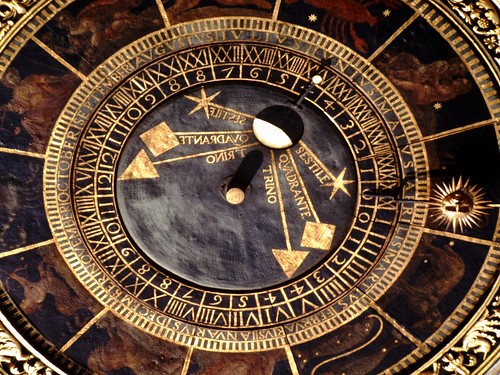
sundial


*Which, I think, is a Friday, not a Thursday, though it would have been a Thursday last year, since the 10th was a Thursday last year.

**Not a very happy day for me; I literally haven’t seen either of my kids (in person) in just shy of ten years.

***And which will mark the anniversary at which I will now for the first time have been divorced for longer than I was married.  What a dubious and lamentable achievement.

****I’m not referring to the real numbers in the mathematical sense, though the prime numbers are members of the “real” numbers.

*****To be fair, Mark Red was also originally conceived as a manga, and it’s well over ninety-thousand words long…more than twice that.  I just checked.

I wrote a post on Iterations of Zero

I haven’t written anything on Outlaw’s Mind this week so far, because what’s the point of that or anything else, after all?  But this morning I got an idea in my head that I decided to write an IoZ post about, and so I did that in the time in which I usually would have written fiction.  Here’s the first few paragraphs of it, followed by a link to the remainder of the post, in case you’re interested:

To really know you’ve created the best possible universe, you’d have to create them all

I was on my way into work this morning and started thinking about a curious question.

You may be aware of the area of theological inquiry called theodicy*. It deals with the “problem of evil”, though I’m sure that’s an oversimplification. In other words, it deals with the issue that, if God exists, and is infinitely powerful, and is omnibenevolent and omnipresent and omni-whatnot, then why is there evil?

We can leave aside arguments based on notions of free will and just desserts; bad things happen to “good” people in the world, whether through the actions of “evil” people or simply through the operations of the forces of nature. Think of childhood cancers and the like, and indeed, most childhood diseases prior to the modern era, as well as the fact that many children, through no fault of their own, are born to parents who are idiots (this probably describes all children, including mine).

One potential solution to the “problem of evil” is the notion that, despite appearances, the universe in which we live is the best possible one there can be. This idea is caricatured by Voltaire in the form of Dr. Pangloss, but it’s a serious point that is seriously made, and there is a certain logic to it. The notion is that, if things were changed, locally, to make some particular situation better, it would overall make more things worse, by whatever criteria you might happen to choose, and so every bad thing that happens, though it may not have any local good to it, is nevertheless necessary to minimize the evil, or maximize the good, of the universe, by whatever measure happens to be used by the one doing the parsing…presumably, God.

But how would such a God know what the best possible universe was? Such a being is assumed to have infinite intelligence**, as well as infinite power and awareness. We could, perhaps, describe it as a sort of “computer” that is infinite in all dimensions (perhaps an infinite number of them) and with limitless processing power, constrained only to the degree that it does not lead to paradoxes and contradictions, since we must assume—or I do, at least—that logic would apply even to an omnipotent being. Even God cannot actually make two plus two equal five without changing definitions, in which case it hasn’t actually been done.

To see the rest, follow this link.

So we profess ourselves to be the slaves of chance, and flies of every wind that blogs

Hello.  Good morning.  It’s Thursday—the first one in March of 2021—and so, of course, it’s time for another of my weekly blog posts.

As is often the case, I have no specific plan about what to write today; it’s very much going to be stream-of-consciousness.  I expect this post will be relatively short, therefore, but I’ve often been wrong in this expectation previously.  We shall see.  Indeed, you can probably already see, since you’re reading the completed product, while I—the writer—will only see it as it takes form, at least in the initial draft.

First, and most important to me, work on The Vagabond continues steadily, and I’m well over halfway through the final edit.  One of the great tragic moments in the book has just occurred, and things are looking very dark indeed for our heroes.  Hopefully, they will find a way to overcome this setback, or one will be provided for them.  You shall have to wait and see, though in a reversal of the situation mentioned above regarding the length of this blog post, I happen already to know the outcome, while the reader can only bite his or her nails* and read on anxiously (when they finally have the published book, that is).

Little new has happened in my personal life otherwise, which is pretty much the way my personal life goes…such as it is.  As usual, I find many of the various deeds of humanity, both globally and locally—down, even, to the people in the office with whom I work—to be often terribly disheartening and discouraging.

Not that things are all bad; obviously that’s not the case.  But the second law of thermodynamics seems always to insist upon making its presence known, and thus it is always easier for things to fall apart than for new things to be built or even for existing things to be maintained.  This is the condition of the universe itself, though ironically it is also the very force that allows life to exist, and which drives all positive process we see.

Were entropy a general constant—as the laws of physics seem strongly to imply that it eventually will be—there would be no change whatsoever, at least no change of any significance.  Life could not exist in a state of pure and total thermal equilibrium, even though its existence is entirely dependent upon the universal mathematical and physical tendency for things to move toward that equilibrium.  This is the curious irony—which might seem paradoxical, though it is not—of the existence of complexity and life.

I think I got the following descriptive and analogous image from Sean Carroll, of a coffee cup with milk being added; it is only during the mixing process when eddies and whirls, clouds and vortices, unpredictable chaotic forms can appear.  It’s only while the drink is mixing that anything interesting, in that sense, occurs.  Once the coffee is well stirred, nothing more of interest will happen**.

Of course, in principle, it is possible for a stirred cup of coffee to unmix spontaneously and separate again into milk and coffee, thence to remix once more.  However, even on so small a scale as a cup of coffee, given the number of molecules involved and the vastly greater number of possible mixed compared to unmixed states, it’s going to take a very long time for that to happen.  Don’t hold your breath.

In fact, though I haven’t worked the specific numbers, I nevertheless feel quite confident that for the coffee cup spontaneously to unmix would take a time vastly greater than the present age of our universe.  The Earth—and any coffee cups resting upon it—will long since have been incinerated by the swelling, dying sun before any such unmixing could happen.  Taking the cup away into interstellar space would only freeze it, significantly slowing any possible unmixing process.  And, of course, coffee left out in the open tends to dry up as the water in it evaporates, and on a far shorter time scale.

Anyway, who’s going to mix and stir a cup of coffee only to leave it sit and wait for the process to reverse itself by random chance?  I don’t know about you, but if I have a nice cup of newly poured and stirred coffee, I tend to start drinking it pretty quickly.

And, also anyway, on time scales such as those involved in local reversal of entropy by spontaneous molecular motion, an astonishing number of events will have happened on the human scale.  Measured in terms of information exchange, it may be that the process of human time is literally speeding up, as computers and the internet and other means of global communication and computation fundamentally accelerate the rate of what’s happening in civilization, though the pace and duration of biological human life does not change nearly as much.

Measured in “flop time”***, as it were, the pace of events really has been, and is, accelerating.  The rate of that acceleration seems unlikely to continue indefinitely, but even if the growth curve levels off somewhat, more “things” can happen in a current decade—let alone a century—than happened throughout most of the first hundred millennia of human existence, at least from the human point of view, which is the only one we have right now.

So, though things do fall apart, and the center indeed cannot hold, it is not merely anarchy that is loosed upon the world.  As Darwin put it, during the process of entropic mixing, when all the interesting stuff happens, and driven by that mixing and that tendency toward increasing entropy, “endless forms most beautiful and most wonderful have been and are being evolved.”  If only he knew how beautiful and how wonderful and how unpredictable those forms are and may someday be, I think he would have been even more awed than he was.

See, I’m not a complete downer.  At least not all the time.

Well, this post is not much shorter than usual, if at all, but I think I will call things to a close here.  I hope you are all as well as you can be, and are being careful of yourselves and each other, and staying as safe and as healthy as you can.

TTFN

Cloudy coffee


*Or someone else’s if they’re very close friends.

**I’m not counting the drinking part just now.  As far as I know, there’s no one waiting to drink the universe once it’s well mixed and cool enough not to burn the lips and tongue…though that’s an interesting notion.

***I recorded an audio blog about this concept but I haven’t yet posted it to Iterations of Zero.  My apologies.

I’ll read enough, when I do see the very blog indeed where all my sins are writ, and that’s myself.

Hello, good morning, and welcome to another edition of my weekly blog post.  It’s hard to know what to write that I haven’t already written—much of it repeatedly—in previous blog posts, though the details no doubt change from week to week.  But, then again, that’s always an issue with writing, as with storytelling in general, and so on.  Is it ever possible really to write (or otherwise create) anything new?

Well, the “Latin” alphabet alone (adding in the “Arabic” digits from zero to nine) iterated out in any reasonable length produces a trans-astronomical number of possibilities.  Even if we leave out punctuation and spaces and other “special characters”, the number of different things that can be written in just ten spaces is 36 to the tenth power, which is a little more than 3.6 times ten to the fifteenth power*.  To get some sense of the scale of that number, consider that the number of stars in the Milky Way galaxy is on the order of ten to the eleventh power, so the number above is a good ten thousand times larger.  The number of cells in a typical human body is on the order of ten to the thirteenth power, still only a hundredth as large as the number I mentioned.

Mind you, the vast majority of those combinations of characters are going to comprise a real tale told by an idiot, signifying nothing.  But, of course, ten spaces is next to nothing.  So far in this blog post I’ve already used more than 1500 spaces or characters.  Still not counting punctuation et al, taking thirty-six to the 1500th power gives us a truly staggering number:  2.8 times ten to the 2334th power.  To get a scintilla of the idea of the scale of that number, consider that the estimated combined number of protons, neutrons, electrons, and neutrinos in the “visible” universe is only on the order of ten to the 80th or so.  Of course, if you throw photons and gravitons and gluons and W and Z bosons, and whatever comprises “dark matter” and “dark energy” into the mix, that number will surely go up by quite a bit, but not by anything close to two thousand orders of magnitude.  Remember, ten to the 2334th is a one followed by 2334 zeroes (in base ten).  You’d have to multiply ten to the 80th by itself about twenty-nine times (i.e., take it to the 29th power) to reach 10 to the 2334th.

Of course, the vast majority of such combinations will produce nothing even close to coherent writing—or even to the quality of writing I’ve produced here so far (which as of this point has over 2300 characters).  But so what?  It’s a bit like considering all the possibilities of DNA.  Even though the vast majority of possible DNA sequences would not be transcribable into anything like a viable living organism if injected into a typical cell, the subset of potential viable organisms is still staggeringly larger than the number that have ever lived.

Thinking along similar lines, consider the Library of Babel, a notion introduced in a story by Jorge Luis Borges, (and instantiated, more or less, in a brilliant website).  It contains all possible books of, I think, 400-ish pages, using certain layout characteristics, and thus would contain, in principle, everything anyone has ever written or could write (of that size or smaller).  The possibilities are so large as to seem infinite.

“And yet, oh and yet, we all of us spend all our days saying to each other the same things time after weary time:  ‘I love you,’ ‘don’t go in there,’ ‘get out,’ ‘you have no right to say that,’ ‘stop it,’ ‘why should I?’ ‘that hurt,’ ‘help,’ ‘Marjorie is dead.’”**

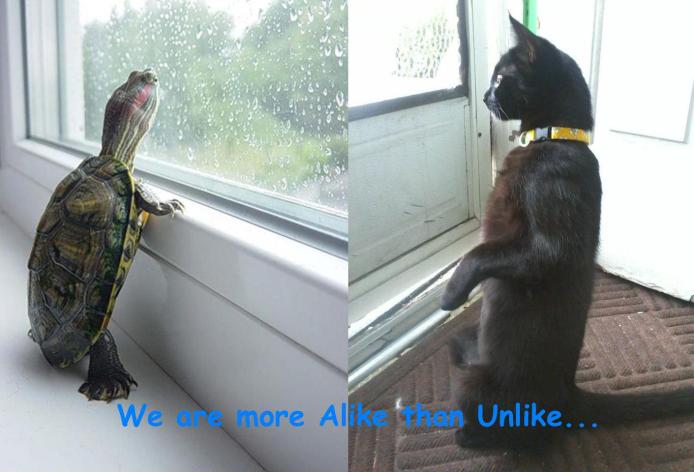
It’s been said by some that all stories (of relevance to humans) have already been told.  I don’t think that’s quite true, for as we learn and explore and develop new understandings of the universe and new technologies, new stories will become possible that never would have been before.  Nevertheless, most types of stories that would be of interest to humans have probably already been written (or otherwise told) in various forms by numerous authors.  And yet we*** still enjoy both creating and partaking of them.  Indeed, the reading of a new story of a given type—of which one may have read dozens or hundreds of others—can still be one of the greatest pleasures in life (though I’m having a hard time with that lately, to my significant distress, as I’ve mentioned previously).  It’s a bit like all those possible humans, I guess.  They all are much more alike than unalike, as Maya Angelou said, but we can nevertheless tell each one from nearly all the others, usually at a glance, and certainly within a moment.

So it is with stories.  Even within the genre of heroic fantasy, it’s trivial to differentiate Harry Potter from The Lord of the Rings from The Belgariad from The Chronicles of Thomas Covenant.  I love them each and all, and I wouldn’t willingly have any of them expunged from reality or memory.  It is, no doubt, likewise with horror, with science fiction, with thrillers, with mysteries, with romantic comedies, and every other genre of story.  Though all have similarities, they are nevertheless distinct, and the possibilities are so immense that they give a better impression of infinity than actual infinity does, though they are, probably, not literally infinite****.

With that in mind, I’ll keep working on The Vagabond, as I have this week, as usual.  I’m about halfway through the last edit; then comes layout and cover design and all that jazz, and then publication.  And thence, on to whatever comes next, such as Dr. Elessar’s Cabinet of Curiosities, which will include House Guest and many other stories.  The possibilities are not easily limited, and so this idiot, at least, will for now keep telling his tales.

TTFN

Alike unlike


*If, as the fictional (often mad) scientists always say, my calculations are correct.

**This long quote is taken from ‘A Bit of Fry and Laurie’, I think it was the very first episode, but I’m not sure.  You can go and watch it here.

***Humans, for want of a better term.

****During the writing and editing of Unanimity I might have disagreed with this last point.  And, by the way, I took the notion—that the immense-but-finite can give a better impression of infinity than the truly infinite does—from Douglas Adams’s The Hitchhiker’s Guide to the Galaxy.