You’re so vain, you probably think that nothing matters

I was going to start by saying that I had probably written all I could about Friday the 13th and the fact that there are 2 in a row when non-leap year Februaries have Fridays the 13th, and that a first glance might lead one to think this should happen roughly every 7 years on average*.  However, as I noted last time I discussed this, because the leap year day is in February, we will not have the two-in-a-row Fridays the 13th (February and March) as often as we might otherwise; it will not happen every 7 years on average.

Then, this morning, after recalling that today was Friday the 13th, I ran through the next years’ Fridays in my head in the shower, and it occurred to me that the next Friday the 13th in February‒which will be in 6 years, as I noted in the past‒will not be followed by a Friday the 13th in March!  2032 (six years from now) will be a leap year, so there will be 29 days in February, so there will be no Friday the 13th in that March.

The next paired ones, then, will be a further 5 years after that, in 2037 (not a leap year).  It would have been 6 years later, but there are two leap years in that interval, 2032 and 2036, so the next one comes a year sooner than it would otherwise.

It occurred to me that, because of the frequency of leap years, which is almost twice that of the cycles of days of the week, the frequency of those paired dates may well be once every 11 years rather than every 7.  At least those are both prime numbers.  I’m not going to work out some exact formula right now, though.  It’s not really important.

Of course, one could say that nothing is truly important, and I am persuadable along those lines.

There is a Doctor Who Christmas Special (the one from series 5) in which the antagonist/guest protagonist (played by Michael Gambon!) describes a woman in a cryo chamber as “nobody important”, and the Doctor characteristically responds by saying, “Nobody important?  Blimey, that’s amazing.  You know, in 900 years of time and space, I’ve never met anyone who wasn’t important before.”

This is typical Doctor, of course, but it raises the objection Dash (from The Incredibles) voiced when told that everyone is special:  Saying that everyone is important can be the same thing as saying no one is.

Of course, important is in the eye of the beholder.  But then again, the beholder is not important, either, except in its own subjective estimation and perhaps that of a few other, equally unimportant, owners of such eyes.

So, yeah, one could argue relative and subjective importance from local points of view, which is valid but more or less vacuous outside its small scale as far as I can see.  On a cosmic scale, it’s all just dust and shadows.  But you could also say that about the entirety of the cosmos itself.

I guess import has always been subjective, even though people are not inclined to see it that way.  But, of course, people are the products of their “local” forces, and they are not responsible for the laws of nature, nor for the things which have happened in the past that have affected them in the present (which could come under a certain interpretation of “the laws of nature” in and of itself).  I won’t get into all that now.

Going back to the shower, but on an entirely different subject, I was also thinking about the effects of diminishing amounts of shampoo in the bottle on the center of gravity of the bottle.  At the start, when it’s full, the center of gravity is roughly in the geometric center of volume of the whole thing.  But as one uses the shampoo, the center of gravity shifts lower and lower, since the air replacing shampoo in the upper part of the bottle is much less dense than the shampoo or the bottle.

But then, as one gets to the dregs, the smaller and smaller amount of shampoo in the bottle contributes less and less to the overall mass distribution of the bottle and its contents, and the center of mass begins to head back up.  Finally, when the bottle is “empty”, the center of gravity will have returned to almost the same place it was when the bottle was full.

All that’s fairly trivial, well-known stuff, I know.  But it got me to thinking about how much of the laws of physics, such as the laws of gravitation (Newtonian form), are solved using such concepts as the center of mass, which is really just a way of combining and averaging the effects of numerous tiny bits of gravitating material as if they were concentrated at one point.

Much of the mathematics of physics works this way, coarsely approximating the very fine details of reality in a way that provides reliable, reproducible guidelines and can produce testable predictions.

But the granularity of reality doesn’t actually ever go away, not at any level.  Even at the level of the quantum wavefunction of a single “particle”, the actual behavior of the thing as it interacts with things in the “larger” world is the summation of the effects of all the possible quantum states of the electron superposed upon each other and interacting with things‒everything‒which are also just collections of superpositions of quanta.  That superposition happening in a “space” that doesn’t directly coincide with the macroscopic space we experience, but whatever its dimensions are, they are real, because they have durable, reproducible effects.

Mathematics may be unreasonably effective in the physical sciences, as Eugene Wigner famously noted, but it seems not to be a refining of description but rather an averaging out, a glossing over, the inking of an underlying rough pencil drawing which nevertheless still constitutes the real, original picture.

It may be that, in a sense, all science is just various forms of statistical mechanics.  We know that, at larger scales, we definitely need the tools of probability and statistics to navigate as best we can the territory of reality.  And yet, we don’t teach this sort of stuff to most people, ever.  I wrote a post about this on Iterations of Zero, if I remember correctly.

I could go on about all this rather easily, I guess, but I am using my smartphone today, and my thumbs are getting sore.  That’s okay; yesterday’s post was probably way too long, anyway.

If I did a video of my thoughts on this I might be able to get into more detail, though it would probably be even more erratic and tangential than my writing.  Still, maybe it would be worth trying.

In the meantime, I’ll write at you again tomorrow.


*Go ahead, do a search on my blog page for Friday the 13th; I’m all but sure it will bring up the pertinent blog posts.


In a better blog than this, I shall desire more love and knowledge of you

Hello and good morning.  It’s Thursday, and I’m writing this post on my lapcom.  I feel as though I ought write these posts only on the computer (not that smartphones are not computers, but cut me a little slack on this, please), and I would be more inclined to do so if Microsoft would stop making Aptos the default font!!!!!

If I could go back in time and change something, that’s one of the things I would be inclined to change.  If I found that there was one person mainly responsible for this new font, well…I don’t know if I’d go all Terminator on them and kill that person’s mother before that person was born, or kill the person when that person was a child, but something needs to be done to erase the stain of this horrible font from existence.

Certainly, if I were given* absolute power over the world, from this moment forward, one of the petty things I would do (I would try to keep the petty things to a very bare minimum, trust me**) is to eliminate that font from any and all standard computer systems anywhere.  I would probably allow for individuals to select the font if they really like it, but would not let them use it on anything but internal work between people who also like the font.

Also, I would probably mark people who chose the font freely for a visit from my secret police.

I’m kidding.  I despise the very notion of thought crime, let alone aesthetic policing in private matters.  This is even though some people’s quality of thought sometimes feels like a crime against nature.  But, of course, there cannot actually be crimes against nature.  Nature does not punish one for disobedience to its laws.  It’s simply not possible to do anything but follow them.

That’s one reason why I truly despise headlines like “The new finding by Hubble that breaks physics!” and whatnot.  Not only are they plainly clickbait, they are stupid clickbait.  I don’t know for sure if it’s just the headline writer or the writer of whatever the attached article might be who makes the headline in specific instances, but in either case, when I see headlines like that, I think that whoever wrote it really, clearly doesn’t understand physics very well.  Nor do they the nature of scientific discovery and advancement.  Because of that, I am far less likely to read the attached article (or watch the video) or even click on its link.

Nothing can break physics.  If you find something that seems to violate physics as you understand it, what you have found is not a violation of physics but rather a place where your understanding of physics is clearly incorrect.  This is far from a horrible thing.  This is how progress in physics (and in other sciences) is made:  by finding the places where our “understanding” doesn’t predict or describe what actually appears to be happening.  The world cannot be “wrong”, so our understanding of it must be, and will need to be revised.

That’s progress.

One should be hesitant to give too much “trust” to anyone who refuses to change their mind.  One of the best lines in a Doctor Who episode (not a truly great episode, maybe, but it has a wonderful speech by the Doctor) is after the Doctor has said to the “villain” (who goes by the human name Bonnie, though she is not human) “I just want you to think.  Do you know what thinking is?  It’s just a fancy word for changing your mind.”

Bonnie responds, “I will not change my mind.”

And the Doctor says, “Then you will die stupid.”***

This is simply true.  If you never learn that you were wrong about something, if you never update your credences or think about things in a new way, you will never learn anything new or develop any better understanding of the world than you did when you formed those credences.  Or, to paraphrase Eliezer Yudkowsky, if no state of the world can change the state of your retina and how you perceive that state, that’s called being blind.

I like to refer to Yudkowsky-sensei a lot, but that’s because he has said a lot of bright and interesting things, and he has said them well.  It’s also nice to know that there are some highly intelligent and thoughtful people in the world—clearly there are, or humans would long since has gone the way of the trilobites—because the idiots and the assholes make so much noise.

The best evidence I see for the fact that most people are good or at least benign (overall) is that civilization still exists, and has done so for a long time.  It is far easier to destroy than to create or even to maintain; the second law of thermodynamics tells us that things will fall apart even if we do nothing at all to break them (it says that more or less, anyway—that’s a bit of a bastardization of the proper, mathematical law, but it is related and implicit).

The fact that civilization still exists—so far, at least—seems to indicate that there must be a lot of people working to maintain and sustain and improve it, because we can easily see how much how many people seem to be trying to make it crumble****.

Assholes tend to make a lot of noise in the world, but they’re pretty much all full of shit and “hot air”.  It’s worth it to keep this in mind, because there have always been plenty of such nether orifices out there, spewing their flatus everywhere like perverse crop-dusters.  But the evidence strongly suggests that they are not the norm; they are just the noisiest.

I suppose that’s a good moral of sorts on which to end this post:  Be willing, even eager, to change your mind when warranted, and try not to let the assholes make you think the world is no better than a camp latrine (even if you’re one of the assholes sometimes, which you are, since we all are, sometimes*****).

Though, to be fair, I am hardly the person to be giving that last piece of advice unironically.

TTFN


*If you must be given absolute power, do you actually then have absolute power?  This is similar to the old song that says “Don’t ever take away our freedom.”  If you have to beseech someone not to take away your freedom, you’re not free, and if you have to be given power, your power is clearly not absolute.

**Or don’t, if that’s not in your character.  I’ve often spoken implicitly against the concept of trust, stating that I don’t feel that I can actually, truly trust any living person.  It’s calculated risks all the way down, which is empirically true if nothing else.  So, I can hardly scold someone if they don’t “trust” me.  Go ahead, form your own conclusions.  I do exhort you, though, to be as rational as possible when you form them, with your conclusions drawn as a consequence of the evidence and argument, not with your evidence and argument being curated based on your knee-jerk or at least hasty “conclusion”.

***He then proceeds to lay out the alternatives; he’s not making a threat, he’s making a point.

****When you read that, did you immediately think of your own least favorite political or other public figure, or perhaps of the people you encounter who disagree with your politics or religion or dietary preference or what have you?  Be careful.  Us/them thinking is not usually conducive to formulating true and accurate pictures of reality (though it did inspire at least one beautiful song):

*****We’re also all deuterostomes (I’m assuming only humans are reading this).  Look it up.  It’s kind of funny.

“Stupid is as stupid does, Mrs. Blue.”

Well, here I am again after all, writing another stupid blog post on another stupid day in a stupid life on a stupid planet.

Now, with respect to that last entry on my brief list, one might say, “Hang on.  Of all the planets we know, Earth is the only one with clear life, let alone intelligence.  Doesn’t that make it an exceptionally smart planet?”

I would agree that, yes, it is an exceptionally smart planet (so to speak).  But that’s not saying very much.  All the other planets in our solar system appear to be lifeless, so they are really neither smart nor stupid.  They are merely lumps.

You can’t (or shouldn’t) call a rock stupid nor should you expect it to be smart.  The concept of “smart” doesn’t apply.  It’s a bit like my term “unsane”, which does not mean the same thing as “insane” as I use it.  “Unsane” means that the concept of sanity (or its lack) does not even apply (it’s a good term to use in a cosmic horror setting).

To be stupid‒in the sense in which I am using it here, anyway‒one must have the capacity to be smart.  It’s an important distinction, I thinktion.  I recall hearing a guest* on Sam Harris’s podcast discussing the notions of smart versus stupid.  Basically, smart could be thought of (in this guest’s view) as doing something in a way that was faster or more efficient than randomness would provide.

I think this person used as an example the process of getting from one’s house to the nearest airport.  The nonintelligent way to go would be, for instance, just to make randomly chosen turns at each intersection.  Using that strategy, one would get to the airport eventually, though the time it takes would scale (I think) proportionally to the square root of the distance…or maybe it was the square or the log, I don’t remember off the top of my head how such drunken walks scale with distance.  I think it must be more like the square than the root.  If I had the energy, I would look that up for clarity, but I’m not up to it right now.

Anyway, the point is, random turns on finite roads will get you to the airport eventually**.  Whether or not life would still exist on Earth by the time you arrived is uncertain, but you would get there.

Any route that took you less time than the “average” random route could be considered relatively intelligent.  The most intelligent route(s) would be the one(s) that got you to the airport in the least amount of time (or by the shortest distance, depending on your preference, though the two often coincide).

On the other hand, going around and around the block on which you live would never get you to the airport.  That would be stupid.  As you can see, it’s worse than just being nonintelligent.

Actually, of course, it would still be stupid if someone chose to do the random walk method to get to the airport when maps, etc., are available (unless one were doing it as an experiment, though in that case one’s goal would not be to get to the airport as efficiently as possible).

My point is probably well hammered into the ground by now:  to be stupid (at least as I am using the word) one must have the capacity to be smart.

For instance, I am supposedly quite smart.  In principle, there are probably few strictly intellectual disciplines which I could not “master” if I had the will (and resources) to do so.  There are some things that require particular bodily or other configurations or capacities that make me incapable of doing them more or less at all‒I could not be a professional basketball player or an Olympic gymnast, for instance.  But when it comes to “mindy” things, things for which a skill can be learned, my attitude has always been more or less that if someone can do it, then I could do it given enough time and effort.  I’ve not encountered anything so far that’s disabused me of that judgment.

And yet, despite that, look at the state in which my life wallows (I do not refer to the state of Florida, though that’s evidence supporting my point).

If I were able actually to constrain and focus my mind on one (or a few at most) subject(s) and just work on that (them), I think I could honestly make a real, significant contribution.  Perhaps it would not be anything revolutionary or monumental, but it would be a difference.

Unfortunately, I cannot seem to remain focused on specific things just on my own.  This is part of why I have done best in preprogrammed curricula.  Medical school, for instance, was fairly easy (in terms of mental difficulty, not in terms of the amount of work).  But depression and insomnia and anxiety and what I now recognize as the effects of ASD, and possible other forms of “neurodivergence”, make it difficult for me to learn things straightforwardly‒to drive as quickly to the airport as possible, figuratively speaking.

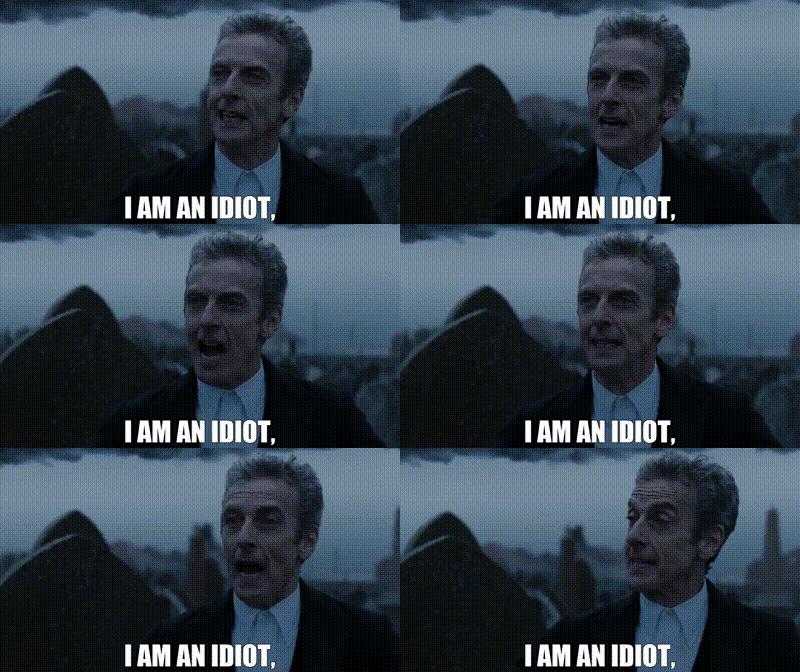
So, what point was I trying to make, again?  Oh, yeah.  To be stupid, one has to have the capacity to be intelligent, at least in the sense in which I am using the word “stupid”.  Maybe it would be better to use variations of the word “idiot” such as idiocy, being idiotic, that sort of thing.  Even the Doctor openly admits to being an idiot, despite being arguably the smartest person in the Doctor Who universe.

I guess that could make me feel better about myself, in principle, since if even the Doctor is an idiot, it’s not too shameful if I am.  But Doctor Who is not reality, nor is any other work of fiction (unless one is invoking the broadest, most unfiltered concept of the multiverse***).  In the real world, my stupidity makes me in many ways far stupider than any annelid worm, for instance, because I ought to be smarter than I am, I ought to be more secure than I am, I ought to be more at ease than I am.

I certainly ought to be more successful than I am now and have been for a long time.  My living quarters and conditions and whole lifestyle now are significantly less posh and luxurious than conditions were in college (and that’s not even counting the fact that I was getting an education then).  Even prison seemed‒in some ways, at least‒healthier and more conducive to well-being than how I live now.  And I don’t see any sign, nor recognize any clear way, that I’m going to do anything but continue to go downhill from here.

And, alas, I fear that the hill I’m descending has no lowest level.  It just keeps on going down, down, without even a “rock lobster” to break up the wretched descent.

Enough.  I hope you have a good day.


*I checked; it was David Krakauer, in the Making Sense podcast number 40, unless I’m quite mistaken.

**Assuming unlimited fuel and an airport (and set of roads and a vehicle) that last long enough.

***See Brian Greene’s The Hidden Reality, and possibly Max Tegmark’s Our Mathematical Universe.

Well, ain’t we a pear, Raggedy Partridge?

Well, today it really is Christmas Eve, with just one “Eve”.  We are approaching day zero, then there will be no more “Eves”.  You might say we will be eves dropping (har).  But don’t worry, there will be no associated invasion of privacy‒except perhaps by Santa Claus, who supposedly sees you when you’re sleeping (creepy) and knows when you’re awake (vaguely threatening).  Also, he supposedly knows if you’ve been bad or good, but we are not given any list of criteria‒not so much as one criterion, in a pear tree or elsewhere‒by which he measures or judges your goodness or badness.

I suspect that any true Santa Claus* would be very forgiving, especially with children, especially if they were trying.

Okay, sorry, that was all silly.  Then again, I guess some people do call this the silly season.  At least, that’s what Martin Riggs called it in Lethal Weapon, when he was trying to talk down the would-be jumper on a building.

They caught/saved that guy (with Riggs’s help) by inflating one of those big Hollywood air cushion things like stunt people use in movies.  I don’t see how that could work in real life to stop an attempted suicide, though.  How would they get such a thing into the correct location?  One is supposed to land in such cushions back first, but someone trying to kill himself would not bother, nor would he aim for the center of the thing, or indeed for the thing itself.

I suppose it’s better than using one of those circular net/trampoline type things, such as one can see in old cartoons.  I’ve never seen one in real life, not even in old pictures, so I’m not sure they aren’t one of those Hollywood-based, self-referential tropes that never really were like anything that truly existed and was used.

I guess such a net might at least have the advantage that it can be maneuvered.  But if someone is falling long enough for those below to make significant adjustments, that person is going to be moving fast when they hit that little net.  And the net is only a few feet off the ground, so even if all the people holding the net can keep their grips, either the person falling is going to slam into the ground below the net with their speed not reduced significantly, or‒if the net has very strong elasticity so it can decelerate a falling person fast enough that they won’t hit the ground‒hitting the net will kill them more or less as readily as hitting the ground would kill them.

Physics can be a bitch sometimes, but I still love it.

Maybe if they had big, premade blocks of aerogel or something it might work.  Does anyone know whether aerogel has been tested to see how well it slows and/or stops rapidly moving/falling objects and how cushiony it is?  If so, is such a person reading this blog post?  If so, I invite you to share that knowledge below, in the comments.

Okay, while I must admit that I never actually plan out any of my blog posts**, this one is more undirected than many.  Or maybe that’s only the way it feels to me.  Maybe I feel chaotic and undirected, but the reader finds the post entirely logical, pleasantly whimsical, and smoothly written.  I don’t know and I seem unable to tell.  If anyone wants to comment about that in the comments below, you would be most welcome.

Anyway, I’m going to leave you with a picture with a Christmas message from the 12th Doctor.  The picture is from the Doctor Who 8th series Christmas special, Last Christmas.  The title doesn’t refer to the previous year’s holiday, but to the fact that every Christmas is the last Christmas for someone.

Despite that sad and heavy line, the episode is quite quirky.  In it, the Doctor and Clara Oswald, with the help of Santa Claus (Really?  Well, it’s hard to tell for sure.), played by Nick Frost (the perfect name for an actor to play Santa, right?), fight these alien crab beings that look a lot like face huggers**** and which feed you dreams/hallucinations while they slowly digest your brains.

A question has just occurred to me:  Could Santa be a time lord?  I can think of how it could work; certainly a TARDIS as the “sleigh” could help explain Santa’s ability to reach every Christmas-celebrating house in one night.

Even more thought-provokingly, I have a storyline worked out in my head in which Jesus was actually a time lord who used the chameleon circuit to be reborn as a baby and was given to Mary and Joseph to raise.   John the Baptist would actually be the time lord’s companion, who‒at the River Jordan, of course‒opens the fob watch containing his essence and returns the time lord to his true self, thus the whole “holy spirit coming to Jesus…”

Anyway, I won’t get more into that; I don’t want to offend anyone too much.

By the way, the words on the picture below don’t come from the episode in the picture.  They are from the 12th Doctor’s last speech to himself to prepare for his regeneration.  Indeed, these are almost the last words of that speech.  I will close this post with the subsequent, final words of the 12th Doctor.

“Doctor…I let you go.”


*According to Ze Frank, Morgan Freeman is attempting to create a true Santa Claus.

**Okay, well, “never” may be an exaggeration.  But if I ever have planned out a post, it was probably a one-time thing or so.  Certainly I strongly suspect I could count the occurrences on the fingers*** of one hand.

***Am I considering the thumb as a finger in this assessment, or am I not?  I won’t tell you, but I will say that I am almost certain that it doesn’t make a difference either way toward the accuracy of my “fingers of one hand” comment, unless the hand was Yoda’s or Nightcrawler’s.

****This is noted within the episode, and sets up a particularly good joke:

Words about fear and words about words

Well, it’s Saturday again, and for the second week in a row, I am writing a blog post.  I warned you that I probably would:  here, go take a look.  See?  I told you.

Of course, a blog post means I’m going to the office today.  It’s not a full day, but it chews up so much of the middle part that there’s no possibility of getting any extra rest, at least not for me.  For instance, I have awakened well before I would need to go to the office, but my anxiety or tension or whatever it might best be called does not let me sleep‒for fear of oversleeping, I guess.  It’s some manner of fear, anyway.  It’s not a fear of physical attack (I think) but it sort of feels like I have to watch my back, as though someone or something is out to get me.

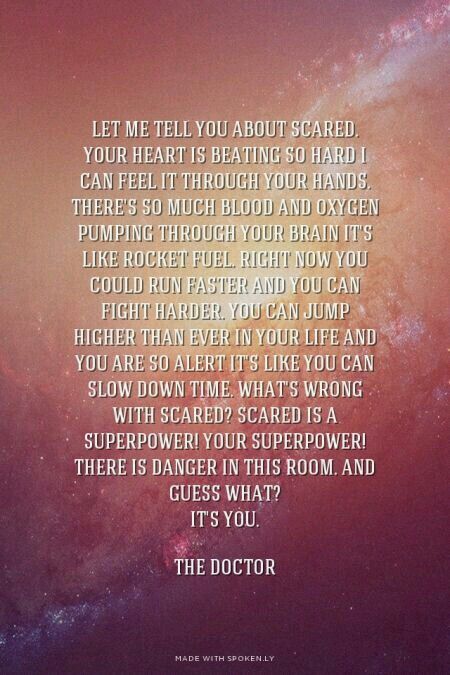
Fear is not the mind killer, of course, despite the popular mantra from Dune.  Fear (up to a point) can sharpen the mind, if it’s not resisted inappropriately.  I think the 12th Doctor’s take on being scared is far better than that from Dune.  See below:

Obviously, too much fear is bad, but as Stephen Fry, playing the unscrupulous tobacconist points out (starting at roughly the 2:45 point here), that’s what the term too much means.

Too much of anything, more or less by definition, is bad.  This is one of those somewhat rare circumstances in which one can say “by definition” and not be relaying a merely semantic point without substance.

This is in contrast to the silly old conundrum “If a tree falls in a forest and there’s no one to hear it, does it make a sound?”  If you simply define your terms precisely, there is not going to be any ambiguity in the answer‒but you have to choose your “definitions”* of each word clearly, especially ones like “hear” and “sound”.

If you’re ever arguing about something (other than etymology and/or usage and/or diction) and you want to go to the dictionary to settle it, then you’ve probably been arguing about something without substance‒arguing past each other, as they say.  I’ve heard such arguments, even between people with seemingly above-average intelligence.

Of course, if they’re arguing for fun, as a sort of mental sport and exercise, and if they both (or all) are enjoying the process, then I have no trouble with it.  It probably sharpens their thinking skills, as long as they don’t let themselves forget that they’re just arguing over misaligned coding and the logical implications thereof.  Even a skilled martial artist who trains purely for exhibitions may be in real trouble in a street fight against serious opponents.

But even the OED doesn’t decide or define what English words mean; it records what words have been used to mean, their origins, their etymology, all that good, interesting stuff.

How did I get on this subject?  I guess I’ll see as I do the editing.  I certainly do bounce and meander in my head, don’t I?  And that process is often inextricably intertwined with writing.

That can be a good thing, sometimes, I suppose.  I would think it’s at least related to the nature of creativity.  But it’s also important to be able to focus and stay on point, to be disciplined, if one is truly to create anything of depth.  One of my biggest problems in the past was that I would come up with, for instance, good story ideas, but I would soon get distracted by some new story idea and get diverted from the first.

One of the best things about having been to prison‒yeah, there were a few good things, though they were strongly overwhelmed by the bad‒was that I was in a situation in which I could discipline myself to write every morning, when lights came on (about 3 am) for 3 to 4 pages, and not go on to a new story until I finished the first.  I mailed the pages out to my Mom, Dad, and sister as I went along, after rewriting them for a bit of legibility**.

In this fashion, I wrote first Mark Red, then CatC, then Paradox City.  Then, after I got out, I continued writing, finishing one story before starting the next, right up until I began Outlaw’s Mind.  That was the last story I started in that pattern, though I’ve since written a bit on The Dark Fairy and the Desperado and even less on HELIOS.

Currently, I just write this every work day.  I cannot explain why in any quick and simple fashion, but it is what it is, as the tautology goes.

I hope you have a good day.  I should be back on Monday.


*I put that in scare quotes because in nearly all cases, words don’t have real, singular, exclusive definitions, but instead have usages.  Now, as the person who coined various words in, for instance, The Chasm and the Collision, I can actually and literally define those words.  I have actual authority over those words; I created those words and I created those worlds.

**I kept my first draft so I would be able to go back and check things if I needed to do so.

Monday morning, wearing down

Well, it’s Monday again.  Time keeps marching on without respite, as it is apparently wont to do, “progressing” in the direction of increasing entropy, whether time is a fundamental aspect of the universe or an emergent phenomenon.  In either case, there doesn’t seem to be any sort of time stream or time vortex like in Doctor Who, but rather a process that simply is a linear dimension with some “entanglement” (not to be confused with quantum entanglement) with the dimensions of space, such that motion and acceleration in space changes one’s “motion” in time, in an updated version of the Pythagorean Theorem.

For those of you who like to share the joke about “Yet another day when I didn’t use a2 + b2 = c2” you’re really depriving yourself of a deep understanding of something that turns up in and governs a ridiculous number of the things and processes in the physical reality in which you live.  Consciousness—despite clever but tortured sophistry (in my opinion) by some prominent philosophers of mind—in no way appears fundamental to the universe*.  On the other hand, the Pythagorean Theorem, which was neither invented nor discovered by Pythagoras, applies in all levels of dimensions, however many you might conjure, and with the modification to make it reflect velocities, it applies to spacetime as well.

There can be no readily conceivable brains** in two spatial dimensions, but Pythagoras nevertheless applies.  In one dimension, it doesn’t really apply, but in one dimension there are no triangles of any kind, so it doesn’t make much difference.  It’s difficult to imagine how consciousness could possibly occur in one dimension (notwithstanding the seemingly one-dimensional paucity of ideas held by so many people, especially in politics).

Anyway, enough of this nonsense.  Well, it’s not nonsense, but it is rather pointless meandering of random thoughts that interest no one but me, and will probably lose me readers.  Weirdly enough, people seem to come and read more often when I write about my depression and self-hatred and anxiety and ASD and how there’s absolutely nothing going on in my life that makes it worth living.

Well, rest assured, all those things are still present and active and driving me toward an early grave, which in some senses will be a release, or at least an escape of sorts.

I keep trying to think of things to engage myself and my interests, but so far to no avail.  I think about asking my boss to give me back my black Strat to play at the office, or I consider bringing in another guitar, or maybe even getting a portable keyboard or something, but when I think of any of them, I cannot even imagine doing anything but sort of staring at them as if I don’t even know what their purpose is.  I don’t play my guitars or my keyboard at the house, either.

It’s likewise with even fiction, other than silly Japanese light novels that take a day or so to read (not continuous time).  I think I like them mainly because of the social interactions of the characters, many of the main ones of whom are somewhat socially awkward.  It can feel, however briefly, that I have a social group of some sort, as I read the stories.  Of course, that means that once I’m done reading there is a comparative let down, which sometimes makes me feel worse than I did before.

I tried to read some of Feynman’s Lectures on Physics, but I lost interest almost immediately, though he was a brilliant and engaging teacher.  I also tried to read some of Anthony Padilla’s Fantastic Numbers and Where to Find Them, which is also very good and fun; if you’re interested in who he is, you can check out the YouTube channel Sixty Symbols, and sometimes Numberphile.  He shows up in both places fairly often.  But in any case, though I like his book (I’ve read it before) it has not been able to grip me.

I’ve also tried to start reading Stephen King’s novella The Life of Chuck, since it’s now a movie and is getting positive reviews.  At least Stephen King is almost always an engaging read.  But I’m not sure I’m getting into the story.  Quite a while ago, I started the first story in If It Bleeds, the collection in which the above novella appears, but I couldn’t get into it at all.  When I can’t even get into reading Stephen King***, things are looking bleak.

I did watch the rest of the latest series of Doctor Who, and it was pretty good, and quite surprising at the end, but Batman only knows when the next series is going to happen, and there will only be a handful of episodes if it keeps up as it has been.  That’s too little too late for me to use as motivation for continued existence.

I don’t know what to do.  I really don’t know.  I feel very lost and, more importantly, very much without any internal impetus.  I can’t even listen to songs I like, let alone try to sing along (or play) without feeling like I’m going to cry, though I don’t understand why.  I’m at the end of my rope (I have two, and both are tied into nooses, just for “fun”).

Anyway, that’s enough.  Sorry to bother you with my crap again, but in my mind, you asked for it by complaining about my tedious math and science stuff.  I hope you have a good day.  Unless you’re lucky (or I am) I’m sure to be back again tomorrow with another blog post.


*The only reason I can discern why some people think consciousness is fundamental to the universe is that consciousness is fundamental to human experience—indeed, one could say that it is human experience—and of course, such people seem tacitly or implicitly to think humans are the measure of all things simply because that is what they are.

**The degree of interconnectivity is just too low.  Connections between 2D neurons would be terribly limited, as would room for such things.  I suppose that, since we can always map anything three-dimensional onto some two-dimensional surface, à la Bekenstein-Hawking black hole entropy and the holographic principle, we could construct a sort of brain in 2D, but that’s a tortuous process, and seems quite unlikely.  Of course, 4D would give us even more available connectivity than 3D—also there are no knots or tangles in 4 spatial dimensions—but there are other issues with 4 (macroscopic) spatial dimensions that would seem to get in the way of life as we know it, such as the nature of gravity (and other forces) and the rate of such forces’ diminishment.  For instance, the force of gravity (and electromagnetism, etc.) in four dimensions would fall off at a rate proportional to r3 rather than r2, and there are apparently no stable orbits in such situations.

***What’s worse, I cannot even get into reading Tolkien.  I’ve tried.  When neither Stephen King nor Tolkien, nor even well-written science books, can engage me, something indeed has happened.

This is NOT a quote from Shakespeare (as far as I know)

Hello and good morning.  It’s Thursday, the first of February in 2024 (AD or CE) and I’m writing a blog post for the day even though I’m not at all sure of any good reason to do so.  I even began it in the traditional way (“Hello and good morning”) in which I have usually started my Thursday blogs, going back to when Thursday was the only day of the week I wrote them, reserving all other days for writing fiction.

I don’t think I’m going to do a modified Shakespeare quote for the title, today, though.  It’s too much of a pain and takes too long, since all of the most obvious ones have already been used.  I suppose I might change my mind before the time I publish this, in which case, you will already know, though I do not know as I’m writing it.

As the 11th Doctor said:  “Time travel; you can’t keep it straight in your head.

Yesterday’s blog post title was an actual quote from the song I referenced in the footnote.  It’s a good song (off OK Computer).  Radiohead did an amazing job making sounds that were evocative of the notion of aliens and the like, and it has the wonderful little riff at the beginning and end.

That album really is one of the greatest albums ever.  It’s not a concept album.  Radiohead is too eclectic a band, I think, ever to try to make a concept album, though their albums tend to have an internal cohesiveness to them.  They often are very careful and strict about the order in which to put their songs, and which ones to include.

For instance, in OK/not OK, their rerelease of OK Computer a few years ago, they included several songs on the “not OK” portion that they hadn’t included in the original, some of which they left out because they didn’t match the tone of the album.  I certainly understand where they were coming from, but it’s a mild shame to have had to wait so long for songs such as Polyethylene (Parts 1 & 2), Man of War, I Promise, and Lift.

That last one is one of my very favorite Radiohead songs.  It sounds too upbeat and hopeful for the tone of OK Computer, but I take that as “deliberately” misleading, a slightly different version of what they did with No Suprises (in which the song sounds like a beautiful lullaby, but the lyrics tell a very different story—I did my own “live” cover of that song, because it’s so representative of how I feel much of the time).  Alternatively, one could say that the tone of Lift is positive because the singer takes a very different attitude toward the subject matter as I take it from the song compared to most people, and is optimistic about it.

I interpret Lift, consistent with my biases and attitude, to be a song about escaping from life (by dying).  “This is the place.  Sit down.  You’re safe now.  You’ve been stuck in a lift.  We’ve been trying to reach you, Thom*.  This is the place.  It won’t hurt ever again.”  And, of course, later there’s the line, “You’ve been stuck in a lift, in the belly of a whale, at the bottom of the ocean**.”

I interpret this as expressing the thoughts of someone who’s finally getting out of all the stress and pain and horror of life (the lift, the two words being only off by one letter) into the safety and freedom from pain that is death.

On the other hand, the song ends with the words, “Today is the first day of the rest of your days.  So lighten up, Squirt.”  That could be taken as life-affirming and optimistic, and I’m by no means certain that Radiohead intended the song to be about what I take it to be about—my biases are clear and obvious, even to me—but that last line can still work in my interpretation.  After all, he doesn’t say it’s the first day of the rest of your life but of the rest of your days.

I’m overreading things, probably.  In any case, it’s a great song, and if you want to interpret it in a positive, life-affirming way, by all means, please do so.  It’s art, innit?  You can interpret it according to your impressions.  Just remember, this was a song from the time in which the band created (or at least finished) such tracks as Exit Music (For A Film), Climbing Up the Walls, Let Down, Fitter Happier, and of course, the aforementioned No Surprises.

As for other “not OK” songs, I really love Man of War, which was reportedly inspired by James Bond.  The video for the modern release is brilliant and haunting.  I also really like both to listen to and to play and sing Polyethylene (Parts 1 & 2), though I haven’t done so in quite a long time.  I did a video of myself playing and singing it once, but it’s not up on YouTube.  I didn’t think it was very good, and I think my voice broke at one point.  I might have shared it here, though.  Yes?  No?  I’ll try to find out before I publish this.  If so, I’ll put a link:  Here.

If not, I won’t***.

By the way, I’m writing this post on my laptop computer (is it an OK computer?  It’s pretty darn good, at least), for the same reason I did so yesterday:  to give my thumbs some rest.  That does seem to be doing at least some good.  The bases of my thumbs are still quite sore when I rub them, and they feel stiff, but at least typing doesn’t make it worse, since I don’t use my thumbs during regular typing.

Anyway, that’s probably all I need to inflict on you today.  I did not know, when I started this post, that I would be mostly discussing Radiohead songs.  I do really like them, though.  And the new mini-band, The Smile, that Jonny Greenwood and Thom Yorke have formed, along with Tom Skinner, has some good songs as well, though I haven’t listened to all of them.  Their recent video for Friend of a Friend has the trio performing for what seems to be a group of elementary school students, and at the end, after bowing to the pleased audience, Thom has a nice little smile on his face.

Who could not smile after having a bunch of young kids cheer for your song?

Anyway, that’s enough for today.  The train is going to be here in a moment, and it’s not as though I have any further agenda.  My pain is nearly back to its usual baseline level, which is not great, but at least I’m more or less accustomed to it.  I’m not going to insert a picture in this blog post, unless I change my mind, but if I do, you’ll already know.

I may write a post tomorrow, but I may not.  It’s more likely than the possibility of me writing some fiction tomorrow, though, sad though that fact may be.

TTFN


*I usually sing it as “We’ve been trying to reach you, Rob.”

**This line “reminds” me of the ending of Weird Fishes/Arpeggi, another brilliant song, which closes with the words, “I…I hit the bottom…hit the bottom and escape…escape.”

***I have no such link, but I do have the original video file.  I decided not to share or upload that, but quickly rendered the audio from it, did a little noise reduction, compression, added some reverb and so on.  You can hear my voice really break at 2:13 or so, but that’s not the only time.  I think you can hear why I didn’t put this video on YouTube, but I like my little comment at the end, so I didn’t even edit out my cringey “Ohhhhh”s, though they are embarrassing.  Here it is:

When there’s nowhere to go but up, all paths are arduous

It’s Wednesday now, in case you were wondering, and I’m once again sitting at the train station.  I’m using the smartphone to write today, because I’m carrying some equipment to the office.  I took delivery of a new bike yesterday, but I had forgotten to bring an air pump, so I couldn’t ride it to the train and then home yesterday.  Thus, I have my pump, and the U lock, and another, backup pump, with me today.  I didn’t want to carry the laptop computer in addition to all that.

It’s probably foolishly optimistic of me to get the bike, but supposedly it’s the right size for me, and the handlebars are a better type than before.  It’s a hybrid type bike‒the sort that might be expected to conquer Gallifrey and stand in its ruins*.  I think it’s going to be okay, though I will need to get used to it.  I’ll give it a brief whirl at lunchtime today, I think, just to acclimate myself.  I won’t be riding it back to the house tonight, because I have a planned occurrence that would not work well with riding a bike.

Yesterday at work, I tried a little experiment, with my boss’s enthusiastic support.  I had heard of, and then watched the first part of, the Danish movie Another Round starring Mads Mikkelsen.  In it, a group of friends, who are teachers‒inspired by an obscure philosopher and tangentially by Ernest Hemingway‒decide to try drinking (only during the workday) to maintain a blood alcohol level of .05% and they find that, as predicted, it has some benefits for them.

Given that I’m quite upright and have a lot of social difficulties and tend to get extremely stressed out during the day, I thought it might be worth a try.  Evidently, my boss agreed and found the idea funny and interesting.  He was far more on-board than I had expected.  So, I looked up the required rate of intake, got a little medicine measuring cup, procured the required supplies, and yesterday gave it a go.

Most of the day, my boss apparently found it hard to believe I had been drinking at all.  It is only a small, if steady, amount of alcohol.  Unfortunately, it didn’t make me feel any better, and though my boss said he thought I had a slight smile or look of amusement on my face, that was an illusion.  It probably just highlights the fact that my face and my feelings do not coincide, which probably explains part of why people around me don’t know how often I am in despair.  Rather than feeling barriers coming down between me and others, I felt, if anything, more alien and separate than usual.  As I said to my boss, I felt “more autistic” than I usually do.  Maybe it’s only tension and stress that lets me pretend to be human most days, at least to myself.

Still, I may try it one more day (today) just to be sure.  I don’t know.  Maybe I won’t.  I don’t think it’s my fate ever to feel normal.  As I think I’ve written before, the only two times in my life when I’ve felt “normal” internally were when I was given Valium for medical procedures‒once for getting my wisdom teeth removed, once for my heart catheterization when I was 18.  I remember both experiences fondly, which in itself is not exactly normal, is it?

Okay, this is bizarre:  they announced, starting a while back, that the northbound train‒my train‒would be boarding on the opposite track than it usually does.  That’s not so strange; it happens from time to time due to maintenance and the like.  However, just a few moments ago, the security people got word that the southbound train is also switching sides.  So, the two trains just swapped tracks, and I don’t see what that could accomplish other than perhaps carrying out a psychological experiment upon riders, and making some people miss their trains.  I’m sure there’s a comedy of errors behind that set of events.

Switching gears again, last night was my second night without using nasal steroids.  That, I think, is probably already having some beneficial effects‒I had energy to walk halfway back to the house from the train last night, though maybe that was due to the other experiment.  But I feel like I’m not holding onto fluid as much and whatnot, and my physical energy is better, so maybe that’s another benefit.  Anyway, I’m using Sinex™ and Astepro™  for allergies, the latter of which smells and tastes even worse than fluticasone.

I don’t know why I’m doing all these things.  Maybe I just feel like I’m supposed to do them.  But why would I bother with attempted self-improvement?  What is there to gain?  I think it’s just a mental habit.

At least there are amusing things to note in the technology of blog writing, to shift topics another time.  Case in point:  in the previous paragraph, in the second from last sentence, I had initially written “What is there…” but apparently my phone’s local autocorrect had changed “there” to “their”, perhaps because many people are prone to write things such as “What is their problem?”  But, of course, after the sentence was finished, Google Docs’** autocorrect rightly highlighted it as needing to be changed back to the way I had written it in the first place.  It’s the battle of the auto-corrects!  And so, artificial stupidity begins to approach a level reminiscent of human stupidity.

On that note, I’m calling it finished for today.  Maybe, if I’m lucky, I’ll be able to call it finished for everything soon, though I would like to make it through to this evening, at least…which, knowing me, may make it more likely that I will not do so.  (That’s, of course, a bullshit characterization of reality born of selective memory and confirmation bias, as when people remember only those occasions when it rains after they forgot their umbrella.  It’s a tough illusion to avoid, though.)

Please try to have a good day.  You could be excused for not thinking so, but believe it or not, I always try.


*That’s a 9th (modern) series Doctor Who reference for any fellow Whovians out there.

**It’s a bit unclear to me whether this should really be “Google Docs’” or” Google Docs’s”.  Of course, when putting a possessive on a plural, one merely uses the apostrophe, but if a word to which the possessive is being applied simply ends in an “s”, as in the case of names and titles and the like (e.g., Davis’s), one adds an apostrophe and then an “s”.  But, although “Docs” is a plural in form here, it’s also part of the name of the program, and it is to that name‒and not to any collection of more than one Doc***‒that I was applying the possessive.  So, which form is most appropriate according to standard usage?  Hmm.

***Of course, there can really be only one true Doc…“and that I am he, let me a little show it, even in this:  that I was constant Cimber should be banished, and constant do remain to keep him so.”****

****Julius Caesar, Act 3, Scene 1, quoted off the top of my head.  Huzzah for me.

Monday, Monday, heavy as a ton day (why is there no Qunday?)

It’s another Monday morning at the train station, and I’m waiting for my morning train.  I don’t feel much like writing today. but I don’t feel like passing my time doing nothing, either.  Similarly, I really don’t have any wish to go to the office, but I likewise have no desire to stay at the house.  I have very little desire for anything.

I have not yet turned either of my two previous “audio blogs” into “video audio blogs” yet.  Perhaps I’ll do that today.  Probably not.

I do sometimes (as I’ve noted before) get irked by the terrible waste of storage space necessary for audio and especially for video, given that written language is such a storage-efficient means of communication once mastered*.  Also, one doesn’t need a microphone or a camera if one chooses to write.  I suppose it may be easier to convey emotions in some sense through audio and video, but I don’t seem to be very good at conveying my emotions in any format, even in person; hell, I often don’t recognize them, myself.

I admit that writing on my phone, as I am doing now, is not nearly as satisfying as doing so on my laptop computer; it is also slower.  Additionally, I make far more typos, since the keys are so small, and the autocorrect is often wildly and stupidly incorrect in its suggestions.  Using the phone likewise exacerbates whatever arthropathy I have at the base of my thumbs.  But I’m always in pain, anyway, so that doesn’t matter very much.

I’ve been thinking lately that maybe I ought to get a new bicycle (a mountain bike style one) to try once again to do my morning and evening train station runs on the bike.  I never did fix the previous one’s front tire, but that was partly because riding it hurt my back.  In fact, I put that one out for the large trash pickup day last week, and it was gone within an hour.  This is something that makes me glad.  I hope whoever picked it up makes good use of it.

I’ve had mountain bikes before and they didn’t seem to hurt my back.  Maybe that style of bike would just work better for me.  Plus, they come in a wide range of prices.  The thing that keeps bringing it back up in my mind is that it would give me greater mobility in more reasonable time than walking gives me.  But bikes are frustrating because they require maintenance, and I’m not great with that sort of thing.  I can readily enough do the work once I start it‒it’s nothing terribly arcane, after all.  But I simply have no motivation to do so.

In unrelated news, I got a calculus problem and solution review book that was free through Kindle unlimited last week, and on Saturday I worked through the problems in the first chapter.  There weren’t very many, and they were pretty easy‒it is chapter one‒but it was also rather unsatisfying to do problems though a Kindle book on a Samsung tablet (I used pencil and paper to do the problems); I just find a physical text more satisfying, probably because that’s the way I did such things throughout my life before.  I don’t know if I’ll do any more of them, though.

Everything seems almost completely dreary and uninteresting, and I feel rotten to the core‒by which I don’t mean that I feel sick**, but that I feel that I am a horrible, horrible person, who tends to bring pain and heartache to the people closest to him, to those about whom he cares the most.  And so, because of that, I am alone.  Which really sucks, but is at least appropriate.

On the way back from work on Saturday, I stopped in at the Yellow Green Farmers Market, which I’ve been meaning to visit, and it was indeed all that I expected:  a lovely place full of stalls and stands and local musicians, just the sort of thing I would really have loved if I had someone with whom to share the experience.  By myself, although it was interesting, it was also rather hollow and depressing.  I didn’t stay for long, and I didn’t buy anything.

I’ve gradually come to realize that things like movies and TV shows and farmers markets and malls and so on are all things that, at least partly, I’ve enjoyed because they let me connect with other people.  I don’t know how to connect directly, but even work and school and reading were and are conduits through which I could actually have friends and be able to interact because there was something about which to interact.  Without such conduits, I seem to tend to involute and wither away.

Even now, once I’ve watched an episode of Doctor Who, which is the only new show I’ve enjoyed since The Big Bang Theory (though that got boring after a few seasons), what I like to do after is just watch other people’s “reaction videos” to Doctor Who episodes.  It’s almost like having friends with whom you’re sharing an interest in something, except there’s no actual back and forth.

Anyway, that’s enough about nothing.  I’m already tired and I’ve just barely started on the way to the office.  Every day is more pointless than the previous one, if such a thing is possible.  The most interesting thing that I’ve done lately is that yesterday I made a makeshift “flame-squirter” as I call it.  It’s pretty neat, but it’s not as intimidating to raccoons as you might expect, and I’m not ready actually to use it on them.  They would probably make a really annoying amount of noise.  And then, of course, they might join the Guardians of the Galaxy or something, I don’t know.  Anyway, the cats I try to feed are hanging around less often these days‒maybe they’re finding food that they prefer somewhere else, and seeing me is certainly not a good enough reason to come to the yard.  If I had any choice in the matter, I wouldn’t even see myself.  So, let the raccoons eat a bit.

Oh, well.  Try to have a good day.


*This despite the fact that the English language is a quite redundant code.  For instance, you will almost never see a “q” that is not immediately followed by a “u”.  When it does happen, you will probably be inclined to notice it, precisely because it is so rare, and so, a q without a u is probably even less common than you imagine it is.

**Apart from in the head.  I feel quite sick in the head, honestly, but I haven’t been able to find any way to treat that.

“Check it and see…”

Well, I’m writing a post today, again, for some unknown and unholy reason, and I’m doing it on my smartphone, because I did not bring my laptop computer back to the house with me last night.  I was not up to carrying it.

I’m writing in the back of an Uber that’s bringing me to the gas station near the office, because I am feeling quite under the weather and do not want to face any train travel today.  I spiked a fever overnight‒not a huge one, but my pulse really raced for a bit there (about 136 at rest).  I don’t have much in the way of specific symptoms, other than a general achiness and malaise that is different from the general elevated pain I’ve been having lately.  Also, I feel just a slight sense of breathlessness.  It’s not literally difficulty breathing, but just a feeling as if I were exerting myself even while sitting still.  My pulse ox is fine*.

You may wonder why I am going to the office at all, if I am sick, and you are not foolish to wonder this.  Unfortunately, my coworker who shares some of my roles was out yesterday because his wife and baby are both sick, so I had to pick up the slack, such as it is, despite exacerbations of chronic pain and being suicidally depressed.  And I don’t know if he’s going to be out again, today, but by the time I find out, it will be too late for me to get to the office on time from where I “live”.

I feel just a little bit queasy, now, also.  It’s not like I’m in danger of throwing up, as far as I can tell.  It’s just a bit unpleasant.

No matter what, I swear I am not going to switch and fill in tomorrow, even if my coworker cannot make it.  The boss will just have to figure something out.  Or he’ll have to close the office.

Sorry, I know this is all boring.  I don’t know what you’re hoping for from me, but this is probably not it.

Oh, I took delivery yesterday of a four part book collection compiled from the writers of the Less Wrong website.  Collectively, the set is called The Engines of Cognition, and their individual titles are: 

Trust

Modularity

Incentives

Failure

In the inside front of each book, on the first page, there is a little quote from some famous thinker, such as Richard Feynman.  This is particularly fun because, in the first volume, the quote is uncredited, but I knew right away Who had said it.  The quote was, “If I always told you the truth, I wouldn’t need you to trust me.”

That quote is from the 11th Doctor, in series 5, episode 5, “Flesh and Stone”.  I think it’s cool that the luminaries from Less Wrong chose a Doctor Who quote for the inside of this book.  There’s a bit of a spoiler associated with the quote in the show, so I won’t get into it any further.  Maybe some of you will eventually want to watch Doctor Who, and I wouldn’t want to mess you up with spoilers‒though that’s always a potential part of any time travel adventure, I guess.

Here’s a related thought:  I don’t understand why more of the companions in Doctor Who don’t ask to learn about the science of the TARDIS and the Time Lords in general.  The TARDIS is “bigger on the inside”’ thanks to “dimensional engineering” but how is that actually accomplished?  How does time travel work?  If the past can be rewritten, what does that say about the many worlds interpretation of quantum mechanics?  If the past can be changed and have within-universe consequences, just rewriting reality, then why (and how) are there parallel, nearly identical universes, such as the one to which Rose was sent?

I know, the writers have no idea of the answers to such questions.  But why aren’t the characters curious about them?

Anyway, that’s enough of that.  I’ll just close by mentioning something related to health insurance.  My sister said (in a comment on Facebook instead of here‒I’m not sure why) that she would very kindly help me with filling out forms.  Unfortunately, the forms aren’t my issue, really.  It’s the actual starting of the process, the picking up of the phone and the calling of the insurance broker.  That’s the main barrier, partly due to social anxiety‒though that feels like too mild a term‒and partly just my resistance to taking care of my health.  I mean, think about it:  how hard would you work to help protect the worst person you know, your least favorite person in the world?

Those are rhetorical questions, of course.  But I would like to remind people that I prefer it if they leave comments here rather than on Facebook or other social media.  For one thing, it apparently helps boost my blog via whatever the WordPress algorithm is.  And I don’t really need my personal Facebook page boosted.

I suppose it matters very little.  Maybe this illness I’m fighting now will end up killing me, and everything else will be moot.  🙂

I doubt it.  It just feels like an ordinary virus.  But who knows?  Maybe I’ll get lucky.  And, as part of that, maybe all of you who read my blog out of kindness and/or obligation, will get lucky and not have to do so anymore.  It would be appropriate for it to happen on the weekend of New Year’s.

Fingers crossed!


*Of course I have my own pulse oximeter.