Desperate but not undaunted

This may be short, but I thought I’d share a bit of info since I brought the general topic up earlier this week.  Just this morning, while I was getting ready for work (and indeed, just as I was about to brush my teeth) the idea for a story popped into my head.  This happens a fair amount, as I think I’ve said, with weird little scenarios triggered by something that’s been going through my mind or that I see, and they coalesce into the root of what might be a possible story.  Well, since I had spoken (so to speak, ha ha) with all of you about this earlier, I decided to pause my oral hygiene routine briefly and go write the story idea down in the notebook function of my smartphone.

I don’t want to overreact or to ask anyone to get their hopes up.  That latter bit would be utter hypocrisy.  It’s always difficult to say what will come of a story idea, or even the shape it will take‒just look at Outlaw’s Mind*, at how much it changed and improved (to me) from its simpler beginning.

I’m writing all this on my phone once again, by the way.  And the fact that I’ve written at least the roots of this story and most of this week’s posts on my phone leads me to toy with the idea of writing a next story wholly on the phone.  I know, I know, I’ve gone back and forth about hand-writing stories versus word processor/laptop computer versus phones, and I got all those notebooks and pens and everything, thinking that I’d write HELIOS in long hand, and now I’m thinking of the opposite.

This is an example of the workings of a desperate mind, one trying, scrambling, scrounging, looking for answers to getting back to writing, or music, or trying to help my chronic pain, or my insomnia, or my depression, and whether or not to pursue the possibility of an ASD diagnosis (not the heart kind‒I know I had that).  I’m trying to find something that has some meaning at all for my life to persist.

I guess that means I haven’t given up yet, but that’s more a matter of habit than anything else.  I am extremely stubborn, and I have trouble letting go of a process once it’s a habit.  Maybe that’s the ASD doing its thing, assuming it’s there.  Maybe I’m just dysfunctional and odd and alien.  I suppose those things aren’t mutually exclusive.

Still, writing about this idea got me thinking of potential scenes and events for the story I mentioned above, so please forgive me if I space out a bit.  Just wait a moment or two; I’ll be back**.

That was kind of fun.  It could be an interesting story, this new idea.  We’ll see if anything happens with it.  I wouldn’t put serious money on the possibility, and I certainly don’t recommend holding your breath.  But if I were to write a novel or novella on the phone, the portability would be a big plus.

That reminds me of those old “palm pilot” things people used to have, the little personal data notebook digital things, with the plastic styluses.  Some people thought they were so cool using those things.  They were always so geeked out about them and seemed to look for excuses to get them out all the time.

Don’t get me wrong; if someone was just having a great time, enjoying using a brilliant piece of then-new technology, then have at them!  Enjoy!  Why not be happy with a new, useful tool, especially if it’s a cool tool?

At least some of the people who ostentatiously used the “personal data assistants”, though, were mainly status hungry.  I get it (though I may not grok it).  Humans in general tend to be status hungry; for ancestral humans, in-group status could have a big effect on reproductive opportunities (and even just basic survival chances), so any genes that pushed toward such behavior would tend, ceteris paribus, to be at an advantage, locally (i.e., in that particular gene pool).

But it is rather bizarre to watch from the outside, and instances of the phenomenon vary between the amusing and the contemptible, with many a superposition of the two.  It still happens today, of course.

Humans also haven’t shown any sign of ceasing to select status hungry people as the ones they follow, even though there are such obvious conflicts of interest and so much bias that makes such people unreliable in the long run.

Oh, well.  I guess it doesn’t matter, because in the truly long run there will be nothing but random elementary particles and forever-expanding spacetime, if the current understanding is correct.

Or, of course, there could be even worse alternatives.

There’s probably no possible horrible situation that couldn’t in principle be made even worse.  Even Sam Harris’s “worst possible misery for everyone” could be made even “worse” just by adding more people to the situation, each one of whom is in the worst possible misery they can be.

I suppose that fact implies the theoretical possibility of its opposite:  the best possible well-being for everyone.  Why does that feel so much more unrealistic?  Well, I could get into some of the potential reasons, many involving the biological necessity and crucial importance of fear and pain.  But that’s for another time, or you can read a bunch of my blog posts here and on Iterations of Zero.  I’m sure you can find my thoughts on the subject.

Aaaaand that’s enough meandering.  You all hopefully are going to have a good weekend.  I am tentatively scheduled to work tomorrow, but we shall see.


*Seriously, go take a look.  If you like it, why not buy some of my published stuff?  And then tell two friends, and so on, and so on, and so on.

**Ha ha.  That’s a trick.  You can’t tell when or for how long I spaced out while writing, unless I tell you, or put a space or row of asterisks in the body of the writing.  I could begin a sentence one day and finish it years later.  It’s a bit like listening to a studio recording that had overdubs and one person doing more than one part.  You hear it all at once, but that’s not how it came to be.

“When you come to a fork in the road, take it.”

And here…we…go, as the Joker said.

I’m writing something now on Wednesday on the way to work, in the back seat of a Lyft.  This time, I’m writing it on my little laptop computer, which has the disadvantage that its keys are not illuminated, and the back seat is dark, so I have to type by memory, to do my own bespoke version of touch-typing.  This isn’t too great of a burden, since I’ve been typing for more than 40 years*, but it does take away some degree of the advantage in speed that typing on a real keyboard otherwise gives me over the phone.

If I ever get another small laptop like this one, I mean to make sure that the keyboard lights up.  It’s just too useful.

Anyway, upon opening this laptop for the first time in a few weeks, I found that it was still at the point in Outlaw’s Mind where I had stopped when rereading through and further editing it.  It’s right after Timothy’s encounter with the policeman.  He’s about to be brought to the Vipassana Center, where things will begin to become stranger for him.

I really am more pleased with the nature of the story as it is than with the more straightforward idea that had sparked it initially and had been prefigured by the original opening, which I am removing.  Really, I have removed it, but it’s still there in my postings here on my blog, of course.  If I were ever to finish it and publish, I suppose I would take it down from here on my site, as would also be the case with Extra Body.

I doubt that any of that will ever happen, though.  I don’t have the impetus to do either thing, nor to start HELIOS, nor any of the oodles of other stories waiting in the back of my mind, some of which are already well-developed and involve an overall universe, linking to others in my stories’ omniverse.

I guess it would be nice to continue with them.  It would be nice not to have to worry about so many little things day by day that drain my hit points and my spirit points.  If I were to win a large lottery payoff**, I guess I would use it to move back up north and just write full time.  I could even spend my spare time studying mathematics and physics and other sciences, if I had the energy.  Why not?

It’s darned unlikely that anything like that is going to happen, unfortunately.  I have no rich relatives or friends, and even if I did, it’s hard to see one of them wanting to support me while I’m writing.

I have so many story ideas in the back of my mind, written down in quick notes in my phone and other systems, or just swimming through my brain.  And I still think of new little ideas for self-contained stories (I hesitate to call them “short” given past experience) as I go along, but unlike before, I don’t jot them down anywhere.  That’s a huge surrender on my part, but I have to be realistic.

If the Everettian quantum multiverse exists, then it’s likely that in some proportion of the wave function I succeed at doing all these things.  Likewise, if the universe is infinite in spatial extent, there are certainly a fraction of the infinite copies of me out there who will have some inordinate luck and go on writing.  However, these possibilities are no consolation, as I have no experience of what they experience anymore than of some small, furry thing from Alpha Centauri.

I guess that’s also a good thing, though, since there are certainly versions of my life that are much, much worse than this one.  I wouldn’t want to experience them.  But, of course, experiencing is one of the functions of the individual, separate identities, not of the conglomerate of those that share some common characteristics or past.  No one should expect to be able to experience both worlds that split after some quantum “measurement”.  It’s not logical.

Once their cells have split, identical twins are separate beings, individuals each in his or her own right, and there is no mingling or superposition of their experiences.  Thank goodness.  Because we are all descendants of an unbroken line of cellular ancestors, and have common past with every living thing on the planet (and a few orbiting in space).  Imagine if we somehow were able to experience every other living thing at some level.  It would be a bit like that weird Gaia planet in the later Foundation novels.

Anyway, while I can dream of having some benefactor or patron who takes care of my living logistics while I write, and maybe even who helps me market and promote my books and related items, I can also, any time I like, dream about having superpowers, or being universally loved, or some other such nonsense.

Such dreams are nice (as the Radiohead song admits), but reality is not obligated to make any of our dreams come true, good or bad.  It doesn’t even make some aggregated average of people’s dreams come true.  It just does what it does, and it is what it is, and we are merely one little, evanescent—although relatively interesting—corner of a universe that may be infinite in space and in time, and perhaps in other ways beyond those.


*Man, are my fingers tired.

**Difficult, since I don’t play.

O madam, my old blog is cracked, it’s cracked!

“Hello and good morning,” he said with a sigh.

Here I am, doing this again, or still doing it, or however you want to characterize it.  Words cannot give an absolutely complete picture of things that happen, not without being as dense in information as the literal reality itself, and if one is going to do that, one is going to have to double the information density of every real thing in order fully to describe it, which cannot be done at scale.  As I’ve said before, the only thing with computing power adequate to completely simulate the universe IS the universe, at least as far as I can tell.

I had meant to be done with all of this, or at least on my way to being done with all of this, or on my way toward something better or at least different starting on Sunday, the first day of Autumn, Bilbo and Frodo’s birthday.  Unfortunately, I had rather severe problems with my feet‒my left heel/plantar fascia and my right Achilles tendon‒that made it unworkable to carry things out the way I had intended.

I’ve been doing my best to calm these foot problems down, and they both are improving‒being a trained MD with 15 years of clinical experience is good for something* it seems‒but it may just be necessary to choose some other path to my destination.  There are many from which to choose, and I am prepared for several of them.  This is not a new or frivolous idea of which I speak, and I have put thought and preparation into it for a long time, all while foolishly hoping for some answer, some rescue, some epiphany, but ultimately finding such hopes to be chimeras or will-o-the-wisps**…or maybe even balrogs.

Anyway, as you probably already know, I posted all of Extra Body here last week over the course of four days.  If you read and enjoyed it, please take a look at my books on Amazon and consider buying and reading one or more of them.  Though I should warn you, most of my stories are much darker than Extra Body.

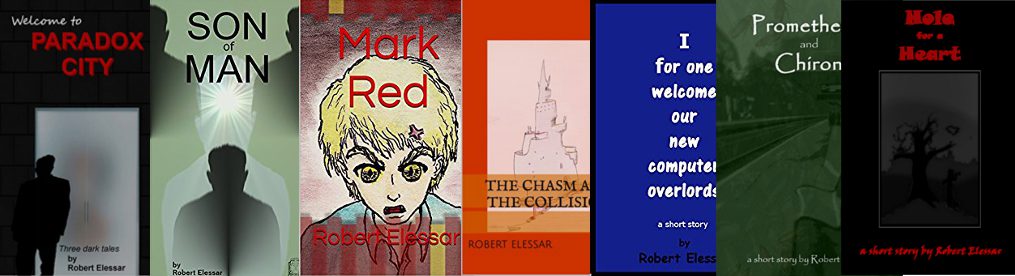
If you’re not good with dark stories, may I suggest The Chasm and the Collision?  My sister has rightly pointed out that it’s my only story with as upbeat an ending as Extra Body.  I would say Son of Man and Mark Red are somewhere in between, and a few of my stories, like If the Spirit Moves You (found in Welcome to Paradox City) and, to a lesser extent, “I for one welcome our new computer overlords” have some lightness to them.  The former could even be called a comedy of sorts.  But both stories center around fairly dark concepts or situations.  Many of my other stories are horror stories…though there’s not a single “supernatural” thing in my darkest ever story, Solitaire, which is available solo and also appears in Dr. Elessar’s Cabinet of Curiosities.

Anyway, I doubt very many people will ever read any of my stories, which I think is too bad, but I certainly have no right to have my stories read.  I think there might be a lot of people who might get at least some joy out of some of them, though.  I think it would also be very satisfying to know that many people read my stories and some fraction of them enjoyed them.  Even if they read them without knowing who the author was, I might not mind.  But maybe I would.  I’m not quite so egoless as all that.

Despite that aside, I have not started writing anything new since publishing Extra Body.  I did open up and look at Outlaw’s Mind and I remade a version of it with the whole first in media res scene taken out, since the story ended up going in directions that I think were better than that original idea.  But I have no will to work more on it.  Likewise, when I even contemplate working on HELIOS, I feel an almost visceral revulsion or intimidation.  And roughly the same thing applies for DFandD, or any of my other potential stories, like Changeling in a Shadow World and Orion Rising and so on.

The various drawing materials I bought upon being briefly inspired by Facebook “reels” of people drawing have laid fallow since I got them.  I can’t imagine drawing something now.  Nor can I really focus enough to read books or watch lectures on serious treatments of General Relativity or Quantum Mechanics, though I dabble here and there throughout most days.

I did read a new book:  Annihilation.  I had seen the movie, starring (a thoroughly misused) Natalie Portman, and wasn’t very impressed.  But then I stumbled across a video page by a young woman who is a Star Wars fan and an author and who said she had loved the book but then had seen and hated the movie, so I got the book (for Kindle).  It was hypnotic and disturbing and bizarre, and definitely far better than the movie.

Unfortunately, it’s told in first person, and when I read first person books I tend to lose a bit of my own sense of self and start thinking with the narrator’s thoughts, even about my real life, at least for a time.  It’s the closest I come, in a way, to having a real “theory of mind” in the ordinary sense.  Otherwise, I don’t tend to have a concept in my mind of what other people might be thinking or doing or feeling when I’m not in their presence.  I think reading fiction from a young age helped save me from being utterly confused by humans in general.

People are observable phenomena, and can be fascinating and fun and engaging, and I like less than half of them half as well as they deserve.  But other than through their own words, or through fiction, I don’t really have an “image”*** of other people’s thoughts or minds.  I’ve never even for a moment wanted to be someone else (though pretending to be‒i.e., acting‒can be enjoyable), because I can’t really imagine what it would be like to be someone else‒not from a subjective point of view, anyway.

I have been playing guitar and singing a bit in the mornings at the office some days, when I know I am by myself and can feel relatively uninhibited.  That’s sometimes enjoyable and sometimes painful (though in a strangely addictive way), and I occasionally think about making a video like some I’ve made previously, of me playing and singing Nothing Compares 2U, or Fake Plastic Trees, or Lucky, or The Man Who Sold the World, or even Karma Police or Ashes to Ashes or Weird Fishes (though I can’t so far do the “arpeggi” part of that latter song), all of which I can play and sing reasonably well.  But the thought of doing the work is too intimidating, and anyway, I can’t really bear the notion of putting my disgusting face out there for people to see.

Okay, well, that was a meandering bit of nonsense.  Unfortunately, here I am, still here, alive and writing this blog‒if nothing else for the moment.  I hope something will change about all that, and soon.  I cannot continue as I am, but I cannot see any better path other then no path at all.  Still, of all things, writing this blog is probably the most ego-syntonic thing I do, and I greatly appreciate everyone who reads and likes and “likes” it, even if I cannot comprehend why you do.  Just, thank you.  I surely cannot thank you as much as you deserve.

TTFN


*Though, like everything else about me, it turned out not to be good for very much for very long.

**Or should that be “wills-o-the-wisp”?

***Not really the right term.  Perhaps “model” might be better?
Extra Body: Chapter 12

As Albert began the luxurious climb back to consciousness, he became aware that, during his sleep—a duration he didn’t yet know—Walter had indeed not finished unlocking the first lock on his door.  In fact, just after Albert had drifted off, Walter had found that his tension, his anger, his jealousy, and his hostility had all started to wane.  His nervous system quickly went from reckless agitation to a state of real calm, of equanimity.

Walter looked down at himself, kneeling before Albert’s door, holding and attempting to use a set of lockpicking tools he had once ordered from Amazon out of curiosity, but which he had never been able to master.  He pulled the torsion bar and the pick out of the lower lock, looked at them, and thought, “What am I even doing?” Continue reading

Extra Body: Chapter 11

Roughly an hour had passed since Albert had last left the bathroom.  He had eaten, and he had drunk his cup of coffee, and he was quietly scrolling through some of the stories on the Google news page, when a feeling of strange disquiet rather suddenly grew upon him.

He lifted his head from his contemplation of his home computer screen and looked around.  His small living space was fairly well circumscribed, and almost all of it was in view from any other point within it.  There really was no place for anyone or anything to hide—at least, nothing much larger than a spider or an occasional roach.

Nevertheless, he felt a sense of unseen threat, or at least some worry, developing.  He looked down at his forearms and was mildly surprised to see them riddled with goosebumps. Continue reading

Extra Body: Chapter 8

Albert was silent for the rest of the drive home, which was not terribly long.  He didn’t think anything clear or precise, just felt a vague sense of contemplation, something that he supposed was almost a Zen-like state.  He was a bit surprised that he was not more nervous than he was, but then again, he felt stronger, more confident, younger—those things had to affect his mental state and acuity, and not just in helping him remember JFK’s youthful medical issues.

Even if the shampoo didn’t directly influence his nervous system—and he didn’t see how it could affect it—just being healthier, feeling healthier, had to have knock-on effects that would improve other aspects of his health.  He thought that he recalled that he had been better at getting “into the zone” when he was younger, such as when he was studying in college. Continue reading

And nature, as it blogs again toward earth, is fashioned for the journey

Hello and good morning.  It’s Thursday, and so:  here’s another blog post—meaning another regular, weekly, Thursday morning blog post.  Of course, people who receive notifications about my blog posts will have seen already that not only did I publish an impromptu entry on Monday, but also that, starting on Tuesday, I’ve been sharing a chapter at a time, three times a day, of Extra Body.

I finished the third editing run-through of that story by Tuesday morning, and I decided, “that’s good enough, I’m done with that, I’m tired of working on it, or on anything else”.  I considered just publishing it through Amazon, but that would have involved designing a cover and getting the formatting right for the paperback and e-book versions, and even then it would have been far from likely that anyone (except my sister) would read any of it, ever.  At least this way, maybe someone who is idly curious but wouldn’t go to the trouble of actually buying the book from Amazon (or other sources) might idly start reading it and even might read the whole thing.

Speaking of the whole thing, it will be completely published by Friday afternoon, which is when Chapter 12 is scheduled to go up.

I don’t know whether the story is any good or not.  I suppose that would depend upon the criteria one uses to judge the “goodness” of a story, and no two people would probably have precisely the same implicit criteria.  I say “implicit” because I doubt most people (or anyone, really) would actually apply any formal judgement criteria to such things.  I think it’s a much more “analog” process, a weighted neural network/high-dimension vector addition (or possibly vector calculus) sort of problem.  As such, it probably changes from day to day and even from moment to moment for every person.

It may be mathematically possible in principle for two people to have exactly the same judgment criteria about fiction*, but I suspect that there aren’t anything like enough people in all the universe—not just spatially but temporally, past and future—to have exactly the same mental state regarding how they judge and react to fiction at any given time, or even in their entire lifetimes (this discounts the potential “quilted multiverse”, if the universe is spatially infinite, in which all states would recur an infinite number of times).

I’m giving this more thought than it probably deserves.  I tend to do that.

On to other matters, or at least, let’s move away from that subject.

This Sunday will be the day of the Autumnal Equinox, the official beginning of Autumn in the northern hemisphere.  It’s also September 22nd (this is often the case with the Autumnal Equinox) and is thus the date of Bilbo and Frodo Baggins’s birthdays (according to Shire reckoning, anyway—I’m not sure precisely how that lines up with the Gregorian calendar, but I suspect Tolkien just kind of took them as roughly aligning, though the hobbits apparently took the 5 (and a quarter-ish) extra days of the year as a non-month in midsummer and had 30-day months for all the rest of the year).  That was also the day on which Frodo left Bag End to begin his long and arduous and torturous path to destroy the One Ring.

So it is an auspicious day in more than one sense, a day on which momentous or portentous things may begin or end or begin to end.

Though Frodo survived, of course, he never was quite the same after his journey, having suffered from the stab of the Morgul blade on Weathertop, and the bite of Shelob, and—most of all—the terrible effects of the Ring itself when it was at its most perilous, its most awake, and its most desperate.

The voice-over near the end of the movie The Return of the King really expresses Frodo’s sense of enduring damage and suffering:  “How do you pick up the threads of an old life?  How do you go on when you begin to understand there is no going back?  There are some things that time cannot mend.  Some hurts that go too deep, that have taken hold.”  How, indeed?

Nietzsche is famously quoted as having said that whatever doesn’t kill us makes us stronger.  In response to that, I would simply say to him, “syphilis”**.

There are many things that do not kill us that nevertheless wear us down, leave scars and damage and dysfunction in their wake.  Of course, one could reply that such things are killing us, they are merely doing it slowly, in a cumulative and collective fashion.  But if one is going to reach for that linguistic/semantic escape clause from the dichotomy of Nietzsche’s statement, then one is merely engaging in tautology.  If one says that anything that doesn’t make us stronger is, by our definition, killing us (even if only slowly), then saying that whatever doesn’t kill us makes us stronger is just saying the same thing.  No insight is gained.

In any case, things wear out and fall apart no matter what.  As far as we can see, that is a fundamental aspect of the nature of reality.  New things do arise, lives are born, stars form, perhaps new “universes” are constantly emerging in an eternal inflationary universe.  But mathematics dictates that all things eventually seek out the most entropic states—not out of any desire, any “telos”, just out of the tendency of the math of complex systems.

Things fall apart.  The center cannot hold.  And Darkness and Decay and the Second Law of Thermodynamics hold illimitable dominion over all***.

TTFN


*Though if the process is truly continuous, in the “real numbers” sense of continuous (quantum mechanics suggests this cannot be so), then there would be literally, uncountably infinite possible arrangements, and so it would be “infinitely improbable” for any two people ever to match exactly.  That seems appropriate, given the story being discussed.

**Perhaps the real “Montezuma’s Revenge”.

***This is a mashup of and paraphrasing of separate literary works, so I’m not surrounding it with quotation marks, but:  credit to Yeats and to Poe****.

****No, NOT the heroic pilot from the newer, Disney-Star-Wars films.  You Philistines*****.

*****This is, ultimately, a reference to the fact that the Philistines, according to legend, stole the Ark of the Covenant from the Temple of Solomon, and thus their name is used as an epithet referring to those who show no respect for sacred or artistic or cultural worth.

Extra Body: Chapter 5

Albert decided to have his dinner before trying anything with the V-42, largely because he didn’t want to let himself get too excited.  It would be only too easy for him to try Walter’s idea and then sit and stare at whatever he threw together, hoping to see a change.  He wasn’t sure that he understood everything that Walter had been trying to communicate, but it seemed to him that, if bacteria and mold and yeast and the like could take food from their environments and make copies of themselves, it wouldn’t be entirely unreasonable for tiny, designed machines to do so.

Of course, he had to let himself accept that, even if Walter was right and the shampoo was actually a collection of numerous tiny devices, that didn’t mean they would copy themselves.  They might just be—what…programmed, designed?—to clean someone and smell nice and…well, and fix their appearance and health.  Even thinking about it seemed impossible, but he’d received so much positive feedback from people at work on his appearance, and Walter was also involved.  It helped him feel less that he might be going insane. Continue reading

Extra Body: Chapter 4

Albert didn’t do much for the remainder of that Sunday, feeling restless but unfocused.  Once he put the V-42 back in its spot in his shower—its volume not noticeably reduced despite the sample he’d given Walter—he just watched some sports on TV and had a very light dinner before going to bed.  Despite his minor anxiety and the fact that he really hadn’t done much that day other than his lunch meeting, he dropped off easily when he laid down to sleep.

The next day at work, his mind wandered quite a bit as he thought about Walter examining the shampoo and trying to find anything in the science journals about it.  When he had used it that morning—careful not to squeeze out more than absolutely necessary—he noticed that it still lathered admirably, and it still smelled and felt as nice as before.  He half expected it to lose its charm over time, but so far that wasn’t the case.

He didn’t need to use his reading glasses at all that day, even at work, even when he was reading comparatively small print.  That hadn’t been the case in years, and now that he thought he knew something about why it was happening—or at least, what the trigger was—he was amazed.

Perhaps because of this, he got a question or two about whether he’d gotten contact lenses.  He was also asked if he had gone to the beach that weekend, or if he had been to a spa.  One rather indiscreet coworker even asked if he had gotten laid, since he looked so vibrant and upbeat.

Albert did feel energetic.  He didn’t find himself needing to drink as much coffee as usual.  He also didn’t get sleepy right after lunch, as sometimes happened.  However, he did feel slightly tense, trying not to dwell too much on Walter’s investigation.  He did not fully succeed, but at least no one complained about his distraction.

In fact, he thought a few of the women at the office actually flirted with him, including some who were quite a bit younger than he was.  Nothing was inappropriate, and certainly no one asked him out on a date, let alone a surreptitious trip to the supply room.  Still, Albert was quite sure that no one had flirted with him since before he’d been divorced.

After work, he held off from calling or texting Walter until he got back home, but once he did, he sent the simple inquiry, Any news?

He was surprised by how quickly Walter replied, and in a text that was unexpectedly long.

Nothing so far.  I’ve been looking through journals and all, but so far no luck.  And I can’t exactly start doing NMR or chromatography or anything during the middle of the day.  I wouldn’t get in trouble, but it would look pretty weird.

Albert didn’t know what those were, but he didn’t feel the need to inquire.  It made sense that Walter would not use any special equipment during working hours.  That made him feel a bit guilty, as he worried that he was taking too much of Walter’s time.  He probably owed his friend at least another meal.

Okay, he texted back.  Thank you very much.

Don’t worry about it.  I’ll let you know if I find anything interesting.

That was it for the evening.  Albert had a moderate meal, watched a game for a bit on TV, and then went to bed.  Despite his tension, he found it easy to drop off, something that was also more reminiscent of his younger days than recent experience.

He slept through the night and awakened moments before his alarm went off.  His morning ablutions were now his favorite part of the day, for that was when he used the shampoo.  The bottle still showed only a minimal reduction in its full level, a fact for which Albert was deeply grateful.

Tuesday was not noticeably different than Monday at the office for Albert.  He continued to get compliments, some with only thinly veiled but non-malicious jealousy, but no one seemed to think anything uncanny or inexplicable was happening.  Those who said anything out loud just seemed to think Albert had started doing some new exercise or diet or similar lifestyle intervention.  He briefly thought that he should think of some credible explanation to give people—maybe Pilates or something along those lines—but the thought didn’t stay with him for long.

Then, not long before quitting time, he got a text from Walter that read, Call me when you leave the office.

That sounded promising, and even vaguely alarming.  Albert felt more than just a twinge of anxiety as he texted back, Will do.

He didn’t wait until he got back home, but instead linked up to his car’s Bluetooth and, after he pulled out of the office, he dialed Walter, hoping he would get through.  After barely more than a single ring, the line connected, and Walter’s voice said, “Hello?  Albert?”

“Yep, it’s me,” Albert replied.  Unable to put off the point of the call with pleasantries, he went on, “So…did you…did you find anything?”  He didn’t quite know why he stammered.

There was a pause, then Walter asked, “Are you with anyone?  I mean, can anyone else hear you, or are you by yourself?”

Even to Albert, tense as he felt, that question seemed melodramatic.  Nevertheless, he was happy to be able to reply, “Nope, no one’s with me.  I’m by myself in my car.”

“Good,” Walter said.  Then he repeated, “Good.  I…well, it’s interesting.”

“What is?” Albert asked.  He hoped that Walter had found some promising information about the V-42 shampoo—perhaps its real identity and what company made it and where it could be bought.  He didn’t want to divert Walter, though, so he said nothing else other than that open-ended question.

“Well,” Walter began, “first I checked the regular literature as best I could, just trying various key words and all that might have anything to do with a new shampoo or even some kind of…tonic or whatever, something that might pep somebody up.  I even did some searches about aging research and all, but there was nothing that came close.

“I went to all the pre-print severs I could think of:  arXiv, bioarXiv, chemrXiv, a bunch of other…”

Albert couldn’t help but interrupt, asking, “What are those?”

“Oh, yeah, I guess it makes sense you wouldn’t really know about those.  Why would you?  Well, pre-print servers are places where people can upload research papers in various scientific fields before they’ve been put in a journal or peer reviewed or anything.  It’s like an extra, early step of peer review, getting feedback and criticism before the journal editors see them and everything.”

“Oh, okay,” Albert said, though he wasn’t sure he understood much better than before.

“Anyway, long story short, I didn’t find anything,” Walter went on.  “I mean nothing.  Not even any basic research that might lead to a shampoo that could…restore hair color and growth and smooth wrinkled skin and everything.  Of course, like I said, something like that could easily be proprietary research.  No sane company would let another company or another country get wind of something that could do what this stuff has done for you.  But that meant I wasn’t likely to find anything even if the study existed somewhere.”

Albert noted that Walter seemed to have bought into the idea of the V-42 truly being responsible for his rejuvenated state.  He wondered if that was just because there had been time for the notion to sink in, or if Walter’s search hadn’t been quite as fruitless as he’d so far made it sound.  He wasn’t sure how to coax the truth about that question from his friend without sounding insulting, though, so he simply said, “I see.  So, what does that mean, then?”

“Well, I figured if I wanted to know more, I’d need to look into things physically, myself, and I had your sample, after all.  So, last night I set it up for a couple of kinds of chromatography, basic spectroscopy, and even used our NMR equipment.”

“You mentioned that the other day,” Albert noted.  “I don’t really know what any of those things are.”

“Well, like I said, why would you?” Walter responded.  “They’re basically ways of figuring out what something, some substance, is made up of.  Spectroscopy checks what wavelengths of light something absorbs or radiates, depending on what you’re doing.  Chromatography separates things out based on stuff like charge or molecule size, that kind of thing.  There’s gas chromatography, thin-layer chromatography, gel electrophoresis, all that kind of stuff.  And NMR uses the fact that nuclei of atoms in high strength magnetic fields react certain ways to radio frequency radiation to figure out what atoms are in things…what elements, I mean.  It’s the same technology that’s used in MRI machines…only it came from organic chemistry labs first and was only used for scanners afterwards.”

A lot of that went over Albert’s head, but it impressed him nevertheless.  “You did all that?” he asked.  “In two days?”

Walter gave a nervous laugh and replied, “No, not all of it.  I mean, gel electrophoresis is mainly used for biological molecules…proteins and DNA sequencing, that kind of thing.  But I did do some basic spectroscopy and chromatography, and I did use our NMR facilities, too.  That stuff doesn’t take long nowadays.”

“Wow,” Albert said, still impressed.  “So…did you find anything interesting?”

“Well, that’s just it,” Walter replied.  “None of the tests showed much but water and some basic elements…carbon, iron, some silicon, some other stuff that’d be a bit weird in a shampoo, especially in the relative concentrations they seemed to be in, but that was pretty much it.  There weren’t even any organic molecules.  No long carbon chains of any kinds, no particularly hydrophobic or hydrophilic groups…nothing.  Nothing that could be a detergent or even a traditional soap.”

Albert wasn’t sure of the specific sorts of things Walter was describing, but the concluding sentence was clear.  “That’s…a little surprising in a shampoo, isn’t it?” he said.

“Yes it is,” Walter agreed.  “There weren’t even any compounds that could’ve been the coloring or scent molecules.”

Albert shook his head, trying to make sure to focus on the road.  He was glad that he’d chosen not to go on the turnpike but was driving on side streets where the traffic, though rather congested, was not speedy or dangerous.  “I don’t understand,” he said.  “I mean…could something have gotten mixed up?”

“If you’re asking whether I was accidentally testing something else instead of the shampoo, then no,” Walter replied.  “I mean, I might’ve conceivably screwed up one, but all of the tests?  I don’t see how that could happen.  And nothing I might’ve screwed it up with could’ve made the tests come out quite the way they did.  Tap water wouldn’t even look like that, not exactly.”

After another brief pause, feeling rather disappointed, Albert asked, “Well…what do you think happened?”

“Well, I wasn’t sure, at first,” Walter said.  “Actually, I’m still not sure, but I’m getting to that.  Anyway, I might’ve thought that maybe you were pranking me somehow, that it was a magic trick or something, you’d switched the samples with sleight of hand, or…”

“I don’t know how to do sleight of hand,” Albert interrupted, feeling very mildly offended, “and I can’t imagine why I would do something like that.”

“Yeah, well, neither can I, really,” Walter admitted.  “But also…well, you know how I’ve always had trouble with allergies?”

Albert was caught mildly off guard, but he reoriented quickly and said, “I think so.  You used to have those prescription nasal steroids and sprays and stuff all the time, at least part of the year.”

“Exactly,” Walter said.  “Especially this time of year.  And, incidentally, you don’t need prescriptions for most of those anymore, which has been good, because if anything, my allergies have gotten worse over time…especially at this part of the year.  But…well, you remember that I said my headache was gone on Sunday after I ate?”

“Sure,” Albert replied.  “I figured the food probably helped with your hangover.”

“So did I,” Walter said.  “But then, over the last two days, I realized that my nose, and my lungs, are completely clear.  I had the best night’s sleep last night that I’ve had in years, because I wasn’t congested at all.  I don’t think even my eyes are watering.”

Albert was silent for a moment.  He thought he understood what Walter was implying, but he somehow didn’t want to say it out loud, so he simply muttered, “That’s impressive.”

“Yeah,” Walter said.  “Just from a couple of sniffs of that stuff.”

“Are you…are you sure that’s what did it?” Albert asked.  “Maybe it’s just a coincidence.”

“If it was just my allergies, I might think so,” Walter said.  “Or, at least, I might consider it.  But seeing what’s happened to you…no, I don’t think so.”

Albert paused for a moment, admitting to himself that Walter had a point.  Finally, he asked, “So…well, what do you want to do now?”

“Hang on,” Water said.  “I’m not finished.  You see, I got kind of frustrated, and also confused, about why I couldn’t find anything, so I decided I’d go old school, and I just got some of the stuff in a pipette and put it on a microscope slide.  I figured at least I might get some idea of what it might be made of.

“But when I looked at the first sample under the regular light microscope, I was…well, I was confused.  It looked almost like it wasn’t exactly a solution or whatever, but almost like there was a bunch of stuff moving around in the liquid.  Or maybe like the whole liquid was just stuff moving around.  And I don’t mean molecules or anything, since every liquid really is a bunch of molecules moving around.  But you can’t see molecules with light microscopy.  But there was stuff moving there, a lot of things, that I could barely make out.  But then, after I’d been looking at it for less than a minute, the movement just suddenly stopped, and everything went clear—well, a bit muddy, I guess, but basically clear.

“And when I looked at the slide, it had just…it looked like ever-so-slightly discolored water.  It wasn’t the same as when I had put it on the slide.”

“Huh?” Albert said.  “How can that…I mean…do you think it, like, reacted to the light or something?”  He wasn’t sure his question made sense, but it was all he could think to ask.

To Albert’s odd pleasure, Walter said, “Well, I wondered that, myself, for a few seconds.  But then I thought, no, it’s been exposed to light all along.  I mean, that bottle is basically transparent, and I’m assuming you don’t shower with the light off.  And the plastic thing I had it in is translucent, at least.  It’s gotten plenty of light exposure, and the microscope light isn’t really that much brighter than the room light.

“But that movement made me really curious.  I was thinking about microbes of some kind, that maybe there were some kind of…I don’t know, protozoa or something in it, like active cultures in yogurt or something.  I didn’t want to try to stain it any or anything.  Anyway, I haven’t done anything like that in years, and I wouldn’t know where to look for the stains in our labs, or which ones to use.  But I knew we did have a setup for phase-contrast microscopy, so I decided to do that.”

“What’s that?” Albert asked, feeling quite out of his depth.  He was still barely halfway back to his house, but he was actually glad that the commute was slow.

“It’s where you shine two lights on a sample, one from below and one sort of from the side, so you highlight contrasts and different surfaces—almost like making shadows so details can stand out, but without having to kill anything in the sample.  I still had enough left in the original to work with, so I got another slide ready.  I was worried it’d just turn to water before I got to look at it, but it was okay.  But I looked at it, and after only a minute or so, it…”

Walter paused, and Albert only waited a moment—realizing he was holding his breath at first—before asking, “What?  What happened?”

“Well,” Walter said after a further brief pause, “I definitely got a better view for a least a minute.  And there were…there were all sorts of little…little things moving around in the liquid.  Maybe the whole liquid was just those things moving around, like I said, I don’t know.  But there were loads of them, I mean I don’t even know how many.  But they were small.  I mean, smaller than bacteria usually look under the magnification I was using.  I know, I looked it up.  And they were…they were almost dancing around with each other, connecting with each other.  And I swear while I was watching, a lot of them linked up and went stationary, like they were…I don’t know, like they were networking with each other or something…and then, all of sudden, all at once, they just…dissolved.  The sample turned itself into basically slightly gritty water, just like before.  I got one more sample, about all I had left of the stuff, and the same thing happened again.  It was moving around, and connecting, then it was like…like it sent itself a signal and just…poof, turned to water with some bits of grit floating in it.”

Albert was utterly puzzled, not able to put together at all what Walter might have seen.   He had been stopped at a light while Walter spoke his last few sentences, but now he started moving again, and this triggered his speech, so he asked, “What…what do you think it was?”

“Well…I know it might sound crazy, but I think…I think that liquid is full of nanomachines,” Walter replied.  “Or, well, maybe even smaller, because I could barely make out even any shape under the highest resolution I had.  And there were loads of them.  The whole thing looked like it might have been made up of nanomachines—hell, I’d almost say Pico machines, but that’s probably exaggerating, I don’t know.”

Albert felt confused.  “Wait,” he said.  “I…I mean, I’ve heard that term before, ‘nanomachines’, but…but what exactly is it?”

“A nanomachine is just what it sounds like,” Walter replied.  “It’s a literal machine, maybe a little motor or whatever, but one that exists on a nanometer scale.  I think it was Richard Feynman who first made the concept popular, in this lecture he gave way back when, called ‘plenty of room at the bottom’ or something like that.  But people have really been working on them for years.  And, in a way, all the stuff inside a cell—proteins and ribosomes and cell membranes and cilia and all that—are kind of natural nanomachines.”

Albert thought for a moment, then asked, “So…so you think the shampoo is like some…I don’t know, what you said before, like yogurt with active cultures in it?”

“No, no,” Walter said.  “What I think is that these are—well, were—actual, tiny little machines.  Real machines.  Remember, I said there was iron and silicon and some other metals and things in the stuff?  I think they’re actually little, tiny robots of some kind, and they move around, and link up and make networks, and probably do computations…and when they detected that they were being observed…they self-destructed.”

If it hadn’t been for what he’d seen happen to himself from using the shampoo, Albert would’ve thought his friend was joking or maybe crazy.  Even so, he couldn’t quite make sense of things.  “Wait,” he said.  “That’s—are people really able to make things like that?”

“No way,” Water replied without an instant’s hesitation.  “We’re decades from being able to make things like that.  I did a literature search.  The most complicated things that’ve been made are these little crawling, wiggling things that don’t do very much, and an electric motor of sorts back in 2011.  Nothing seriously this complex has been made yet, not even close.  Certainly nothing that could network up and form more complicated structures in real time, and then self-destruct.  And nothing even remotely close to what we’ve seen this stuff do to you…and to my allergies.”

“Wait,” Albert said.  “If no one can do this, why do you think it’s what’s happening?”

“Because of what I saw and what I felt and what has been happening,” Walter said.  “I can’t think of any other explanation that makes sense.”

“But wait,” Albert said.  “If people aren’t even close to being able to make these things, then that doesn’t make sense.”

“Well…not necessarily,” Walter said.  Albert thought he heard a hesitant note in his friend’s voice.

“What, you don’t think this is something like aliens or something, do you?” Albert asked, not liking the need to pose the question, but feeling it was inescapable.

“Not exactly,” Walter replied, and he still sounded unsure of himself.  Albert could practically feel the tension in his friend’s posture over the phone, but he waited for Walter to go on, which he finally did, saying, “You remember what I said in the restaurant, when I saw the name of the shampoo, about ‘life, the universe, and everything’?”

Albert vaguely thought he did, so he replied, “I think so.  Why?”

“Well, the brand name of the stuff, the manufacturer, or whatever, is ‘H, o, G’,” Walter said.  “Thinking about the Hitchhiker’s Guide, does that ring any bells?”

Albert was thoroughly nonplussed, and he didn’t try very hard to understand Walter’s point before saying, “Not really.”

“Oh, come on,” Walter said.  “I mean, you’ve read the book, right?”

“Sure,” Albert said.  “Way back in college…or maybe it was high school, I don’t know.”

“Okay, fair enough,” Walter admitted.  “You never were as into that kind of stuff as me.  But you remember the part about how Zaphod Beeblebrox stole that ship at the beginning, before he picked up Arthur Dent and Ford Perfect?”

Albert felt that the conversation had taken quite a large detour, but trying to process Walter’s description of what he’d seen was certainly not easy for him to do, so he gave relatively serious effort to following the new thread.  “I…think I remember that, basically.  There was something about some aliens that did really bad poetry or something, wasn’t there?”

“Right!” Walter said.  “That was the Vogons.  So, all right, do you remember the name of the ship Zaphod stole?”

Albert tried briefly to remember, but he didn’t put much effort into it before saying, “Nope.  I don’t remember.”

“It was the Heart of Gold,” Walter said simply, then he stopped.

Something in Walter’s voice made Albert think he expected a reaction from him, and Walter said nothing else for several seconds.  Albert, however, could not think of much to say other than, “Okay.  I guess I think I remember something like that.”

“Don’t you see?” Water went on, his voice tense.  “The Heart of Gold.  Heart, H.  Of, O.  Gold, G.  H…o…G.  The name of the brand, or whatever, on that shampoo bottle you have.  And then the stuff is V-42.  And in the Hitchhiker’s Guide, 42 is the answer to life, the universe, and everything.”

Albert felt like closing his eyes, but he was driving, so that was not really an option.  Walter sounded far too triumphant for the information he was conveying.  Compromising with himself, Albert said, “Okay.  I see what you mean.  So…you think that whoever made this stuff, like…I don’t know, named it after those things because he was a fan?  Or she was a fan?  Is that supposed to be part of a prank or something?  I don’t understand.”

“No, no,” Walter replied, and he sounded mildly exasperated, or at least impatient.  “I don’t think that’s it at all.  What I think is…well, look, do you remember what was special about the Heart of Gold, the ship that Zaphod stole?”

Albert was thoroughly nonplussed, and he felt too distracted by traffic to try too hard to follow Walter’s point.  “I…no, I don’t think so,” he admitted.

“Okay, well,” Walter began, sounding slightly disappointed, “I guess you haven’t thought about it in a long time.  Well, the Heart of Gold was a spaceship that used an infinite improbability drive to be able to get to anywhere in the universe more or less instantly, so it didn’t have to use the hyperspace bypasses, like the ones the Vogons demolished Earth to make room for.”

Albert was utterly confused, not knowing at all why Walter was going into this trivia about a book he himself hadn’t read since college at the latest.  Now that Walter was saying this, Albert did think he recognized at least some of the plot points mentioned, but he had no idea what the conversational point was.  He had thought that Walter was going to tell him something about the nature of the shampoo.  He had been describing how he thought it might be a liquid full of “nanomachines”, and that was why it could do what it could do, but now he had taken this wild tangent into an old comedy science fiction story.

Slightly impatient, he said, “Walter, I’m having a hard time following you.  I mean, I get the idea that maybe this stuff is named after those things from the Hitchhiker’s Guide to the Galaxy, but so what?  It doesn’t really help us find more of the stuff.  Unless you think we could go to…I don’t know, an internet forum or a Facebook group or something that likes the books and try to look around for someone who might have invented this stuff?”

“No, no, I don’t think that at all,” Walter replied.  “I don’t think there’s anyone on Earth who could’ve made this stuff.  Trust me, I keep up with most of the latest developments in science and technology, at least as relates to chemistry and microbiology and stuff like that.  It’s part of what I do for a living.  This stuff is, like, way beyond anything anyone’s working on even in…I don’t know, MIT or Caltech or anyplace.”

Albert was now even more thoroughly confused.  “Well, then, what do you mean?” he asked.

“I think…” Walter began, but then he seemed to catch himself.  “I…well, you remember, the infinite improbability drive did really weird things sometimes.  Like, when the missiles were shot at the ship, it turned them into, I think it was a potted plant and a sperm whale or something like that.  The whale I remember, definitely.”

Albert, in the middle of taking a turn at a light, didn’t say anything for a moment, hoping that Walter’s meaning would become clear.  By the time he finished his maneuver, he had no new ideas, so he said, “Okay.  I don’t remember it as well as you do, obviously.  But I still don’t get what your point is.”

“Well…hear me out,” Walter requested, as though Albert had not been doing so.  “What if…what if when the ship’s drive got activated one time, one of the infinitely improbable things that happened was…was the creation of a bottle of shampoo made of nanomachines and that shampoo appearing in a convenience store on Earth?”

Albert felt his brow contract.  He could practically hear it contracting, producing its series of furrows, smoother than they would have been the week before, in his forehead.  He glanced at himself in the rear-view mirror, almost as if to make sure he was really awake.  Then, finally, he said, “What are you talking about?”

He heard Walter take a breath in before saying, “What if this stuff wasn’t made by anyone on Earth, by anyone at all, but was…was produced as a byproduct of the activation of the infinite improbability drive in the Heart of Gold spaceship, like that whale and that plant?”

Albert paused again, not sure he understood his friend correctly, hoping that he did not understand his friend correctly, because what Walter was saying was legitimately mad.  “Walter,” he said, “that’s a book.  A science fiction, comedy book.  I think it was originally based on a…a radio show or something that was on the BBC way back when, wasn’t it?”  He surprised himself by remembering this last fact, if it was indeed correct.  “It’s not…that spaceship doesn’t really exist.”

“No, I know,” Walter said, sounding far too easygoing in his acceptance.  “But…but wouldn’t something happening in the real world because of a science fiction story be just the sort of thing an infinite improbability drive might make happen?  I mean, what could be more infinitely improbable than that?”

Albert was becoming concerned for Walter’s sanity, and he began to feel a twinge of regret for having brought his shampoo to his attention.  Trying not to sound patronizing, he said, “Walter, that’s not an ‘infinite improbability’, whatever that even means.  It’s impossible.  Fictional worlds can’t…can’t bleed over into the real world.  That’s…things don’t work like that.”

“Maybe they do,” Walter countered.  “Maybe they can, anyway.  I mean, we know fiction can influence the real world, in mundane sorts of ways.  I mean, money is an imaginary, made-up thing, but there aren’t many things that are more powerful in day-to-day life.  And who knows how the universe works, down at the deepest level?  ‘There are more things in heaven and earth than are dreamt of in your philosophy, Horatio,’ right?”

Albert at least recognized that line, grateful for his liberal arts education, and he said, “Quoting Shakespeare doesn’t make what you’re saying any more real, because the characters in Hamlet aren’t real any more than the…the spaceship in the Hitchhiker’s Guide to the Galaxy is real.”

“But isn’t it true that there’s some quantum mechanics principle that there are all sorts of parallel worlds, that, like, every time some kind of quantum event happens, the universe splits, and every possible thing that happens, happens in at least one of those universes?  I think I read somewhere that there’s this principle some famous physicist said, that everything not forbidden by the laws of physics is compulsory?”

Albert was beginning to get exasperated, and he wished he were already closer to home so he could cut the conversation short.  Allowing his mild irritation to come through in his voice, he said, “I don’t really know that much about quantum physics or whatever it is, but you just said yourself, ‘everything not forbidden’.  Well, I’m sorry, but I bet most physicists would say that something hopping out of a science fiction…no, a spoof science fiction story and happening in the real world is probably one of those ‘forbidden’ things.  I mean, you might as well say this stuff was made by…I don’t know, Jedi knights or something.”

Walter was quiet for a moment, and Albert now felt a little bad that he’d gotten so stern with his friend.  Finally, lacking a bit of his prior energy, Walter said, “Okay, well, maybe that is crazy.  Maybe it’s just named after that stuff because whoever invented it thought it seemed like something that everyone would think was impossible, and it was a private joke.  But even if that’s it, it makes sense, because this stuff is…well, it really should be impossible, or at least it should be something way in the future.  I mean, it’s a ‘shampoo’ made out of nanomachines that doesn’t just clean your hair but…but it’s making you younger.  Or, well, it’s making you physically seem younger, at least externally.”

Albert decided to throw Walter a bone, only too pleased that his friend seemed to have dropped the truly insane point he’d been trying to make.  “It’s not just that I seem younger externally,” he said.  “I feel healthier than I have in years.  I mean, a lot of years.”

“Exactly,” Walter said.  “And you look it, too.  But also…I mean, I just took a couple of whiffs of it and my allergies are better than they’ve been in literally as long as I can remember.  I mean, maybe when I was in grade school they were this good.  But maybe not even then, I don’t really trust my memory on this.  But I can tell you, my nasal passages are clearer than they’ve been in my adult life.  Hell, you might even be able to hear it in my voice.  It sounds different to me.”

Albert wasn’t at all sure.  He hadn’t spoken to Walter often enough lately to be able to discern a difference from his typical tones.  Now that he thought about it, Walter sounded perhaps less congested than he had on Sunday, but then again, Walter had been hung over when they’d met, so it wasn’t surprising that he sounded better on a Tuesday evening.

Still, Walter’s point was real, voice changes or not.  Albert not only literally looked better than he had in a long time, he could see better.  His skin was tighter.  He’d literally developed not just darker but more hair, faster than it could have grown, since he’d started using the V-42 shampoo.  Whimsical science fiction ideas aside, the stuff was amazing, and he didn’t doubt that Walter had seen what he had described.

“Okay,” he said, after a pause in which Walter seemed to have waited patiently for his comment.  “So…so the shampoo isn’t really shampoo, it’s made out of…of tiny robots.  I mean, even I’ve heard a little about stuff like that, but you’re right, I didn’t think anyone had gotten anything like as close to this…advanced, yet.  It’s got to be some kind of…leaked secret or something, then, right?  I mean, if it was on the market anywhere then we would’ve heard of it, right?  I mean, you should have heard of it, you’re…you work in this kind of field.”

“Well, not really,” Walter replied.  “Not exactly, anyway.  But you’re right, this stuff is…it’s unheard of.  I mean, there’s no news of anything close to this advanced in nanotech.  Not anywhere, not in journals, not in pre-prints…hell, there’s not even any conspiracy theories about it.”

Albert thought that Walter’s own musings about the possible origin of the stuff sounded wilder than any conspiracy theories he’d ever heard, but he didn’t want to point that out.  Instead, he glumly admitted, “So, I guess this means I’m not going to be able to find another bottle once this one runs out.”  He hated having to admit that to himself, and he wondered if it meant that, as soon as he stopped using the V-42, his overall look and complexion and health would revert to what it had been before his fortuitous find in the convenience store.

“Well…maybe,” Walter said.  “But maybe you won’t have to.”

“What do you mean?” Albert asked.

“Well, look,” Walter began, “I know that a lot of ideas behind nanomachines had the notion of…of making self-replicating nanomachines of some kind.”

“Self-replicating?” Albert asked, though he thought he recognized the term.  “What do you mean?”

“It means making tiny machines that copy themselves using materials from their environments,” Walter replied.  “Sort of like living cells, but more efficient and more durable.  I think…I think some famous scientist and math guy back in the day said that the best way for us, or for any species, to really colonize the galaxy would be to make self-replicating probes and send them out into space, to land on planets and remake themselves repeatedly and grow like that.  So maybe, just maybe, this stuff can replicate itself, make more of itself, if it has access to the right kinds of basic materials…like the iron and silicon and stuff that I found in it.”

“Wait a second,” Albert said, almost putting on the brakes as an alarming possibility occurred to him.  “Are you saying…do you think this stuff might be some kind of…I don’t know, some extraterrestrial probe or something, some…I don’t know, some colonization thing from some aliens?”

“No,” Walter replied, sounding almost contemptuous.  “It’s hard to imagine why aliens would send a bunch of nanobots to Earth inside a shampoo bottle, and make them so they…improve the health of any human who uses them.”

Albert had to admit that sounded far-fetched, but it wasn’t as absurd as Walter’s own earlier notion, so he didn’t think it was quite deserving of such evident scorn.  “Well,” he said, “maybe they’re, like…friendly aliens, aliens who want to send a nice thing out into the galaxy, who want to help other developing civilizations or something.”  Even as he said it, he felt foolish, but he couldn’t deny how otherworldly the shampoo’s effects had been.

“I don’t know,” Walter said.  “I still think the whole shampoo bottle thing seems hard to swallow from aliens.”

“Fair enough,” Albert said.  “But the shampoo bottle is real.  I mean, you saw it, yourself.”

“Yeah,” Walter admitted.  “I did.  And I don’t know if I quite understand that.  But, anyway, we’re getting sidetracked.  You were saying that once it’s gone, it’s gone, but maybe it doesn’t have to be that way.  If this stuff is…is self-replicating, you might be able to make more of it.”

“How?” Albert asked, not quite allowing himself to be optimistic, and not quite following Walter’s point.

“Well, look,” Walter said.  “What if you took some of it…just a little bit of it, maybe even less than what you gave me to test…and put it in, I don’t know, a little cup, with some water and maybe some…I don’t know, maybe some electronic stuff, like maybe an old cellphone or charger or remote control or something, and just left it?”

Albert felt that he must seem slow, but he was puzzled by this idea.  “I don’t get it,” he said.  “Why would I do that?”

He heard Walter sigh rather forcefully before responding, “Because if this stuff can self-replicate, then it might be able to turn the components of a standard electronic device, or even just some steel wool and sand and wires and stuff, into more of itself.”

“That…that seems hard to believe,” Albert said.  “How could it…know how to do that?”

“I don’t know,” Walter said.  “How could it tell when I was looking at it and know to self-destruct?”

“Maybe it didn’t,” Albert said.  “Maybe it doesn’t do well under bright light.”

“No, like I said, that doesn’t make sense,” Walter asserted.  “It was in the lights at the convenience store, and it’s been in the light at your house.  I mean, you don’t keep your bathroom light turned off all the time, do you?”

“No,” Albert admitted.  “I’d rather not make a mess of the floor when I need to use the toilet.  But I turn it off when I’m at work.  Although, I guess I leave it on overnight most nights.”

“Right,” Walter said.  “And that’s full-spectrum light, so even if there was some wavelength it was sensitive to, that would’ve been hitting it before.  It’s not like I used anything that would’ve exposed it to ultraviolet or X-rays or anything unusual.  Okay, the NMR exposed it to some atypical stuff, but that wasn’t the only thing.  And it literally turned to water while I was looking at it, three times in a row.”

Albert tried to take a few deep breaths.  He wasn’t entirely sure what Walter was getting at, but it seemed he thought that the shampoo could make…well, could produce more of itself if he gave it the chance.  If that was so, then he could conceivably have a lifetime supply of this shampoo, without ever having to buy more.

It was ridiculous.  But so was what had been happening to him.

“Okay,” he finally said.  “So…what exactly should I do?”

Walter was silent for a moment, evidently thinking, then he replied, “Okay, well, maybe just…like I said, do you have any old…I don’t know, old cell phones or remote controls or other electronic things you don’t use anymore?”

“I…I’m sure I’ve got something like that,” Albert said.

“Okay, well, maybe get a cup of water, big enough to at least partly put whatever you find in it, and put that in it.  Hell, maybe add a paper clip or a rusty nail or something in it, just to make sure there’s plenty of iron or whatever.  And then put a drop—maybe like an eyedropper full, but if this is right, I don’t think it’ll matter all that much—of the shampoo in it.  And then, just…wait.”

“How long?” Albert asked.

“I don’t know,” Walter admitted.  “I mean, I don’t think you should expect anything to happen while you’re looking.  But maybe…maybe just let it sit overnight or something, I don’t know.  Maybe it’d take longer than that.  Who knows, it could take days or even weeks.  But if it is some kind of self-replicating nanotech, it might be able to turn the stuff into more of itself.”

“And what if it doesn’t?” Albert asked.

“Then we’ll try something else.  Maybe get some actual, elemental stuff, some raw, lab-quality iron and silicon and the other things I saw in the NMR.  We have that kind of stuff here, somewhere.  I wouldn’t even need to order it.  But I don’t…well, I hope it doesn’t even need to do that.”

Albert’s mind was boggled, but he wasn’t able to be as dismissive of these ideas as he had been of the whole Hitchhiker’s Guide notion, given what had been happening to him.  Maybe that had been Walter’s point in bringing that up.  Maybe he’d presented something truly ludicrous just so that Albert would find his other suggestions banal by comparison.  That seemed like a risky strategy, but who knew what Walter might decide to try?

“Okay,” he finally said.  “I’ll…I’ll try to find something like that and put a bit of it in a cup overnight tonight.”

“Excellent!” Walter said, sounding almost boyishly pleased.  “I can’t wait to find out what happens.”  After a pause, he asked, “Will you let me know when you find out, if anything happens?”

“I…sure, why not?” Albert said.  “But I don’t know how long it’ll take, if anything does, or how long it’ll take to tell that nothing is happening.”

“Give it a week, at most,” Walter said.  “Let it soak for a week, and if nothing happens, we’ll try something else.”

“Okay, will do,” Albert said, oddly pleased to have at least some plan of attack, however strange.  “And I’ll let you know.”

Shortly after that, the pair hung up, and Albert continued the drive home.

Extra Body: Chapter 3

Albert left early for the lunch meeting on Sunday, eager and even slightly nervous about seeing his friend.  He’d had abundant energy the day before, so he’d gone for a walk, done some chores around his place, and gotten a head-start on his laundry, since he wasn’t going to be hanging around during the day on Sunday.  He had even gone to a small local restaurant for his dinner, by himself.

Ordinarily, he would have been a bit self-conscious, thinking it was pathetic for a fifty-year-old man (plus a few years) to be eating out alone on a Saturday night.  That night, though, he’d felt fine about it.  The evening air was pleasant, so he had walked to the restaurant, and he felt more than satisfied with the available options.  He enjoyed a glass of wine with his dinner, feeling only very slightly affected by it, and when walking back to his house afterward, he thought that, just maybe, his waitress had been flirting with him. Continue reading