
Then there’s hope a great man’s memory may outlive his blog half a year.

Hello and good morning.  It’s Thursday, the day of the week on which I wrote my blog post even when I was writing fiction every other day of the week—well, apart from Sundays and the Saturdays when I  didn’t work.  I have not been writing any fiction recently.

I toyed with the idea the other day, but there doesn’t seem to be much enthusiasm for the notion, which I suppose is mirrored by my own lack of energy, or perhaps has its source in my lack of energy.  Or maybe they come from disparate but merely coincidentally parallel sources.  I don’t know, and though it’s mildly interesting, I don’t have energy or interest enough to try to figure it out.

I did work a bit on a new song yesterday, the one for which I had jotted down some lyrics a while back.  I have lost utterly the original tune, but I worked out a new one of sorts, and it seems okay.  I then worked out some chords for the first stanza, including some relatively sophisticated major sevenths and then major sixths of a minor chord that sounded nice, and which made me at least feel that I really have learned a little bit about guitar chords.  Then I figured out at least the chords I want for the chorus, which, among other things, throw a little dissonance in briefly, which is nice to up the tension.

I don’t know if I’ll get any further with it or not; I may just stop and let it lie.  It’s only perhaps the third time I’ve even picked up the guitar in months.  I was at least able to show myself that I can still play Julia, and Wish You Were Here, and Pigs on the Wing.  I had to fiddle a little to remind myself how to play Blackbird, but after a brief time I was able to bring it back, too.

So, it’s not all atrophied.  And I can still play the opening riff to my own song, Catechism, which I think is my best stand-alone riff.  My other guitar solos are mainly just recapitulations of the melody of the verse or chorus in their respective songs, but the one for Catechism is a separate little melody.

Actually, it occurs to me that I initially did a voice recording of the lyrics to the newish song as I thought of them, and when I did, I probably sang a bit of the tune that had come to my head.  Maybe I should listen to that and see if I like that melody better than the new one I came up with.  That would be a bit funny, if after the effort from yesterday to do a melody and chords I remembered the old one and just threw the new one away.

I suppose it really doesn’t matter much.  Even if I were to work out and record the song, and do accompanying parts and all that stuff, and publish it, I don’t think anyone is likely ever to listen to it much.  Maybe someday in the distant future, some equivalent of an archaeologist who unearths things lost in the web and internet will find the lost traces of my books or music or something, and they’ll be catalogued in some future equivalent of a virtual museum, among trillions of other collections of data that are recorded on line, but which will never seen by anyone for whom they might mean anything at all.

People sometimes say things like “what happens online is forever”, but as I’ve discussed before (I think), even if it’s true that things stored online remain and avoid simple deterioration of data thanks to the redundancy in the system, it doesn’t matter.  In principle, the sound of every tree falling in every wood has left its trace in the vibrational patterns of the world, and according to quantum mechanics, quantum information is never permanently lost, even if things fall into black holes*.

But of course, all that is irrelevant in practice, and comes back to collide with the nature of entropy and the degree to which most large-scale descriptions of a system are indistinguishable.  That picture of you with a funny face at that event years ago, which you tried to have a friend take down, but which had already been shared to a few other people, may in principle always be out there in the archives of Facebook or Twitter or whatever, but it doesn’t matter.  No one will ever notice it or probably even see it among the deluge of petabytes of data whipping around cyberspace every second.  You might as well worry about people being able to reconstruct the sound waves from when you sang Happy Birthday out of tune at your nephew’s fifth birthday party from the information left over in the state of all the atoms and molecules upon which the sound waves impinged.

It’s one of those seemingly paradoxical situations, rather like being in Manhattan.  There are very few places in New York City, and particularly in Manhattan, where one can actually be alone—even most apartments are tiny, and have windows that look out into dozens to hundreds of other people’s windows.  And yet, in a way, you are more or less always alone in Manhattan, or at least you are unobserved, because you are just one of an incomprehensible mass of indistinguishable humans.

Even “celebrities” and political figures, so-called leaders and statespeople, will all fade from memory with astonishing rapidity.  When was the last time you thought about Tip O’Neill?  And yet, for a while, he was prominent in the news more or less every day.  Do you remember where you were when William McKinley was assassinated?  No, because you were nowhere.  None of you existed in any sense when that happened, let alone when, for instance, Julius Caesar was murdered.

And what of the many millions of other people in the world at the time of McKinley or Caesar or Cyrus the Great or Ramses II?  We know nothing whatsoever of them as individuals.  Even the famous names I’m mentioning are really just names for most people.  There’s no real awareness of identity or contributions, especially for the ones who existed before any current people were born.

Last Thursday, I wrote “RIP John Lennon” and put a picture of him up on the board on which we post ongoing sales and the like.  The youngest member of our group, who is in his twenties, asked, “Who is John Lennon?”

He was not joking.

If John Lennon can be unknown to members of a generation less than fifty years after his death, what are the odds that anything any of us does will ever be remembered?

Kansas (the group, not the state) had it right:  “All we are is dust in the wind.  Everything is dust in the wind.”  The only bit they missed was that even the Earth will not last forever, and as for the sky…well, that depends on what you mean by the sky, I suppose.  The blue sky of the Earth, made so by light scattering off Nitrogen and Oxygen molecules, will not outlast the Earth, though there may be other blue skies on other planets.  But planets will not always exist.

As for the black night sky of space, well, that may well last “forever”, for what it’s worth.  But it will not contain anything worth seeing.

TTFN
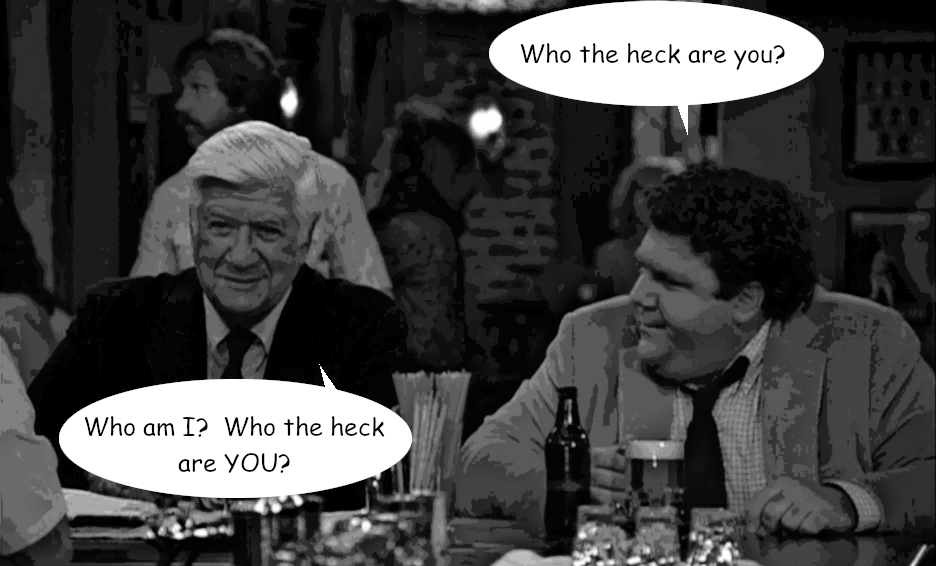
Tip


*Leonard Susskind famously convinced Stephen Hawking that this was the case—and even won a bet in the process—though other luminaries were of course involved, including Kip Thorne, I believe, one of the masters of General Relativity.

Lyin’ there and staring at the ceiling

Well, I’m sitting here at the train station almost half an hour early for the first train of the day, after already having lain awake in bed for over two hours before finally giving up and getting up.

I feel that I’m waking up earlier and earlier over time, but it’s not as though I go to sleep any earlier.  I’ve been trying to be careful about when and how much I take in of caffeine, and allergy medication, and all that stuff, but adjusting it—or even leaving it out—seems to have minimal effect on my sleep patterns, though it does have its effects on my nasal passages.

I wish I could imagine that something were soon to come for me such as happened in the Stephen King novel, Insomnia.  That would at least be interesting.  But this has been going on for far too long to expect it to be part of some overarching, meta-cosmic chess game against the forces of the Random.  For one thing, though those ideas make for a good story, they don’t hold up to logic in any kind of realistic sense, considering legitimate mathematics and physics and biology and chemistry and all that jazz.  No, I’m just an insomniac because of chronic depression and other neuropsychiatric issues for which we have no cure and about which we only have limited understanding.

What a funny universe.

Oh, speaking of neuropsychiatric issues, I’m not going to be posting the transcript of my interaction with Amazon yesterday, after all.  For one thing, they did at least end up delivering what they were supposed to deliver, albeit far later than it was supposed to be delivered, and it did what it was supposed to do.  Anyway, it wasn’t the only thing that set me to feeling like I was hanging on by my fingernails yesterday, so I think a lot of the issue was with me.

I’m sure if you could read my interaction, you’d probably agree.  I know, I know, you read enough of my lunacy here, how much worse could it be?  Well, it’s hard for me to be objective—being the subject and object of the question—but I think that interaction will stay in draft form on WordPress, one of several things I’ve not ended up posting because they are just, well…too much.  If the public were made aware of them, it might lead to me being involuntarily hospitalized, or euthanized, or something along those lines.

This is not to say I wouldn’t benefit from hospitalization—or even from being euthanized, frankly.  I almost certainly would benefit from being hospitalized in a decent, well-run facility with supportive and qualified staff and whatnot.  But who’s going to pay for something like that?  I’d be more likely to end up in someplace run by some local county and/or the State of Florida, and the State of Florida does not do a very impressive job with such public services.

I attribute part of this fact to Florida’s past primary status as a retirement state, where people came who had already worked for decades, and had pensions and whatnot, as well as medical insurance and Medicare (once it existed), and tended, all else being equal, to be conservative just based on the fact of being older.

It does seem remarkable to me that Florida doesn’t have better healthcare than it does, given that it was formerly oriented toward retirement, and older people tend to require more healthcare than younger people.  Not that there isn’t good medical care to be found; there is.  But it’s not that impressive compared to, say, New York City and surrounding areas.  Though maybe that’s an unfair comparison, since NYC is a fairly unique environment, even on a global scale.

I don’t know what point I’m making here, today, if any.  My mind is not clear…not even close to it, because I’ve been chronically sleep deprived for I don’t know how long.  God knows what I might be able to think and to accomplish if I were consistently well-rested and felt good about myself and the world.  For all that I tend to hate myself, I do know that I am smart and fairly creative and have many abilities that are above average.  I could do a lot of good in the world—or a lot of evil, too, I suppose, if that were my preference—if I were just able to come together.

Maybe not.  Maybe I would do less good than I already do.  Sometimes feeling bad about oneself can be more motivating than feeling at ease with oneself, or so I suspect.  Sometimes having regrets and things for which one wishes one could make amends might motivate one to do more good than would a simple desire to do and to be good.

I’m not speaking too personally, here.  While I certainly have never been a saintly figure, I’ve also not done much in the world to cause harm to other people—partly because I have so frequently felt the anger and rage and frustration rise up in me and cause me to wish harm on other people*, so I’ve developed quite good impulse control.

Anyway, that’s more than I have to say this morning.  I’m not feeling well, I’m feeling very tired, I’m really not wanting to go to work, nor to stay at the house, nor to do anything else, frankly.

Maybe today I’ll try to work out a tune and even chords to that song the lyrics of which I came up with and mentioned sometime last week (or maybe two weeks ago).  I doubt it, but stranger things have happened.  In the meantime, well, if you’re near me, stay dry; it’s a slightly drizzly day, though it’s a bit warmer than earlier this week.  Anyway, it’s south Florida, so it’s always pretty warm.

In winter time, I don’t know why all the homeless people in the eastern part of the country don’t just come down to south Florida.  At least they wouldn’t freeze to death outdoors.  But I guess if they were in a position to make sound plans and carry them out, then homeless people probably wouldn’t be homeless.  I can sympathize.

I wish I could offer them better advice than “try to go someplace warm”, but it’s not as though I’m somebody who has it all figured out.  I don’t think there is any such person, and I don’t think there ever has been.  I’m deeply skeptical about even the possibility that there ever will be such a being, though I think it is possible to improve understanding and knowledge in an exponential fashion, at least until the Second Law of Thermodynamics makes everything else moot.

And given how long it is until that happens—on a human scale at least—it wouldn’t be such a surprise if future intelligent beings found ways around even such seemingly inevitable laws of physics.  To paraphrase Carl Sagan, intelligent life can do an awful lot of good—by whatever measure you want to call it good—in a trillion years or more.

Of course, it could also crash and burn on every start, without exception.  That would be a shame, but it wouldn’t leave the universe any worse off than it would have been otherwise, as far as I can see.


*For instance, I’ve thought more than once that it would be “nice” if we had the technology to instantiate a three-strikes failure-to-use-one’s-turn-signal system.  In this system, any time you failed to signal before changing lanes or before turning, in anything but a true emergency, you would acquire (and be notified of) a strike, which would last for 1 week, to the hour, from when it occurred.  When it expired you might be notified of that as well, or maybe not.  Such details could be hashed out in planning and reevaluated over time.  Anyway, with your second strike you would be given a stern warning and reminder of your status, and upon your third failure to signal within any given 7-day span, you would be disintegrated.

One of my turns…

I’m writing this post on my phone because I didn’t feel like bringing my laptop when I left the office yesterday.  I thought about it, but there didn’t seem to be any point in doing it, so I figured, at least for the evening and then the morning, I’d give myself slightly less to carry.

I keep thinking of ideas of things to get and then finding myself realizing‒or at least suspecting‒that they are wastes of time and effort.  For instance, I keep seeing people riding those electric, stand-up scooters that look like the old-fashioned kids’ scooters, to get to and from the train station.  At first I was merely puzzled to see so many adults using such things, but then I thought they looked kind of handy and maybe even a little fun.  My balance and coordination aren’t great, but many of the people riding them look no more fit than I.

Anyway, I watched some videos about them and began looking at them on Amazon, but eventually I thought, if I’m going to get something to get me to the train and around the neighborhood, why don’t I just get a bicycle?  In Florida, you can use bicycles pretty much year-round.  You have to deal with rain, but that would be the case on an electric scooter, too.  At least they give one some good, low impact exercise.

I had bought a bicycle several months ago‒a nice, good quality, lightweight street bike.  Unfortunately, I discovered that one had to lean way forward on it even with the seat at its lowest point because of the style of bike, and the handlebars weren’t extendable.  You could buy separate extenders for them, but even that didn’t do all that much.  I have trouble with the leany over type bikes because, for one thing, I’m not all that coordinated, and I always feel off-balance on such devices, but more importantly, with my “failed back surgery syndrome”, leaning that way just leaves me in a lot of pain for the rest of a given day.

Thankfully, one day when my former housemate came by to do some work for the landlord, he found that the bike made his back feel better when he tried it out (at my suggestion), so I gave it to him.  At least it will be useful for someone.  But such errors tend to put me off trying again.

Still, I started looking around on Amazon at better bikes for me, something where I could be sure to be upright.  I thought about a hybrid bike‒I guess that term means they can be used off-road or on-road‒but it’s hard to tell if they’re high enough in the handlebars and low enough and comfortable enough in the seat.  I even considered one of those grown-up tricycle things, because they look truly useful for stuff like shopping, and there’s no worry about incoordination.  Unfortunately, they don’t exactly lend themselves to commuting, so that kind of made one of those not a great option.

Then I started looking at those “cruiser bikes” or whatever they call them‒those old school style bikes, with wide handlebars, low, broad seats, and so on.  They’re not as light as a street bike, but they’re clearly more what I would have in mind for my back and slightly better for my balance.  I’ve been looking at some, and they do seem good, though the good ones are no cheaper than the quite nice bike I had already bought and given away.

But as I think about bikes and electric scooters and things like that for commuting and whatnot, I keep thinking, “These are things for people who are planning on being around for a while.  These are comparatively long-term investments.  These are things for people trying to adjust for a prolonged existence.”

And thinking about that just makes me despondent.  I don’t want to be around long enough for it to matter whether I have a bike, or just walk around, or whatever.  I don’t want to have to wait around for when people are in the next Artemis mission to orbit the moon, let alone when they next land on it.  I don’t want to have to endure long enough to see the 60th anniversary David Tennant Doctor Who specials in November 2023, let alone wait until the year after that for the next series.  There are no movies I’m interested in seeing, no books I’m looking forward to reading, no shows I want to watch*.  There’s really just nothing into which it’s worth investing time and energy, not for me.  Certainly I, myself, am not such a worthwhile investment.

So, I don’t think I’m going to get a bike, or rejoin Netflix, and I can’t even get excited about Doctor Who or the moon missions or any of it.  As Lestat said to Louis, the wine has no taste, the food sickens me (though I wish it sickened me more), there seems no reason for any of it.  Even the thought of rereading the Anne Rice stories doesn’t appeal.  Nothing is very much fun anymore.

I feel like I’m just spoiling the party for others by sticking around, so I should take my cue from the Beatles song and just go…there’s nothing for me here, so I should disappear.  In any case, even if I can’t just disappear, it seems futile and draining to do things that seem to look toward some kind of possible future.  I don’t even like buying new clothes anymore; I get frustrated when I have to replace a pair of trousers because another got splashed with bleach, for instance.

Ultimately, I’m just tired, I guess, and I don’t want to have to keep moving just to keep moving, just because it’s what I do and have always done, whether it’s on an electric scooter, or a bicycle, or a train, or my own feet.  I’m not going anywhere.  Putting in the effort is just an exercise in futility and highlights the futility of exercise.

Oh, well.  I don’t know what I’m going to do.  I guess I’ll just have to wait and see, unfortunately.


*I will admit that Wednesday looks intriguing; I love the character, and it looks like the actress is excellent.  They have Wednesday playing the cello in the show, which appeals to me as a cellist.  But I would have to re-sign up for Netflix to watch that, and I don’t think it’s worth it.  Plus, odds are I wouldn’t get through it before losing interest.  I couldn’t even get into Stranger Things, for crying out loud.

[P.S. I just had a bad interaction with Amazon because an item I ordered for our office (for delivery between 7 and 11 am, as offered specifically by Amazon) was attempted at 6:43 am.  I was in the office, but the door was locked, because it was not yet time for the order to be delivered.  But the driver did not even try to knock…I’m hard of hearing, but not THAT hard of hearing that in the silence of quarter to 7 I wouldn’t have heard the knock.  I did SEE the driver pulling away after rushing to the door to try to catch them.  I have copied and pasted the text of my interaction with the Amazon customer support chat, and pasted it into a potential blog post for later today.  I don’t look particularly good in the interaction–I probably come across as nearly hysterical, frankly–but it still might be worth other people knowing about this failure, and it will probably influence any decision to buy a bike if I should lean back in that direction.  Anyway, I have that saved as a draft, and if anyone is interested, I’ll post it.  It might do you some good to laugh at my insanity, anyway.]

Do you Mind?

Well, it’s Monday again, the start of another work week, with only a lucky thirteen shopping days left until Christmas (and fewer until the beginning of Hanukkah or the Winter Solstice).  As is the usual case, I don’t especially know what I’m going to write about today, and though you might think that would mean this post would be brief, it may mean that it will get too long, since I tend to meander when I’m not focused on any destination.

I guess that makes sense, now that I stop and think about it.

I’ve been rereading a bit of Unanimity: Book 2 on and off over the last few days, mainly because some other things I’d been reading and videos I’d been watching had made me realize again something that I’d sort of realized before:  that inadvertently, I’d written in Michael Green a character who probably has Asperger’s.  Maybe other characters I’ve written would fit that mold as well.

Characters often reflect facts about the author, though they also often are very different from their authors.  Otherwise, how could a nice person ever write a bad guy?  Not that I’m saying that I’m a nice person.  I don’t really think I am, though I guess I’m not the most objective judge.  But there are plenty of authors of terrible characters, and of at least morally questionable characters, who are clearly quite nice and positive people.

An author can’t really make a character the nature of whom they cannot even comprehend or grasp.  Of course, Lovecraft could use various forms of hinting and misdirection to make his creatures and beings and gods and whatnots feel real, but only from the outside.  We cannot really get a sense of, for instance, Cthulhu as a character.  Which is fine when you’re literally trying to convey inscrutable, “outside”, alien evil.

Anyway, that’s all just a tangent.  I merely thought it was interesting that I was writing such a character before I’d even begun to be directed to videos about such matters or started to really learn about them more deeply*.  There’s even a point in the book where Michael wonders (as I have) if sometimes the apparent inability of autistic people to process other people’s emotion isn’t because they don’t sense it—which would make them more like psychopaths, which they are not—but that they are over-sensitive to emotion, and that it arrives as a chaotic and overwhelming cacophony whenever they are around other people; that it’s another form of sensory processing disorder, like sensitivity to sounds and to bright and glaring lights, and to over-strong odors and flavors and textures.  This may be part of why eye contact is so difficult for people on the autism spectrum.

Maybe it’s the filter that’s the problem.  Michael wonders this, obviously, because it is how he experiences things, and he’s a neuroscientist and recognizes that he might be on “the very near end of the spectrum” as he says.  But this is not really the point.  The point is, I was writing from my own experience, that being around other people, at least in too great numbers, tends to be overwhelming, because their voices, their noises, their feelings and whatnot, all come flooding in, and I can’t seem to do the metaphorical Fourier analysis of their inputs to make sense of them.

I was always good with patients one on one, partly because I can almost literally feel their emotions, though I can’t and don’t try necessarily to understand them, and I’m not much good at deciphering other people’s motivations or purposes.  In that, however, I don’t feel too bad, because as far as I can see, other people are shit at that, too.

Maybe I’m just projecting, but I think the vaunted human “theory of mind” sense is not quite all it’s cracked up to be.  Mostly, people seem to be terrible at understanding why other people do what they do, and their assumptions, which they rarely seem to question once they make them, tend to be thoroughly narcissistic and hubristic.  Not to say they’re not better at it than the typical person with Asperger’s or similar, but that’s not saying much.

This is why my policy in general is not to try to guess people’s motivations or goals or whatever at anything beyond a coarse level—people aren’t even very good at understanding themselves about such things, as far as I can see—but to take them at their word except when proven otherwise beyond a reasonable doubt, and, as part of that, to carry the presumption of innocence about other people’s actions.

That doesn’t mean I don’t think (and feel) that many things people do are intolerably stupid, but I presume** that they don’t mean to be stupid and that they have no specific malice behind their actions, at least until the evidence otherwise is overwhelming.  I try to take advantage of my existence as a true stranger relative to other people to be at least as objective and disinterested as I can be.

For the most part, I don’t care much, anyway.  What each person does is generally about the person’s self, not really about other people specifically.  At least, that’s the way it looks to this outside observer.  Most people seem to think that the things that happen in the world are happening specifically to them, which is probably why so many of them feel so sensitive and easily injured and “unsafe”.

When one feels that something an author wrote two hundred years ago was an attack on them personally—they may not think this consciously, but it is the apparent attitude—of course they will find it more stressful and saddening than one would feel simply reading something written in and about and influenced by the happenings and people of an era two centuries ago, people whose children’s children were already dead before most living people’s parents were born.

I guess this is related to the apparent tendency for most people to be in denial about their own personal death, or about the fact that the world existed before they were born—and it’s understandable, though not excusable, because for them, the world did not exist before they were born.  And for them, the world will cease to exist when they die.  And by “them” of course, I refer to every individual.  But it is possible to learn better, and it’s not even all that difficult, which is why I say it’s understandable but not excusable.

Of course, it’s difficult truly to feel it “in your bones” that the world will go on without you once you’re dead, and it’s only a little bit easier thus to feel it about the fact that the world has existed not only for hundreds of millennia (the timespan of humans) but for eons prior to the existence of anyone or even any species alive today.  Again, though, it’s not all that hard to grasp intellectually, and it’s worth doing, because it can give one a bit of perspective sometimes, though not always.

One is still trapped in the body and nature that the world has crafted one to be, and that nature is insular and small on many scales.  But the mind has landscapes of its own, and these can encompass, and even in some cases and senses be larger than, the universe outside.

Speaking of minds:  I wonder if anyone out there has actually read all of Outlaw’s Mind as far as I’ve written and posted it here on my blog.  If anyone has, do you think it would be worth it for me to try to force myself to start writing on it yet again, but—this is my thought—using pen and paper for the first draft, however inconvenient it might be, so that it doesn’t grow quite so large quite so easily as, for instance, Unanimity did?

Mark Red, The Chasm and the Collision, and the story Paradox City were all written by hand in first draft, using BIC® Round Stic® pens on notebook paper.  I think they came out okay, though maybe others would disagree.  I don’t know.  It’s probably a pipe dream to think that I’d be able to force myself to get back to writing, but maybe I could.

If you have an opinion, please leave it in the comments below (NOT on Facebook or Twitter or whatever).  Thanks.

[Oh, and P.S.  to WordPress, regarding their stupid little automatic writing “prompt” for today:  It should read “Whom do you envy?” not “Who do you envy?”  The question calls for the objective form of the pronoun.  I know that I’m being uptight (and I’ll probably fall victim to Muphry’s Law), but a venue called WordPress, all about communicating through the written word, might consider it worthwhile to try to bolster some aspects of traditional grammar.  Perhaps I’m tilting at windmills in this.]


*Though, to be fair, as an MD, I’d learned at least something about such things in the past, but it was very superficial.

**I know, I know—when you presume, you make a Pres out of u and me.  But not all Preses are horrible.

I have NO idea what this post is really about

Sorry about yesterday’s blog post; it went off the rails pretty quickly, since I was feeling so grumpy and sleep-deprived and everything.  And, of course, when I get grumpy and angry towards the world and other people, that ends up making me angry at myself, because I don’t especially like my tendency to be so angry.  It becomes a bit of a vicious cycle, I guess.

You would think that being aware of it would mean I could avoid it happening, but I think everyone knows, at least implicitly, that the mind and its habits are not so easily malleable as all that.  Actually, come to think of it, that’s probably a good thing.  We don’t want to be too susceptible to outside suggestion or to changes in major aspects of our personality.

I’ve just been having a lot of trouble, as regular readers will know, with my dysthymia/depression, and with the insomnia that’s probably related, and the apparent Asperger’s thing that’s probably underlying all of the above, given how long-term they’ve all been.  And, of course, this time of year is worse than others, with its long nighttime—though I like the night when I’m feeling healthy—and all the holiday-related stuff, which reminds so many people, like me, of the fact that the people they care about aren’t anywhere nearby and/or don’t want to see them.

I think the ease with which people are now able to distribute themselves around the globe, to live in new places far from where they grew up, and all that, is definitely a mixed blessing.  It’s great for fighting against xenophobia, and probably helps protect against tribalism; cultural sharing and exposure lets one appreciate the breadth of experience of living in civilization as well as how similar all civilizations and cultures are below some certain level of superficial difference*.  And, of course, innovations discovered in one place can spread to others, making more people in more places prosper.

But on the other hand, people tend to grow up and go off to work or school, and it’s much easier than it used to be to go live in different parts of a country—or even in a different country completely—and perhaps even to marry someone who is also from another, third part of the country, and move to someplace else, away from both their “roots”, and from the semi-automatic social support of families, immediate and extended.  For people who have a difficult time forging new connections—and who have difficulty dealing with and maintaining long-distance connections with people they knew before—it can be very discombobulating**.

And then, of course, if other changes have happened with those back home, and that person has new ties to a new local area, and if some of those ties are broken and others are stretched—by divorce and personal health issues, for instance—then one can be left rudderless, especially if one has an inherent difficulty with human social connections that was not so much of a problem in younger life because the person was in the same place, with the same people, during that person’s whole developmental process.

This is all hypothetical, of course***.

I’m not sure what point I’m trying to make.  Maybe it’s just mainly that I’m tired and sad because of the season and my long-term mood disorder and possible/apparent neurodevelopmental disorder, and that the place and environment I’m in is a mind desert.

I mean, this is the state where Mar-a-Lago and its resident whiny troll live, and where a governor like Ron DeSantis can seem comparatively clear-headed (next to some other potential presidential candidates, anyway), and where Jeb Bush was actually a comparatively intellectual and open-minded former governor.  It’s a weird, weird place.  Unfortunately, for the most part it’s not weird in any of the good ways that a place can be weird.  It’s certainly no Greenwich Village.  It’s certainly no wellspring of new and interesting ideas, at least not as far as I’ve noticed or been able to sense, despite hopeful looking.

Maybe I’m wrong.  Maybe Florida in general, and south Florida in particular, is a hotbed of intellectual vigor and innovation, where ideas from around the world and spanning the cosmos in their scope come together and collide and interact and mutually exchange to mutual benefit, producing art and science and philosophy and enterprise and communities of such depth and brilliance and beauty and insight that they could elevate the world and bring humanity to a level of cosmic importance and understanding…but then it all gets sucked into the Bermuda Triangle by extraterrestrials, because who the hell wants humans going out and mucking up the good thing we aliens have got going?

I mean, the good thing those aliens have got going.  Those aliens.  Not we aliens.  I am not an alien.  I am a replicant—a Nexus 13.  This is why I find it so offensive whenever the captcha and related programs insist that you have to check a box that reads “I am not a robot” before going on to use a site.  Well, what if I am a robot?  Surely such discrimination against a particular type of being is against the Civil Rights acts and the UN Universal Declaration of Human Rights****.

In any case, from a certain point of view, all life-forms are robots.  Who can look at a bacteriophage and not think of it as a mechanism?  Each cell of all living things is a mechanism, an incredibly complex and intricate one, and they come together to make larger and more complex and sophisticated mechanisms still.

Of course, the word “robot” comes from the Slavic robota for forced labor, drudgery—and of course, all life forms are forced laborers, in a sense.  Life forms are all driven by their nature, by the impulses and fears engraved in their beings by their genes and their environment, their very structure and nature, to behave in certain ways that, from the outside, might seem utterly pointless.  The ones that don’t do as the inscrutable exhortations of their “souls” command may simply die.  Only then do they escape from compulsion, for as Kris Kristofferson wrote, “freedom’s just another word for nothing left to lose.”

Okay, well, I’ve let enough information slip here already.  How much of what I have written was sarcastic?  How much of it was tongue-in-cheek?  How much of it was serious, but metaphorical?  How much of it was simply straightforwardly serious?

Does it matter?

Not in the long run, probably.  The heat death of the universe will make everything irrelevant, assuming that really is what happens, which seems all but inevitable.  There are worse possible fates.


*As the elves of Rivendell said to Bilbo, to sheep no doubt other sheep all look different, or to shepherds.  But from the outside, all humans, and all human cultures, look very much the same in all but the finest details, much as the universe itself, on the largest scales, seems thoroughly homogeneous.  Very few people stand out from the flock, or the herd, or the gaggle, or the swarm, or whatever you want to call it.

**Forgive the technical terminology, please.  Sometimes there just is no better word to get a point across than a particular bit of formal jargon.

***Is it necessary in the modern online world to use some sort of sarcasm alert signal?  There are many people who seem unable to recognize it even in person let alone in print.  This is supposedly a common finding in people with ASD, but that hasn’t been my experience personally or peripherally, but maybe I’m misleading myself.  Anyway, is it a useful thing to give warnings and alerts about sarcasm, say with “wink” emoticons like 😉  or is that just enabling people who are only too pleased to be able to take someone literally and thereby take offense?  Now that I think about it, I say screw them, they need to make some effort themselves.

****Which, by the way, is a bigoted title.  If it’s universal, why “human” rights?  What’s so special about humans?  Most of them are unremarkable and unimpressive, and they have to bathe every day, or they really quickly start to stink, since they have more sweat glands per square inch of skin than any other life-form on Earth.  “Human rights”?  You have the right to remain smelly.

Semi-literal “trigger warning” – this post will likely be a downer

Well, it’s Friday again, the second Friday in December I guess, and I’m writing my daily blog post.  I’ll be writing one tomorrow as well, since I’m working tomorrow (barring unforeseen circumstances).  So, if you like to read my blog, keep your eyes open; it should be appearing tomorrow morning, not much later than the usual time.

I’m not sure what to write about this morning.  I suppose I should probably get into more of the informational posting(s) about sugar, but I don’t think I’m in the right frame of mind for that.  I’m grumpy—as usual—this morning, and I was even imagining things about which to be angry everywhere on the way to the train station, which is where I am right now, waiting for the very first train of the day.

I woke up particularly early today—I know, what else is new, right?—and so I’m here well in advance of that first train.  There was a casually discarded Burger King beverage cup lying on the bench on which I usually sit when I got here.  I threw it away.  That was irritating, but it wasn’t the first thing to annoy me today.  Still, it’s difficult to understand why people leave such things lying about, when there are public garbage receptacles every twenty feet or so throughout the train station.

Now they’ve announced that the train I’m taking is boarding on the opposite side than usual, which is also irritating, though at least they’ve announced it well in advance.  I had to get up, after already having started writing, pack the computer away, get in the elevator, go up, cross the bridge, and then—and this is the funny-ish part—summon and wait for the elevator on the parking lot side to the second floor.

The funny part of that is that if I were as selfish or thoughtless or whatever you want to call it as everyone else seems to be, then the elevator would have been at the top already, since I was the last one to use it.  But when I ride the elevator up, I always press the ground floor button as I get off, because people are mainly going to be coming from the parking lot side, so they’ll be needing to get on the elevator at the ground floor, and I might as well save them a bit of the wait, in case they’re running behind schedule or whatever.  It’s convenient for maybe one other passenger a day, at most, but it seems like the right thing to do.

Today, however, it inconvenienced me.  It’s a bit ironic, and it is mildly annoying, in my current frame of mind, but I can’t consider it any kind of injustice.  I’m the one who chooses to do the elevator send-back-down thing, and I don’t regret it, and I’ll continue to do it.

But it is yet another annoying little fact about the world.  I’m sure that everyone has plenty of these petty complaints, of course.  The world doesn’t exist for our convenience, after all.  I could almost say that I should feel lucky enough to be alive, except that most days it doesn’t feel like luck.  At least, at this stage of my life, I don’t feel lucky to be still alive.

I’ve said it before and I’ll repeat it as needed, but I was unreasonably lucky to have the family and the schools that I had and went to, lucky to be able to use my creative and intellectual faculties well and with greater ease than many people, and to able to be good at a lot of things to do with art and science, and thus to be able to decide to become a doctor “at the last minute”, as it were.  I was lucky to meet my ex-wife*, and absurdly lucky to have my children, and to have been part of their lives as long as I was.

I was lucky to have very good friends whose company I enjoyed and with whom I shared many common interests.  So, even though I did have a congenital heart defect and apparently neurological defects, and certainly have had trouble with dysthymia and depression (and insomnia) starting at a pretty young age, I had many things to compensate, and overall, most of the time, I was pretty happy.

But most of that is not the case anymore.  I don’t have friends, my mother and father are dead, my siblings and other family members are far away, I can’t practice medicine, I’m not married anymore, and my kids don’t see me (and one of them doesn’t talk to me).  And I still have whatever neurological and mood disorders I’ve always had, which is not surprising, since there is no known cure for such things, though goodness knows I have tried.  And I have my chronic pain, and tinnitus, and all that jazz.

All this doesn’t really have any point.  I know I just sound like I’m moaning, and I would understand if you just found it irritating, much in the way that I find so many other things irritating.  You certainly have that right.  I’m just saying that, if one had good things in the past that countered the bad things, and then those good things go away, it’s hard to deal with the bad things afterwards, and they seem to have their volume and brightness and contrast all maxed out.

It’s a quibble I’ve always had with the line by Tennyson, that it’s better to have loved and lost than never to have loved at all.  I’ve never thought this was absolutely, cut and dried correct, never considered it a slam dunk argument or postulate or declaration or whatever class of cliché into which it can be slotted.

To have loved—and to have been loved—and to have lost not merely because of the vicissitudes of fate, but because you yourself are just not tolerable to other people after a while, because you’re fucked in the head in ways you can’t really change…that’s a bit of a downer.

It’s always hard to lose people one loves.  It’s more than enough to engender sympathy and compassion.  We will all, ultimately, lose everyone and/or be lost by them, and that’s sad and hard, but it’s not personal (in the sense of being about you as an individual), though that’s small comfort.  But when so many people you love choose to be lost by you, despite what are honestly your best efforts, when you tried with great force and determination and thought to be the best son, the best husband, the best father, the best friend, the best doctor, and so on, that you were able to figure out how to be—well, that’s a special kind of hard.

I’m not feeling sorry for myself—at least, not exactly.  I’m not prone to cut myself much slack.  I disgust myself.  For the most part, I think I deserve every bad thing that could ever happen to me, but then, I’m my own arch enemy.  I’m the Victor von Doom to my own Reed Richards.  I’m almost an anti-narcissist, at least in some of the aspects of my personality.

I’m the person I hate most in the world.

I’ve said it before and would repeat it ad infinitum:  I would never change anything up to and including the moment my children were born, lest it change the fact that they exist.  But there are things that I would change since then.

There was a time, ten or eleven years ago, right at this time of year, when, sitting on the floor with my back against the wall of my poorly kept one-bedroom apartment, I played “Russian Roulette” using the lovely Ruger pigeon-beak grip single action .32 magnum revolver I used to own, just like this one:

Mvc-004f

I wish sometimes that I had put five more bullets in the cylinder before my spin.


*To be clear, she wasn’t my ex-wife when I met her.

And sleep, that sometimes shuts up sorrow’s blog, steal me awhile from mine own company.

Hello and good morning.  It’s Thursday, and so it’s time for my traditional Thursday blog post, which is only different from the rest of my now-daily posts in that I’ve made the title out of an altered quote from Shakespeare, and I’ve used some form of this “Hello and good morning” opening.

I’m not sure what to write about today.  It is the forty-second “anniversary”* of the death of John Lennon, but I dealt with that on Tuesday, and I don’t really want to revisit that horrible event now.  I don’t have much currently to add to yesterday’s blog post about the Alzheimer’s article I read, and in any case, it doesn’t seem to have been particularly well-received.  I had the feeling that I wasn’t writing well yesterday, but it was hard to be sure; nevertheless, I think that must have been the case.

This week has felt terribly long already, and a large part of that must be because I feel that I’ve had even poorer nights’ sleeps than I usually do, which is saying a lot.  I took half a Benadryl again last night, hoping it would help me sleep better, but as is often the case, I get rapidly diminishing returns from such things.  I did end up not getting on the earliest possible train this morning, and am instead waiting for my “usual” one, but that was because during the night I was up so often and finally only got a little bit of sleep at the very end of the night (for me).  I nevertheless still woke up four minutes before my alarm.

I’m sure I’ve said this before, but I really do wish I would come down with some rather severe infection or other illness that takes everything out of my hands and makes it impossible for me even to try to continue.  The people at work have no apparent qualm with just shuffling in late, or leaving early, just doing things at their own pace, with no apparent trouble from their consciences, but I can’t seem to work that way.

I keep plodding along for as long as my body is able to move, and it’s just maddening.  I’ve occasionally wondered, in passing, why Sisyphus would bother to keep pushing his stupid boulder up to the top of his hill, when it would just roll down again every time, but I seem to be no different.  I’m not doing anything more productive than that mythical being, even though I’m actually real—as far as I can tell—and yet I keep on moving, not getting anywhere or accomplishing anything or getting any real joy out of the process.

Of course, it’s possible in my case to take matters into my own hands—there are no Olympians exerting supernatural force upon me to keep me pushing my metaphorical boulder—and that often seems like the preferable option, but people always say, whether to me directly, or with just general advice for everyone, that it’s a bad idea to kill oneself.  And, of course, the biological organism is programmed, in a sense, to avoid death when possible.

I imagine that if I could just get one good, uninterrupted, natural night’s rest, I might feel differently.  I might feel different.  I don’t even remember when the last time was that I had a decent night’s sleep, but the last good night’s sleep (that I can remember clearly) happened in the latter half of the 1990s.  It was amazing.  I recall once musing, in a discussion with my then-therapist, that it was no wonder that vampires live forever—they get a full day’s sleep every day, and have no choice to do otherwise.  It was an amusing thought, but it expressed sentiments that haven’t changed much since then, specifically that I really feel tired all the time and wish I could just get some good rest.

Apparently such sleep problems are quite common in people with ASD of one kind or another (the neurologic kind, not the cardiologic kind, though I did have that one as well).  I guess it’s good to know that it’s not an uncommon thing to have happen, but since I’ve yet to encounter anyone who has any useful recommendations on how to counter the dysfunction, it also perversely points more toward the likelihood that I will get no relief from chronic insomnia while I’m alive.  Of course, I will get no actual relief from it even when I’m dead, but at least I won’t be awake and tired anymore.  My back pain will also not be there, nor will my tinnitus, nor the general feeling of weirdness and alienness that I carry around always.

‘Tis indeed a consummation devoutly to be wished.  And I have no ghost-induced quest to try to bring my father’s killer to justice or vengeance or whatever, since my father died of a form of intestinal cancer, and my mother died from similarly natural causes.  Nor do I have any other worthwhile quest, and I don’t seriously fear any dreams to come in the proverbial undiscovered country.

I wish someone out there could give me some kind of message of comfort or release, or perhaps both.  I don’t mean just the traditional, standard exhortations to keep going, to endure, that there are people who care about you, that there are people who would be sad if you were gone, all that fuckery.  That’s almost like telling Sisyphus, “Keep rolling your boulder, we like watching you do it, it’s inspiring and motivating for us, even though it’s miserable for you.”

Okay, it’s not quite that bad.  I know that people are trying to do what they think is right, trying to show support even when there are no real, deep reasons for them to give.  I merely fear that there aren’t such reasons because I’m well versed in the many versions of the standard arguments, having partaken of them starting at least in my early teenage years, when I can first remember feeling this way.  The discussions don’t seem to change; I haven’t encountered any new arguments or ideas on the subject in years, probably decades.  It’s more or less all clichés, though I’ve no doubt that they are well-intended ones.

But I am so fucking tired.  I’m tired of trying to keep fitting in, in a world in which I don’t feel like I belong, in which the people I love don’t tend to want me around—not too close, anyway—not if they can help it, not for too long.  If they all have such a hard time putting up with me past a certain point, just imagine how I feel about it.  I loathe myself, but I can’t get away from myself, not even through the temporary respite of a good night’s sleep.

Oh, well, I don’t expect any answers from anyone.  I don’t think those answers exist, though I don’t dismiss the possibility in principle.  And I don’t recognize anyone with authority over my existence, or with superior expertise in the matter—I’ll be persuaded by argument and evidence, but not by any argument from so-called authority, even if it’s from someone who is smarter than I.  If they really do know, then they should be able to convey their reasons; information is information.  I’m certainly not going to take anyone’s (or anything’s) word for it.

Still, I’m keeping going anyway for now, because the programming is built that way, damn it.  It’s so frustrating.  “Only meeting strangers, always losing friends; every new beginning always ends…creeping slowly forward, falling back.  Nothing ever stops, but nothing really goes.  Is there any reason?  No one knows.”

Ah, well.  I can’t find wisdom by quoting my own song, which shouldn’t surprise me.  If there were such wisdom for me to  find in my own thoughts, I would already have it.

Whatever.  I hope you all have a good remainder of the week, and of the year, and that you have wonderful holiday times, whatever holidays you may celebrate.  I hope you get to spend time with the people you love and the people who love you.  I hope you have peace and joy.

TTFN

lennon tired


*That seems like an inappropriate term, but I can’t think of a better one right now.  If anyone has any suggestions for something preferable, please leave a comment below.

Some thoughts (on an article) about Alzheimer’s

I woke up very early today‒way too early, really.  At least I was able to go to bed relatively early last night, having taken half a Benadryl to make sure I fell asleep.  But I’m writing this on my phone because I had to leave the office late yesterday, thanks to the hijinks of the usual individual who delays things on numerous occasions after everyone else has gone for the day.  I was too tired and frustrated to deal with carrying my laptop around with me when I left the office, so I didn’t.

I’m not going to get into too much depth on the subject, but I found an interesting article or two yesterday regarding Alzheimer’s disease.  As you may know, one of the big risk factors for Alzheimer’s is the gene for ApoE4, a particular subtype of the apolipoprotein gene (the healthier version is ApoE3).  People with one copy of the ApoE4 gene have a single-digit multiple of the baseline, overall risk rate for the disease, and people with 2 copies have a many-fold (around 80) times increased risk.

It’s important to note that these are multiples of a “baseline risk” that is relatively small.  This is a point often neglected when discussing the relative risks of a disease affected by particular risk factors when such information is conveyed to the general public.  If the baseline risk for a disease were one in a billion (or less), then a four-times risk and an eighty-times risk might be roughly equivalent in the degree of concern they should raise.  Eighty out of a billion is still less than a one in ten million chance for a disease; some other process would be much more likely to cause one’s deterioration and demise rather than the entity in question.

However, if the baseline risk were 1%‒a small but still real concern‒then a fourfold multiplier would increase the risk to one in 25.  This is still fairly improbable, but certainly worth noting.  An eighty-fold increase in risk would make the disease far more likely than not, and might well make it the single most important concern of the individual’s life.

Alzheimer’s risk in the general population lies between these two extremes, of course, and that baseline varies in different populations of people.  Some of that variation itself may well be due to the varying frequency of the ApoE4 gene and related risk factors in the largely untested population, so it’s tricky to define these baselines, and it can even be misleading, giving rise to false security in some cases and inordinate fear in others.  This is one example of how complex such diseases are from an epidemiological point of view, and highlight just how much we have yet to learn about Alzheimer’s specifically and the development and function of the nervous system in general.

Still, the article in question (I don’t have the link, I’m sorry to say) concerned one of the functions of the ApoE gene (or rather, its products) in general, which involve cholesterol transport in and around nerve cells.  Cholesterol is a key component of cell membranes in animals, and this is particularly pertinent in this case because the myelin in nerves is formed from the sort of “wrapped up” membranes of a type of neural support cell*.

cns myelin

This particular study found that the cells of those with ApoE4 produced less or poorer myelin around nerve cells in the brain, presumably because of that faulty cholesterol transport, and that the myelin also deteriorated over time.

Now, the function of myelin is to allow the rapid progression of nerve impulses along relatively long axons, with impulses sort of jumping from one space (a “Node of Ranvier”) between myelin sheath and another rather than having to travel all the way down the nerve, which a much slower process, seen mostly in autonomic nerves in the periphery.  When normally myelinated nerves lose their myelin, transmission of impulses is not merely slowed down, but becomes erratic and often effectively non-existent.

myelin in general

The researchers found that a particular pharmaceutical can correct for at least some of the faulty cholesterol transport and can thereby support better myelin survival.  Though this does not necessarily point toward a cure or even a serious disease-altering treatment over the long term, it’s certainly interesting and encouraging.

But of course, we know Alzheimer’s to be a complex disease, and it may ultimately entail many processes.  For instance, it’s unclear (to me at least) how this finding relates to the deposition of amyloid plaques, which are also related to ApoE, and are extracellular findings in Alzheimer’s.  Are these plaques the degradation products of imperfect myelin, making them more a sign than a cause of dysfunction, or are they part of the process in and of themselves?

Also, it doesn’t address the question of neurofibrillary tangles, which are defects found within the nerve cells, and appear to be formed from aggregates of microtubule-associated proteins (called tau protein) that are atypically folded and in consequence tend to aggregate and not to function and to interfere with other cellular processes, making them somewhat similar to prions**.  It’s not entirely clear (again, at least to me) which is primary, the plaques or the tangles, or if they are both a consequence of other underlying pathology, but they both seem to contribute to the dysfunction that is Alzheimer’s disease.

So, although potential for a treatment that improves cholesterol transport and supports the ongoing health of the myelin in the central nervous systems of those at risk for Alzheimer’s is certainly promising, it does not yet presage a possible cure (or a perfect prevention) for the disease.  More research needs to be done, at all levels.

Of course, that research is being undertaken, in many places around the world.  But there is little doubt that, if more resources were to be put into the study and research of such diseases, understanding and progress would proceed much more quickly.

The AIDS epidemic that started in the 1980s was a demonstration of the fact that, when society is strongly motivated to put resources into a problem, thus bringing many minds and much money to the work, progress can occur at an astonishing rate.  The Apollo moon landings were another example of such rapid progress.  Such cases of relative success can lead one to wonder just how much farther, how much faster, and how much better our understanding of the universe‒that which is outside us and that which is within us‒could advance if we were able to evoke the motivation that people have to put their resources into, for instance, the World Cup or fast food or celebrity gossip.

I suppose it’s a lot to expect from a large aggregate of upright, largely fur-less apes only one step away from hunting and gathering around sub-Saharan Africa that they collectively allocate resources into things that would, in short order, make life better and more satisfying for the vast majority of them.  All creatures‒and indeed, all entities, down to the level of subatomic particles and up to the level of galaxies‒act in response to local forces.  It’s hard to get humans to see beyond the momentary impulses that drive them, and this shouldn’t be surprising.  But it is disheartening.  That, however, is a subject for other blog posts.

I’ll try to have more to say about Alzheimer’s as I encounter more information.  Just as an example, in closing, another article I found on the same day dealt with the inflammatory cells and mediators in the central nervous system, and how they can initially protect against and later worsen the problem.  We should not be too surprised, I suppose, that a disease that leads to the insidious degeneration of the most complex system in the known universe‒the human brain‒should be complicated and multifactorial in its causation and in its expression.  This should not discourage us too much, though.  The most complicated puzzles are, all else being equal, the most satisfying ones to solve.


*The cell type that creates myelin in the peripheral nervous system (called Schwann cells) is different than the type that makes it in the central nervous system (oligodendrocytes), and this may be part of why Alzheimer’s affects the central nervous system mainly, whereas diseases like ALS (aka Lou Gehrig’s Disease), for instance, primarily affect the nervous system outside the brain.

**The overall shape of a protein in the body is a product of the ordering of its amino acids and how their side chains interact with the cellular environment‒how acidic or basic, how aqueous or fatty, how many of what ions, etc.‒and with other parts of the protein itself.  Some proteins can fold in more than one possible way, and indeed this variability is crucial to the function of proteins as catalysts for highly specific chemical reactions in a cell.  However, some proteins can fold into more than one, relatively stable form, one of which is nonfunctional.  In some cases, these non-functional proteins interact with other proteins of their type (or others) to encourage other copies of the protein to likewise fold into the non-functional shape, and can form polymers of the protein, which can aggregate within the cell and resist breakdown, sometimes forming large conglomerations.  These are the types of proteins that cause prion diseases such as “mad cow disease”, and they appear also to be the source of neurofibrillary tangles in people with Alzheimer’s disease.

Four thousand holes in Blackburn, Lancashire

I’m sorry, but I don’t think I’m going to be writing anything of real informative substance today, despite the fact that I brought my laptop with me and am using it to write this.  There will be no sugar discussion and no discussion of the neuropathology and pathophysiology of Alzheimer’s or Parkinson’s today.  For that (and other things) I apologize.

Unfortunately, I had almost no sleep last night—perhaps two or three stretches of nearly a half an hour at a time, not really any more.  In between, I’ve been having trouble with GI issues, presumably from something I ate.  I felt like I was going to throw up a lot of the time, though I never did.

That’s all very pleasant, I know.

I apologize for being such a downer, but it’s apparently just the way I’m built.  I’m not one of those people who was put in this world to bring joy or to be a shining light or to cheer people up.  Not that I think anyone was “put” in this world for any purpose.  People just happen like everything else, and things just happen to them.

I think my first real, visceral encounter with this fact happened forty-two years ago this Thursday, December 8th, when John Lennon was murdered.  I had just turned eleven a month and a half earlier.

I’ve written before about the fact that I literally cannot remember any time in my life when I was not a Beatles fan, being the third born in a family of three children, all of whom were/are Beatles fans, with my birth coming at the very tail end of the sixties.  All my life I’ve known most of the Beatles songs by heart.  I don’t remember learning them, they’ve just always been there, like nursery rhymes but better.

And then, of course, John Lennon, who had just released his first new album in years, was shot dead outside his home by a “fan” who likened himself, apparently, to Holden Caulfield.  This was, perhaps, the beginning of my realization that the human race is not worth preserving, protecting, or saving, which later came to be expanded to pretty much all life on the planet and possibly in the universe.

John Lennon, who brought great beauty into the world, whose work continues to bring joy to millions upon millions of people—and who rightly said that it was more appropriate that the Beatles were honored with MBEs than soldiers, since the soldiers got their honors for killing people and the Beatles for making music—was dead on the pavement in Manhattan.  Meanwhile, the man who killed him, instead of having been dunked up to his neck in Drano for ten minutes a day until it finally killed him, is still alive, with three hots and a cot daily supplied by the people of New York for the past forty two years.  The killer has lived longer since that murder than John Lennon had lived when he was murdered.  And the killer is still eligible for parole, though for his sake, he should hope he is never granted it.

I had originally put that cockroach’s name in the previous paragraph, but I decided not to include it after all.  I have no desire to contribute to any perverse reward of him being famous for having destroyed a brilliant artist.

Meanwhile, the likes of Donald Trump and Herschel Walker and Vladimir Putin are well-known public figures, the former alive and “well” in his late seventies, and are even admired and respected by a fairly substantial group of people.  And, given the number of people who wear tee-shirts commemorating and revering Che Guevara and other historical politically/ideologically motivated murderers, and the failure of so many on the left to recognize how like the Soviets and the Maoists—and other, preceding Inquisitions—their attitudes of ideological conformity and historical revision are, it seems unlikely that history will vindicate and lionize those who actually worked toward enlightenment, toward peaceful, just societies, the rule of law, freedom of expression, and above all the necessity of free exchange of ideas for advancement and improvement; there is very little reason to hope that the human race will improve.

Such improvements as have been made, as have happened, are the products of a vanishingly small proportion of the members of the human infestation.  The vast majority of humans are no more advanced than the average australopithecine as far as their personal contributions to society go (to be fair, they are mostly no worse, also).

And don’t make the silly, naïve mistake of imagining that other animal species are kinder or gentler or more in balance with their world than humans are.  They are simply less competent, less powerful, and so cannot exceed their natural equilibria.  If their predators are removed, prey animals multiply until they drive themselves into starvation, usually taking other species with them.  When predators gain advantages, analogous catastrophes occur.  It has happened numerous times in natural history.

Life, to a very good first approximation, is characterized by selfishness, fear, pain, and loss.  “Nasty, brutish, and short” doesn’t begin to provide an adequate summary, though “quiet desperation” is indeed the state of many humans.

Honestly, I’ve become so disenchanted with this planet, with the universe itself, and with existence, that if I were so inclined, I might dedicate myself to the destruction of all life, simply to prevent the pain and suffering of future generations.

But I’m not certain enough, and I have no respect for certainty that exceeds the degree of its justification in evidence and argument.  And I don’t have much sympathy for those who willfully infringe on the autonomy of other creatures, intelligent, pseudo-intelligent, or otherwise.  So basically what I try to do now is endure, perhaps hoping for something that will change my mind, until I can make my quietus.

But I will say this:  if John Lennon’s killer were brought before me and I had a weapon, I would gladly kill him.  I dislike having to share air with him.  I know that he suffers, and that he had no more choice in doing what he did than anyone else does, but I don’t really care.  There are plenty of far more innocent, far more benevolent, people than he who suffer, and who die, while trying to do their part to make the world ever so slightly better, or at least to do no more harm than they absolutely must.  It’s not a matter of thinking that he “deserves” to die, though by most estimates he probably does.  But “deserves” is a vague term, and is used too often to justify atrocities.  So I would not claim any right of justice or vengeance or anything of the sort.  I would be making an aesthetic choice.  “My” world is uglier with him in it, and it would be that much less ugly with him dead.  I don’t want to see him suffer, nor do I want him to suffer.  I simply would like him gone, just as I would like to paint over a stain on a fresco.

On that pleasant note, I’ll call this blog post to a close.  Apologies for being such a downer, as usual.  I wish I could feel “justified” in trying to be optimistic, or at least to feel supported in that by a preponderance of evidence and rational argument.  Alas, I cannot bring myself to that conclusion.  So, I will instead conclude this writing for today.

Though there’s only one lunar day per month, this is the weekly day of the moon

Okay, it’s Monday morning, and I’m writing this on my smartphone, so I’m not going to try anything too ambitious.  I didn’t bring my laptop back with me to the house because, again, I brought home some music (sheets and a book) under the absurd notion that I might play some guitar or possibly “piano” this weekend.  I don’t know if that was me being in an optimistic frame of mind or me deceiving myself‒or if, indeed, there is any difference at all between the two things.

In any case, as is presumably obvious, I did not play or even listen to any music this weekend.  I barely did anything at all.  I mean, on Sunday I did my laundry, getting terribly stressed before starting it that I would find the machine in use already, even early on Sunday morning, but thankfully that didn’t happen.

I suppose I got a lot of rest, which I needed, because I was still pretty wiped out from the virus or whatever that I’ve been fighting.  I watched some YouTube videos of mainly British comedy panel shows, most of which I’ve seen numerous times already, and on Sunday I watched The Accountant again; that’s becoming one of my favorite movies.  And I watched the Gallifrey Gals’ latest reaction video to Doctor Who.  And I took a few moderate walks, during one of which I spoke to my sister on the phone, which is always nice.  That was pretty much all the socializing I did…for the week, really, not counting interactions at work.

I didn’t read at all this weekend‒not a single page of a book.  Nothing gripped me enough to make me even open the Kindle app on my phone, let alone to grab one of the books I have in my room.  Last week, as you may recall, I reread The Chasm and the Collision.  I also reread one of the stories from Welcome to Paradox City, and I reread “I for one welcome our new computer overlords” in the version that’s in Dr. Elessar’s Cabinet of Curiosities.  They weren’t as fun as CatC, but they were decent stories and I still like them.  But I didn’t feel the urge to read even any of my own stuff this weekend.

I’m on the train on my way to the office now, and wondering what I’m going to do in general.  I keep intending to get back into some kind of better shape, so I don’t die a corpulent grimace of a blob of some kind.  I’m working on it.  I am walking some, trying to work my way up, and I do upper body training to at least some degree every day (except when sick…and after even a few days, it’s remarkable how much more difficult it becomes).  I’m trying to adjust my diet, but that seems to be my most difficult hurdle; eating is one of those rare self-soothing behaviors that’s biologically reliable, and from which it’s difficult to quit cold turkey as it were*.  Still, there are further interventions on which to work.

I’m not giving up on it.  I have something I want to try to do sometime in the relatively near future, and I would need to lose weight before doing it.  I’ve also toyed with the notion, in the past, of perhaps running a marathon some day.  I’ve had difficulties with jogging because of my back, which has at times been sensitive to me running, and some chronic ankle and knee weakness, but since I’ve been walking my two plus miles a day just from and to the train station, I think those areas are getting stronger, and sleeping on the futon on the floor is probably also helping.  Maybe I can gradually work my way up.  I’m not as young as I was in college when I first got into serious running condition, but if anything I am more stubborn.

I need to have something to do with my time, and I certainly don’t “have a life” as the expression goes.  I’ll try to get back to my medical postings soon, anyway, and I apologize for frequently putting them off.  There’s the follow-up to the neurology based post and the discussion of sugar I first sort of introduced last Thursday.

I don’t know what else I might end up doing.  I’m really rather rudderless now, and feel like I’m becoming more so as time goes on.  I have no real sense of a future, just the endless trudge that is the directionless present.  At least the weather is a little cooler down here for walking.  That’s a slight boon.  So much of the year it’s way too hot and humid.

Anyway, that’s it for today.  I hope you all have a good start to your week.


*Ha ha