Discussions of my “first draft” styles and a bit of shameful self-promotion

I wrote yesterday’s post on my miniature laptop computer‒what I call a “lapcom” if you remember, and even if you don’t‒and today I am writing this on my smartphone, because I didn’t feel like lugging the lapcom when I left the office.  It’s not done deliberately (by me), but I am curious about something.

You see, to my surprise, yesterday’s post appears to have been rather popular and successful.  I say “to my surprise” because to me it felt rather disjointed and erratic and like it didn’t go anywhere.  I’m not sure why that is or to what it is in response, or indeed, whether it was merely a fluctuation in a chaotic system and had nothing whatsoever to do with any particular thing I had done.

Still, as you may know, I do feel that I write differently when using different tools for doing it.  On the lapcom, I tend more easily to run off at the page, if you will, because typing on a word processor is just so easy and natural for me.  That doesn’t necessarily make the writing better, though.  I fear that I get too verbose sometimes.

And, of course, writing on the smartphone is less fluid, more cumbersome.  It also tends to exacerbate the arthropathy in my thumbs, for what are probably obvious reasons.

Pen and paper‒for first drafts, anyway‒ is certainly my most long-standing method of writing, and I don’t think I tend to get quite as carried away with that as with typing.  I suspect, but don’t by any means know for certain, that the things I write by pen and paper‒the fiction, at least‒are somewhat better, or at least more fun, than what I write on either a phone or a computer.

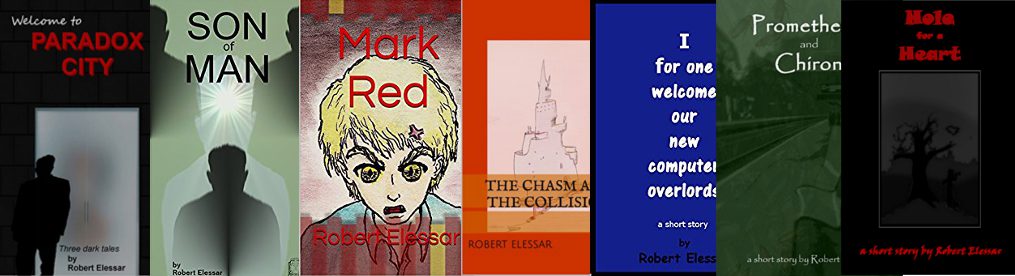
Here’s a bit of a rundown.  The following stories I wrote by hand in the first draft, having no other options:  Mark Red, The Chasm and the Collision, and my long short story Paradox City.  I also wrote my stories House Guest and Solitaire with paper and pen, the latter in one sitting, the former way back in high school.

I wrote the first draft of Son of Man at least partly on a very small smartphone that I really liked.

The Vagabond is a bit of a mixed bag.  I started it while at university, and finished the first draft while in med school.  Part of the first draft was written by hand (i.e., with pen on paper) but most of it was written on a Mac SE using the good old word processing program WriteNow.  Does anyone out there remember that one?

The rest of my stories, at least the published ones, were written on mini laptop computers (well, some here and there would have been on full-sized ones) from the beginning.  Most notable of these, perhaps, is Unanimity, which is very long.  But many of my “short stories” were written on regular keyboards, including the other two stories in Welcome to Paradox City, and my “short” stories, Prometheus and Chiron, “I for one welcome our new computer overlords”, Hole for a Heart, Penal Colony, Free Range Meat, and In the Shade, the latter of which‒like House Guest‒appears only in my collection Dr. Elessar’s Cabinet of Curiosities.

Oh, right, and of course Outlaw’s Mind, Extra Body, and The Dark Fairy and the Desperado have all been written (so far) on the lapcom.

If anyone out there has read a sampling of some of these, or all of them, and can give me any considered feedback on any overall difference in quality between the means of writing, pros and cons, I would certainly appreciate it.

And if any of you haven’t read any of the above, well…what are you waiting for?  If you’re a fan of fantasy/sci-fi/horror, you might like some or all of my stuff.  If you’re not sure where to start, by all means, I’ll give you recommendations based on your personal preferences, if I can.

I suspect that The Chasm and the Collision would have the broadest popular appeal, especially for people who like the Harry Potter books and similar stories.  Son of Man is probably my purest science fiction story, but this is not “space opera” type science fiction.  “I for one welcome my new computer overlords” is basically science fiction*, too, in case the title didn’t clue you in.

Everything else is horror of one kind or another.  Most of my horror is supernatural in one sense or another, and I veer into the borders of Lovecraft’s universes in at least two stories**.  Mark Red is supernatural and in some senses horror-adjacent, since it involves vampires and so on, but it’s really more a teen/young-adult supernatural adventure, a story originally intended to be a manga.

My darkest story has no supernatural elements in it at all.  That’s Solitaire; it can be had in stand-alone form for Kindle, and it also appears in the middle of Dr. Elessar’s Cabinet of Curiosities.

Well, that’s been about as much self-promotion as I think I’ve ever done here before.  I didn’t really intend to do it, but once I got going on discussing my various story drafts, it just seemed to go that way.  I hope I haven’t been too insufferable.  I’m really not a raving egomaniac, though I may be some other type of raving maniac.

I hope you all have a good day.


*And I guess Extra Body is sort of light-hearted sci-fi.  It’s even somewhat comical, as my story If the Spirit Moves You is a sort of supernatural comedy (expect no laugh-out-loud moments, though, since they are dry comedy at most).

**The Death Sentence, which appears in Welcome to Paradox City, and In the Shade, mentioned above and in my other collection.

Learning about science, troubles with reading and socialization, and (not) writing fiction

It’s Saturday morning, and boy was yesterday’s audio blog a little weird.  I think it’s not so much that I said anything particularly weird—certainly not for me—but rather the odd meanderings thing took, from musing on the fact that I’ve been losing any joy of any kind in my life, becoming more and more bored or even irritated by more and more things that used to be interesting, on to the various declining cinematic universes and finally to thoughts about General Relativity.

At least that latter part encouraged me to read some material and watch some relatively hard-core YouTube videos about General Relativity and its mathematics.  By “hard-core”, I don’t mean there was any graphic sex involved.  First of all, I don’t think they allow stuff like that on YouTube, but even more to the point, I don’t see how one could work such a thing into an educational video about matrices and tensors and stuff like that.  I mean “hard-core” as in being more in-depth than just a general information, analogy kind of educational presentation, and especially that it talked about the mathematics underlying the science.

Not that I’m against the more general stuff.  I certainly began all of my interest in science with general knowledge/information.  When I was a kid, growing up (which is what kids do if things go well), I had a whole bookshelf I called my “science shelf” full of various kid-level books about everything from biology to paleontology (there were lots of dinosaur books—my first career ambition was to be a paleontologist) to “how things work” kinds of books and so on.

I didn’t really start to have as much physics and astronomy related material until after Cosmos came out.  That show was the reason our family got our first color TV.  I also asked for (and received) a hardcover copy of the book for my 10th or 11th birthday (it came out in 1980, I think, so it should have been 10th), and I was very pleased.  That book and show really triggered my love of space-oriented and physics-oriented science, including—of course—cosmology.

I chose my undergraduate college precisely because it was where Carl Sagan was a professor, though I never did meet him.  I would have thought it presumptuous and appalling to try to seek him out and bother him with gestures of my admiration and thanks.  I tend to feel that way about inflicting myself upon anybody—friend, foe, or stranger.  I just feel that I don’t have any right to intrude upon anyone else’s life or time, and also that I frankly don’t know what to say if I do meet them.

It’s a bit sad, though.  By most accounts, Professor Sagan tended to be quite pleasant and positive toward people who liked his work, and he considered himself—according to him—first and foremost a teacher.  He certainly taught me a great deal.  Though his books are now somewhat out of date, they are mostly still great repositories of fact and interest, and they remain overflowing founts of wonder.  I feel confident in recommending them to anyone, most prominently Cosmos, Pale Blue Dot, and especially The Demon-Haunted World.

Of course, I’ve read a lot of his intellectual descendants since then, and his cousins as well in other fields (Stephen Jay Gould’s and Richard Dawkins’s books and collections about biology are wonderful, too, for instance).  One thing I like about listening to podcasts that focus on ideas is that the guests are often people who have recently (or not-so-recently) written books, and if the subject is interesting I can read their books to get more deeply into their work.  I first encountered David Deutsch and Max Tegmark (and many others) on Sam Harris’s podcast, for instance.

And, of course, I have also read books by Brian Greene and Sean Carroll (and others) about physics in general.  It was to The Big Picture that I turned yesterday after my audio blog, in addition to the aforementioned video, to review some of the mathematical basics of General Relativity.  From there, maybe I’ll go on to the YouTube videos of Leonard Susskind’s* real graduate level lectures at Stanford, and to reading Sean Carroll’s textbook.  I’d also like to read through Zee’s Quantum Field Theory, As Simply As Possible, which I’ve mentioned before (with the thought of going on to his textbook if I can).

I have Zee’s layperson-oriented book in hardcover, but the print is small, and it’s difficult to read.  Still, I took delivery yesterday of a new set of reading glasses that are slightly stronger than the ones I was using, so I hope they’ll make it easier.  I’d really prefer to learn by reading than even by watching videos.

Of course, all this is probably just “pie in the sky” thinking.  My biggest difficulty is just summoning the will, the energy, to do these things.  It’s similar to the trouble I have with writing fiction.  I have quite a few story ideas I could write, but I have no drive, no desire to do the writing.  There’s no percentage in it, so to speak.  It’s not as though I have any fans out there telling me how much they like my books and want more.  I mean, my sister has read them all, and she liked at least most of them, and says she really liked The Chasm and the Collision.  That’s very nice, and I do appreciate it.  Apparently, though, it’s not the required stimulus for me to want to write more fiction.

Perhaps nothing would be.  Perhaps I’m just deteriorating too much, or have deteriorated too much.

Or perhaps it’s that I feel that a truly tiny minority even of people who engage with fiction do so in written form nowadays.  There’s too much competing immediate gratification out there, and primates—probably almost all life forms—are prone to fall for immediate gratification, and to someone else doing the imaginative work for them.

I fear that much of the general population has allowed their personal imaginations to atrophy, much as physical health atrophies when someone goes everywhere by car.  People even play Dungeons & Dragons online now, apparently.  That seems weird to me.  I don’t think I could really stand to play role playing games with strangers.  Playing them with my friends, as I did back in junior high and high school, for countless hours, was greatly enjoyable, and I think it did exercise and improve my imagination and my story-telling and story-creating “muscles”.

Oh, well.  I don’t have anyone with whom to do any of that stuff now, and I can’t even really imagine trying to find new people with whom to do it—see my above discussion about inflicting myself on people for part of the reason, but that’s not the only one.  I also don’t want to invest the considerable necessary stress and effort and anxiety into trying to find friends with whom I actually share interests—if such people even exist—and then have it all go sour or just go away as nearly every other relationship of any kind that I’ve ever had has done.  The juice, however delicious, is not worth that old vice-grip-on-the-testicles (and on all the joints and tips of one’s fingers) level squeeze.  The juice doesn’t last, anyway.

I’m on the train now, and I’m not exactly producing anything edifying, am I?  I’ll bring this week’s writing to an end, but I hope I’ll have the will to keep studying, at least.  And, of course, I hope most fervently and sincerely that all of you have a very good weekend.


*I also have his series The Theoretical Minimum in kindle and/or paperback and/or hardback form; his most recent one was about GR.  But I’ve had trouble reading physical books of any kind (let alone the Suss kind…ha ha) lately; I’m hoping my new reading glasses will help that.