Most people are dead, and it will probably always be that way

I sometimes think about historically based films in which tragedies happen and deaths occur.  I know they’re highly fictionalized, but think of Braveheart and of Gladiator* and movies of that sort, where the loss of loved ones makes viewers sad but drives the protagonist to “great” deeds that change the course of local history‒or, well, that make the course of local history.  After all, one only knows history after it happens, and once it’s happened, one cannot change it.  One can be mistaken about it, one can misrecord it, one can lie about it, but one cannot actually change it.

Even if it were possible to time travel, going into the past to alter something, it wouldn’t change the history from which you came‒as even the Marvel movies have pointed out, you’d just have created a new future, a new history, local to you.  It wouldn’t change your previous one‒that would be paradoxical.

Yes, Back to the Future is bullshit.  This really shouldn’t surprise you.  It’s still a fun movie.

Anyway, that’s beside the point I planned to make.  I think of tragic deaths in historical dramas that we see and about which we feel heartbroken, or even about real historical horrors‒human made, like the vast slaughters of Genghis Khan’s hordes or natural, like earthquakes and volcanoes and tsunamis and the like‒and about all the deaths involved, and sometimes I think:  “They would all be dead now, anyway, no matter what.”

Not one single person who was born before 1900 is alive today, as far as I know.  If there is one, that human is an all-time record holder in longevity, and is unlikely to live much longer.  And I would probably bet my own life** on there being no one alive who was born before 1850.  Indeed, the majority of humans who have ever lived are dead.  It’s not as big a majority as it might be, given how long humanity has existed, but that’s only because of recent exponential population growth.

In principle, of course, with a fast enough exponential population growth, it would be possible for the majority of humans to be presently alive, even with current lifespans.  But that’s not sustainable in the real universe.  For it to be sustainable in the long run, eventually humans would have to expand their empire over matter and space at faster than the speed of light, and reach far beyond the cosmic horizon, which is impossible in principle, as far as we know.

I say “eventually”, but don’t let that mislead you.  It would happen with surprising speed.  There’s a well known fact that, given a typical doubling/generation time of about 20 minutes, and assuming enough resources, a single bacterium could multiply to a volume greater than that of the visible universe within a month.  I’ll try to check my math on that when I get to sit down with a pen and paper***, but whether the specific time of a month is not quite right, it’s in the right ballpark.

This is the sort of doubling that is thought to have happened‒at an even faster rate, of course‒during the “inflationary” stage of the universe, if inflation happened.  Of course, in a sense, if “dark energy” is really the cosmological constant, then we are still undergoing inflation even now, just with a slower doubling time.  That doesn’t help is with our exponentially growing human population, though; spacetime itself can expand at, functionally, faster than the speed of light****, but nothing travels through spacetime faster than light.

Anyway, we’re already slowing down our population growth rate, which is good, since Malthusian growth tends to be unpleasant for almost everyone.  Therefore, as time goes by, the fraction of all humans who are dead will probably more and more overtake the fraction who are living.  And all early deaths are, in hindsight, not too terribly early.

This is one reason I get slightly irritated by people who talk of “saving lives” or characterizing a person’s death, per se, as a tragedy.  If every death is a tragedy, then the anti-natalists are right, and each new life should be avoided.  But, of course, it’s not that death in and of itself is a tragedy‒or if it is, it’s an inevitable one that’s going to happen to us all, sooner rather than later.  Even a being that lived for thousands or billions or googols or googolplexes of years would come no closer to living eternally than does a mayfly.  This is a mathematical fact.

It’s suffering that is the tragedy, not death.  Death can be a decent shorthand, in certain circumstances, because‒as Carl Sagan pointed out‒if one is dead, there is very little one can do to be happy.  Then again, if one is dead, there is also very little that can happen to make one disappointed or sad or in pain or afraid.  And since these things are more common and sustainable, or at least more reliable, than joy is, life itself, as a shorthand, is at least as good an indicator of suffering as death is of loss of possible joy.

It’s possible, I think, to live without joy‒meaning that it can happen, not that it’s a state one can or should seek.  But I don’t know that it’s possible for any true living things, or at least any living things with any equivalent of a nervous system, to exist without suffering.

So, perhaps Dumbledore’s post-mortem***** admonition to Harry Potter could be truncated to “Do not pity the dead, Harry.  Pity the living.”  Full stop.


*Which should have been the title of the sequel to Jaws.

**That’s maybe not as impressive as it might seem, since much of the time I hate my life and myself.  But it’s the only life I have with which to bet.

***With a typical length of 1 micrometer (10-6 meters) and a doubling time of approximately 20 minutes (leading to 72 doublings a day), after only one day, a colony of bacteria would be roughly 4700 cubic meters in size, a cube more than 16 meters (just over 50 feet) on a side.  After 2 days, its volume would be about 2 x 1026 cubic meters, or a cube 280,000 kilometers long on a side.  That’s nearly the distance from the Earth to the Moon.  After the 2160 doublings involved in a month of doubling, that would yield a volume of 2 x 10632 cubic meters, or with a side length of about 5 x 10210 meters.  A light year is 10 trillion kilometers, or 10 quadrillion meters, which is “only” 1015 meters.  So that’s a cube with a side length of 5 x 10195 light years‒waaaaaay more than a googol light-years.  Indeed, if you subtracted a googol from that number, it would not change it to any degree measurable by any means known to humans (5 x 10195 minus 1 x 10100 is still, basically, 5 x 10195).  The visible universe is only about 92 billion light-years across, yielding a sphere with a volume of “only” 4 x 1080 cubic meters.  It’s not even close to the order of magnitude of a volume of 2 x 10632 cubic meters!  My estimate was far short of the mark.  But that only strengthens my point, doesn’t it?

****It doesn’t actually do so locally‒I suspect that is also impossible, since it would defy the speed of local causality.  It’s only the summation of all the local doublings spread across the entirety of space that can make distant points separate at faster than the speed of light.  Then again, can “traditional” inflation cause any kind of local superluminal expansion?  I don’t think so.  Could two points in space a Planck length apart separate at a local speed that exceeds c even during inflation?  I doubt it, though I’m not absolutely sure.  Of course, if space is mathematically continuous, then there are no two closest possible points, anyway.  Between any two points on the real number line, there exists an uncountable infinity of other points, no matter how arbitrarily close you make them.

*****Of course, if one can deliver admonitions, one is not really dead in any useful or meaningful sense.  But it’s fiction, and it’s magic within fiction, so leeway can be given.  We have no evidence nor have I encountered any even borderline convincing arguments for any “life after death” in the real world, unless you count things like multiverses or Poincaré recurrences or the like, and I don’t, since they really entail other versions of a person, not a continuity of personhood.

The art of our necessities is strange that can make vile blogs precious.

relessarwithquestions

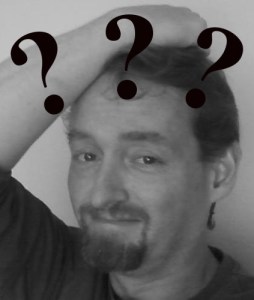
This is about the last picture of me that I like…

Hello and good morning!  It’s Thursday, as you no doubt already know, and thus it’s time for another of my staggeringly popular weekly blog posts.

I should let anyone who’s paying attention know that I did in fact write a post for Iterations of Zero last week, but while editing it, I decided that it was just too negative to share right now.  Maybe I’ll change my mind in the future, but I figured there’s enough material on IoZ dealing with depression and its fallout, and I thought people wouldn’t be too chuffed to read more of it.  Perhaps I’m wrong in this.  If so, please let me know.

I now hereby remind you all that my giveaway offer is still in place until the end of the year:  If you send me a request, either here or through my Facebook or Twitter accounts, I’ll happily send you the Kindle edition either of one of my novels or three of my short stories, whichever you prefer.  You can pick them, or—if you like—I can pick them for you.  In such a case, I’ll be inclined to send you works that I most want to promote, so fair warning.  Of course, I’m happy to try to match your preferences if you just tell me what you enjoy, but I can’t guarantee that I have works that match all possible tastes.  My short stories, in particular, tend to be rather dark.  Still, if it’s sci-fi, fantasy, and/or horror that you crave, I think I can find a shoe that fits.

I’m very near the end of this run-through of Unanimity, which is nice, though of course the ending is sad in many ways.  The fact that I’m making such progress—glacially slow though it often feels—leads me think that the book will be ready for release sometime relatively early next year, always assuming I live that long.  It will definitely be my magnum opus to date, at least as far as size goes.  I hope it’s worth the wait*.

Now, to indulge in a bit of a tangent:  when I searched online to confirm that I wasn’t misusing the term “magnum opus”**, one of the top results delivered was the Instagram page for what seems to be a hair salon or similar out in Portland, OR (they had some lovely pictures, by the way).  This led me to wonder, as I do from time to time, whether there would be any benefit from my starting an Instagram account.  I don’t currently have one (which was implied by what I just said, wasn’t it?), and I’ve never really followed or looked closely at any such account hitherto.  I’m not big on photo sharing in general.  I don’t like how I look, so I don’t tend to share pictures of myself***, and there are few enough external events in my life that merit pictorial representation to the masses.  Of course, in addition to my Facebook and Twitter accounts, I do have a YouTube channel, but that’s mainly used for sharing “videos” of my songs and recordings of some of my stories.  I’d be interesting to learn what your thoughts are on the benefits (or detriments) of Instagram for authors and other writers.  Do Stephen King and J. K. Rowling have Instagram accounts? I doubt that Shakespeare does.

That’s about all I have for now.  I’ll work on something new for IoZ for this week, and I’ll try to keep it as upbeat as I’m able, but I am grumpy by nature, it seems.

Again, please do contact me if you want some free stories to read for the holidays, even if they’re not exactly holiday-oriented tales.

In closing, in apparent contradiction to my grumpy nature and my dark imagination, I wish you all the very best in everything, even if you don’t necessarily know what that might be.  After all, does any of us really know what’s best for ourselves? But whatever it is, I wish it for you, my dearest readers, and for your families and friends…and what the heck, while we’re there, I’ll wish it for everyone.

Also, I want a pony.

TTFN


*Obviously, I think it’s terrific, but I’m biased.

**I did and do know what it means, but I wanted to make sure there weren’t misleading connotations in its common use.  It turns out I was both correct and fine, which happens sometimes.

***I used to be reasonably satisfied with my appearance, but chronic pain, depression, and prison will tend to take the glow out of one’s skin and the sparkle from one’s eyes, to say nothing of the gleam from one’s teeth.

They have their exits and their entrances, And one man in his time blogs many parts

Well, you wouldn’t think it would catch me by surprise—it’s something that happens every month, after all, in an entirely predictable fashion—but I didn’t realize until this morning that today was the second Thursday of October and is thus the “official” day for me to write an episode of “My heroes have always been villains.”  Obviously, since I wasn’t thinking about it, I haven’t given a second’s thought to what villain I should discuss today.  Rather than pick a random baddie from my memory’s hat and produce an off-the-cuff essay on him or her, I’ll push that project back until next week or next month.  I apologize if anyone out there was looking forward to a new episode today.  Then again, if there are such people, I haven’t heard from them; I’d be quite gratified if you’d make yourself or yourselves known.  I can exculpate myself a bit for my oversight by admitting that I’ve been rather worn down, tired, and slightly ill, this week (see my IoZ entry here for a brief discussion of the nature and effects of my troubles with insomnia), so I’m behind my mental curve.

Even as I wrote that last sentence, I realized that I’ve often made comment in these, my public venues, about being under the weather.  Now, I don’t think that I’m too whiny and hypochondriacal, as a general rule, but I certainly don’t seem to operate at my physical optimum much of the time.  It’s a problem that I need to keep in mind, going forward.

I will say this, in tangential reference to the above issue:  I’m glad that I decided to put my audio productions on indefinite hiatus.  It’s a melancholy gladness, if that’s not a contradiction in terms, because I really do like those audio productions, and if you’re interested you’re welcome to partake of the ones I’ve made, either here, or on my YouTube channel.  But making them requires a lot of mental energy and physical time.  Since putting the audios on pause, I’ve gotten more writing done on Unanimity, and I’ve worked steadily on my two other short stories during the the hours I would have spent recording and editing the audio, leading to an increased total output of about five pages a day versus only three on average (or roughly 2500 words versus 1500) before.  This is a serious improvement.

It would be nice to be able to do all this full-time, instead of in the interstices between actions of daily necessity required to put food on the table, so to speak.  Then I could write just as much and still make my audio files, which would be a lot of fun.  I hope someday to reach that state, but I obviously haven’t done it yet.

Unanimity goes well, though, and is honestly approaching its climax and resolution (I swear!  No, really!).  I still expect—if I work on it as steadily as I ought—its first draft to be finished before the end of the year, and probably well before that long novel is ready to be published, I’ll release one or both of the short stories I’m working on, Penal Colony and In the Shade.

It’s amazing how something can take so many hours, so much effort, and yet yield a product that can be consumed within the course of, say, a few days for a novel, or at most an hour or two for a short story.  It would be nice if I could give the readers of my work as much lasting entertainment as I get durable engagement from producing them, but I guess that’s the nature of all creative arts.  Even a small, independent film is created through untold hours of effort by astonishing numbers of people, to be then enjoyed within the space of two hours.  A great painting or sculpture can take perhaps less total work, but is then enjoyed in mere tiny, minutes-long chunks by even the most passionate enthusiasts of the arts.

I wonder how many people would have to read my books to make the “man-hours” of reading surpass the man-hours of production; it’s a hurdle I’d love to cross with all my stories.  I don’t know if anyone’s done the math on such a question—I assume that the numbers would be different for different people and different works—but if they have, I’d love to know about it.  I’m sure that Stephen King, for instance, passed that milestone decades ago.  He probably passed it with Carrie, and I doubt that he’s ever caught up in the time since, despite the staggering pace at which he writes.  To match such an outcome is a high bar for anyone to set, but as I’ve long said, only those who attempt the impossible can achieve the unbelievable.

And now, I think that will just about do it for today.  I’ll say, tentatively at least, that I’m going to put off the next episode of “My heroes have always been villains” until November, unless I receive any complaints or protests from those who don’t want to wait.

I’ll close with an exhortation—probably preaching to the converted, but there it is—that you all be cautious of falling prey too much, too often, to the easy distractions of videos and memes and other short-attention forms of entertainment.  Keep reading.  Read “real” books, read e-books (they’re just two forms of the same thing), read fiction and nonfiction, read articles and blogs, read poems, read plays, but do keep reading.  Written language is the lifeblood of civilization, and stories are the default mode of human thought (or so it seems).  To read, and to write, are affirmations of and contributions to the health and longevity of the human project and are well worth anyone’s time.

So I am convinced.  I may, perhaps, be biased.

TTFN