There’s hope a great blog’s memory may outlive his life half a year.

Hello and good morning.

First of all, 

Actually, that was second of all, wasn’t it, following my traditional Thursday blog post salutation?  I would almost count that greeting as not being a first thing, however; it is practically automatic, requiring no new knowledge and very little in the way of thought.

Still, there clearly is some caloric expenditure in my nervous system related to doing it, and obviously there are impacts upon the world immediately around me.  And once the post is posted, that impact expands, at least a little.

After a very short while, I suspect, any impact that my writing that particular opening had will be entirely washed out by noise‒even thermal noise at some point.  Like the man said, “The world will little note nor long remember what we say here”.

Of course, the irony is that Lincoln’s speech is what we do remember most from Gettysburg.  By “we”, I mean Americans in general.  I don’t know if anyone in the rest of the world ever reads Lincoln’s Gettysburg Address (though it is a very well written, concise, and moving speech).

And yet, his point is that we ought to remember the battle, and the lives of the soldiers involved in it, and (to my mind) we ought to try to understand the causes of the Civil War and to wonder to what degree the soldiers on each side really were committed to the arguments and ideas supporting their group, or if, deep down, they were just fighting for “our group” against “their group”.*  Yet we most remember, ironically, the words of the man who said that the world would little note nor long remember what he said there.  That was the point I was making.

Anyway, it’s January 1st, the first day of 2026.  Huzzah.  Rah.  Yippee Kiy Yay.

I don’t think it bodes well for the year to start on a Thursday, since this is the day that DentArthurDent had such trouble getting the hang of.  On the other hand, maybe it’s a good thing, since Thursday is and has been my blog day for quite some time, even when I was writing fiction every other weekday.  Probably neither fact matters.

Of course, I am going to work today, despite it being such a universal holiday, and I am not at all happy about it.  I did no celebrating overnight, of course; what on Earth would I celebrate?  But my sleep was not good, anyway, because of all the fireworks and nonsense.  Also, the people with whom I share a house had a big family get together that had barely ended by the time I started writing this.  And, of course, I have chronic insomnia anyway.

It’s actually rather cold here in south Florida‒in the mid-forties right now‒and that makes getting to work slightly less pleasant than usual.  Also, the transit systems are on holiday schedules, and I have a long commute, especially since I have no vehicle.

I also feel that I might be coming down with a cold, but I’m not going to call in sick, because then it would look like I was pretending to be sick so I wouldn’t have to come in on New Year’s Day.  Still, my ears are plugged and my throat is a bit raw, and what might be just my allergies is acting up more than usual.  I’m not really coughing or sneezing, though.  Still, maybe I’ll develop pneumonia and die.  Fingers crossed!

Speaking of ears (I was, you can go back and check), all of a sudden in the middle of the night last night persistent tinnitus began in my left ear.  I have had chronic tinnitus in my right ear for about 18 years now, probably largely due to recurrent ear infections, which have tended to localize to the right side more often than the left.  When you have chronic tinnitus for so long, you get to the point where you…almost…don’t notice it anymore, though I do notice how bad the hearing is in my right ear.

And now my left ear feels very much like the right, with the high, sharp, intense pitch constantly sounding.  Mercifully, it seems to be roughly the same pitch as the noise on the right, a very high D note.  But it is quite annoying, and I fear my hearing is going to be too reduced for me to enjoy music, which is not so much terrifying as horrifying.

Ah, what are you gonna do?  This is life‒it’s a load of crap, but at least you get to die at the end.

I suppose I’ll be writing another post tomorrow, and probably Saturday as well, so you have that (those?) to which to look forward if nothing else.  I don’t know how many people will even read this post today, to be honest.  Will it be fewer than usual?  Will it be more?  Does it matter?

I know the answer to the last question at least.

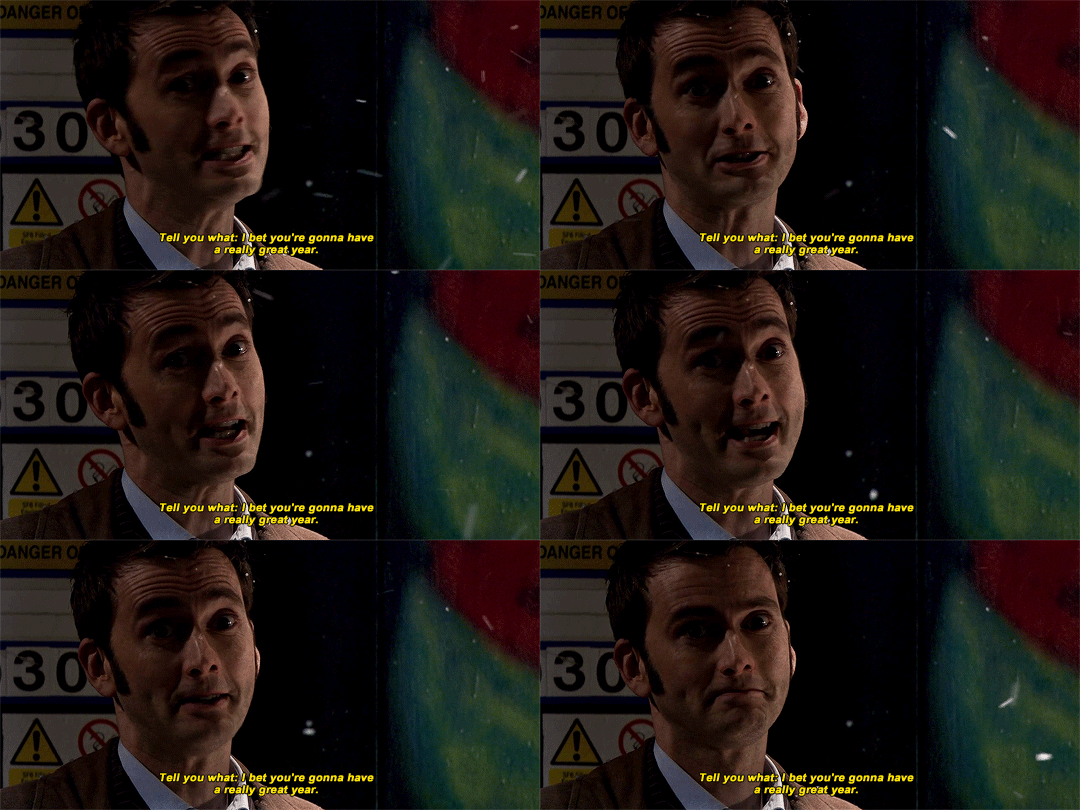
Again, Happy New Year.  I’ll leave an optimistic-seeming GIF here below for you.  I don’t necessarily share the sentiments, but to be fair, as the Doctor knows full well, great isn’t necessarily good.

TTFN


*I’m reminded of Faramir’s words (in the movie) regarding the fallen soldier on the field:  “The enemy?  His sense of duty was no less than yours, I deem.  You wonder what his name is, where he came from.  And if he was really evil at heart.  What lies or threats led him on this long march from home.  If he would not rather have stayed there in peace.  War will make corpses of us all.”

“Cobwebs long since overrun by an old Wellington boot”

Welcome to a rare Saturday blog post.  You can’t say I didn’t warn you that I would be writing a post today.

Actually, of course you can say it.  You can say anything your mouth, lungs, and brain are capable of creating as a sound.  Think of Chomsky’s perfectly grammatical but nonsensical sentence, “Colorless green ideas sleep furiously,” or Stephen Fry’s even more nonsensical, “Hold the newsreader’s nose squarely, waiter, or friendly milk will countermand my trousers.

We are not constrained by nature to be truthful (or even sensible) in what we say.  Human society would probably work better overall if we were incapable of lying (at least actively).  It would take a bit of time to get used to it, and many people would have to learn just not to say anything most of the time.  But I think it would be better, certainly in a peaceful society‒which, alas, we have not yet achieved.

On the other hand, deception is a huge part of nature (the living part of it at least), in one way or another.  Especially when there are predators and prey and competitors for mates and for food and so on, lying‒in one sense or another‒is an extremely useful survival strategy and tactic, at least when done well and carefully.

It may be that, in a mature and peaceful civilization, lying is detrimental and to be discouraged‒indeed, to be eliminated if possible*.  But as long as there is not true peace and true freedom‒as long as there are people who will take advantage of and harm and victimize other people‒sometimes deception will be necessary.

It is, or at least it can be, analogous to the notion of using violence in self defense.  Pacifism seems all well and good on the surface, but when there exist people willing to use violence against others in aggressive, oppressive ways**, then pacifism is just a fatal vulnerability.  Pacifistic “resistance” can work if one’s opponent has a relatively strong moral code or conscience.  But against an actual psychopath, or a psychopathic ideology, non-violent passivity is just doing your opponent a favor.

And no, despite what V said, ideas are not bulletproof.  They can be bullet resistant, but enough bullets in enough brains‒for instance, the brains of every person who holds a particular idea‒can erase any idea as it is.  Some ideas are harder to wipe out than others, and some spring up anew in disparate places even after being eliminated, but enough destruction can obliterate anything that is not a fact of external nature***.

So, violence and deception are at times necessary in a society in which there are occasional psychopaths, or at least psychopathic behaviors.  But that doesn’t mean we should not aspire to create a society that is honest and peaceful.  It just means we cannot try to skip to the end by eliminating all capacity for violence and deceit in ourselves; that can only be done when (if) all potential threats have been quelled, and brought more or less permanently out of the realm of possibility.

Wow, I had no intention or notion to write a post centered on moral philosophy today.  And it was all triggered by my cliché opening sentences.  It’s quite strange just how stochastic my writing can be when I haven’t planned ahead.  And, of course, I never plan these posts ahead of writing them.

Also, in case it’s not clear, I don’t plan them retrospectively, since as I said yesterday, I am not capable of violating the laws of causality (such as by traveling faster than the speed of light in a vacuum).

I think that’s enough for a Saturday morning now, though.  I hope you’re all having a good weekend, whether it’s a holiday weekend for you or not (it both is and very much isn’t for me).

Until next time, please be well.  And, if you can manage it, keep being well even after next time.


*There can still always be a fifth-amendment style right not to speak and a right to privacy.  Unless and until there exists some form of communal mind, I think there are legitimate rights to privacy.

**Such people do exist, and they may exist as long as there are people, springing up de novo at times, because it can be an evolutionarily and game theoretically stable strategy to be a psychopath in a group of relatively honest people.  See:  POTUS.

***It can eliminate our knowledge of such things, but knowledge is an epiphenomenon.  The laws of physics themselves do not require humans to know that they exist in order to do so.  To believe that humans are the center of the universe (literally or metaphorically) or that the human mind creates reality is astonishing and contemptible hubris.

No one else here will save you

It’s Saturday, and I’m writing another blog post.  You can’t say I didn’t warn you.

Well, actually, you can say that‒nothing is stopping you from enunciating those words‒but if you do, you’ll either be mistaken or lying.  And it would be hard to excuse you making that mistake, since I’m right here, reminding you that I did warn you, and I’m even putting a link in* to the post in which I warned you.

As for topics about which to write, well, I don’t know.  The world is such a boring place right now.  There’s nothing interesting or troubling or unusual happening at all.

I was being tongue-in-cheek there, as I hope was obvious (though social media and the internet more generally have shown us that this can never be taken for granted).  However, it’s also true that the tragicomedy of current politics is not really very interesting, any more than is any other set of primate dominance conflicts.  To the primates themselves, and perhaps to those who study them, it might be interesting, but to everything else in the universe‒including yours truly‒it’s just a bunch of noisy, smelly, stupid animals making a mess while jockeying for positions in a contest that only matters to them (and not even to all of them).

But it is still a potentially violent process, and there tend to be brutal injuries and fatalities, so I’ll repeat my admonition:  it’s fun to repeat the slogan “punch a Nazi” but it’s important to recognize that that is just a slogan, like “catch the wave:  Coke” or “nobody doesn’t like Sara Lee”**.

The actual Nazis‒you know, the real ones from 30s-40s Germany, not just the people you call Nazis the same way some might say “your mama”‒were stopped by people with real weapons, and it required real violence and personal danger.  Passive or verbal (or even fist-based) resistance works against relatively civilized opponents, like the colonial British in India, but would not work against actual Nazis, actual fascists, or against other actual totalitarians like the Soviets or Pol Pot or Chairman Mao and his successors, or the various smaller-scale dictators, authoritarians, totalitarians, and just generally other bully types throughout history.

Such people are not civilized‒not completely‒and they will use force against those who oppose them, or just against those whom they don’t like, or of whom they don’t approve 

You can say “punch a Nazi” when you’re talking about people who just act like Nazis, or who seem to sympathize with such ideologies, but when it comes to actual “Nazis”, the slogan should be more along the lines of the Joker’s three favorite things‒dynamite, and gunpowder, and gasoline.

Or, as Chris Cornell sang in his Casino Royale Bond song:  “Arm yourself, because no one else here will save you.”

The political right in the US has long been the group of people who are most fervent about defending the 2nd Amendment, but the right has betrayed so many of its former ideals already, and totalitarians (and would-be ones) will generally do their best to disarm a populace they want to control or oppress or simply to kill.  So, if you’re at all serious in thinking that those on the current “right” are akin to Nazis‒and this is not necessarily wrong‒I say again, get weapons and train yourself to use them well.  Learn the arts of sabotage and improvised munitions.  Take a bartending class and learn to make a Molotov Cocktail***.  Heck, buy a flamethrower; they’re legal (and ironically, they don’t count as firearms).

Of course, in fighting against oppressors, it is essential to remember Nietzsche’s admonition about fighting monsters and gazing into abysses.  Learn from the examples of the French Revolution, the Bolshevik Revolution, and the Chinese Communist Revolution; “revolutionary” ideologies tend to turn into paranoid self-policers, but not necessarily in a good way.  Remember, many of the initiators of the French Revolution ended up meeting the Guillotine themselves at the hands of their own co-revolutionaries.

Remember Robespierre.  Remember Trotsky.  Don’t become just as evil as the people you oppose.  Also, remember the presumption of innocence (even for people you hate) except in true, immediate danger to life and limb.  Just because you don’t like someone doesn’t mean they are evil (and just because you like them doesn’t mean they are not).  Just because you are fighting against “bad guys” doesn’t mean you are necessarily a “good guy”.  To be a “good guy” requires self-reflection and self-criticism and devotion to the concept of fallibilism.  Remember, Stalin fought against Hitler and helped defeat him, but he was most assuredly not a good guy.

On that cheery set of notes, I wish you a happy weekend.  Wishes may be useless, of course, as ineffectual as “thoughts and prayers”, but they are real, nonetheless.


*Not referring to the website/social media platform LinkedIn.

**I know these slogans are really old, but none that were more recent popped into my head, and I couldn’t be bothered to try to think of one.

***Yes, I know, it’s not a real drink.

Sticks and stones…

I don’t really know what to write about that’s personal at the moment, so I thought I’d weigh in on a matter that’s occasionally been popping to my mind.

Those who believe that we are marching toward fascism in the United State—and I’m not saying they are necessarily wrong—need to start availing themselves of their 2nd Amendment Constitutional rights, if they haven’t already done so.

Many have long held that the 2nd Amendment did not secure the right to keep and bear arms as protection against ordinary criminals or terrorists or even mad people like school shooters and the like.  They maintain that it is a measure put in place to protect the citizens against the potential depredations of an oppressive government (such as the one against which the founders had recently revolted).

I’m not Constitutional scholar enough to know for certain what the definitive intention of the writers of the 2nd Amendment was, and given how disparate the interpretations thereof are, I would suspect that no one is.  But we don’t really need to dwell too much on that, since we are the ones interpreting the Constitution now.  Here are the words:  “A well regulated Militia being necessary to the security of a free State, the right of the people to keep and bear Arms shall not be infringed.”

The argument can be made that the 2nd Amendment is a straightforward compound sentence with two separate subjects.  The first part basically says that we all know that any free state of any kind is going to have to have some kind of military.  It’s a necessity.  But the second half says that because of the fact stated in the first part, the right of the people—not the militiato keep and bear arms shall not be infringed.

The point, I am led to understand, of this interpretation of the 2nd Amendment is that since the government is always going to have a militia—and since over time, governments may become tempted to use those militias against their own citizens—the citizens should be armed, so that they can at least fight back.

In any case, whether you buy that interpretation of the 2nd Amendment or not, it’s a good point to consider now.  If you honestly think that the current government is really striving to enact a form of fascism in the United States, and that it will oppress innocent people and use force against them—and how are laws enforced other than through the threat of literal violence by the police or the military?—then you need to be prepared for active resistance, not just rhetoric.  When name-calling fails (impossible as that might seem), what are you going to do to resist unlawful encroachment by those who seek to use the offices of government to further their own selfish ends?

Thomas Jefferson had his faults, of course, some of which are difficult to understand, but he did almost solely write the founding document of the United States of America*.  He was also, based on some of his writings, a bit of a radical recurrent revolutionary, at least in principle.  He famously wrote that he thought there should be an armed revolution as often as every twenty years if people wanted to remain free.  “What country can preserve its liberties if their rulers are not warned from time to time that their people preserve the spirit of resistance?  Let them take arms…the tree of liberty must be refreshed from time to time with the blood of patriots and tyrants.  It is it’s natural manure.”

I don’t know how tongue-in-cheek he might have been when he wrote that, but it doesn’t really matter, because the message is the message, and it stands or falls on its own, regardless of who said it or why.

If you hate oppressive, authoritarian, or totalitarian regimes, it’s hard to blame you.  But while the slogan “punch a Nazi” is funny, and seems vaguely tough and “cool” to people who’ve never been in a serious fight in their lives, the Nazis—the real Nazis, the originals—were not defeated by people punching them.  They were not defeated by protests.  And though words helped, they were not finally defeated with words, certainly not the sort of words we find tossed about on social media.  They were fought, they were captured—and when nothing else could be done, they were killed—by other armed people.

I cannot recommend going out and killing people you don’t like just based on political differences.  That’s catastrophic, cosmic-level idiocy.  But if life, liberty, and the pursuit of happiness are actually under immediate threat carried out by armed individuals, then such people must be resisted with arms, if one wants to have any chance of success.

Imagine how hard the Warsaw Ghetto would have been even to make happen, let alone for the people there to be gradually massacred, if most or even just some of the original 400,000 Jews who had been put there had been armed and had recognized that their lives were in danger.

Imagine if all the Jews and Gypsies and gay and handicapped people in Germany and Austria and Poland and France and Czechoslovakia and so on had all possessed personal firearms.

There are, last I heard, more guns in private hands than there are citizens in the US.  Whether or not one sees this as a good thing depends very much upon one’s criteria for goodness in this matter, but it is true that it is much harder for the Thought Police to kick in people’s doors to enforce conformity if a good percentage of those people are armed and know how to use their weapons to fight** in defense of their lives and those of their families.

Anyway, I thought this was an important point to make; at least it’s one that nags at me.  It’s very easy, and relatively safe, to argue with people on social media, calling them names from the other side of the country or the other side of the planet.  But when would-be oppressors from any part of the political spectrum come to enforce their ideas violently upon others, clever online memes are unlikely to stop them.

I don’t condone armed attacks against people who aren’t in the muscle end of the family, so to speak, and in any case, such things often backfire.  But if the SS or the KGB or the DHS or any other manner of secret police are coming for you and those you love, though you have committed no actual crime, and if you aren’t sure what they’re going to do if they capture you/them, it seems perfectly reasonable to shoot as many of them in the head as you can.  You can at least make their job both difficult and dangerous.

Words may never hurt me, but sticks and stones can break my bones, even if I don’t choose to use them.  So, if I honestly think such things are coming, I really should pick up my own sticks and stones.  It’s vastly better to use reason and discussion and politics to settle differences, to arrive at compromise, to make things work as well and as honorably as we can for everyone, but when faced with a literal and immediate threat of deadly force, it is perfectly moral to defend oneself with deadly force.


*That’s the Declaration of Independence, in case you were wondering.

**This is crucial.  Guns are not magic talismans, and if you’re going to get one, you should learn how to use it.  You should train and indoctrinate yourself in gun safety, and—equally important—you should practice so that, when necessary, you can use your weapon very unsafely.

It might be the pate of a politician, which this blog now o’erreaches

Hello and good morning, o dedicated reader(s).

I honestly don’t feel very much like writing today‒I feel extremely low even for me, very gloomy, very pain-riddled and dysthymic, my mood made worse by the diminishing daytime in the northern hemisphere‒but since I did my little throw-away non-blog last Thursday, I figured I might as well do something today.  I don’t know if anyone truly looks forward to my blogs‒it’s hard to imagine someone’s day being worse because they didn’t get any input from my thoughts‒but just in case someone does, I will write.  Or, rather, I am writing.

I don’t want anyone to think that my depression is unusually bad due to political events, and certainly not for anything parochial, provincial, local in time and space.  Cat forbid!

I’m sure that people throughout history have thought that whatever local politics was happening just then, at that moment, was Earth-shattering and of monumental importance.  But, of course, as Ozymandius reminds us, all the great people and events of the past, all the presidents and emperors and warlords and whatnots, are but headless, trunkless, disintegrating statues in a featureless desert.

Actually, most of them are never even that.  During the Cold War, admittedly, especially the latter part during maximum arms race and belligerence between the US and the USSR, it was possible for politics to engender the destruction of much of civilization (and I truly didn’t think the odds were good that we would avoid thermonuclear war for very long*) but even then the moment-to-moment politics was almost incidental.

The Cold War and its existential dangers lasted through numerous presidents and premiers, the former of various political parties‒Truman (D), Eisenhower (R), Kennedy (D), Johnson (D), Nixon (R), Ford (R), Carter (D), Reagan (R), all the way up to George H. W. Bush (R).  And, of course, on the other side, we had Stalin (C), Khrushchev (C), Brezhnev (C), Chernenko et al (C), and Gorbachev (C).  One might imagine that Bush, Sr. and Gorbachev would be truly celebrated historical figures, given their leadership positions at the end of the Cold War, but I don’t see a lot of evidence thereof.

Now, political stupidity** has, of course, caused havoc locally on many an occasion.  More people were killed thanks to the ideological idiocy of Stalin and Mao, for instance, than were killed in wars in the 20th century, despite the immensity of those wars.

But, of course, nearly all the people who died in and around the first world war at least (and most of those alive during the second) would have been dead by now, anyway.  And certainly, everyone who died unnecessarily during the French Revolution and the Napoleonic wars would definitely be dead by now, whatever might have happened.  And all the people slaughtered by the hordes of Genghis Khan would be dead now, no matter what.  And certainly anyone killed due to the mismanagement of even the worst of the Caesars would be dead now‒as dead as Julius Caesar, as they say.  And the people of Greece and Macedon and “Asia Minor” and Egypt and Persia and all those other areas would be dead now whether Alexander the Great had conquered his known world or not.

I recall a column that Michael Shermer wrote in Scientific American (back when it used to be worthy of his writing) called “Remember the 6 billion” (roughly the population of the world at that time).  His point was that, within the following 120 years at most, every single person then alive would die…and for the most part it would go entirely unnoticed, because new people are constantly sporulating to take the place of the ones that fall by the wayside.

The “Great Men” (and women) of history are mostly just names and caricatures; they have no effect on the long term structure of civilization.  We recall that Alexander was a brilliant military leader‒an artist in that realm, perhaps‒but his contributions to that field have no major bearing on modern life.

The ideas of Archimedes, for instance, have had much more durable effects, but that’s because they are discoveries about the nature of the universe, of reality and its underlying rules or tendencies, and so they are, in a sense, universal and universally discoverable by any intelligent civilization anywhere in the cosmos.  Ditto for Galileo and Newton, for Maxwell and Einstein and Schrodinger and Planck and their compatriots.

Not that we should not celebrate those achievements and discoveries, but they are in some senses nonspecific to any individual.  Even the work of Darwin, which may seem both specific (har!) and provincial, since it refers to life on Earth, is probably at least as universal as the work of Newton or Dirac or even Emmy Noether.  Natural selection applies to numerous things even within the higher orders of civilization‒languages, political systems, forms of transportation, the durability and character of bureaucracies, etc.  A form of it may apply to the formation of planetary systems and the potential origin of life therein, and even to the possible bubble universes of the hypothetical inflationary multiverse (or more specifically in Lee Smolin’s speculative notion of universe natural selection through black hole related cosmogenesis).

But politics‒well, it’s provincial in pretty much every way.  Can you imagine any truly alien race caring who got elected president or which party ran the poorer campaign, why one did better or the other worse?  Go canvas the dolphins for their opinions, or the octopuses, or the corvids, or ask a beehive or a termite mound or an ant colony.  Try to get them to give flying fuck at a tiny little that’s ass*** about the minutiae of human politics.

No, my depression, like my pain, is endogenous, or at least it is not trivially reactive.  It is always with me, a truly dark passenger (who often takes the wheel).  It’s probably a product of my atypical, alien neurology, but of course, I’m not anything like as alien as a cephalopod or hymenopteran or a cetacean.  I’m just humanlike enough to exist in the uncanny valley:  weird enough to be unsettling, but not weird enough to be interesting or cute or “beautiful” because of it.

So go ahead, catastrophize or hyper-celebrate about the latest political farce, not recognizing that a lot of what went wrong on all sides was that very tendency to demonize, to catastrophize, to overreact and to be self-righteous.

There is a saying that came into prominence sometime in my teens to twenties (I don’t recall the first time I heard it).  I initially found it irritating just because it was such a “new thing”, but I think its message has endured and even grown in value:  get over yourself.

Everyone needs to take this admonition to heart.  We are all just virtual particles, not-quite-really-real bosons that can carry some degree of information or “force” when there are enough of us around, but which all ultimately pop back out of existence before our presence can even really be noticed by any outside observer.

That’s okay.  It had better be okay, because it’s not optional****.  And if that state of the world, that nature of reality, is unnerving to you, don’t mind it too much.  It won’t trouble you for very long.  No one here gets out alive.

TTFN


*We still haven’t avoided it for very long.  It’s only been a danger for about, what, 70 years?  Really, it’s a little less than that since we’ve had truly civilization-ending amounts of sufficiently powerful nuclear weapons.  So, since I’m just now 55 years old, the threat of global thermonuclear war is only about a decade-ish older than I am.  It could almost be thought of as my eldest sibling.

**Redundant?

***I would not put it past dolphins to try such a thing.

****It’s a bit like free will:  You either have it or you don’t, but you don’t have any choice in the matter.