
I am back at the house with an upper respiratory infection of some kind. Further bulletins as events warrant.
Author: Robert Elessar

Still here, for the moment. Not happy about it.
I’m not going to write a full blog post this morning; I have too much to do at the office, since it’s payroll day. I want to try to get as much of that done as early as I possibly can, so I don’t want to spend too much time editing and sharing this.
Anyway, I don’t get the impression that it makes much difference, certainly based on yesterday’s number of readers‒though maybe that number has significantly increased since last I looked. Nevertheless, I guess I feel that, since I’m still around, I might as well inflict a small sample of my personality onto the world at large*. It’s not as though I have any reason to be nice to the world.
So, there’s no real topic here, today. That’s okay. Everything is moribund, and more so with me than with most people online. I feel that it won’t be long at all before I post my last blog post, and I’ve probably already shared my last song and maybe I’ve even made my last video.
If, when it comes down to it, I know that it’s my last post that I’m writing (or that it is probably so) I will try to make it clear here, though I might postdate the publication of it so it arrives after the fact, so to speak. It will probably involve quotes and/or snippets from various songs and possibly poems, and maybe the specific sharing of the last song on the first disk of The Wall.
More on that if it develops. Otherwise, that’s enough for now. I hope you all have a good day.

*So that people won’t feel bad when I stop doing it. ^_^
Please share this:

We skipped the light fandango…
Well, here I am, writing a blog post again on Tuesday, Batman* only knows why. I don’t really have anything of substance to say. Not that I had anything of substance to say yesterday.
Actually, come to think of it, I did encounter a neat fact last week.
One morning I decided to get in a bit of reading in one of the textbooks I keep in my office‒Classical Electrodynamics by John David Jackson. I employed a technique I’ve often used for reviewing: I flipped a coin to increasingly winnow down the textbook‒heads is first half, tails is second half, etc.‒and pick a random section to start reading.
I knew that much of the mathematical formalism and at least some of the technical matters in the book would be unfamiliar, so I didn’t expect to understand fully what I was reading. But I also know that the stuff I do and don’t understand will linger in my brain, and as I’m exposed to other things that go with it or explain it or link up with it, the picture will form. I don’t read or learn especially quickly, but I do learn deeply, and in a way that connects ideas and principles together in the end.
There was much of this brief section (which was about refraction and/or absorption of light** by water) that was slightly over my head. Nevertheless, it was interesting, and the author introduced a graph (see below) showing at the top the refraction of light by water across wavelengths, and how it tends to vary. I assume we’re all at least implicitly aware of the fact that different wavelengths are refracted by water differently‒thus the phenomenon of rainbows.
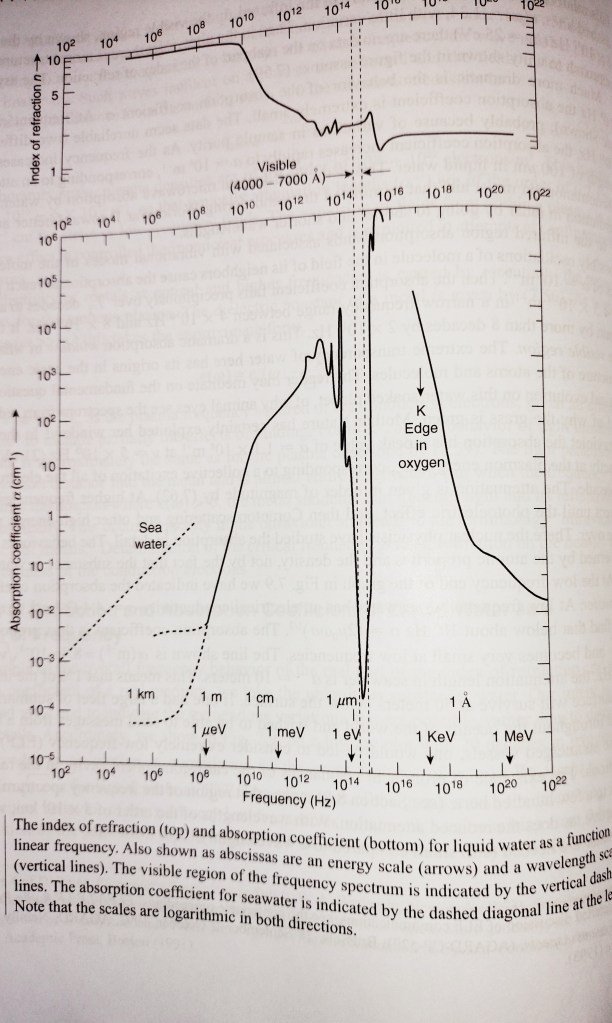
Below this is a table showing the absorption of electromagnetic radiation by water across frequencies. Here there is a steep upward slope when coming in toward the center from highest and lowest frequencies. It peaks at around the microwave/infrared wavelengths from the left and around the ultraviolet from the right.
Then a striking thing happens. There is a sudden, precipitous drop in absorption down to very low levels in a fairly narrow range of frequencies in the “middle” of the graph, meaning that in this range, light passes through water with relatively little absorption. This is the range we know as visible light.
The author took the time to point out that this fact about the nature of water‒that it is more or less transparent in this very narrow range of frequencies‒is exactly why we Earthlings tend to see only in that range. It’s not an accident of evolution, some ancient, stochastic occurrence that is thenceforward cemented, unchangeable, into all descendants, like the DNA code and ribosomes and the chirality of biological molecules. It is instead a fundamental fact of physics that determines where creatures will be able to see if they first developed vision while living in water and then developed eyes that, like the rest of them, were mainly made of water.
There’s no point in making retinal proteins that react to wavelengths of EM radiation that are almost entirely absorbed by water.
That simple fact‒simple in summary, at least‒is enough to explain a huge swath of the nature of our visual perception, and it doesn’t require any further explaining to understand why we see in the range of light we do.
That was just a randomly chosen section of a textbook that reputedly is extremely difficult. I don’t disagree with that assessment of difficulty; it was a very dense bunch of material even in just 4 or 5 pages. But to think that one can find such remarkable facts while just trying to read and learn in random order from a textbook!
So, that’s an interesting little tidbit that seems worth sharing, at least to me. It’s far more interesting than anything going on in the human world right now. What’s more, this is a fact that has existed as long as water itself has existed‒and implicitly, it existed even before that, lying there waiting in the fundamental laws of nature. And it will be there long after everything but those fundamental laws is gone.
If you want to embrace eternity, and things like Hilbert’s Hotel and Cantor’s diagonal proof make you worry about your sanity (this happens to many of us, so don’t feel bad) then focus on this fact about visible light. It’s there, it’s real, it’s quasi-eternal, and it’s concrete.
Though the absorption spectrum for concrete is…quite different.
*This harkens back to the reference from Batman Begins, when Flass says “I swear to God,” and Batman snarls “Swear to me!” It seems fun to use Batman when one would normally say God.
**By “light” I mean all electromagnetic radiation, from radio waves to gamma rays.
Please share this:

Thoughts meander like a restless spore inside a humid room
In case you’re confused: Yes, it is Monday, even though I’m writing a blog post. I just decided that I might as well do something that gives the illusion of productivity, since, y’know, I’m awake and on my way to the office anyway.
As for topics about which to write, well, on that I don’t know. I don’t think there are any momentous or interesting things worth discussing that are happening in the world right now (ba-dump-bump, chhh!).
Still, it is true that to a very good approximation every event that happens and that seems so earth-shattering and important in the moment is utterly forgotten by everything except quantum mechanics and Laplace’s demon.
Don’t believe me? Do you remember that scandal in the Roman Senate when Cinna the Younger misdirected Republic funds to buy a “servant” for his household? No? Neither does anyone else. Of course, that was 2000 years ago, so you may think it doesn’t count, but I’m sure almost none of you know about any of the “crucial” events of the day or the escapades of popular stars even 40 years ago. I certainly don’t remember any, and I was fifteen at the time, and I have an unusually good memory.
Also, time‒with respect to online information, anyway‒is cycling more quickly nowadays. Sure, information can last a very long time online*, but that doesn’t really matter in a dispositive way, because there is a constant gusher of new and distracting information coming in at all times, with signal and noise intermingling haphazardly. It’s a bit akin to the fact that although Manhattan is crowded with millions of people in a small area‒so you might think your life would be less private‒in many ways it is more private than other places, because when there, you are one indistinguishable face among those millions.
The internet makes Manhattan look like Mayberry.
Still, it would be nice to be able to get my words and maybe my stories and maybe even my music out to more people who might find them interesting and/or entertaining. It’s not immortality in anything like a literal sense‒nothing is‒but still, there’s at least some little internal drive to spread the memetic code of me out in the world. I could think of myself like the fruiting body of a fungus, spewing the spores of my thoughts into the wind, seeing if they’ll be able to infest and infect any other people out there.
It might at least be interesting to give someone the psychological equivalent of a persistent, itchy rash thanks to my words.
Of course, the fungus metaphor is an ironic one for me, since I cannot stand mushrooms for eating, and even the smell of wild mushrooms after damp weather (or mildew for that matter) fills me with literal nausea. Then again, given my own poor opinion of myself, maybe it’s right for me to think of myself and my ideas (my celium, perhaps…get it?) that way.
Fungi don’t have any qualifications or requirements to meet other than survival and reproduction. And that’s very much the nature of online information exchange; the stuff that spreads most isn’t the “brilliant” or the “important”, it’s just the catchiest. The whole process is stochastic.
Of course, there is an entire ecosystem of such meme-plexes, and they vary in their tendencies to spread quickly versus being more long-lasting. Like the species in a rainforest, some spread quickly and germinate and reproduce quickly, but then quickly die, with short, frequently repeating cycles; others spread and grow more slowly, some perhaps becoming the mighty trees that dominate the structure of the forest, but which perforce have longer, slower growth and death cycles. And, of course, the various other plants (and animals) in the jungle create and are each others’ environment. There are even parasitic plants, and opportunistic ones that germinate only after a fire. It’s very complicated, and no one plant is crucial or eternal**, though they may think they are.
Am I pushing the metaphor too far? I don’t think so. I think it’s important for people to recognize that no one controls the internet, just as no one controls the economy, just as no one controls the ecosystem, just as no one controls the evolution of the universe itself. Everything just happens thanks to the interactions of numerous smaller elements interacting according to local forces and pressures.
That’s enough for a Monday, I think. I hope you all have a good one.
*But not forever, despite what anyone says. I fear no contradiction here, because to prove me wrong, you would have to wait until forever had passed. At which point, if you are right, I will gladly concede the issue.
**Unless you count microbes‒some of those could be considered immortal. Of course, in a sense, since it all has one common ancestor somewhere, life as a whole could be considered just one gigantic, very long-lived (but probably not immortal) organism.
Please share this:

Random thoughts on Saturday morning
I’m on my way to the office this morning, so I figured I would write some reasonable facsimile of a blog post, since I might as well do something that’s vaguely creative and/or productive.
On Thursday, I wrote with my little mini laptop computer, but today I am writing on my smartphone, since I didn’t feel like carrying the laptop. I think, unless I start writing fiction again*, I’m going to pretty much avoid using the mini computer, and instead use this even-more-mini one.
As for subject matter about which to write, well, there’s really not much that comes to mind. I do sometimes wonder if I would ever write an entire book on Google Docs on my phone. It feels almost appropriate, since my “nickname” is Doc.
Even the very young daughter of two coworkers knows me as Doc.
I seem to get along better with small children than I do with so-called adult humans. Maybe it’s because their thought processes are more like mine, or maybe it’s just that they have potential to be wonderful and brilliant and creative, if only they can avoid being damaged in the wrong ways.
Unfortunately, it seems almost no one avoids that damage. Weirdly enough, though almost everyone recognizes that children are (literally) the hope for the future of humanity, after paying lip service to that notion, everyone then just lets children grow and develop haphazardly, catch-as-catch-can, putting terribly few resources into education, let alone into research about how best to do education. There should be as much rigor in the study of education as there is in the study of diseases and medicine in general, or even as much as there is in fundamental physics.
All these hugely successful billionaires ought to put their considerable resources into this area instead of making government “more efficient” or whatever, as if the most “efficient” government were demonstrably the best one. But they seem to have no thoughts about education, that tremendous public good that can provide potentially unlimited returns for the future.
Imagine these entrepreneurs who consider themselves to be brilliant planners and producers** starting businesses or other projects with no plan, with no research, just old, hackneyed notions mixed with fashionable but untried and highly nebulous ideas, and with limited supervision or moment-to-moment adjustment, feedback, or attempt to improve. If one in a million such businesses turned out to be successes, one would have achieved more than one deserved.
And yet we approach education with almost no more insight than existed a hundred or even two-hundred years ago. And our societal attitude toward education (certainly in the US) is frankly unconscionable. If there were appropriate punishment for people who don’t seem to care about the specific development of the minds of the next generation of humans, it would be hellishly severe and enduring, because such are the consequences of such attitudes toward education.
Oh, well. Humans are demonstrably stupid, even more so than one might think from following the news, and the government officials and successful business people are by no means any exception to that tendency. I suspect that large-scale intelligence would have been better coming from descendants of the dinosaurs (i.e., birds), since their brains often seem much more tightly woven. Probably, though, I would be as disappointed by them as I am by all the fucking humans.
Well, I doubt they’ll change or improve. And like unsupervised children playing with matches, eventually someone is going to burn the house down, and a lot of them are going to die in the fire. Maybe all of them will die. At this point, that wouldn’t break my heart, but then, my heart’s sort of like a scrambled egg already‒if you were going to make it even more shredded than it is, you would first have to unscramble it some.
Anyway, that’s enough of that. As the YouTubers say so often, if you like my content, please give it a “thumbs up” (i.e., a “like”), subscribe, and share it on your own social media. Seriously.
And have a good day, if you can.
*It seems vanishingly unlikely‒more so every day‒which ought to be very sad to me. Intellectually, it still is, I suppose. But as for emotions, when I think of ever writing any more fiction, I just feel empty and dead and rotten inside. Likewise with music.
**I suspect, for the most part, their huge success is largely, if not entirely, stochastic. In other words, some very lucky things happened early on and they kept benefitting from that afterwards, but not because of any particular brilliance of their own. It just seems that they must be brilliant because we only hear about those who lucked out and made it to the top, not the countless ones who failed using the same methods. It’s a bit like imagining you could learn something about what makes someone successful by interviewing people who won the lottery, but paying no attention to the millions who lose.
Please share this:

No more Shakespeare quotes for now – they’re just pretentious and irritating, anyway
Hello and good morning. I don’t really know what I’m going to write about today—even more so than usual. As you may be aware, I don’t tend to begin my blog posts with any clear subject matter in mind; I just start writing.
This is not, by the way, how I write my fiction. There, I tend to have the basic plot in my head from the start, but I don’t outline or anything along those lines, except in my head. I just write the story as it comes to me, but it’s clear that it develops below the surface when I do it.
I must say, I’ve become very frustrated recently with the process of trying to share my books and/or music with different people via, for instance, Instagram and Threads, which I mentioned earlier this week (I think). I briefly even rather liked interacting on Threads, because it seemed like there were a lot of interesting but otherwise “normal” people there—normal to me, anyway. I left occasional comments here and there that got shared and “liked” and to which people responded more positively than negatively. I even had one person comment, on something I’d written: “Nicest. Reply. Ever.” Really.
Well, now I’m blocked (temporarily) from posting and replying or anything on Instagram and Threads, but when I was shown that there was some kind of suspension and I “appealed”, it said something along the lines of “Oh, so sorry, that was a mistake. You haven’t done anything wrong.” I don’t know if something had been flagged because I sometimes had the page open on a computer still when I looked at it on my phone or something and commented from more than one machine in quick succession, or what.
Anyway, I’m still blocked from sharing or commenting—supposedly through the 17th, though it’s unclear whether that means the beginning of the 17th or the end thereof. And it’s kind of taking the wind out of my sails. I don’t actually think that the universe “sends messages” to people, but nevertheless, it is possible to learn about the nature of things from the consistent pattern of events. Once bitten, twice shy, they say, and I’ve been bitten too often.
There’s the old saying about the fact that a cat that walks once on a hot stove will never do so again, but will also never walk on a cold stove. Often this is presented in a derogatory fashion—oh, those poor, simple-minded, overly risk-averse creatures who cannot understand how stoves work!
But cats are no more foolish for avoiding stovetops than a human would be for looking both ways before running into a usually non-busy street. You might rush into such a road a thousand times without incident, but that doesn’t matter if on the thousand-and-first time you’re killed or maimed for life.
There are some things in the world, of course, that are well worth at least some risk of burning your feet or getting hit by a car, but being able to interact on Instagram and Threads with people who seem interesting or, at least, seem to be members of a species distantly related to mine, is not one of those things. And it’s certainly not worth it just to try vainly to spread word about my books and music. The world will little note nor long remember much of anything, and it will certainly not remember anything about me.
So, anyway, it was a stupid idea, but it was briefly slightly exciting, at least on the level that something counts as “exciting” for me—meaning that I’ve had a few quiet chuckles here and there, encountered some people who shared some potentially useful resources (I doubt I’ll be taking advantage of them, given how that inquiry has worked out) and even looked forward to people’s responses on the few occasions they happen.
Most of the people who “liked” my shared songs* and books and whatnot are probably bots, anyway.
Oh, and by the way, to the “brilliant” people who run Brilliant dot org—when a person comes back to your site to study and learn about things, and then is immediately afterward bombarded with emailed warnings and pop-up alerts about “your streak is about to end” in clear attempt to cajole them to come on more frequently, for people like me, it makes me want to avoid the fucking thing, which is what I’ve ended up doing for long stretches several times now. That’s particularly frustrating, because otherwise I like Brilliant.org a lot, and think it is a good learning venue, at least a supplemental one.
I also just finished the latest volume of a light novel series I’ve been reading that was pretty good, and that’s frustrating, because there’s not even a scheduled release date for the next volume, and I can’t seem to find anything else interesting to read. So, life continues to be a quiet, subtle, understated Hell, that burns not with open flame but with slow, steady friction as if one were constantly being rubbed by burlap and sandpaper.
Oh, well.
TTFN
*One of which, ironically, was “Like and Share”.
Please share this:

No (get) alarms (me) and (out) no (of) surprises (here), please.
It’s Tuesday morning, the last day of the second week of the new year (from which you could rightly conclude that it is January 14th). I’m on my way to the office and I’m writing a pointless blog post. I really don’t have anything of interest to write, but the Force (of habit) is strong with this one.
I’ve been modestly exploring new (to me) social media platforms, including Instagram, Blue Sky, and Threads. The only one on which I actually interact much is Threads, but even there, I don’t really do much, and there’s no sense of any actual connection with anyone. Still, I decided I would do a belated retry of promoting my books and/or music on these apps. So I shared a copy of a song on Instagram, and then from there on Facebook, Twitter, BS, and Threads. Then I shared links to my books on those same venues (well, okay, not Instagram…that doesn’t seem well set up for one to share simple links, or if it is, I haven’t yet figured it out).
And that’s about it. I’ve been reading a reasonably good Japanese light novel series called Chitose Is in the Ramune Bottle, but I’m just about to finish the latest volume and there won’t be another one for a long time. I have no interest at all in any other fiction or nonfiction. I don’t even want to read my current books or old favorites or whatever.
I have 5 credits with Audible, which I think is the maximum they let you carry, but I haven’t been able yet to find even one audio book in which I’m interested.
The world is just a projection onto acrid gray fog.
I guess today I’ll share maybe another song, a link to one of my other books, maybe both. Maybe I’ll also share a “video” of me reading one of my short stories. Maybe I’ll even put one or two down here to let WordPress join the party.
And that’s just about all I have to say about that.
Please share this:

Blog Post for 1-10-2025, Friday
I’m going to write a very brief post today, just since I didn’t write anything yesterday. I was out from work with a rather severe exacerbation of pain, from head to toe. I actually thought about just sharing here an embedded or linked connection to my “bad cover” of Hurt, by NIN/Trent Reznor (and which was so achingly covered by Johnny Cash). I shared it directly on Instagram, partly just to see if it was possible to share whole longish “videos” there, and it was. So I shared from there to Threads and Facebook, TWFKAT*, and BlueSky and so on.
I think I’ll embed that video here below, or rather, I’ll link to the YouTube video.
Anyway, then I just tried to lay down and rest, and I dosed myself up with stuff to try to help diminish the pain and to help me sleep (I didn’t really get any more sleep than usual, unfortunately).
You know what, I think I’m also gonna link to one of my own original songs on all these various new social media sites with which I’ve been halfheartedly dabbling. I’ll link that here, too.
As for why I’m in so much pain, well, the abrupt shifts in weather haven’t helped. Also, I tried a new form for my ab exercises, since I’m always trying to find ones that reduce my pain, but this one backfired.
Then, I had such a stressful day at the office (payroll, loud and chaotic noise, tinnitus acting up like a diamond tipped drill driving from one side of my head to the other, people acting like idiotic children) that at one point I beat myself in the forehead with my fist so often and so hard that I gave myself a mild case of whiplash and possibly a mild concussion. I certainly felt loopy afterward.
Unfortunately, there was nothing immediately life-threatening, so, as Bob Seger put it, “here I am, on the road again”.
Anyway, I’m off work this weekend, and I’m still quite sore and whatnot, so hopefully I’ll get some rest but will also have the gumption to walk some.
Meanwhile…I guess I hope you all have a good weekend. “Like and Share if you agree.”
*The Website Formerly Known As Twitter. Presumably because of an overabundance of musk, my feed on that site is no longer showing any posts here on my site. Right now, I can’t be arsed to try to figure out how to fix it.
Please share this:

In the voids between galaxies, it’s already next year, but there’s still no life there.
It’s Tuesday, now‒the first Tuesday of the new year. This is not anything particularly interesting, of course. It’s really just another day. But it is also the last day of the first week of the new year, the 7th day of the year, as indicated by the fact that it is January 7th.
“Brilliant, Holmes!” I hear you say.
In this case, though, it truly is elementary. It’s also pretty boring, so I’m sorry to go on about it.
There have been troubling things in national news, of course: the terroristic suicide attack-by-vehicle in New Orleans; the guy who blew up his cyber truck; severe cold weather striking large swaths of the eastern US; and, of course, no one has yet yelled “Psych!!” regarding Donald Trump’s election for a second term as president.
I’m not as rabidly anti-Trump as many; he’s just a man, of soft and squishy flesh and blood, like everyone else. He’s also just one more incompetent government official on a world stage that might as well be a collection of (poor quality) Three Stooges clones.
It would be remarkable and praiseworthy if humans actually elected smart, calm, intellectually honest government officials with personal integrity. Alas, when holding elections, humans seem unable to be as rigorous in their evaluation of candidates as they would be when screening babysitters or even gardeners. And, of course, since few people are in the habit of reflecting on themselves in any way to improve on their own flaws in judgment, it seems unlikely that things will change very quickly.
This is all nothing new, of course. The modern shape of cyberspace and the borderline-antisocial media add little twists and peculiarities, introducing new dynamics to the system. But the dominating principles of primate social and sexual dominance hierarchies and displays have not changed much, if at all.
The only really interesting thing I’ve found in the news is the statement about a new study‒an elaboration of a first theoretical paper from some years ago‒that proposes a potential alternative explanation for the fact that the expansion of the universe appears to be accelerating that doesn’t require “dark energy”.
The cosmological principle, which underlies the usefulness of standard model, lambda-CDM cosmology, states that, on the largest of scales, the universe is uniform and homogeneous. However, on anything other than the largest scales, the universe is decidedly clumpy. This is because of gravity, of course, pulling things together in regions where things are more dense (making them still denser) and making the spaces in between ever more rarefied and so on.
But, of course, gravity is not just a simple attractive force; it works its effects through the warping of spacetime, and in ordinary circumstances (so to speak) its effect on time is far more significant than those on space. This is a very real effect, one for which we have to adjust when using GPS satellites for instance, so while general understanding of it may be relatively rare, it is not an esoteric bit of physics. It’s textbook stuff.
The point being made by this new hypothesis is that perhaps there is no real dark energy, but instead, in regions where more mass exists, time slows down. This is a bit of an oversimplification, but it’s quite true, and indeed, to a large extent, all the apparent physical effects of gravity are produced by the differential flow of time between places where the manifold is more vs. less curved.
So, in the places where matter/energy is relatively scarce, time moves “more quickly”. So, since the universe is definitely expanding (due to the Big Bang), those regions are going forward through their expansion more quickly than regions with more matter, and so the space between galaxies and clusters appears to expand more quickly, and as the comparative difference, the contrast, in energy concentration increases, the difference in passage of time will tend to increase, too, producing an apparent accelerated expansion.
[Note to self: how would this model be expected to affect the extreme measured uniformity of the Cosmic Microwave Background? Is this going to be a point of evidence against it?]
This is not a definitive, tested hypothesis, but it rests on sound principles. It probably won’t supersede lambda-CDM, but it has the potential to do so. This is no crank, RFK Jr. style hypothesis by any means. I haven’t read the papers involved yet; rather I read articles and watched some videos about it; I will try to learn more.
But, since the discovery of the accelerating expansion of the universe in the late ‘90s was the single most exciting (non-personal) event in my life, the idea that there is a new approach that might change that again is also truly exciting.
It makes me wish I had just gone into physics as I had originally intended. However, post-open heart surgery, transient cognitive impairment, and an exacerbation of depression triggered by the same thing, made it too difficult, in the short term, to keep up with my physics and math classes in the semester after my heart surgery, so to English I went.
But as I picture the large-scale universe differentially flowing through time and thus expanding at relatively different seeming rates, producing this wonderful, higher-dimensional twisty-bulgy-filamentous shape, I can at least feel a little twinge of the joy of contemplating science. My only real contribution to science was in studying the effects of gliotoxin on naked DNA in vitro, and though that’s quite interesting, it’s not exactly cosmology.
Oh, I also wrote a pretty decent review article about the various effects on cognition and other neurological functions of heart-lung bypass as done during open-heart surgery. Clearly, that was motivated by personal experience.
Anyway, that’s it for today. Tomorrow begins the second week of the year, but I don’t expect to write again before Thursday.
Please share this:

There is no title–just a lease. Ha ha.
Well, it’s Saturday, and I’m on my way into the office again, since we are open today. And therefore, as I warned you, I am writing a blog post.
I have no idea what I’m hoping to gain by doing this. I have no clear notion even of what in principle could be gained from this. However, I am a creature of habit, as well as of compulsion and desperation, so, well, I’m doing this. I also try very hard to be a man of my word, though I probably fail as much as anyone does at that.
I don’t really have much news to discuss. There’s little percentage in discussing the actual news, i.e., events from around the globe, since in the modern world saying something online that someone disagrees with is tantamount to being a revolutionary religious heretic in their eyes, endangering not only the world but the souls of the unborn.
Of course, one of the expressions that most irks me in this vein is when people say that someone is “destroying their existence” or something along those lines, by what they’ve said. This is obviously nonsense. I try very hard not to say unkind or hurtful things to people‒courtesy is the lubricant of civilization, after all‒but mate, if I wanted to destroy your existence (and acted on that want) you would not be complaining about it; you would not exist.
This is part of the stupid conflation of words with violence, an idea that can only really be held by those who have little experience with real violence*. I’m sure I’ve discussed that here before, and it doesn’t really bear repeating.
Yesterday morning, I had a little bump up in my mood and energy level, which I didn’t understand, but I also didn’t really question at the time. Maybe it was because the holidays are over or something, I don’t know. Maybe it was because a reply I made on threads got hundreds of likes‒which surprised me‒or because a deliberately stupid joke I made in response to another thread got a decent number of likes and no fewer than two people posting gifs of famous scenes of people saying “Boo”. That made me chuckle, because it was more or less exactly the response for which I was hoping.
I don’t like to think I’m that shallow, for such things to significantly give me a boost, but who knows? This stupid human body and limbic system with which they saddled me has all sorts of bugs and hacks and workarounds that just piss me off.
Anyway, such online responses are very temporary and shallow for me, enjoyment wise. And yet, alternatively, when other people actually contact me directly via social media, in most cases, my immediate response is stress, tension, hyperalertness, anxiety, etc. And in me, any form of fear quickly sublimates into hostility and battle-readiness, usually in a very literal sense.
I often have to take hours and hours before I can reply to a simple greeting through one of the various messengers (even ones that aren’t obviously bots trying to sell something or other, which I ignore) and sometimes it takes me days. Even ordinary SMS messages can be stressful. When I hear the text alert on my phone, my usual reaction is either “What do you want!?” or “Oh, shut up, will you?” before I even know who sent the text.
Even positive texts from friends and family, perhaps in response to my own holiday greeting texts sent to them, cause tension, even though I’m glad to receive them.
I suppose one could call it anxiety, but that’s not exactly the way it feels‒though maybe I’m splitting hairs. Anyway, I just feel at a loss whenever anyone tries to communicate with me, especially if I’m mentally engaged in something else. I feel as though I’ve forgotten entirely what one is supposed to do in such situations, but I know that I’m inclined to say or do stupid things.
So, I have to pause and think and give my brain time to digest the fact that someone has messaged me. Somehow, it always feels as though it is a threat‒ironically, it can be more threatening to receive messages from someone I like than from someone I don’t, because those are people whose opinions about me matter to me, at least in principle. And I know I always screw up relationships with people who matter to me.
It’s even stressful to see when I have comments here‒but please don’t let that dissuade you! I want comments, I appreciate them, just don’t take it personally if I take a long time before responding to them. I won’t say preparing to respond is as bad as trying to work up one’s nerve to walk across hot coals, but maybe it’s analogous to preparing to jump into a very cold lake. Even if you know that, once you get used to it, you’re probably going to enjoy it, every time there is a kind of “stage fright”.
It’s analogous with physical contact for me. I have no skill with how and when to initiate physical contact with someone, whether comradely or romantic or whatever. This skill I have never been able even to begin to acquire, let alone to master, though back in the day I got pretty good at faking my way through seeming to feel natural with verbal interactions at least.
This probably has been a large contributing factor in my dolorous and limited romantic history. Even when with someone with whom I wanted to be intimate, and who I knew wanted to be intimate with me, I have near-paralytic difficulty starting anything, even something minor like a touch on a shoulder.
Part of that is an automatic warning in my head that says, “Danger, danger, you are making a mistake. There is no way that anyone, least of all this very special person, could want you to touch them in any way, let alone to do anything further. You are disgusting! Don’t inflict your slimy touch on someone else, especially not someone about whom you really care.” Well, it’s words to that effect‒it’s rarely thought out explicitly, it’s just the uncrystallized, supersaturated feeling those words convey that tends to get in my way.
Oh, and I also tend to get pretty tense when someone touches me‒even if it’s a significant other, sometimes, and even though, in the right situation, even a minor touch can be soothing‒because I feel like I don’t know how to react and I’m sure I’ll screw it up, and anyway, they’ll be in danger of catching cooties** if they touch me. And, of course, a lot of the time I don’t really want to be touched.
I don’t know how I got onto this topic, but anyway, my temporary boost yesterday lasted only a few hours. I didn’t sink to as low as I had been on Thursday, but after all, if you’re treading water, it may seem for a moment, due to the chaotic action of the waves and maybe a random burst of extreme effort from you, that you have risen higher above the surface of the sea…but you will not stay elevated. You will sink back down to the level of whatever passes for neutral buoyancy, after briefly dipping lower. And, of course, unless you reach shore or a passing boat finds you, sooner or later, you will drown.
That is, unless you’re lucky enough to be eaten by sharks.
*Or perhaps those who have suffered brain damage due to real violence, but those people can be cut a lot of slack.
**Figuratively speaking. I don’t have lice (which is what I am led to understand the term “cooties” originally meant) nor any other literal contagious infestation or infection.

 Robert Elessar