Words about fear and words about words

Well, it’s Saturday again, and for the second week in a row, I am writing a blog post.  I warned you that I probably would:  here, go take a look.  See?  I told you.

Of course, a blog post means I’m going to the office today.  It’s not a full day, but it chews up so much of the middle part that there’s no possibility of getting any extra rest, at least not for me.  For instance, I have awakened well before I would need to go to the office, but my anxiety or tension or whatever it might best be called does not let me sleep‒for fear of oversleeping, I guess.  It’s some manner of fear, anyway.  It’s not a fear of physical attack (I think) but it sort of feels like I have to watch my back, as though someone or something is out to get me.

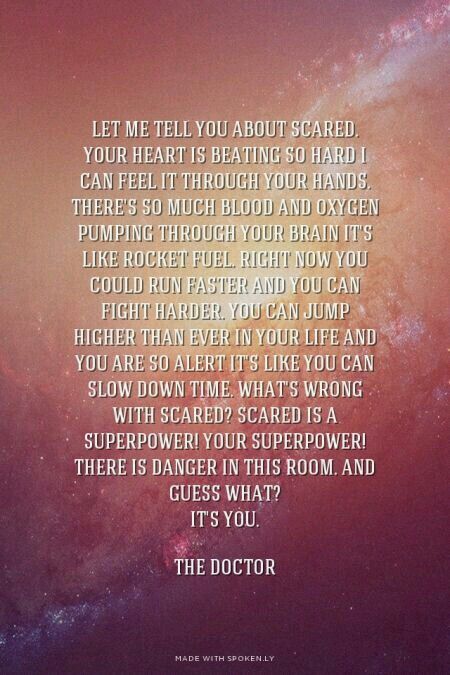
Fear is not the mind killer, of course, despite the popular mantra from Dune.  Fear (up to a point) can sharpen the mind, if it’s not resisted inappropriately.  I think the 12th Doctor’s take on being scared is far better than that from Dune.  See below:
Obviously, too much fear is bad, but as Stephen Fry, playing the unscrupulous tobacconist points out (starting at roughly the 2:45 point here), that’s what the term too much means.

Too much of anything, more or less by definition, is bad.  This is one of those somewhat rare circumstances in which one can say “by definition” and not be relaying a merely semantic point without substance.

This is in contrast to the silly old conundrum “If a tree falls in a forest and there’s no one to hear it, does it make a sound?”  If you simply define your terms precisely, there is not going to be any ambiguity in the answer‒but you have to choose your “definitions”* of each word clearly, especially ones like “hear” and “sound”.

If you’re ever arguing about something (other than etymology and/or usage and/or diction) and you want to go to the dictionary to settle it, then you’ve probably been arguing about something without substance‒arguing past each other, as they say.  I’ve heard such arguments, even between people with seemingly above-average intelligence.

Of course, if they’re arguing for fun, as a sort of mental sport and exercise, and if they both (or all) are enjoying the process, then I have no trouble with it.  It probably sharpens their thinking skills, as long as they don’t let themselves forget that they’re just arguing over misaligned coding and the logical implications thereof.  Even a skilled martial artist who trains purely for exhibitions may be in real trouble in a street fight against serious opponents.

But even the OED doesn’t decide or define what English words mean; it records what words have been used to mean, their origins, their etymology, all that good, interesting stuff.

How did I get on this subject?  I guess I’ll see as I do the editing.  I certainly do bounce and meander in my head, don’t I?  And that process is often inextricably intertwined with writing.

That can be a good thing, sometimes, I suppose.  I would think it’s at least related to the nature of creativity.  But it’s also important to be able to focus and stay on point, to be disciplined, if one is truly to create anything of depth.  One of my biggest problems in the past was that I would come up with, for instance, good story ideas, but I would soon get distracted by some new story idea and get diverted from the first.

One of the best things about having been to prison‒yeah, there were a few good things, though they were strongly overwhelmed by the bad‒was that I was in a situation in which I could discipline myself to write every morning, when lights came on (about 3 am) for 3 to 4 pages, and not go on to a new story until I finished the first.  I mailed the pages out to my Mom, Dad, and sister as I went along, after rewriting them for a bit of legibility**.

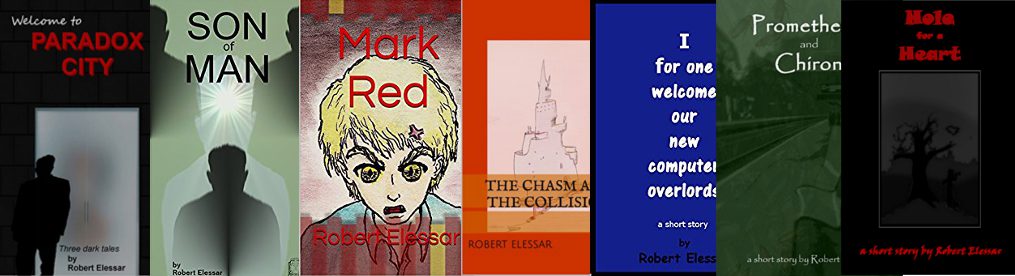
In this fashion, I wrote first Mark Red, then CatC, then Paradox City.  Then, after I got out, I continued writing, finishing one story before starting the next, right up until I began Outlaw’s Mind.  That was the last story I started in that pattern, though I’ve since written a bit on The Dark Fairy and the Desperado and even less on HELIOS.

Currently, I just write this every work day.  I cannot explain why in any quick and simple fashion, but it is what it is, as the tautology goes.

I hope you have a good day.  I should be back on Monday.


*I put that in scare quotes because in nearly all cases, words don’t have real, singular, exclusive definitions, but instead have usages.  Now, as the person who coined various words in, for instance, The Chasm and the Collision, I can actually and literally define those words.  I have actual authority over those words; I created those words and I created those worlds.

**I kept my first draft so I would be able to go back and check things if I needed to do so.

Some Halloween-style pictures among unrelated words

First of all, Happy Halloween to everyone who celebrates this day in any fashion.  Even if you don’t celebrate it, you might as well have a good day.

I don’t discriminate based on Holiday celebrations.  How very admirable of me.

Once again, I mean to keep this post short by making my target 701 words to start with, because I’m very tired this morning.  It was difficult to get up at all, and I still feel as if I’m vaguely sedated.  Unfortunately, it doesn’t seem to have been one of those sedatives that’s associated with euphoria.  It would be nice if it were, right?  If they would agree, I would agree.

Unfortunately, I’m just groggy and weak and blurry.  By which I mean I feel that the world seems slightly blurry to me.  I don’t mean that I am blurry if you look at me.  I might imagine that I could be blurry (meaning as a function of me not just poor vision in the observer) but I have looked in a mirror already this morning, and while I am far from easy on the eyes, I seem to be in focus.

Thinking of atypical interpretations of things people say, I was listening to one of the guys on the phones in the office yesterday, and I heard him use the expression “qualified individual”.  Now, I know what he meant, and it’s a perfectly valid term when discussing a promotion with a customer.  But it occurred to me that one could use the term to refer to someone who is an individual…but only from a certain point of view.

For instance, Norman Bates could be thought of as a “qualified” individual.  Yes, he’s a single person in the sense that he is one organism*, but there is more than one distinct personality in his head.  You could also say that the narrator in Fight Club is a “qualified” individual, as is James McAvoy’s character (should that be “characters”?) in Split.

Oops, sorry, I guess I could have given a spoiler alert for those movies.  But if I had done that, it would have ruined the surprise!

Of course, from certain points of view, even your typical unqualified** individuals are not as monolithic or monotonic or monotropic or, well, monopersonic as one might imagine.  We know that in split brain patients, when the corpus callosum is severed to reduce the problem of, for instance, uncontrollable seizures, the two sides of the person’s brain can act and think in some ways like two separate people.  They act like two individuals in other words, though in such circumstances, that word is least applicable, since if anyone is “undivided”, it is not these people.

But they are only a special, more extreme version of that which is true of the rest of us.  Our minds are all divided into many separate modules and centers, often running largely in parallel with each other.  There is no one central, “terminal goal” region of the mind; there are separate and conflicting areas and aspects, and even they are not constant.  Many introspective practices, particularly those associated with Buddhism, recognize that the concept of an individual, homuncular “self” is nebulous at best and is never even close to being real.

It seems the term “individual” is just as incorrectly presumptuous for people as the term “atom”*** is for, well, atoms.  However, if we’re referring to more physical literality, then it’s still pretty accurate, certainly for everything more complex than a flatworm.  If you start splitting people (and other animals) in pieces, what you get, at best, is a creature with missing bits and lots of dead former body parts.  You don’t get more than one being.  Often you get no one, because you will have killed the person with whom you started.

In such a case, one divided by two might in a sense equal zero.

Of course, even in basic mathematics, if you divide one by ever larger numbers, you get closer and closer to zero (it’s the limit as the denominator goes to infinity).

Speaking of going to infinity, the value of 1 / (701 – x), where x is the number of words I’ve written, has now crossed the singularity at infinity and is asymptotically approaching the x-axis from below.  On the positive side of the x-axis, starting from the beginning of a post’s first draft, that number can never be smaller than 1/701, since even I cannot write a negative number of words****.  But once I’ve passed the 701 point, the numbers can become an infinitesimal negative fraction, in principle.

In practice, I’m practically finished here.  I hope you all have a good day.  I will probably write a post tomorrow.


*Not counting skin and intestinal flora and the like.  If we count those, then we can all, like Walt Whitman, truthfully say “I am large, I contain multitudes”.

**Again, this has nothing to do with the person’s skills or résumé or experience or innate abilities, it’s just saying that one wouldn’t normally feel the need to add any caveats when calling a person an individual.

***Which means, basically, “uncuttable”.  And what we call atoms can indeed be “cut”.

****A number of negative words, on the other hand…

O heavy lightness, serious vanity, misshapen chaos of well-seeming blogs

Hello and good morning.  It’s Thursday, of course‒thus the “traditional” opening salutation‒and here I am again, writing another in a line of hundreds of Thursday blog posts.

Have I said all that I could say, already?  Probably not.  The number of possible 800+ word strings of English writing is surely unfathomably vast.  If I were going to try to give some kind of upper boundary, we would consider that there are a few million words in the English language, and I could just try to solve for a few million to the 800th power.  That’s a huge number (104800). But most of those combinations‒all of them, effectively‒would be nonsense.

By “all of them” I mean that, if one applies the constraints of grammar, or even just of making tolerable sense to a potential reader, the number of strings of 800 coherent words is so much smaller than the number of possible strings of 800 words without care for sensibility that, if one were looking at some shape or field that represented the latter, the former would probably be too small to see, given the constraints on the resolving power of visible light.

It’s a bit like the possibilities implicit in DNA.  The human genome is on the order of a billion or so base pairs* long, if memory serves, and each “site” on the genome has 4 possible “letters”.  So, the potential number of sequences of DNA in that genome is on the order of 4 to the billionth power, which would be 2 to the 2 billionth power, which is about 10 to the 600 millionth power (10600,000,000).

That’s a huge number. Remember, a googol is merely 10100, and it is already a number that far exceeds the number of baryons in the (visible) universe (which is on the order of 1080).  And remember how exponentials work:  every time you add 1 to the exponent you multiply by the base number, in this case 10.  So, 10101 is ten times larger than 10100.

As you can see, the number of possible DNA sequences is beyond astronomical, at least unless we get into, say, the measures of entropy represented by an event horizon, as an indicator of the number of possible quantum states it could have “within”.  But distances and times and numbers of particles in the accessible universe are unnoticeably small compared to the number of possible sequences of DNA**.

However, the vast majority of those base-pair combinations would certainly not code for anything that we would consider human, or indeed any other living creature that’s ever existed on Earth.  Most are the analogue of throwing random words together to make a blog post.  They wouldn’t come close to coding for anything that would be a living creature.

Nevertheless, even ruling out all the nonsense, the number of possible viable human genomes is vast.  It may still be larger than the number of particles in the visible universe, but don’t quote me on that‒I haven’t checked those numbers.  In any case, it’s much larger than the number of humans who have ever lived, and probably larger than the number of humans who will ever live even if the species goes on to become cosmically significant.

What this all comes down to, I guess, is that I haven’t come close to writing all the possible blog posts I could write, even ruling out ones that wouldn’t make any sense and even ruling out ones that differ from others only by a word or two.  I guess this blog itself constitutes a case in point.

But boy, it can be a lot of work trying to write something new every day, and even more work trying to write something interesting.  That’s why I don’t bother with the latter criterion; I just write whatever comes out, which is usually something at least mildly interesting to me, and I figure it’ll reach kindred spirits if they happen upon it‒and if such people even exist.

Speaking of kindred spirits, I hope you all have a lovely day.  At least I hope it will be as good as it can possibly be‒which it will, since once it’s happened, it can’t have been otherwise than it was.

TTFN


*In case you don’t recall, DNA is a long chain molecule of polymerized “nitrogenous bases”, adenine, guanine, thymine, and cytosine.  Because each DNA base can pair up only with its complementary base (A with T, G with C) this allows for high fidelity copying, and thus reproduction.

**Now, if the universe is spatially infinite‒which it looks like it is, but may not be‒then of course the number of particles or quantum states or even planets with life would be infinite, and thus larger than any possible finite number, no matter how big you might choose.  Fun things happen when one deals with infinities.

And therefore, since I cannot prove a lover, to entertain these fair well-spoken days, I am determinèd to prove a blogger…

Good morning and Happy New Year to all!

I was just idly wondering, is New Year’s Eve/Day the single most broadly celebrated holiday in the world?  I wouldn’t be surprised if it is…and I suppose I wouldn’t be much more surprised if it isn’t.  Still, considering the general adoption of the Gregorian calendar by, as far as I know, all the nations of the world, I would suspect that New Years is the most generally recognized possible day of celebration worldwide, across all cultures.

That said, I hope all of you who do celebrate it had a wonderful time doing so this week and didn’t suffer too many ill-effects in consequence.  This new year number sounds just a bit like the beginning of a count-down (20…19…), which could be the lead-in to good things and/or bad, but next year at least we should all have clear vision to face whatever comes.

Okay, enough of that nonsense.  I have few new things to say with respect to writing this week, but I’ll give you such updates as there are.  First, of course, I am very close (relatively speaking) to the end of Unanimity.  Interestingly, just yesterday I re-started taking the train—both to save vehicular wear and tear and to force myself to get in some walking every day—and between the train and then some time in the office before work, I got significantly more writing done than I had on any other day in weeks.  Some of this may simply be because I’m approaching the end of the story, and the excitement is building, driving me to push out work more quickly.  Some of it may be from resting over the dual holidays (thankfully, I did rest, being neither very social nor much of a drinker).  But I think just not having to drive (except to the station in the morning) and thus not having to worry about traffic, to say nothing of getting a bit of exercise, really seems to do me some good.  Here’s to hoping I’m right.

Penal Colony also approaches its end.  Which is to say, the editing process is nearing completion; the story has been finished for some time.  I’m enjoying editing it, and I’ve certainly cut a lot of fat out*.  It’s at least a little bit light-hearted, despite its dire predictions about a possible sinister side of social media in the future (I know…can you imagine!?).  It’s certainly not as heavy as Solitaire, but that’s not exactly a high bar to clear.  Of course, all of this means we’re going to have to start working on the cover design any day now, which is its own special, and sometimes stressful, task.

In other news:  I don’t recall whether I’ve blogged about this already, but I recently read the book, Bird Box, responding to all the hype (and some interesting-sounding hints) about the Netflix movie (which I have not seen), and it was quite good.  I left a nice review, not too long, but hopefully useful, on Amazon, and I’d like to take this opportunity once again to cajole all of you readers—especially if you read independent authors—to rate and, if possible, to review the books you read on Amazon, or at least some significant fraction of them.  I know, I tend to harp on about this a bit, but it makes a tremendous difference.  It’s also very useful for an author to get feedback from general readers, who after all are the market for whom the books are written.

I don’t have a tremendous lot more to discuss this week, and I’ve almost reached my stop.  I wish you all, once again, the very best of new years, and I hope you enjoy yourselves and read plenty of books in 2019.  While it’s true that there are a great many other good sources of information and entertainment available, some of which are more seductive—and certainly more passive—than reading, written language remains the lifeblood of civilization, and the most direct and efficient means by which to convey information and stories between human minds.  As physicist Lisa Randall points out in her wonderful book Warped Passages, sometimes a few words (and perhaps a bit of math**) can be worth a thousand pictures.

TTFN


*I have a darkly humorous fantasy of some future person reading Penal Colony and thinking, “This is the story after you cut a lot of fat out?  What was it like before?

**which is, after all, just a special type of words