Here we go again. Heavy sigh.

It’s Tuesday now, in case you didn’t know, though of course you might not be reading this on a Tuesday.  If by some bizarre set of circumstances my writing is still being read in the far future‒or even more improbably that it goes backward in time somehow or tunnels across to some other part of the universe that nevertheless has people who can read English‒there may not even be Tuesdays where and when you exist.

In case that’s the case, I will just say that in the 20th and 21st centuries‒and actually for quite some time before‒we divided the days into groups of 7, which we called weeks*.  There were roughly 52 of these in a year (52 x 7 = 364, one day and some change less than a full year).

In the English-speaking world we called these days Sunday, Monday, Tuesday, Wednesday, Thursday, Friday, and Saturday.  I could go into the etymology of those names, but that’s a bit of a pain.  Anyway, you’re the ones who are in some future, presumably advanced civilization; why can’t you look that stuff up for yourselves?

Anyway, our “official work week” ran from Monday through Friday, with Saturday and Sunday off.  However, that was far from the only schedule people followed, and in a form of evolution due to mutual competition, people vied with each other to work more days and longer hours for less pay, because other people were willing to do it.  Not to participate would lead one to be less likely to get or keep a job, and that could lead to destitution‒at least somewhat more quickly than does steadily working longer and longer for less and less, which is a kind of creeping but pernicious societal malaise.

Of course, other, parallel forces led to decreasing regulation of companies’ ability to “encourage” their workers to work more for less, and since in the short term** everyone works in response to their local incentives, people tended to allow these things to happen.  And lawmakers and regulators, subject to the inherently woefully dysfunctional political party system, became less and less incentivized to care about the needs and worries of those they nominally represented, and to whom they had sworn their service***.

They were happy to allow the fortunate wealthy and powerful to take advantage of the foolishly earnest and mutually (and self-destructively) competitive citizens, because they were rewarded for allowing it.

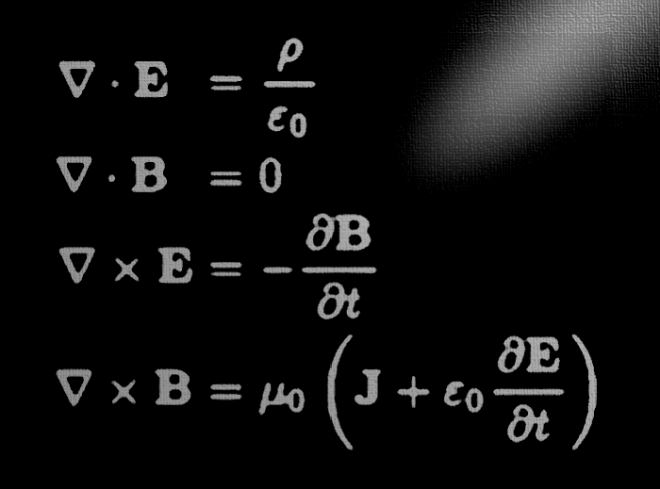
Everyone responds to local forces, of course.  Even spacetime itself responds to the spacetime immediately adjacent to it, as the electromagnetic field responds to the state of the field immediately adjacent to it, as demonstrated by the implications of Maxwell’s famous equations, which I’m sure jump right out at you:

Of course, the meaning of “local” is circular here, almost tautological, since the definition of local is merely “something that can affect another thing directly” more or less.

So it’s only too possible for a system to evolve itself into a state that is overall detrimental to those within the system.  Everyone, even the most seemingly successful, can be in a worse situation than they would be in otherwise, but it’s very difficult to see the way out, to get a “bird’s eye view” of the landscape, if you will.

One can therefore get stuck in situations where, despite the overall equilibrium being detrimental to everyone, any one individual taking action to try to move things in a better direction would make their local situation worse for them.

How is one to respond to such a situation?  Well, one can simply go along with it and try to do what’s best for oneself locally, and that is what most people do most of the time‒understandably enough, even though the overall situation may be evolving toward its own miserable destruction.

Or, of course, one could do what family therapists are often said to do:  effectively setting off a bomb***** in the middle of a difficult situation and seeing what happens when the dust settles, figuring that nothing is likely to be much worse than things are at a given present.  At least this allows for a new system to form, like the biosphere after the various mass extinctions.  Maybe it will become better than the previous one.

Maybe they all will always evolve toward catastrophe, to collapse and then be replaced by a new system.

It would be better if people could learn, and could deliberately change local incentives in careful and measured ways, adjusting settings to correct for and steer things away from poorer outcomes and so on, in ways that are not too disruptive at any given place or time.  That’s nominally what many of our systems are meant to be doing, but they don’t do a very good job at it.

Probably it would be better to do a hard reset.  But I’m not sure.  And it’s probably not worth the effort.  The odds of humanity surviving to become cosmically significant seem very low to me, and I’m not sure it would be good for the universe‒whatever that might mean‒if they do.

It’s probably all pointless, and I’m tired of it, anyway.  I don’t want to be part of this equilibrium or lack thereof anymore.  I want to make my own quietus.  Maybe “civilization” should do the same.


*Not to be confused with “weak”, which sounds the same but means more or less “the opposite of strong” and has little or nothing to do with divisions of time.

**And that’s pretty much the only term that comes naturally and easily to humans, for sound biological but horrible psychological and sociological reasons.

***If they were Klingons, they would surely be slain for their dishonor.  I don’t necessarily disagree with such an outcome morally, but practically, it would probably lead to increasing chaos****, so we understandably avoid it most of the time.

****It’s an open question whether such chaos is inherently bad.

*****Metaphorically, of course. At least, it’s usually metaphorical.

All ideologies are wrong

I don’t know if what follows will be clear or will convey my thoughts very well, but here goes.

I was in the shower this morning, thinking about nothing specific, and somehow I started feeling irritated, as I often do, at people who are dogmatic about ideologies and try to apply them to every possible situation or state of the world.  Then a connection of ideas clicked into position for me in the phase space of the mind, and I thought about the notion of scientific models.

There’s a famous quote about model-building/using in science that says, “All models are wrong, but some are useful.”  (I don’t recall who said it, but I’ll look it up before posting this and I’ll put it in the footnotes*.)  The statement refers to the fact that, to try to understand the world, scientists build models—not usually literal, glue-together type ones, though that occasionally does happen—and see how well those models replicate or elucidate facts of external reality.

They are all simplifications, as they must be, since only the universe itself appears to have enough processing power to simulate the universe fully.  Being simplifications, and reality being complex and prone to chaos (the mathematical form thereof, though the classical kind does occur as well) a simplified model can never be entirely correct.  But some of them are nevertheless quite valuable and useful—take General Relativity and Darwinian natural selection as two good examples—though we know they do not fully encompass every aspect of reality.

Some models are misleading, such as the old notion of the brain as a cooling mechanism for the blood, and some are simply not that useful, such as seeing the brain as a system of hydraulic tubes and valves of some sort.  And when you try to apply a model to a situation in which it doesn’t apply, it will give you wildly wrong (or “not even wrong”**) answers.

It occurred to me there in the shower that human ideologies are quite similar.  They are simplifications, models of the world.  Some are useful in some ways and to some degree, and some are about as applicable as the notion of a spherical cow (which, despite being the punchline of a physics joke, could in principle be useful somewhere sometime).  But it is as absurd to measure every event or occurrence or interaction against some finite ideology as it is to try to apply the germ theory of disease to the question of “dark energy”.

It’s absurd—if you’re being rigorous and serious—to think that the ideas of Karl Marx contain all that is needed to produce a good, fair, productive, and stable society.  But it’s just as absurd to think that laissez-faire, free-market capitalism will for its part provide everything that could possibly be needed for a robust and free and beneficent world, or that the ideas of “post-modernism” contain all that need be said about civilization.

The world is complicated, with many forces interacting at many levels, and no single idea, however personally attractive, can encompass all of it in a useful way.  Capitalism can encourage the production of great innovation and abundance, but it has no inherent justice, despite some popular belief and the works of Ayn Rand.  It can leave people utterly bereft and tortured and miserable through no fault of their own but bad luck.  It can also evolve into inadequate equilibrium states in which isolated, hoarded wealth sits still and does no one any real good while the whole of civilization collapses around it, just as biological systems can evolve into self-destructive states, like cancers, when an individual mutated cell becomes so successful at reproducing itself that it kills off the body in which it resides.

But if people are not rewarded for their work or their creativity or their acumen to some degree that is at least on some level commensurate with the value they produce, then people will stop producing.  Nature does not tend to evolve creatures that act purely to their own detriment without any “personal” gain of some kind  It’s not an evolutionarily stable strategy; such creatures are rapidly selected out.  Humans are no exception.

And history (and mathematics) has shown that economies are too complex to be planned by anyone or any group, and probably by any form of individual intelligence, no matter how advanced.  The information and knowledge required is too staggeringly vast.

It’s not merely political or economic ideologies that are limited and imperfect, either.  All religions fall into this same category.  Some have good and useful ideas, but only the indoctrinated could imagine that highly limited ancient collections of stories or poems or proscriptions and prescriptions can provide even vague guidance about all the things in the modern world, let alone the potential future world.  “Eastern” religions do no better than “Western” ones, though again, some are more useful and some are less so.

Of course, any ideology that is dogmatic is much more likely to be useless or detrimental than one to which inheres the potential for updating and improving itself.  It’s more or less mathematically impossible for a finite set of ideas put down on paper (or wherever) to have successfully discerned all that can be known about how to approach reality.

I think it would be much better if we thought of our various ideologies as models, hypotheses—theories*** at best.  Then we could have many options available to measure and address issues as they arise, and we could honestly assess whether the notions of, say, existentialism or deontology or utilitarianism best apply to a given moment or challenge.

Again, I’m not sure how well I’ve expressed my thoughts here, and I’m sure I could go on and on about this, trying to tease through it as well and thoroughly as possible.  I’ll spare you (and me) that for the moment.  But I think it was a useful realization.  Though I doubt even this has universal applicability in all possible worlds.

Have a good day.


*It was George Box, a statistician, who is credited with this particular phrase, but the idea had been expressed in terms of maps and territories in similar overall fashion previously.

**This expression is attributed to Wolfgang Pauli (of the eponymous exclusion principle fame), one of the early giants of quantum mechanics.

***In the scientific, not the colloquial sense.

“Cobwebs long since overrun by an old Wellington boot”

Welcome to a rare Saturday blog post.  You can’t say I didn’t warn you that I would be writing a post today.

Actually, of course you can say it.  You can say anything your mouth, lungs, and brain are capable of creating as a sound.  Think of Chomsky’s perfectly grammatical but nonsensical sentence, “Colorless green ideas sleep furiously,” or Stephen Fry’s even more nonsensical, “Hold the newsreader’s nose squarely, waiter, or friendly milk will countermand my trousers.

We are not constrained by nature to be truthful (or even sensible) in what we say.  Human society would probably work better overall if we were incapable of lying (at least actively).  It would take a bit of time to get used to it, and many people would have to learn just not to say anything most of the time.  But I think it would be better, certainly in a peaceful society‒which, alas, we have not yet achieved.

On the other hand, deception is a huge part of nature (the living part of it at least), in one way or another.  Especially when there are predators and prey and competitors for mates and for food and so on, lying‒in one sense or another‒is an extremely useful survival strategy and tactic, at least when done well and carefully.

It may be that, in a mature and peaceful civilization, lying is detrimental and to be discouraged‒indeed, to be eliminated if possible*.  But as long as there is not true peace and true freedom‒as long as there are people who will take advantage of and harm and victimize other people‒sometimes deception will be necessary.

It is, or at least it can be, analogous to the notion of using violence in self defense.  Pacifism seems all well and good on the surface, but when there exist people willing to use violence against others in aggressive, oppressive ways**, then pacifism is just a fatal vulnerability.  Pacifistic “resistance” can work if one’s opponent has a relatively strong moral code or conscience.  But against an actual psychopath, or a psychopathic ideology, non-violent passivity is just doing your opponent a favor.

And no, despite what V said, ideas are not bulletproof.  They can be bullet resistant, but enough bullets in enough brains‒for instance, the brains of every person who holds a particular idea‒can erase any idea as it is.  Some ideas are harder to wipe out than others, and some spring up anew in disparate places even after being eliminated, but enough destruction can obliterate anything that is not a fact of external nature***.

So, violence and deception are at times necessary in a society in which there are occasional psychopaths, or at least psychopathic behaviors.  But that doesn’t mean we should not aspire to create a society that is honest and peaceful.  It just means we cannot try to skip to the end by eliminating all capacity for violence and deceit in ourselves; that can only be done when (if) all potential threats have been quelled, and brought more or less permanently out of the realm of possibility.

Wow, I had no intention or notion to write a post centered on moral philosophy today.  And it was all triggered by my cliché opening sentences.  It’s quite strange just how stochastic my writing can be when I haven’t planned ahead.  And, of course, I never plan these posts ahead of writing them.

Also, in case it’s not clear, I don’t plan them retrospectively, since as I said yesterday, I am not capable of violating the laws of causality (such as by traveling faster than the speed of light in a vacuum).

I think that’s enough for a Saturday morning now, though.  I hope you’re all having a good weekend, whether it’s a holiday weekend for you or not (it both is and very much isn’t for me).

Until next time, please be well.  And, if you can manage it, keep being well even after next time.


*There can still always be a fifth-amendment style right not to speak and a right to privacy.  Unless and until there exists some form of communal mind, I think there are legitimate rights to privacy.

**Such people do exist, and they may exist as long as there are people, springing up de novo at times, because it can be an evolutionarily and game theoretically stable strategy to be a psychopath in a group of relatively honest people.  See:  POTUS.

***It can eliminate our knowledge of such things, but knowledge is an epiphenomenon.  The laws of physics themselves do not require humans to know that they exist in order to do so.  To believe that humans are the center of the universe (literally or metaphorically) or that the human mind creates reality is astonishing and contemptible hubris.

And blogged with restless violence round about the pendant world

Hello and good morning.  It’s Thursday of course, which is why I opened with that greeting.  I appear to have survived World Suicide Prevention Day.  I suppose one could argue that this fact is a good thing, though it can also be argued the other way.  I’m of more than one mind on this subject, so I’ll perforce withhold my own judgment.

Of course, it is now the 11th of September in 2025 (AD or CE), the 24th “anniversary” of 9-11-2001.  That was a bad day, there’s no doubt about it, and it heralded more bad days to come‒though two days later was, for me, one of the two best days of my life.

Anyway, there was big news yesterday, with more than one violent and newsworthy event happening in the western US.  I’m not going to get into my specific takes on things, since I don’t really do that sort of thing here.  I’ll just say that I was annoyed by the senators and representatives on the democrat side (probably there were some on the republican side) who immediately sent their “thoughts and prayers” (i.e., nothing whatsoever) and then said things like “political violence is never acceptable in a democratic society”, some of them being broader and saying political violence is never acceptable, period.

I just had to point out that our country (the US) was founded via political violence‒the American Revolution, you know.  I also pointed out that, when government no longer respects the Constitution and the rule of law, and legislators (and law enforcement personnel) are not stepping up to hold people accountable to their freely sworn duties, and the judiciary is biased in favor of those who ignore the judiciary, then sometimes violence becomes the only recourse, just as was the case when this country was founded.

I will make one judgment-type statement and say, when someone has only engaged in speech of one kind or another‒even if that speech ironically seems to endorse or at least express acceptance of certain kinds of violence‒then the proper response is more speech or counter speech (by which I do not mean trying to shout someone down).  Speech is not the same as violence in nearly any situation‒unless you’re one of the Fremen of Arrakis in the older movie version of Dune‒and should not be countered with violence.

It is, however, less scary to use violence against someone who is not immediately threatening violence than against those who actually are threatening or ordering or enacting violence.  That, though, is the path of cowardice.

Naked house apes are, finally, just apes.  If they recognized and accepted that fact, then they could be on guard against the baser primate drives and habits and instincts that no longer serve them well in the modern world.  But so many of them seem, either implicitly or explicitly, to consider themselves something other than animals, and that delusion lays the groundwork for much error, which can be catastrophic and tragic.

It’s a bit like someone believing for no good reason that their car is partly self-steering, and that once the cruise control is on, they don’t even need to watch traffic or steer for themselves.  Things are not going to turn out well for such a person.  And unfortunately, things are likely to go badly for other, perhaps more sensible, people who just happen to be near the first person.

“Heavy sigh,” to quote Justine from The Accountant (and The Accountant squared, which is what the name of the sequel is, apparently*).

In other, less momentous news, I practiced the guitar (and sang) a bit yesterday.  Among other things, I looked up the form of the “Blues” scale (and the major and minor pentatonic scales and the so-called Japanese scale, a slightly different pentatonic scale) and fiddled around with them.  Well, I guess I guitared around with them, actually, since a guitar is not a fiddle (though Jonny Greenwood has been known to use a bow on his guitar from time to time).

I did this because of a suggestion in the comments a bit ago by one of my old friends who is also a stellar guitarist.  He suggested that I might use a blues guitar bit for the possible lead on my song Come Back Again.  Unfortunately, I had to admit that I didn’t know specifically what that entailed.

I have a sensitive ego for such a self-hating person, so I ended up looking it up and playing with it to correct my shame.  I must admit, the blues scale is a real blast and sounds great for something so simple.  The pentatonic scales are a bit more boring, but I sort of already knew that.  I don’t expect that I’ll ever be an improvisational player; I tend to have to plan things out and lay them out and think them through and do trial and error.  But still, it never hurts to practice one’s scales.

Well, actually, when one’s arthropathy is acting up, it can hurt to practice, and it often does.  But that’s not exactly what I meant, as I suspect you already knew.

I hope you all have a good day, and don’t dwell too much on political violence, recent or older.

TTFN


*One could expand out The Accountant2 to be The AAccccoouunnttaanntt, and we could then group like variables together, which would get us The AAaaccccoouunnnntttt, or The A2a2c4o2u2n4t4.  It’s probably not as catchy that way, but I suspect the title character of the movies would appreciate it.  Of course, the preceding presumes that the “squared” bit on the original title applies to all the letters in the word “Accountant”, since it’s one word.  Otherwise, in traditional mathematical notation, it would end up being The Ac2ouan2t3.

“But more when envy breeds unkind division: There comes the ruin, there begins confusion.”

Hello.  Good morning.  It’s Thursday, which you could have guessed from my salutation if you’re familiar with my ways.

I’m sorry I’ve been such a downer lately (though anyone who reads my stuff regularly should not be surprised).  I started the week on a relatively optimistic note, or at least on an energetic one.  I suspect that was because I basically sedated myself on Friday night and Saturday night, and thereby got as much as five or so hours of uninterrupted sleep on those nights.  I also pretty much vegetated during the day on the weekend (other than doing my laundry) which was made all but obligatory by the residual effects of the sedation.  But the benefits didn’t last long.

I don’t know what to write, today.  I feel rudderless and with very little wind in my sails (to combine pleasingly nautical metaphors).  Maybe I’ll discuss a little bit about current events.  It’s been another weird week, as has almost every week since the beginning of the year.

Of course, the weirdness didn’t start there.  In the US at least, a lot of the weirdness really got going after 9-11, when everyone became overly paranoid about potential terrorism (especially involving planes) and security theater made everyone feel more afraid rather than less*.  Yet, as far as we know, most of it has saved no lives and it has immiserated countless people.

As part of the consequences of our neurotic response to the 9-11 attacks, what had been the longest unpatrolled border in the world (between the US and Canada, which did not even require passports to go between the two countries) became less amicable, marking the beginning of a feeling of separateness between what had been possibly the two closest allies and friendliest neighbors in the world.

Newt Gingrich helped with the radicalization of the Republican Party even before that, and through his slimy, slippery, poikilothermic mentality, he took what had been a party with principles down the beginning of its road to being the mockery of its former self that it has become.  Don’t get me wrong, the Democrats have responded in kind, in their own way, though their approaches are different**.

I think one of the biggest weaknesses that has led to the decline of global politics and especially of politics in the US is the indulgence of the tendency to demonize those who disagree with one, especially about anything that comprises a tenet of one’s political (and other) faith.  Speaking as a non-human, this is one of the attributes that makes humans so mutually self-destructive, and it is a tragedy.

This is the process that leads to the dehumanization of the “other”, which frees one to commit atrocities, because one does not see the other as having the same rights, or even the same consciousness, the same “soul”, as oneself.

It’s a particularly pathetic, utterly blinkered and myopic view, since all humans are infinitely ignorant and impotent in the final analysis.  While I do agree with Ayn Rand that humility—in the sense of presuming oneself inherently and inescapably worthless and valueless—is not a virtue, intellectual humility is always appropriate, because every person, every mind, no matter how brilliant, is as far from being infinite—and thus as far being incapable of error—as is the simplest flatworm, or indeed, the crudest virus.

One can only work on self-improvement if one actually recognizes and owns the fact that one has room for it.  This is one of the best lessons taught by Jesus in the Gospels (which I have read often, though I am no Christian).  It’s the one where he says, “Why lookest thou to the mote in thy neighbor’s eye, but considerest not the beam in thine own?  Thou hypocrite.  First take out the beam from out thine own eye, and then thou wilt see clearly to help thy neighbor with the mote in his eye.”  It goes something like that, anyway; I’m paraphrasing, but then again, so was King James’s editorial staff, since the original writing is, I think, in Greek, and if Jesus was a real person, he probably spoke Aramaic or something along those lines.

Anyway, his message was good.  If it were told in the modern world, it would probably be something like “the parable of the airplane oxygen masks”, i.e., make sure to secure your own mask before helping those who have difficulty securing theirs, because if you pass out and are incapacitated because you were focused only on others’ failings, then you’re no use to anyone.

This is plainly nothing new—after all, even though all the words attributed to Jesus were written decades to centuries after his crucifixion (if even that happened) and he may be entirely fictional, this message was considered important at least two millennia ago.

And warnings of the dangers of nationalism and blind loyalty to an “ethos” based largely on xenophobia and other rather pathetic fears have not been heeded by modern humans, though there were ample and terrible lessons about it throughout the last century.

Of course, Rupert Murdoch and his spawn helped spur this deterioration of discourse along—not out of any apparent sense of even misplaced idealism, but rather out of a seeming desire for ever greater profit and power.

Barnum’s Law still applies:  There’s a sucker born every minute, and two to take him.

This would seem to imply twice as many “takers” as “suckers”, but the two categories are not mutually exclusive (and of course, we have no word on the nature and character of all the other people born every minute).  Suckers can also be grifters; humans (and other people) don’t come neatly sorted and compartmentalized.  Even truly great people can have terrible flaws, but that doesn’t erase their greatness.  And seemingly unremarkable people can be (and do deeds that are) utterly inspiring.

The only time anyone goes beyond potential improvement or redemption is when they die.  That’s also the only time anyone becomes free of error.  It’s all very unsatisfactory, of course, but then, the Buddha long ago recognized that such is the nature of life itself.

All suffering is born of desire—but then again, so is all action.

I don’t know what my final point is; perhaps there can never be any single ultimate point, no “terminal goal” to use AI/decision theory terminology, not in minds that evolved with many, often competing, drives.  But at least I’ve been able to avoid just talking about my pain and depression and desire for self-erasure today.  You’re welcome.

TTFN


*Congratulations, Osama bin Laden and the rest of Al Qaeda.  You won.

**For instance, those on the “left” are big proponents of (and self-congratulators about their own) empathy.  For the most part empathy is useful, though Paul Bloom has quite reasonably pointed out some of its shortcomings.  Still, one place where the “left’s” empathy conspicuously and consistently fails them is in trying to empathize with or even to consider the points of view of those on the “right”, of “conservatives”.  It’s worth a bit of reflection.

I do wish thou wert a dog, that I might blog thee something.

Hello and good morning.  It’s Thursday, and I’m writing another blog post.

I did an update yesterday to my little miniature laptop, and now the MS Word (and presumably Office overall) has also been updated, with—as usual—relatively frustrating consequences.

Microsoft appears to have a real knack for changing things that were perfectly fine and making them not as good as they used to be, adding things that no intelligent person wants—like their frequent, irritating interruptions asking us if we want to let their AI assist us.

And, of course, they still have their stupid Craptos font in place as the baseline, even though it looks terrible and not at all professional.  Honestly, I’d rather submit a scientific paper in Comic Sans than in that stupid new Aptos, largely because they haven’t given us a choice whether or not to have that as our primary font.

They also have that stupid office icon everywhere that looks sort of like a ribbon folded over four times, or whatever that stupid symbol is supposed to seem to be.  It’s distracting and intrusive.  Why do they change things just for the sake of changing something?  It’s just stupid.

This is one of the big failings of some among the “progressive” end of the political spectrum.  They rant on and on about wanting to make “change”.  But change, in and of itself, is not necessarily a good thing.  I’ve gone over this so many times, but random change is much more likely to be detrimental than beneficial, especially in a system that is functioning relatively well.

Most mutations in germline cells don’t lead to improved survival and reproduction.  Only the rare few that happen to confer some local advantage will make an organism more robust.  That’s natural selection, and it is inherently blind and stupid.  It only produces “progress” because it has unthinkably long time-scales and numbers of organisms with which to work, and is utterly blind to suffering and failure and, yes, even to extinction.

When engineered systems are changed, those changes need to be evaluated, carefully thought through, and ideally tested thoroughly before being put into full implementation.  Otherwise, matters can degenerate rather than be enhanced.

Random mutations almost never produce benefit; even a complex, reasonably stable system is going to suffer if there are arbitrary changes.  Most systems in reality are not streamlined, smoothly functioning, sleek and simple designs.  They are Rube Goldberg machines, and if one bit of random “machinery” goes off, almost always the whole thing will fail completely.

In the body, random genetic changes are likely to lead to cell death or, even worse, to the development of cancer.  Similarly, radical changes in products or governments are almost always catastrophic.  This is one of the reasons even Jefferson noted, in the Declaration of Independence, that prudence recommends that, while imperfections in a current government are tolerable, it’s usually better not to go the way of revolution but to endure, changing the system gradually from within.

Only when there is no other way to do things that does not entail worse suffering should one overthrow or radically change the government.

Of course, for government changes to be overall beneficial, it’s important for the people involved to be knowledgeable and thoughtful, careful, committed to making things as good as possible and willing to correct their own errors (which requires them to admit to being fallible).  This is part of why the current and recent governments, in the USA at least, have been horrible.  They are run by micro-brained monkeys throwing their feces at each other, too stupid to realize that they are ignorant, and too narcissistic (on both sides) to be self-correcting.

Even the people at Microsoft, which is a premier technology company and has made real advances and improvements in its day, seem prone to this moronic “change for the sake of change” thing.

I hate them.  I hate all of them.  I hate everything.  It’s all so, so, so irritating.  People are so stupid they think that they—or some people—run the world, which is utter nonsense.  They seem to imagine that the people and places that exist now are real, while the countless dead people in the past are not.  But we are the same as our dead forebears.  We are all just individual molecules in a vast bath, or as Kansas so eloquently put it, “just a drop of water in an endless sea”.

The fact that all these little AI assistant things are being mindlessly added into products is an example of change that it not well-considered.  It’s just a desperate, hysterical attempt to compete again others who are doing the same stupid thing.  We don’t know yet what good, if any, will come of it, but outcomes will almost certainly be unforeseeable—even by AIs.

I don’t know if it’s possible for me to have any realistic hope at all for the future of civilization, whether human or artificial or some combination.  So far, AIs have only impressed me when they have carefully focused goals, like winning at Go or figuring out protein folding.

I’m angry and frustrated.  At times, I just want to destroy all life in the universe and all potential for future life.  It just so often seems that life is a thoroughly bad idea in and of itself.

But probably it will be more efficient if I just destroy me.  I’m sure most people would prefer that to other options.

In the meantime, try to have a good day if you can, enmeshed as you all are in the poisonous net of reality.

TTFN

Some of this is metaphorical

I’m back on the smartphone to write today’s post, and I’m on my way into the office quite early.  I’ve already been awake for hours, but there was truly no point in getting up so far ahead of time, so I just laid around*.

I did get a bit of extra rest, because yesterday I left the office early, after only about a quarter of a day.  I didn’t really get any extra sleep, but at least I decompressed a little.  This means, however, that I am well behind on preparing the payroll, so today is going to be irritating.  It must be done, though, and no one else is going to do it.

I guess it’s good to be useful.

Yesterday, my boss suggested that I ought to take about three or so days off sometime, and do something fun.  But I just shrugged, feeling worse for having to say it, and asked him, “Where would I go?  And what would I do?”  In my head, I added, “There isn’t anything.  Or anyone.”  I really do nothing for fun, and certainly there is no one with whom I do anything fun, or even just hang out.

On the other hand, I don’t want just to hang out with someone and do something.  Trying to do some random activity with some random person would be more stressful than doing nothing.  My tastes and my personality are at least somewhat esoteric.  I wish I could find another member of my species.  But I fear perhaps that I’m just a mutant or a hybrid or something, and there is no other member of my species.

Certainly I feel no real sense of kinship with any of the major figures in any of the political parties.  The most vocal people on both the left and the right are flagrant idiots, and most of their statements** are, as I think I said yesterday or the day before, “idiocy on performance enhancers”.

The specific idiocies tend to be different on the two sides of the current spectrum.  The most extreme people are as different as Hitler and Stalin‒very different in their ideological dogmas, but all too similar in all the ways that count the worst.

Never trust anyone who is sure they know what’s right, because it’s pretty clear that no one does.  And people who believe that they know what’s right‒not just for themselves, but for everyone‒are capable of committing grotesque atrocities, all the while fumigating their self-image with the fact that they have good intentions.

You know what was built with good intentions, right?

My inclinations tend toward classical liberalism, à la John Stuart Mill et al.  I have sympathy for the most sensible of progressives, and I am a fan of progress in general.  But, of course, arrogating the word “progressive” to yourself (or “anti-fascist” or “patriot” or any other such “Look at me, I’m a good guy!” terms) does not actually make you progressive by any sensible use of the term.

Likewise for conservatism‒I can  sympathize with the notion that one should not just haphazardly make changes to long-standing ideas and institutions.  All improvement is change but not all change is an improvement.  Random change is as likely to be bad as to be good‒probably more likely, like random mutations in the genome of a reasonably well-adapted organism.

But there are so very many “conservatives in name only” and “Republicans in name only” in the sense that they are not really in line with anything that the GOP has traditionally promoted, nor any sensible conservatism.

As DMX said, “Talk is cheap, motherfucker.”  Or, to paraphrase Forrest Gump, progressive is as progressive does, conservative is as conservative does.  And perhaps most egregiously, Christian is as Christian does.  Ugh.  Dealing with that hypocrisy*** would take a  whole post at least, and right now I don’t have the stomach for it.

So, to make myself a bit clearer, in case anyone was confused by my recommendations that the left should avail itself of its 2nd Amendment rights:  the reason I addressed them thusly was that they are traditionally the side that’s been more opposed to personal gun ownership and use, and so they are less likely on average to have guns.

It is the “right” who are currently in power (in the US) and they are pushing many boundaries of constitutionality (and they also tend to be fans of militarized police forces and the like).  So, if you fear that they are going the way of fascists and authoritarians in the past‒and there is at least some evidence to support this thesis‒then you must admit something the right has long since pointed out and of which it has in principle been aware:  it is harder to oppress an armed populace than it is an unarmed populace.

I’m against oppressors, authoritarians, totalitarians, etc., on any side, largely because I know‒to the extent that I know anything at all‒that they are mere flesh and blood, mortal, tiny-minded Naked House Apes.  This fact is not shameful in and of itself‒no one chooses their own nature‒but when nearly hairless, ridiculous-looking primates start thinking that they are something fundamentally superior or even divine, that they are anything but dust in the wind, then they start making messes.

If it were only themselves that they were hurting, things would be better.  Though it would still be sad, it would be morally tolerable.  But like drunk people getting behind the wheel of a car or like people who refuse quite safe vaccination against highly communicable and dangerous diseases, they become a danger to other, innocent**** people.  And, when threatened with the unrepentant use of force (deliberate or negligent, active or passive) by such supremely finite minds, people have the right‒if there is any right to anything at all‒to protect and defend themselves, and their loved ones, and the innocent, and the helpless, with force.

Of course, even this must be done judiciously, and one must always exercise the principle of charity against even one’s perceived opponents.  The presumption of innocence is crucial, and not merely at the obvious level.  Otherwise matters are prone to degenerate into mindless feuds.

It’s not that your opponents are not monsters; it’s that you are also a monster.

That’s enough for today.  I’m already exhausted.


*Weirdly enough, this is unrelated to getting laid or sleeping around.  Believe me; it’s completely unrelated.

**I was going to use the word “argument” but that would be an insult to the word.

***Based on the gospels, Jesus really did not approve of hypocrisy.

****In this matter, at least.

No one else here will save you

It’s Saturday, and I’m writing another blog post.  You can’t say I didn’t warn you.

Well, actually, you can say that‒nothing is stopping you from enunciating those words‒but if you do, you’ll either be mistaken or lying.  And it would be hard to excuse you making that mistake, since I’m right here, reminding you that I did warn you, and I’m even putting a link in* to the post in which I warned you.

As for topics about which to write, well, I don’t know.  The world is such a boring place right now.  There’s nothing interesting or troubling or unusual happening at all.

I was being tongue-in-cheek there, as I hope was obvious (though social media and the internet more generally have shown us that this can never be taken for granted).  However, it’s also true that the tragicomedy of current politics is not really very interesting, any more than is any other set of primate dominance conflicts.  To the primates themselves, and perhaps to those who study them, it might be interesting, but to everything else in the universe‒including yours truly‒it’s just a bunch of noisy, smelly, stupid animals making a mess while jockeying for positions in a contest that only matters to them (and not even to all of them).

But it is still a potentially violent process, and there tend to be brutal injuries and fatalities, so I’ll repeat my admonition:  it’s fun to repeat the slogan “punch a Nazi” but it’s important to recognize that that is just a slogan, like “catch the wave:  Coke” or “nobody doesn’t like Sara Lee”**.

The actual Nazis‒you know, the real ones from 30s-40s Germany, not just the people you call Nazis the same way some might say “your mama”‒were stopped by people with real weapons, and it required real violence and personal danger.  Passive or verbal (or even fist-based) resistance works against relatively civilized opponents, like the colonial British in India, but would not work against actual Nazis, actual fascists, or against other actual totalitarians like the Soviets or Pol Pot or Chairman Mao and his successors, or the various smaller-scale dictators, authoritarians, totalitarians, and just generally other bully types throughout history.

Such people are not civilized‒not completely‒and they will use force against those who oppose them, or just against those whom they don’t like, or of whom they don’t approve 

You can say “punch a Nazi” when you’re talking about people who just act like Nazis, or who seem to sympathize with such ideologies, but when it comes to actual “Nazis”, the slogan should be more along the lines of the Joker’s three favorite things‒dynamite, and gunpowder, and gasoline.

Or, as Chris Cornell sang in his Casino Royale Bond song:  “Arm yourself, because no one else here will save you.”

The political right in the US has long been the group of people who are most fervent about defending the 2nd Amendment, but the right has betrayed so many of its former ideals already, and totalitarians (and would-be ones) will generally do their best to disarm a populace they want to control or oppress or simply to kill.  So, if you’re at all serious in thinking that those on the current “right” are akin to Nazis‒and this is not necessarily wrong‒I say again, get weapons and train yourself to use them well.  Learn the arts of sabotage and improvised munitions.  Take a bartending class and learn to make a Molotov Cocktail***.  Heck, buy a flamethrower; they’re legal (and ironically, they don’t count as firearms).

Of course, in fighting against oppressors, it is essential to remember Nietzsche’s admonition about fighting monsters and gazing into abysses.  Learn from the examples of the French Revolution, the Bolshevik Revolution, and the Chinese Communist Revolution; “revolutionary” ideologies tend to turn into paranoid self-policers, but not necessarily in a good way.  Remember, many of the initiators of the French Revolution ended up meeting the Guillotine themselves at the hands of their own co-revolutionaries.

Remember Robespierre.  Remember Trotsky.  Don’t become just as evil as the people you oppose.  Also, remember the presumption of innocence (even for people you hate) except in true, immediate danger to life and limb.  Just because you don’t like someone doesn’t mean they are evil (and just because you like them doesn’t mean they are not).  Just because you are fighting against “bad guys” doesn’t mean you are necessarily a “good guy”.  To be a “good guy” requires self-reflection and self-criticism and devotion to the concept of fallibilism.  Remember, Stalin fought against Hitler and helped defeat him, but he was most assuredly not a good guy.

On that cheery set of notes, I wish you a happy weekend.  Wishes may be useless, of course, as ineffectual as “thoughts and prayers”, but they are real, nonetheless.


*Not referring to the website/social media platform LinkedIn.

**I know these slogans are really old, but none that were more recent popped into my head, and I couldn’t be bothered to try to think of one.

***Yes, I know, it’s not a real drink.

Sticks and stones…

I don’t really know what to write about that’s personal at the moment, so I thought I’d weigh in on a matter that’s occasionally been popping to my mind.

Those who believe that we are marching toward fascism in the United State—and I’m not saying they are necessarily wrong—need to start availing themselves of their 2nd Amendment Constitutional rights, if they haven’t already done so.

Many have long held that the 2nd Amendment did not secure the right to keep and bear arms as protection against ordinary criminals or terrorists or even mad people like school shooters and the like.  They maintain that it is a measure put in place to protect the citizens against the potential depredations of an oppressive government (such as the one against which the founders had recently revolted).

I’m not Constitutional scholar enough to know for certain what the definitive intention of the writers of the 2nd Amendment was, and given how disparate the interpretations thereof are, I would suspect that no one is.  But we don’t really need to dwell too much on that, since we are the ones interpreting the Constitution now.  Here are the words:  “A well regulated Militia being necessary to the security of a free State, the right of the people to keep and bear Arms shall not be infringed.”

The argument can be made that the 2nd Amendment is a straightforward compound sentence with two separate subjects.  The first part basically says that we all know that any free state of any kind is going to have to have some kind of military.  It’s a necessity.  But the second half says that because of the fact stated in the first part, the right of the people—not the militiato keep and bear arms shall not be infringed.

The point, I am led to understand, of this interpretation of the 2nd Amendment is that since the government is always going to have a militia—and since over time, governments may become tempted to use those militias against their own citizens—the citizens should be armed, so that they can at least fight back.

In any case, whether you buy that interpretation of the 2nd Amendment or not, it’s a good point to consider now.  If you honestly think that the current government is really striving to enact a form of fascism in the United States, and that it will oppress innocent people and use force against them—and how are laws enforced other than through the threat of literal violence by the police or the military?—then you need to be prepared for active resistance, not just rhetoric.  When name-calling fails (impossible as that might seem), what are you going to do to resist unlawful encroachment by those who seek to use the offices of government to further their own selfish ends?

Thomas Jefferson had his faults, of course, some of which are difficult to understand, but he did almost solely write the founding document of the United States of America*.  He was also, based on some of his writings, a bit of a radical recurrent revolutionary, at least in principle.  He famously wrote that he thought there should be an armed revolution as often as every twenty years if people wanted to remain free.  “What country can preserve its liberties if their rulers are not warned from time to time that their people preserve the spirit of resistance?  Let them take arms…the tree of liberty must be refreshed from time to time with the blood of patriots and tyrants.  It is it’s natural manure.”

I don’t know how tongue-in-cheek he might have been when he wrote that, but it doesn’t really matter, because the message is the message, and it stands or falls on its own, regardless of who said it or why.

If you hate oppressive, authoritarian, or totalitarian regimes, it’s hard to blame you.  But while the slogan “punch a Nazi” is funny, and seems vaguely tough and “cool” to people who’ve never been in a serious fight in their lives, the Nazis—the real Nazis, the originals—were not defeated by people punching them.  They were not defeated by protests.  And though words helped, they were not finally defeated with words, certainly not the sort of words we find tossed about on social media.  They were fought, they were captured—and when nothing else could be done, they were killed—by other armed people.

I cannot recommend going out and killing people you don’t like just based on political differences.  That’s catastrophic, cosmic-level idiocy.  But if life, liberty, and the pursuit of happiness are actually under immediate threat carried out by armed individuals, then such people must be resisted with arms, if one wants to have any chance of success.

Imagine how hard the Warsaw Ghetto would have been even to make happen, let alone for the people there to be gradually massacred, if most or even just some of the original 400,000 Jews who had been put there had been armed and had recognized that their lives were in danger.

Imagine if all the Jews and Gypsies and gay and handicapped people in Germany and Austria and Poland and France and Czechoslovakia and so on had all possessed personal firearms.

There are, last I heard, more guns in private hands than there are citizens in the US.  Whether or not one sees this as a good thing depends very much upon one’s criteria for goodness in this matter, but it is true that it is much harder for the Thought Police to kick in people’s doors to enforce conformity if a good percentage of those people are armed and know how to use their weapons to fight** in defense of their lives and those of their families.

Anyway, I thought this was an important point to make; at least it’s one that nags at me.  It’s very easy, and relatively safe, to argue with people on social media, calling them names from the other side of the country or the other side of the planet.  But when would-be oppressors from any part of the political spectrum come to enforce their ideas violently upon others, clever online memes are unlikely to stop them.

I don’t condone armed attacks against people who aren’t in the muscle end of the family, so to speak, and in any case, such things often backfire.  But if the SS or the KGB or the DHS or any other manner of secret police are coming for you and those you love, though you have committed no actual crime, and if you aren’t sure what they’re going to do if they capture you/them, it seems perfectly reasonable to shoot as many of them in the head as you can.  You can at least make their job both difficult and dangerous.

Words may never hurt me, but sticks and stones can break my bones, even if I don’t choose to use them.  So, if I honestly think such things are coming, I really should pick up my own sticks and stones.  It’s vastly better to use reason and discussion and politics to settle differences, to arrive at compromise, to make things work as well and as honorably as we can for everyone, but when faced with a literal and immediate threat of deadly force, it is perfectly moral to defend oneself with deadly force.


*That’s the Declaration of Independence, in case you were wondering.

**This is crucial.  Guns are not magic talismans, and if you’re going to get one, you should learn how to use it.  You should train and indoctrinate yourself in gun safety, and—equally important—you should practice so that, when necessary, you can use your weapon very unsafely.

When will the system crash?

Well, it’s another Monday‒the second one in December of 2024*‒and I decided I’d write a little Monday morning blog post.

I’m writing this on my phone today.  I wrote last Thursday’s blog post on my miniature laptop computer, and it got too long and only a few people apparently read it‒or, well, only a few people went to the page.  I can’t tell if they’ve actually read the thing.  The only real way to tell if someone reads something is if they make a comment that clearly responds to the substance of the post.

It’s rather appalling how rarely people read at all anymore.  The odds of someone both liking and actually sharing any of my blog posts are absolutely miniscule.  I suppose I shouldn’t complain too much, since I wrote an actual song called Like and Share” about some evils of the social media landscape.  But the evils I was decrying really focused around the people who curate their online presence to seem as though they and their lives are “perfect” while having who knows how many skeletons in their closets, and the other people who, through comparing themselves to the false images of people online, come to hate themselves and their own lives.

I would love it if people shared my blogs or even my songs or my books (well…the links to my books), but I guess the way one grows one’s audience and gets spread and “retweeted” and so on is by sharing politically charged content with some particular stance.  The more vituperative and divisive and snide, the more likely a thing is to be noticed and shared.  Of course, that’s not going to guarantee spread, but it seems to be an almost necessary thing.

The fact that my primary medium is writing doesn’t help.  With that in mind, I made a little vertical video yesterday, intended primarily for Instagram because “Why not?”, and I shared it there and on YouTube and Facebook and even Threads and X and Bluesky just because, again, why not?

I’m terribly frustrated.  Maybe I should take some controversial stance.  Maybe I should say outrageous and hateful things.  It wouldn’t be that hard.  I hate nearly everything in the whole stupid world.  The problem is that my hatred is equal opportunity.  I find the left and the right to be equally sub moronic, though the malady presents slightly differently in the two political directions.

Maybe I should start promoting an all-out war between neurodivergent people and the NT’s, sort of like Magneto against the humans.  Humans screw everything up.  Many if not most of the positive advances in civilization came from people who were probably “neurodivergent”.  The normies just take advantage of those advances and drive the world into the abyss.

Maybe I should start brainstorming and propounding the benefits of initiating a planet-destroying catastrophe.  I mean, it would be easy enough (in principle) to arrange for various asteroids to end up hitting the Earth; all one really needs is a space agency‒perhaps even a private one, a la SpaceX.  After that, Newtonian mechanics is enough to do the job, plus a little trial and error.

I don’t think it would be enough just to wipe out the human race or current civilization.  I’m thinking of complete sterilization.  None of the other life forms on this planet are any more benevolent or kind or positive than humans are; they’re just less competent.  Weirdly enough, humans appear to be by far the most compassionate, the kindest, the most “life-affirming” species on the planet.  All those that seem kinder or less damaging are simply less powerful.  Even things like lichen and bacteria and archaea have caused massive, even global, catastrophes in the past.

The fact that humans, of all things, are the kindest species on the planet is surely the strongest argument that can be made that life on this planet‒and perhaps all life in the universe‒is simply a huge mistake, and one that ought to be rectified.

I’m pretty sure my own life is a huge mistake, with the exception of my kids.  Certainly everything since about 2012, and possibly somewhat earlier, has been one giant error message written across the monitor of my existence.  I should just power down everything; not restart it, just shut it off and throw it in the trash.

Any thoughts?  “Like” and “share” if you feel the urge.


*Geez, that means the year is almost over again, and I’m still here, like a bad outbreak of herpes.