Here we go again. Heavy sigh.

It’s Tuesday now, in case you didn’t know, though of course you might not be reading this on a Tuesday.  If by some bizarre set of circumstances my writing is still being read in the far future‒or even more improbably that it goes backward in time somehow or tunnels across to some other part of the universe that nevertheless has people who can read English‒there may not even be Tuesdays where and when you exist.

In case that’s the case, I will just say that in the 20th and 21st centuries‒and actually for quite some time before‒we divided the days into groups of 7, which we called weeks*.  There were roughly 52 of these in a year (52 x 7 = 364, one day and some change less than a full year).

In the English-speaking world we called these days Sunday, Monday, Tuesday, Wednesday, Thursday, Friday, and Saturday.  I could go into the etymology of those names, but that’s a bit of a pain.  Anyway, you’re the ones who are in some future, presumably advanced civilization; why can’t you look that stuff up for yourselves?

Anyway, our “official work week” ran from Monday through Friday, with Saturday and Sunday off.  However, that was far from the only schedule people followed, and in a form of evolution due to mutual competition, people vied with each other to work more days and longer hours for less pay, because other people were willing to do it.  Not to participate would lead one to be less likely to get or keep a job, and that could lead to destitution‒at least somewhat more quickly than does steadily working longer and longer for less and less, which is a kind of creeping but pernicious societal malaise.

Of course, other, parallel forces led to decreasing regulation of companies’ ability to “encourage” their workers to work more for less, and since in the short term** everyone works in response to their local incentives, people tended to allow these things to happen.  And lawmakers and regulators, subject to the inherently woefully dysfunctional political party system, became less and less incentivized to care about the needs and worries of those they nominally represented, and to whom they had sworn their service***.

They were happy to allow the fortunate wealthy and powerful to take advantage of the foolishly earnest and mutually (and self-destructively) competitive citizens, because they were rewarded for allowing it.

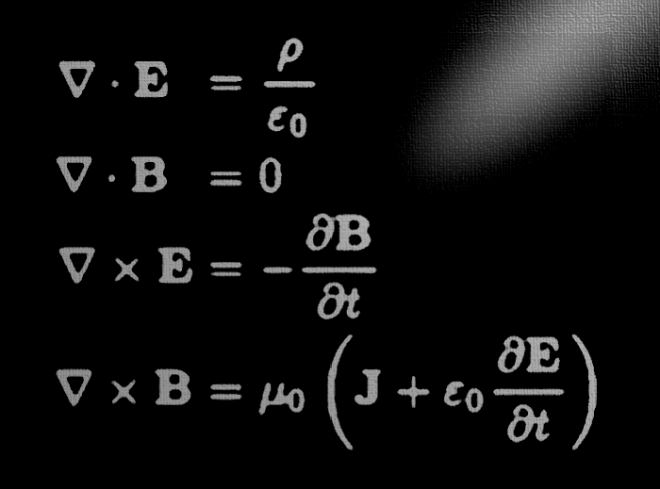
Everyone responds to local forces, of course.  Even spacetime itself responds to the spacetime immediately adjacent to it, as the electromagnetic field responds to the state of the field immediately adjacent to it, as demonstrated by the implications of Maxwell’s famous equations, which I’m sure jump right out at you:

Of course, the meaning of “local” is circular here, almost tautological, since the definition of local is merely “something that can affect another thing directly” more or less.

So it’s only too possible for a system to evolve itself into a state that is overall detrimental to those within the system.  Everyone, even the most seemingly successful, can be in a worse situation than they would be in otherwise, but it’s very difficult to see the way out, to get a “bird’s eye view” of the landscape, if you will.

One can therefore get stuck in situations where, despite the overall equilibrium being detrimental to everyone, any one individual taking action to try to move things in a better direction would make their local situation worse for them.

How is one to respond to such a situation?  Well, one can simply go along with it and try to do what’s best for oneself locally, and that is what most people do most of the time‒understandably enough, even though the overall situation may be evolving toward its own miserable destruction.

Or, of course, one could do what family therapists are often said to do:  effectively setting off a bomb***** in the middle of a difficult situation and seeing what happens when the dust settles, figuring that nothing is likely to be much worse than things are at a given present.  At least this allows for a new system to form, like the biosphere after the various mass extinctions.  Maybe it will become better than the previous one.

Maybe they all will always evolve toward catastrophe, to collapse and then be replaced by a new system.

It would be better if people could learn, and could deliberately change local incentives in careful and measured ways, adjusting settings to correct for and steer things away from poorer outcomes and so on, in ways that are not too disruptive at any given place or time.  That’s nominally what many of our systems are meant to be doing, but they don’t do a very good job at it.

Probably it would be better to do a hard reset.  But I’m not sure.  And it’s probably not worth the effort.  The odds of humanity surviving to become cosmically significant seem very low to me, and I’m not sure it would be good for the universe‒whatever that might mean‒if they do.

It’s probably all pointless, and I’m tired of it, anyway.  I don’t want to be part of this equilibrium or lack thereof anymore.  I want to make my own quietus.  Maybe “civilization” should do the same.


*Not to be confused with “weak”, which sounds the same but means more or less “the opposite of strong” and has little or nothing to do with divisions of time.

**And that’s pretty much the only term that comes naturally and easily to humans, for sound biological but horrible psychological and sociological reasons.

***If they were Klingons, they would surely be slain for their dishonor.  I don’t necessarily disagree with such an outcome morally, but practically, it would probably lead to increasing chaos****, so we understandably avoid it most of the time.

****It’s an open question whether such chaos is inherently bad.

*****Metaphorically, of course. At least, it’s usually metaphorical.

The year is dead; long live the year. Whatever.

It’s Tuesday, December 31st, 2024‒New Year’s Eve.  Of course, as I’ve written before, every day is the first day of a new year, in a trivial but nevertheless true way.  The day to mark the new year is an arbitrary choice.  We could have had the new year begin “officially” on the first of any month.  Indeed, we could have started it in the middle of a month, or perhaps on the winter solstice.  Or we could have 12 months of thirty days, leaving a 5 day extra period which we could use as a long holiday and an official new year celebration, with an extra day every leap year.  We could do this around the winter solstice, or even around the summer one, like hobbits do.

Oh, well.  It’s not as though people are going to collectively change, any more than people are going to go back to really celebrating holidays:  with most workplaces closed except for hospitals and police and fire stations and the like, with people spending the holidays with loved ones.  Once one business stays open on those extra days, competitors (direct and indirect ones) will stay open, too, or suffer a disadvantage that may lead them to be more likely to go out of business.

The world of commerce is red in tooth, claw, and debt, so after a while, only those who push every edge they can without getting more negative marginal returns, will dominate.  And that will become the norm.

No one made it happen, no one planned it.  Everyone’s caught in the currents of chaos, but those able to use the flows to their advantage‒chaos surfing, as I call it‒will thrive, at least temporarily, even if they don’t realize why they are succeeding, which they usually don’t.

It’s similar with the workers:  once some small subgroup is willing to eschew holidays and to work longer hours, they will have advantages over other workers, at least as long as working more proves advantageous to them and their workplaces.  Soon, the marketplace of workers will skew toward people being willing to work longer hours in worse conditions, as long as it provides a relative, local advantage.  Those who cannot match this will fall by the wayside, perhaps becoming homeless, getting addicted to drugs, going to jail or prison‒self-destructing directly or indirectly.

This is not a conspiracy by employers or governments or anyone else.  No one is that clever, and they are all beset by their own local pressures and competitions.  Why else would the very wealthy do anything but sit back and eat ice cream until they die (figuratively speaking)?  They are no more happy or satisfied than most other people.

It’s analogous to the situation with trees and forests.  It takes a lot of effort and resources for trees to grow tall.  Why do they do it?  Because other trees do it, and any tree that doesn’t want the sun blocked out had better do the same*.  If all trees could agree somehow to stay short, they could all thrive and get adequate sunlight and nutrition and water and air at a fraction of their usual height and resource usage.

But once one tree grows taller, the arms race begins.  Such is the way of economies and ecologies.  They cannot be planned, they cannot even really be controlled or constrained (at least not without disastrous results).  At best, they can be “herded”.  That’s a metaphorical herding, by the way‒a careful nudging of things to keep the eddies in the phase space currents from driving the system toward deteriorating returns, along whatever axes one may use to measure such things.

None of this happens due to some malicious plot, and it is not generally evil.  This competitive jockeying and self-abnegation while seeking seemingly locally selfish ends, or at least responding to local pressures (internal and external), has led to all the many scientific and technological advances that we have, from improved farming techniques that allow the world to sustain billions, to better healthcare, better sanitation, better transportation, greater safety from the elements, greater understanding of the universe at large…and the sometimes-cesspool that is the world of electronics, computers, smartphones, tablets, and digital interactions.

No, this shit all just happens “on its own”.  Natural selection works in places other than biology, and it is a ruthless, blind, and amoral driver, here in the region of spacetime where increasing entropy is in the stage where that increase leads to local complexity rather than uniformity.

Whether or not the local manifestation of it will last long remains to be seen.  There are many ways for any particular state of a system to be obliterated, or for that system itself to decay and disintegrate.  It requires constant effort to maintain anything like homeostasis and growth, but not just any effort will do.  One must constantly reassess, course correct, look for mistakes from which to learn, adapt to all the new, varying states of the system, or perish.

I don’t know about you, but I’m very unsure that it’s worth it.  In all honesty, I did not want to see 2025, and really, I still don’t.  I want to find the courage just to check out.  There’s very little for me here, and of all the things in the world that frustrate and irritate and disgust me, I’m the worst.

I guess if I write a blog post on Thursday, you’ll know that I am still around to see 2025.  If so, please don’t congratulate me.  It is not a good thing; it’s yet another failure in my long string of them.

Anyway, I hope you all have a Happy New Year.


*I’m anthropomorphizing here, but don’t get confused.  The individual trees don’t get to choose, evolution just favors the tall in this situation, ceteris paribus.

I hope you all have a good Friday (get it?)

It’s Friday, and for those of you for whom this is the last workday of the week, I hope you have a good weekend; I work tomorrow, so this is not a TGIF sort of Friday for me.  I am obviously writing a blog post today, and I plan to write one tomorrow, as well.  Aren’t you lucky?

However…

…my current plan after that is to bring my small laptop computer with me when I leave the office tomorrow and then, next week, write fiction in the morning every day except Thursday, on which day I will revert to my old, once-weekly blogging.  I don’t know how long this pattern will last; I’m not making promises, merely predictions.  Still, I want to try to finish Extra Body and publish it, and maybe even start writing HELIOS afterwards, though that’s a longer term prediction, and so, like the weather forecast, it becomes inherently less reliable.

I already reverted to the old form of blog title yesterday, that of using a Shakespearean quote, altered to insert some form of the word “blog”.  I hadn’t planned to do so, but since I discussed some matters about which I wished I could take vengeance, I naturally thought of Shylock’s little speech in The Merchant of Venice.  I had to have a title anyway, and it was Thursday, so, to quote Doc Brown**, “I figured…what the hell.”

(Had it been Saturday night, I might have thought it all right to say, “What have I got to lose?”)

I didn’t include a picture, as I often used to do for my Thursday posts (imagining that this would garner me more readers).  That’s because finding a usable picture, then modifying it to suit my needs, was always very effortful.  I could do it pretty quickly, and some of the results were even fairly creative and artistic (in my opinion), but they were not worth the effort.  And if they drew more attention, they drew the attention of people who were more interested in pictures than in words, which is not my intended audience, at least not for this blog.

Oh, my!  I just realized that this is “Good Friday”.  It seems odd to call “good” the day memorializing someone’s crucifixion, especially if it’s the crucifixion of a good person.  Still, “good” is a fairly protean concept in any case, and I understand the reasoning behind it, such as it is, for the day, but it still seems slightly perverse to me.

It first occurred to me to check if it was indeed that traditional Christian holiday because there seem to be slightly fewer people at the train station at this time than there usually are.  As far as I know, the train schedule is a standard weekday one, and on Sunday it will be, as always, on a Sunday schedule, so there’s no need to modify it for Easter.

I don’t think I’ve ever ridden the Tri-Rail on a Sunday, come to think of it.  But I have ridden it on many a “holiday”, when it was on a restricted schedule, because my office, like so many businesses in the modern world, is much less likely to take national holidays off than used to be the case for most organizations a few decades ago.

The businesses of the modern world are stuck in a Nash equilibrium (of sorts) in which were any of them to change and improve their practices (in the sense of being less aggressively competitive and allowing employees more days off), they would be outcompeted, would lose business, might go out of business, in which case their employees would also be harmed by losing jobs, which would affect the overall job market, dogs and cats would live together…mass hysteria!  In such situations, there is no way for individuals to change their practices without harm to themselves and even to the system, even if those practices are plainly not optimal.

It is for these reasons, among others, that governments are instituted among the peoples of the Earth (“deriving their just powers from the consent of the governed”), to try to act upon situations that will not correct themselves.  Unfortunately, governments too can fall into perverse equilibria of various kinds, and once they do, getting them out of it can require significant, sometimes catastrophic, upheavals.

Think of having to pull the power cord on your computer to restart it because it’s gotten bogged down or frozen, and Ctrl-Alt-Del isn’t doing anything at all.  If they haven’t been auto-saved, you might lose some files on which you were working, but at least the computer can be useful again.

That’s a strained metaphor, I know, and I apologize.  But sometimes one does have sympathy (albeit not full agreement) with Jefferson’s notion that, for people to remain free, and presumably for governments to do what they are supposed to do, there should be a literal revolution/rebellion every twenty years or so:  “The tree of liberty must be refreshed from time to time with the blood of patriots and tyrants.  It is its natural manure.”

That’s a bit extreme, perhaps, but maybe it would be interesting if, say, once every twenty years or so, everyone in government had to be replaced.  This is beyond the concept of term limits, and it would not be a staggered affair but would happen all at once.

I know, I know, there would be many detriments, including harms due to the fact that, ceteris paribus, people tend to get better at jobs the longer they work at them.  There would be real losses and setbacks associated with everyone being new to the government.

But then again, when people do politics as a career, they often learn bad habits, and the system can develop unplanned but subsequently entrenched and self-reinforcing negative patterns, equilibria that cry out for punctuation***.  These lead to losses of opportunity, economic losses, the loss of lives, and the occurrence of needless suffering‒but these costs are usually unnoticed because they are diffuse and scattered.  It’s related to the way we don’t recognize antacids as genuinely life-saving drugs, because we’re not aware of the many people who would have died‒who used to die, and often quite young‒from ulcers and perforations and gastric and esophageal cancers.

It’s also related to the fact that, environmentally and public health wise, nuclear power is orders of magnitude safer than fossil fuels for the world and for people’s health.  The number of illnesses and premature deaths per capita caused by even the worst nuclear disasters, even if they were scaled up to account for the greater preponderance of fossil fuel based power, is probably little more than a rounding error compared to the respiratory illnesses and other causes of suffering and premature death due to airborne particulates and similar problems from fossil fuels.

Well, there I go again, swerving all over the shop from one tangent to another, like a space probe passing near a bunch of unrealistically closely packed planets and having its trajectory repeatedly altered as it does so.

Speaking of such things, I do wish I could find a way to keep the energy I tend to have on Monday mornings for physics and mathematics and make it last through the rest of the week.  But my mental energy and clarity seems to be swiftly diminished by the slings and arrows of outrageous stupidity throughout the working days, so even by Tuesdays, I am usually significantly enervated.

Well, whataya gonna do?  This post has gotten too long already, anyway, and we’re getting close to my train stop.  I hope those of you who celebrate this holiday have a truly good Friday, and the rest of you as well.  Tomorrow, I’ll probably wish you a happy Easter.


*An interesting phrase combining a present tense verb with a future-oriented adverb in a way.

**That’s the one from Back to the Future, not the one who makes the really great canned sodas you can get in good delis and similar places.

***To bastardize a concept from Gould and Eldredge.