OK…

OK…

Imagine a story about someone who is trapped in some infernal prison.  It’s not a prison with walls, necessarily, but is instead a prison of the mind, perhaps, and that person is trying to get messages out, calling—begging—for help to get free.  But the messages are “coded”.  The person is allowed to communicate with the outside world, but the jailer is watching and reading all outgoing correspondence and doesn’t want the person to receive any help, even if there is anyone out there who might help him—which is not at all clear.

So, the prisoner is forced to send out these coded messages, without a code key, in hopes that people will recognize them as what they are—as attempts to beg for help.  But every response the resident gets simply makes clear that the others outside don’t get it.  They just see the messages as stories, as hypotheticals, as songs…whatever.  They’re not getting the message.  He’s had to be too subtle, and the message is not getting across because he’s had to be too subtle.

Now, take a step back—or perhaps take a step forward, or a step inward—and we realize this story is not actually a story of a person imprisoned by someone else, but that the person who imprisons him is himself.  He hates himself too much to think that he deserves help, and he hates the prospect of openly asking for help, feeling that he has no right to help from anyone—and so it is he himself who is keeping himself in prison—he himself who is forcing himself to send out only coded messages in a subtle way, and he himself who is responsible for just how much people don’t get the point of his requests for help.  Or perhaps they simply agree that he does not deserve to receive help, the prisoner and the one who imprisons him, both of whom are the same person.

People grow more and more resigned—or gleeful or whatever—knowing that the prisoner will never escape, that no one will ever come to help, that there is only one way out, and in the long run, that will be the way he must take, to the horror or perhaps to the glee of those in the outside world.

Now, imagine that this isn’t the story at all, but is something happening in the real world, at this time, in the present moment, as we speak, as we write, as we read.  Is such a thing possible?

Will the prisoner ever receive the help that he needs to escape?  Because it is not possible for him to escape on his own.

Outlaw’s Mind “cold opening”

As I mentioned previously, here is the draft of the “cold opening” to Outlaw’s Mind, to see what everyone thinks, so far.  Please, feel free to give feedback below if you’re interested.

I want to point out that, right after this, we go back in time to Timothy’s youth, and only work our way to this stage of the story gradually.  In fact, I haven’t written that far yet.  So, maybe, if readers show interest, I’ll soon post some of the subsequent portions of the draft.  Let me know what you think, please.

Outlaw’s Mind

by

Robert Elessar

Timothy Outlaw was quite surprised when he saw flashing lights and heard a brief siren through the front window of the upstairs apartment in which he lived.  His was a quiet neighborhood, not truly middle-class perhaps, but certainly not poverty-stricken, and every family or individual he knew on the street was a solid, sensible, positive part of the community…at least as far as he knew.

When he first saw the lights, looking up from the laptop in front of him on his kitchen table, Timothy worried that some neighbor might have suffered a heart attack.  But then a second, and then a third set of lights appeared, he heard the very brief boop of a siren, as of some emergency vehicle prodding someone else out of its way, and he thought he heard voices, one of which seemed to come from a two-way radio.

He walked to his front window, which looked down onto the front lawn of the duplex in which he lived, and he saw, to his astonishment, three police cars and an ambulance, pulled rather haphazardly into and around the property next door.

The ambulance he could just barely consider expectable.  The couple who lived in the house next door—much smaller than the formerly one-family dwelling in which Timothy lived—were retired, albeit recently.  Health problems were more common as people got older, and Timothy thought he’d heard that heart attacks were particularly frequent among the recently retired, though he couldn’t be sure that was right.  But police cars?  Maybe one police car, they often came along with an ambulance, at least until it was clear what had happened.  But three?  Three police cars?  At the Rosencrantz’s house?

Timothy didn’t like to associate himself even in a peripheral way with troubling events, but this was too much, too close to home.  He wanted to see at least generally what was going on.  The weather was still warm enough that he didn’t think he needed a jacket, so he simply went to the side door that opened on to the long stairway down to the side of the house.  This was on the other side from the Rosencrantz’s place, but he could still see the multiple blinking flares from the emergency vehicles, reflecting off windows and the sides of houses in the early night.

As he came around to the front of the house on the narrow concrete walkway, he saw that his downstairs neighbor, Bernice, was walking back into the yard, a sweater pulled around her shoulders.  She hunched, rather theatrically, against what seemed to Timothy to be a mild and rather pleasant breeze.  Then again, maybe she was hunched against something else.

She saw Timothy even as he saw her, and she nodded.  She appeared to try to give a greeting smile, but it came out as a grimace.

“Hi, Tim,” she said.

“Hi,” Timothy responded.  He didn’t really like the shortened version of his name, but he strove never to make much of it.  “What’s going on?”

“Oh, nothing,” Bernice replied, coming closer to him and standing at an angle, where she could converse with him while watching the lights and vehicles and people in the neighboring yard.  “I thought I’d go over and see if there was anything I could do to help, but I guess it’s too late for that.”  Bernice was a recently divorced LPN, with long ER and ICU experience, so it wasn’t unreasonable of her to offer to assist even trained EMTs and police officers.  But that hadn’t really been the substance of Timothy’s inquiry.

“But what happened?” he asked.  “Are Mr. and Mrs. Rosencrantz all right?”

“Ah,” Bernice said, though Timothy honestly couldn’t see how she couldn’t have known what his question was about.  “That.  Well…I guess I would have to say no on both counts.”

Irritated by her evasiveness, but able to keep it under good control thanks to recently acquired practices and habits, Timothy said, “What do you mean?”

“Well,” Bernice said, sounding both weary and sad, with a hint of the cynical undertone that so many career nurses developed, “from what I can gather, it looks like Mrs. Rosencrantz is dead…and Mr. Rosencrantz is the one who killed her.”

“What?” Timothy said.  “Are you…you can’t be serious.”  He knew, though, that no matter how jaded she might be, Bernice would never joke about such a thing.

“I wish I wasn’t,” she said.  “But I know one of the cops, there…he’s come into the ER when I’ve been working a couple of times.  He said they got a call from Mr. Rosencrantz a little while ago saying that he’d…well, that he’d just lost his temper with his wife over something and had bashed her head in with a metal knife holder.  Didn’t stab her, nothing like that, just beat her in the head with the holder.  Then, I guess, he called 911, but it looks like it’s too late for her.”  She sighed.

“Holy shit,” Timothy said softly.

“Yeah, you can say that again,” Bernice replied, nodding sadly.

Timothy could barely gather his thoughts.  He couldn’t quite comprehend the notion of his neighbor, a small, slightly stout man with a sardonic sense of humor and a comically jaded attitude suddenly losing his temper and beating his wife to death with a blunt object.  The two had occasionally bickered, even within the range of Timothy’s hearing, but it had been almost a theatrical kind of bickering.  It had always seemed to Timothy that, on those occasions when the Rosencrantz’s were fighting, they were doing so mainly out of a sense of obligation, as if it were a required part of being a recently retired couple, but not because they disagreed about anything of any depth.

And Mr. Rosencrantz looked like a man who had more likely been the target of bullying in his young life—and perhaps even in his adult life—than to be the instigator of violence, even if he were provoked severely by a sharp-tongued wife…which had not been a very accurate description of Mrs. Rosencrantz.

It wasn’t that Timothy couldn’t imagine people being violent, even to those closest to them.  Quite the contrary, he knew of such things only too well.  But he thought that there were certain types of people who were the ones who might one day lash out destructively, and other types who simply were not.  It appeared he had mis-classified Mr. Rosencrantz.

He watched for a bit, Bernice standing silently next to him.  He saw the two EMTs come out through the front door of the small house, a stretcher rolling between them, on which lay a small figure in a black plastic bag.  Timothy hadn’t ever really noticed just how tiny and frail Mrs. Rosencrantz had been—her physical presence had always been one of great energy, so one never felt that she was anything but large—but seeing what was clearly her form lying on the stretcher, pushed easily by the two emergency workers, who didn’t even need to make any special maneuvers to bring their burden down the few stairs from the front porch, that point was driven home.

With that, he felt a wave of anger begin, a judgmental contempt for Mr. Rosencrantz.  It was such the mark of a bully, for someone who was small and weak in one way or another to seek out those who were smaller and weaker to victimize.  Who knew, perhaps Mr. Rosencrantz had committed spousal abuse many times over the years but had been able to keep it contained and hidden enough that he didn’t get caught.  Timothy hated such a thought.  Poor Mrs. Rosencrantz, trapped in her marriage by tradition and fear, might never have said or done anything to stop it.  Timothy had no disdain for her, or for anyone in such a situation.  He understood how the threat of violence, how someone else’s rage, could be so frightening as to rob one even of rational self-preservation.

No, the blame was—always—on the perpetrator.  Timothy had no patience, no pity, no sympathy for people who committed acts of violence upon others.  This was not because he couldn’t understand their actions.  He could understand them only too well.  He had demons of his own that would surely have caused little Mr. Rosencrantz, the victimizer of a littler, frailer woman, to jump back in terror, and possibly flee screaming, if they were made manifest before him.

They were trying to manifest themselves now.  Timothy recognized it, the surging heat in his head, the decreased focus of his thoughts, the ache of his own fists, which wanted to bunch into cudgels and beat little Mr. Rosencrantz until he couldn’t move, couldn’t even be recognized, for his horrible crime and betrayal.

But Timothy recognized those feelings, and he knew what to do.  Without even needing to close his eyes anymore, he embraced his emotions, his anger, his hatred, cuddled them like a big, lovable pet, solidified them…and then, with the words “scatter to the winds,” he lifted them up through the top of his head and let them do just that.  The physical aspects of his anger—the tension, the faster heartbeat, the widened pupils—would take a few moments to re-settle, but his anger itself, the emotion, the thought of it, behaved just as though it had been a bag of leaves torn open in a gale.  Timothy could almost see little autumn shapes, sculpted from unnecessary emotion, fluttering and swirling about one another, reduced to impotent, disorderly remains, to decay on the lawns of the neighborhood.

Bernice, on the other hand, seemed to have no such technique for assuaging her own emotions.  Not looking away from the two EMTs as they rolled the late Mrs. Rosencrantz up to the rear of their ambulance—which would not be needing its sirens—she said, “I can’t believe that little piece of shit did that.  The piece of shit.  And Mabel was such a sweet lady, too.”

Timothy realized just then that he had never known Mrs. Rosencrantz’s first name.  And though she had not ever struck him as saintly, he didn’t think the word “sweet” was too great an exaggeration, especially at a moment like that.

Sweetness, however, did not seem to be the mode in which Bernice was settled.  As the EMTs lifted their stretcher and its occupant up into the ambulance, she muttered, “I’d like to get that little bastard in one of my ER cubicles, and get some central line kits, and catheters, and suture sets, and everything else.  I’d put him on IV fluids and even intubate him if I had to, but I’d see how long I could keep him alive and wishing he was dead.  Piece of shit.”

Timothy’s mouth dropped.  He’d never heard Bernice talk in such a way, and it shocked him tremendously.  He wondered if Bernice—whose own marriage had ended less than a year before, but had no doubt been deteriorating for a long time before that—had personal experience with spousal abuse.  Surely that was it.  What else could explain such frankly horrific sentiments from a woman whose calling was care and healing?

Timothy felt that he ought to say something to her, but he didn’t know what it should be.  Before he could even mouth something mindless and banal, though, two policemen walked through the front door of the Rosencrantz’s house, with the small form of the man in question—not much bigger than his wife had been—between them, handcuffed, head down, and with tears noticeably streaming down his face, glinting in the porch light and the streetlights.  He certainly looked contrite.  He looked devastated.  Timothy could well believe that the man was as shocked by his own actions as anyone else would be, and that he would never stop feeling their horror for the rest of his life.

Bernice, however, had no apparent sympathy for him, any more than Timothy had at first felt.  As the somber-looking officers guided their charge toward one of the cars, Bernice suddenly yelled out, “You piece of shit!  How could you?  You son of a bitch!”

The officers escorting Mr. Rosencrantz stopped briefly, apparently surprised, despite their usual occupation, at the epithets being hurled.  Mr. Rosencrantz did not look up, but instead lowered his head even further, and sobbed audibly.

Far from being moved by this—at least in any benign direction—Bernice doubled down, yelling, “Yeah, you’d better cry, you shit!  I hope you get raped in prison, you bastard!  I hope you’re made into some big thug’s bitch!”

Timothy, thoroughly caught by surprise in the face of Bernice’s uncharacteristic anger, when she’d seemed merely grim and sad at first, didn’t have any idea what to say.

Now a new person appeared in the doorway of the house, as the officers began to move Mr. Rosencrantz along again.  This was another policeman, but based on his age and his uniform, he must have been of higher rank than the other two.  He looked quite surprised as he came out to stand on the small porch, and he looked first over at Timothy and Bernice, then around the street.  Only when following his gaze did Timothy notice that quite a few other neighbors had come out into the open to watch the proceedings.  One man, the neighbor on the other side of the Rosencrantz’s house, was nodding his head vigorously in response to Bernice’s words, and Timothy thought he heard the man mutter “Damn right.”  In the glow of the streetlamps and the porch lights, the man’s face looked almost demonic.  His expression would not have been out of place on a member of the Spanish Inquisition.  Clearly, he agreed with Bernice’s sentiments.

The new, senior officer, quickly assessing the situation, called out in Timothy’s direction, “Take it easy, Nurse Bernice.  That sort of thing isn’t helping anyone.”

Timothy had time to realize that this must be the cop that Bernice knew from the ER, before the nurse—whom the officer had clearly been trying cleverly to remind of her usual role as a caregiver—spat out, “There’s nothing that can help anyone here!  The only thing I want to help is to help give him a lethal injection!  I’m happy to volunteer!”

The Rosencrantz’s opposite neighbor chuckled evilly in response to this proposal, and more clearly than before, he said, “I’ll be a witness.”

The officer, clearly irritated, glowered and looked from Bernice to Timothy.  “Hey, sir,” he said, “why don’t you take Nurse Bernice inside.  This isn’t good, she’s only hurting herself, and the situation’s already bad enough.”

Surprised at being thus addressed, and thoroughly unused to being the calm one in any situation, it took a moment for Timothy even to respond.  Finally, he said, “Right.  Right.”  Turning to Bernice, he tentatively put a hand on her shoulder and said, “He’s right, Bernice.  Let’s go inside.”

Bernice’s gaze snapped up to Timothy with a speed that startled him, and he almost drew his hand away in fear.  He half expected her to begin shouting at him, but she just glared.

“Come on,” Timothy said.  “It’s not worth it.”

This seemed to have some effect, and Bernice’s face calmed just a bit, as she said, “You’re right.  You’re right…he’s not worth it.”

Not bothering to correct Bernice’s slight misquote, Timothy said, “Come on,” and he turned, gently pressuring Bernice to do so also.  She went along, not enthusiastically, and Timothy added, “Do you want to come up to my apartment and have a Coke or something?”  He wished he could have offered her a beer or a glass of wine—or even a shot of whiskey—but he did not use alcohol nor keep it around.

Bernice, trudging along beside Timothy, seemed to consider his offer, but then she said, “No, I don’t think so.  I don’t think I need to be around other people right now.  I feel like I need to hurt somebody, and there’s no point in having a target, especially not a nice guy like you.”

As they drew level with the front door of the house—the entrance to Bernice’s ground-floor apartment—Timothy took his hand away.  Bernice headed for her door but seemed to catch herself.  Her shoulders, her posture, her manner, were all so stiff and tense that Timothy half expected her to loose a barrage of obscenities upon him for pulling her away.  Instead, though, with clear significant effort, she said, “Thank you, though.  I appreciate the offer.”

Relieved, impressed, and rather goofily proud of himself, Timothy said, “You’re welcome.  Any time.”

Bernice seemed about to turn around and head back to the door, but she stopped, looking disturbed and puzzled, though still glowering.  “I’m sorry,” she said.  “This really isn’t like me.  I’m just so angry.”

Timothy did not have to lie to respond, “Don’t worry about it.  I understand, believe me.”

Apparently, his thorough sincerity was successfully conveyed, for Bernice looked more relaxed, as well as a bit grateful, as she nodded and said, “Thanks.  Good night.”

She turned and walked into her apartment.  She closed the door with perhaps just a bit more force than was necessary, but only just.

Before rounding the corner to the stairs up to his apartment, Timothy heard a voice call out, “Thank you, sir!”

He turned, surprised, to see the senior officer still standing on the porch, clearly looking at him.  Not used to being on polite, let alone good, terms with members of law enforcement, Timothy stammered, “Pardon?”

The officer chuckled, clearly recognizing Timothy’s discomfort.  “I said, thank you.  That was well done, and it was really helpful.  I appreciate it.”

Timothy, both utterly wrong-footed and remarkably proud in an almost kindergartenish way, said, “It’s my pleasure.  I’m…I’m sure your job must hard enough without…without people making it worse.”

The officer nodded somberly, and he said, “That it is.”  He tipped a two-fingered salute to the brim of his cap, a gesture that made Timothy’s pride and gratitude swell even more than they had so far, then turned and walked into what must be a crime scene investigation.  Though apparently there was no mystery involved in what had happened, Timothy guessed that thoroughness was an absolute requirement, particularly in cases of suburban homicides.

As he almost floated up the stairs to his apartment, Timothy was ashamed of himself for feeling such joy in the face of the terrible tragedy, but he couldn’t help it.  This new technique Dr. Putnam had taught him was the greatest thing he’d ever found in his life.

It was too bad Mr. Rosencrantz hadn’t known it.  If he had, his wife might still have been alive, and he might not have been facing the possibility of spending the rest of his life in prison.
And folly, doctor-like, controlling skill, and simple blog miscalled simplicity

Hey, everybody.  I’m really feeling tired and worn out today, so I’m not going to say very much in this post.  This time, I think I really mean it.  There’s not much to report, anyway.  I’m not sure there ever is.

I’ve written about 3000 words on Outlaw’s Mind this week so far, but I had to go back to the computer to do it; the longhand project was encountering some problems.  I’m afraid my handwriting has degenerated beyond even its former, maddeningly messy form, hard though that may be to believe for those who have seen my curse-ive before.  Also, it’s become more difficult and slower for me to do.  Some of this may just be due to lack of recent practice, but it was very frustrating, and so I abandoned that noble idea.

I did some recording (on video) of myself playing some songs on guitar, and singing along, for practice and self-evaluation purposes, and one of them—the Beatles song Help—turned out reasonably well, so I decided to share it on YouTube.  I’ve embedded it here:

I also am taking a break from my antidepressant.  It doesn’t seem to be doing much good, and it’s been having some irritating side-effects.  I know it’s not usually a good idea to change one’s medical regimen without consulting one’s doctor, but since I am the one who “prescribed” it, and since I am the only doctor I’m seeing anymore, I guess that criterion is met.  We’ll see how it goes.

Other than that, there’s not much to say.  Life, as John Mellencamp said*, goes on, long after the thrill of living is gone.

I hope you’re all doing much better than I am, and that you’re staying warm, staying safe, and staying healthy.  Maybe next week I’ll write more.  Maybe not.  I don’t know.

TTFN

empty man


*I’ve probably even quoted the line many times before, but I don’t feel like checking.

Therefore, since brevity is the soul of wit, and tediousness the limbs and outward flourishes, I will be brief. Your noble blogger is mad.

Hello again and good morning again.  It’s Thursday again, and so, once again, it’s time for my weekly blog post.  Again.

I’m pleased to be able to report that I’ve done a bit of new writing this week.  I finished rereading Outlaw’s Mind last Saturday, and then Monday morning I got my clipboard and some high-quality notebook paper, and I started to write.  One thing that helped me do it was remembering my old strategy, which was to say to myself that I was going to write at least just one page.  If I didn’t write more, that was fine.  Even when writing by hand, one page isn’t all that much—something like four hundred to six hundred words, I think, given my handwriting.

As is usual, I’ve written more than that, totaling just around six pages in the last three days.  That’s not as fast as I write when I type, which I can do almost at the speed of thought, but that may be beneficial.  I think I sometimes tend to write too much when I type.  Unanimity may be a good example—a story that became over half a million words long before I finished it.  Probably, had I written it by hand, it would have been at least slightly shorter.  But maybe not.  I tried to shorten it as I was editing, but there were no actual bits of the story that I felt willing to take out.

I’ve been thinking about maybe putting some of Outlaw’s Mind up here on my blog, in its current, quite rough draft form, just to give a teaser and possibly to get reactions from people.  I may have mentioned this notion before; I know I tend to repeat myself and run off at the keyboard.  Anyway, I was thinking of posting the “cold opening”, as it were, first (I don’t think I’ve already done that, have I?).  Of course, after that opening, the story goes very much back in time to tell of things that led up to the events in the opening.

If anyone would like me to do that, and would like to read it, please leave a comment here, on this post.  Again, I reiterate, comments on Facebook or Twitter may never be seen (by me, anyway).  I don’t often check even Twitter for reactions*, and Facebook gives me terrible stress and tension even to click in and zip through looking for comments and responses, as well as to see what people I care about are doing.  I feel that, at any time, someone is going to ambush me with an instant message, and I won’t have any idea how to reply to it, and so I’ll quickly pretend that I didn’t see it, and try to remember to come back later, all the while feeling terribly guilty about not immediately taking part in a conversation—even though, morally at least, one shouldn’t feel obligated to talk at any given time, just because someone else wants to.  But it’s hard when it’s people who matter to you.

This is one of the reasons I don’t answer my phone, and I don’t even promise to respond to voicemails (I say I will if it’s interesting enough, but that’s quite a high bar to clear).

Email is nicer.  I tend to like email.  And comments here are not too bad, because I’m always getting on WordPress for one reason or another (often to read other people’s blogs), and interactions are more measured, thoughtful, and in-depth.  Usually.  They are also not expected to take place in “real time”.

Anyway, that’s about it as far as my life goes.  I do my fiction writing in the morning.  I diddle around on the guitar for a short time after that most days, but as those of you who have seen my videos know, my playing and singing are nothing** to write home about.

I try to find fiction that I can enjoy reading, but it seems to get harder all the time—which is a truly dreadful thing, to me.  At least I can usually find non-fiction that engages me, especially about science and a bit of math and philosophy, and to some degree psychology, especially about Asperger’s/Autism Spectrum Disorder, which I’m trying to learn much more about to confirm or deny my self-suspicions.  I’m pretty well along toward the “confirm” end of the spectrum, if you’ll pardon the pun, but I am always leery of confirmation bias.  As I once wrote on an altered version of the old X-files poster from Mulder’s office, “I don’t want to believe.  I want to be convinced by evidence and argument.”

Anyway, I know that’s all boring, so I apologize.  I never do have anything much of value to say or to do.  I’m sure the oxygen (and nutrients) I consume could better be used elsewhere, and my carbon-compound contribution and other entropic effluvia merely push the universe—and more locally, the planet—toward its endpoint slightly more quickly.

The villainous part of me likes that.  But the rest of me just feels ever-increasing self-loathing.  It’s very amusing.

I hope you’re all doing reasonably well—or better yet, as well as you possibly can—this year so far.  Take care of yourselves, and each other.  What better things do you have to do?

TTFN

venus


*I mostly just enjoy seeing amusing Tweets.  240 characters isn’t enough for anything more.  It plainly is not enough for any intelligent conversion, discussion, or debate.

**Should I have written “nothings” there since I was mentioning two subjects?  Or is “nothing” always singular, since there is only one, ultimate, nothing, which means none of each and every possible thing, as in set theory, in which there is only and exactly one “empty set”.

To sleep: perchance to dream: ay, there’s the blog

Hello.  Good morning.  Thursday.  Blog post.  You know the drill.  Or at least, you get the idea.

I don’t really have much to say or report.  I did a quick, off-the-cuff post on Tuesday about a subject that has been frustrating me more and more (the relief for which I am less and less suspicious will ever arrive, for me at least), but I don’t know that I have anything to add to it.  If anything occurs to me, and I have the energy to try to convey it, then that’s what I’ll try to do.

I’ve stalled out on reading the last 14 pages of Outlaw’s Mind so far, after having read up to that point by Monday or Tuesday.  This is after having optimistically* taken paper and a clipboard home over the weekend hoping** I’d make short work of finishing the reread and then getting on with writing.  I like the story, and I know where I want it to go and, as they say, the rest is just scratching and scribbling.  Instead, I did essentially nothing at all this weekend—apart from throwing away a bunch of the things I own because I can’t see any point in having them and they were just annoying; and preparing some other things to bring in to give “to the office” so to speak.

I wish I could say that the weekend of doing nothing was at least restful, but if anything, I felt more tired after it than I did at the beginning, not that I expect I would have felt less tired if I’d worked all weekend or anything in between.  The last time I remember waking up feeling rested was sometime in the mid-nineties (which, I just realized, is half of my life ago).  If anything, I tend to feel worse early in the day, but I wake up very early whether I feel rested or not***, so it’s quite frustrating.

Basically, I’m just tired, and getting more so (or so it seems to me) as the future becomes the present and then the past.  And I’m alone.  It’s hard to see this becoming gradually more so as time passes quite in the same way tiredness does, but I feel more alone all the time—ever more like an alien or a changeling who really doesn’t belong here, nor has any purpose here, and who has no realm or planet to which to return.  No respite appears available, and more and more, the only viable escape seems like oblivion—which would not be a relief, obviously, since relief is a state of mind and oblivion is the lack of any states of mind, but it would at least mean cessation.

There’s a moving episode in the 5th season of modern Doctor Who called “Vincent and the Doctor” in which the Doctor meets Vincent Van Gogh, and after they defeat an alien together (of course), the Doctor brings poor Vincent to a future museum so he can see and learn that he would eventually become a beloved, respected, nearly worshipped artist, one of the greatest of all time.  It may sound silly, and in a sense, it is, but it’s actually very moving—well-written, superbly acted, beautifully filmed and directed, and if your eyes are dry after the scene with Vincent in the museum, I don’t know what to think of you.

But of course, the saddest part is that, on returning him home, and then coming back to the “present”, the Doctor (and Amy Pond) discover, not to the Doctor’s surprise, that Vincent still killed himself, only a few weeks or months after their meeting, just as always.  The Doctor makes a lovely, and I think insightful, little “speech” about how the good things in life can’t necessarily correct or eliminate the bad things, but that the bad things don’t necessarily spoil the good things.  Vincent was still ill with whatever mood disorder and possible “neuro-divergence****” he’d always had in his own time; that hadn’t changed.

Still, it would be nice to imagine Van Gogh having been shown just how revered and admired his work would one day be, albeit not within his lifetime.  In the real world, he never had so much as a hint or probably even much of a fantasy that such a thing might happen.  It would be nice for any artist, or anyone, really, to learn that his (or her) work and life deeds had been important, and to see some of the ways in which it was so.  But it wouldn’t change much in the here and now…and it’s always now.

And sometimes “now” seems to go on forever and it can be so, so very exhausting.

I wish I could rest until I felt rested, and if that’s impossible, then just keep resting.  Making one’s quietus with a bare bodkin is an intimidating prospect with a comparatively high wall of activation energy.  But the wall is not constant, and at certain times, in certain states, in certain circumstances, the barrier becomes lower, and it may then be surmounted.

TTFN

to sleep


*I know, what the hell was going on in my head that I would be optimistic about such things?

**Hope is always foolish.

***Which I guess should go without saying, since I just said I haven’t felt rested after a night’s sleep, or anything else, since the mid-nineties.  Duh.

****He only too clearly didn’t see and experience the world quite the same way anyone else did or does.

Please don’t expect (or tell) people who really NEED help to help themselves. It’s stupid.

This is just a brief post expressing a pet peeve of mine that applies (and has done so often and at length) to me personally.

I’ve encountered this issue anew, eliciting ever-increasing tension, stress, anger, irritation, despair, etc., in my research into Asperger’s/Autism Spectrum Disorder, as people “on the spectrum” are quite often plagued by anxiety and depression, among other things, including frequent suicidal ideation…and of course, much well-intended advice is given (it being the worst and most prevalent of all vices).

The issue involves people* making suggestions such as, for instance, that those who are troubled by depression should exercise regularly, because regular exercise often seems to help depression**; or that they should talk to close friends or family members (a particular problem with “Aspies”, or so it seems to me, since communication difficulty, particularly of emotions and the like, is a major part of the condition); and that, if one is severely depressed and self-loathing and having suicidal thoughts (or intentions), one should seek help right away.

Or similar sentiments.

This all feels so condescending and simple-minded and contradictory.  It’s a bit like telling an actively drowning person that getting swimming lessons would be really good for helping them not drown, or that being helped by a friendly dolphin (or any kindly member of some other strong-swimming aquatic species unrelated to the drowner) would be quite beneficial for them, or that they should really come quickly to shore and grab a flotation device before they drown.

It’s missing the point(s) entirely.

If one could exercise regularly, one would already obviously not be THAT depressed.

If one could easily talk to people (especially if one is on “the spectrum”***) and had people to whom one felt one could talk in a relevant way about the relevant subject(s), then that would be an obvious thing, and probably already done.

And if one is feeling utter despair and profound, demonic self-loathing, then availing oneself of help of any kind–including life-saving help–seems not only impossible but frankly immoral.

You don’t do your best to give succor to or save the life of someone who is utterly reprehensible and an unadulterated malefactor who has no chance for reform or to be redeemed, right?  Would you save the likes of the next Hitler or Stalin or Charles Manson or Mark David Chapman?

If someone is lying on the ground having a heart attack or a stroke or has just been hit by a car, we don’t advise them to get up and get themselves to a hospital, do we?  It’s absurd.  It’s insulting.  It’s irritating and it’s idiotic, and it makes the world and the rest of humanity seem even less worth sticking around for****.

I wish people would stop it.  When someone really needs help, it’s means they can’t survive and/or thrive by their own actions.  Thus the metaphor “in over one’s head”.

I’ll close with an a related cartoon that captures more than one aspect of my (not quite domesticated) peeve (apologies, I do not know whom to credit for it):

drowning in depression


* Well-meaning, one must admit or at least assume.

**I have my own suspicions about the direction of causality here.

***Especially if alexithymia is one of their afflictions.  I myself score 157 out of 185 on the online test of this, such as it is.  I have a hard time even knowing what I’m feeling at any given moment, let alone communicating it clearly.

****It can even make it seem tolerable to end a sentence with a preposition, or to allow sentence fragments to stand alone on a line of type for dramatic effect.

Let the doors be shut upon him, that he may blog the fool no where but in’s own house.

Hello and good morning.  It’s Thursday again.  I thought for a moment that it was 1/12/2022, but that was yesterday.  I liked it because it was a date full of 2s (even though there were 1s, there were 2 of them, so that added to a 2 in my book) and of course, today is the second Thursday of the year and of the month, and thus this is my second blog post of the year.  It would have been nice to have that match up, but alas, it was not to be.

Tuesday was an interesting date if you write it in a European order:  11/01/2022.  It’s an almost palindrome, but with the right side of the mirror having doubled the values on the left side.  This makes me imagine some quantum mechanical system or some higher-dimensional theory in which there are two versions of certain particles or forces, but with all things reflected in some variant of CPT, with one always having some quantity twice that of the other.  I have no idea if this could apply to anything in reality.  Maybe it’ll explain the whole neutrino question, or the muon anomaly, or the nature of dark matter or dark energy.

I highly doubt it.

I forgot to mention last week that I had done a sort of video* of me playing American Pie (and singing) and had posted it on YouTube.  Here it is.

I don’t quite like how the audio turned out (except at the end).  I was trying to combine multiple simultaneous recording sources, and that was a nice idea, but I ended up doing the mixing and reverb in a way that doesn’t sound ideal.  It also creates the illusion that I actually miss an occasional note while singing, and we all know that cannot be accurate**.

I bring this up because yesterday I did another “sort of” video (see previous footnote), but I did a better job with the multiple sound inputs and the reverb and so on, so that audio came out better.  We live and learn, I suppose.

Here’s the other video, of me playing and singing Hallelujah, and I think you’ll agree the sound here is better.  Try not to look at me, at least if you have food in your stomach.

I don’t like to be a “Like and Share” whore, particularly since I wrote a song with that very title in a rather disapproving tone (though it was not so much about liking and sharing per se as the psychologically damaging culture associated with living by one’s “likes”).  Nevertheless, I do ask if you like those videos you might “Like” them, as with this blog.  This is purely to boost my self-esteem, which should be an easy enough task; there’s way more room to go up than down.  Also, if you want to subscribe, certainly feel free to do so, and of course, I welcome comments.  If you want to support my work financially, though, I have no Patreon or Cup of Joe*** set up, but you can always buy my books/stories.  The Kindle editions are not expensive.  Or tell your friends about them, if they like fantasy/sci-fi/horror.

Speaking of books/stories…

I’m nearly done with my reread of Outlaw’s Mind so far and should soon be back to writing more of it.  I’m enjoying the reread, and that should hopefully help my enthusiasm.  The good thing about working on what had started as a short story but has morphed into a novel is that it will probably be a reasonably short novel, which is a novel thing for me.  Ha ha.  It will have significant tie-ins to my eventual novel Changeling in a Shadow World, which may end up being a series or at least a multi-volume story.  As I think I’ve mentioned previously, that series will have at least a peripheral connection to The Chasm and the Collision, though no characters from CatC will appear in it.

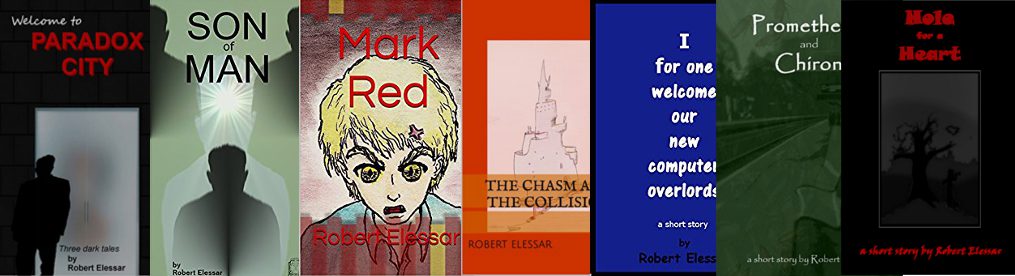
In general, all my works appear within the same Omniverse****, not just because they’re all written by me, and its components can sometimes interact with each other.  In fact, those who are paying attention will notice that Hole for a Heart and Unanimity are literally in the same world, with the latter taking places slightly earlier than the former.  Don’t believe me?  Just read.

Inspired by a few YouTube videos, I bought two fiction books this week.  The first was Revival by Stephen King, which I’d avoided as not seeming like my kind of story.  But a video reviewer rating his favorite books described it briefly (without spoilers) and made me realize that it might be just my kind of Stephen King book after all.  I’ve already finished it*****, and it was quite good—above-average King.

I had mentioned and recommended another book that I’d read a while back to someone at work, as being very unusual, quite creepy, and rather disturbing.  Then, that very lunchtime, as I watched the Stephen King review video, the YouTube algorithm posted a video about that very book.  This isn’t as weird a coincidence as one might think, because I had been following similar videos about similar books.  The book is House of Leaves, by Mark Danielewski, and with this reinforcement, I ordered a physical copy, and have already started reading it.  It’s as good, and as weird, as I remember.

By the way, the video I saw was titled, “Is House of Leaves the scariest story ever?”.  My answer is, “No,” but it is scary at many points, and it is disturbing (not in a gross or gory way, but in the sense of giving the reader the urge to quote the 12th Doctor in saying, “Three-dimensional Euclidean geometry has been torn up, thrown in the air, and snogged to death!  My grasp of the universal constants of physical reality has been changed…forever.”), and it does leave one feeling “What the Hell?” quite often, but in a good way (if you like horror).

That’s about it for now.  I expect to restart work on Outlaw’s Mind as early as this weekend, if I can summon the discipline and drive.  In the meantime, I hope you’re all well and enjoying your new year.  I’ll leave you with the very pleasing news that 2/22/2022 is a Tuesday.  How cool is that?

TTFN

house of leaves

This is a sample of the interior of the book House of Leaves


*By “sort of”, I don’t mean that it’s not really a video.  It’s clearly a video.  But the video portion is not worth any attention.

**This is sarcasm, of the self-derogatory sort.  I hadn’t tried playing and singing that whole song in one go before, so I’ll cut myself a tiny amount of slack, but not much.

***Or whatever that thing is.

****My original term was Metaverse, then Mark Fuckerberg stole the term, even though I’d thought of it at least a decade before Facebook even existed.  I could still use it, of course, but it’s tainted now.  Anyway, Omniverse is probably better, I just need to get used to it.

*****My first new fiction read in quite some time.

And these external manners of lament are merely shadows to the unseen grief that blogs with silence in the tortured soul.

Hello, good morning, and again, Happy New Year.  It’s Thursday‒the first one in 2022‒and so it’s time for my first blog post of the year.

There’s really not much to report this week.  The pandemic continues‒and when I say this, I’m referring both to the literal one and to the pandemic of human stupidity.  The latter seems unassailable even in the face of the deaths of millions of people, more or less at random, due to an infectious disease against which science (and those who use it) has been providing astonishing and unprecedented weapons which many more millions (particularly in the US, it seems) eschew because of numerous examples of misguided, often magical-thinking nonsense fueled by that bane of QI contestants: General Ignorance.

The thing about ignorance in the modern age, especially in America, is that it’s frequently willful ignorance.  There’s no shame in being ignorant, per se.  There exist an infinite number of facts about which we all are and always will remain ignorant.  But, to use a perhaps tired metaphor, though the ocean of ignorance is endless, it is possible for us to expand the island of our personal and collective knowledge.

Lately, however, it feels as though most people in America would rather drown.  If this were a literal urge, I could sympathize with them*.  Unfortunately, it’s merely figurative and unrecognized, and it leads to appalling facts such as that the per capita number of deaths from Covid-19 in the US is more than three times the global per capita deaths number**.  This in a country that likes to imagine itself the greatest nation the world has ever known.  Unfortunately, although aspirational greatness‒the desire and the will to be and to achieve great things‒can motivate actual improvement, and sometimes even greatness, unfortunately, once you decide you just are great, without having to do any more personally to earn or maintain the designation, you’re at serious risk of going the way of the Roman Empire and countless other such self-satisfied civilizations.

Oh, well.  These things happen.

I have continued rereading Outlaw’s Mind as it is so far, but I’m not finished and so haven’t yet started writing anything new on it again.  It’s a good story, I think, and I enjoy reading it, but then again, I wrote it.  Who knows if anyone else will ever read it?  Much of the time‒a growing fraction thereof, in fact‒I don’t hope to live to complete it.  To be honest, I often didn’t hope to live to see 2022.  But here it is.

Oh, well.  These things, as I said, do happen.

I’ve been thinking a bit about the Bystander Effect, partly because of a book I recently read‒Rationality, by Steven Pinker‒and partly because of personal reflection.  For those unfamiliar, the Bystander Effect is that circumstance in which a person is ill or injured, or being attacked, or something along those lines, and there are many people around them who could, in principle, help them…and no one intervenes because of the diffusion of responsibility, though if there were merely one or two people nearby, they would likely do something.

The Internet and the Worldwide Web seem to be “places” where a person could surely, if they needed help, reach some person, somewhere, who could and would help them.  But it is, ironically, home to possibly the greatest instantiation of the Bystander Effect ever seen, for each individual knows that there are, potentially, millions of other bystanders, and what’s more, they are all effectively anonymous each to all or nearly all the others.  It’s a place where a person can be truly, abysmally alone despite being in the largest crowd that has ever existed.  It’s the ultimate example of somewhere one can shout, or even scream, at the top of one’s figurative lungs, all while surrounded by countless other people, and yet, no one seems to hear.

What’s the difference between billions of voices all talking without speaking and hearing without listening, and silence?  Silence is at least peaceful.

Where, oh where is Sailor Saturn when you need her?  Oh, yeah, right, she’s in a fictional universe.  What a pity.  Well, they say when you want something done to your satisfaction, you should do it yourself.

Anyway, let’s hope this coming year regresses to the mean a bit, assuming we’re measuring our mean of year quality using the last decade and a half (or better yet the Nineties).  Of course, taking in the whole span of human existence, during most of which life was proverbially nasty, brutish, and short, the overall mean quality of years is probably way below even this pandemic year.  So, maybe what’s happening now is not an outlier in the negative direction which general tendencies will tend to correct back upward, but rather this is the correction, and the progress of civilization has been the extraordinary, truly aberrant, outlier.  Maybe our success is not truly a sign of any real progress within human and civilizational character, and unless improvement is deliberately, persistently, and intelligently and rationally pursued, regression to the mean will happen.

The cosmic mean, by the way, is about six protons per cubic meter***, at a temperature of only roughly 2.7 degrees Kelvin above absolute zero, and it’s getting colder and less dense every instant, approaching absolute zero asymptotically.  It’s cold****, and it’s lonely*****, but at least it’s peaceful…and it’s silent.

TTFN

mouthless emoji


*And the deep ocean is a good place to be buried, all other things being equal, since it makes for an excellent carbon sink, especially if you’re interred near a subduction zone.

**Based on the best numbers available to me.

***Which is about the atomic mass of lithium, interestingly enough.  Unfortunately, even if it were all, actually lithium, which is not the case, there wouldn’t be enough nearby to treat your bipolar disorder before you asphyxiate.

****But it probably wouldn’t feel very cold, because there’s no direct conduction of heat away from a warm surface like a human body.  Space is an excellent insulator; all your heat would only gradually be lost by radiation, contrary to what one sees in some movies when people like the Ebony Maw get sucked into space through holes in spaceship hulls.

*****But at least it’s not ironically lonely, like the “alone in a crowd” situation.

O heaven! that one might read the blog of fate, and see the revolution of the times.

Hello and good morning.  It’s Thursday, and so—as inevitable as death or at least as inevitable as taxes—it’s time for my weekly blog post.  This will be the last blog post of 2021 AD, a year many of us will not be sad to see the back of.  Indeed, you can see that I feel so strongly about this that I’m even willing to end a sentence with a preposition.

New Year happy

It’s New Year’s Eve eve today, if you will, though there is no such official holiday.  It’s not even an informal one like Devil’s Night, the night before Halloween*, itself an “Eve” holiday, though that’s often forgotten—and rightly so in my opinion, since Halloween is much more fun than most other holidays and certainly far more widely celebrated than All Hallows Day.

There’s nothing inherently special about New Year’s Day (or Eve).  It’s an arbitrarily chosen time for us to restart our calendar year because we have to do it some time.  It’s not like the solstice- and equinox-based celebrations I’ve discussed before, which have legitimate, astronomical bases and are objectively interesting moments in the Earth’s orbit.

New Year doesn’t even always happen at the same place in the planet’s orbit.  It can’t.  For one thing, it’s celebrated hourly for 24 hours over the course of that day, depending upon when midnight arrives in a given time zone.  This is a perfectly reasonable way to do things, of course, but it means that the holiday itself is smeared out along the planet’s orbital path even on a given year.  And, of course, since the orbital length is not an integer number of days**, the celebration of New Years smears out in another way over the course of time, to jump back a day every fourth year, but not on years that are multiples of a hundred, except YES on years that are multiples of four hundred (I think that was it), and so on with all the corrections used by the modernized Gregorian Calendar to try to keep the year reasonably aligned with the seasons and with the solstices and equinoxes mentioned above.

All of which is, of course, quite fascinating from a scientific and cultural point of view, but really, the holiday is about a chance for renewal, a symbolic rebirth or at least a new beginning, like starting a new iteration of a game, with the scoreboard is set back to zero, so it’s possible for anyone to win by the end.

I don’t know where people get these ideas.

Of course, we cannot literally start over, nor would most of us want to if we could, since almost everyone has made at least some progress that they wouldn’t care just to throw away.  Much of our identity in any given moment is dependent upon our memory of the past.  But it can be useful, and sometimes heartening, to embrace the notion of a restart point for at least some things in our lives, such as diet and exercise and other difficult habit-based situations.

I have been embracing something like that notion in that I’ve been rereading what I’d written so far of Outlaw’s Mind, to try to get back into the flow of the story.  The process has been slow, since I haven’t been reading very much every day—I’ve been very tired mentally and emotionally, and even physically, and just in general very discouraged.  I’ve not really been looking forward to even seeing the new year arrive, to be honest.  I have no good reason to think that it will entail anything other than continuing mental, social, physical, and emotional disintegration, which have been the hallmarks of my last nine or ten years at least, and have accelerated recently.

Still, I have been reading the story, without doing any editing, and I do enjoy it.  I usually enjoy reading my stories.  That makes one person.  So, I think it will be a useful exercise and will help me then to move forward with the story thereafter.  I’m feeling tempted again to try to write it out longhand when the time comes.  I have some lovely high-quality notebook paper to use for that now if I have the nerve.

I haven’t been thinking much about Changeling in a Shadow World this week, but that’s fine.  There’s only so much one can do prior to starting to write the thing, and I’m not going to start that before Outlaw’s Mind is done.  I had a couple of fun and rather silly ideas for short stories in the last week, which I jotted into the notebook app on my phone.  They are technically horror story ideas, but one at least is a sort of crude, dark-comedy type horror story idea.  I don’t know if I’ll ever write it, but it’s a fun notion, and involves a mutated and/or genetically engineered form of gonorrhea, among other things.  The other is a bit less sophomoric in character, but it’s quite a bit darker, too, at least in philosophical implications.  If those ever happen, you’ll be welcome to read them.

In the meantime, despite my apparent cynicism, I do in fact wish you all a very Happy New Year, both in terms of your celebration thereof, which I hope you’ll share with your beloved families and friends to the degree that you can do so safely, as well as in terms of the upcoming year.  I won’t quote John Lennon*** and say, “It can’t get no worse”, since it can always get worse, but I will say that, given human drive and persistence, and the fact that, contrary to some appearances, a great many very smart and disciplined and optimistic people are working to improve things at all levels, there are at least good odds that a lot of things are going to improve in the upcoming year.

It’s not something to take for granted, since it will always be easier to destroy than to create, but those smart, creative optimists are pretty frikking impressive sometimes.  The James Webb telescope is out there now, in its position in the Lagrange point, and it’s steadily working toward eventually giving us the deepest, most amazing views of the cosmos we’ve yet had.  And there’s nothing arbitrary about that.

TTFN

New Year


*Celebrated by some people in the region in which I grew up by setting random fires.

**Not a whole number of days, I guess, would be more precise.  An integer number might imply that it would be possible for an orbit to last a negative number of days, there being as many negative integers as positive ones, and it’s hard to see how that would make any sense at all.  I suppose one might imagine a science fiction story—perhaps involving The Doctor—in which a planet’s orbit around its sun carries its inhabitants backward in time instead of forward.  For them, the End of the World would indeed be predictable—the birth of their solar system and ultimately of the universe itself.

***In his backup lyric from the song It’s Getting Better All the Time.

Heaven give you many, many merry blogs.

tardis with wreathHello, good morning, and welcome to Thursday, and to another edition of my weekly blog post.  It seems I’m still here so far, for better or for worse, and I’m writing a blog post this week.  I expect it to be relatively short, at least for me, though I’ve been wrong in that expectation before.

I haven’t written anything new still this week on Outlaw’s Mind, but I thought I would try to get myself more inspired to write it by rereading what I’ve written it so far, which I hadn’t done before restarting it after finishing Dr. Elessar’s Cabinet of Curiosities.  So, I saved it as a PDF file* and sent it to myself both at home and at work.  I’ve begun rereading it, and I think this will help, because I’m enjoying the story so far and kind of refamiliarizing myself with the events therein.  Hopefully it will make a difference.  If it doesn’t, I’m not sure what I’m going to do.  I’m really having difficulty summoning the will to do much, and I don’t know how to counter it—I’m already taking the best dose of the combination of depression treatments that’s worked best for me in the past, and I’ve tried most at one time or another.

I did write a little impromptu blog post on Iterations of Zero about the Solstice, which you can read if you’re interested, though it will be a few days late.

It’s a tad late for them to arrive before Christmas, I suppose—except for Kindle editions—but if there are any avid readers in your list of present-recipients, I’d like to offer or suggest that you might want to give or send them a copy of one or more of my books.  If they like fantasy/sci-fi/horror, they might enjoy at least some of my stuff.  Here’s my blog page, “My Books”, and here’s the blog search of My Books, if you’d rather look at something like that.  And below is a screenshot, with link, to my Amazon author’s page, if you’d rather just look there.

authors page capture

The picture of me associated with that page is basically the same photo that’s here on this blog.  It’s ten years old, roughly, but I don’t think I’m going to update it.  I’ve “aged” (in appearance, anyway) far more than ten years’ worth in the interregnum.

I guess that shouldn’t be surprising.  In that time, I spent a few years in Florida State Prison, and this is a place that even Stephen King has referenced in at least one of his stories**.  That’s not the only thing that’s worn me down, obviously, but it was not minor, nor have been the consequences on my subsequent life of having been there, and of the fact of having been sent there.  I don’t recommend it.  The Florida DOC prides itself on not being any kinder than they are required to be by law; they boast*** on their website about their lack of air conditioning, for instance.  Their philosophy, and the entire attitude of Florida criminal law, is explicitly not about rehabilitation but about retribution.

This is not to indict every person who works in the organization.  There are many whose motivations are honorable, who want to do the best they can both for society and for those in the system, and this includes administrators, correction officers, educators, healthcare personnel, and so on.  Of course, there are also plenty of assholes, but that probably is no surprise.

Enough of that subject.  It’s Christmas Eve tomorrow and Christmas on Saturday.  I hope all of you who celebrate, either directly or indirectly, have a wonderful time.  If you’re able, spend time with the people you love the most, and with those who love you.  Be forgiving, and patient, and give them all the benefit of every doubt, even if they don’t return the favor.  Don’t take them for granted.  Remember, “Every Christmas is the last Christmas for somebody.”  Why be anything but kind in the meantime?

That’s a rhetorical question; I’m not inviting any suggested reasons.  I have a hard enough time being positive as it is.

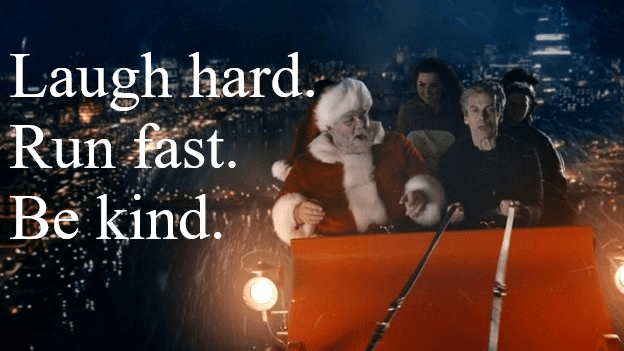
Anyway, again, have fun, eat well, laugh hard, play games, sing songs, watch TV and movies, love your friends and family****, and above all, be kind.

TTFN

santa who


*To avoid the urge to edit it while I reread it.

**The one that comes to mind is in his excellent, chilling, pseudo-sci-fi short story The Jaunt, which I first read in the collection Skeleton Crew.  I recommend both the story and the collection.  Actually, it’s hard to go too wrong with any of King’s short story collections!

***They used to, anyway.  I haven’t checked lately.

****“Because love, it’s not an emotion; love is a promise.”