
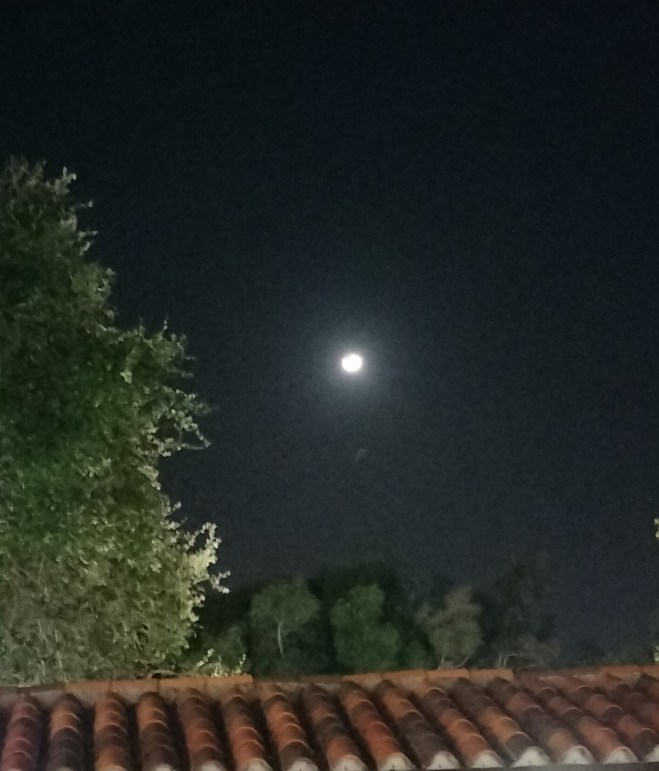
Therefore the Moon, the governess of blogs, pale in her anger washes all the air

Hello and good morning.  It’s Thursday, the first of May*, the beginning of yet another stupid month.  They just keep coming, on and on and on, so irritatingly relentless that I find myself wishing for the elimination of the Moon and the destabilization of the Earth’s rotation and orbit just to break the tedium.

I know that would inconvenience a great many other people, though, so I’m not going to try to make it happen.  To be fair, it would be much “easier” to alter the Earth’s rotation than to shift the Moon.  A decent-sized asteroid collision at the right angle could alter both the rate of Earth’s rotation and its angle to the ecliptic.

Of course, such an impact would have devastating consequences for almost everything and everyone on the planet’s surface.  So that’s a win-win scenario!

I’m kidding.  But I often fantasize about wiping out all life as we know it, because none of it is truly benign and it’s all futile and will always be marked broadly by fear and pain and other suffering, because all those things are evolutionarily vital (in the literal sense).  I shouldn’t choose that for other people, though, so I probably would never do such a thing even if I could.

Thinking back to earlier, though, I’ve been pondering the question of just how one would move the Moon in its orbit, and I thought about the reflectors up there in the old Apollo landing sites, still used (last I checked, anyway) to measure the distance to the moon with great precision.

There have long been discussions about how to alter the course of an asteroid that looked to be prone to intercept the Earth.  One way might be to vaporize a portion of the asteroid, causing its “outgassing” to act almost as a rocket propellant, and by Newton’s third law (or, equally valid, by the law of conservation of momentum) the asteroid would shift its trajectory in the direction away from the artificial outgassing.

Well, what if one were to train powerful lasers at one site on the surface of the Moon**?   The fact that the moon is tidally locked with Earth means it’s constantly showing the same face to us, so one could keep focusing on the same portion of the surface.  One could study the albedo and absorption characteristics of the surface of the Moon to try to pick the best wavelength for causing “outgassing” of that surface, and that outgassing would propel the moon away.

It would be a slow process, since the Moon is big, and shifting its orbit significantly would require the delivery of quite a bit of energy, but that’s okay.  One could set up a single laser (or pair of them on opposite sides of the Earth, or more if one desired faster effects) perhaps solar powered and using ordinary telescope-style tracking equipment and software, to train the lasers always on the same point on the surface of the moon.

Gradually, the Moon would shift away from Earth (you’d need to keep adjusting your aim a bit), more quickly than it currently is, and eventually:  lunar liberation!

Of course, even given the abysmal state of science on Earth (and particularly in the US right now), people would eventually notice the Moon moving, and they might even notice the “outgassing”.  But a lot could be done before then.

If one wanted to have a much quicker effect, or rather, a more instantaneous effect, one could develop a large depot of antimatter, which we know how to make in particle accelerators.  Storing antimatter is challenging, of course; it must be kept within electromagnetic fields in high vacuum, since it will annihilate if it encounters its matter counterpart.

Still, with enough time and patience and care (and money), one could gradually accumulate a large stockpile of antiprotons and positrons, perhaps stored adjacent to each other so their mutual electrical attraction makes containment slightly easier.  Then, when one had gathered enough, one could launch it toward the moon in a fairly standard rocket‒it wouldn’t need to be manned, and it certainly wouldn’t need to return to Earth.

Release your tons (I would guess) of antimatter onto the surface of the Moon, perhaps at the center of “mass” of its face that points toward Earth, and watch the fireworks!  There would be complete annihilation of matter-antimatter in a release of energy far more extreme than any mere nuclear weapons could produce.  Heck, if you wanted to bypass the whole Moon process, you could just accumulate your antimatter here on Earth over time, maybe near some damage-multiplier like the ice caps or near a super volcano or something, and release the containment when you’re ready.

In a typical nuclear explosion, less than one percent of the mass involved in the reaction is “converted to energy”***.  In an anti-matter reaction, ALL of it would be converted.  Imagine releasing hundreds of times more energy per kilogram than the most powerful nuclear weapons.

Of course, antimatter is absurdly expensive to make, but economies of scale might help that.  It’s not as though one would be expecting a profit‒unless one went the Bond villain route and used one’s anti-matter bomb to hold the Earth for ransom, which is a thought.

That’s enough of that madness for now.

Speaking of madness, today begins “Mental Health Awareness Month”.  I would say that I’m already aware of mental health in a general sense, I just don’t have much personal familiarity with it.  Mental illness, mental dysfunction, mental dysregulation, these are things with which I am more personally acquainted.  I’m only too aware of them.  Physical health falls into a similar position.

All right, well, before I discuss more ideas about how to alter or eliminate all life as we know it‒I’ve many such ideas, I’m afraid‒I should draw to a close for the day.  In case you can’t tell, I’m not right in the head, am I?  So this is a sort of appropriate month for me, especially coming as it does right after Autism Awareness Month.  Batman only knows what will happen next.

TTFN

*Also known as May Day.  I wonder how that came to be used as a distress call, as in, “Mayday, mayday, we are going down!”

**Alternatively, one could, in principle, use a very large array of adjustable mirrors on Earth, and they could be shifted to reflect sunlight and focus the reflections on one spot on the moon, but to get a strong effect would require a worldwide collaboration or at least acceptance of these mirrors.  It’s hard to see that happening.

***I used “scare” quotes because technically it’s all energy to begin with, it’s just changing form.

Whither one goes affects whether the effects of the weather are noteworthy

It’s a bit chilly this morning, at least for south Florida.  As I looked at the weather app when I was getting up, it reported that the temperature near me was about 51 degrees Fahrenheit.  We can take 32 away from that then multiply by 5/9‒so that’s 19 x 5, which is 95, divided by 9‒which gives just over 10 degrees Centigrade (or Celsius, depending upon whom one asks).

I guess that’s pretty cool, though certainly there are many places north of here where people would welcome it as a relatively balmy day for this time of year.  Alternatively, in parts of the southern hemisphere, where it is summer, it would seem aberrantly cold, even more noteworthy than it is in my neck of the subtropical woods.  Going farther afield, on Mars it would be truly a record-setting heat wave, whereas on Venus, such a temperature would be impossibly, unfathomably cold.

The surface temperature of Venus is, if memory serves, around 900º Fahrenheit, or nearly 500º Centigrade, or nearly 800 Kelvin (I am rounding the Kelvin “273” addition to Centigrade because I only have one significant figure in my recalled estimate of Venus’s average temperature in Fahrenheit, and adding other specific digits would be misleading and unjustified).

It’s interesting that Venus, the planet named for the goddess of sexual and romantic love, is the most hellish planet in the solar system.  It’s hot enough at the surface to melt lead.  The atmospheric pressure is 90 times that of Earth and largely consists of carbon dioxide.  The cloud cover is constant and it rains sulfuric acid.

Perhaps Venus, the morning “star” (and the evening “star” too, depending on which side of the sun it’s currently on from Earth’s point of view) is more appropriately given one of its other names, which is:  Lucifer, the light-bearer, herald of the dawn, who in later mythology was associated with the Devil (at least before his fall).

Of course, it’s hard to reconcile Lucifer’s supposed fall with the fact that the planet is still conspicuously up there in the sky.  And I do mean “conspicuously”.  Apart from the sun and the moon, Venus is easily the brightest thing in the night sky.  Sometimes one can still see it even as the sun is beginning to rise; the cloud cover of Venus makes it highly reflective of visible light.

Anyway, I find it sardonically and cynically amusing that the goddess of love is associated with a nightmarish hellscape, but I have a personal history that makes me look askance at romance.  I am, in other words, biased.

Venus is a good object lesson in the potent effects of carbon dioxide’s tendency to allow visible but not infrared light to pass easily through it, and so to create a “greenhouse effect” even in the modest concentration it achieves on Earth.

The physics of this is well understood, relating largely to the resonant frequency of the bonds in the molecule as well as its size and shape.  Smaller, tighter molecules like molecular nitrogen and molecular oxygen, the two gasses that make up the vast majority of Earth’s atmosphere, don’t interact much with infrared light, and are more prone to scatter shorter, bluer wavelengths of visible light‒this is a rough explanation of why the sky is blue (and why the sunrise and sunset are much redder, as that sunlight is going through more of the atmosphere due to the angle at which we see the sun at those times of day, and the blue is partly scattered out of it, leaving relatively more redder light behind).

Anyway, the broad physics of the greenhouse effect is almost elementary, and has been understood for a long time.  The specifics of what precisely will happen in any given set of circumstances can be tricky to tease out, given the complexity of reality‒you might say that Venus is in the details‒but the specifics are often less important than the broad strokes.

After all, when a giant asteroid is heading toward the Earth, it isn’t that reassuring to know that only, say, 75% of species will be driven extinct by its impact, and that life will survive and eventually once again thrive.  How much would someone have to pay you for you to be willing to accept a 75% chance that just you will die, let alone everyone like you on the planet?

There might well be a big enough sum for you to be willing to risk your own life, especially if you got to enjoy the money for a while before the dice were thrown, or to leave it to your heirs.  But for your whole species?  Is there a reward big enough to be able to take that chance?  Let’s assume you’re not a raging misanthrope/panantipath like I am for the sake of this question, since depending on my mood, I’d be inclined to negotiate for a higher chance of extinction.

Also, of course, by pretty much every possible form of ethics you might follow, you don’t have the right to roll the dice on all the members of your own species.   You don’t have any right to roll the dice on the members of your own family, unless they unilaterally and spontaneously and freely grant you that right.

Sorry, I don’t know why I’m writing about these topics today.  They are just what spewed out of me, like vomit from the proverbial drunkard or pus from a squeezed abscess.  I wish I could write something more interesting, or write something that helped my mood some.  Writing fiction did at least help fight my depression, but it’s hard when almost no one reads my stuff.

Maybe I should take to writing at least a page of fiction a day by hand, on the notebook paper and clipboard I have at the office, during downtime, instead of watching videos.  Yesterday I mainly watched ones about spontaneous symmetry breaking and the electro-weak era and the Higgs mechanism.  To be fair to me, it’s very interesting stuff, and it actually would have some relevance to my potential comic book turned manga turned science fiction story, HELIOS.

Of course, that’s named for another mythological figure, one that’s even hotter than Venus.  But I don’t know if I can write it.  Motivation is difficult.  Still, as Stephen King reputedly once told Neil Gaiman, if you write just one page a day, by the end of a year you’ll have a decent-sized novel*.

Once I get writing, I have a hard time stopping at only one page.  If you’re a regular reader of my blog, you’ll probably know this implicitly‒my general target for post length is about 800 words, but I almost never am able to keep it that short.

I guess we’ll see what happens.  And, of course, I’ll keep you all…posted.


*He has also noted that, for him‒as I have often found it to be for me‒writing fiction is the best form of therapy.