
Hello and good morning.
I’m going in to the office today, since down my way, Hurricane Milton has not been very impressive so far. This is not a surprise. We were always going to be only on the periphery of the system, and on the leeward side of the state (so to speak). There wasn’t even any rain of significance down by where I live; just a bit of relatively high wind.
We are going through a bit of rain as I ride in my Lyft to work, but for south Florida, it’s a piddling amount so far. The wind is mildly interesting, but I’ve ridden a 650 cc scooter (basically a motorcycle with automatic transmission) through wind and rain much worse than this. I don’t think that was a wise thing to do for anyone who cared about his or her life and health much, but for me, it was just fine.
I’m in a Lyft, by the way, because the train service is suspended today, as it was yesterday. This was probably not absolutely necessary, but I respect the abundance of caution.
Traffic, at least, seems very light, which is also not surprising. Most people in the area are not working today, I suspect. We shall see how many people come to the office today.
I’ve been a bit frustrated lately, as an infection of some kind (possibly a few different ones) has afflicted quite a few people at the office, but I have not gotten sick. Not only would such an illness give me the opportunity for rest for which I am able to excuse myself (and might even allow me to sleep, given the physiology of the immune response), but it’s also an opportunity potentially to develop some more severe, life-threatening superinfection*.
Apparently, some people used to call pneumonia “the old man’s friend”. Well, I’m not that old (and I wouldn’t recommend my friendship to anyone, even a pulmonary infection) but apparently the average lifespan for people on the autism spectrum‒assuming that I am, which I give very high likelihood‒is somewhere in the mid-50s. So, it wouldn’t be unreasonable for something to kill me sometime soon.
Of course, such averages are strongly affected by outliers. People with the highest support needs are probably more likely to die at significantly younger ages, and that will tend to bring the average down. It’s a bit like how the very high infant mortality rate strongly skewed the average lifespan in pre-modern times. People who did reach adulthood probably didn’t live much shorter lives than we do now.
Actually, modern people in the west may be backsliding lifespan-wise, at least in America, as we eat more refined carbs and are less active and so are more prone to hyperinsulinemia, which brings with it not just increased risks of diabetes and elevated lipids, but even increased risks of high blood pressure, heart disease, stroke, and many cancers, as well as infections.
The infant mortality issue illustrates one way in which reported average lifespans and similar statistics can be misleading, at least for people who don’t understand what’s behind the numbers. It reminds me of something I may have discussed here before: people (rightly enough) make fun of the fact that (to make up a statistic that’s probably not too far from reality) ninety percent of people think they are above average drivers.
Now, it is almost certainly true that ninety percent of people are not above average drivers; it’s just that so-called neurotypical people tend to have overinflated (and undeserved) senses of self-esteem. But the notion that seems to be implied in most discussions of such statistics is that it’s impossible for 90% of people to be above the average. This is not the case, at least not if “average” refers to the arithmetic mean, as it usually does.
If ninety people out of a hundred each scored exactly 51 (out of a 100, say) on some test of driving ability, and the remaining ten only scored 1 point each, then the average score would be ((90 x 51) + (10 x 1))/100, which is 46. So, ninety percent of people would not only all be above average, but would be five points above average. It’s not a very impressive score, but it is true.
Now, if it were said that ninety percent of people think they are above the median, then that would be erroneous by definition, because of the meaning of the term “median”.
Most people don’t seem to understand these and other mathematical concepts, and yet those concepts and related ones of many and varied kinds can have significant impacts on the lives of billions. I once wrote a blog post on Iterations of Zero recommending that probability and statistics be more aggressively emphasized in secondary school education, because I think understanding them would give people far greater insight and even agency in the world.
And yet, we see “humorous” memes such as the one below, of which there are numerous iterations and variations:
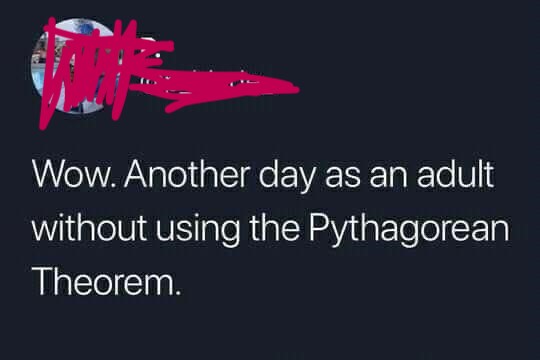
I say the fault for that lack of use lies with the individual, not with their education. Just because they don’t use the Pythagorean Theorem doesn’t mean it isn’t and couldn’t be useful**, and even if the specific theorem wasn’t useful then the capacity to do it and other, related things, is useful.
I feel I may have mentioned it here recently, but even when one doesn’t use mathematics*** in one’s profession, working with them strengthens the mind and makes it more fit for many other purposes. Usually, one doesn’t do push-ups to become really good at doing push-ups, and one doesn’t jog in order to become a really good jogger. One exercises to become stronger and healthier, more capable. The mind is even more responsive to exercise than is the body, and if there are limits to how strong it can become‒in whatever sense‒I don’t think anyone has come close to reaching them****.
That’s that for today. I hope you’re all weathering your personal storms reasonably well. The one down here hasn’t done much to me; I probably could have slept outside in the rear of the house last night without any trouble. The wind might have been soothing. It might even have helped me get a better sleep. It’s not as though it could have been much worse.
TTFN
*By which I mean an infection that opportunistically occurs due to the body’s weakened defenses caused by an initial infection, not an infection with exceptional nature or virulence.
**Understanding geometry is so potentially useful in so many ways that it’s said that the only time in his life that Isaac Newton laughed was when someone asked him what the point was in studying Euclid. Newton is universally reputed to have been quite arrogant, vindictive, and impatient, to say the least. One can only imagine the sheer amount of vitriol and scorn that would have been conveyed by that solitary gelastic moment.
***Or philosophy, or physics, or chemistry, or biology, or history, or literature, etc.
****Not even Newton or Von Neumann.

 Robert Elessar
Statistics as a course was difficult for me. I busted my ass just to pass it. I loved algebra, though. Maybe I had a lousy prof. Wouldn’t you think someone with a knack for algebra would be able to master statistics? Maybe my question proves what eluded me. I do know that statistics are often misused. Anyway, glad Milton didn’t pack the punch that was expected. Hope you get some rest this weekend.
I think statistics/probability is a different KIND of process than algebra. Algebra is very precise, with exact answers and clear, deterministic logic, whereas statistics and probability are, by nature, more nebulous. I don’t think it’s any surprise nor any shame to be good at the former but find the latter troubling and more difficult. You are in very good company in that matter.
As for people lying with and misusing statistics, that’s one of the reasons I wish people were more educated about them, so they can less easily be misled. The way people apply statistics may be misguided and misleading at times, accidentally or deliberately, but as Eliezer Yudkowsky points out (paraphrasing E.T. Jaynes, apparently) “the theorems of Bayesian probability are just that, THEOREMS in a coherent proof system.” But I can’t hold it against anyone for not reading Jaynes’s book–I’ve only been able to get about 4% of the way into it. Yudkowsky’s book(s) is/are much more fun, especially Rationality: From AI to Zombies. It’s comprised of a lot of collected blog posts that are nice, “bite-sized” chunks. It’s even available on Audible now! I won’t say it’s simple or easy, but he does make it fun a lot of the time, and he is a far better teacher, I suspect, than your professor was.