This tue, tue sullied (or solid) day

Tuesday or not Tuesday?  That is the question.  And the answer, for today at least, is that today is Tuesday.

I don’t know when you’re reading this, though.  Odds are, if you aren’t reading this on the day I publish it, that you are not reading it on a Tuesday.  In fact, once we get out past the rest of this week* there should only be a roughly 1 in 7 chance that you are reading this on a Tuesday.

That’s probably pretty obvious, huh?  Still, it can be useful to be in the habit of thinking in terms of probability and statistics, since that’s the way nature sorts itself out, right on down to the level of quantum mechanics, to the best of our understanding.  If people had a better understanding of the nature of probability, many things in the world would run far better, or so I suspect.

I have written at least one previous post (on Iterations of Zero) about how I think probability and statistics should be emphasized far more in general math education at the secondary school level (even for non-college-prep students).

Imagine a world in which most people had grown up learning about the nature of probability with reasonable rigor.  There would be fewer headline-based scares about things that are unlikely enough to be irrelevant‒e.g., plane crashes‒and more appropriate understanding about things like vaccination and disease prevention of various kinds, among numerous other matters.

Imagine if the people of the world really understood the difference between absolute risk and relative risk, and if they grasped the difference between sensitivity and specificity for medical tests.  Heck, imagine if the public at large had a decent elementary grasp of Bayesian probability.  Bayes’s Theorem is not really all that difficult, when you get right down to it.  Veritasium did a nice video about it**.

Of course, as I’ve said before, if wishes were horses, we’d all be neck deep in horse shit, whereas that’s only figuratively the case as it is.  But it would be nice if politicians and other people with undue influence had to deal with a general public that was savvy about the legitimate use of statistics and why (and how) they are fundamental to a thorough understanding of the world itself.  It’s not an accident nor a mistake that Jaynes named his book Probability Theory: The Logic of Science.

And science is not an esoteric thing.  It is not a high-falutin’ mode of thought that doesn’t pertain to the average person.  It comes from the Latin scire, meaning to know.  It is fundamental to the nature of our epistemology, to not just what we know about the world but how we come to know it, how complete and how incomplete is our understanding and what the nature of the world really is at deepest and broadest and finest and coarsest levels.

So, it’s fairly pertinent to everyone, really.  After all, if you want to win a game (or get your best score or whatever) you’re best off understanding the rules as well as you can.  A true novice is unlikely to win a game of chess, or of Go, or even of Mario Kart against someone who knows what they are doing.

Now, nature isn’t our adversary per se‒if it were, we would all be long gone‒but it “knows” its rules and always and only plays by those rules, by definition.  In fact, if you come upon a place where you think nature has broken its rules***, what’s really happened is that you’ve come to a place where you don’t understand the rules.  Nature cannot be “wrong”.  There is no such thing as the “supernatural” in reality, because anything that actually happens, that actually exists, is part of nature.

Even if you discovered that you were in a situation such as that described by Descartes or The Matrix, in which the reality you think you know is an illusion, that is simply a newly discovered fact about the nature of reality, and it raises**** the question of what is the nature of that illusion, what is behind it, and by what laws of physics do those entities operate?

So, anyway, it’s good to learn about how reality works if you want your best chance (never a guarantee) of doing what you want successfully and getting what you desire from life.  No one here gets out alive (at least it’s very unlikely) but you might as well make the game as rewarding as you can in the meantime.


*Which I suspect would be when most non-same-day readers would read this.

**He also did a really nice one about the logistic map and chaos and the Mandelbrot Set that will blow your mind if you haven’t thought about it before.

***I’m thinking of those stories with submoronic headlines such as “New discovery breaks physics!” which don’t make sense to anyone who knows anything, and which should embarrass those who write them.

****It does not beg the question.  To beg a question is not to raise the question, but rather to proceed as if it had already been asked and answered in a way that you’re presuming it to be answered.  It is a way of skirting fundamental issues and avoiding having to prove a case.  In other words, it is willfully or accidentally disingenuous.

Neither jot nor tittle, but just a title

It is Friday.  Friday it is.  I do not, though, plan to eat any green eggs and ham, nor do I intend to train Jedi.  I merely like to fiddle around with words.  I have also even been known to write and speak about cellos and violins and violas and basses‒wording around with fiddles, that is.

Anyway, this should be the end of the work week for me, so don’t expect a blog post tomorrow.  I’m not saying that there definitely won’t be one; it’s an outcome with a low probability, but it’s not zero.  In principle, the probability of any physically possible event happening is never zero.  But the odds can be so vanishingly small as to be zero for all practical purposes.

For instance, it’s physically possible for the entire Earth (the Moon included) to quantum tunnel to the Andromeda Galaxy, but I wouldn’t hold your breath.  I suspect that the odds of it happening are so low that the time scale between now and the evaporation of the largest black holes due to Hawking radiation (roughly a googol* years) would not even begin to make it likely to happen, even if it weren’t for the fact that the Earth and the Moon will have been so dead and so disintegrated by then that even the memory of their memory’s memories would have been long since lost to any mind that might still exist at that time…probably.

So, you can treat that Earth-Moon Andromeda tunneling as “impossible” for all practical purposes, but in principle, it could happen…

…right…

…NOW!

Okay, well, as far as I can tell, it hasn’t happened.  The sky is too hazy for me to see if the stars have changed, but I don’t think they have.  It would be quite something to experience the local stars of a different galaxy, but of course, if we tunneled into Andromeda, we might be in a relative star desert, or we might be in a place with too many stars for our long-term safety.  Also, if our solar system’s net momentum persisted, we would be unlikely to arrive in any kind of stable orbit of the center of that galaxy.

And, of course, I did not say the sun would come with us‒that would make the whole thing even more vanishingly unlikely‒so we’d all freeze in fairly short order, apart from organisms that use geothermal sources as the base of their food chains and energy cycles.  Those might survive for eons.

Anyway, it’s vastly more likely that I’ll work and write a blog post tomorrow than that we will quantum tunnel to Andromeda**, but it is still a very small likelihood***.  It may be less than one percent, I don’t know.  But it’s quite unlikely.

So, though it might be worth a quick glance to check in come the morning, especially if you were going to do that sort of thing anyway, I would not go out of your way, and I certainly wouldn’t recommend holding your breath.  I don’t think even a sperm whale could hold its breath that long, and I think they have the longest breath-holding record of any mammal (if anyone knows otherwise, please let me know).

In other news‒not that I’ve really given you any news so far‒my keyboard arrived safe and sound (so to speak) yesterday afternoon, so hopefully this morning I’ll be able to finalize the chords to Native Alien.  Then, maybe this weekend, I’ll record a little guitar-chord and voice demo so I don’t lose track of the song.

Then, next week, I can start working on a song based on the trigger “humility”.  I still have no clear conscious notion of an idea for such a song, but I’m not worried about that.  I know I can produce something (not the Beatles song).

I have to keep reminding myself that I don’t need to produce anything great as far as lyrics go‒I think the lyrics I have for Native Alien, which I shared the other day, are okay but not terrific‒I just need to get some words down.  I can always edit and alter things as the process evolves, just as the first draft of a story (or to a lesser degree a blog post) is just the beginning.

I’m also continuing with the circuit course on Brilliant, and I’m alternating reading that book Vector and The Lord of the Rings (yet again) and my own book, The Chasm and the Collision (also yet again, though LotR still holds the 2nd place record for my number of reads, well ahead of CatC and only bested in number of readings by The Chronicles of Thomas Covenant the Unbeliever).

All these are things that I can do alone, of course.  If there’s something to do that would require someone else’s participation, well, I’m shit out of luck.

I think that’s a phrase that applies fairly well to me, come to think of it.  And the word “alone” might as well have my picture next to it in the dictionary.  Though that might be confusing, since I can think of other words that would merit my picture even more than “alone” would‒words that would do their part to explicate just why I am alone, no doubt.

Batman knows I don’t want to hang around with me.

Anyway, I hope you all have a nice weekend, and if anything truly improbable happens to you, I hope it’s a very good improbable thing.


*That’s 10 to the 100th power, or a 1 followed by 100 zeros, in case you’ve forgotten whence the software company cribbed their name.

**Quantum tunneling is not rare on small enough scales, though.  It happens countless times every second in the heart of the sun, for instance.  If it did not, there would not be enough heat and pressure to overcome the coulomb barrier to fusion, and the sun would be some very large equivalent of a brown dwarf…or maybe it would contract more and get hot enough for fusion to take place without tunneling, but then I think the sun would be hotter and brighter and more short-lived, and I think it’s unlikely that the Earth would have produced any life, let alone humans.

***Think about it:  if you took something with odds of ten to the minus 120‒that’s 119 zeroes between the decimal point and the first non-zero digit‒and then made it a billion times more likely than it is, you’d still have odds of 10 to the negative 111th power, or 0.000000000000000000000000000000000000000000000000000000000000000000000000000000000000000000000000000000000000001.  This is a good reminder that relative risk (or probability) is not the same as absolute risk (or probability).

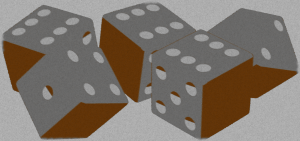
Is an “almost” pair o’ dice just one die?

Oooooh, it’s Friday the 13th!  It’s so spooky!

Not really, of course.  It’s just a day.  I like Friday the 13ths, mostly just because so many people seem to imagine they are unlucky, though I think that superstition may be less prevalent now that it was in the past.  Nowadays, the day is probably mostly associated with the slasher film “series” that uses that title.  Not that even the original movie’s story ever had much to do with the day.  It just was a catchy, well-known “scary” day, following in the footsteps of Halloween (although the latter at least had a theme that suited the day).

Of course, a major reason I like this day is that the number 13 is a prime number, and I like prime numbers.  I like 13 especially, because 13 is possibly the most feared and reviled of the primes, associated with bad luck in much the way that 7 is associated with good luck.

Hmm.  I know at least part of 7’s appeal probably has to do with the dice game “craps”.  7 is the most common total to achieve when rolling two six-sided dice, because there are more ways to get that total than any other number.  Meanwhile, of course, there is no way to get a 13 on two (normally numbered) six-sided dice, but it is only just out of reach.  It’s the first number that’s too high for such a pair o’ dice*.

Of course, you can’t roll a 1 on two six-sided dice either, but that feels more trivial.

I honestly don’t think the reason for 13’s association with bad luck probably has anything to do with dice; it wouldn’t make too much sense.  But someone out there, please correct me if I’m wrong.

It’s interesting to think about probability regarding dice, not least because the very field of probability theory was first created by a guy who wanted to optimize his chances of winning at dice.  According to what I’ve read, he succeeded, at least temporarily.

Nowadays, of course, that field has grown into a special subset of mathematics and physics and information theory and so on, affecting everything from thermodynamics and statistical mechanics to meteorology and quantum mechanics.  In a certain sense‒given that Schrodinger’s equation describes wave functions that have to be squared (in a complex conjugate way) to get literal probabilities that, based on Bell’s Theorem, cannot be further simplified, as far as we know‒probability may be something truly fundamental to the universe, not merely a tool for situations in which we don’t have access to information.  Based on Bell’s Theorem, which has been shown to apply in the Nobel Prize winning experiments of Aspect et al, it seems that, at root, as far as we can tell, the quantum mechanical operations are fundamentally indeterministic.

Of course, just because something is “random” at a lower level doesn’t imply that, at higher levels of organization, it can’t behave in ways that are very much deterministic in character.  Lots of little things behaving in a locally random manner can combine to create inevitable larger-scale behavior.  Perhaps the most straightforward and compelling such thing is the behavior of gases and the Ideal Gas Law***.  The motion of any given molecule of gas is unpredictable‒at the very least it is stochastic and has so many degrees of freedom as to be unpredictable in practice, but since quantum mechanics is involved in intermolecular collisions, it may truly be random in its specifics.

And yet, when oodles and oodles of molecules of a gas come together****, their collective behavior can be so utterly consistent‒with very little depending on even what kinds of molecules comprise the gas‒as to produce a highly accurate “law” with only 4 variables, one constant, and no exponents!

If that doesn’t seem remarkable to you, either you’re jaded because you’ve known it since secondary school or I haven’t explained it very well (or both, of course).

It’s interesting to think about the probabilities of dice games using more than two dice and/or dice with more or fewer than six sides.  Tabletop role-playing gamers will know that in addition to the 5 “perfect” Platonic solids*****, there are quite a few other symmetrical (but with sides not formed from “regular” polygons) solid shapes that can be turned into everything from ten-sided to thirty-sided dice.

But RPGs tend to involve rolling one die at a time, except when rolling up characters, at which time (in D and D and Gamma World, at least) one uses 3 six-sided dice (or 4 when applying a technique to yield better-than-average characters).

I wonder why there are no games of chance using more than 3 six-sided dice or using, say, multiple four-sided dice or eight- or twenty- or twelve-sided dice.  The probabilities would be more trouble to work out, but they would not be harder in principle.  If any of you out there either know of or want to invent a game of chance using more than 2 dice and/or other than six-sided dice, feel free to share below.

In the meantime, I’ll call this enough for today.  I am supposed to work tomorrow as far as I know, though that’s always subject to change.  If there’s no post here tomorrow, then it probably means I didn’t work.  I probably will work, though I couldn’t give you a rigorous working out of the mathematics involved in determining that particular probability.

Have a good day if you’re able.


*You can sometimes see them by the dashboard lights.

**Unless superdeterminism is correct.  However, this is a very hypothetical thing, and I’m not very familiar with what arguments are proposed to support it, so I won’t get into it.

***PV = nRT if memory serves. [Looks it up]  Yep, that’s right.  Four variables and one constant (R).

****Even if it’s not right now, over me.

*****These are, presumably, solids that really care about each other but in a non-romantic way.