
And his brain ate into the worms…

Ugh.  Didn’t we just leave this party?  Evidently, we did not leave it precipitously enough, because here we are‒or at least, here I am‒rejoining it in the morning.

It seems like an ill-advised notion, but then again, I’m not sure who specifically advised me, or any of you, to do it.  There probably were a few literal, formal pieces of advice that we all or each received throughout our lives‒advice about getting up early and going to work and striving to fulfill our potential, and how if we didn’t we were somehow letting ourselves and (more importantly) letting everyone else down.

“The early bird gets the worm” is a typical phrase about such ambition and dedication and hard work.  But like many of us, I’ve often thought that worms are overrated.  They’re not rated highly at all, I’ll admit, but nevertheless, I think they are rated too highly.  Evidently‒according to what I have read‒all earthworms in at least the northern part of North America were killed off in the last ice age.  Nevertheless, plants grew and flourished without verminous help in the soil before Europeans accidentally brought their own earthworms here.

Of course, the saying is metaphorical, I know that.  We’re not really advised to seek earthworms early in the day, though perhaps liver flukes and flatworms and tapeworms and roundworms are also considered as among the worms that might be caught.

No, probably not.

But anyway, even though metaphorical, that saying raises higher level questions, such as, “Is the life of a metaphorical early bird worth having?”

Consider what that life entails:  Getting up (early), pecking around on the ground for worms and probably also for various other insects and their larvae and a few arachnids as well*; trying to avoid, in that process, being caught by some predator (such as a house cat); trying to find and attract a mate when the season is right; helping build a nest, if you’re that kind of bird; guarding the eggs and maybe sitting on them yourself, until they hatch; then, feeding and protecting them until they can fly on their own; then repeating these steps until disease or starvation or one of those house cats gets you.

That’s it.  And while there are many embellishments and flourishes and complications in the typical human life cycle, overall it is much the same as that of the bird.  Why would we expect it to be otherwise?

Admittedly, humans (and humanoids) can dream up other things to do, and some of them are more interesting and fulfilling, from their own points of view at least, than the ordinary early bird pattern.  But though, in the long run, humans as a whole may become significant enough to do something truly meaningful on a cosmic scale, almost all of them have no deeper lives than those lived by the early birds.

That’s not necessarily a bad thing, of course.  Taken with the pertinent attitude, such a life can be well lived and fulfilling.  It probably won’t end happily, because it’s not in the nature of life to be happy when ending; there’s just no real evolutionary benefit to having such a tendency.

Still, before imbibing the so-called Kool-Aid™ of the motivational life-messages‒those social moralities that keep us getting up and joining the rat race (to shoehorn in another animal-related metaphor)‒it would probably behoove us to consider whether that is the life we think we want, to ponder if that overall shape and experience are okay with us as the outline of our lives.

If so, there’s nothing wrong with that.  As long as you’re not interfering with other people’s ability to try to live their lives as they try to see fit**, then do what seems best to you.

But it’s useful to think about what might be the overall shape of your life if you continue as you currently are and if that shape will be aesthetically (or otherwise) pleasing to you.  If not, what change might improve that overall shape, trying to take all reasonably plausible inputs and outputs into consideration?

I won’t say that the unexamined life is not worth living, because, if it’s unexamined, how do you know that it’s not worth living?  Huh?  Huh?  Nevertheless, I will say that the unexamined, unconsidered life could be fulfilling only by accident, whereas it may be possible, with deliberation, to steer toward a better one.

Not that I’m a good piece of evidence in favor of this.  I think and overthink to the point that I hate the noise of my own mind, but I haven’t been able to steer myself into an optimal shape***.  But at least I make a lot of “noise” about such things.  That might be worth something.

Anyway, have a good day.  Enjoy your worms or salads or whatever other life forms you kill and consume to remain alive today (I’m assuming you are not a green plant).  Watch out for the Kool-Aid™ and even more so for the cats.


*I am quite sure that, to such a bird, these things taste delicious, so I don’t mean to disparage their diet as unpalatable.  Appetites of various kinds are species specific; what’s appetizing or sexually attractive to, say, a housefly is unlikely to appeal to any psychologically healthy human.  Likewise, the most beautiful human woman ever is not going to do anything for a male tarantula.  He also probably would have no interest in having a bite of her salad.

**This is more difficult to navigate than it may seem at first, because even when one is acting on one’s own, there are always effects at some level, there are always “externalities”, and occasionally these will have an impact on other people‒a foreseeable but perhaps unforeseen impact.  And vice versa.

***Should there be a “yet” at the end of that sentence?  I don’t know; we’ll have to see what happens to me in the future.  We can be reasonably sure, though, that there shouldn’t be a yeti at the end of that sentence, or of any sentence except one that mentions such creatures.

So in the world. ‘Tis furnished well with blogs

wow

Good morning!  Welcome to yet another blog post, since this is yet another Thursday.  They do seem to keep coming and coming, don’t they?  Thursdays, I mean.  Thursdays have been going on for a lot longer than blog posts have been, and they’re likely to continue long after my blog posts have stopped.

Of course, on a cosmic level, the very notion of dividing time into days, each representing roughly a revolution of the Earth on its axis, is highly local and arbitrary.  The naming of days—such as naming one of a continuously repeated seven after a Norse thunder god known to most people nowadays as a character played by Chris Hemsworth—is even more local and arbitrary.

One “day” on Jupiter is only ten hours long, despite the fact that Jupiter’s diameter is ten times as great as the Earth’s.  This rapid revolution contributes to some truly amazing weather patterns on that planet.  A “day” on the moon, on the other hand, is about twenty-eight Earth days long…and there’s no weather there at all.

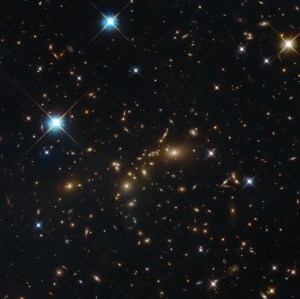
A day on Mercury, named after the wing-footed messenger god of Greek mythology, is almost sixty Earth days long.  And all these variations are just a few of the ones represented within our solar system, itself a tiny, tiny pixel in our galaxy (a “day” of which is a quarter billion Earth years long), which is in turn just a tiny, tiny splotch among hundreds of billions to about a trillion galaxies in the observable universe.  And that, of course, is only a chunk—miniscule to infinitesimal—of a much larger region of spacetime that seems likely to be infinite.

But don’t worry.  Your personal, day-to-day concerns still really matter.  Sure, they do.

Okay, sorry about that bit of sarcasm.  I’m pretending to be more cynical than I really am.  Your individual, day-to-day concerns do matter, in the only way that anything can matter:  they matter to you.  Meaning, like beauty, is in the eye of the beholder.  This is good, and can be highly life-affirming, unless you’re one of the unlucky people who feels that they themselves don’t matter, even to themselves.  For such people, the crushing weight of reality can feel at once both infinitely oppressive and at the same time very much worthy of a “meh.”  As a person who writes horror stories, among other things, I can honestly say that this is real horror.

Some horror fiction expresses a sense of being lost and trapped in a hostile and very large universe, which cares about us only as irritating insects, and seeks to crush us as such.  A similar notion is occasionally (metaphorically) invoked even by such science educators as Neil deGrasse Tyson, who has been heard to speak of “all the ways the universe wants to kill us,” or words to that effect.  But of course, this is a highly narcissistic misinterpretation of reality, used only as a figure of speech by Tyson (in order to emphasize certain points) and as a plot conceit for horror.  If the universe really “wanted” to kill us, we would be dead.  Instantly.

The real horror, from the reflexively hubristic, human point of view, is that the universe doesn’t give a tiny little rat’s ass about us.  As far as we know, the only place in the universe that’s even capable of caring about anything at all is in the minds of humans…and perhaps other sentient creatures.  As far as we know, only here on Earth (and in low Earth orbit) does caring exist at all.  Now, depending on the likelihood first of the origin of life, then of multicellular life, then of intelligent life, there may be many other such islands of caring in the universe, and if the universe is infinite in size, simple math reveals that there must be an infinite number of such islands.  But it’s equally simple to see that there is a proportionally larger infinity of places where there’s nothing that cares about anything.  This is far from the worst way things could be.  If there really were a Crimson King, or a Morgoth, or an Azathoth and Nyarlathotep and Cthulhu* out there, we would be in for a much rougher time than we actually experience.

Of course, as physicist and pioneer of quantum computation David Deutsch argues beautifully in his book The Beginning of Infinity, we humans—and our descendants, whether biological or technological or both—have the potential really to become significant on a cosmic scale.  As he also points out, there is no guarantee that we will do so, but there appears to be nothing in the laws of nature that prevents it.  It’s up to us** to decide.

That cosmic importance or lack thereof, however, does not and cannot change what is happening right here, right now, and which seems for the moment so inescapably important:  That it is Thursday, and that I am writing this blog post…and, of course, consequently, that you are reading it.  Nothing can ever actually be more important than “now,” because “now,” ultimately, is all we ever experience.

And now, I leave you with a brief update:  Unanimity proceeds well, shrinking as I edit it much more slowly than it grew as I wrote it, like a volcanic island having sprung forth to be subsequently eroded in the middle of a vast sea of strained and overused similes.  It’s got quite a ways to go before it’s a lush, tropical setting that you’d want to put on your vacation itinerary, but it’s getting there.  If you do visit, I won’t guarantee that it will be a uniformly happy trip—some very bad things indeed do lurk there—but at least it should be interesting.

TTFN


*A curious side-note:  of these three examples of entities from H. P. Lovecraft’s worlds, only Cthulhu appears well-known enough not to be marked for correction by Microsoft Word’s spell-checker.

**And of course, to our continued luck in avoiding cosmic catastrophes that are, for the moment, utterly beyond our power to prevent or avoid.