“Sleep”, writing, and studying physics–report for June 5, 2024 AD/CE

Well, I got almost 4 hours of uninterrupted sleep last night, plus 20 minutes or so of on and off dozing.  While that sucks big-time, it’s better than it’s been lately.  At least I’m not seeing bugs on the walls out the corners of my eyes right now–though I still keep briefly thinking there’s a cat waiting by any door that I open, until I look down and see that there isn’t.

What can you do?  Not much right now, it seems.

Anyway, I produced a decent amount of work this morning.  I wrote 1,373 “block” words and 1,388 “net” words, with a difference then of just barely over 1% no matter which number you take as your denominator.  The total word count of this would-be short story is now 54,327 words, and it is 83 pages long in the format I described yesterday (I think).  It’s definitely more of a novella.

I’ve been doing a bit of reading these last few days, skipping between Sean Carroll’s two Biggest Ideas in the Universe books and the first volume of Feynman’s lectures and Jordan Ellenberg’s Shape*.  As you know, I’ve been trying to teach myself more of the physics on which I missed out by switching majors after my heart surgery, especially General Relativity and Quantum Mechanics/Quantum Field Theory.  Sean Carroll’s** “Biggest Ideas” books are focused on explaining those things for interested laypersons without avoiding the mathematics, but not practicing teaching/practicing how to do the math, so it’s a good beginning.  Of course, in a perfect world, I intend to beyond the overviews and actually to get comfortable with using the mathematics, particularly because I want to understand the cosmological constant at the level of the mathematics of General Relativity, because that’s the only part that I don’t quite get intuitively.  But really, I want to understand and be able to use all of it, and to be able to read all the papers on arXiv and understand them at the level of a professional, like I can with medrXiv and bioRxiv.

I doubt that I will live that long.  But, in the meantime, at least I’m learning new things.

Tomorrow is Thursday, so of course, I will be doing my more standard Thursday blog.  It’s silly to call it a “weekly” blog, since I’ve been writing these reports almost every day; once I’ve started a habit it’s hard for me to deviate from it.  But I don’t plan to write any fiction tomorrow, but instead will just focus on the blog post.  I’ll see you then (so to speak).


*I’ve not yet encountered a better teacher of mathematics than Professor Ellenberg.  He captures and conveys the fun and beauty of math as well as anyone I’ve encountered and better than the vast majority.  He narrates his own audio book versions, too.  If you want to review general mathematical ideas and then general geometric ideas (and their surprising applications) in an accessible and enjoyable way, you could not do much better than reading (and/or listening to) his books.

**Professor Carroll is another great teacher, though he deals with slightly more high-falutin’ stuff than Professor Ellenberg in his books, so the subject matter can be denser.

And simple truth miscall’d simplicity, And captive blog attending captain ill

Hello and good morning.  It’s Thursday again, and so it’s time for a more fully fledged blog post for the week, in the manner in which I used to write them when I was writing fiction the rest of the week (and playing some guitar in the time between writing and starting work most days).

I’ve been rather sick almost every day since last week’s post, except for Friday.  I don’t think it’s a virus of any kind, though that may be incorrect.  It’s mainly upper GI, and it’s taken a lot of the wind out of my sails.

I haven’t played guitar at all since last Friday.  I’ve also only written new fiction on a few of the days—Friday, Monday, and Wednesday, I think—since the last major post.  Still, on the days I wrote, I got a surprisingly good amount of work done, I guess.  It seems as though Extra Body is taking longer than it really ought to take, but once it’s done, I’m going to try to pare it down more than I have previous works, since my stuff tends to grow so rapidly.

I’ve been trying to get into doing more studying and “stuff” to correct the fact that I didn’t realize my plans to go into Physics when I started university.  I had good reasons for this non-realization, of course, the main one being the temporary cognitive impairment brought about by heart-lung bypass when I had open heart surgery when I was eighteen.

I’m pretty sure I’ve written about that before, but I didn’t know about it then, and I didn’t learn about it until I did the review paper I wrote for my fourth-year research project in medical school.  I just felt discouraged and stupid, though I consoled myself by studying some truly wonderful works of literature as an English major, including once taking two Shakespeare courses at the same time.  That was great!

It’s always nice to learn about things, all other things being equal.  I don’t think there are pieces of true information about the world that it is better not to know.  Our response to learning some intimidating truth about the greater cosmos may not be good, but the fault then lies not with the stars but with ourselves.  If you truly can’t handle the truth, then the problem is with you, not with the truth.

Of course, knowing what is true is generally not simple, except about simple things, and often not even about those.  This is the heart of epistemology, the philosophical branch that deals with how we know what we know when we know it, so to speak.  The subject may seem dry at times, especially when it gets weighed down by jargon that serves mainly just to keep lay people from chiming in on things—at least as far as I can see—but it is important and interesting at its root.

Not but what there can’t be good reasons for creating and using specific and precise and unique terms, such as to make sure that one knows exactly what is meant and doesn’t fall into the trap of linguistic fuzziness which often leads to misunderstanding and miscommunication.  That’s part of the reason most serious Physics involves mathematical formalism; one wants to deal with things precisely and algorithmically in ways that one can make testable and rigorous predictions.

Physicists will sometimes say that they can’t really convey some aspect of physics using ordinary language, that you have to use the math(s), but that can’t be true in any simplistic sense, or no one would ever be able to learn it in the first place.  Even the mathematics has to be taught via language, after all.  It’s just more cumbersome to try to work through the plain—or not so plain—language to get the precise and accurate concepts across.

And, of course, sometimes the person tasked with presenting an idea to someone else doesn’t really understand it in a way that would allow them to convey it in ordinary language.  This is not necessarily an insult to that person.  Richard Feynman apparently used to hold the opinion that if you truly understand some subject in Physics, you should be able to produce a freshman-level lecture about it that doesn’t require prior knowledge, but he admitted freely when he couldn’t do so, and was known to say that this indicated that we—or at least he—just didn’t understand the subject well enough yet.

I don’t know how I got to this point in this blog post, or indeed what point I’m trying to make, if there is any point to anything at all (I suppose a lot of that would depend on one’s point of view).  I think I got into it by saying that I was trying to catch up on Physics, so I can deal with it at a full level, because there are things I want to understand and be able to contemplate rigorously.

I particularly want to try to get all the way into General Relativity (also Quantum Field Theory), and the mathematics of that is stuff that I never learned specifically, and it is intricate—matrices and tensors and non-Euclidean geometry and similar stuff.  It’s all tremendously interesting, of course, but it requires effort, which requires time and energy.

And once other people have come into the office and the “music” has started, it’s very hard for me to maintain the required focus and the energy even in my down time, though I have many textbooks and pre-textbook level works available right there at my desk.  I’ve started, and I’m making progress, but it is very slow because of the drains on my energy and attention.

If anyone out there wants to sponsor my search for knowledge, so I wouldn’t have to do anything but study and write, I’d welcome the patronage.

But I’m not good at self-promotion, nor at asking for help in any serious way.  I tend to take the general attitude that I deserve neither health nor comfort in life, and I certainly don’t expect any of it.  I’m not my own biggest fan, probably not by a long shot.  In fact, it’s probably accurate to say that I am my own greatest enemy.

Unfortunately, I’m probably the only person who could reliably thwart me.  I’m sure I’m not unique in this.  Probably very few people have literal enemies out there in the world, but plenty of people—maybe nearly everyone—has an enemy or enemies within.  This is one of the things that happens to beings without one single, solitary terminal goal or drive or utility function, but rather with numerous ones, the strengths of which vary with time and with internal and external events.

I’ve said before that I see the motivations and drives of the mind as a vector sum in very much higher-dimensional phase space, but with input vectors that vary in response to outcomes of the immediately preceding sum perhaps even more than they do with inputs from the environment.  I don’t think there will ever be a strong way fully to describe the system algorithmically, though perhaps it may be modeled adequately and even reproduced.  This is the nature of “Elessar’s First Conjecture”:  No mind can ever be complex enough to understand itself fully and in detail*.

A combination of minds may understand it though—conceivably.  Biologists have mapped the entire nervous system of C elegans, a worm with a precisely defined nervous system with an exact number of neurons, and of course, progress is constantly being made on more advanced things.  But even individual neurons are not perfectly understood, even in worms, and the interactions between those nerves and the other cells of the body is a complex Rube Goldberg machine thrown together from pieces that were just laying around in the shed.

Complexity theory is still a very young science.

And the public at large spends its energy doing things like making and then countering “deep fakes” and arguing partisan politics with all the fervor that no doubt the ancient Egyptians and Greeks and Romans and the ancient Chinese and Japanese and Celts and Huns and Iroquois and Inca and Aztecs and Mayans and everyone else in ancient, vanished, or changed, civilizations did.  They all surely imagined that their daily politics were supremely important, that the world, the very universe, pivoted on the specifics of their little, petty disagreements and plans and paranoias**.

And so often so many of them, especially the young “revolutionaries”, whose frontal lobes were far from fully developed, were willing to spill the blood of others (and were occasionally even willing to sacrifice themselves) in pursuit of their utopian*** imaginings.  This is true from the French Revolution to the Bolsheviks to the Maoists and the Killing Fields, and before them all the way back to the Puritans of Salem, and the Inquisition, and the Athenians who executed Socrates, and the killers of Pythagoras****, and the millions of perpetrators of no-longer-known atrocities in no-longer-known cultures and civilizations.

And then, of course, we have the current gaggle of fashionably ideological, privileged youth, who decry the very things that brought them all that they take for granted, and who will follow in the blood-soaked footsteps of those I mentioned above—l’dor v’dor, ad suf kul hadoroth, a-mayn.

In the meantime, I’ll try to keep writing my stories, and try to keep learning things, and if I’m able to develop an adequate (by my standards) understanding of General Relativity and Quantum Field Theory, it’s just remotely possible that I might even make legitimate contributions to the field(s).  But more likely I’ll self-destruct, literally, well before any of that happens.

I’ve probably gone on too long already, as has this blog post.  I thank you for your patience with my meanderings.  Please try to have a good day, and I hope those of you who celebrate it are having a good Passover.

TTFN


*This implies that Laplace’s Demon could not be within the universe about which it knows the position and momentum of every particle and the strength of every force.  It needs to be instantiated elsewhere.

**Should that be “paranoiae”?  It feels like that ought to be the formal way of putting it, but Word thinks it’s misspelled.

***Not to be confused with “eutopian”.  Utopia means “no place”, whereas Eutopia would mean “good place” or “pleasant place” or “well place”.

****He was caught despite a head start, so I’ve heard, because he refused to cross a bean field, believing that beans were evil.  He was a weird guy.  It’s apparently from his followers that the term “irrational”—which originally just meant a number that cannot be expressed as the ratio of two whole numbers—developed its connotation as “crazy” or “insane”.  They didn’t like the fact that irrational numbers even existed.  Too bad for them; there are vastly more irrational numbers than rational ones…an uncountable infinity versus a “countable” infinity.  It’s not even close.

Squaring away a queasy stomach

It’s Tuesday morning, and I’m not writing any fiction today, because I don’t feel terribly well.  I took a lot of pain medicine yesterday, of more than one kind, and I think it upset my stomach.

Indeed, I woke up very early this morning feeling nauseated.  I wasn’t queasy enough to throw up, which is in some ways disappointing, since that always brings at least a bit of relief, but I was certainly unable to rest.  I decided, finally, just to get up and get an Uber in to the office, since I knew if I waited too long I might choose to stay “home” for the day, and that wouldn’t make me feel any better.

So I showered and then ordered an Uber; today the prices were reasonable, even for a ride all the way in to the office, which helped cement my decision.  It’s frivolous, of course, in that it’s an unnecessary expense, and I really need to avoid doing it too often.  But it ended up being interesting.

I decided, while en route, not to do any writing in the car, either on my phone or on my laptop computer, since I was worried about car-sickness.  Instead, I eventually started playing with the notion of the standard Uber tip buttons.  I thought, to myself, if I were to give a 25% tip (the maximum automatic one), that fact would increase the total amount paid, and so the net tip would be less than 25% of the new total.  So, if I added 25% of the extra, that would increase the total even more, but it would then still be less than 25% of the new total, so I would need to add more, and eventually it would converge on a final number.  As I did a quick bit of figuring, I realized that the final amount I was approaching was 33% more than the original amount.

I realized—this is not a terribly impressive mathematical insight, I know, but I was and am queasy and so it was an interesting distraction—that this process effectively entailed an infinite series, in the form of 1 + 1/n + 1/n2 + 1/n3 +… and so on.  The first little ad hoc trial I had done made me realize that, at least that series had taken n as 4, and iterated it, giving a final number that was 1 and 1/3.  That seemed interesting.

I wondered if this was a general pattern.  So, using a calculator this time, I took one then added a fifth, then added 1 over 5 squared, then one of 5 cubed and so on, and pretty clearly arrived at a final total that was one and a quarter.  A few other numbers made it clear that this was general, and it makes sense if you work it backwards.  25 (one quarter) added to 100 gives you 125, and 25 out of 125 is always going to be on fifth of the new total , or 20%.  33 and a third (or a third) added to 100 gives you 133 and a third, and 33 and a third out of 133 and a third will always be a quarter of the total.

And then, of course, there’s the old mathematics joke about an infinite number of mathematicians going into a bar, with the first one ordering a pint of beer, the second ordering a half pint, the third ordering half as much as the second, the fourth ordering half as much as the third and so on, until finally the bartender holds up a hand and says, “Gentlemen!  Know your limits!” before drawing two pints of beer and putting them out on the table.  This is because 1 + ½ + ¼ + … goes to 2 in the limit as iterations go to infinity.

So, the series 1 + 1/n + 1/n2 + 1/n3 +…converges to 1 + 1/(n-1), which is (n-1)/(n-1) + 1/(n-1), which is n-1+1/(n-1) or just n/(n-1).  I’ve tried to start working the algebra of the infinite series to produce this result (just for fun), but didn’t put much time into it, and it’s not really necessary, since I can see the result clearly by working backwards.

Of course, looking at my result, I know this is really basic stuff, and at some level I already “knew” it, at least formally.  But there’s nothing like working out a thing for yourself to make it sink in and make true sense to you.

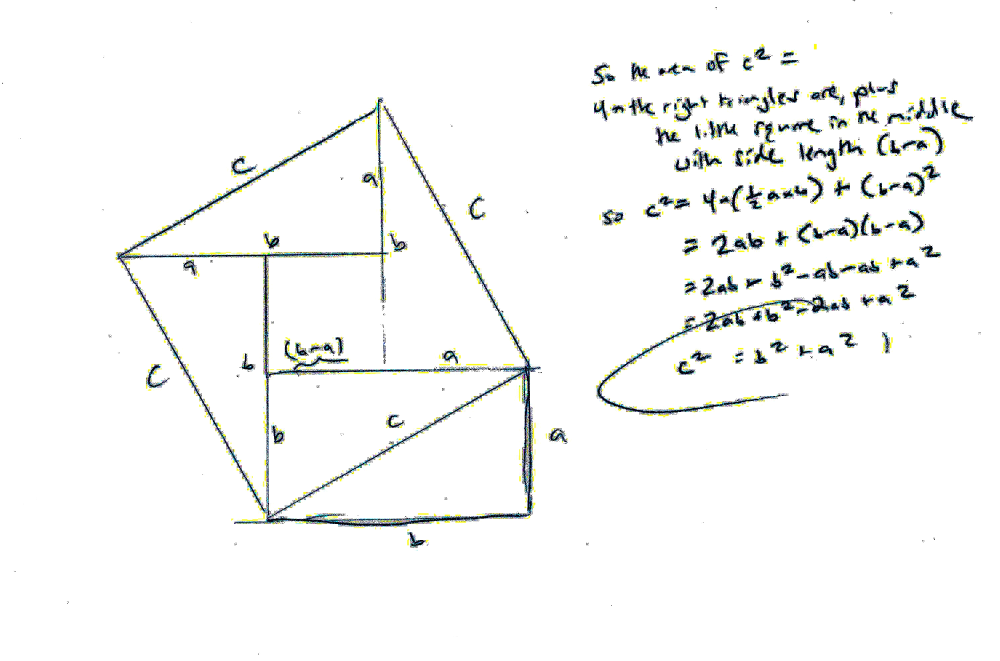
This is a bit like something I did when I was in the Education Department at FSP West during my involuntary vacation with the Florida DOC.  I was helping inmates try to get their GEDs, which was rewarding work given the circumstances.  But at one point it occurred to me that I didn’t think I’d ever seen the Pythagorean Theorem proven*.  So, I set out to prove it for myself, just for a laugh.  It looked something like this:

pytho

I didn’t use any of the standard, purely geometrical proofs that one often sees, but instead applied a combination of geometry and algebra that I kind of fiddled together on the spot.  I don’t know if what I did was perfectly rigorous; probably not.  Nevertheless, after I’d worked things through and simplified my algebra and indeed came out with c2 = b2 + a2, I was more convinced than ever before that the Pythagorean Theorem was not merely a well-supported hypothesis, but was indeed a theorem, and that given Euclidean geometry and so on, it was absolutely true.

All this is frivolous, or trivial, or whatever the term you might want to apply.  It certainly has little bearing on my day to day life.  But it is reassuring to think that, contrary to popular belief, it is possible to have new insights into fundamental ideas and things, however basic they might be, even at an older age (in my forties and fifties in these cases).  The human brain does not stop “growing” or improving after one reaches one’s twenties or thirties or after one has left one’s teens (or at least, whatever kind of brain I have doesn’t stop).  Even old dogs can be taught new tricks; and how much more amenable to teaching are naked house apes!

I’ve often been frustrated when people complain that they learned things like the Pythagorean Theorem in high school (or whenever) and had never had to use them at any point in their lives.  That may well be true in a simple sense, though I think the usefulness of that theorem might surprise people (it appears often in the workings of advanced physics, for instance, including in the Lorentz transformations in Special Relativity, and also in calculating the probabilities of outcomes from the magnitudes of the wave equation when makings measurements of a quantum system).

But ultimately, I feel like asking such complainers, “Do you do push-ups in order to become better at doing push-ups?  Do you do bench presses and squats to become competitive squatters and pressers of benches?  Do you jog to become professional joggers?  Do you do yoga to become a champion yogi?  No, the vast majority of people who do such things do them to make themselves fitter overall, stronger, with better endurance and flexibility, to be better able to do the many things in the world for which it will be an advantage for them to improve their strength and their flexibility and their endurance, and to be healthier overall!”

So it is with exercise of the mind, except the mind is far more plastic, far more able to be improved and trained, than the structures and strengths of the muscles and bones and ligaments and cardiovascular system.  Learning some of the methods of geometry and algebra and calculus, learning basic physics, including Newtonian physics and thermodynamics, learning some Boolean logic, some probability and statistics, some basic biology and chemistry…all these things are both inherently useful, and also give you skills and tools and abilities that are adaptable to hitherto unguessed situations and problems in the world, and give you insight into how much commonality there is to the structure of reality.

Understanding a bit about Chaos and Complexity theory can help you recognize why the specifics of the weather are fundamentally unpredictable but nevertheless the climate can be amendable to explanation and broad prediction.  Understanding a bit about Bayesian reasoning can give you the comfort of knowing that, even if you have a positive mammogram, and that test has an 80% sensitivity, you probably have nothing like an 80% chance of having cancer.  Indeed, you could be an order of magnitude or so less likely than that, depending on base rates and false positive rates and the like.

And in a somewhat orthogonal area of inquiry, if you want to understand something about the human condition, it wouldn’t hurt to expose yourself to the works of Shakespeare, who wrote about that subject as well as or better than practically anyone else ever has, and who did it in remarkable and beautiful language, coining figures of speech we in the “Anglosphere” still use, regularly, in daily life, four hundred years after he created them.

Also, if you live your whole life without ever having read book one of Paradise Lost, I think you will have sadly missed out on a great experience.  It’s not really a very long read.  Milton made his Satan a relatable and charismatic, almost heroic, character, and seeing how he did this can help you understand the power and persuasion demagogues and ideologues can bring to bear in the world, and how dangerous and yet enticing they can be.  Also, Milton’s writing is just beautiful, sometimes better even than Shakespeare.

And in To His Coy Mistress, Andrew Marvell prefigures the works of Billy Joel’s Only the Good Die Young by over 300 years.  And I’m pretty sure Pink Floyd referenced the work in Time.

Anyway, that’s what I did this morning to distract myself from an upset stomach, showing that these pursuits and skills can have wildly unpredictable uses.  So, until and unless you have actual organic illness that prevents your brain from learning, you can still grow, and can take more and more of the universe into your mind.  And, as Milton’s big bad himself said, “What is else not to be overcome?”


*It probably was at some point in my education, but I didn’t recall the proof, so it had clearly never really sunk in for me.  I didn’t doubt the theorem—all the greatest mathematical minds of antiquity and modernity were convinced of it, and it has always worked in practice.  But that’s not quite the same thing.

“People have this power–the numbers don’t decide”

It’s Saturday again, as I warned everyone would happen if we didn’t do something to stop it.  Unfortunately, no one appears to have listened, so, well…here we are again.

Of course, as I also warned you all, I am working today, and so, here I am writing another blog post, just like all the others.

Except it’s not quite exactly the same as all the others.  And, given the 1000 or so words per blog post, and the number of possible words there are available, even avoiding random jumbles of characters, the number of possible blog posts that I could write is probably far greater than the number of potential days I have left in any plausible human lifetime…or any plausible universal lifetime short of infinity, probably.

Let’s do some quick and dirty math.

I’m going to estimate very roughly, because I only have vague (but educated) intuitions, but let’s assume I start any given blog post with a choice from a list of maybe twenty words.  That seems like a decent ballpark figure.  After that, there are only a limited number of potential next words that would make any sense and that I might be inclined to use.  I’m going to cull that down to 10 options per each next word, and I’m going to ignore individual word probabilities and predominances relative to other words.  I’m also going to ignore the fact that I often write more than 1000 words per post.  We’re just being quick and dirty here.

So, with 20 first words, then ten to choose from for each next word, if we assumed more or less random sorting among those, we’d have a potential number of blog posts of roughly 20 x 10 to the 999th power, or 2 x 101000 possible blog posts.  That’s a staggering number of possible posts, each just a thousand words long.

How staggering is it?  Well, the famous number “googol”, is 10100 (ten to the hundredth power, or 10 times 10 times 10…repeated a hundred times).  It can be written as a 1 followed by 100 zeroes.  That number itself is roughly 10 to the 19th times as large as the number of baryons in the entire visible universe.  In other words, that’s ten billion billion times as many.  That’s more than a billion times the number of people alive on Earth now times the number of baryons in the universe.

But that’s just a googol.  A googol is so small compared to 2 x 101000 that if you subtracted a googol from 2 x 101000 the change would be so unnoticeably small that to notice it, one would require a precision far beyond the most precise measurement humans have ever made.  We’re talking about one part in about 10 to the 900th power.  That’s rounding off!

The best we’ve done as far as comparing experiment and theory goes is the magnetic moment of an electron‒or maybe it’s the fine structure constant, I’ll have to check on that (no, it’s the electron one).  That has been measured to agree with theory out to about the 12th decimal place, if I remember correctly.  As Feynman has said, that’s like measuring the distance between NYC and LA to the precision of the width of a human hair (which is far more precise than would in any case be useful or even applicable for such a distance measurement).

Anyway, the point I’m making is that the number of possible blog posts that can be a thousand words long with a few‒admittedly somewhat overgenerous‒constraints is staggering.  If I could write a blog post every Planck time for the rest of the life of the sun* I wouldn’t even make a dent, not a noticeable scratch or scuff in that number.  And you can’t really do more than one quantum event in any given Planck time, if I understand correctly, anyway.

So, I’m not going to run out of possible blog posts any time soon.  Even though I’ve probably overestimated the number of words I’m likely to use following any given previous word‒and I haven’t weighted the odds as would some GPT-like language model that creates text without thinking, based on huge numbers of things other people have written‒it’s still such a huge number that it’s too large really even to contemplate seriously.

And yet, time after weary time, I write blog posts about very similar things, such as my pain and my depression and the fact that I could really use some help from someone.  It’s very boring, I guess.  I apologize.  If you’re looking to diverge very much, I guess my blog might not be the ideal place for you.  But, of course, the huge majority of all possible blogs that would fit my above-listed criteria would be gibberish**, so we don’t want to get too caught up in those numbers.

It’s a bit like thinking about the human genome.  There are, I think, on the order of a billion base pairs in the human genome, and each “slot” has 4 potential nucleotide “letters” (adenine, guanine, cytosine, and thymine) so the number of possible genomes is about 4 to the billionth power, or 2 to the 2 billionth power…and every 210 is roughly 103 (210 being 1024),and 21000 is about 10300 so 2 to the billionth is about…1027,000,000, if my calculations are correct.  I’m not sure they are, but you get the idea.  It’s a big f*cking number!

Most of these orders of base pairs would not designate a human, nor even anything that could live at all.  So let’s whittle things down in truly draconian fashion and say only 10 to the 90th are potentially viable***.  That’s still far more potential humans than the number of baryons in the visible universe.

I think you can see that we’re never actually going to instantiate that number of humans, since each human is made of a substantial number of baryons…it’s something like 1027, but that’s just a ballpark figure****.  So, unless we find a way to generate a lot of new baryons, and fit them into the visible universe without causing the whole thing to collapse upon itself due to gravitational effects, the whole of actual humanity will always be a sea of unimaginably untapped potential.

I think we all kind of knew that, anyway, didn’t we?

Likewise, the number of actual blog posts I‒or anyone else‒will ever write before the heat death of the universe (assuming that’s the way things end) is embarrassingly negligible.  But we work with what we have.

And speaking of that, I guess I’d better mentally prepare myself for work, since I am already on the train.  I hope you all have a good weekend.  Whatever you do, it will probably be more interesting than anything I’m going to do.  Believe it or not, I find some consolation in that fact.


*It’s about 1060 Planck times:  1043 Planck times per second times 60 seconds per minute times 60 minutes per hour times 24 hours per day times 365.25 days per year times about 5 billion years.

**I mean even more so than my actual blog posts are.

***Don’t make the mistake of thinking that’s a reduction by 26,999,910/27,000,000. It’s way more of a reduction than that.  Don’t be fooled by the comparatively small numbers in exponents.  We’re taking a number that was 27 million digits long and making it only ninety digits long.  If you subtracted the second number from the first, it would be such a small change you’d have to look out well past the 26 millionth digit even to see a difference.

****Again, don’t be confused by the relative closeness of the exponents and worry that we’ll run out of baryons soon.  10 to the 27th is vanishingly small compared to 10 to the 81st.  In fact, curiously, 1027 x 1027 x 1027 = 1081.  Every single gram of hydrogen contains 6 x 10²² atoms, and obviously the number of grams of hydrogen in the universe is waaaaaaaaaaaaaay bigger than that!

The man that hath no music in himself…is fit for treasons, stratagems and blogs

galileo math

some of Galileo’s figuring

Good morning, all.  It’s Thursday, so—as per usual—it’s time for another weekly blog post.  Here we go!

I’ve had a mildly underproductive editing week, because last Friday, Saturday, and then this Monday, I got wrapped up in completing my latest song, Come Back Again.  If you’re interested, you can listen to it on YouTube, here on my website, or on my Facebook page.  It’s also posted in audio-only format on Iterations of Zero.  If anyone wants, I could send you an mp3 copy; that seems vanishingly unlikely, though.  The only people who seem to listen to my songs are immediate family members and similarly unfortunate, obligated people.  I do think the song is surprisingly decent, considering I did it using only two electric guitars (not at the same time), two smartphone rhythm apps (sampled and altered in various ways), a very cheap desktop keyboard, an actual desktop with smartphone for some of the percussion, and the amazing free audio editing software Audacity.  Oh, and of course, a microphone and voice recording program for the singing.  I suppose you could add pens and paper for writing the words and music.  All in all, not much was needed.

It’s curious that, in order to publish my songs effectively, I need to make “videos” of them, even though the visuals only consist of the icon from my Iterations of Zero website.  I don’t even use the icon from this site, because that’s just my face, and I can’t imagine anyone wanting to look at my face long enough to listen to a song.

It’s interesting, though, that one can readily upload videos to Facebook (and Twitter, I think), but they don’t easily let you share simple audio files.  As a stereotypical standup comedian might say, “What’s that all about?”  It’s a little odd that everyone wants to upload videos and pictures ad infinitum to sites like Facebook and Instagram—as they presume, without any discernable justification, that other people want to look at them—but not audio.  Yet the latter can be appreciated even while commuting, even while driving, as the wonder of audiobooks and podcasts (and radio) demonstrates.

Perhaps I’m just a curmudgeon*, but I feel that most videos shared by ordinary people, and often even by professionals, are just talking faces with nonspecific backgrounds relating matters that could be communicated purely by voice (or—God forbid—the written word!).

Anyway, my song is out there.  As I’ve said before, making and releasing these songs really is a vanity project for me, not just in the egotistical sense of the word, but also in the sense of it being in vain…pointless.  The latter sense of the term applies to me far more often than does the former.  Though I have a reasonably good opinion of my ability to perform tasks of various kinds, and to master subjects with a fair amount of depth, I am not vain in the narcissistic sense about much.  I have no illusions about the importance of anything I do or make or its value to anyone else.  Mostly, I’m just a proverbial Voice Crying Out in the Wilderness ™**.  Or, to be a little less pretentious, I’m a case of “I am, I said,” with not even furniture taking note of the declaration.

Nevertheless, since Tuesday I have returned to my usual schedule of working on Unanimity.  I’ve encountered an interesting place where the way I wrote the book has shifted character times slightly…meaning I had to go back in time from events of an immediately preceding section to catch up with what was happening to other characters.  This is common, of course, since we can’t skip back and forth sentence by sentence to see that one character is doing in “real time” while something is happening to another.

But I think I’m going to have to adjust it.  I think the story will flow better if I take the section in question and transplant it to just before the immediately preceding section.  This is a minor enough change, and I think most authors probably do it often, but it’s interesting to me because I don’t think I’ve ever needed to do it before.  Usually when I write something, it comes out pretty much as the story is “meant” to flow.  Unfortunately, Unanimity is just such a long novel, with so much going on, often to characters in separate locations, that it wasn’t all going to come out quite in optimal order on the first draft.  Not to say it wouldn’t be tolerable in its current form—it would be—but it wouldn’t be ideal, from my point of view.

That’s all probably not interesting to anyone else but me.

Meanwhile, speaking of audio (I was, you can go back and check), I’m “currently” listening to a wonderful book called Infinite Powers:  How Calculus Reveals the Secrets of the Universe.  I highly recommend it.  Seriously.  Even if you’re not a math type person (though I have to admit that I am one, a bit), I think it will give you easy-to-understand but clear and real insights into not just why calculus—and mathematics in general—is so useful to nearly everything of substance in science and technology*** but also why it’s so breathtakingly beautiful that some people are utterly captivated by it and pursue it hour after hour, year after year, even in their spare time.

Galileo famously said that the book of nature is written in the language of mathematics.  And someone else said (I can’t find the credit for the quote), “Physicists defer only to mathematicians, and mathematicians defer only to God.”  We can imagine universes where the charge and mass of an electron are different than they are here, or where coupling constants and the cosmological constant and the ratio of the strength of the gravitational to the electromagnetic force are different—and we can readily imagine life forms whose genetic data isn’t encoded in DNA…but it’s impossible to conceive of a logically consistent universe in which the square root of two is the ratio of two integers, or in which there is a largest prime number.

Maybe God defers to mathematicians.  Or maybe He just is one.

And with that bit of casual blasphemy, I think I’ve done enough damage for this week.  I hope you’re all well, and that you’re enjoying listening to, reading, watching, and doing whatever it is that—when integrated under the curve of your lifespan—makes your existence as joyful and fulfilling as possible.

TTFN


*There’s no “perhaps” about me being a curmudgeon; the “perhaps” refers to whether I’m merely a curmudgeon, or if there’s more to me than that.  The jury is still out.

**Actually, I’m quite sure that’s not from the book of Proverbs; I think it’s from Isaiah or Ezekiel.  Let me check…
…yes, it’s from Isaiah.

***Which, in the modern world, means pretty much everything, full stop.