The undiscovered country from whose blog no traveler returns

Hello and good morning and all the rest of that stupid bullshit.

I’m writing a blog post today—obviously—which means I’m going in to the office today, which means that, unfortunately, I am still alive.  I cannot give you any good reasons for these facts.  They simply are the case.

There are explanations, of course, as there are for all things, but they entail nothing more than the mindless churning of physical and, at the next level biological, and, at the next level psychological forces that happen more or less on their own.  They carry a certain metaphorical inertia; to divert them requires a deliberate application of some manner of force.  But since they are not literal, straightforward cases of inertia, it’s not always easy to tell just what the proper application of what “forces” should be to cause them to change their direction into one which one might prefer.

I’m at the train station now, waiting for the 2nd train of the day.  I had a terrible day yesterday, pain-wise.  It let up ever-so-slightly in the afternoon to evening, thanks to lots of Aspirin and Tylenol and Icy-Hot and all that stuff, but it still felt as though I had recently tried to do some fairly serious acrobatics without stretching and had not only failed, but had fallen hard on barely-padded ground.  I still feel stiff and sore.  Also, the bases of my thumbs ache severely; for that reason, among others, I’m typing this on my laptop computer rather than my cell phone.

I don’t have much else to report, and I certainly have nothing positive to relay to you.  As my pain eased slightly yesterday, my mood improved slightly, but it was never very good, and it’s now nearly as low as it was yesterday morning.

I’m also a bit nauseated.  That’s probably partly because of the excessive use of analgesics over the last 24 hours, even beyond my ordinary intake.

I really feel horrible, and I don’t know what to do.  I feel no sense of any future other than one of stress and pain and further alienation, or alternatively, of being a burden to people I have no right to bother.  I wish, I wish I had the strength of will just to stop eating and waste away until I die.  That wouldn’t be so bad.  After a while without food, once one gets into deep ketosis, there is little or no real pain, just lassitude.  And I have lassitude anyway, so I don’t think it would be all that much worse.

But it’s very difficult just to say “no” to food when it is available; billions of years of evolution has sifted things so that not eating when food is available is quite difficult.  I’m probably going to have to find some other way.

I’ve looked into things like hemlock—it seems like it might be nice and “classical” to go the way of Socrates—but although some descriptions of his death involve acceptance and serenity and the like, it seems they are highly fictionalized, which should come as no surprise.  Apparently, actual death caused by hemlock poisoning is quite uncomfortable, and associated with nausea and cramping and neurological symptoms of various kinds that might lead one to seek “help”.

Likewise, unripe ackee fruit—which grows in abundance around the house in which I live—is associated with quite uncomfortable symptoms and is not even close to universally fatal.  And again, the urge to try to relieve one’s symptoms might lead to one aborting the whole project.

Of course, asphyxiation via inhaling pure nitrogen or pure helium (for instance) is actually quite benign, since it is not associated with any feeling of suffocation—especially if one has a non-rebreather mask, so one does not retain carbon dioxide, which is the actual source of the feeling of not being able to breathe, and is indeed the primary driver of respiration.  I have two non-rebreather masks, and tubing, and even a regulator valve, but though I ordered helium tanks, I couldn’t figure out how to hook up the party-type helium tank output valve with the tubing and respirator mask—so I let people use the helium for balloons.

Also, one really needs a decent space and privacy for something like that, and one needs to make sure one’s mask doesn’t slip as one loses consciousness.  If that happens, one could live but have hypoxemic brain injury.

I’ve looked into ordering nitrogen tanks, but you can’t just get them delivered already filled; you have to go to some welding supply place or similar to get the nitrogen, and it’s hard to cart a nitrogen tank around when one does not have a vehicle.  There are similar problems with liquid nitrogen.  You can order a crucible (or whatever the term is) in which to carry it from Amazon (as you can the gas tanks) but to get the liquid you need to go to restaurant supply places or medical supply places or similar.  And, again, it’s hard to carry such things around without a vehicle.

Of course, there’s always simple use of blades—the proverbial bare bodkin—but though I am not afraid of cutting myself, to cause life-threatening bleeding thereby is not easy, and it is also supremely messy, leaving behind a horrible spectacle for some poor slob to find.  It’s likewise not entirely reliable and requires privacy.  I could lay down in my shower with water running and do it, but then my “housemates” and the landlord would eventually have to deal with the situation—at the latest by the time I started smelling—and that would be inconsiderate and traumatic.

When I think of the people I’ve known in recent years who have died of overdoses of narcotics—usually heroin—I again find myself wishing I had a drug problem.  But I don’t like opiates, though I was prescribed them for a few years for my chronic pain.  They didn’t work as well as I would hope, and the side-effects were annoying and unpleasant.  Of course, a goodly dose of an opiate plus a goodly dose of a benzodiazepine has a goodly chance of shutting down one’s respiratory drive, but as with asphyxiation above, that can sometimes just lead to brain damage.

My brain is dysfunctional enough.

A good fall from a high building (or mountain or cliff or bridge) is pretty reliable, of course, if one can muster the courage to throw oneself off.  However, there aren’t very many buildings or similar near me that are aesthetically high enough, and I don’t really have access to any of them, anyway.  Also, again, it leads to one making a mess for innocent passersby, and I would rather not do that.

There’s always the prospect of just swimming out into the Atlantic, which is truly close at hand, until exhaustion leads inevitably to drowning.  There’s not much mess that way, and most of what there is might be cleaned up by ocean life.  If I were more comfortable in the water, that might be a good option, and I still do consider it.  But it requires real determination, and I am not all that strong a swimmer.  I mean, I’m a good enough swimmer to swim out far enough to drown, but there’s enough stupid animal fear built into this operating system that I worry I wouldn’t be able to force my way through it.

I really don’t know what to do, or what I should do.  I’m still brainstorming ideas.  Meanwhile, I’ve really got loads of physical pain…but the psychological pain is worse.  The former wears down and eradicates one’s resistance to the latter, and the latter makes it difficult to keep a useful attitude about the former.  And I have so much trouble sleeping.  I’m really very tired all the time.

TTFN

standing on ledge newer

Universal heat death will be cold, but today it’s too hot and yet too air conditioned, and life hurts

     I don’t quite clearly remember all that I wrote in my blog post yesterday, and even the memory of the process of writing it has that slightly hazy feel of delirium, though I don’t think it literally applies.  Today I have to go to the office, because it is payroll day, and I’m already way behind on what I need to get done for that.  But I am still in a great deal of pain, even for me.

     I do remember deciding to indent my paragraphs by five spaces, as a kind of homage to the days of writing fiction‒though I used tab keys for that then, because I was using MS Word, not a smartphone.  I’m still indenting for this post.

     I’m getting on a very early train today so that I can get into the office in time to get some catch-up work done, and at a slow pace, because I still am in enough pain that my usual concentration is markedly diminished.  I don’t feel quite as delirious as I did yesterday‒I seem to have had some form of GI bug that made things worse‒but I’m far from my peak powers.  I still feel rather ill.  But I cannot simply take much time off.

     It’s oppressively hot and humid out.  Just standing still and waiting for the train caused me to be covered with sweat.  And then, getting on the train, I find the car is over-air conditioned, so it feels, at least for a moment, uncomfortably cool.  This is an interesting paradox of our climate control of our little, self-contained worlds: we control transient environments perhaps too much, and can never fully acclimate to the overarching external circumstances.  Admittedly, the weather being so hot and humid is quite uncomfortable, so I have a preference for some degree of climate control.  But it becomes a minor shock to the system when one leaves one environment for another.

     And, of course, the second law of thermodynamics (and the first) demands that the only way we can get it cooler inside is by putting more waste heat, and at higher entropy, into the outside world than we remove from the interior of, for instance, a train car.  No matter how efficient the system may be (and I doubt that it’s all that efficient) it cannot, in principle, be perfectly so.  This has been known for more than a century and a half.  Even the biological machinery that maintains a mammalian body within a narrow range of temperature, which is more efficient than any equivalent product of technology, still produces tremendous waste heat in highly disordered form, converting low-entropy energy into high entropy heat that cannot readily be used, eventually radiating into the surrounding cosmos, where it spreads out more with the expansion of spacetime, as all things head toward a predicted final fate of maximal entropy.

     Of course, on a universal scale, that process is going to take a very long time, so long that a human lifespan might as well be one of the fabled “virtual particles” of quantum field theory, popping into and out of existence before the universe can notice them‒though they can have effects.  I’ve written about this stuff before, I know, and won’t go into it again.  I’m sure if you searched either on this blog or on Iterations of Zero, you could find posts that discuss such things.

     As for me, I feel that my little, virtual existence is rapidly approaching its end.  Every day is painful, and that pain is not productive or useful; it certainly does not seem to make me stronger.  And, of course, I don’t really do anything for fun, I don’t do anything useful, I don’t make any arguable contribution that I can see.  I don’t think I’m even so much as a part of the quantum foam that has effects that can be felt in the reaction rates of elementary particles.  I’m just a virtual photon in intergalactic space.

     Though, I guess, I’ve had some effects already, since I have saved some lives and eased some suffering, and I’ve written several books and short stories, and most importantly, I have two wonderful children.  But my effects on them‒and certainly the impact of my fiction, and any past effects of my medical work‒are no longer happening. I hear from my daughter, but I have nothing of use to offer her, and I almost never hear from my son.

     I’m not doing much that has even a local, transient use anymore.  I certainly don’t think I’m having or sharing any insights or ideas that could honestly be useful to any of my readers.  And I no longer seem capable of making friends, nor of connecting with my prior friends, nor anything else along such lines.

     So, when I vanish back into the vacuum state of whatever quantum field I represent, there will be no real loss to anyone in the universe.  It would be nice to have family and friends around as one gets sicker and wastes away, but I don’t think I’ve earned any such thing.

     It is whatever it is, I guess.  I’m very tired, anyway.  And so much of what I am is pain, nowadays, without any counter-balancing joy.  At least I have done those bits of good in the past, for whatever they are worth.

     Anyway, I’m getting close to my stop.  I’m still a bit queasy, I’m sorry to say.  Or, well, I’m sorry to be able to say it truthfully.  It’s the fact, not the sharing of it, that troubles me.

     I hope you all have a good day, though.  Try not to air condition things too much‒it only serves to make the universe that much hotter that much sooner.  Ironically, so does heating things, by the way.

     Take care of yourselves and each other.  Spend time with your friends and families.  Be beneficent or at least neutral as much as you can.  And don’t worry too much.  In ten to the hundredth years, no one will remember all this, even in principle.

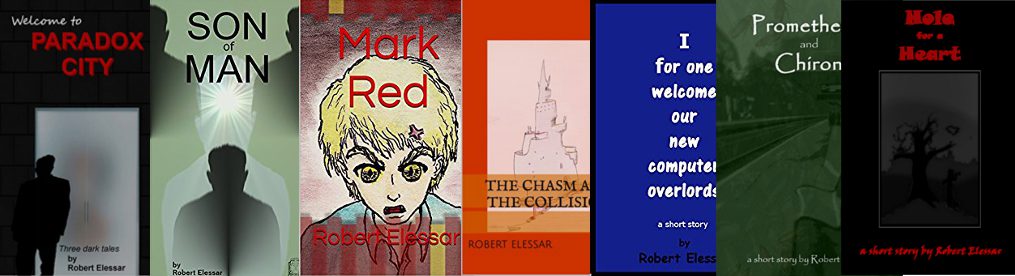
Author’s note for “Prometheus and Chiron”

pandccover

See on Amazon

Prometheus and Chiron is a more or less straightforward horror story, and its trigger was also straightforward—so straightforward that you might be able to guess it without me telling you, once you’ve read the story.  But I’ll tell you anyway.

One morning, in the waning months of the year, I was nearly alone on the train station platform, waiting for my usual train.  The sun had not yet risen, so it was still quite dark.  As I dithered about (most likely doing some writing or editing), I glanced across the track, and saw a woman standing very still beneath one of the electric lights on the other side.  I looked away for what seemed only a moment, though it could have been quite a bit longer, and when I looked back up, the woman was gone, as though she’d vanished into thin air.

A look down the platform soon revealed that she had simply walked to the other end, for undisclosed reasons of her own.  But her initial silent presence and subsequent seeming vanishment made me think about the possibility of a ghost haunting a railroad platform.  What might have led someone to die in, and then to haunt, such a place?  Under what conditions would such a ghost be visible?  What if it were a ghost that only a certain type of person could see?  This wouldn’t necessarily be a person with psychic abilities (as in my story If the Spirit Moves You, from Welcome to Paradox City) but a person who has certain characteristics, perhaps similar in some special way to the person whose ghost remains.

The story took shape pretty quickly from there.  I don’t recall how long it was before I started writing it, but by the time I did, all the elements were present.  I wanted to deal, of course, with the hellish experience of a spirit being trapped in one place, right where she had died, and the frightening fact of a living person finding himself able to see such a ghost.  But I also wanted to deal with the much realer hell that both of the characters in the story exemplify, one with which I’m familiar on many levels:  as a physician who has treated those with chronic pain and with addiction problems, as a sufferer of chronic pain due to back injury, and as someone who has seen friends and family die as a consequence of addiction.

The ghost-woman trapped at the station represents the classic, purely self-destructive individual that most people probably imagine when they think of drug addicts:  someone who, for whatever reasons, started taking drugs and got hooked on them.  I dealt with this tangentially in Ifowonco, but it’s central to Prometheus and Chiron.  This ghost is a woman whose life was ruined—and ended—by her abuse of narcotics.  Unfortunately for her, at the place she died, a supernatural force was present, one not merely destructive but actively malevolent.

Tommy, on the other hand—the protagonist—is a different breed of addiction victim.  He’s a former Marine, a hard worker, a basically upright citizen and good person, who worked in the construction industry.  Because of an accident on the job, he’s been left with chronic pain from low back and knee injuries.  He’s qualified for disability benefits, but as many people know, these can be woefully limited in the relief they provide.  To cover his cost of living, Tommy has to do at least some paying work now and then, but he has to hide that work from the authorities, so he doesn’t lose his benefits, and he has to treat his pain to be able to function at all.  Unfortunately, the only available medicines capable of dealing with significant chronic pain are opiates…and they come with a series of liabilities, including increasing levels of physical dependence—and the risk of psychological dependence—and consequent, agonizing withdrawal symptoms if one is suddenly deprived of them.  This is a terrible, no-win situation in which all too many well-intentioned people find themselves.

It’s this dependence on opiates, which he shares with the ghost-woman, that allows Tommy to see her, and that, combined with his good heart, makes him vulnerable to the danger he encounters.

The title of this story arrived after I’d almost completed the first draft, but it must have been percolating through my subconscious for some time.  It is, in a way, somewhat pretentious, but I couldn’t help myself; it seemed so appropriate.  It also risks, for those familiar with mythology, giving away the end of the story.  I recognized that possibility but decided that the risk was worth it.

Prometheus and Chiron is shorter than many of my short stories, and it’s fairly concentrated and direct.  Writing it was enjoyable—it almost always is—and more than a little bit cathartic.  It allowed me to express some of the personal horror I experienced while taking prescription pain medications for many years while at the same time suffering through the pain that made them necessary.  (It wouldn’t be too over-simplistic to say that those experiences were a large part of what led to the crashing and burning of my previous life.)

Writing Tommy’s character was a revelatory experience.  Knowing that he was going to be going through some very bad things indeed, I named him after someone I knew—not well, but well enough to know that I didn’t like him much.  However, as I wrote, I realized that my fictional Tommy was a far finer person than my impression of his namesake.  This led me to wonder if, just maybe, the real person had aspects to his character that were also quite admirable, if only on some small scale, and which I was being uncharitable in not recognizing.  I can’t give you an answer to that question, because I only knew the real Tommy briefly and haven’t seen or heard from him in a long time.  Maybe, though, if we all knew the inner workings of other people’s minds as well as we experience imaginary characters through the medium of fiction, we would find at least some sympathy for even the most unpleasant of people.  For me, at least, that’s probably a lesson worth considering.

Enough philosophizing.  Ultimately, Prometheus and Chiron was meant to be, and is, a fairly simple supernatural horror story, and I don’t expect or ask for anyone to care much about it on any other level.  I hope you enjoy it.