All my books and stories are available and would make excellent Christmas gifts for book lovers!

Hello and good morning.  It’s not Thursday today, of course, but I just thought of something that I wish I had thought of and posted yesterday instead of the rather rambling and negative post that I did create.

Although it’s probably too late for Hanukkah*, it should not be too late, if you have avid readers on your list of Christmas gift recipients, to order them a copy of one of my books, if you think they would be interested.  I have six titles available in paperback through Amazon, which I’ll summarize here:
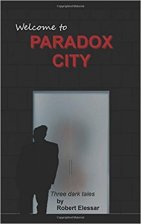
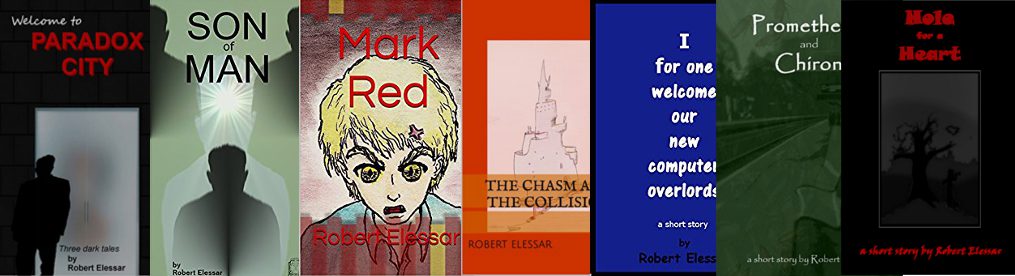
Welcome to Paradox City IconWelcome to Paradox City:  A collection of three dark “short”** stories, one of which is a light-hearted near-comedy and the other two of which are darker.  The first, The Death Sentence, is about a man who finds a previously unnoticed room in his public library, and in it discovers a bizarre but intriguing book containing illustrations and writing in languages he doesn’t know…but which also contains one particular line that can be at least pronounced, as it is written in Latin characters.  He only slowly discovers the secret of that sentence…and of the rest of the book itself.  The second story, If the Spirit Moves You, is about a man who suddenly discovers that he can see ghosts—or “the unquiet dead” as they prefer to be called—and that he may well be the only one who can, and who can help them make contact with the modern world.  The third story, Paradox City, involves a man who enters a popular but rather peculiar nightclub, which bears the name of the story’s title.  Though the entertainment is good, and the service is excellent, and he meets and falls for a charming young woman who is equally taken with him, this is a club in which peculiar, impossible, sometimes paradoxical, and ultimately horrifying things can happen…and if you make the wrong decision, you might get stuck there forever.

Mark Red Cover

Mark Red:  Mark Reed, the title character (obviously), is a teenager who spots an attempted mugging and rape.  He tries to intercede to help the woman, but her assailant stabs him, giving him a mortal wound.  However, it turns out that the mugger’s target was a vampire, who deliberately put herself in the situation to prey on the criminal.  She makes short work of her assailant, but then has only one way to save Mark, which she feels compelled to do because he got hurt trying to help her.  She gives him some of her blood to replace what he’s lost, turning him into a demi-vampire—with a combination of the aspects of humans and vampires, the nature of which state he learns over time.  The vampire, Morgan, determines to stay with and protect Mark from his own urges for blood until such time as she can find out how to cure him, for as she explains, contrary to popular folklore, a full vampire can never die at all, even if they wish to.  And if Mark ever kills a human by drinking their blood, he will become a full, uncurable vampire, cursed with immortality.
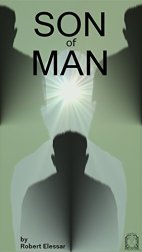
41lnfutijalSon of Man:  David McCarthy, a college student in Chicago, is going to the university library one morning when, without transition, he finds himself in a featureless cylindrical room.  The wall of the room opens, and two men—Anderson and Greer—eventually explain to him that he is now more than two hundred years in the future.  They tell him that only a few decades after the time from which he was taken, an apparent global thermonuclear war, now call the Conflagration, destroyed civilization and most of the people, but that the human race was saved by a “man” now known simply as The Father, who united humanity, willing or not, under his control and guidance, and rebuilt civilization, with his astonishingly advanced technology and inexplicable genius.  He also initiated the “domestication” of the human race, killing any person who initiates violence against others, and sterilizing their first-degree relatives.  Though grateful for the Father’s rescue of civilization, the two men, their friend Michael, and some others think that he has gone too far, and they enlist David to help them either convince the Father to abdicate or to find a way to remove him…choosing David for reasons that he at first cannot believe.  The Father has an enemy within his own mind—a mind that now spans the entire world—and that enemy wants to help them overthrow the Father.  He alters David in an inexplicable way and assist the group in their quest to achieve their goals.  But his motives are not certain, and he also reveals to them some secrets of the Father’s past and nature that horrify them, especially David.

CatC cover paperbackThe Chasm and the Collision:  Alex Hinton and his friend Simon come home from middle-school one day and find that Alex’s mother has, apparently, left a newly purchased and unrecognized—but delightful-smelling—bunch of berries in the fruit bowl in the house.  Alex tries the fruit and discovers that it tastes even better than it smells, and he shares it with Simon and with a girl name Meghan, on whom Alex has a crush.  Soon, Alex and the other two begin seeing and hearing seemingly impossible and sometimes terrifying things, which no one else perceives, and they begin developing new, amazing abilities.  They also find a strange apparent “space warp” in the wall of the dining room of Alex’s house.  Eventually, they are accosted, captured, and brought back to what turns out to be a piece of another world—Osmeer—which is the counterpart to Earth, but in a universe that lies adjacent to ours in higher-dimensional space.  They learn that some process has set the universes on a collision course, and that if they collide, the impact will wipe out everything in both universes in a new Big Bang.  A great genius of Osmeer has created what is called The Chasm—a way of taking part of Osmeer out of its world and positioning it between the two universes to hold them apart, at least temporarily.  Within the Chasm, that part of Osmeer has permanently sunset-colored skies, and time flows there roughly thirty times faster than in the original universes.  The pre-teens learn that in the other universe, not only are there intelligent “dinosaur dogs” called tixuns with advanced sense of smell, who work with humans, but also intelligent, furry “mole-weasel” creatures called orcterlolets, that can tunnel and build by manipulating the fabric of space itself.  Most amazingly, they learn that all the plants of that world are conscious, and can communicate with each other telepathically, as well as with gifted humans and tixuns called Gardeners.  The man who created the Chasm has also helped breed and create a special tree, called Wynestrith, whose purpose is to save both universes by returning them to their proper places.  Alex, Meghan, and Simon have unwittingly become embroiled in that quest, and they learn that there is a cult, and a Prophet, and a much darker and more terrible Other, an Ill Will, that wants the collision to happen, and that only the three friends, working with Wynestrith, will be able to prevent the collision, and the destruction of two universes.  But they will have to survive to do so, and also—hopefully—they will be able to succeed without their parents and teachers finding out they were ever gone.***

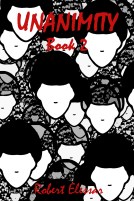
Unanimity Book 1 simple Cover ProjectUnanimity Book 2 simple Cover ProjectUnanimity Book 1 and Unanimity Book 2:  Charley Banks is a pleasant young university student, majoring in English, with a long-term girlfriend he loves very much, nice parents, and a positive outlook on life.  He takes part in a seemingly harmless neuroscience experiment, testing a new form of external magnetic cortical stimulator, innovated by one of the school’s professors.  After the test, though, in the follow-up MRI, he has a severe grand mal seizure.  When he wakes up in the hospital, he discovers, to his amazement and delight, that when he touches other people, if he focuses on the curious sensation that now happens at the point of contact, he can merge with their minds, taking over their nervous systems, replacing their consciousness with his own, but with access to all they know and are.  At first the union only lasts while he’s touching them, but soon this ability grows, and he is able to maintain his presence in others even after separating.  He then becomes able to control more than one person at a time, and then becomes able to extend himself further using bodies he already controls, all while still controlling his normal, original body.  He keeps this gift secret even from his girlfriend (at first), and as the power grows, he decides to use it to correct some perceived and real injustices done to people he cares about.  But his methods are extreme and horrifying, and it becomes clear over time that his mind has been altered in other ways than simply giving him his new abilities.  This becomes still more dangerous when he discovers the astonishing effects of having a person die while he’s controlling them.  His power, and his willingness to use it, seems to grow without obvious limit, and even after a few other people, including his girlfriend, learn of his ability, and of his altered character, its unclear what, if anything, can be done to prevent Charley from someday encompassing the entire human race.

All of these titles are also available in Kindle format, including Son of Man, for which I somehow failed to link the paperback and the Kindle versions.

I also have several “short” stories that are only available in Kindle format for now, though I plan to collect them into a paperback edition along with a new novella soon.  Most of them are available through Kindle Unlimited if you’re a member, and anyway, they’re less than a buck apiece if you buy them.  I won’t go into too much detail; instead, I’ll copy the blurb from each listing on Amazon.  My short stories tend to be rather dark, and most of them would count as horror (not “Ifowonco” or Penal Colony, though).  They include:

“I for one welcome our new computer overlords”:  Peter Lunsford, a lonely, book-loving, self-educated and self-destructive salesman, has an abrupt and radical change of fortune.  His subsequent actions lead a genius named Darrell White, enabled and inspired by Peter’s choices, to create the world’s first artificial intelligence.  Unfortunately, this happens at a time when humanity has devastated itself with global war and is unprepared to accept the existence of these new and superior minds.  These facts will combine to create a future that Peter would not have had the courage to expect, and the implications of which are impossible to foresee.

Prometheus and Chiron:  Tommy—a former Marine, a part-time construction worker, dependent on opiates for the treatment of chronic pain—is waiting for the train home one evening, when he sees a strange, shivering, ill-appearing woman seated on a bench across the track from him.  Her presence fills him with dread and revulsion, for no reason he can understand.  Even after a month passes, she remains seated in the same place, always visibly suffering.  No one else at the station ever seems to see her at all.  But Tommy sees her, and even dreams about her.  And she sees him.

Hole for a Heart:  While driving through central Pennsylvania on a road trip from New Jersey to Chicago, Jonathan Lama spies a peculiar pairing on top of an approaching hill:  A huge pecan tree, next to which lurks an out-of-place scarecrow.  Intrigued, and craving a break in his long drive, he pulls off the highway and goes into the nearby gas station.  There, he hears the story of a man named Joshua Caesar, a person of possibly supernatural evil, who terrorized the region almost seventy years before, and was finally brought to rough justice by his neighbors in retaliation for his crimes.  Local legend holds that the figure of the scarecrow is Joshua Caesar’s body—not changing, not decaying, staked out next to the highway for nearly seventy years.  Jon is entertained but of course does not believe the tale.  Then his car suddenly refuses to start, and while he waits for a tow-truck to arrive, stranger things begin to happen…things which lead him to doubt his sanity, and to wonder if, just maybe, the legends of Joshua Caesar’s unchanging scarecrow corpse are actually real.

Solitaire:  (This is my oldest—and darkest—published short story.  It’s not for the faint of heart.)  It’s the early nineteen-nineties, and Jerry, a successful advertising executive, is having a breakdown.  He’s done too much shading of the truth, and he’s watched too much Headline News, and he can no longer make sense of the world.  Now, sitting at the breakfast table, he contemplates the possible future for himself and his family while dealing out a hand of solitaire…

Penal Colony:  While heading for his car after a night out celebrating the closing of a big deal at work, Paul Taylor meets a strange, despondent man, poorly dressed for the cold, who seems horribly depressed by some personal setback.  Still slightly drunk on both alcohol and success, Paul invites the man for a cup of coffee and some food at a nearby all-night diner.  There, this peculiar man tells Paul of a conspiracy begun by the creators of various social and virtual media companies…and of technology that allowed these conspirators to control the minds of the people of the world for their own personal enrichment.  He tells of the overthrow of that conspiracy by a group of which he had been part…a group which had then turned on and “exiled” him.  Though the man’s story is engaging, and the man himself is personally convincing, Paul is forced to admit that he has heard of no such conspiracy or overthrow.  The man finally explains to Paul why he hasn’t heard of it.  It’s an answer that Paul cannot believe…until the man proves it.

Free Range Meat:  Would you try to help a dog locked inside a car on a hot, sunny day?  Brian certainly would.  As an environmentally conscious “near-vegan,” he loves all the creatures of the world—even humans, most of the time—and he does his best to help them whenever he can.  So, when he hears the obvious sound of a dog trapped in a black SUV on the hottest day of the year, he commits himself to helping it get out if its owner doesn’t arrive within a few minutes.  But isn’t that an unusually dark SUV?  Even the windows are so tinted that Brian can’t see inside.  And don’t those barks and whimpers sound just a little…off?  What breed of dog makes sounds like that?  These are troubling questions, and as Brian will learn, sometimes even the noblest of intentions can lead one to places one might do better to avoid.

That’s everything (so far).  None of it is, perhaps, traditional Christmas fare, though CatC is a fantasy/sci-fi adventure whose heroes are middle-schoolers, so its arguably a holiday-worthy story.  But a book, like a puppy****, is not just for Christmas.  Most people can’t read one of my books in one day, in any case.  And to a book lover, there is rarely any better gift that can be given than a new book.

(I would advertise my songs here as well, but they definitely aren’t holiday-type ditties.)

Happy Holidays!


*Except for Kindle books, of course.

**I use scare quotes because though not truly novellas, they are quite long for short stories, especially Paradox City, which gives the book its title.

***This is my most “family-friendly” book.

****Which is also very good cold on Boxing Day.
For they blog truth, that blog their words in pain

Hello and good morning.  It’s Thursday again, and so—as required by the dark ritual, which is designed to summon the Great Old Ones and bring about the end of mankind’s dominion over the realm that rightly belongs to Cthulhu*—it’s time for another of my weekly blog posts.

I can’t say that there’s much new happening around here in the past week.  As you know, last week was Thanksgiving in the US, so I wrote an early blog post that was nonetheless released on the appropriate day, thanks to the wonders of computer technology.  It was not a terribly exciting holiday for me.  I just loafed around in my room, played some video golf, went to 7-11 for some snacks and lunch, and loafed around some more.  I don’t remember specifically giving thanks, but I suppose there must have been some general thankfulness there somewhere, as I expressed in last week’s post.  I can at least honestly say that no turkeys were harmed in the making of my Thanksgiving celebrations.

The Vagabond is still proceeding well.  I’m within 20 pages of the end of the latest run-through, and it’s getting a bit better each time, which is good, since that’s the whole point.  It’s soooooo** much faster to get through than Unanimity was.  Not that I don’t love Unanimity.  I do love it, very much, and I’m quite proud of it.  I like the characters in it a lot, which is not unusual; I almost always like my characters, even the bad guys.  But it is a long book, and editing it was laborious.

It occurred to me yesterday, though—and with a bit of irony, since they’re bit players at most—that in Unanimity, I particularly like Charley’s parents.  They seem like people you’d like to know in real life.  They’re not my favorite characters in the story; I’m not sure quite who my favorite would be.  Possibly Michael; he’s the one with the most attributes of my own personality, though he has them in a much more pleasant form than they occur in my real self.  But Charley’s parents are fun people.

In unrelated news, not even tangential to what I’ve been discussing so far, but which I can’t help but think about:  I’ve been developing some inflammation/strain in the proximal portion of my left forearm, near the origin of some of the hand flexor muscles and tendons.  I know why it’s happening.  I’ve been working on the guitar part for the Beatles song Julia (it’s actually the only instrumental part of the song) and that involves fingerpicking a long series of changing chords, many of which are barre chords.  I’ve practiced to the point where my hand no longer wants to cramp before the end of the song, and I’ve duly impressed myself (which isn’t too hard) but apparently the repetitive strain continues to take its toll.  I’d better finish learning the song and record myself doing it so I can feel that it’s finished and move on, since NSAIDs don’t seem to be helping much.  Do any of you know whether there would be benefit in using a spandex elbow-forearm “brace”?  My medical background suggests that it might be useful, but not with a high degree of confidence.

As far as the infectious disease front goes, I remain Covid-free***, though not everyone in my office is so lucky.  This makes an already slow time of year a bit slower, which in some way makes my job easier, and in other ways makes it harder, and overall makes it gloomier.  This was particularly trying yesterday, when we had a surprising cold snap for south Florida.  I’m sure that people up north would not be impressed, but the temperature dropped by almost thirty degrees in twenty-four hours, and it usually doesn’t get that chilly, even in passing, until January or February.

Oh well.  Subtropical world problems, I suppose.  You may find it funny, and you’re welcome to enjoy the schadenfreude.  It’s already warming back up, in any case, and at least the rainy season is more or less over, as is hurricane season.

That’s about all I have for now, though I’m sure I could find tangents down which to become lost if I chose to let it happen.  But I’ll spare you that indulgence and keep things short this week.  I hope you all continue to have the best possible days and weeks and months and years and other intervals of time that you can possibly have.  At the very least, try to stay safe and healthy.

TTFN

Resized_20190620_162430


*Though, to be honest, in my view—and I imagine that Cthulhu would agree—if one of the Elder Gods can’t just claim the realm on his own, he frankly doesn’t deserve to have it.

**That should be read with a long “o” sound, not with an “oooh” sound like a ghost.  In case you didn’t know.

***Which seems like it could be an excellent bogus marketing claim to put on product packages to lure in thoughtlessly health conscious people, as when one sees “gluten free” on products that of course are gluten free…like plain corn chips or plain potato chips.  I half expect to see motor oil advertised as gluten free and GMO free.  Which it is.

My conscience hath a thousand several blogs, and every blog brings in a several tale

Hello, good morning, and welcome to another of my weekly blog posts.  It is not Thursday morning as I write this, but it will be Thursday (or later) when you read it.  I’m writing it a day early, to be published on the usual day, since this Thursday is a major holiday where I live.

Given that, I would like to wish Happy Thanksgiving to all those in the US who are reading this, and to everyone else, a happy day in general.  It can feel as though there’s much not to be thankful for right now, but I’m sure that, in the modern world, we still have many reasons to feel fortunate—certainly those of us with the luxury of reading and writing blogs.

Positivity isn’t my strong point, as my regular readers may know, but it is worth remembering that we take for granted a tremendous number of incredible advances that our forebears even a generation past could not have imagined.  If you go back a century, to the time of the 1918-ish flu pandemic, it’s sobering to realize that they didn’t have antibiotics to treat the numerous bacterial infections that often complicate influenza, let alone ventilators, oxygen monitors, corticosteroids, or molecular biology to be able to discern the nature of the disease-causing agent.  Indeed, DNA itself was decades away from being described, so the tools for understanding and treating a highly contagious and dangerous viral illness were far weaker than they are today.  Vaccinations had been invented, but they were in crude form, and the science of understanding, let alone designing them, was in its infancy.

And the internet, of course, or anything like it, was not even a dream of science fiction yet.

So, if we work at it—and I say again, it’s not my strong point—we can find things about which to feel truly thankful.

On to other, lighter matters.  I did a rather unusual experiment recently, one about which I have mixed feelings.  I’d be thankful (!) for any feedback you might think appropriate.  As those of use who use Amazon know, when you’ve purchased something, Amazon often sends an email asking if you’d be willing to rate and review what you bought.  I think this is a useful service, but it can become onerous at times, so I don’t review nearly everything I purchase, even books that I read and enjoy.

I received a request to rate a jacket I’d just purchased.  It was the same brand I’d bought a few years ago, and my old one was getting a bit raggedy with use, so I ordered a new one (in a different color—black, of course).  I decided that I really should give a review, since I’d used the product and liked it enough to buy it again.

Well, as you may also know, once you’ve reviewed one item, the Amazon page asks you if you want to rate and review other items you’ve purchased—you know, while you’re in the mood and all.  And at the top of the list was my own creation, Unanimity Book 1, for which I’d already received more than one request for reviews.  I bought copies of the book for the people at my office I thought might enjoy it, and then another one for someone who asked me later for a copy, so the review requests were recurrent, as tends to happen with all of my books.

I’ve occasionally been tempted to write a comical, self-serving review that makes it obvious that I’m the author to anyone reading, but I’ve never done it before.  It was my understanding that Amazon doesn’t allow people who have a fiduciary interest in a product to provide reviews for it.  I respect that policy, as I understood it.  But they kept asking, and asking, and asking…and I’m not made of stone (except perhaps for my heart).  Finally, on a whim, I wrote a brief review, starting off by revealing that I am the author of the book, and I rated it five stars.  This is not, of course, an unbiased rating, but it is at least an honest one, in that I really do think it’s worthy of that rank to me, not least because of the effort involved in writing it and the characters, whom I like very much.  I wasn’t really expecting the review to go up.  I figured Amazon’s automatic checkers or whatever they might be would block it and send me a kind but firm email stating that they can’t publish reviews from people involved financially in a product.  Well, only Amazon itself is more financially involved in my books than I am.  But at least so far, the review is there, which is amusing to me, at least, but I do feel the need to repeat my disclaimers about it and the rating.

To be honest, if I’d thought it was really going to work, the book I’d feel least conflicted about reviewing would be The Chasm and the Collision, which is certainly my most wholesome, family-friendly story, written specifically with my children in mind at the time*.  I’m quite proud of the world-building I did in it, which includes telepathic plants, mole-weasel creatures called orcterlolets who can directly manipulate the local shape of space itself, flying manta-ray like monstrosities called gowstrin, a bit of bastardized M-theory describing universes floating next to each other in “the bulk” and in danger of colliding, and three middle-schoolers who inadvertently get caught up in the emergency attempt to prevent that collision, which would destroy everything in our universe as well as the one of Osmeer.  And, of course, as I say in the jacket blurb, our heroes must try to help prevent this cosmic catastrophe while not getting in trouble for being late for school.

Yeah, I don’t feel any qualms about recommending that book to pretty much anyone.  My sister has read it more than once, and the last time she did, she actually thanked me for writing it.  That was pretty huge.

The Vagabond, of course, being a horror story, is far from as family-friendly as CatC, but it is coming along nicely, and it is fast-paced, and a far more in-your-face horror story than, say, Unanimity.  The horror in the latter is complicated, partly psychological, partly existential, involving the threat of the complete loss of free will, autonomy, self-awareness, etc., without anyone even knowing of the threat, let alone being able to do anything about it.  At least with a traditional, moustache-twirling, evil incarnate type villain, you know what you’re up against and can make a stand.  When the villain is one of the people you love most in the world, who doesn’t even think that he’s doing anything bad, and about the threat from whom you know only because he told happily you, things are a little dicier**.  At least, I think so.

But The Vagabond will probably be more straightforward fun for most people, and it is certainly shorter.  Still, if you read only one of my books, I would recommend The Chasm and the Collision, without knowing more about your preferences and tastes and whatnots.

With that, I think I’ll draw this prematurely written blog post to a close.  I do, honestly, hope that all of you who are in the US have as good a Thanksgiving as possible, while doing everything you can to keep yourselves and those you love safe and healthy.  Hopefully, you can console yourself by imagining the November blow-out that will come once we have this latest virus*** under better control.  “So tighten your belts, and think with hope of the tables of Elrond’s house!”

TTFN

Thanksgiving (2)


*I don’t think either of them has read it, or any of my other books, though each book is dedicated to them.  They don’t want to have much to do with me since the time I was invited to be a guest of the State of Florida for three years…in fact, my son won’t interact with me at all, though my daughter does stay in contact, and shares news of her various adventures.

**I think that’s a neologism.  Certainly, MSWord doesn’t recognize it.

***And our various politicians and the political processes itself.

And thus the native blog of resolution is sicklied o’er with the pale cast of thought

Hello and good morning.  Welcome to another Thursday, and—as I always point out, rather unnecessarily—to another edition of my weekly blog.

For those of you living in countries that celebrate some equivalent or descendant of Armistice Day (in the US, it’s Veteran’s Day), I hope you had a pleasant yesterday, enjoying a holiday that was originally intended to commemorate the final resolution of World War I and a return to relative peace.  Though I have great respect for all those who have fought to protect freedom, as is sometimes ruefully necessary, and I certainly think they deserve to be treated far better than they are—at least in the US—it’s good that we celebrate the fact that these brave ones, at least, the living veterans, were able to come out of the other end of their wars alive and somewhat intact.

The weather in south Florida has continued to be abysmal, what with the recent, slow-moving tropical storm.  Unfortunately, even without such cyclonic phenomena, south Florida can be so damp and rainy that it’s almost unbearable.  I’m also suffering from the clock change that happened just a bit more than a week ago, which brings aggressively forward the months of seemingly endless night, with the sun setting yet another hour earlier in the already nocturnally dominated Fall and Winter.  I don’t look forward to the latter part of December, as I’m prone to Seasonal Affective Disorder.  Of course, those who know me might well wonder in what way my seasonally affected affect effect is in any way different from my usual personality.  It’s a valid question, and I can only reply that it makes my underlying dysthymic and depressive tendencies more difficult to ignore and resist.  I try.  But often I fail.

Anyway, enough of that for the moment.  Work on The Vagabond continues and is productive.  I think it’s already a better book than it was before, stylistically.  I haven’t changed the story at all, and I don’t intend to alter it in any noticeable way.  This is not to say that it’s a perfect story; I’m not even sure what would constitute such a thing.  Still, I think it’s a good supernatural horror novel.  It has action, suspense, danger, a good number of scary parts, a bit of romance, and some fun characters, including a truly malevolent villain.  This is all, of course, my own judgment, and I am inescapably biased, but I still think I’m correct.  I hope you’ll all take a chance and decide for yourselves, when the time comes.  I think it is something to which you can honestly look forward, if horror novels are your cup of tea.

I’m still running up against internal and external metaphorical walls with respect to making content for Iterations of Zero.  I’m not giving up on it, but it’s frustrating, because I don’t want to take time away from fiction to do it.  Writing fiction is something I do by simply starting every day with the work—though currently that’s editing, not primary writing—as soon as I get to the office.  Coming up with a story idea is fairly easy.  I accomplish the rest by committing to write at least a page every day, when I’m not editing, and then go from there.  Almost inevitably, once I get started, I end up writing quite a lot more, and usually it’s time itself that calls a halt to the work.

“It’s the job that’s never started as takes longest to finish,” as Sam Gamgee’s old Gaffer always said; the converse is that, once you begin a job, it can sometimes be hard to stop.  There appears to be a kind of metaphorical inertia, which is why it’s such a good thing simply to set the schedule and commit to writing whether one happens to “feel like it” or not.  When I think of what I could have accomplished if I had taken that approach when I wrote The Vagabond, I sometimes want to weep.  That novel is only about 160,000 words long, but it took me more than ten years to finish it*.  In comparison, I completed two longer novels and a short story that was almost a novella** over the course of just under three years by working every day during the hour or so after the lights came on at FSP West.  While I don’t recommend that location and environment to anyone, it still just goes to show what you can do by saying to yourself, “To hell with inspiration, just work.”  Trust me, FSP was (and still is, I presume) not a place of inspiration, though tragically, it is sometimes a place of forced expiration.  (It could also, during “lockdowns”, sometimes be a place of barely contained urination, when we were forced to stay on our cots face-down for hours on end at times.)

On that pleasant note, I think I’ll call it good for today.  As usual, I wrote more than I thought I would—again, all it took was forcing myself to get started, and just to do it, and then matters moved forward almost on their own.

I hope you all have a good week, and month, and year, and so on.  Please stay safe and healthy.

TTFN

Do it


*To be fair to myself, I was doing other things—college, post-bacc courses, teaching, medical school, residency, etc.—during that time.  Nevertheless, I could have written so much more had I just committed to doing it.  A big part of my problem was procrastination born of neurotic perfectionism, in which the perfect becomes the arch-enemy of the good, or even of the “good enough”, in a way that is far more horrible than any fictional villain ever could be.  I’m sure many of you can relate.

By way of advice, with respect to this, all I can say is that the best thing you can do is to give up completely on the idea of “perfection”, or even “greatness”.  The terms aren’t even well defined; you’ll always be able to poke holes in yourself and your work, no matter how much effort you put into it.  I feel confident that no work of fiction or nonfiction has ever been perfect.  Some have been and are considered “great”, but that judgment is reserved for their posterity, and as far as I know, it is never universally agreed upon.  Just do it, as Nike and Palpatine counsel, trying to keep improving incrementally as you go along.  Practice will tend to make you better—that’s just how nervous systems seem to work—though it will never make you “perfect”.  If you just keep growing a tiny bit all the time, and keep doing what you’re doing, before you even realize it, you can become and accomplish amazing things.

You will never be “perfect”, but in many ways that’s a blessing.  After all, if there is no highest point to reach, there’s nothing to stop you from continuing to climb higher and higher without limit.  Surely that’s preferable to perfection.  It’s certainly more interesting.

**Mark Red, The Chasm and the Collision, and Paradox City.

For a blog of powerful trouble, like a hell-broth boil and bubble.

Good morning, all.  It’s Thursday again, as so often seems to happen right after Wednesday, and so—whether you would wish it or not—it’s time for another edition of my weekly blog post.

Before I say anything else, I want to let you know that I have finally written a new post for Iterations of Zero, which I titled “Some Universes Even Go Both Ways”.  It’s a slightly fanciful, broad, and quite non-rigorous “thought experiment” about whether there’s any reason the Big Bang (specifically involving inflationary cosmology in my ponderings, though that’s not a requirement for the point I made) wouldn’t happen in both directions in time.  If you like that kind of thing, please feel free to read it.  It was fun to write, though I don’t know how well that predicts how much fun it will be to read.

I’m currently enjoying a book called The End of Everything (Astrophysically Speaking) by Katie Mack*, and just this morning, while reading along, I learned that there’s a relatively new version of the “ekpyrotic universe” proposal that has some things in common with the ideas from my blog post, including universes that face toward or away from each other in time.  Mack doesn’t go into much detail about the hypothesis, but it comes from real, serious, working physicists, so it’s sure to be much more well-thought-out than my little indulgence.  Such coincidences do, at least, make one feel moderately clever, since serious people are exploring ideas that are not entirely unlike something one thought of on one’s own.  Don’t go looking for me on the short list for the Nobel Prize in Physics anytime soon, though**.

Of course, I’ve dealt with other fairly high-level physics concepts in a couple of my novels, including The Chasm and the Collision—which imports crude concepts from M Theory—and Son of Man in which I introduce the idea of using particles that travel through complex time as a way of precisely scanning events that happened in the past without upsetting those particles (I first encountered the notion of complex time in A Brief History of Time, which is still a great book, even if some of its speculations have been ruled out).  I also threw in a bit of repulsive gravity, engineered through the creation of a highly uniform quantum field to create negative pressure (I used it to make floating buses, of all things) in Son of Man.  But of course, these ideas are just plot devices for me, and neither book could honestly be considered “hard” science fiction.  Still, neither one involves anything technically supernatural, even though I call CatC a fantasy adventure story.

The Vagabond, on the other hand, does involve the supernatural, it being a supernatural horror story, and the process of editing it is going along pretty well, especially now that I’m done with my latest “bad cover”.  I’m almost finished with my second run-through of the book; I’ve continued to need to tweak things to adjust for contradictions in the flow of the original story as written.  These mostly deal with times and days of the week, which I evidently didn’t give much attention when I was writing the novel (probably because I wrote it over such a long and intermittent period of time, myself).  I certainly didn’t give them the attention I should have.  It’s still a fun story, though, and I’m smoothing out the rough edges as I go along.

Speaking of the “supernatural”, as in contrast to science fiction, I may have said before that I think all so-called supernatural notions in any story’s universe must, in fact, entail a kind of science.  If what we call the supernatural actually exists in some fictional universe, then it is a part of that universe’s nature, and so is not supernatural at all.  It must follow rules and have consistent, non-contradictory characteristics.  If magic followed no rules, then no character would ever be able to use it.  I’d love to be able to talk to Albus Dumbledore about “magic theory” in the Harry Potter universe, since I’m quite sure that he understands as much of it as anyone does.  I’ve always felt a bit disappointed that there weren’t any magic-theory classes at Hogwarts.  Maybe even NEWT students just aren’t ready for it, and they only begin such studies in university.

Are there universities of magic in the Harry Potter universe, as there are regular schools of magic such as Hogwarts?  I imagine there would have to be.  I guess only J. K. Rowling knows for sure…or perhaps even she knows not.  We certainly never read about anyone’s post-graduation education in the books; no one talks about having advanced degrees in Potions or the like.  Maybe I’m asking too much from what were, after all, meant to be kids’ books***.

Anyway, with that rather incoherent bunch of random thoughts, I think I’m nearly done.  Halloween is coming up this Saturday, but it’s going to be a disappointing one, I fear, despite the full moon.  I haven’t written any new stories for the holiday, but I think Prometheus and Chiron, Free Range Meat, and especially Hole for a Heart would make appropriate short stories for your Samhain celebrations, as would the stories in Welcome to Paradox City.  Of course, Unanimity Book 1 and Book 2 are appropriate reading for Halloween at some level, though it’s not really a typical Halloweeny horror story.  Maybe Mark Red, being about a vampire and a demi-vampire, would fit the holiday better.

For me, though, there’s too much real horror—though it’s more depressing than frightening—at the political, cultural, epidemiological, and intellectual level to be able to enjoy celebrating imaginary ghosts and goblins much.  Also, there’s just no one with whom I could really celebrate it.  Maybe I’ll watch a horror movie to take my mind off the much greater, and yet drearier, horror that is reality, from the human to the cosmic to the quantum scale.

Unfortunately, I’m trying to avoid candy.  Sigh.

Well, that’s okay.  I hope any and all of you who are going to be celebrating enjoy yourselves to fullest extent allowed by human and physical law.  At least it’ll be a good day for wearing masks.  Please stay safe and healthy.

TTFN

9734_1044064641361_1817998561_91048_2300407_n


*This was probably the trigger for the thoughts that led me to write the blog post.

**Or for Literature, frankly, which is arguably my central area of focus.  And my ideas relating to Peace, unfortunately, tend to involve the severe reduction of the number of humans in the world, occasionally flirting with a target of zero.  Given the state of human affairs—especially politics—I don’t feel too bad about entertaining such thoughts.  I have a notion that a curve describing the average IQ of the human race might steadily rise as the population lowers, until, just below zero, it reaches some maximum, or perhaps even shoots toward a limit of infinity.  But then, of course, we hit a singularity at zero.  Actually, well before that, the curve becomes nonsensical, since you can’t have fractions of people (as far as I can tell).

***I don’t think I am, nor do I think Rowling would disagree with me—kids can handle far more than “adults” think they can, and often more than “adults” themselves can handle, since they tend not yet to have stifled their creative imaginations.  I suspect that magic theory and university-level education for witches and wizards just didn’t really have anything to do with the story Rowling was telling, so she never brought them up.

I blog of dreams, which are the children of an idle brain, begot of nothing but vain fantasy

Good morning and hello everyone.  I hope you’re all doing well.  It’s Thursday, as you know, and so it’s time for another weekly edition of my blog.  This being the second Thursday of the month, it would have been an edition of “My Heroes Have Always Been Villains,” had I been able to keep that feature going*.

Work has continued on The Vagabond quite nicely; I finished the first run-through early this week, which served to familiarize me once again with my book that I wrote so long ago.  It sometimes feels like a very long time ago, and I guess it was…between twenty and thirty years, or more than half my life.  Weirdly, though—since it has been quite a while, and in some ways, it seems like ages—when reading it, I have to admit that it also seems quite fresh and recent.  I feel very much just the same person as I was when I wrote the novel, which is almost ridiculous considering how many things have happened to me since then**.  I suppose this is just one of the peculiarities of human consciousness…or at least of my own consciousness, which may or may not be considered human, depending upon whom you ask.

I think I wrote last time about how a woman in my office asked about my books for her son.  Well, as promised, I got the boy a copy of The Chasm and the Collision, and I got a copy of Unanimity Book 1 for her (definitely not for him).  She told me a few days ago that her son had been reading CatC and enjoying it and had reached chapter 4 already.  Because of that, I decided I’d read that chapter myself again, just to know exactly where he was.  It’s okay for me to skip ahead; I already know what happened.

Well, I’m pleased to say that I really enjoyed it, and on and off I’ve been reading further***.  As I’ve said before, it’s my most family-friendly book, having been written about three middle-school students, and being therefore written for middle school students, as well as for “children of all ages” as they say.  That’s not to say it’s a childish or light-hearted book; there are some rather scary and dark portions, and it’s not short, except when compared to Unanimity.  It’s nominally a fantasy adventure, and without dark and dangerous forces, such stories don’t work at all.  My sister, who is older than I am and reads even more, says it’s her favorite of my books, and that the main character, Alex, is her favorite of my characters.  I might have mentioned that last week.  Apologies for redundancy.

I say it’s “nominally” a fantasy adventure because it could be more literally described as a science fiction story.  There’s nothing “magical” in it, and even the “travel to other worlds” aspect uses concepts that I cobbled from M Theory, as I understand it from my layperson’s perspective, drawn from the popular works of Brian Greene, Lisa Randall, Stephen Hawking, and the like.  Don’t worry, I don’t get much into that—I don’t know enough of it to do so even if I wanted to—but it does give me an arguably plausible way to bring in other universes and the spaces between them, and the possibility that the Big Bang was caused by two “branes” colliding with each other…and that such a collision might happen again.  (The word “brane” never appears in the story, however.)

Anyway, don’t worry about all that.  It’s a highly speculative science fiction story that really has the character of a youth fantasy adventure.  It even contains some environmentalist ideas, though they are by no means in your face.  I know, right?  A book by me, displaying any kind of conscience?  What’s the world coming to?  But again, you don’t have to worry about all that.  It’s a fantasy adventure about three middle-school students who get caught up in an inter-universal crisis and must do their best to help avert cosmic catastrophe while not getting in trouble for missing school.  I’m proud of it, and I can pretty much recommend it to anyone without reservation.  It doesn’t contain even a single instance of profanity!  I do encourage you to read it if you like that sort of thing.

Speaking of that, I would like humbly to request that, for those of you who have read my stories and books, could you perhaps take a moment to go to Amazon and rate and/or review them?  I considered doing it myself, as a kind of joke—making it clear that I was the author writing the review—but that seemed just too cheesy, and I don’t think Amazon lets authors do that, anyway.  I’m fairly sure they block reviews from people who have a financial interest in a book, which seems impressively and surprisingly ethical of them.  I can’t help but approve.

Finally, I’m thinking about releasing another of my songs as an official “single” to be put up on Spotify, YouTube Music, iTunes, Pandora, etc., like Like and Share, Schrödinger’s Head, and Catechism, but I only have two more original songs so far that could be so released:  Breaking Me Down and Come Back Again.  I’ve linked to their “videos”, so if any of you want to have a listen and give me your recommendations—even if that includes a recommendation never to allow human ears to hear the songs again for the sake of all that’s good and pure—I’ll gladly take your input.  I won’t necessarily follow it, but I would love to have it.

With that, I’ll leave you again for this week.  I’ve still not been able to kick-start myself into doing more with Iterations of Zero, though I have drafts of a few things.  Keep your eyes open, if you’re interested.  And, honestly, do consider reading The Chasm and the Collision.  Heck, if you can figure out how to work it out, I’ll gladly autograph a copy for you, for what that’s worth.  Most importantly, continue to take good care of yourselves and your family, friends, and neighbors, and stay safe and healthy.

TTFN

CatC cover paperback


*No, I haven’t gotten over it yet.  Maybe I’ll try to do one of them a year or something, perhaps around Halloween.

**Including, but not limited to, medical school, residency, moving to Florida, having kids, acquiring a severe back injury and chronic nerve pain, getting divorced, spending time as an involuntary guest of the Florida DOC and as a consequence being unable to practice medicine or vote among them…all sorts of interesting things that make for a most stormy life so far.

***Interspersed with reading Why We Sleep, by Matthew Walker, PhD.  This is a very good and, I think, very important book.  I encourage you to read it.

My soul’s imaginary sight presents thy shadow to my sightless blog, which, like a jewel hung in ghastly night, makes black night beauteous

Hello, good morning, and welcome to another Thursday and to another edition of my weekly blog post.  Welcome also to a new month (October, obviously), the first day of what has always been—for various reasons—my favorite month.  A major contributor to that favoritism is that, at the end of October comes Halloween, which is my favorite holiday.  It’s also the beginning—in northern parts of the northern hemisphere, anyway—of the real onset of Autumn, with leaves changing colors and becoming heart-rendingly beautiful as they prepare to drop off the trees before Winter sets in.  Such magical Autumn visions have come to feel almost like the memories of fever dreams for me as I spend an ever-growing fraction of my life in southern Florida, the state referred to by Homer Simpson as America’s dong*.  There is no real Autumn here, though at least the weather becomes slightly less hot and humid as the year wanes.  Autumn and Spring—and even Winter, frankly—are the best times to be in Florida.  How ironic that the season when most people come to visit is during the months of “summer vacation”, when heat, humidity, and near-daily thunderstorms are the norm.

Speaking of Autumn—because it, like my most recently published work, takes place in Autumn—things are moving along nicely in The Vagabond.  I’ve nearly finished my first read-through/edit of the book, making many minor modifications as I go along, and I’m approaching the final confrontation of the story.  It’s quite a lot quicker to read than Unanimity, being only about a third as long.  That’s not an insult to Unanimity or a special compliment to The Vagabond, by the way.  Each book is as long as it must be.  The Vagabond is a simpler, more straightforward story, though its events happen on something of a larger scale than those of Unanimity and have even more dire potential consequences if things end up badly.

A somewhat humorous event took place earlier this week.   A coworker saw a hard copy of Unanimity Book 2, and she said her son loves to read, so she wanted to get a copy for him.  I asked her how old her son was, and she replied that he was eleven.  Now, I enthusiastically encourage kids of all ages to read, and the earlier they start, the better, but…well, apart from the fact that it would be bewildering to start reading Unanimity Book 2 before reading Unanimity Book 1, I had to tell her very clearly (and repeatedly, since she didn’t seem quite to believe me) that this really isn’t a book for eleven-year-olds.  Very bad things happen in it—it’s a horror story, after all—and as I’ve said in other circumstances, the type of horror in it is a very human type.  It’s nothing easily dismissible, like monsters under beds, ghosts, zombies, vampires, and the like.  I told her I would get a copy of Book 1 for her to read, and that she should read it, thoroughly, before deciding if her son was ready for it, which I doubt he is.

Then, quite happily, and without reservation, I recommended (and ordered for her) The Chasm and the Collision, a book specifically for and about people of her son’s age or only slightly older**.  She also noticed the cover of Mark Red on the screen while I was ordering CatC, and said her son likes stories about vampires and the like.  I wasn’t sure about this one.  If he’s a truly precocious eleven-year-old, such as I was, he might indeed enjoy it without any trouble, but it has its moments of deeper darkness, and some “mature themes”.  When she asked the leading question, “There’s no swearing in it, is there?”  I had to answer that, yes, there was, though I don’t think it’s excessive.  Of all my stories, I think the only one without any profanity at all—I could be wrong about this***—is The Chasm and the Collision, which I specifically kept free from expletives, following the wise advice of my father.

Anyway, with some hesitation, I ordered her a copy of Mark Red also, worrying because, well, the story opens with an attempted mugging/rape.  It’s a crime that goes very badly for the mugger/rapist—after going very badly for Mark Reed when he tries to intercede, thus leading to the story—because the would-be victim happens to be a vampire, Morgan****, who deliberately lures in such assaults to take their perpetrators as her prey.  After that plunge in at the deep end, things become a little less unwholesome, but it’s quite a start for a story.

Maybe I should just attach a blanket “trigger warning” of some kind that applies to everything I write.  This is my mind.  It’s not a safe space.  Not even for me.  Enter at your own risk.

On that cheery note, I think I’ll call it quits here for the week.  I’m continuing to work toward reinvigorating Iterations of Zero, so hopefully I’ll have something to share there, soon.  No matter what, though, I hope you all enjoy this most wonderful time of the year that we are entering, despite all that’s happening in the world.  Do your best to stay safe and healthy, and remember, human events are transitory, ephemeral, evanescent, short-lived, and redundant.  Don’t take them too seriously.

TTFN

full-14

[This is an old, and not very good, concept drawing I did of the above-mentioned opening of Mark Red]

*If you’ll pardon the observation, taking that metaphor in hand—so to speak—it doesn’t have the look of a perky, young body part, but rather of a fairly limp, aged, and dispirited one, shrinking over time as sea-levels slowly rise.  This certainly fits with the human aspect of the state, though its natural beauty is beyond question.  I think “The Governor”, aka Skink, of Carl Hiaasen’s books, would agree with me.

**My sister concurs that this is a good recommendation, and she thinks the boy will enjoy it greatly.  It’s her favorite of my books, and its primary protagonist, Alex, is her favorite of my characters.  It’s hard for me to choose, but he’s certainly in the upper echelons of my preferences as well, and of course I am proud of the book.

***It occurs to me that I for one welcome our new computer overlords might not include any cursing.  That doesn’t make it a young kid’s story, of course, but it is rather pleasing for me to realize.  It’s simply a fact, after all, that I tend to write dark stories, and in dark situations, people often curse.  It’s no mere coincidence that Halloween is my favorite holiday.

****Morgan is probably my favorite character that I’ve written.  I just think she’s really cool.  I was absurdly delighted when Tony and Pepper named their daughter Morgan in Avengers: Endgame.  I even fantasized that they named her after my character.

O, let my books be then the eloquence and dumb presages of my speaking blog.

Good morning everyone!  It’s Thursday, and of course, that means that it’s time for another of my weekly blog posts.  This is the first post of Autumn this year (in the northern hemisphere, anyway).  It is also, I’m extremely pleased to note, the first blog post after the release of Book 2 of Unanimity, both in paperback and e-book form!

This very much feels like the end of an era for me—in a good way.  The process of writing and then editing and then publishing Unanimity has been a monumental undertaking, at least from my own small and narrow point of view.  I had no idea when I started the story that it would end up so large.  It certainly didn’t seem likely to become such a long tale.  The concept seemed fairly simple, at first glance…and at second, third, fourth, fifth, and further superficial glances.  But developing the occurrences and progression of the story ended up being quite a process, partly because—I think—it’s a specific plot notion that hasn’t been done before, at least not in quite the same way.  Perhaps I’m flattering myself.

In any case, I’m pleased with the result, and I’m pleased with the fact that it’s complete.  I don’t yet have my copy of the paperback in hand—it’s on its way—but I’m excited to have and hold it.  I was miffed when the problem of its length first made me need to split the book into two volumes, but on the other hand, Tolkien had to do that too, so I’m in good company.  At least it gave me the opportunity to design two slightly different covers, representing the increasing extent and penetration of Charley Banks’s power and “infestation” throughout the course of the story.

I’m afraid the official release date of Unanimity Book 2 on Amazon is September 21, 2020 instead of September 22, which was what I wanted…but in order for it to be available by September 22, I had to put it into the process on the 21st, because there’s always a delay…and indeed, I received the notification that it was, in fact, ready only on the morning of the 22nd.  So, it appeared to the public, as it were, on the first day of Autumn (in the north) and on Bilbo and Frodo’s birthday, which was what I wanted.

In the meantime, I decided to release—officially—my song Catechism, which is now available for your listening pleasure on Amazon, on Spotify, on YouTube/YouTube Music, and on oodles of other venues, most of which I’ve never used.  I posted a version of it on YouTube previously, and I think on one or both of my blogs, but this is the “official” version, from each play of which I get a modicum of royalties, so of course I encourage you to put it on your own favorite song playlists!  It has new, official “cover art” with which I’m reasonably happy, and which you can see below.  The song opens with some sound effects made by recording and then splitting, overlapping, stretching, and partly reversing various noises from the office in which I work.  I could dream up convincing explanations for how that all fits into the theme of the song, but honestly, I really just did it for fun.

As I announced I would last week (I think), I’ve continued to work on The Vagabond, rereading and editing as I go, improving the language and whatnot, and enjoying the story quite a bit.  Weirdly enough, it also takes place in a university, though the university in this case is plainly and rather blatantly an alternate-universe version of my own undergrad alma mater, which is not the case in Unanimity.  I suppose it makes sense that one writes about situations drawn from memorable times in one’s life, and of course, I started writing The Vagabond originally when I was in university.  You don’t have to have attended college to enjoy it, though.  Even more so than with Unanimity, the college and the town in The Vagabond are just the setting for a battle between universal good and evil.  It’s a much more straightforward story, with far less moral ambiguousness and ambivalence than is found in Unanimity.

I was so young and innocent then.

Really, though, it is a fun story, I think—but then, I would, wouldn’t I—and I’m looking forward to finishing its tweaking and editing and fixing up.  Then, at last, I’ll be able to return to and complete the story of poor Timothy Outlaw, which has also become longer than I would have imagined when I first came up with the story idea.  I think I sometimes get carried away, but whataya gonna do?  You can’t count on anyone else to write the stories you want the way you want them written, so if you want to read them—and to let other people read them—you’ve got to write them yourself, in your own way.  Ditto with music, I suppose, though with that it’s much more—for me—just enjoying the amazement of the fact that I can do it at all, rather like a dog that learns to read, write, and speak.  It’s not that he does it well, it’s that he does it that matters.  Which is not to say that I don’t think my songs are worth a listen—I think they are—but I would never claim to be as good a composer/songwriter/performer/producer as I am an author.

Opinions surely vary on all such things.  Heck, I think Hemingway is (slightly) overrated, though my father thought he was fantastic.  And although A Christmas Carol is a brilliant story, I couldn’t actually force my way though Oliver Twist despite my best efforts and the fact that I was familiar with the story.  This from someone who’s read The Silmarillion about a dozen times.  So, everything succumbs to taste at some level.

Except Shakespeare.  If you think you’re unfamiliar with Shakespeare, and you live in an English-speaking culture, you’re simply incorrect.  A significant fraction of the metaphors and sayings and expressions we still use on a regular basis come from Shakespeare, and a remarkable number of our words are first found in his works*.  His influence is something even the Beatles could only dream of (though perhaps, over the course of the next four centuries, they will achieve a comparable degree of long-lasting influence).

With that, as usual, I’ve written more than I expected to write again.  For me, at least, writing is easier than talking to people, so I guess it shouldn’t surprise anyone, least of all me.  All things in the universe follow the principle of least action (or so it seems), but sometimes “least action” can be a misleading term.  I think of it instead as the vector addition of all the various “forces” acting on us at any given moment, in some vast phase space of such forces, with a potentially limitless number of dimensions and parameters.  For all that, it’s still just head to tail addition of vectors, and we go where the net “force” pushes us.  Which, right now, in my case, is to make me finish this blog post.

TTFN

catechism cover


*This doesn’t mean he invented them; he may just have been the earliest one to use such words in a form that was recorded and endured.  After all, as David Mitchell has pointed out, Shakespeare had to have a pretty good idea that his audience would know what he was talking about, so he couldn’t have just made stuff up willy-nilly.

Write loyal cantons of contemned love and blog them loud even in the dead of night.

Hello and good day.  It’s Thursday morning, and so it’s time for another of my weekly blog posts—though I almost forgot about it and simply started editing Vagabond instead.  I guess that’s a good indicator of how dedicated to the editing I am, but it’s a little embarrassing.  Still, I suppose it’s not all that embarrassing, or I wouldn’t share it.  Or perhaps sharing the embarrassment is a way of diffusing and defusing it—after all, I can tell myself that if I’m not afraid to share it, it must not be all that bad or all that serious (which, of course, it’s not).

Enough self-psychoanalysis.  It’s been a reasonably productive week, and on Monday morning I came to a decision:  At least for now, I’m going to stick with editing Vagabond*, rather than working on Outlaw’s Mind.

I haven’t come to this decision lightly.  I simply noticed that, each morning, when I was starting on the new writing at the beginning of my schedule—knowing that I would, after about a thousand words, switch over to Vagabond—I was less enthusiastic about the new work, and frankly felt an unpleasant tension.  This was mainly because of time constraints, but also due to the division of focus.  Working on both projects at once makes both take longer than they would otherwise; it makes the whole process less efficient, as does essentially every form of multi-tasking.  It became clearer and clearer that, if I worked on both “at once”, they would both come out later than the likely finishing point of even the second of the two if I just worked on them one at a time.

Also, the mental shift from one story to the other was a minor daily lurch.  Though both could be considered horror stories, Outlaw’s Mind is a much subtler, more slow-growing, almost psychological horror—the presence of the word “mind” in the title might make that obvious—whereas Vagabond is pretty much a straight-up, gonzo horror story.  The former does have an element of the seemingly “supernatural” but it’s not obvious or in your face.  Whereas Vagabond is all about that supernatural intrusion of a force of evil upon the otherwise mundane world.

Also, though it’s true that I’ve put off Outlaw’s Mind due to the very long process of editing Unanimity, it’s certainly fair to say that Vagabond has been waiting much longer than Outlaw’s Mind.  It’s been waiting almost thirty years—possibly a bit more since it was first started.  So, The Vagabond has priority, at least for now, and I intend it to be my next published work**.  After that will follow Outlaw’s Mind, which I’ll need to figure out whether I can fit comfortably into the planned Dr. Elessar’s Cabinet of Curiosities, or if I’ll need to have it stand alone.  In any case, the Cabinet will likely have at least one “new” story no matter what, because I intend to recreate the remainder of my old short story House Guest, which is even older than Vagabond, and include it in the collection.  Don’t worry, that shouldn’t delay things much.  It truly and honestly is a short story, and making it any longer would be to its detriment.  So let it be written; so let it be done.

On other matters, I keep thinking about possible ways to work into my schedule the writing of at least a weekly post on Iterations of Zero.  There are many subjects about which I’d like to write—and IoZ is a blog that can be about anything and/or nothing—but which I feel don’t really match the tone of this, my author-oriented blog.  I’ve toyed with the notion of combining the two, but I fear the strange collision of other types of articles with the ones here, which are mainly about creative writing and related matters.  If you’re not sure what I mean, take a trip to IoZ and check out a few random things I’ve written there.  Then, if you wish, you can let me know your thoughts on whether they would be appropriate for this blog.

Of course, I can’t close without reminding you that Unanimity: Book 2 is coming out next Tuesday, September 22, 2020, and is available for pre-order in e-book format (for the print format, you’ll have to order once it’s out).  If you haven’t ordered Unanimity: Book 1 yet, there’s still time to get it and even to read it before Book 2 comes out, and of course, I encourage you to do so.  One reader of Book 1—who shall remain nameless until and unless I receive permission to share—told me that her mind was blown already by chapter 6 and 7.  And that’s before any of the real horror starts***!

Speaking of real horror, please everyone, stay safe and healthy out there.  And try to take advantage of the relative decrease in travel and interaction by getting some good reading in.  Written language is the lifeblood of civilization, and thankfully it can even be enjoyed when one is socially isolated.

TTFN

Unanimity Book 1 simple Cover Project


*Or The Vagabond as I think I’ll title it in the end, since there’s a revered manga series whose English title is Vagabond, and though there’s essentially no chance of confusion between the two, I hate knowingly repeating a title.  Also, all the characters in my story, once they know the antagonist’s chosen title, refer to him/it as “the Vagabond” and not simply “Vagabond” as though it were a given name.  This will be a bit of a wrench, since I’ve simply called the story Vagabond since I first started writing it, and single word titles can be dramatic.  Then again, the definite article does often convey a certain gravitas.  Also, I just published Unanimity, which is definitely—and inescapably—a one-word title.  Why do the same thing twice in a row?

**I’m planning on recreating a picture I drew a long time ago, portraying the title character standing by the road and thumbing a ride.  I loved that picture, and it’s a brilliant option for the cover, but I cannot for the life of me locate it in any of the old sources of my artwork (since all the physical drawings and paintings are lost and probably destroyed).  Perhaps I can find it in my ancient MySpace page, but I’m not optimistic.

***Though, to be fair, only barely.

Write till your ink be dry, and with your tears moist it again, and frame some feeling blog that may discover such integrity.

Good morning, everyone!  It’s Thursday, and it’s thus time once again for my weekly blog post.

I don’t have all that much that’s new to report, at least with respect to writing.  I’ve been continuing to work steadily on Outlaw’s Mind, producing about a thousand plus words per weekday, which means a little over four or five thousand words a week.  After completing my daily “quota” of new writing, I’ve been going over to Vagabond, or The Vagabond (I haven’t decided which title to choose, and I’d welcome reader input on the question).

It’s been quite a treat to reencounter scenes that I remember only when I come to them in the book.  For instance, there’s a particularly vivid nightmare sequence, set in a supernaturally nasty, gigantic underground sewer system, that surprised me with recognition when I arrived at it during my reading/editing this week.  I was particularly pleased to discover that it had been written rather well, at least from my own biased point of view.

In a different way, in can be just as enjoyable to find places where my original writing was a bit awkward, and to realize that I can fix those places handily now.  It shows me that—again, from my own point of view, at least—I’ve become a better writer over time.

It’s required an effort of will to keep from looking at and trying to complete the fragment I have of House Guest, a short story that helped win me a national award when I was a teenager, because I don’t want to distract myself from Outlaw’s Mind.  The latter is proceeding well, as I said, but it’s definitely growing to be a short novel, and I’m going to have to make a rather nail-biting decision—both practically and artistically—whether I want to include it in Dr. Elessar’s Cabinet of Curiosities or to let it stand alone.  It’s growth is, I think, a good thing, because I’ve found that there’s more to the life and character of young Timothy Outlaw than I would have expected from the simple seed that produced the story.  This was one of those little notions that popped into my head, and which I “jotted” down in my cell phone note-taking app for later.

It’s amazing that two short sentences can turn into a much longer story than expected, but then again, the story has become about much more than those two sentences ever implied.  I suppose that’s not terribly surprising.  One could summarize even the entire Harry Potter series in a few sentences, after all, if one were so inclined, but the story is so much more and so much deeper than such sentences could lead one to imagine.

I can’t lay claim to anything like J. K. Rowling’s ability, but I seem to be able to write as much as she does, keeping all other things such as needing to keep a “day job” in consideration.  It would certainly be wonderful if as many people in the world read and enjoyed my books as do hers, to say nothing of making a similar amount of money*.

Hopefully, if the internet and its progeny survive unabated into the future, that means that my stories will always be out there, somewhere—even if only as archaeological relics.  Once published, the stories have a life of their own, separate from their author, and not subject to his persistence; this may be a very durable form of life, as information independent of its particular substrate.

And with that peculiar reflection, I think I’ll call it good for today.  I really would love to have your input on the Vagabond title, and on “My Heroes Have Always Been Villains,” and on anything else that strikes you as worthy of comment.  Of course, I want to remind you that Unanimity Book 2 will be published on September 22, 2020, and that it’s already available for pre-order in e-book form.  And Unanimity Book 1, is already available.  You should have time to read it between now and when Book 2 comes out, if you’re a reasonably fast reader.

Do your best to stay safe, sane, and healthy out there.

TTFN

Unanimity Book 2 simple Cover Project


*Though that’s not terribly important to me.  I’m not saying I would turn it down or wouldn’t be delighted to have such an income, but obviously, it’s not for money that I write, nor for prestige, nor for any simple, short-term, tangible purpose.  I write because I love to make up stories and get them down in print and publish them so that other people can read them if they want, because I have always loved to read other people’s stories; it’s been one of the greatest and most reliable joys of my life.  But no matter how few or many people read my stories, I think I’ll always be my own number one fan, in the sense of enjoying reading and rereading my own books.  I’m not quite as bad a Number One Fan as Annie Wilkes, but I do have my yandere moments toward myself, if that makes any sense.