Crowns in my purse I have and blogs at home, and so am come abroad to see the world.

Hello and good morning.  It’s Thursday again—the last Thursday in March of 2022, and indeed, the last day of March in 2022.  Given those things, it must be time for my weekly blog post.  Actually, those latter two facts are irrelevant to it being time for my blog post; they are merely trivia.  But they give me something to say, at least, and “trivia” is not always trivial*.

I’ve not gotten much done on Outlaw’s Mind this week—none at all, in fact—partly because the story is making me feel kind of glum**.  I like Timothy Outlaw, as a person, and I feel bad about things that are happening and are going to happen to him, so it gives me a rather unpleasant feeling, since after all I am the one doing it.

But I didn’t want to stop writing, so I decided, more or less on a whim, at the beginning of the week, to start work on a project that’s been “waiting” even longer than Outlaw’s Mind:  My “light-hearted” fantasy adventure Dark Fairy and the Desperado.

432253_312039878911721_1234585539_n (1)

This is a story that took its earliest origin in two doodles I drew—well, okay, they weren’t doodles, they became legitimate cartoon drawings, really, and they were based on two real people.  One was based on a picture of me, dressed up as a western gunslinger type from when I had gone to visit Universal Studios (the one in California).  The other was based on the Halloween costume of a friend of mine that I had met and spoken to online.  Once I had the drawings, eventually I decided I wanted to think of a story involving the characters.

l_163a2f9a35aa0a844a164833bd571697

This is the first drawing of the Dark Fairy, looking pure and happy as she contemplates the fiery destruction of a human city. She has her reasons.

I had thought of making a manga about them, much as I had meant to do for Mark Red.  However, though I drew many pictures of them—some of which I will have included in this post—and of other characters they met in their travels, and I even drew and colored the first page of a potential manga, I eventually realized that I don’t have enough enthusiasm for making manga to get me to keep working on one.

avatarofdeath

This is NOT the first picture of the Desperado, which I haven’t been able to locate, but I like it.

As with Mark Red, I’ve long planned to write the story of the DFandD as a book, and so I took that as my distraction from Outlaw’s Mind for now.  I did, of course, post the next part of the latter story here on Tuesday, and will continue to do so until I reach the latest point so far, but I may otherwise take another hiatus from Timothy Outlaw.  I think I’ve done too much horror over and over for a while, and I need to write something that doesn’t involve quite as much fear and despair for the characters.

1432072772388

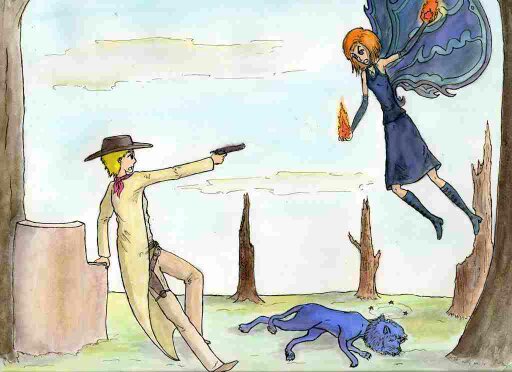
The first meeting of the Dark Fairy and the Desperado. It turns out better than it seems.

It being me who is writing, there will, of course, still be violent and even sometimes “horrific” elements—even the main characters are dangerous people, to say the least—but it will have a much more tongue-in-cheek attitude.  For instance, one of the people our protagonists encounter will be an extra-dimensional demi-god who calls herself Lucy; she is a huge fan of the Beatles, and she models herself and her universe on their songs.  I like her, and I’ve drawn some fun pictures of her, as well, with hints of kaleidoscope eyes and all.

In other news, I’ve been trying to get into shape for my planned, or hoped-for, “epic” quest, and I’ve come a long way, baby.  I’ve increased my walking time to over two hours nonstop, and I walked over six miles two days ago.  I’m taking the train today (as I did yesterday), which forces extra walking on me and gives me extra time to write while commuting.  I’m writing this on the train right now (though I’m unlikely to be on the train when you read it).  I’m also getting a bike, and I may end up using that at times to get to and from the station, giving me even more of a workout.

Partly this is all an attempt to fight my depression, which is supposed to be improved by regular exercise.  I’m sorry to say that it hasn’t been helping much so far; every day I have severe bouts of self-hatred and despair, when I literally wish for death.  But maybe after enough time it will make a difference.  If not, I can always try to exercise until it kills me.  And in the meantime, I’ll get into better shape.  Either way, it’s good.

Also in the meantime, I’ll be working on DFandD, which I may end up starting with the definite article, thus making it The Dark Fairy and the Desperado.  Let me know what you think, if you have any opinion about which would be better.  I don’t promise that I’ll be persuaded by your arguments, but I do promise to pay attention to them.  I’d also actually like to hear what you think about my present diversion from Outlaw’s Mind to Dark Fairy and the Desperado.  I don’t know if anyone out there has actually been reading the sections of Outlaw’s Mind as I’ve been posting them and might be devastated, or at least disappointed, if I leave another long hiatus before finishing it.  If that’s the case for anyone, please do let me know.

In the meantime, I hope you all are as well as you can possibly be, living in a world dominated by humans.  Honestly, I don’t know what most of you see in them.  I guess, every once in a while, among seven or eight billion, there are a few of them that are pretty good, and who may even make it worth putting up with the rest, as the 12th Doctor said.  I’m not convinced, but I’m willing to consider it.

TTFN

full-16 (1)

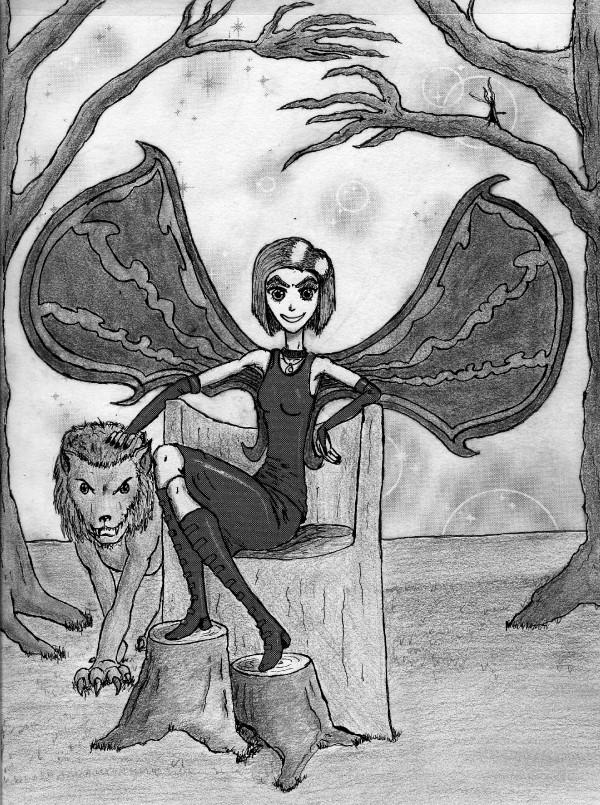
My favorite picture of the Dark Fairy

img022

A very early scene which is in fact about to be written! Even if you’re dying of thirst in the desert, you don’t want water doing that.


*Though in this case, it probably is.

**I know, right?  It’s unheard-of.

Outlaw’s Mind – Part 7

Timothy’s mother was as anxious as he was about the prospect of him being on anti-depressants for some indefinite period.  However, she was also troubled by the various difficulties into which he got himself because of his violent temper, and her fear of that, her fear for him because of that, was greater than her fear of the medicine.  She filled the prescription, the copay for which was tolerable, and brought it home after work two days after Timothy’s appointment.  He was to start taking it the following morning.

When he broke the small tablet in half on the score-line next morning, an easy thing to do, Timothy felt almost as though he were some mad scientist in a horror comic.  It felt so strange for him to be taking a medicine that was normally used by adults.  He swallowed the half pill with a glass of water just before he brushed his teeth that morning.  He half-expected an immediate and powerful reaction, but this was not the case.  As far as he could tell in the time immediately following, he might as well have taken a sugar pill.

This lack of response didn’t last for very long, though most of the effects brought about by the medicine were slow, subtle, and gradual in development.

The first effect that he noticed, though, was not subtle, and it was only barely tolerable.  About two hours after taking the half-pill that morning, while still in early classes, Timothy began to feel a strange queasiness.  His stomach churned a bit, as though rebelling against his small breakfast.  He wondered whether he might have eaten a bad egg.  An unpleasant bit of sweat developed to go along with his nausea, and more than one person asked him if he felt okay.

He responded that he thought he might have eaten something that didn’t agree with him.

This stomach upset lasted less than an hour, thankfully, and Timothy thought nothing further of it for the rest of the day.  If he felt slightly more at ease in his skin than usual, this seemed likely to be due to the joy of having gotten past that bout of ickiness.  Or so he assumed.

When his nausea recurred the next day at roughly the same time, Timothy decided that he wasn’t going to eat eggs in the morning anymore.  Thankfully, this bout lasted no longer than the previous one, and afterward he felt slightly giddier than he had the day before.  This was not to say that he was giggly or especially cheerful, nor that he started conversations readily.  But he did pay more attention to the antics of the people around him, interactions which he normally more or less shut out of his awareness as irrelevant to him.

He realized that he was not wrong to have done so.  He didn’t think he’d ever noticed before how pathetic and contemptible were the things with which his fellow high-school students concerned themselves.  These were the early days of Facebook; Twitter and the iPhone were practically neonates, and though the neighborhood in which Timothy lived was not wealthy enough to have any students who owned one of the first-gen smartphones, they were still the talk of the school, as were YouTube and Facebook.  People worried so much about how many “likes” some pointless picture got, or what mean things someone might have said in a comment about something they had posted.

God, they were disgusting.

What was wrong with people?  Was it just because they were teenagers that they were all so vacuous and stupid, or were adults that way as well?  Timothy had his suspicions about the answer to that question, and they did not reflect well on his opinion of the human race.

On his third morning of nausea, after he’d had as mild a breakfast as he could take without going hungry—which was a problem, because he felt a bit more appetite than usual—Timothy finally started to recognize that this nausea was probably a side-effect of the generic Paxil he was taking.  This realization made him feel very foolish indeed, for he’d read the list of potential side-effects, and had even been slightly leery of the prospect of nausea when he’d read about it, yet even so, when he actually felt the sensation, he failed to put two and two together.

He shook his head at himself in his early class, mopping the slight sweat from his brow with the back of his hand as he did so.  It was pathetic.  He’d always thought of himself as at least reasonably smart—no genius, but clever enough to get good grades if he worked hard—but now he saw the glaring deficiency in his own logical processes.  He was only barely less contemptible than the idiots around him with their social cliques, and their fake online personas, and their sheep-like trendiness.

At least he had the good sense to recognize how stupid he was.  That had to count for something, at least.  Also, now that he recognized that his queasiness must be due to the medicine and not to anything that he ate, Timothy figured he could go back to eating what he wanted in the morning.  In fact, he thought he might celebrate by having a couple of blueberry waffles with loads of butter and syrup the next morning.

Later that afternoon, in geometry class, Timothy surprised himself by snorting—borderline quietly at least—in derision as one of his fellow students asked what he thought was a moronic question about a very simple geometric proof the teacher was demonstrating.

Though the snort was relatively quiet, so was the room, and both the teacher and the student at whom the snort was directed heard the noise.  The teacher said nothing, but she looked out over the classroom to try to catch sight of who had made the disrespectful exhalation.  Timothy felt no guilt, but he betrayed nothing on his face, nor did he own up to having done anything wrong, even in the silence of his own mind.  The student at whom he had snorted, meanwhile, flushed red and lowered his head a bit, his embarrassment and shame painfully plain.

The teacher shook her head ruefully, with plain disapproval, and then returned to her answer to the student’s question, being even more patient and careful that she had been before.

Timothy recognized her behavior, and he found it almost as weak and laughable as the question had been.  Then, another student caught his eye, smirking and rolling his eyes and head in a very subtle “do you believe this guy?” nod toward the boy who had asked the question.

Timothy felt a strange thrill to be sharing his contempt of the stupid student with someone else who also realized how pathetic was that boy’s inability to grasp such basic, straightforward, painfully logical concepts.  Maybe not everyone was a hopeless case.  Maybe there were other people like him who could at least recognize how pathetic everyone was.  He didn’t talk with the boy who’d shared his sense of scorn, but he made a mental note of the boy’s face and tried to recall his name.  If circumstances presented the chance, he might just try to make friends.

By next morning, Timothy had more or less forgotten his waffle urge, but he did take a few Pop-Tarts out of the cupboard in the morning, as well as some cookies—there was usually a box of Chips Ahoy in the fridge, which tended to last quite a while, since neither Timothy nor his mother ever usually ate more than one or two cookies at any time.  That day, though, he took five of them as a garnish to his two full—untoasted—Pop-Tarts and washed them down with a full glass of milk before leaving for school.

He felt pleasantly full and realized that he’d also been sleeping much better, and enjoying it more, over the previous few nights.  Maybe this antidepressant stuff really was the right choice for him.

His nausea that day was less than before, which was a hopeful sign.  However, with the purely physical queasiness tapering off, his more ethereal sense of disgust seemed to be growing in compensation.  In the break period between second and third hour, he heard a nearby girl bemoaning—in all melodramatic seriousness—the breakup of some boy band.  Perhaps it was just one of the members of the group leaving, Timothy wasn’t quite sure.  In any case, the girl’s eyes were actually damp with tears as she shared her dismay with two friends, both of whom seemed almost as devastated as she was.

When the girl said, “I don’t know how I can live after this,” in a whiny wail, Timothy could hold his tongue no longer.

“Well, let’s all hope that you don’t,” he snapped, quite plainly.

The girls, clearly recognizing that Timothy was responding to their conversation, looked at him with puzzlement.  Perhaps they hadn’t followed the sense of his comment, or perhaps they were just too surprised that their usually taciturn classmate was jumping into their interaction.

“What?” the girl said, her already mournful expression making her look sub humanly stupid.

“I said, let’s hope that you don’t,” Timothy replied, only too happy to clarify.  “Live after this, I mean.  Let’s all hope that you don’t live after this.”

The girl now seemed to recognize that she was being insulted, as did her friends.  There were many girls in the school who would immediately have responded in kind, throwing barbs back with great relish, or becoming indignant and haughty.  Some would even have threatened violence as readily as any belligerent boy.  These girls, perhaps because of their grief, however banal, were in a different mode.  One of the two friends of the first girl said, “That’s not very nice.”

Timothy sneered and said, “Why should it be nice?  I mean have you heard of the Darwin Awards?  They’re these joke awards that are given for people who do the rest of the world a favor by getting themselves killed because of their stupidity before they have a chance to reproduce.  I was just thinking it’d be really good for the rest of the world if you…” He nodded toward the first girl.  “…really can’t find a way to live after this, and just die.  I mean, we’d be better off without you, if this sort of bullshit really gets you this upset.  Fucking cockroaches make more sense than you do.  In fact, if you were shrunk down to the size of a cockroach and put next to one on the floor, I’d step on you and let the cockroach go on about its business.  And I’d be right to do it.”

Timothy made his minor speech quickly and intensely, and he was so clearly completely serious, so obviously not joking in anything he said, that the three girls were more flabbergasted—perhaps even frightened—than they were offended.  Nearby students also turned to look, a few with wide eyes.  Some might have considered intervening, shooting harsh words back Timothy’s way, but if so, when they saw him, they thought better of it.

Timothy couldn’t know it, but his own eyes were intensely wide as he spoke to and regarded the bereft girl, his pupils dilated so widely that his irises looked almost completely black; with the right lighting, one could probably have seen the reflection of his retina in his gaze, a real-time version of photographic red eye.  His whole body was tense but still, the demeanor of a jaguar about to leap from a high branch onto the back of a jungle explorer, to crush the skull in its powerful jaws.  His lips were drawn back from his canine teeth and his nostrils were flared.

He didn’t really think about it, but if he’d been handed a gun at that moment, he could easily have shot the poor moaning girl in the head without qualm, and he would have felt that he’d done the world a service.

The three girls’ faces paled, and they shared nervous glances with each other, before the first one, the to whose comment Timothy had reacted, quietly said, “Sorry.”         The three girls broke up their conversation, two heading to their seats and the third staying where she’d been seated.  If Timothy’s reputation had not already been one of a scary recluse who could be violent, it would have become so at that moment.  As it was, that reputation merely worsened and gained new inflection because of that interaction.

As the next class began, Timothy privately reveled in the sense of accomplishment over having shown the girl how pathetic her reactions to such trivialities were, and how trivial her own life was as well.  It occurred to him, far in the back of his mind, that his own existence was every bit as trivial as hers was, but that at least he recognized the fact, and thus had intellectual and moral advantages over her, and over billions like her.

The rest of that school day passed without incident.  Timothy had no other classes with that girl or her friends, so there was no chance for any awkwardness or confrontation.  He strolled home with a kind of tense energy, more than ready—indeed, almost eager—to face anyone who was prone to give him any shit.  No such person appeared, however.

Not even recognizing his own disappointment at the lack of conflict, Timothy went home and stowed his jacket, tossed his backpack on his bed, then went into the kitchen to have lunch.  He opted for the last pouch of Pop-Tarts in the box, eschewing healthier options in the fridge.  When he threw the box, and the two-tart wrapper into the kitchen garbage—he decided to toast the pastries this time—he realized that the kitchen bag was all but overflowing.  His mother would be irritated if she came home and found it in such a state; this was rarely an issue, since Timothy was generally quite responsible with household chores, spending most afternoons at home alone before his mother arrived from work.  It was with only the mildest sense of irritation that Timothy tugged the bag out of the garbage can, tied it shut, and pulled out a replacement, as he waited for his Tarts to Pop.  Once they did, and he was sure therefore that they weren’t somehow stuck in the toaster where they might burn or even catch fire, he picked up the tied-off garbage bag and headed outside.

Timothy and his mother lived in the ground-floor unit of a two-unit dwelling.  It was a thoroughly unimaginative building design, being an almost perfect rectangular prism of a brick building, in a neighborhood overflowing with similar structures, but it was pleasant enough of the inside, and it even had a yard of sorts, with a concrete patio in the rear.  It was here that the larger garbage cans and recycling bins were kept, and Timothy toted the white plastic bag from the kitchen easily, swinging it into the large garbage receptacle and flipping the lid back shut.

A loud and threatening buzz suddenly passed by his left ear, startling him.  He jumped in place and backpedaled, looking around and spotting the large, dark brown shape that had done its flyby of his head.  It was a good-sized paper wasp, reddish brown and sleek, and it had probably been near the garbage, perhaps investigating it for possible food.  Timothy, his heart racing with startlement and fear, and with anger at that fear, followed the thing’s flight and saw it land on what must have been a fairly new nest which stuck out from the side of the building, just under a brick protuberance that went all the way around the building, marking the separation between first and second floors.

The nest was remarkably big for something that must have been begun sometime in the last week, at least since the last time Timothy had taken out the garbage.  It was one of the open-plan paper wasp nests, in which the individual cells, facing more or less downward, were freely visible to any passerby.  Timothy had occasionally wondered how such nests handled heavy rain, since they were, supposedly, made of actual paper.  At other times, he’d seen nascent nests more sensibly placed under the small, charcoal grill that was slowly rusting nearby on the patio, but which was occasionally used either by Timothy and his mother or by their upstairs neighbor.  These, of course, were addressed rather easily and quickly.  Maybe their placement wasn’t so sensible after all.

He didn’t waste too much time pondering nesting site choices, however.  His mood was dominated by alarm and hostility, and as he watched the wasp crawling on the surface of the nest—there was another, identical wasp already puttering about there—he thought to himself that he was fortunate that it hadn’t been yellowjackets hanging around the garbage.  Yellowjackets, the prime assholes of the insect kingdom, tended to sting first and show curiosity later.  These wasps, though, were more than potentially aggressive enough, especially if their nest were allowed to grow, and any offspring within it were reared to adulthood.

As he watched the two forms move over the nest, their inactive wings forming dark Vs above their bodies, Timothy felt both disgust and fascination.  He’d always thought it amusing that so many people were terrified of spiders, a feeling for which he had no sympathy.  Spiders were just vaguely interesting and generally inconsequential to humans, at least in any direct sense.  If a spider bit you, it was usually because you had all but forced it to do so.

Wasps, on the other hand—especially those dark brown, dark-winged paper-wasps, that some people called hornets—looked like the earthly incarnation of evil itself and deserved that impression far more than spiders ever could.  Unlike honeybees, they could sting with impunity, and so were far more likely to do so.  As far as Timothy knew, they didn’t do any significant pollination, and they certainly didn’t make honey or any other useful or positive thing from a human point of view.  Many wasps, he’d seen in nature documentaries, were parasites.  Some of them even had horrifying lifestyles in which they would paralyze some insect or caterpillar, and lay their eggs on the living host, to let their larvae eat the poor creature alive when they hatched.

No, wasps were surely evil, or at least they looked it.  Timothy had read—and seen—The Lord of the Rings­ and The Hobbit, and he’d occasionally thought that Tolkien should have discarded his apparent obsession with spiders, and also that he could have terrified his readers far more by having the Ringwraiths fly upon giant wasps or hornets, rather than dragonish lizards.  That would surely have stricken greater fear into their prey, at the very least.

These were ordinary, inch-or-so-long wasps, but they were more than trouble enough.  Though Timothy recognized that their nest was not constructed with ill intent, he nevertheless felt a deep affront at the creatures’ audacity in daring to forge a home on the building in which he and his mother lived.  Such impudence could not go unpunished.

He strode back into the house, his startlement and fear having sublimated fully into a mixture of hatred and glee; he was looking forward to this.  He opened the cupboard under the sink in the kitchen, and he saw there a can of ant and roach spray, as well as a slightly larger can of flying insect spray.  He picked this last can up and pondered it.  It seemed to be made more for killing flies and isolated insects inside the house than for assailing wasps in their nests.  He looked deeper under the cupboard to see if there was any of the long-range, nest-targeting, wasp-killing spray that he knew he’d seen in the stores before.

He didn’t find any of that spray, but he did see something that struck him as even better.  Smiling coldly to himself, he put the bug spray down and grabbed hold of this other stuff.  To use it, he would need one more item, and this he took from a higher kitchen cabinet, above the stove, after closing the cupboard under the sink.  He strode back outside, noticing out of the corner of his eye that the lady who lived upstairs was just getting home from work, pulling her car into a street space in front of the building.  He didn’t wave or make any other greeting, too fixated on his goal for such distractions.

He rounded the back of the building with grim determination, looking up to see that both wasps were still present.  Holding his second item in his left hand, he was still able to use his left thumb to pop open the top of the bottle of charcoal lighter fluid he held in his right hand.  He couldn’t recall the last time he and his mother had cooked out on the puny little grill, but as far as he knew, lighter fluid didn’t go bad.  He took aim at the wasp nest and squeezed the bottle vigorously.

It was nearly full, having perhaps only been used once, and judiciously at that.  The stream surprised Timothy by slightly overshooting the wasp nest, but he corrected his aim easily and soon the two wasps were startled and took brief flight as the liquid doused their nest.

Timothy knew that not much fluid would probably be needed.  The nest was paper, after all.  Still, he wanted to be sure—and he anticipated a nice spectacle—so he maintained his squirt on the nest until he was nervous that the wasps might think to follow the liquid stream to its source and attack.  He finished by making a trail of lighter fluid down the brick side of the building to the corner near him.  He would need a fuse of sorts, not wanting to have to try to reach up to the nest to light it.

The wasps, after initially having been startled off their nest, now landed again, their movements somewhat agitated.  He wondered what they thought in what passed for their tiny little, pathetic brains.  Were they just as clueless as the idiot girls in his class?  Did they have any inkling of what a threat this new liquid posed?  Or were they simply puzzled, wondering why this odd-smelling rain had fallen onto their new nest from below?

Well, if wasps were stupid, at least they had an excuse.  They were tiny, and their brains were comparably tiny.  How much could they be expected to understand?  In fact, their priorities were probably much more sensible, given what they were, than those of the horde of imbeciles who populated his school.  Neither the wasps, nor their larvae, would be worried about some insect equivalent of a boy band, or some micro-world version of Facebook.  Their decisions were surely all focused narrowly on life versus death.  That they were unable to recognize the impending doom that the lighter fluid represented was no indictment of their attitude; there was simply no way for them to know.

This wouldn’t save them, of course.  Just as they would have tried to sting him if he’d come too close to their nest, so they were invading his and his mother’s living space.  The fact that they surely meant no harm and posed no real threat wasn’t relevant.  The law of the jungle applied, and they would surely—if they had been capable of such thoughts—have expected nothing different.

Still, as he slid open the big box of kitchen matches, having put the lighter fluid bottle on the ground, Timothy felt a slight pang, wishing he could have squirted the idiot girls in his class with the fluid he was about to ignite, rather than the wasps.  They would have deserved it more.

Taking two matches from the box before sliding it closed, Timothy held them parallel, their heads paired together, and struck them on the side of the box.  They were high quality matches, and they flared instantly alight with one strike.  Timothy had been careful not to get any of the lighter fluid on himself, so he wasn’t worried about any spreading of the flame.  He took a small step closer to the building and touched the lit heads to the nearest portion of the trail of lighter fluid he’d sprayed.

It lit easily; it seemed he was right about such fluid not going bad very quickly.  Stepping back, he watched with joy as the bright orange flames climbed up the trail he’d made on the wall.  They moved down a bit, too, but he wasn’t paying any attention to that.  There was only concrete below.  The garbage cans were not close enough to be in any danger, and there was no grass other than a weed or two that sprung from cracks in the pavement.  These would be a loss to no one even if they were burned, but Timothy knew that wasn’t going to happen.  He had been reasonably careful.

The fire licked its way up the path he’d given it in seconds, and suddenly the wasps’ nest was engulfed in a tiny inferno.  At least one of the wasps hadn’t noticed the danger fast enough to avoid it, and Timothy grinned as he saw it twitch and writhe, its wings shriveled and consumed before anything else, as lighter fluid it had been investigating burst into easy flame.  Timothy hoped this was the one that had buzzed by his ear and frightened him.  Such was the fate he wished he could deliver to anything and anyone who made him feel afraid, even for a second.

The other wasp took off quickly enough, but it didn’t fly far.  It hovered over the area as the nest burned, blackening and shriveling in place, even as the first wasp—which somehow was still holding on—was consumed by the flames.  Possibly there were eggs in some of the cells of the nest.  Maybe there were even larvae, which the surviving wasp hoped to be able to free from their flames.  Timothy hoped so.  He hoped that the larvae were cooking in their paper cells, and that their mother, or father, or whatever that other wasp was would feel a heroic urge and would try to get them out, burning itself alive in the bargain.

He glanced down then back up.  The nest was burning nicely, as was the lighter fluid that remained on the side of the building, blackening the brick in a long streak, a thin tentacle of which reached down to the pavement below, where it stopped.

He wondered, if he timed things just right, and waited for the still-flying wasp to get close enough, and if he squirted some extra lighter fluid right near where it was hovering, if he might be able to catch it in a new burst of flame.  He thought he had a pretty good idea of how the squirt of the fluid would fly now, having just used it seconds before.  He thought he could judge it well enough to make the attempt.

He reached down to pick up the bottle, popping the cap again and looking back up.  The flames were not as fierce, the lighter fluid was burning off rapidly, but the nest was well lit and, true to its papery nature, burned steadily.  Timothy wasn’t sure where the first wasp was in the blackening mess.  The other, however, was flying about madly three or four feet away.  It wasn’t close enough for his plan to work.  He held the bottle of lighter fluid pointed generally toward the burning nest and waited for the right moment.

“What are you doing!?”

A loud, strident shriek only feet from his right ear made Timothy jump in place.  He had the presence of mind not to squeeze the lighter fluid bottle as he spun to the right and saw his upstairs neighbor, whose name he couldn’t recall for the moment, gaping in horror, a plastic grocery bag filled with garbage dangling from her right hand.  Her wide-eyed, wide-mouthed look took in the burning on the wall of the building as well as Timothy with his lighter fluid in hand.

Caught very much off-guard and flustered—though not ashamed or embarrassed—Timothy stammered, “I’m…the wasps.  There’s a nest.”

The neighbor was not listening.  She dropped her groceries and sped back around the side of the building.  There, Timothy knew, was a spigot, attached to which was a moldy old, still-serviceable garden hose.

In seconds, the woman came back around the bend, tugging along with her the hose, from which spewed a limp-looking stream of water.

“Wait,” Timothy said.  “We need to get the other wasp first.”

The neighbor ignored him.  Lifting the hose, she placed a thumb over its end, partly blocking the stream and increasing its pressure.  This new, more directed jet spewed out much straighter; some of it scattered onto the woman’s work clothes, with traces of it wetting Timothy’s pants, not that he cared.  The woman brought her water stream, much as Timothy had done to the lighter fluid, first up to the nest itself and just past it, dousing it and almost instantly extinguishing its flames.  Then she washed down the streak on the wall, which had mostly gone out already anyway.  Timothy had half a thought that she’d started high because that was closer to her apartment.  He couldn’t imagine that she really cared about extinguishing a wasp’s nest.

When it was clear that the flames were all out, the woman lowered her hand and the hose, the water flow returning to a rather lame splash that wet the pavement more locally near her feet.  She wore athletic shoes that had long since seen better days, and she obviously wasn’t worried about them getting wet.  Timothy, after glancing at the water, looked back up to the nest.  The surviving wasp circled the largely blackened, soggy remains of its home, finally landing on a relatively stable portion near the top.  He could make nothing out of any remains of the other wasp, nor could he see if there were any squirming, partly baked larvae.

“What were you doing?” the upstairs neighbor woman asked.  “Are you trying to burn down the building?”

Timothy turned to regard her drawn, ashen, flabbergasted face with honest puzzlement.  “What do you mean?” he asked.  “It’s a brick building.  It’s not gonna burn.  Not from that.”

The neighbor seemed stunned by what Timothy thought was an unassailable argument.  He exerted tremendous self-control to keep from rolling his eyes.  This woman didn’t seem much sharper than the girls in his school who had so bewailed the fortunes of their favorite boy band.

“What if something caught on the ground?” the woman asked—grasping at straws, so Timothy thought.  “What if you were just wrong about the building not burning?”

Timothy shrugged.  He didn’t see how he could have been wrong about the flammability of brick, and experience had just demonstrated that he was correct.  Rather than point that out, though, he gestured toward the hose that continued to splatter water at the woman’s feet, creating a widening area of wet, dark pavement in the brighter patio.  A good portion of the water flowed off the side of the concrete, probably a welcome treat for the bedraggled grass around its edge.

“I’d just have grabbed the hose, like you did,” Timothy said.  “It’s no big deal.”  He looked back up at the nest, where the plainly confused, still-living wasp took off and landed repetitively, as if not quite able to process what had happened or to decide what to do.  He wondered whether it had any notion of attachment to the other wasp and whatever eggs or larvae had died with the nest.  He wondered if it felt grief.  He hoped that it did, but he suspected that it would probably forget that either the other wasp, or eggs, or the nest, had ever existed.  Who knew, perhaps even at that moment it was thinking the waspy equivalent of, “Wait, what was I just doing?  Why did I come here?”

The human neighbor, meanwhile, perhaps exasperated by the fact that she’d been unable to catch Timothy in any logical errors, said, “Well, what about the marks on the wall, here?  What about that?  There’s a big burn mark all up the wall!”

Timothy thought she was exaggerating a bit, but there was a diagonal streak of brownish-black discoloration where his pseudo-fuse had been, culminating in the larger splotch of black surrounding the remains of the wasps’ nest.  He shrugged again and said, “It’s not like it’s facing the street or anything.  And it’s not like the building’s that much to look at in the first place, anyway.”

The woman’s mouth dropped open more widely than before, and Timothy had to exert a substantial effort of will to keep from snorting in amusement.  As it was, he didn’t think he was completely successful in suppressing a smirk.

“You…look, this is my home, too,” she finally said, “and I’m not going to have it burned down—or even just burned—because you want to get rid of a wasp’s nest.  Why didn’t you get some bug spray?”

At least this was a reasonable question, Timothy had to admit, so he pushed away his momentary amusement and admitted, “Well…we didn’t have the right kind of spray, so I figured this’d work better.  And it’s more fun.”

The woman’s eyes widened.  She looked strange to Timothy now; he thought there was some new revelation or realization in her expression, though he couldn’t have imagined what it might be.  Honestly, most other people were so stupid and useless sometimes.

“More fun,” she said quietly, half to herself.  Since she didn’t seem to be inviting a response, Timothy regarded her silently.  Finally, trying to make her expression stern, the neighbor said, “Well, I don’t want you to have any more of this kind of fun today.  I live here, and it makes me very nervous…and I don’t like how it looks, even if it’s in the back of the building.  So put away your…your charcoal lighter stuff and put away your matches.”  Then, as an afterthought, she added, “And I’m going to be speaking with your mother when she gets home from work.”

Timothy didn’t quite understand the significance of this last comment, but he said, “Okay.  I’ll put it away.  I didn’t get the other wasp, anyway, so maybe the spray would have worked better.  But this way’s more…I don’t know.  Anyway.  I’ll put it away.”  He didn’t feel guilty or ashamed, and he honestly felt no anxiety whatsoever about his mother learning of his little adventure.  His mother was certainly no fan of wasps.  She might well have thought he was foolish in choosing to fight them with fire rather than asking her to pick up some wasp spray on her way home—and he’d have to concede such an argument if it were made—but he didn’t see her being particularly upset.  Why would she be?  She hardly ever used the patio in the rear of the building.  It wasn’t as though she sunbathed or anything, and there wasn’t much else to do back there.  The surroundings consisted mainly of the rears of other buildings next door and one street over, some of them even less beautiful than their own.

Giving a quick nod—a courtesy granted more out of habit than out of any recognition that respect was due—Timothy walked past the neighbor and back around to the front of the building, going inside and locking the door behind him.  He didn’t particularly want to encourage the woman to follow him inside in case she got it into her head that he needed more berating.

Although, if push came to shove, it might not have been such a shame if she tried to muscle her way into the apartment.  Then he’d have every excuse to treat her in some analogous way to how he’d treated the wasps.  That might be even more enjoyable.

Shrugging, deciding that concern wasn’t really important or necessary, Timothy stowed the lighter fluid carefully under the sink after replacing its cap, then put the kitchen matches back in the higher cabinet.  Then he went to his room, bringing his cooling Pop-tarts with him, where he got started on the modest amount of homework he had to do.

His mother got home about an hour and a half later.

He knew when she got home because her car—which needed a new muffler—made a very characteristic noise, and Timothy’s room was nearer the front of the building than the rear, where his mother’s master bedroom was.  In the back of his mind, he heard that, before his mother was able to get to the front door and let herself in, the neighbor accosted her.  Apparently, she could also hear, and also recognized, the sound of Timothy’s mother’s car.  He was done with his homework by then, and was watching a video on his computer, a collection of “epic fails,” in which people did various injudicious things and met with outcomes that were violent and looked painful because of their foolishness.

As he watched, snickering at the more intense catastrophes, Timothy thought about what he’d said to the girls in school that day, about the notion of the Darwin Awards.  Though he didn’t think anyone in the video he was watching had died—he thought that the sharers would probably have considered it in poor taste to spread such imagery, and it might even have been against the YouTube rules, whatever they were—he thought that it wouldn’t be a bad thing for the human race as a whole, and for the progress of civilization, if they did.  He was grateful, at one level, that these people had lived, because their antics gave him a real-life slapstick comedy source, and that was pleasant enough.  But on the other hand—and this was a much larger hand—there was little doubt that removing these people and culling from the gene pool whatever attributes made them so stupid, might well be a good thing in the long run.

He’d be willing to forego a little amusement to see that happen.

He didn’t pay any significant attention to his mother’s interaction with the upstairs neighbor, and he certainly couldn’t hear their words.  He also wasn’t really curious, barely even recalling the neighbor’s stated intention to tell his mother about his wasp burning activities.  He paid only vague attention when he finally heard his mother unlock and then open the front door of the apartment.  It was the sort of thing that happened every day and was hardly worth noticing.

Once she came in though, his mother didn’t stay in the kitchen, nor did she head to her bedroom to change out of her work clothes.  Instead, to Timothy’s mild surprise, she walked over to the door of his room, which was slightly ajar, and pushed it open without knocking.

Her push was not violent, nor was it ominous, nor was it in any other way threatening.  Timothy looked up and around from where he sat at his small desk, wondering what his mother might want.  Some little bit of the back of his brain, recalling aspects of the earlier interaction with the neighbor, thought that his mother might just be coming to give him some choice words, the proverbial piece of her mind.

He was surprised, almost to the point of being unnerved, by the fact that she stood in his doorway for what felt like a very long time, just staring at him.  The look on her face was difficult to read, but it clearly wasn’t anger, not in any usual parental, disciplinary sense.  To a stranger, in fact, her expression would probably have looked blank, a nearly ideal poker face.  Timothy, though, thought he saw competing, deep, and subtle emotions playing around her eyes.  She looked sad; indeed, she seemed almost on the verge of heartbreak.  She also looked afraid, but it was a strange, subtle kind of fear.  She looked resigned, practically to the point of despair.

And for some reason, he thought she looked protective.  If she had told him that she had just slapped their neighbor for daring to criticize her son, Timothy would have been surprised…but not very surprised.

Above all else, his mother looked capable of terrible deeds.

Finally, she broke the silence, asking, “Where are your pills?”

Timothy was briefly wrong-footed by the question, but a second’s thought made clear what she must mean.  He didn’t so much as take a daily multivitamin, so there was only one item that met the description “pills” in his room.

“They’re right here,” he said, reaching out to where, next to his desk lamp, a small, translucent brown cylinder with a white cap and a printed label sat.  He held the bottle up as proof.

“Give them here,” his mother said.

Timothy wondered why she wanted them, but he saw no reason not to obey her.  She was the one who paid for them—at least, she was the one who got the insurance that paid for them, as part of the benefits of her employment.  He put the bottle into her hand, which she outstretched, taking a step into the room to get close enough to receive them.

She looked at the bottle for a second, then back up and Timothy and said, “Come with me,” nodding her head in the direction to her left and rear.  Now Timothy felt a bit like questioning her, wondering what she needed from him that he should follow her.  Something about her face, though, that weird combination of looks that combined to give a superficial semblance of blankness, made him feel that he shouldn’t push his luck by giving her any trouble.

It was cliché but was also a simple fact that Mrs. Outlaw had not raised any stupid children, and Timothy proved this in his choice simply to push his chair back and rise from his seat, following his mother as she stepped back, turned to her left, and walked down the tiny stretch of hallway to the bathroom.  She pushed its door wide and turned the light on.

Timothy, having been raised almost exclusively by his mother, always put the seat and the lid down on the toilet after every use.  He had done so since he could remember first using the bathroom on his own, and it was not so much a rule of the house as a law of nature, a fact about him that was nearly as innate as his right-handedness.  On entering the bathroom, once the light was on, Timothy’s mother reached down and raised the lid and the seat.  Then, to Timothy’s mild astonishment, she popped open the bottle of paroxetine, from which no more than three full pills had been used, and she poured its contents into the toilet.

“Wha…” he muttered, but his mother glanced at him, and he said nothing more for the time being.

His mother looked into the bottle as though trying to ascertain that there was no possibility that any pills had been left behind.  Of course, none had.  When apparently convinced of this fact, she reached out and flushed the toilet, its crashing, watery sound almost cacophonic in the quiet apartment.  She watched the water go down, apparently wanting to make sure that all the pills had been flushed successfully, presumably so that none remained to be fished out and taken.

Timothy tried to imagine a circumstance in which he, or anyone else, would do such a thing to take a dose of generic Paxil.  Nothing came to mind.

His mother closed the toilet seat and lid in one motion, then she tossed the now-empty prescription bottle into the bathroom garbage before turning and facing Timothy.  They were very close together in the small bathroom, and though Timothy was roughly his mother’s height—he would soon be taller than she, though she was rather tall for a woman—he felt intimidated by her presence.  He did not, however, draw away.  She didn’t seem threatening, and if she was angry, it was not directed at him.

Even so, her voice was stern and harsh as she said, “Listen to me.  You’re not going to be taking any more of those pills, you understand?  No more Paxil, no more anything else like them.  No antidepressants, and no…I don’t know what else the doctor might want to put you on.  He’s going to have to find some other answer.  Do you understand?”

Puzzled by her intensity, but not for an instant doubting her seriousness, Timothy said, “Sure.”  He felt a mild pang of disappointment, having felt a guarded optimism about the usefulness of the medicine, but it had only been a few days, after all.

“I’m serious,” his mother said, her gaze so unblinking that his own eyes burned in sympathy.  “I don’t want you taking any of those medicines, not while I’m around.  If…if you and Dr. Putnam decide to put you on anything and you go buy it behind my back…if I find out you’re taking anything like that…you can get out of my house and go live by yourself somewhere, do you understand?”

Timothy’s mouth dropped open a bit.  “Huh?” he said.

His mother’s mouth closed into a tight, severe line and then, barely opening it, she said, “Look, I don’t know what it is, but those pills…whatever they do, it isn’t good.  Not for you.  Maybe for other people, I don’t know, but it’s not good for you.  They don’t help you.  They make it worse.”

Now Timothy was supremely confused.  “What do you mean?” he asked.  “I haven’t gotten in any fights or broken anything or whatever.  I mean, I got in a little argument with these dumb girls at school today, but it wasn’t anything violent.  They were just being stupid, and I told them so.”

His mother continued to regard him implacably.  She cocked her head in a fashion that reminded Timothy somehow of a curious dog or cat, but her look was clearly not so much puzzled as contemplative.  After another, brief pause, she said, “Think about it again in a few days.  If you want to talk to me about it then, you can.  Right now, I just want you to go to your room and relax.  I’ll call you when dinner’s ready.”

Timothy was mightily confused now, but he wasn’t sure even what question to ask.  He opened his mouth the speak, but since he couldn’t figure out what to say, he shut it again.

His mother, who was farther inside the bathroom than Timothy was, said, “Go on.  I can’t get out of the bathroom with you standing there.”

Blinking stupidly, feeling embarrassed by his own confusion, Timothy said, “Okay.”  He turned and shuffled back to his room, wanting to feel disgruntled over his mother’s refusal to explain herself, but not really all that bothered by it.  He returned to his room, shut the door—leaving it just barely ajar, as a nearly unconscious gesture to show his mother that he had nothing to hide—and went back to his computer.  His mother apparently knew him well enough to have recognized that she didn’t need to remind him about his homework.

Now, my fair’st friend, I would I had some blogs o’ the spring that might become your time of day.

Hello.  Good morning.  It’s Thursday, so of course it’s time for my weekly blog post.  This is the first blog of spring, not counting my uploading of the next part of Outlaw’s Mind earlier this week.  Although, it’s autumn in the southern hemisphere now.  I tend to prefer autumn to spring, generally, but that’s largely due to Halloween coming and the changing of the leaves.  Of course, the leaves don’t change in south Florida, so that’s annually disappointing.  I assume there are some changing autumn leaves in the southern hemisphere, at least in some places, though they may be rather different than the ones in the northern.  Are there oaks and maples and the like in the southern hemisphere?  I would guess not, but I could be quite wrong.  I don’t think I’ve ever thought about it before.

I’ve been continuing my walking, though I’ve dealt with significant foot blisters that have slowed my progress, and I’ve gone through, I think, at least three new pairs of shoes—none very expensive, thankfully—trying to find ones that minimize my trouble.  Yesterday, at least, I was able to walk five and a half miles, and at the end, my blisters felt no worse than they had before I started, so that pair of shoes gets a good grade from me.  If this keeps up, it shouldn’t be too long before I can undertake my dreamed-of epic quest.

I’ve written just over four thousand words on Outlaw’s Mind this week, after basically slacking off the rest of last week and restarting on Monday.  It’s getting harder and harder to bother with anything at all lately.  But I’m rather stubborn, and most things I do in life I do not because I feel enthusiastic but because I had decided that I was going to do them, and so go through with it.  Enthusiasm is not one of my noteworthy attributes, I fear.  Anyway, the story is progressing, and the shocking event due to happen to Timothy has now begun, and it’s only developing and worsening from here.

It’s interesting that, no matter how clearly imagined and expected the course of a plot is, there are almost always little diversions or variations due to the actions of certain characters, who do things that were not necessarily planned by the author*.  Characters have their own personalities—they almost have a kind of free will, in a way—and they must behave the way they behave, since they are people, and sometimes people do things that I wouldn’t have thought about in advance.

It’s not that it’s truly surprising, not in any profound sense; it’s just that I sometimes come to the point where I realize certain characters in a story are going to do or say things that may affect the plot, because that’s who they are.  This is not to say that the story arc has changed, just that some specifics get adjusted.  Chaos theory being what it is, of course, it is possible for characters’ actions to change the course of a story profoundly, and in ways that were not readily predictable.  This is because they are, in a sense, real people, and with a flap of their (usually figurative)** wings, they can change the weather on the other side of the world, whether it’s spring there or autumn or anything in between—or they can change the specific outcome of a story.

I don’t really have much else to write about today, I fear.  Or maybe that’s a relief.  I don’t know.  I occasionally try to express deeper, more personal concerns, here and elsewhere, but I get the impression that these are of no interest to anyone (in the blogosphere or in real life), and I don’t seem very good at expressing or conveying them, anyway.  Alexithymia, I guess, or just general awkwardness and cluelessness on my part, is or are to blame.  Eventually, I guess I’ll run out of things even to try to say—sometimes I think that has already happened, at least ten years ago—and the rest will be silence.  This will probably be a welcome happenstance for most of those who even notice it.

Be that as it may, I hope you all have a good springtime—or a lovely autumn to the people in the southern hemisphere—and that you treat well the people you love and the people who love you…and even yourselves.

TTFN

robin 3


*I’m speaking hypothetically, of course.

**I have at least one prospective story in which a main character does have literal wings, and she is rather chaotic as well.

Outlaw’s Mind – Part 6

From there they went through a series of investigations over the course of quite a long period of time.  Timothy, after all, had to continue to go to school, and even though Dr. Putnam was true to his word about fighting balking insurers successfully, such fights sometimes took a fair amount of time.

One of the first things Dr. Putnam considered was that perhaps episodes of low blood sugar were what triggered Timothy’s outbursts.  Timothy read up on this himself a bit, once he was told about it, and he thought it made some sense, at least as a possibility.  After all, very low blood sugar—so he learned—tended to trigger the body to release large amounts of the various stress hormones, activating the fight-or-flight system, and this, combined with the low blood sugar making the brain function poorly, could lead to hostile and irrational behavior, even violence.  Dr. Putnam even told Timothy about a tribe—he inserted the caveat that this story might be entirely fictional, as far as he knew—that somehow had a tendency toward low blood sugar, and who had developed the practice of, upon meeting one another, getting into semi-ritualistic fights, so their hormone responses would raise the glucose level back up and make them feel better.

Dr. Putnam also told Timothy that, paradoxically, some people who were at risk for developing diabetes showed up initially with episodes of low blood sugar, as their pancreas overcompensated for insulin resistance.  Timothy tried to recall whether, on the many occasions when his temper had taken control of him, he’d had enough to eat, or if there had been any other pattern to his diet one way or the other.  He could, unfortunately, recall nothing specific about what or when he’d eaten on any of those occasions.

Dr. Putnam said that he already knew, based on standard blood tests, that Timothy’s fasting blood sugar was normal, but that the fact didn’t mean Timothy couldn’t still be insulin resistant.  So, after first doing an irritating test called a glucose tolerance test—involving fasting, a blood draw, drinking a sugary drink and then having three more blood draws—that showed nothing, Timothy was put through an even more irritating test called an insulin tolerance test.  This involved fasting for twelve hours, getting his blood drawn, and then being given insulin, which dropped his blood sugar down even from his fasting level.

This test made Timothy feel as awful, as nauseated, as vague, as physically tired, as stupid, and just generally as barely alive as he could remember feeling, but it did not make him feel angry—not even at Dr. Putnam nor at the people who administered the test.  When he was allowed to eat finally, after more blood tests measuring glucose, and growth hormone, and other blood hormone levels, the cheap hospital food they gave him tasted more wonderful than anything he’d ever had before in his life.

All of this turned out to be for naught, since the hormone and chemistry levels revealed by those tests were, per Dr. Putnam, all completely within normal range.  He jokingly told Timothy that the only abnormal thing about his tests so far was how normal they all were.  Timothy could see the humor in this, and he could also recognize the man’s point when he commented that at least Timothy knew, better than most young men his age, that his health was excellent.  However, it was frustrating.  It didn’t make him angry—his sense of rage-inducing injustice never included a reaction to simple facts of inanimate reality.  Reality, as far as he could see, promised nothing and owed nothing, so if brute facts turned out not to be the way he wished them to be, well…that was just tough.

Another possibility Dr. Putnam entertained, but which he apparently considered somewhat less likely, was that Timothy’s outbursts were a form of seizure.  Once he learned a little more about what seizures were, Timothy found this potential explanation much more intriguing.  It felt more right to him than some of the things that had been discussed before—except the brain tumor notion—because when Timothy’s rages occurred, they really felt as though they were coming from some separate and irresistible part of him that was beyond his control, as though there was another being inside his head, a being that expressed itself—indeed, that existed—only in extreme rage.  If this was caused by some atypical, irregular firing from a microscopic lesion somewhere in a specific part of his brain, then that would match nicely with Timothy’s experience.

He found the process of getting an EEG interesting, in some ways more so than the MRI had been, and certainly it was far preferable to the ordeals of the two “tolerance tests” he’d endured.  It felt almost like science fiction to be having wires attached that sensed the electrical activity in his brain, weirdly even more so than the MRI had felt.  Unfortunately, that interest was unrequited, for Dr. Putnam informed him that his brain’s electrical activity—like its physical structure, like his blood, like his hormones, like everything else so far—was entirely within normal limits.

Timothy amused himself at one point with the notion that he was so angry because he was perfectly designed and everything and everyone else was so imperfect that they couldn’t be tolerated.  Of course, this was just an ironic mental joke, one he never spoke out loud, for he was the last person to think of himself as perfect.

The thoroughly non-pathological results of all the tests so far would have been far less irksome if Timothy’s problems had been diminishing.  Unfortunately, they had not.  His deliberate self-isolation protected him from many personal arguments and conflicts that could have escalated, but it left him with a bit less emotional armor against some other frustrations.  Thankfully, he had no new altercations before his hand was reasonably healed and his brace unnecessary, because it was doubtful that unhealed fractures would have deterred him.

Not too long after, though, on his way to school, a passing student whom he’d seen but with whom he’d never interacted, mistakenly prodded the sleeping dragon in Timothy’s head.  Timothy had some mild trouble with seasonal allergies, and during the springtime, especially in the morning, his tended to breathe through his mouth due to congestion.  Something about his expression, with his mouth hanging open as he walked to school, must have seemed amusing, because this other boy, who was mildly overweight and didn’t seem like a mental marvel himself, walked adjacent to Timothy for several steps and said, “Look at the retard!”

Since there was no one else close enough to be the target of the remark, Timothy was obviously its victim.  He didn’t have time, at the moment, to think about the stupidity of the boy’s remark, how poorly it reflected on him rather than on Timothy, how utterly unlike the truth it was, since Timothy was one of the better students in the school.  He just felt instantaneous ignition in response to the mean-spirited, hurtful snipe, and in response to the sneer on the other boy’s slightly chubby face.

Without thought or warning, Timothy exploded, swinging his left fist across his body and into the left side of the boy’s face.  There was no thought behind this, and there was likewise no notice of any feedback to Timothy of the pain in his own fist caused by striking the cheekbone of the boy, padded though it was.  His senses were suddenly and acutely narrowed.  The targeted boy, who had clearly not even seen the blow coming, recoiled, and he fell over to his side more because of the surprise and the tangling of his feet than in response to the force of the blow.

“What the fuck…” the boy said as he stumbled, catching himself with his right arm, so he didn’t completely become prostrate on the ground.  This was just as well for him, because Timothy did not hesitate, but instead followed up with a kick that landed on the boy’s upper rear thigh.  The swinging of this kick was accompanied by a growl of rage from Timothy, in whom coherent, human thought was temporarily suspended.

The boy yelped when the kick landed, and he quickly rolled himself away from Timothy.  Looking back up, his eyes wide with surprise more than pain, he seemed about to shout something at Timothy.  That shout never reached the air, though, for Timothy continued to stride forward, swinging his other leg toward the boy’s face.

Though plump, the boy had good reflexes, and he blocked and dodged at the same time, taking only a glancing blow on his forearm.  Timothy growled more loudly, his noise mingling with the other boy’s own inarticulate cries of surprise and growing fear.

The boys had been walking on a sidewalk next to a side-street, along the normal path to Timothy’s school.  In rolling and scrambling away, the targeted boy fell into the street.  A car was, at that moment, passing by on the other side of the road, and the driver honked, though the vehicle was half-a-road-width away from the boy.  This startled the boy, but not Timothy, who had no eyes for anything but the target of his ire.  This time, for no clear reason, he switched back to his arm, and with it and a flexing of his upper body, he swung down at the boy.

Again, the boy’s good reflexes served him well, and he was able to take the blow on his own raised arm.  This was a more solid connection than the kick had been, and it probably hurt, but the boy was able to ignore it.  He rolled, scrambled, and forced his way farther out into the street, finally regaining his feet as he scrambled toward the other side of the road.

If the road had been very busy, either or both of the two boys might have been hit by a car, but to their good fortune there was a relative lag in the traffic.  The targeted boy, realizing intuitively that he was facing someone on whom words would not work—though they had triggered the attack—just did his best to get to his feet and run.  Despite what might have seemed to be a sedentary frame, he seemed to have good underlying physical health, because he was able to rise and begin sprinting in nearly one motion, taking off at an impressive pace, across the street and onto the opposite sidewalk, heading more or less toward the school.  Some part of his brain probably told him that, if he were to reach the school, or even to get close to it, the presence of adults might deter his growling pursuer.  He was almost certainly wrong in this, since Timothy was not more likely to be inhibited by the presence of authority figures than he was by the presence of potentially lethal automobiles.  Instead, it was luck, and Timothy’s blind rage, that prevented any further damage.

Timothy sprinted across the street after the boy, his rage giving him terrific speed, and his own lighter frame easier to get into motion than the other boy.  However, his riveted focus on his target meant that he didn’t pay much attention to where he was going, so when he went up onto the other side of the road, his foot caught on the edge of the curb.  His forward progress was levered into a downward trajectory, and though there was a grassy berm on that side, Timothy was tall enough that his face came into contact with the sidewalk.

He didn’t feel the pain of the contact, but the blow jarred him enough to send his perceptions bouncing and jangling around in his head, with flashes of whiteness exploding from within the redness of his furious vision.  This barely stunned him for even a second, but that was enough time for the other boy to gain a significant lead, and to go around a nearby corner.  Timothy began to scramble to his own feet, but his trailing shoe still dangled over the curb, and he stumbled again.  Thwarted now in his targeted rage, he howled aloud in fury—not noticing that the several other students within earshot turned and looked at him with fear and puzzlement.

Not thinking still, he slammed his left fist down in a hammer blow against the sidewalk pavement.  He would probably have repeated this several times, but he caught sight of a good-sized rock nearby, one larger than his two fists put together—probably a remnant of some past construction job—and he seized this, raising it and then slamming it down onto the sidewalk.  The sound of its impact rang out like a muffed gunshot, and this noise pleased the anger that possessed Timothy.  He raised the stone again, still almost fully prone, and smacked it down onto the sidewalk.

Even the most enraged young teenager couldn’t develop enough force to do any serious damage to a concrete sidewalk, but the stone, evidently made of more flawed material, cracked after the fifth such impact.  Timothy, who had punctuated each blow with an incoherent shout that was almost a roar, first hit the pavement with each of the two new, smaller rocks, then flung them randomly away from him.

By now, no longer in the presence of its target, and apparently accepting that it would be unsatisfied, his anger began to fade.  Timothy struck the sidewalk with the sides of both fists once, and now he was able to feel the soreness in the bones of his right hand as he did this, as well as the stinging in his left hand from the previous, more severe, blow.  He lowered his face into the border of the grass and the pavement, giving a final shout that contained self-directed anger in almost as great a proportion as that which was directed outward, and he clenched his eyes shut.

Slowly, he regained a semblance of calm.  When a passing student, a girl, asked him if he was all right, he was able to reply, “I’m fine,” with reasonable, if limited, courtesy, not looking up, before finally getting to his own feet and continuing toward school.  His whole body shook with the residua of anger, but his self-loathing was the greater force.  He averted his eyes from any other gaze the rest of the way to the school, so he didn’t know if anyone was looking at him, nor did he listen for any comments on his mad behavior.

The incident was never reported to any school officials, apparently, whether because the other boy was afraid or felt that he’d started the “fight”, or because he just thought it would be more trouble than it was worth.  So, this was one of the rare incidents whose only consequences were painful scrapes and bruises on Timothy’s forehead and hands, and a renewed aching in the recently healed bones of his right fist.  The other boy never approached him again, and indeed, Timothy never saw him except from a distance.  He supposed, if that other boy had been part of some gang, there might have been more dire consequences.  That could have been bad indeed, for Timothy didn’t think that he’d be deterred by a gang of boys any more than he would be by a single one, or by a car, or by a teacher.  This would not, though, make him immune to any weapons—sticks, knives, and even guns were not outside the realm of possibility—that a youth gang might bring against someone who had wronged one of their members.

There were occasions, through the months and years, when Timothy regretted that there had been no such reprisal.  There were many times when he more than half-envied his father’s destruction at the hands of an armed bar patron.

As the months and even years ticked by, Timothy’s tests ordered by Dr. Putnam continued to come back negative.  Though many others would have been pleased by such results, in Timothy’s mind, they lived up to their designation.  He saw only detrimental facts about reality in his discovery that he had—so far—no obvious, organic cause within him that provided a clear source for his episodes of uncontrollable rage.  As more and more tests failed to give him the moral reassurance that his temper was not simply a character flaw, his mood and sense of self became more and more despondent.  To his credit, he continued to work hard in school, to study, to practice, to work toward a future in which he could be a productive member of society.  This felt like an impossible dream at times, though he knew it was painfully prosaic.

He continued to get into “fights” as time went by, their frequency never seeming to diminish.  As before, he was often saved from far more severe outcomes, such as possibly causing permanent damage or even killing someone, by apparent good luck more than anything else.  He was suspended from school on more than one occasion, and by rights—given the whole tendency toward zero-tolerance policies that were becoming more and more common—he probably should have been expelled.  Thankfully, though, nearly all the faculty and staff of the school knew him to be a dedicated student, a hard worker, as well as a lonely young man.  They also couldn’t help but notice the pattern that Timothy’s rage was always in response to something that someone else had done.  It was usually out of proportion, but there was always a trigger in someone else’s behavior.  This led to the speculation that Timothy was being bullied, or abused, either by other students, by some family member, or even by some other, unrelated adult.

It was also to Timothy’s great fortune that, in his rages, he never tended to reach for any kind of weapon.  This seemed to be either a function of the primitive urgency of his fury, which precluded the use of anything but fists and feet, or to some tiny degree of subconscious control exerted by the rational part of Timothy’s brain.  It was not merely good luck, for there were many occasions on which a nearby rock, or stick, or chair, or some other object could easily have been wielded, producing potentially lethal results.  Yet, as with the boy on the way to school, Timothy only ever used such makeshift weapons against inanimate objects or against himself.

Timothy’s mother became increasingly impatient with him as she was called to the school on multiple occasions, often the subject of thinly veiled suspicion that she was a less-than-fit mother.  She was frustrated with the occasional trips to the emergency room, but this was helped by Dr. Putnam, who told them that, for minor injuries that might require no worse than stitches, they could simply bring Timothy to his office, and he would be worked in.  This saved on embarrassment sometimes, and it saved on fighting insurance companies to reimburse for ER visits and ambulance rides.  Timothy suspected as well that Dr. Putnam frequently chose not to bill them for such visits.

As the more glaring physical causes of Timothy’s rage were ruled out, Dr. Putnam was forced to move to other possible diagnoses, though he never wavered in his belief that these rages were caused by some dysfunction in Timothy other than a mere problematic personality.  Timothy’s recollections of the various events to the doctor seemed only to reinforce that sense.

Dr. Putnam came to wonder, as he said in some of his discussions, whether Timothy’s rages might be the presentation of some form of endogenous depression, as he had mentioned in one of their earliest meetings.  This, Timothy suspected, was at least partly due to reports from the school, where Mrs. Gibson, and some of the teachers, noted that Timothy had become more isolated and withdrawn from social interaction with other students, though there were acquaintances with whom he interacted, and even people he helped with homework and the like.

In one of his office visits, during the early part of his junior year of high school, Dr. Putnam asked Timothy about depression, leading finally to the question, “Timothy, do you ever think about hurting or killing yourself?”

Timothy gave a mordant laugh and replied, “Well, I hurt myself a lot, but I guess you know that.  But that’s usually just…well, not accidental, but you know, it’s not really something I think through.  I mean, I’ve heard about people doing things like cutting themselves and burning themselves and all that.  I’ve even wondered sometimes about what it felt like, and everything, and I’ve certainly gotten pissed at myself enough to think about doing it like a punishment.  But I really don’t think it’d make me less angry, or whatever.  And I’m worried it might even make me worse, because it’d be something I’d feel nervous about and all that.  And it’d hurt, too, and that…doesn’t tend to make me less angry.”

Dr. Putnam watched Timothy with a tilted head, as he often did, waiting through several seconds of silence before saying, “You didn’t answer the other part of my question.”

Timothy sighed, having been quite aware of his own omission.  He took a moment to compose his thoughts before saying, “Okay, well…if you mean, do I think about, like, ending it all because I feel miserable and want to get away…you know, want to escape from pain or something like that, or just because I hate myself, then, no.  I mean, for one thing, I don’t think I could ever do that to Mom.  Not for something like that.  I’d rather try anything I could—everything I could—before I’d even think of doing anything like that.

But…ever since you told me about that Texas Tower guy…and when I think about those kids in Columbine, and the other stories you hear in the news about people killing their families, or their girlfriends, or whatever, and then killing themselves…well, from a long way back, I decided that, if I ever thought that I was getting to the point where I was going to do something like kill innocent people, or especially kill my Mom, or people at school, or anything like that…well, I figured, if I was at that point, then, yeah.  I’d make sure to kill myself first.  I mean, I have the right to kill myself, right?  But I don’t have the right to kill anyone else.”

It was hard to read Dr. Putnam’s face as he said, “I see.”

“Is that crazy?” Timothy asked, honestly curious but not worried about the doctor thinking so.

“No,” Dr. Putnam said, shaking his head quickly.  “It’s not crazy.  I’d go so far as to say that it’s unusually sane.  At least in a certain sense.  But I do need to know how seriously you’ve considered this, so I want to know…if you don’t mind, have you ever thought about…how you might do something like that, if the time came?”

“Well, yeah,” Timothy admitted, now feeling slightly embarrassed.  “I mean, I wouldn’t want to do anything that’d cause anybody too much trouble, right?  I sure wouldn’t want to kill myself at home, so that Mom would have to be the one to find my body or something.  That’d be terrible.  And I don’t think I’d want to cause other people too much trouble, either.  I mean, I thought about jumping off a building or something, but that’d be dangerous if I did it when anyone else was around.  So, if I did that, it’d have to be at night, or someplace kind of deserted.  I thought about maybe even going to the ocean somewhere and just trying to…I don’t know, swim out as far as I could, until I couldn’t swim anymore.  But that’d take some serious willpower, you know?  I’m not sure I could pull it off.  But it would be pretty clean, at least.

“Or I guess I could try to…find someone around school or the neighborhood who sells drugs and try to take an overdose of something.  Stuff like that.”

After another long pause, Dr. Putnam said, “It sounds like you’ve thought about this a lot.”

“I don’t know if I’d say that,” Timothy said, eager to wipe the worried frown off his doctor’s face.  “I mean, I’ve thought about it…carefully, I guess you might say.  But it’s not like I think about it regularly or anything.  I don’t.  Almost never.  But I figured, once I’d decided that, if I had to, I was gonna do it, I might as well think it through, you know?  Doing something like that just…off the cuff is just gonna make things messy and bad, you know?  But it’s probably been months since the last time I thought about it.”

There was another long pause, Dr. Putnam regarding Timothy with what now seemed to be a look of real compassion and concern.  Timothy wasn’t sure, but he thought, behind his glasses, that Dr. Putnam’s eyes seemed to be glistening slightly, as if he were fighting tears.  But then, he thought, surely that wasn’t the case.  After all, Dr. Putnam had to have seen an awful lot of people suffering, and even dying.  He couldn’t be moved near to tears by some stupid teenager who couldn’t control his temper.  If he was that touchy-feely, he surely would have had a nervous breakdown by now.

With a sigh, Dr. Putnam finally spoke, saying, “Well…I wouldn’t say that you have typical symptoms of depression, but well, it can present in lots of unusual ways, especially in young people.  And it can present with irritability, certainly, that’s a known fact.  So, maybe it really is the cause of your difficulties.  But that leads to a bit of a problem.”

“What’s that?” Timothy asked.

“Well…the treatments for depression are…well, many and varied is probably an understatement.  There’s therapy, of course.  Cognitive behavioral therapy is probably the most consistently effective of these, and it works very well in a lot of people.  And it has the advantage of not producing side-effects…unless you count a greater self-awareness as a side-effect.  But the thing is, it works on people’s negative thoughts, helps them reorient and correct problematic patterns of thinking.  And I don’t see that as the root or nature of your difficulties.”

“Okay,” Timothy said, not completely sure that he was keeping up, but agreeing with the doctor in that he didn’t think he had patterns of thought that led to his anger.  If anything, he tried to be positive, he was disciplined, he worked hard.  And he didn’t dislike other people, either.  In fact, his troubles might have been fewer if he did.  After all, if he hated other people and the world, he wouldn’t care much about occasionally losing control and brutalizing them.

“So, if you’re suffering from depression, then it truly is an endogenous type, some trouble with a set-point in your brain somewhere, in the mood circuitry.  And the treatments for that are pretty much anti-depressants or, in extreme cases, ECT.”

“What’s that?” Timothy asked.

Looking embarrassed, Dr. Putnam replied, “It’s ‘electro-convulsive therapy.’  Sometimes people call it electro-shock therapy, but that’s a little misleading.  But I don’t see myself being able to get you treated with ECT, even if you wanted to be, even if I thought it was the right choice, without serious lying through my teeth.  And having you lie through your teeth.  And I don’t get the impression that you’re a very good liar.”

Timothy thought about that comment, not ever really having considered the notion before.  After only a moment’s thought, he said, “Yeah, I don’t really think I am.  Sorry about that.”

“No need to apologize,” Dr. Putnam said.  “It’s not something to be ashamed of.  A lot of people may find lying useful in the short term, but I think it’s one of the attributes of humanity that’s caused us the most trouble throughout history.  I like the fact that you’re not a good liar.

“But the trouble with the chemical anti-depressants, which are our other options, is that, for one, they’re just fraught with unpredictable side-effects.  More importantly, though, there’s good evidence that when they’re given to children and adolescents, they don’t act in quite the same way they do in adults.  There’s even some data to indicate that they increase the rate of suicide in such individuals.”

“Whoa,” Timothy said.  “That doesn’t sound like a good thing.”

“No, it doesn’t,” Dr. Putnam said, smiling a little in apparent amusement at Timothy’s understatement.  “Not to say that every young person who takes them has a bad outcome.  I’m sure they’re useful in many cases.  But…they’re so hard to predict.  It’s impossible to know, for instance, which particular med, or even class of med, is going to work on any given patient.  It all comes pretty much down to trial and error.  Which is not the ideal way to practice medicine.”

“Yeah, I guess not,” Timothy said, surprising himself by feeling disappointed.  The notion that his rages might be caused by some underlying depression, some misaligned set-point in his brain, was at least consistent with the fact that it never seemed to come from a conscious process, and indeed seemed more to be a force that overwhelmed him than the product of some errant train of thought.

Dr. Putnam paused for another interval.  Timothy idly wondered whether there were other patients waiting to be seen, and the thought made him feel slightly guilty.

Before he could mention anything about that, though, Dr. Putnam said, “Timothy, I know we’ve spoken briefly of it before…but I was wondering, did you ever…well, have you ever tried marijuana?”

“What?” Timothy said, then caught up with his thoughts.  “Oh.  Yeah, I remembered you talking about that once, and…well, there were these guys from school who were going off somewhere to smoke some once, after school, and I kind of…well, I went up to them.  They looked a little nervous at first—I mean, I’m not someone who hangs out with guys like that much, and I’m like a ‘good student’ type, except for the fighting, so maybe they thought I was gonna tell on them or something.  But I just kind of…asked if it’d be all right if I tried a little, like a puff of it or something.  I even offered to pay for it.”

“Of course, you did,” Dr. Putnam said with a smile.

“Yeah,” Timothy went on.  “Well, anyway, they were, like…well, they were like really cool about it, actually.  I was kind of surprised.  I mean, I’d always kind of thought that people who used drugs were like, seedy and suspicious and kind of…I don’t know, bad kids and that.  But they were really cool.”

“Well, there are drugs and there are drugs,” Dr. Putnam interjected.  “Marijuana is quite different, in lots of ways, from most other illicit drugs.”

“I guess so,” Timothy said, not sure he understood the point.  “But anyway, these guys were all, like…really welcoming, you know.  It was almost like how I’d imagine people’d be if you asked if you could join a church service on Sunday or something.  They were all smiles and congratulations, you know?”

Dr. Putnam smiled more widely, and he said, “Huh.  I’d never thought about it quite that way, but…well, it makes sense.  Marijuana can be almost like a religion to some people, and it certainly can be a sacrament.  I’m not too surprised they welcomed you.”

“Yeah, they did,” Timothy said.  “And not even in a funny kind of way, like a ‘ha-ha, isn’t this hilarious, this good student coming and asking to take a hit off our joint,’ kinda thing.  They really seemed like they liked the idea of me trying it, like they thought it might be good for me.  I kinda liked them.”

“I see,” Dr. Putnam said.  “So, what happened?”

“Well…I took a puff, and tried to hold it in, like they said I should.  Man, I couldn’t do that for long.  I was coughing and stuff, and they kinda laughed and everything, but I was laughing, too, so it wasn’t like they were being mean.  And they said I probably shouldn’t do more than that my first time, or I might feel sick.”

“Interesting,” Dr. Putnam said.  “Sounds like a good and a careful bunch of pot-heads.”

Timothy cocked an eyebrow.  He realized that Dr. Putnam was speaking tongue-in-cheek, but he still felt mildly irritated by what seemed like a condescending attitude.  The look on the doctor’s face, though, alleviated his irritation, for the expression of pleased affection was impossible to miss.  At least, it was impossible for Timothy to miss, who had come to know his doctor better than he knew pretty much any of the kids at school.

Forcing a smile, himself, Timothy said, “Yeah, I guess so.”

“So, what was it like?” Dr. Putnam asked.

“Well, it was…interesting, that’s for sure,” Timothy said.  “I mean…everything felt a little different, and all that, with some things getting sharper and some things more…I don’t know, not blurry really, but unimportant or not worth noticing, something like that.  And I felt a little floaty.  And time got a little weird, too.  I mean, when I walked home after that, I felt like I was moving in slow motion, and that everything didn’t seem quite real, you know.  And I felt like it must’ve taken hours for me to get home, but when I looked at the clock it was the same time as usual.”

“So, did you like it?  Did it help?” Dr. Putnam asked.  Timothy thought he sounded as though he were struggling between unreasonable optimism and fatalistic pessimism.  But, of course, he had to know something about the outcome, since Timothy was here now.  His problem hadn’t disappeared.

“Well…not really,” Timothy said.  “I mean, those guys told me I should come back any time I wanted, which was really nice of them, but…I never felt like I wanted to do that again.  It was too weird, I felt too out of control…though that’s not quite right, I mean, I didn’t do anything weird.

“But also…it didn’t help my temper.  In fact, it might’ve made it worse, or at least different.  You see, I got into my closet a little bit after getting home, and maybe I was more clumsy than usual, but…well, I had a bunch of board games and other stuff from when I was little up on the shelf, and I guess I bumped them and a lot of them fell down.  And an old Etch-a-Sketch hit me on the head.  And I just…flipped out.”

“What do you mean?” Dr. Putnam asked.

“Well, I…I mean, well, I don’t usually get mad at…at things, you know.  But I sure did this time.  I mean, I ripped a lot of those games to shreds, and I threw them around the room, and I smashed the Etch-a-Sketch against my bed post, and my desk, and threw it against the wall…I can remember it happening, but it was like I wasn’t doing it myself, quite…though, I guess that’s not quite right, because it was definitely me that was so mad.  I mean, I hated that stuff that had fallen on me, I hated the fact that that junk was up there, even though I hadn’t used it in I don’t know how long.  I hated myself for being so stupid as to want to keep it all, just because it was from when I was younger, and it was stuff I had fun with back then.  And I wanted to just…just wreck it so bad that you couldn’t even tell what it used to be.”

“Wow,” Dr. Putnam said quietly.  He looked as though his heart had just been broken.

“Yeah,” Timothy said.  “I mean, by the time I calmed down, the room was…well, it looked like a bomb had gone off in it.  The stuff from inside the Etch-a-Sketch was all over, and paper and cardboard and game pieces were everywhere…and puzzle pieces, and old pieces of plastic models, too.  I really did a job on it.

“I mean, it’s good that Mom doesn’t come home early.  I had time to clean everything up and throw it in the dumpster down the way before she got there, and to vacuum up the Etch-a-Sketch stuff…that stuff’s a pain, I can tell you.  I couldn’t fix everything…I mean, there’s dings in the paint in a couple spots on the walls of my room, and the edge of my desk has a bunch of marks where I hit it with stuff, and so does the end of my bed.  But…well, when Mom came in later, all she said was she was impressed that I’d cleaned my room on my own, and when I told her I’d decided to get rid of a bunch of the old stuff I had in my closet, I’m pretty sure she knew it wasn’t that simple.  But she just said ‘good’ and thanked me again and all that.  I only realized later that she could probably smell weed on my clothes and stuff…I hadn’t even thought about it.  I don’t know what she might’ve thought about that.  Maybe she thought I’d had a stash that I was trying to clean up or something.”

“Somehow I doubt that,” Dr. Putnam said quietly.

“Yeah, I was really just kidding about that,” Timothy said.  “I think she kind of guessed what must’ve happened but decided not to make anything of it.  I mean…I had cleaned up after myself, after all.”

“So you had,” Dr. Putnam said.  He was not smiling.

“Yeah,” Timothy said.  He thought that Dr. Putnam must be thinking that his words sounded like those that might have been spoken by someone who had committed some quite severe crime…perhaps even a murderer.  Or maybe he just thought Dr. Putnam was thinking that because it was how he felt, himself.

After a silent pause, something with which the two had become at least fairly comfortable in each other’s presence, Dr. Putnam said, “Well…I think that’s put the kibosh on that hope, at least.  And obviously, I’m not going to recommend any other kinds of illicit drugs.  They’re all much more likely to do harm than to do good in your circumstances.  I don’t think even MDMA would be a good idea, however much some people find that it makes them feel…what would you call it, unconditional love?  But it lasts far too long in the body, anyway, so if you had a bad reaction…well, I don’t even like to imagine that.”

“Yeah, seriously,” Timothy commented, though at that point in his life, he had no idea what MDMA was.

“Similar problems—maybe even worse ones—apply to LSD or Psilocybin,” Dr. Putnam went on.  “Although there has been some recently renewed research into their therapeutic benefits, I don’t think we know enough yet, and again…their effects last far too long.”

“Right,” Timothy said.  He at least recognized the acronym LSD, though he didn’t know much about it, and he guessed that the other word, which he could not recall having ever heard before, might refer to something similar.

“But…well, the whole point of most antidepressants is that they have long effects, as well,” Dr. Putnam said.  Then, with a wrinkling of his brow, he added, “Well, no, I guess that’s not the whole point.  But still, a medication of that sort is usually best if the patient can take it once or, at most, twice a day.  Most medicine that’s used for any kind of chronic purposes is made that way.  And the antidepressants are just such animals.  And I don’t know the latest data on it, but they’re probably second only to blood pressure meds among the most prescribed pharmaceuticals in the word, or at least in America.  And of course, we don’t know in great detail how any one of them works in any given person to combat depression…not that we have a very much better idea of the causes and responses to hypertension, if it comes down to that.  And this is all despite the millions and millions of people who have used these medicines.”

Timothy wasn’t sure what to say.  He felt very much that Dr. Putnam was now talking to himself.

“But I don’t like the idea of sitting and doing nothing while counting on luck to keep you from getting involved in some situation that causes you much more trouble than you’ve had so far,” Dr. Putnam went on, now focused more on Timothy.  “After all, you have been lucky in some ways, and you can’t count on that forever.  I don’t remember where I read it, but some law enforcement expert once said that if you keep on getting into gun fights, sooner or later, you’re going to be killed in one, no matter how good you are.  And I don’t want anything parallel happening to you.”

“Okay,” Timothy said, moved by the doctor’s obvious concern, but far from clear about what the plan was.

Dr. Putnam looked down at the surface of the desk, on which Timothy’s medical record lay open.  Timothy didn’t think he was really reading it, but was just staring randomly, while the wheels in his head turned and he tried to think of the best course of action.  Finally, the doctor looked up and said, “Okay.  Well, here’s what I think we should do.  I’m going to write you a prescription of the lowest dose of the antidepressant, Paxil.  It’s what’s called a selective serotonin reuptake inhibitor.  That’s a fancy way of saying that it works by making the neurotransmitter serotonin stay in a synapse longer, and serotonin is at least one of the neurotransmitters associated with positive mood and equanimity.  Now, for that class of meds, Paxil is sometimes decried because it has a relatively short half-life, but in your case, I think that makes it our number one choice.  So…I’ll have you start by taking half a pill in the morning, even of the smallest dose, and seeing how it goes for at least a week before going to the full pill.”

He pulled out a prescription pad and started writing on it.  Timothy, a bit troubled, said, “So…I mean, what do people…what does someone feel like when they take this medicine?  I mean, it’s a medicine for depression, so it’s gonna make you feel different, right?”

Dr. Putnam looked up from his pad, tilted his head, and replied, “Well, to some degree, I suppose.  Though the antidepressants famously aren’t really supposed to make you feel in any noticeable way different other than to very gradually improve the symptoms of depression.  If they do that, because, by the way, like I said, it’s often difficult to find the right medicine for any given person.  But with Paxil, at least, people don’t’ tend to feel sedated, or groggy, or anything like that.  A few people I’ve prescribed it have reported that it made them much more garrulous than usual.”

“Garrulous?” Timothy asked.  He’d heard the word, but he couldn’t recall its meaning.

“Talkative, chatty…gabby, I guess you might say,” Dr. Putnam explained.

Timothy couldn’t help but chuckle.  “That’d be a really…interesting change for me,” he said.

Dr. Putnam chuckled as well, and he said, “Yes, you do tend to be a bit laconic, don’t you?”

“Yeah, I guess I do,” Timothy replied, privately telling himself that he needed to look up the meaning of ‘laconic’ when he got home, because he felt too embarrassed to ask Dr. Putnam to elaborate about two words in a row.  He guessed it must be somehow opposite to ‘garrulous,’ but he didn’t want to make a mistake, especially about a word that seemed to apply to him.

“Anyway,” Dr. Putnam said, “it’s relatively low in side-effects, and since you’re taking a very small dose, it should be particularly good that way.  A few people get a little bit of nausea when they start taking it, but that tends to pass quickly.  It’s not supposed to cause dry mouth or anything along those lines, though of course some patients will still claim that it does for them, and I’m in no position to gainsay them.

“Now…this is a very important point,” Dr. Putnam’s tone suddenly became much less casual as he finished writing out his prescription.  Looking directly into Timothy’s eyes, he said, “I told you already that, in younger people, there is some indication that SSRIs and other antidepressants can sometimes increase the risk of things like suicide.  And even in adults, in the early stages of treating depression, as the mental inertia starts to fade, but before depression symptoms are all gone, there can be a brief bump in the risk of attempted suicide.  Now, obviously, I think this is a small risk in your case…very small, because I wouldn’t be taking even a chance of it if I thought it was…I don’t know, even a one in a hundred chance.  But it’s serious business, no matter how unlikely.  If you find that you’re thinking…differently than you usually do, especially in a bad way, especially about things like hurting yourself or killing yourself…I want you not to take a single other dose of this, and I want you to call me at your next full pause.  Understand?”

Timothy felt a bit nervous—which he supposed was Dr. Putnam’s intent—and he wasn’t at all sure he liked the idea of taking something that required such warnings.  Still, he was more than happy to agree to these particular terms.  “Yeah,” he said.  “I understand.”

“Good,” Dr. Putnam responded, smiling in clear relief that Timothy was taking his warning seriously.  He tore off the paper on which he had been writing and handed it to Timothy.

Timothy looked down at the paper which he now held.  Dr. Putnam’s handwriting wasn’t quite as bad as cliché made out such writing to be in physicians, but still Timothy had to squint to make out what looked like it might be the word “pavaxetine” or “panoxatine” or something along those lines, followed by “10ng,” perhaps, then below this a clear “1/2 tab” followed by what looked for all the world like “qam,” which was not a word Timothy could be sure how to pronounce.  Would it “kam” or “quam”?  He would have suspected the word “gam,” which he knew from reading was an old slang term for legs, if not for the very prominent rearward tail on the “q”.  In any case, that would make little more sense than the unpronounceable thing he thought was correct.

All this was followed by a peculiar line that read, “increase to” then a weird symbol like a small “i” with a horizontal line between the dot and the main body of the letter, then the word “qam” again, and a clear bit of English, “as directed.”

At the bottom of the open space, above Dr. Putnam’s signature and various license numbers was the line, “Disp # 30.”  This, at least, seemed clearly to mean that 30 pills would be given through this prescription.  That made sense, he supposed; a month was about thirty days.  So, he was expected to need to take this medicine for at least a month, it seemed.

Then, he noticed, on a pre-printed space that read “Refills____”, Dr. Putnam had entered the number “5”.

Jesus.  Did that mean he was expected to need to take this medicine for 6 months?  This was a new thought to him.  The longest course of medicine he’d ever taken before had been a two-week course of Amoxicillin when he’d had a particularly bad sinus infection a few years before.  He knew that many adults had to take daily medications, of course, but he hadn’t expected to need to do so at his age.  Even his mother took no prescription medications, and rare over-the-counter meds.

Looking up at Dr. Putnam with some trepidation, he asked a question that was only tangential to his real concerns.  “Is this gonna be expensive?  I mean, is insurance gonna cover it?”

Dr. Putnam gave what amounted to a combined shrug and nod, and he said, “It ought to.  I’ve written it for the lowest dose, and for the generic version of the drug.  Of course, if your mother has any questions or wants to talk to me about anything regarding the medication before your start it, she’s more than welcome to call the office, and they’ll have me call her back.  She knows, of course, that I was thinking of trying antidepressants, and she already gave her permission, but I want her to be as comfortable as possible.”

“Right,” Timothy said.  He knew very well that Dr. Putnam and his mother had discussed the possibility of medication for his problem.  His mother’s big caveats had been that she didn’t want him on one of those “tranquilizer” meds like Valium or Xanax, and that she sure as hell didn’t want him on “that Ritalin shit.”  Dr. Putnam had laughed pleasantly in response to this last comment, assuring her that he was not even close to considering “that Ritalin shit.”  He had sounded more contemptuous of the stuff than Timothy’s mother had, and this had seemed to reassure her.

Now Dr. Putnam leaned forward, looking at Timothy with even more directness and seriousness.  He said, “Now, listen, Timothy.  I want you to try these, and to try them seriously.  I’m hoping that they may be able to help, and if they don’t, that another, related medicine might.  But I want you to be very…careful, I guess is the word.  I’m quite serious about you telling me if something is changing about the way you think, especially if you start thinking about hurting yourself, okay?”

Timothy thought he understood the doctor’s concern, and he was more than a little nervous because of it, so he was quite honestly able to reply, “Don’t worry.  I’ll tell you.”

He left after a quick exchange of pleasantries and made an appointment for a two-week follow-up on the way out.  As it turned out, though, it was not hurting himself that was the issue with this new therapeutic approach, and it was fortunate for him—and for others as well, no doubt—that his first really troubling encounter after starting the paroxetine was with invertebrates rather than with a fellow human.

They were red-hot with drinking; so full of valor that they smote the air, for blogging in their faces

Hello and good morning.  It’s Thursday, so it’s time for another of my weekly blog posts.  It’s also Saint Patrick’s Day, which is probably celebrated in the US as energetically as anywhere in the world, including Ireland—though perhaps I’m wrong; I’ve never been to Ireland.  I haven’t worn anything green today, except maybe a tag or label somewhere, but I doubt anyone is going to try to pinch me.  Do people still do that on Saint Patrick’s Day?  They used to do it when I was in school, but that was decades ago, and it’s not as though I keep in the loop of popular culture much.

I’m also not likely to have any corned beef and cabbage for dinner, regrettably.

I haven’t written much on Outlaw’s Mind this week—only a little over 2000 words, because I’ve really only done two days of writing.  I did post the next section of the story earlier this week, here.  I don’t know if perhaps I should start inserting those “read more” lines in such postings or not.  The story sections make for long blog posts, and if one were trying to scroll down to the previous entry, it would be quite a scroll.  Not quite a full Torah, maybe, but possibly a Dead Sea.

I’m slightly frustrated that the entries come up in reverse order when one clicks on the subject heading Outlaw’s Mind*, with the most recent one first.  There may be a way via WordPress to adjust that, but if so, I’m not sure what it is, and I haven’t had the gumption to seek it out.  Apologies.  My motivation is not the highest it’s ever been, and I’ve never been great at such executive functions at the best of times, at least on my own behalf.  I do better when I’m working for others, which is probably not unusual.

I’m not entirely sure why I’ve been so reticent about writing my story this week.  A small part of it is that something very bad is about to happen that will throw Timothy’s life into a severe tailspin, right after things had just begun looking up from a threatening event that had appeared to resolve or begin to resolve well.  I wonder if it’s typical for authors to feel guilty when they make heartrending things happen to their characters.  It’s not like I won’t do it, since it’s part of the story.  It just makes me feel bad.  But I feel bad anyway most of the time, so at least I’m used to it.

That’s probably the biggest part of the decreased writing this week—my mental energy just hasn’t been good.  Physically, I guess my energy has been tolerable.  I’ve been walking a fair amount, and even jogged a tiny bit during my 4.5 mile walk on Tuesday, to try to get my feet prepared for a potential “epic” quest I’m tentatively planning to undertake, but even that notion isn’t as exciting as it was at first.

I get up in the morning, I do a tiny bit of exercise, I shower, I go to the office, I write a bit, then I putter around on the guitar a bit, then I do work stuff (reading a bit during breaks), then in the afternoon (for the past few weeks, anyway) I walk, and then I go home and watch some videos and go to sleep.  Lather, rinse, repeat as needed.  There’s eating in there, too, of course.  Always eating.  It’s my version of “stimming”, I suppose, though I do other forms of that, too, I guess.

I’m really tired.  Not physically, unfortunately.  I am able to walk pretty long distances without much difficulty other than some blistering that’s resolving steadily, and it’s not as if I’m able to sleep all that well, as I would expect would happen if I were merely physically tired.  That’s one thing I’d like to be able to look forward to about an epic-level undertaking:  being physically exhausted enough just to fall asleep and stay asleep.  It would be so nice simply to sleep until I feel rested and to wake up refreshed, rather than waking up over-alert and tense, like a deep-cover spy embedded in a foreign world that, if not frankly hostile, is at least thoroughly alien.  Or maybe I’m more like a hobbit stuck in Mordor trying to pass himself off as an orc, who’s not even sure that the Shire still exists, let alone that there are any allies anywhere.  Mordor sucks, whether or not you’ve got anywhere else to go, and so does having to try to pass as an orc.

Anyway, enough melodrama for now.  I hope you all have a lovely Saint Patrick’s Day, if you’re celebrating it, and that you have a nice meal and not too much beer, if beer is your thing.  Spend time with people who love you, if you have them.

TTFN

saint patrick day


*There are two such entries, because I made an error on the first one.  The second one should be the “correct” one to click on if you’re looking for subject headings.  Eventually, I’ll get around to figuring out how to remove the first one.  Or maybe I won’t ever get around to it.  If I do, I will.

Outlaw’s Mind – Part 5

When he returned to school the next Monday, Timothy received a small amount of sympathy from a few people because of the brace on his arm, and he even got some admiring comments from a few of the less savory school types for the damage he had done to the window that he had struck.  He had no use for such recognition, though.  The first order of business for him had been to find Earl and apologize.  He plainly, and in the presence of others, stated that he had been completely in the wrong, that Earl had done nothing to deserve what had happened, and that he, Timothy, had deserved far worse injury and far worse punishment than he had received.  Earl had eyed him suspiciously at first, but he seemed convinced of the honesty of Timothy’s apology, and he accepted it.  That was good, as far as that went.  Earl even listened with interest as Timothy told him about the possibility of a brain tumor, and he seemed to be honestly worried on his behalf.

But their friendship never really recovered.  Earl stopped seeking out Timothy’s company, and though he didn’t rebuff Timothy when Timothy sought him out, he was plainly far from enthusiastic about his former good friend’s company.  Timothy, of course, could not blame him, and though sad, he accepted this as just desserts, and eventually left Earl alone.

He decided, in fact, to expand that policy to everyone else as well.  Since his temper had exploded even against—especially against—his own best friend, that meant it was not good for him to be close to other people.  He knew, from observation, from reading, from thought, that people were most likely to lose their tempers with the people with whom they were closest.  And he certainly couldn’t accept that outcome in his own case.

That began a period of self-imposed semi-ostracism for Timothy’s, one that went on through the rest of his high school career and on into post-high school education and employment.  He was never rude to people—at least he tried never to initiate rudeness—but he also never encouraged people who seemed interested in getting close to him.  He never invited anyone to go to his house after school, or to go to a movie with him, or to hang out on the weekends.  He never sought out nor responded to the advances of any other girls after Allison.  Even worse, in his mind, than getting involved with someone whose tastes ran to a kinky arousal in the face of Timothy’s anger would be the possibility of meeting some wonderful girl and falling in love…and then having his temper explode and be taken out on her, as his father’s temper had on his mother.  As with the case of the possibility of mass murder—something he had never actually contemplated—Timothy would rather die than accept the possibility.

All this was necessary because, unfortunately, the MRI of his brain found nothing at all abnormal.

Timothy really was disappointed by this result, though nearly anyone else would have been relieved.  As he was given the scrubs to change into, as he walked into the big, cool room with the MRI tube, as the little cage was put in place around his head to improve the imaging, Timothy felt no anxiety, no fear, no discomfort.  If anything, he was excited.  He was eager.  As his slender, teenage body slid easily into the narrow tube—after the tech or nurse or whatever had injected something into an IV placed in his arm—Timothy greeted the loud thumping and pounding of the machine as drums of celebration, the sounds of some primeval tribe doing a magic ritual first to locate and then remove the demonic thing that had begun to grow within his head.  He fantasized about meeting with Dr. Putnam, about being shown pictures of where the tumor was, his mother in the doctor’s office with him this time.  He fantasized about being referred to some famous neurosurgeon who worked on kids—he knew enough about medicine to know that Dr. Putnam would not perform such a surgery—fantasized about meeting the surgeon, who was socially awkward but had the manual skills of a brilliant pianist.  He fantasized about going to the hospital, where pretty nurses and candy-stripers sympathized with his plight, commenting on how brave he was, because he was able to tell them with complete honesty that he was not afraid at all.  He imagined returning to school, his head in bandages, greeted with close to awe by his classmates.  He imagined being reconciled completely with Earl, who could surely not help but admit that the assault that had happened before had been a medical problem, one that was now solved.

Alas, when he went to Dr. Putnam’s office the following week, missing school again, this time with his mother beside him, the doctor had told them with what he obviously hoped was unadulterated pleasure that Timothy’s brain looked perfectly normal.  Timothy’s mother had breathed a rather clear sigh of relief; whatever Timothy’s own fantasies, she had obviously been terrified of the possibility of her son needing brain surgery.

Dr. Putnam, looking across the desk in his office at them, had clearly been able to read Timothy’s expression, and he said, “I know you’re disappointed in a way, Timothy.  And I understand.  Like the pheo idea, a brain tumor is something that could be removed and with it the problem of your anger would have been solved.  But it actually is better this way.  I know you don’t know about it, but even the most successful brain surgery can have complications.  There can be permanent neurologic deficits, there can be seizure disorders.  Tumors can recur.  It’s not a good thing.”

Timothy heard him, and he understood his points, but he was not emotionally persuaded.  He felt dejected and dispirited, his hopeful fantasies dashed to pieces.  Still, trying to be manly about it, he grimaced and said, “So, what do we do now?”

Dr. Putnam’s smile of approval gave Timothy some consolation.  “Now,” the doctor said, “we go looking for other things—horses and zebras alike—and see if we can find a culprit that causes your attacks.  Because I honestly…”

He was interrupted by Timothy’s mother, clearly befuddled, saying, “Horses and zebras?  What are you talking about?”

“Sorry, sorry,” Dr. Putnam said with a placating raise of his hand.  “It’s a…private joke between me and Timothy.  It’s a way of saying ‘common and uncommon,’ basically.”

“Oh,” Timothy’s mother said.  Based on her look of combined puzzlement and disgruntlement, Timothy guessed that some part of her was wondering if Dr. Putnam himself was completely right in the head.

If Dr. Putnam recognized this, it didn’t seem to bother him.  He went on, “Anyway, I think it’s pretty clear that there is some…biological cause of your bursts of anger.  Because the way they’ve been described to me, they don’t completely match your personality in other ways.”

Timothy thought he knew what Dr. Putnam was getting at; it was similar to what the counselor, Ms. Gibson had said.  His mother, however, asked, “What do you mean by that?”

“Well, what I mean is, people who are violent, or who act out violently,” Dr. Putnam replied, “are often people with a…recognizable constellation of personality traits.  People—children and teenagers—who have problems with violence often have a general pattern of anti-social behavior of one kind or another.  This doesn’t mean they’re all budding sociopaths or anything along those lines.  Quite the contrary.  Many of them simply have problems adjusting, have social difficulties of various kinds, or home situations that are particularly problematic…that sort of thing.  Timothy is not at all that sort.  Though I know his father is no longer alive, you clearly provide a stable, nurturing home environment, and he gets good grades and has a good attitude about school, according to the report of his guidance counselor.”

Timothy felt himself blush a bit, though he’d known that Ms. Gibson had said many complimentary things about him in her initial referral.  His mother, he noticed, also seemed to find Dr. Putnam’s remarks nice to hear.  Timothy was glad.  He knew that life was hard for his mother a lot of the time, and she certainly didn’t get the thanks and recognition she deserved.  He, as a teenage boy, probably didn’t let her know often enough that he really appreciated her.  He made a mental note to try to do so more regularly, but such mental notes are easily mislaid.

Dr. Putnam went on, “What’s more, though he’s clearly gotten into some pretty serious fights, he doesn’t seem to have been involved in bullying anyone.  Nor, from what I can tell, has he ever been the victim of significant bullying.”

“Ha!” Timothy’s mother said, almost sardonically.  “No, you can definitely say that again.  Timothy’s particularly unwelcoming to bullies.”

Dr. Putnam looked surprised by this interruption, and he cocked his head and asked, “What do you mean?”

Timothy’s mother waved a hand, still smiling from the doctor’s earlier compliments, and she said, “Oh, nothing.  Just that…well, a lot of his fights, or whatever, seem to happen when he, or someone else, is getting picked on by someone.  Not all of them, obviously…not this last one…but a lot of them, going right the way back.”

“Interesting,” Dr. Putnam said.  If he had other, more particular thoughts about that observation, he didn’t express them, instead saying, “But you see my point.  Timothy’s acts of…of temper are not typical expressions of those who tend toward violence as young people, and his other personality traits are generally positive.  This makes me think there is some more…medical cause for the problem.”

Timothy’s mother, far from being a dummy, even in the face of some welcome flattery, said, “I hear what you’re saying, doctor, but…well, isn’t it just possible that they could be…true, true, and unrelated.  I mean, people are complicated, and can have lots of different parts to their personality, right?”

“Absolutely true,” Dr. Putnam said with a bright smile, obviously pleased by the question’s intelligence, even though it went against his main point.  “It’s entirely possible for a person to have a personality with seemingly contradictory parts.  Like Whitman said, ‘I am large, I contain multitudes.’”

Song of Myself,” Timothy’s mother said, confusing Timothy mightily, but conjuring an even broader grin on the doctor’s face.  “I read that in college.”

“You have good memory and good taste, in addition to being a good mother,” Dr. Putnam said.  Timothy felt like saying, “Get a room, you two,” but he would have said it in an encouraging rather than a disparaging way.  It would have made him quite happy to think that his mother and Dr. Putnam might flirt and become romantically entangled.

Of course, then he looked at the doctor’s left hand a saw a wedding ring—he assumed it was a wedding ring, he didn’t see why a man would otherwise wear a plain gold band on his left ring finger—and his sense of justice rose up to block off even speculation about possible liaisons between the doctor and his mother.  Propriety would not allow him to encourage, even in his imagination, the doctor to be unfaithful to his wife, whoever she was.  If he thought Dr. Putnam was that kind of person, he would not want him as his doctor.

While Timothy’s mind bounced between the aspects of his own personality, Dr. Putnam went on, “But though you make a good point, and it may be true, I think we need to consider it a diagnosis of exclusion.  Meaning, we want to rule out all the other reasonably possible explanations before we let ourselves accept that one.  And not just because it’s one that’s harder to…well, to treat, I guess you could say, but also because it really does seem to me as though this…this anger of Timothy’s is something separate from the rest of his personality.”

Timothy’s mother smirked, and she said, “In the old days, you might sound like you were saying that you thought he was possessed by an evil spirit or something.  But I know what you mean.  Timothy’s father was…similar to Timothy that way.  He was a good man.  I married him, after all, and I’m not the sort of person who’s attracted to dangerous boys because they’re dangerous.”

This comment disturbed Timothy, reminding him of his brief relationship with Allison, but he was too intrigued by his mother’s words to dwell on it too much.  She didn’t often talk about his father, and Timothy’s memories of the elder Mr. Outlaw were mainly incoherent.

“He definitely wasn’t as smart as Timothy is,” his mother said, “but I don’t think his temper was quite as bad, either.  Which isn’t saying much, mind you.  It was plenty bad when it went off.  But it always seemed to go off in response to something, if you know what I mean.  Even those times when it…when he got violent with me, it was always after I said or did something that was at least a little bit…mean-spirited, I guess you’d say.  Not to say that I thought I deserved it, mind you.  I want to make sure that’s absolutely clear.  I’ve never done anything in my life to deserve being punched in the face by a man twice my size.”

This seemingly casual remark drew a raising of the eyebrows and a look of sympathy and almost shock from Dr. Putnam.  Timothy, too, felt a bit of a wallop.  He’d never heard his mother speak so openly about those occasions when his father had abused her.  He didn’t think he’d ever witnessed anything like what she had just mentioned, but he knew that she’d been hit by his father and had borne bruises and worse from such assaults.  He’d also known—even his younger self had recognized this—that his father had been horrified and guilty about such violence, that he’d been filled with self-loathing because of it.  Timothy had wondered, on more than one occasion, whether his father’s death had not been a completely random shooting in a bar fight, but had actually been, perhaps unconsciously, sought out, rather as Timothy had decided to kill himself if he ever felt that he was in danger of killing innocent people.

Dr. Putnam grimaced as though sharing the pain Timothy’s mother had felt when Timothy’s father’s fist had connected with her face in a rage so similar to Timothy’s own.  He said, “Tell me…did Timothy’s father ever…well, did he ever strike Timothy?”

“No,” both Timothy and his mother said at the same time.  They looked at each other and shared a tiny smile, then his mother repeated, “No.  No, he…I think he would rather have cut his own hands off rather than hit his own son…or any child, really.”

“Or put it through a window, maybe?” Dr. Putnam asked.

Timothy thought he might be trying to be funny, but his face was as deadly serious as it was surely possibly to be, and Timothy’s mother clearly took him seriously, and seemed to recognize his point.  “Well…maybe,” she said.  “I think that’s true.  I think if he’d been in a situation where he thought he was going to hurt Timothy, he would very much have put his hand through a window, or a wall rather than actually hit Timothy.  I don’t know why he didn’t feel so strongly about me, but…well, I’ve always been able to take care of myself pretty well, in general, so maybe he didn’t feel like he needed to hold back, or wasn’t able to hold back in my case.  And I did divorce him, after all.  To his credit, he never tried to fight me about it, or to threaten me or frighten me.  He wasn’t that kind of abuser, if you take my meaning.”

“I think I do,” Dr. Putnam said.  “And I think it all goes toward what I was saying earlier.  This anger, this rage, seems to be at least partly genetic, or at least congenital, and it’s clearly in conflict with the larger aspects of both Timothy’s and his father’s personalities.  The very similarities between them make me think that it’s not just a personality trait—or at least, I think that’s a less likely explanation.  I think it’s some more basic, some more physical process.  And if that’s true, then there may be ways to treat it.”

“Okay,” Timothy’s mother said with a shrug, “I guess I’ll go along with that.  But…it’s not a tumor, obviously, and I thank God for that, but if it’s not, then what is it?”

“It’s a fair question,” Dr. Putnam responded.  “We’ve looked for the most obvious, most easily-corrected things—at least from a certain point of view—to start with, which makes sense.  It’s like looking for your keys under a streetlamp because that’s the place you can see.  But if the keys aren’t there, you just have to bite the bullet and try to find where they really are, even if it means you’re going to have to grope in the dark a little bit.”

Timothy found the doctor’s tendency toward figurative speech a trifle irritating, but his mother seemed to follow without effort.  “That groping around can be expensive,” she said.  “I know it might be an interesting problem for you, and I believe you want to do what’s best for Timothy, but…well, insurance companies aren’t known for being so generous, even though they ought to be, considering their business.”

“Of course,” Dr. Putnam said.  “I understand your concern.  But I think that’s going to be the least of our worries.  I’m very good at arguing with insurance companies, usually because I know very well why I’m doing what I’m doing, and what the medical basis for what I’m doing is.  I’ve never yet lost an appeal with an insurance company on behalf of a patient.”

Timothy’s mother raised her eyebrows.  “That’s impressive,” she said.

Dr. Putnam shrugged, and he said, “I don’t tend to give up easily when I’m fighting on behalf of my patients.  The insurance people don’t have quite that strong a motivation.  And they don’t tend to have as thorough a knowledge of medical science, though there’s no good excuse for that last bit.”

“Okay, well, then, I’ll rely on your skill,” Timothy’s mother said.  “So, where do we go from here?”

Full fathom five thy blogger lies; of his bones are coral made

Hello and good morning.  It’s Thursday, March 10th, 2022, the second Thursday in March, and it’s time again for my weekly blog post.

As those who follow this blog know, I posted the 4th part of Outlaw’s Mind earlier this week.  If you haven’t seen it, you can feel free to go and read it here.  If you haven’t read any of it, and you’re interested, the first part is here, and you can see the listing of all the “parts” here.

I call them “parts” because they really aren’t chapters.  As I break them up, chapters tend to be longer in most cases, but I haven’t assigned chapters yet in this story.  I often don’t do that until the story is finished, after I’ve trimmed and adjusted things.  This story is being posted in very raw form, and if it’s rough and not as good as it might be because of that, I apologize.  I do appreciate those of you who read it, and I hope you enjoy it.

I’ve done a decent amount of writing on it this week—about 6500 words—the single biggest chunk last Saturday morning, when I cranked out a ridiculous two thousand words in under an hour.  I have no idea how to explain that.  It may very well be crap because of it, I’m not sure.

I don’t honestly know whether any of my writing is anything other than crap from anyone’s point of view but mine.  I’m not fishing for compliments; nor am I fishing for insults*.  I just honestly don’t know.  I don’t know very well how people react to anything I do, frankly.  People in general are confusing to me, sometimes even people I’ve known my whole life.  I do know that, for the most part, they don’t like having me around much.  Can’t blame them; I feel the same way about myself.

I haven’t done anything new, musically, but I did re-figure out the chords and specific melodies of my song Come Back Again (which is available to listen on YouTube if anyone is interested).  I hadn’t written down the chords except the basic opening ones originally, and when I happened upon a sheet with a few of those the other day, I figured I’d write out the melodies as they are and refigure those chords—maybe even change them some from the original, though I don’t think I did.  I’ve never been completely happy with how the song turned out as I arranged and “mixed” it before, but there are things about it that I like**.  It’s maybe too slow, and it’s certainly a bit gloomy, but then again, I’m a bit gloomy…in the same sense that the Pacific Ocean is a bit damp.

I’ve been trying to get into somewhat better walking condition, trying to work through calluses and blisters to get ready for a near-epic undertaking that I have tentatively planned.  I’ve been going slightly farther each day (with a few days off to let blisters settle out), and last night I walked about three and a half miles after work.  Once I’ve gotten up to about six miles at a pop without new blisters (no pun intended) or soreness, I think I’ll be pretty much physically ready for my undertaking, though there will be other preparations needed beyond that.

I’ll be saying/writing more about it as time goes on, and when it happens, I mean to make YouTube videos and will of course share them here and via my few anti-social media channels.  I don’t know whether anyone will even notice, but I hope to make it a useful process, perhaps calling attention to some charities or other.  My favorite one so far, and the one linked to my Amazon Smile account, is Reading Is Fundamental.  I remember their public service messages from when I was kid, and I agree entirely with their title.

I’ve said it over and over again, in various places and times:  I think written language is the lifeblood of civilization.  Almost everything good that we’ve done on any kind of scale, and any durable progress we’ve made, has depended on written language in one form or another.  As Carl Sagan put it, “Writing is perhaps the greatest of human inventions, binding together people who never knew each other, citizens of distant epochs.  Books break the shackles of time.  A book is proof that humans are capable of working magic.”

We watch videos of people all over the internet and web, and see stories told in movies and TV shows, but with a book, we can hear the words and thoughts of other people speaking directly in our minds, even ones who lived a very long time ago, in a galaxy that was then far, far away…certainly on any human scale***.  Through writing we can store memory and experience and understanding that can endure and build over the course of millennia.  We can step outside our parochial concerns—and all of our daily concerns are, finally, parochial, as is all politics, and social movements, and fashion trends, and all else that seems to grab people’s attention so very strongly.

That’s about all I have for this week, I suppose.  It’s probably actually more than I have, frankly, since I haven’t really said anything of substance, and I’ve probably wasted your time.  Apologies for that.  I hope you’re doing well otherwise, though.

TTFN

sunken-ships-5


*Hopefully that’s obvious, at least.

**I’m fond of the lines, “Only meeting strangers; always losing friends.  Every new beginning always ends”, because it is self-evidently and logically true when you think about it.

***After all, the Earth orbits the sun, the sun orbits the center of our galaxy, and our galaxy is moving even relative to the cosmic microwave background, towards the Andromeda galaxy, and of course, the universe itself is expanding.  The Galaxy Song, by Eric Idle/Monty Python gives a nice rundown of just how much motion that is, over how great a scale.  The last bit about the expansion of the universe being limited by the speed of light isn’t quite correct, but it’s not a substantive error as far as the song goes.

Outlaw’s Mind – Part 4

Timothy’s injured hand was able to write, but it was difficult and painful.  This was not quite as bad a problem as it might otherwise have been, because Timothy was suspended from school for two weeks due to his outburst.  He might have faced worse; he might have faced complete expulsion, had it not been for Mrs. Gibson going to bat for him, for the fact that he was otherwise an excellent and motivated student, and that his mother was able to bring up the fact that his outbursts were thought—by Dr. Putnam, at least—to be medical in nature.  It helped that Earl had not been seriously injured.  His personal soreness lasted a much shorter time than Timothy’s did.

Timothy’s schoolwork was brought to his home—not by Earl, but by another student who was more an acquaintance than a friend—and so he was able to avoid falling behind during the period of his suspension.  He dedicated himself obsessively with doing at least as good a job on all the studying and homework while he was on suspension as he would have done when in school.  Partly this was done as penance.  He found the writing quite painful, and this pain served, in his own mind, as a punishment for his inability to control himself, to keep from lashing out at Earl.  It was not the only cost he paid for that, but it was the most immediate one.  He relished it, and this embrace of his own discomfort, if it did nothing else, at least made sure that he returned to school eventually with work that earned nearly uniform “A” grades.

His appointment with Dr. Putnam happened during his suspension, which would officially run out the following day, with Timothy returning to school the next Monday.  He arrived at the doctor’s office with his brace on, though at home he sometimes eschewed it, welcoming the pain thus caused.  Despite Dr. Putnam’s statements about how he sometimes ran a little late, Timothy was brought back to the exam room a few minutes before two.  His mother had not accompanied him; she’d already lost too much time at work, and Timothy was more than confident in taking the bus.  The city was hardly a hotbed of crime, particularly toward teenage boys during the day, but even if it had been…well, woe betide any but the most hardened criminal who would have tried to interfere with Timothy’s hopeful trip.

And it was a hopeful trip for him, despite the failures of the pheochromocytoma workup.  Timothy hated his temper, hated the dark force of anger that episodically arose within him, beyond even his best attempts to control.  It had always felt, to him—once he’d gotten old enough to think about it in such terms—to be a force rather than a state of his own mind.  He felt ordinary frustrations on a day-to-day basis just as much as any other boy in a single parent home.  Yet, oddly enough, these almost never instigated his uncontrollable rages.  He had always complained as much as any child when told that it was bedtime, when told to clean his room, and he was irritated by such requirements as much as the next child.  He’d thrown his share of minor tantrums over toys his mother refused to buy, pets he was not allowed to have, and all the typical, “character-building” deprivations of a typical childhood.  These had almost never devolved into explosions of the extreme rage that led him to lose control of his reactions and seek to cause utter destruction.

Over the years, he thought he began to recognize some hint of a pattern in his furies, a common factor in most, but not all, of the instances in which his rage became a physical force that overwhelmed his ability to control himself.  These were almost always in response to a perceived situation of victimization or injustice.  The case of the two bullies trying to steal the backpack from the younger boy, which had led to his breakup with Allison, was almost prototypical in character.  He later came to suspect that his attack on Earl had not really been triggered by the teasing Earl had done with his name, but by the fact that he had done so to try to impress the other group of boys nearby, victimizing Timothy—if only in the most minor of ways—to try to seem cool or funny to other high school boys.

Timothy’s recognition of this pattern, though, was years in the future.  As he sat in the exam room, waiting for Dr. Putnam to arrive to remove his itching stitches, he was just hoping that the doctor might find some other physical cause to explain his problem, preferably something that could be treated.

Dr. Putnam walked into the exam room at seven minutes after two—Timothy confirmed this by looking at the cheap K-mart watch he wore then, and which had not suffered any damage in his outburst because it was on his left wrist.  This was impressive, especially since the waiting room outside had been fairly packed with patients waiting to see either Dr. Putnam or his partner.

“Afternoon, Timothy,” the doctor said as he walked into the room, holding a medical chart.  “It’s good to see you.”  As he walked up to stand near Timothy, a thought seemed suddenly to occur to him and he asked, “Actually…do you prefer to be called Timothy, or would you rather it be Tim, or something else?”

Adults rarely asked such things, even of teenagers, so Timothy was mildly surprised.  “Um…well, to be honest, I kind of like just Timothy better than Tim or anything else.  Is that okay?”

“Of course, it is,” Dr. Putnam replied.  “You’re the patient, and it’s your name.  Heck, if you prefer a bit more formality, I’ll be happy to call you Mr. Outlaw.”

Timothy grimaced and replied, “Please, no.  I…that always sounds like it’s supposed to be some stupid TV show or comic book character or something.”

Dr. Putnam gave only a mild chuckle and replied, “I suppose you could see it that way.  And I will respect your wishes.  So, Timothy…how’s the arm?”

Timothy shrugged, holding his right forearm up for the doctor to look at it, regarding it himself as well as he said, “It’s fine, I guess.  I mean, the cuts are all fine, that’s for sure.  They itch and stuff, but even that’s getting better.”

“How about your hand?” Dr. Putnam asked, tilting his head.  “I had a look at the X-ray reports when the hospital sent over your records.  That had to have hurt quite a lot.  I imagine it still does.”

Timothy contemplated his hand, the back of which was marred with the greenish-turning-yellow residua of fairly extensive former black-and-blue patches.  “Oh.  Yeah,” he said, sounding quite dismissive even to his own ears.  “It hurts, especially if I bump it on something.  And writing hurts, too.  But that’s a good thing.”

“Why do you say that?” Dr. Putnam asked, eyeing Timothy quite sharply.

Timothy felt embarrassed, for reasons that weren’t clear to him.  “Do you think that’s wrong?” he asked in return.  “I mean…do you think that’s weird?”

“Not necessarily,” Dr. Putnam replied.  “I can think of many ways in which pain can be and is a good thing.  But I’m curious as to why you think so.”

“Oh,” Timothy said.  “Well…I guess it’s sort of like…like punishment, I guess.  I mean, partly, it’s just…it’s just what I deserve for what I did.  But also…I don’t know, maybe if it hurts enough, I won’t…won’t lose my temper like I did.”

“I see,” Dr. Putnam responded, nodding and smiling.  “So, you’re hoping for some Pavlovian conditioning, is that it?”

Timothy had not known what the man had meant.  If he’d been exposed to the concept before that day, he could not recall it.  “Some what?” he asked.

“Sorry,” Dr. Putnam said with a shake of his head.  “I’m sure they haven’t covered that yet in your biology classes.  Or perhaps it would be psychology.  But there was a scientist named Pavlov, and he demonstrated a thing called conditioned reflexes when he trained dogs to salivate…to drool…whenever he rung a particular bell.”

Timothy, confused, asked, “How would he do that?”

“Well, for quite a long time, he rang that bell whenever he was bringing the dogs food.  Dogs’ mouths water when they anticipate eating something good—just like people.  But pretty soon, with the bell always being there, just ringing the bell would trigger the drooling, even if there was no food coming.”

“Huh,” Timothy said, not quite getting the connection to his own situation.  “That’s…interesting.”

Dr. Putnam smiled, and Timothy felt certain that the man recognized his confusion.  “Well, that idea laid the groundwork for a…a framework of approach called ‘behaviorism,’ with the idea that all behaviors of all complex organisms are just such conditioned reflexes, and that they can be modified by the application of controlled rewards and punishments…reinforcement, treats, the giving and taking away of treats and the like.  They did a lot of work with pigeons, interestingly enough, but they were convinced that every animal, including humans, acts as it does because of all those conditioned responses.  And that behaviors can be encouraged or discouraged by careful and consistent application of rewards and punishments.

“So, I was saying, it sounds like you’re thinking along those lines.  If you focus on the pain in your hand as the outcome of your rage, then—so the theory goes—you’ll be less likely to lose your temper in the future.”

Timothy brightened.  “Yeah,” he said, “that’s kinda what I was thinking.  Does it…well, I mean, if these guys all study this kind of stuff, does it work, that reward and punishment stuff?”

Dr. Putnam pursed his lips slightly, bobbed his head and shrugged, replying, “Well…sometimes, and to a certain extent, depending on what the cause of a behavior is.  But it turns out that the behaviorists were a bit too simplistic.  The causes of behavior are a lot more complicated than they thought.  Though, of course, rewards and punishments do have effects, there’s no doubt about that.  But they’re nothing like as absolute as they thought them to be.”

Timothy, feeling slightly glum in response to this revelation, asked, “So…what can make a difference?”

“Well, that would depend on what’s causing the problem,” Dr. Putnam said.  “Here, let’s start getting your stitches out, and we’ll talk more about it while I do it.”

Timothy had already taken his brace off and hadn’t put any dressing on the wounds already for several days, the cuts having closed over quickly and cleanly thanks to the speed of healing in his still-growing body.  Dr. Putnam grabbed a small paper-and-plastic kit of some kind from a cupboard.  It looked vaguely similar to a microwaveable meal.  Then the doctor had wheeled a portable, adjustable table up in front of Timothy and raised it to a level at which Timothy could comfortably rest his forearm, which he did after the doctor laid out a white paper sheet.  Dr. Putnam next wheeled a rolling stool up in front and, after donning a pair of latex gloves, he peeled open his little kit, which contained some gauze, a pair of tweezers, and a pair of scissors.

“Is that, like, a ready-made thing for taking out stitches?” Timothy asked.

“Exactly,” Dr. Putnam replied.  “It’s called a suture removal kit…which is almost exactly what you said.”

As the doctor reached out to pull Timothy’s arm gently toward him, Timothy asked, “Do you just…throw it away once you’re done with it?”

“More or less,” Dr. Putnam replied.  “It may seem a little wasteful, but the benefit of avoiding the spread of infection outweighs the cost.”

“Oh.  I guess that makes sense,” Timothy commented.

Dr. Putnam examined Timothy’s arm quickly but thoroughly, declaring that all the wounds looked as though they were healing beautifully.  Then, starting with the largest of the cuts, he began carefully snipping the sutures and pulling them out.  It felt strange to Timothy, but it was not uncomfortable, and certainly not painful, so he didn’t flinch even with the first suture removed.

After taking out several, and not looking up from his work, Dr. Putnam asked, “I was wondering if you’d ever heard of Charles Whitman, the Texas Tower shooter.”

“I don’t think so,” Timothy replied.  Then unable to hold back a true and deep puzzlement, he asked, “Why would…why would someone shoot a tower?”

This brought a larger laugh than had Timothy’s earlier comment about his name, and Dr. Putnam said, “No, sorry.  He didn’t shoot a tower, he shot from a tower.  He was a man who, more or less out of the blue, one day went up into a tower at a university and, with a rifle, started shooting random people on the ground.  He was a good shot—I think he’d been a Marine—so he hit quite a few.  If memory serves, I think he killed about fourteen or fifteen people, and wounded many others, before the police finally killed him.”

“Holy crap,” Timothy said, carefully avoiding profanity in front of the doctor.  “So, he was like those school shooter people, huh?  At that one high school?”

“A little bit,” Dr. Putnam said, pulling another suture.  “But this man had been a relatively well-adjusted adult, not a…well, not a poorly socialized high school loner.  And he apparently left a note, talking about how he’d been having headaches and increasing fits of uncontrollable rage developing over recent time.  He’d…well, he’d killed his wife and mother before shooting people from the tower, it turned out, but he couldn’t understand, himself, why he’d done it, and why he was doing what he was doing.  He requested that his body be examined after his death, especially his brain—he was pretty sure he was going to be killed, I guess.  And he was right.”

“Wow,” Timothy said, thinking with horror—and with slight anger—at what the man had done, particularly at the notion of killing his mother.  Timothy had a powerful sense of loyalty to his mother, since she was the one who raised him, and he strongly disliked anyone who disrespected a mother.

“Yes,” Dr. Putnam said.  He was now well over halfway done with the suture removal.  “Well, the investigators followed his request, and they found that he had a brain tumor—I forget what type—that was pressing against a part of his brain called the amygdala.  The name’s not really important, but what matters is that this particular part of the brain regulates things like fear and hostility…anger and aggression.  So, it was pretty clear that the tumor was probably the cause of his increasing fits of uncontrollable anger, and what finally made him kill all those people.”

“Wow,” Timothy said.  Then, suddenly, it occurred to him that Dr. Putnam wasn’t telling him this story just out of desire to share an interesting and morbid tale.  After all, it didn’t seem like the sort of thing most doctors would discuss with their patients, especially young patients.  Timothy made what he thought should have been the obvious connection from the first, and he asked, “Wait, do you think I might have a brain tumor?  That…that that’s what might be making me get so mad all the time?”  He had already become used to the notion of tumors when dealing with the search for the pheochromocytoma, so he was not resistant to the idea of some other kind in his body, though if he were honest with himself, the notion of a tumor in his brain was more disquieting than that of one in his body.

Dr. Putnam paused in the process of the suture removal, and he looked Timothy directly in the eye.  “Well,” he said, “I think it’s something we should consider.  I mean…you tell me.  Do you think you have a tumor?”

Timothy thought this was a ridiculous question.  Dr. Putnam was the doctor, not him.  How should he know if he had a tumor?  “I don’t know,” he said.  “I mean, how could I tell?”

“Well, the only way to tell for sure is to look,” Dr. Putnam replied, now returned to the removal of the last few stitches.  “But have you had any unusually bad headaches, vision changes, any…local weakness or sensory weirdness?”

Timothy didn’t really know what might constitute “sensory weirdness,” but he said, “I don’t know.  I don’t think so.  I mean, I get headaches every now and then, but nothing especially bad.  And I haven’t had anything going on with my…my vision, I guess.  Not that I’ve noticed.  I don’t wear glasses or anything.”

Dr. Putnam finished with the last suture, had Timothy lift his arm, wrapped all but the metal implements up in the white drape and brought them over to the large, red metal waste receptacle, into which he threw them.  The metal implements he dumped into a curious container on the wall, which was also red.  Then he turned back to Timothy and said, “Well…maybe it’s not a tumor.  Which, I suppose would be a good thing, when you get right down to it.  No one really wishes for a brain tumor.”

Timothy wasn’t so sure he agreed.  “But a tumor could be taken out,” he said, unable to disguise the hopefulness in his voice.  “I mean…if my bad temper is caused by a tumor, they could take it out, and then I wouldn’t…wouldn’t hurt anyone anymore.”

Dr. Putnam regarded him seriously for a moment, then said, in a subdued voice, “Hurting other people worries you a lot more than hurting yourself, doesn’t it?”

“Sure, of course,” Timothy replied, surprised that anyone would have to ask such a question.  “I mean…it’s kind of up to me if I hurt myself, right?  I mean, it’s my body, I’m the one who’s gonna be in pain, so…so if I hurt myself, it’s my problem.  But if I hurt someone else…I mean, that’s not right.  It’s…I can’t just go around hurting other people.”

After the tiniest of pauses, Dr. Putnam asked, “Have you hurt other people?”

Timothy recalled that his mother had deflected the conversation in the ER away from the fact that he’d attacked Earl, and made it seem as though the only thing he’d done had been to hit the door.  Even at the time, Timothy had suspected that Dr. Putnam had recognized that more had gone on than was being revealed, and he didn’t see any need to hide his shame.  He also didn’t think he deserved to have it hidden.

“Yeah,” he replied, looking down.  “I mean…I didn’t hurt him badly or anything, I don’t think, but I hit my friend Earl…hard.  I hit him a bunch of times before the gym teacher started coming over and I was able to…to stop myself and to run over and hit the window instead.”

“Did you want to hurt your friend?” Dr. Putnam asked.

“No,” Timothy replied emphatically.  Then, being more honest with himself, and more careful, he added, “Well, I mean…when it was happening, I wanted to hurt him.  I mean, I wanted to hurt almost anything.  I felt like I wanted to…to just hurt and break anything, everything.  I wanted to…to break the whole world if I could, sort of.  But that was only while I was…while I was flipping out.  I’ve never really ever wanted to hurt him.  I mean, he’s my friend, right?”

“Of course,” Dr. Putnam said.  He smiled.  “Believe it or not, that’s reassuring.  There are people out there who wouldn’t care whether they hurt other people, who sometimes actually enjoy hurting other people.  They’re called sociopaths.  They use pain and fear in other people as a tool, to get what they want.  But your situation is very different.  It seems clear to me that you’re a normal, even an unusually good-hearted, young man who has this…this anger problem as a kind of…a bug of some kind.  A factory defect, say.”

Timothy, a little slow at following Dr. Putnam’s point, said, “And you think it might be because of a brain tumor?”

Dr. Putnam shrugged and replied, “Well…maybe.  But there are lots of other things around that can have similar effects.  You’ve already ruled out the pheochromocytoma notion, I see, but that was always a bit of a zebra, anyway.”

This made no sense to Timothy.  “A zebra?” he said, wondering if maybe it was Dr. Putnam who had a brain tumor.

Smiling indulgently, Dr. Putnam said, “That’s a bit of medical short-hand.  When you hear hoof-beats coming down the road—in America, at least—if you look for their source, you expect to find a regular horse, not a zebra.  It’s a way of saying that common things are…well, common.  It’s a rule of thumb to keep us from getting too excited about possible wild tangents and carried away with the prospect of diagnosing exotic illnesses…which we sometimes do, especially early in our medical careers.  Most of the time, though, the ordinary, run-of-the-mill diagnoses are the right ones.  But of course, every now and then, there’s a slip-up at the zoo, and the zebras get loose, so you can’t rule them out entirely.  But you have to weigh your estimates based on how common things are…and how one illness or process can masquerade as another.”

“Oh,” Timothy said.  He thought he followed most of Dr. Putnam’s point but was far from sure.

Dr. Putnam seemed to realize that Timothy wasn’t keeping up with him quite as well as he might, and he stepped forward, patting Timothy on the shoulder before saying, “The point I’m making is, there are numerous things that could be causing your problems.  Among the most common, for instance, depression can often present as anger and irritability.  So can thyroid disease…though Dr. Barrett ruled that last one out pretty well with your blood tests.  And of course—perhaps most common of all—some drugs can cause fits of extreme anger.  So, I know they’ve gone over this with you before, but I want to get it straight from the horse’s mouth…or the zebra’s mouth, if you prefer.  Do you use any drugs?  Remember, everything you say is confidential between you and me, even from your mother, even from police.  Unless you’re planning a murder, of course, which I seriously doubt.  But…have you used any recreational drugs, especially cocaine, or amphetamines?”

Timothy, not bothered by the question, was able to shake his head and honestly reply, “No way.  I haven’t even tried to sneak a beer or anything.  I mean, mom doesn’t drink, because of my dad and all, and…well, because of my dad and because of me, I don’t want to screw around with anything that might make my temper worse.  I’m really scared about that.”

Dr. Putnam smiled.  “I think that’s a wise attitude,” he said.  “Until we know more about what’s going on—if we figure it out—I think it would be very sensible for you to stay away from all drugs.  Certainly, illicit drugs.  Perhaps, in the future, there might be a place for modest amounts of medical quality marijuana, which might be useful in taking the edge off things, but…well, for now, even that particular generally benign substance should probably be avoided.”

Timothy was mildly surprised to hear even such a guarded endorsement of weed, but he didn’t dwell on it.  Instead, he asked, “So, what do you think we should do?”

“Well, first I’m going to do a quick neuro exam, just to see if there’s any signs of anything focal, then we’ll decide what step to take next.”  After saying this, Dr. Putnam proceeded to do a thorough set of checks on everything from how Timothy responded to lights in his eyes, to looking back and forth and up and down, checking his strength—he gave the grip strength a pass, he said, because of the state of Timothy’s right hand—checked his hearing, his peripheral vision, his reflexes in places Timothy hadn’t known there were reflexes, tested his ability to feel even light touches with a tiny plastic string on the bottom of his feet, his arms, his hands, his face…numerous things, the purpose for some of which Timothy couldn’t readily guess.

Then, smiling slightly, Dr. Putnam said, “Well, you’ve certainly got no focal neurologic deficits.  Meaning, your exam is as good as a human could hope for.  It doesn’t rule out a tumor, but it means that if there is one, it’s probably small.  Which is good.  And I already know that your blood work is as normal as can be.  So, I think the next step is to set you up for an MRI.”

Timothy had heard the term but wasn’t too sure what it meant.  “What’s that?” he asked.

“Well, it’s a little bit like the X-rays, in that it lets us see inside your body, but it’s much more sophisticated.  It uses very strong magnetic fields and radio waves to take images inside your body…inside your brain, in this particular case.”

“Really?” Timothy asked, honestly curious.  “How does it do that?”

Dr. Putnam tightened his lips a bit, then smiled mischievously before answering, “To be honest, I don’t really understand it myself.  It’s something to do with quantum mechanics, and physics wasn’t my best subject as an undergrad.  But it definitely does work.  We can get incredibly detailed pictures of the insides of almost any part of a person’s body with it.  Way better then X-rays.”  He paused a moment, then asked, “You’re not claustrophobic, are you?”

Timothy, wanting to be clear and honest, said, “I…I know a phobia is a fear thing, but I don’t know which one that is.”

“A fear of enclosed spaces,” Dr. Putnam said.

“Oh,” Timothy said.  “Well then, no.  Not as far as I know, anyway.  I mean, I don’t get in places like that for fun or anything, but I don’t think I’ve ever been bothered by them much.”

“Good,” Dr. Putnam said.  “That’s good.  That’ll make things easier.”

“Why?” Timothy asked.

“Oh, sorry,” Dr. Putnam said, “I didn’t realize I might’ve been a bit cryptic there.  To do an MRI, you have to be kind of slid into a pretty narrow…tube, I guess, is the word.  That’s to get the magnetic field particularly strong, I guess.  Claustrophobic people can find it problematic.”  After a moment of watching Timothy absorb this information, he said, “The only other problem is, it’s a bit loud.”

“Huh,” Timothy said, honestly more intrigued than worried.  “That’s weird.”

“It is, a little,” Dr. Putnam agreed with a laugh.  “I don’t know why it has to be so noisy, but I guess it really has to, because they always are.”

Little else of significance was said during that office visit.  As Timothy left, Dr. Putnam’s office staff set him up for an appointment at a nearby MRI place, giving him a sheet with the location and the date of his appointment.  Timothy noted that it was the following Wednesday, at two in the afternoon.  Which meant he was going to miss still more school.  He was glad that he’d worked hard on the assignments that had been sent home for him, so he was well-prepared to keep up.  It was mildly irritating to have to miss school again, but if it could give him any clues about why he lost his temper so much, it was worth it.  Even the prospect of brain surgery—which he was more than intelligent enough to realize would surely be the treatment of choice for a brain tumor—seemed far from worrisome.

In fact, that weekend, as he passed the time at home reading ahead on his schoolwork, as well as watching TV and movies, he went to some medical sites on the still-young internet, trying to see what he could learn about brain tumors.  What he learned didn’t really help him much; it was far too general.  Then he researched the “Texas Tower Shooter” Dr. Putnam had mentioned.  He couldn’t recall the man’s name, but that title alone brought him to places where he could find out enough.  It wasn’t Wikipedia, of which he would become a contributing fan later in his life, but there were some true crime sites already in existence, and he was able to get at least a rough idea of what the man in question had done.

He supposed he should have been sympathetic with Charles Whitman, the shooter.  After all, the man really had been the victim of a brain tumor and had led a previously relatively normal and useful life, at least by the account Timothy read.  However, rather than feeling sympathy or pity, Timothy found himself becoming angry, even disgusted by the man.  Whitman had killed his wife and his mother before going up into the tower to start killing strangers…and had written some kind of note, which was effectively a suicide note.  So, he had known that he was going to die.  He had expected to die.

And this was what irritated Timothy, what had irritated him about the high school shooters in Columbine…and it worse than irritated him, it disgusted him, it filled him with vindictive ire.  These people had known that they were likely to die, they had planned to die.  But if they were willing to die, why the hell hadn’t they just killed themselves, which they could have done without harming, without killing, all those other, innocent people?  They had been prepared to die, had been willing to die themselves, so there was absolutely no excuse for not simply killing themselves and saving the horrible steps in between.  Timothy fantasized about being able to bring such people back to life and submitting them to torture, while screaming at them, “Why didn’t you just kill yourselves, you selfish pricks?  You want to die now, don’t you?  Well, you don’t get to.  This is for what you did to everyone else!”

He tried not to think too explicitly about what he would like to do to them, because it got his anger going, and that wasn’t a good thing.  Righteous—and even self-righteous—anger was far more insidious and tempting, far harder to keep under control, Timothy was to find, than spiteful or selfish anger.  That made it particularly dangerous.  It was only too easy to give yourself free rein if you were able to think of your victim as evil, as deserving of punishment.  But ultimately, he decided early on, that was just an excuse people gave themselves.  It was one he could not afford.

The example of the Texas Tower Shooter did clarify one thing to Timothy about himself, giving him a very important determination:  if he were ever to come to the point where he thought he was not going to be able to control himself enough to avoid killing, or even just hurting, a bunch of innocent people…if that state ever seemed inescapable, then he would just kill himself, as all those other suicide murderers should have done if they’d had any balls at all.  If he was ever so angry that he had to kill just anyone, then the choice of who that anyone should be was obvious.

It would be him.

This tempest will not give me leave to ponder on blogs would hurt me more

Okay, well, hello and good morning, everyone—everyone who’s reading this, anyway.  It’s Thursday again, and so it’s time for my weekly blog post.  It’s March, also, but I don’t think there’s any such thing as “Marchly” blog posts.  March is the month in which Spring begins (in the northern hemisphere), so that’s nice.  It is if you like Spring, anyway, and most people do…for good, sound, biological reasons.

I’ve been slightly less productive on Outlaw’s Mind this week than I was last week, having written only a little over 4000 words this week…4153, to be exact.  This is mainly because I didn’t work last Saturday, so I didn’t write anything in the morning that day.  It turns out I’ve been writing about a thousand words a day, lately (plus some additional fractional number on average, which can’t apply to real words per se, so I won’t figure it exactly…readers can feel free to do the division for themselves if they like).

The story is progressing nicely.  Or, rather, it’s progressing well.  It’s not very “nice” right now; in fact, Timothy is going through what will probably end up being the worst thing to happen to him so far.  That’s the way it goes with stories; you have to torment the protagonist.  Ease and comfort don’t exactly make for gripping reading, unfortunately.

It’s probably a universal fact of life—again, for good, sound, biological reasons—that fear and suffering and discomfort are much more engaging than any achieved joy or experienced satisfaction.  The Buddhists are probably right, that life is fundamentally characterized by suffering, and it’s not unreasonable just to want to get off the ride—by meditation or by other means.

Though, of course, there is in most creatures most of the time a terribly strong drive not to get off the ride—yet again, for good, sound, biological reasons.  That’s even without Hamlet’s lamented dread of what dreams may come.  Even if you’re convinced that the reason no traveler ever returns from the bourne of that undiscovered country is that there’s no place from which to return and there’s no one to do the returning once you go there—and certainly no suffering—nevertheless the dread of it remains, as does the addictive clinging to the maladaptive habit that is life.  It’s terribly frustrating.

I’m being slightly melodramatic here.  I apologize.  I’m frustrated by a great many things—stupidity (my own and that of others), events in the outside world, events in my life, events in my inside world, the nature of my inside world, and so on—and this blog is pretty much my only venue for expressing those frustrations.  It’s not like I can talk to anyone about them.

I mean, it’s physically possible to talk about them, don’t get me wrong, but physical possibility is not a dispositive fact.  After all, it’s physically possible for a person to run full tilt at a brick wall and quantum tunnel through it.  But that’s so improbable that you’re probably waaaaay more likely to win every lottery in the world on the same day…without even playing any of them deliberately*.  But, in principle, it could happen the next time you don’t look where you’re going.

If such tunneling became, somehow, much more likely, perhaps because some omnipotent being had tweaked the nature of quantum interactions, I suspect that the universe as we know it would fall apart.  For one thing, fusion reactions would happen way too easily (I think) if tunneling were so much more likely, and maybe every form of “ordinary” matter would accumulate locally into massive atomic nuclei—little bits of neutron-star matter everywhere, accompanied by all the local equivalents of supernova explosions that would happen as protons converted into neutrons, and positrons and neutrinos went flying everywhere…dogs and cats living together…mass hysteria!  But, again, this is just speculation and silliness.  The point is, there are easier ways to get through walls.

Actually, I don’t think that was the point.  Oh, well.

Anyway—as you could probably guess—I have a very difficult time having normal conversations.  I have a pretty difficult time having even abnormal conversations.  So please forgive me if I express myself here, at least a little bit.  You’re the one reading it.  No one’s forcing you to do so**.

I did post the third part of Outlaw’s Mind here earlier this week, and if you’re reading it, I hope you’re enjoying it.  I guess I’ll probably continue to post it for now.  It astonishes me that I ever thought this was going to be a short story, or even just a novella.

I’m trying to force myself to read fiction again, so I’ve again gotten the Kindle versions of a few “light novels”, such as are popular—so I gather—with young people in Japan.  They tend to be short books, which helps, but they’re often too short…they’re almost always serial stories, and that gets frustrating, because there’s no resolution in any given volume.  It’s also somewhat dispiriting to get to the end of a story, or the end of a volume, anyway, and have to face the fact that, no, I’m not some Japanese high school student who has friends and romances and interactions and peculiar occurrences in his or her life.  I’m just still me, which is surely not something for which anyone would wish.

Oh, well, whataya gonna do?  I hope you’re all doing well, and feeling well, and minimizing your suffering and all that stuff.  If so, keep it up.

TTFN

stormy road


*I haven’t worked the numbers at all—I’m not sure how one would even determine the odds of accidentally winning lotteries without having deliberately played them, and I don’t have the necessary skills to calculate the rough rates of macroscopic quantum tunneling, though that, at least, can be done—so I may be wrong about the comparison.  But I don’t think I am.

**I hope.  Please, if someone is threatening you or otherwise coercing you to read my blog, try to find a way to alert the “authorities”, or leave a message in the comments below.  It doesn’t have to be an obvious message, in case you’re being monitored.  Goodness knows I’ve sent coded messages in blog posts, apparently ones that are so obscure that no one even notices that they exist, like last week.

Outlaw’s Mind – Part 3

Okay, here it is, the third part of Outlaw’s Mind, for anyone who is interested in reading more.


It was shortly after that incident that Timothy had finally allowed the school counselor to talk him into seeking some form of medical help for his problem.  That counselor, a pleasant but serious woman in her forties known to him only as Mrs. Gibson, had recognized—after quite a few sessions with the troubled young man—that he was not a case of the youthful signs that predicted a future of sociopathy, or antisocial personality disorder.  She had quickly discerned that he was more troubled by his rage than those around him were, that he wanted to behave well, that he wanted to accomplish a good life.  But his rage, as he had awkwardly explained to her, seemed to have a life of its own.  He even sometimes woke up from dreams feeling furious, not able to recall what had triggered it, but unable to dismiss it.  He was, when younger, a somewhat artistically expressive youth; he drew pictures and occasionally even made clay sculptures, amateurish on both counts, but nevertheless pleasing to him.  When he woke up in the night consumed by unreasonable anger, his only recourse was often to destroy these minor works of his own art, damaging himself so that he wouldn’t damage anyone else.

Mrs. Gibson had recognized that this anger might well be fundamentally biological, that it might literally have a life of its own within him.  This idea had thrilled Timothy, as it matched his own experience of the anger he’d inherited, with accrued compound interest, from his father.  Thus, after his disturbing epiphany with Allison, he went to see Mrs. Gibson again.  She spoke to him of a type of tumor—not cancerous, but dangerous—that she’d heard of, called a “pheochromocytoma”.  He had asked her to write the word out for him, so he could do research of his own.  With real pride in her eyes, she had done so, and had then referred him to an endocrinologist she knew through her family, calling the doctor’s office that day while Timothy was in the office.

Timothy’s mother had been leery of this at first.  She feared the expenses entailed in serious medical workup, let alone in treatment, but thanks to Mrs. Gibson’s connection and recommendations—and, it seemed, the doctor’s fascination with the possibility of treating such a young man with such a rare condition—the endocrinologist had assured Mrs. Outlaw that he would accept whatever payment her insurance company offered, meager though it was.

A further hurdle of getting a referral from a primary physician, something required by the insurance company to Timothy’s tremendous irritation, had been eased by the neurologist getting him a quick appointment with a general internist of his acquaintance, who quickly evaluated Timothy, found him grossly healthy, and wrote a clear and convincing referral to the endocrinologist, as though he had been caring for Timothy for years.

When Timothy first met Dr. Barrett, the doctor sat him down, checked him over, checked his blood pressure and pulse rate, looked at the EKG that the primary doctor had done, and then sat down to go over what Mrs. Gibson had told him about Timothy’s past.  Timothy had granted her permission, in writing, to do so.

Dr. Barrett had explained to Timothy that a pheochromocytoma was a type of tumor of neuroendocrine origin, that secreted large amounts of “catecholamines” such as epinephrine and norepinephrine, the former also known as adrenalin, often in bizarre, pulsatile fashion.  He told Timothy that often people afflicted with these tumors had baseline high blood pressure and frequent headaches, neither of which Timothy had, but that they were by no means universal, and in any case, Timothy was very young and otherwise healthy.  He might tolerate physical processes now that would later produce much more glaring symptoms and signs if left untreated.

Timothy had felt that his personal symptoms and signs were more than catastrophic enough.

Dr. Barrett had seemed utterly confident that they would find the evidence of one of these “benign” tumors, given Timothy’s history, and he’d seemed almost insultingly happy about it.  Timothy forgave him this, though, because one thing the doctor had made clear to Timothy was that most of the time, correcting a pheochromocytoma was simple:  the tumor was surgically removed.

Timothy had fantasized longingly about being admitted to the hospital, prepped, fearlessly interacting with the staff, eager to have an operation, and he fantasized about awakening afterward to a smiling, handsome, soap-opera surgeon who told him the tumor had been removed and he was cured.

Alas, this was not to be.

Timothy had joyfully submitted to blood tests and had even been happy to spend a good portion of one weekend at home so that he could do a twenty-four-hour urine collection.  This, the endocrinologist explained, was to measure catecholamine breakdown products.  As the doctor had explained—and as Timothy confirmed in his own research, using the then-early internet as well as the public library—at any given moment, the various adrenalin-related chemicals in the blood of a person with a “pheo” might be well within normal range, and so the blood test, while necessary, was far from sensitive.

Unfortunately, when Timothy had gone back to Dr. Barrett, the man had been disappointed to report that the levels were normal.  He had obviously been able to see how crestfallen Timothy was, because he had hastily assured him that, especially in such a young person, the frequency and amount of the secretions were not likely to be as obvious as they were in a typical patient.

Dr. Barrett commissioned a second, then a third, twenty-four-hour urine collection.  The Outlaws’ insurance plan had refused at first to cover either of them, had been cajoled and pressured finally into covering the second, but had stubbornly insisted that the third was not medically necessary nor indicated.  Dr. Barrett had, with some sorrow and obvious sympathy, covered the price of this one out of his own pocket.  He had met with Timothy for a final time, trying to reassure him with the knowledge that at least he knew that his endocrine system was normal, based on all the tests they had done.

This had not reassured Timothy.  A problem that could not be detected could not be removed.

In the weeks following this failure, Timothy’s temper was, if anything, worse than before.  He got in several fights at school, avoiding major trouble mainly because he’d been held back by groups of other students as soon as he’d shown that he was going to continue attacking even once it was clear that he had the upper hand.  This had, on each occasion, been carried out by older boys, and even they had seemed afraid to try to restrain Timothy singly.  He was not physically imposing, a slim, average-height fourteen-year-old, but when his rage gripped him…

One of his friends from the time, a boy named Earl Walla, had told him after one occasion, “Tim, when you get pissed off, it’s freaking scary.  I mean, I don’t even have to see your face.  It’s like I can feel it coming off you, like you’re possessed or something.”

“That’s stupid,” Timothy had told him, feeling a chill go down his back, nevertheless.

Timothy had lost that friendship not long after.  Earl, though a nice enough boy, was of course subject to the usual teenage frailties of wanting to seem cool and jaded to other boys, and to girls.  One day, when PE class was outdoors, and the boys were doing laps and sprints around the track, Earl had made a point of saying, within easy hearing of a group of other boys that he had apparently deemed cool, “Hey, I saw this rerun on TV the other day, and I realized what you’re missing.”

Timothy, utterly puzzled, and breathing rapidly from a recent wind sprint, just said, “What?”

“It was that stupid old show, Lassie.  I realized, what you need is a collie dog, like that one,” Earl had said.

His hands on his knees, holding himself slightly bent over as he caught his breath, Timothy had asked, “Why would I need a dog?”

“Not just a dog, a Lassie dog.  The kid who owns Lassie was named Timmy, just like you.”

Timothy had closed his eyes, irritated.  “I don’t like being called Timmy,” he said.

“Why not?” Earl had asked.  “That kid’s famous, or he was anyway.  He’s probably rich, too, if they’re still showing that show on reruns.”

“I don’t like it,” Timothy had said.  “I’m not ‘Timmy’.”

If Earl had heard the early warning signs in his friend’s voice, he had not paid attention to it, perhaps because one of the nearby boys had chuckled appreciatively when he’d first suggested the Lassie association, with its diminutive version of Timothy’s name.

“Okay, okay,” he said, in a mock-placating tone, obviously still poking fun at his friend in what should have been a typical, traditional, and harmless bit of male bonding camaraderie.  “Well, how ‘bout this.  There was this old singer in the sixties called Tiny Tim.  He sang this song called ‘Tiptoe Through the Tulips’.  What do you think about Tiny Tim?”

A few of the other boys had laughed a bit more loudly, one of them mumbling “Tiny Tim” in appreciation.

Timothy, however, had not been amused.  He had looked up from under his brow at his grinning friend, feeling his head begin to pound, the fatigue of the run quickly dropping away.  “Don’t call me that,” he had growled.

Earl had not heeded the danger, or he been distracted from it by the response to his comments from the other boys.  If Timothy’s anger was indeed a palpable force on prior occasions, Earl was oblivious to it that day.  At least for the moment.

“Come on!” he’d said, laughing at his own ideas.  “It could be one of those retro things, something that’s cool now because it’s so dorky.  You could go on tour.”  Then, glancing back at the other boys to confirm their approval, he broke into a silly little dance on the balls of his feet, his arms cocked at the elbows, his index fingers making rings with his thumbs and his pinkies extended, and he sang in a high falsetto that was quite a good impression of the original singer, Tiny Tim, “Tiptoe…through the tulips…by the ocean…”

That was as far as he got.

Earl was probably lucky that Timothy—for no particular reason—targeted his stomach rather than his chin or face, because Timothy exploded upward, striking Earl with the force of his entire body behind the blow.  It struck Earl in the belly, just below his ribs, and it lifted him off the ground a few inches.  If Timothy had landed an uppercut with that force, he might have broken Earl’s jaw…or his neck.

Timothy considered none of this at the time.  Even before Earl had begun to fall over, his breath knocked out of him by the blow, Timothy’s left hand had followed up with a blow to his friend’s exposed side.  This was later found to have caused minor rib fractures in the floating ribs.

Earl was unable to yell in pain, his wind still knocked out of him, but he had fallen to the ground, bent in half.

With no particular thought behind the decision, Timothy had chosen to continue punching rather than to kick his friend’s now-horizontal form, and this might well have saved the boy from far worse injury than he ended up receiving.  He swung downward with his right hand, striking Earl in the rear of his right shoulder.  It sounded like a drum thanks to the resonance of Earl’s lungs.

The boys who had laughed at Earl’s comments had jumped to their feet, but they said nothing, simply stared in shock at Timothy laying into Earl.

Earl had balled up automatically as he had fallen, and Timothy continued to pummel at his back, one blow near the spine, another more on the side, one or two falling frighteningly close to Earl’s neck.

Finally regaining his breath, but clearly not able actively to resist, Earl had yelled, “Stop!  Stop!  I’m sorry, Timothy, I’m sorry!  Please, stop!”

Timothy heard tears in his friend’s voice.  Earl was bawling like a grade-schooler, bunched up like a fetus, and begging Timothy for mercy before the eyes of the boys he’d clearly been trying to impress.  Timothy recognized this, knew that he was overreacting, knew that the nearby boys were right to be gaping at him in undisguised shock and impotent horror.  And he wanted to keep beating on his friend.  He wanted to beat him bloody.  He wanted to beat him to death.

It was the spectacle of Earl’s utterly conquered tears that had prevented this, more than the sound of the gym teacher yelling in fear and anger as he rushed toward them.  Timothy, his rage still mostly in control of his actions, stood up, did not wait for the teacher to get close, did not obey any commands but those of his own ire.  He screamed aloud, a guttural, primal sound of ancient fury, and he took several strides toward the school.

There was a door nearby—it was not the one they had used to exit the school, but was a single door, perhaps there for teachers’ access or for emergency purposes.  It was metal, but with a pane of what was presumably safety glass in it.

Timothy, hating the world, hating Earl, hating himself, swung at the glass.  Whatever it was made of wasn’t quite strong enough, for it spiderwebbed in response to his blow.  This time, bones broke in Timothy’s hand, but he didn’t feel them any more than he’d felt the brick wall.  He swung again, and this time his fist went through the safety glass.  Though not ordinary window material such as would have been in a house, the broken edges were still sharp, and Timothy suffered several lacerations in his forearm both as he put his hand through the pane and as he pulled it out to try to strike again.  One of these cuts must have been over a decent-sized blood vessel, since it immediately started to bleed copiously.

Timothy was no more forestalled by this than he had been by pain in his hand.  Indeed, a tiny but serious part of him thought, “That’s good.  Maybe I’ll bleed to death.  I deserve it.”

Then the gym teacher, who was also the school’s wrestling coach—Timothy could never remember his name in later years—had seized him from behind, put him in a full nelson long enough to calm him down, and had tried at the same time to put direct pressure on Timothy’s wound, clearly unfazed by the direct contact with a student’s blood even in that era of HIV and Hepatitis.  Even as he had held Timothy in place, despite howls and shrieks and a flailing of legs, the gym teacher had yelled for someone to call 911.

Timothy had been brought to the emergency room, calmed significantly by shock and—just possibly—by a modest amount of blood loss.  The coach/gym teacher had controlled his bleeding well enough until the EMTs had arrived, then they had put a compressive dressing on it and sped him along to the hospital.  There it was discovered that, despite the amount of bleeding, no truly major blood vessels had been damaged, so Timothy would not require surgery.  He did need stitches, though…twenty-eight of them, spread over four different cuts, a few other minor ones simply requiring ordinary bandages.

These were likely to heal faster than the bones of his right fist.  X-rays—done in the ER, after his mother had finally arrived from work, having given approval for the stitches over the phone, and the urgency being strong enough for the ER docs to go ahead—revealed that he had simple fractures in two his metacarpals and in the first phalanx of his pinky.  Timothy, who learned the meaning of the bone names later, wondered whether the pinky fracture had happened at that earlier time when he’d smashed his fist against the brick wall.

He asked the ER doctor whether it could have been an older fracture, and she told him she doubted it.  There was no sign of any healing having taken place in it—no callus formation, as she called it—so it seemed to have happened at the same time as the others.  In retrospect, this would have become obvious to Timothy, for the pain, and its duration, of the recovery from this new injury was far worse than had been that following his hammer blow to a much harder surface.

Thankfully, none of the fractures was displaced, so treatment would be supportive, and no cast was recommended, though a brace of sorts was made, which could be taken off to bathe, but which the ER doctor recommended Timothy leave on at most other times.

As things were preparing to wrap up for Timothy’s discharge from the ER, the doctor had asked his mother if she wanted a prescription for some pain medicine for Timothy, but his mother had fervently shaken her head, and had acted somewhat insulted.  Timothy would come to curse that decision, but he also found himself glad of the pain his injury caused him.  As before, he felt that he deserved it.  This self-spite, however, did nothing to reduce his tendency to rage; it anything it worsened it.

While they were being given discharge papers, Timothy’s mother looking quite weary as she tried to focus on the necessary information, a voice had called from the side, “Timothy Outlaw, is that you?”

Both Timothy and his mother had looked up in surprise.  The ER nurse doing their discharge just glanced up and smiled as a tall, balding man in horn-rimmed glasses and a long, white coat approached.  Timothy could not recall the man’s name—though he was impressed that the man had recalled his—but he recognized this as the primary care doctor who had been willing to give the rubber-stamp referral to the endocrinologist.

“Oh, uh, hi, doctor…” Timothy had stammered.

“Putnam,” the man had replied.  “I’m Dr. Putnam.  Not sure if you remember me…”

“Sure, I do,” Timothy had said.  He held up a hand to wave, but it was his right hand, so his injury and dressing were prominently displayed.

“What happened?” Dr. Putnam asked with a sardonic smile.  “Did you get into a fight at school?”  He was speaking in a jocular tone, but Timothy thought his eyes looked too sharp for a casual inquiry.

Before Timothy could respond, his mother jumped in.  Timothy judged her to be embarrassed—he supposed she probably recognized Dr. Putnam as well as he now did—for she said, “No, actually, he got in a fight with a door at school.  Well…the window of a door, anyway.”

Dr. Putnam raised an eyebrow, and Timothy thought that the man suspected that his mother was not being completely forthcoming.  Apparently weighing his further inquiry to avoid discomfiting Timothy’s mother, he simply asked, “How on earth did that happen?”

Timothy felt embarrassed, could even feel the heat in his own face, but he decided to continue with his mother’s minor fiction and replied, “Well…I got really mad about something one of my friends said, and I…I kind of just punched the door.  The window, I mean.”

“Good lord,” Dr. Putnam had said.  Looking at Timothy’s bandaged and braced hand, he said, “You must have hit it pretty hard.”

“Yeah,” Timothy said, his voice barely audible even to himself.

His mother, on the other hand, took this point up with greater enthusiasm.  “Oh, yes,” she said.  “He broke the window…and it was some kind of plexiglass, apparently.”  Looking with motherly contempt at her son, she added, “Twenty-eight stitches and three fractures.  That’s in him.  I only hope the school doesn’t bill us for the window.  That wouldn’t be covered by insurance.  If they do, I can promise you that you’re going to pay for it out of your allowance and any after-school job you might get, with interest added for my trouble.”  Timothy thought that she was being quite serious.

Dr. Putnam’s eyebrows drew down in concern, and with a tilt of his head, he looked at Timothy and asked, “How did things go with Dr. Barrett?  Any…well, not good news exactly, but any revelations?”

Timothy hung his head, somehow ashamed that Dr. Barrett’s and Mrs. Gibson’s speculations had been incorrect.  He didn’t say anything, but let his mother reply, “None.  Not a thing.  He peed into a jug for twenty-four hours on three separate weekends, and I don’t know how many blood tests they did, but they didn’t find anything.  Not a trace of one of those stupid theological tumors or whatever they are.”

Timothy knew that his mother was merely pretending not to know the name of the tumor that had been speculated as possibly causing his fits of fury.  She had done a fair amount of research on it herself, wondering aloud whether such things could be genetic and whether one might have explained the behavior of her son’s father, the cause of his eventual untimely death.  Her mispronunciation was an act of defiance and contempt at the fact that her hope—both current and retroactive—had been dashed.

Dr. Barrett, instead of correcting Timothy’s mother, had laughed strongly in response to it, drawing an answering smile from her.  It was clear that he understood the reason for her renaming of the negated diagnosis.  Then, still smiling, he had said, “So, I guess there’s still no clear cause of the outbursts, then?”

Timothy was impressed that the man, who had after all been only barely involved in his previous care, recalled his case so clearly.

His mother, weary and exasperated, said, “Nope.  Nothing.  I guess he’s just got a rotten temper.”

Timothy again looked down, but not before he noticed Dr. Putnam regarding him sympathetically.  The man’s voice was soft and empathic as he said, “Well…maybe.  But I’d like to think of that as a diagnosis of exclusion.  It’s pretty unusual for someone to have such a forceful temper that they break a window and their own arm over something a friend said.  A girlfriend, maybe, but a high school pal?  That seems more unlikely.”

“What is it then?” Timothy’s mother said, her voice conveying no hope at all.

“I’m not sure,” Dr. Putnam had said.  “But I think I might have some ideas.  Do you think…well, would you mind Timothy coming to see me at my office?”

Timothy’s mother sighed and said, “I don’t know.  How are we going to justify it?  I don’t want to have to fight with the insurance company.  I can barely afford the food he eats.”  Timothy knew this to be an exaggeration; he and his mother were not quite so on the verge of poverty as she was pretending, but they were far from comfortably well off.

“Well, for starters, we can have it just serve as an ER follow-up visit,” Dr. Putnam replied.  He turned to the nurse, who had patiently stood waiting, an indulgent smile on her face, while the doctor had spoken with the two living members of the Outlaw family.  “Emma,” he said, “have they made any appointments for follow-up?”

“No, Dr. Putnam,” she said.  “We were just going to have him come back to the ER for suture removal.”

“Oh, no, that’s no good,” Dr. Putnam had said playfully.  “No offense, but there’s no way to know how long he’ll have to wait when he comes back.  I sometimes get a little behind schedule in the office, but not as badly as someone with a follow-up is going to face in the ER.  Wouldn’t you say?”

“It depends on how busy the day is,” the nurse had replied, smiling, clearly fond of Dr. Putnam.  “But, yeah, it can be a wait sometimes.”

“All right, then,” Dr. Putnam said.  “Since I am, officially, young Mr. Outlaw’s primary doctor of record, why don’t you set him up with an appointment in my office?  Tell them I told you to work him in.”

“I’d be happy to,” the nurse—Emma, apparently—said.  “Why don’t I do that right now?”

“Thank you very much,” Dr. Putnam said.

As the nurse went around the desk to call Dr. Putnam’s office, Timothy’s mother said, “Are you sure this isn’t a bother?  I mean, we’re already taking you away from your work here.”

Dr. Putnam looked honestly startled by her comment, then he gave a quick laugh and said, “No, not at all.  Actually, I just finished admitting a patient of mine for what is, I suspect, nothing too severe, but we can’t be too careful.  Otherwise, this is my afternoon off.  I’m not even supposed to be on call, but…well, you can take the doctor out of the hospital, but you can’t get the hospital out of the doctor.  Or something like that.”

Timothy’s mother had laughed, clearly drawn in more by the doctor’s demeanor than his words.  The man positively radiated warmth and compassion, rather the opposite of the way Earl had described Timothy when he was angry.  How Timothy wished he could have that attribute rather than the one he possessed.  There were no doubt many teenage boys who would have thought that being utterly terrifying to those around them—even only upon occasion—was a wonderful thing.  Timothy knew better.  He knew that fear and anger made people distant, kept a person lonely, and only drew in twisted people like Allison, more frightening in her way than Timothy himself.

He would go on to develop a serious “man-crush” on Dr. Putnam, as he was sure many others had before him—and eventually to consider him a friend and one of his only confidants.  Without Dr. Putnam, he might well have met an end similar to that of his father, but probably at a younger age.

He would later come to suspect that this might have been the better fate…but that would be much later.

Emma came back from around the desk and told them that Timothy had an appointment for two weeks from that coming Thursday, at two in the afternoon.  Dr. Putnam gave this his strong approval, told Timothy that he looked forward to seeing him, and then bid the trio of Timothy, his mother, and the nurse goodbye.  They all watched him go rather breathlessly, like fans who’d just met a celebrity.