
It’s Wednesday morning (not quite five o’clock yet) and it is February 25th. There are only ten more shopping months until Newtonmas*.
For those of you who don’t know (and as a reminder for those of you who do know) Isaac Newton was born on December 25th, 1642 (AD**). Now, there is a parenthetical here: Newton was born on December 25th by the Julian*** calendar, which was the one used in England at the time of his birth. By the Gregorian**** calendar, Newton would have been born in early January of 1643.
This might seem to imply that December 25th nowadays shouldn’t be considered Newtonmas, but of course, it’s a closer fit than celebrating the birth of Jesus on that day; supposedly, biblical scholars have found that Jesus was probably born in the summer or something. As with many things, “The Church” appropriated the popular holidays celebrating the winter solstice and grafted Christian religious significance onto it.
There’s nothing particularly bad about that. All these holidays and divisions of the year are fairly arbitrary (though celebrating solstices and equinoxes is common enough in multiple cultures, which makes sense because these are objective events in any given year that can be noticed by any culture that is paying attention).
The length of a year is a concrete, empirical fact, as is the length of a day and the length of a lunar orbit around the Earth. None of them are straightforward multiples of each other, unfortunately‒they are waves that are not harmonically associated with each other.
I don’t know how long it would take for their “waves” to come back into some primordial alignment and “start over”, but it’s probably moot, because the length of a day and of a lunar orbit and of the orbit of the Earth are changing slowly. The moon, for instance, is moving steadily (but very slowly) away from the Earth over time, and so its time of orbit is increasing (since things that orbit farther away orbit more slowly).
I think Kepler’s third law was/is that the period of a planet’s orbit around the sun is proportional to the 3/2 power of the length of the semimajor axis of its orbit. I’m not sure if that exact power holds up on the scale of, say, the lunar orbit, but the laws of gravity are as universal as anything we know. Indeed, there are materials that are opaque to light, but as far as we know, there are none that are opaque to gravity. Gravity is nevertheless constrained by the geometry of spacetime, so orbits will always slow down at a faster rate than the distance from the center around which a mass orbits increases.
The inability of anything we know of to block gravity is one thing that makes me take seriously the notion that, at some level, there could be more than three spatial dimensions. If gravity is not confined to three dimensions then nothing that is so confined could stop it; it would merely flow around any obstacle (maybe gravity waves, for instance, can even diffract around matter and energy, though that might not imply higher dimensions).
This is related, indirectly, to the fact that it is impossible to tie a knot in a string in 4 or higher spatial dimensions.
By the way, having those extra spatial dimensions curled up tiny, as is usually presented in depictions of the notions of string theory, is not the only way for them to exist and be undetected. If most of the forces in the world we know‒the electromagnetic, the strong force, the weak force, and the various matter-related quantum fields‒are constrained to a 3-brane because their strings are “open-ended”, then we could live in a 3-brane (in which all other forces, including matter, are confined) nested in a higher-dimensional “bulk”. Gravity could be conveyed by a “looped” string, which could pass through the 3-brane, interacting but not being confined to it. This could also explain the comparative weakness of the gravitational force and might even explain dark matter (and why it is so difficult to detect).
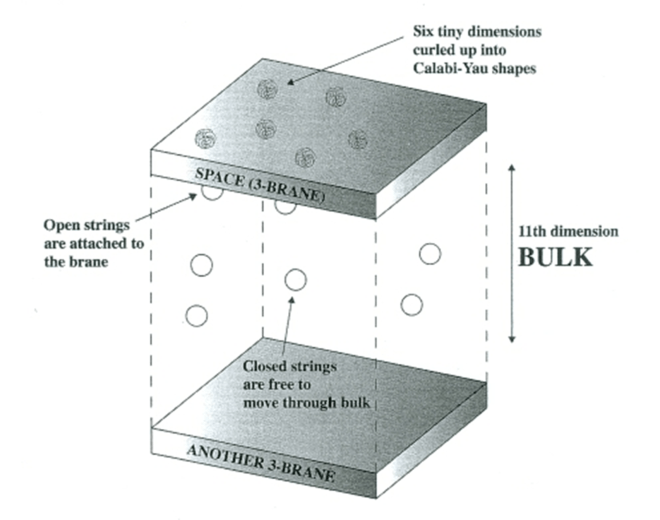
This sounds extremely promising, maybe, but there are issues and hurdles, not the least that strings and higher spatial dimensions are very difficult to detect, if they exist. Also, it’s very hard to pin down all the implications mathematically in a useful way.
I remember one lunch break when I was still in medical practice when I tried to see if I could work out mathematically if “dark matter” could be explained by a relatively nearby, parallel brane-universe (it would probably be more than one, but one was difficult enough) whose gravity spills over into and overlaps the gravity of our brane-universe.
Here’s a sort of reproduction of some of the scribbling I did then:
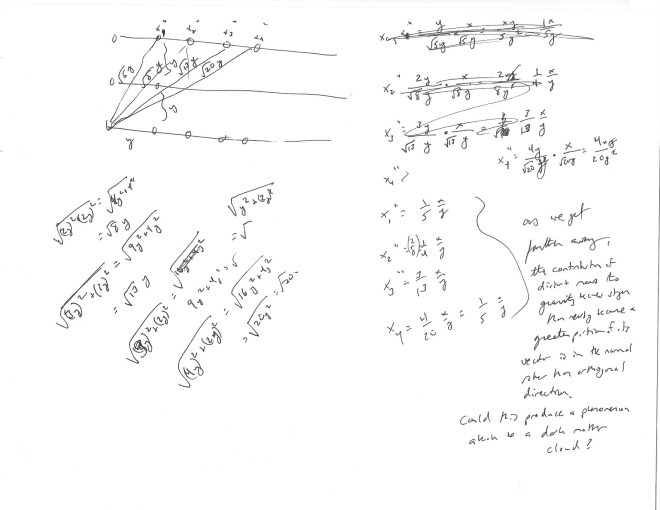
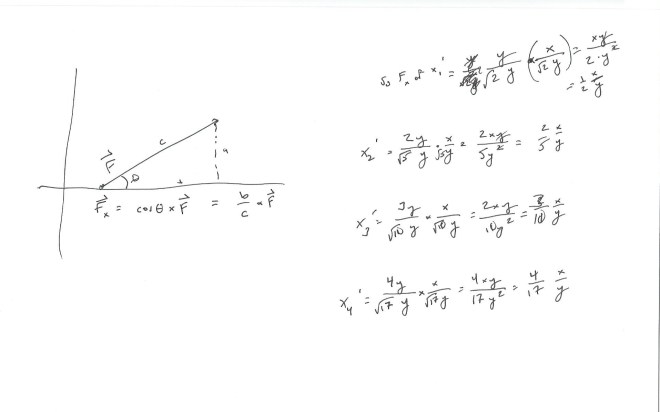
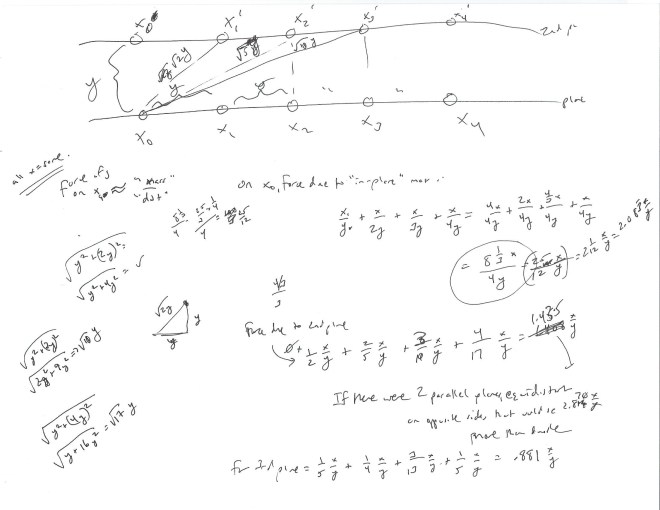
Unfortunately, though I could visualize what I was considering and get an intuitive feel for what the math would be like, my precise mathematical skills were just not up to the task of sorting it out rigorously. Also, of course, lunch was not long enough, and I had many other things on my mind. Anyway, findings like the “bullet cluster” provide some fairly strong evidence that “dark matter” is something physical within our three dimensions of space.
Okay, that’s enough for today. I’ve managed not to talk about my depression and stress and self-destructive urges/wishes (except just now, of course), so I hope you’re pleased to have had those things cloaked from you today.
Take care.
*Working out the exact number of days, I think I figured that it was 302. December 25th is 7 days before New Years, so it’s day number 358 in the (non-leap) year. And today is the 25th day of the second month, and January has 31 days, so today is day 56 of the year. And, of course, 358 – 56 = 302.
**Why not my usual “AD or CE?” Because at the time, in England, it was just “anno domini”.
***Named for Julius Caesar, though as far as I know, he had no more to do with actually formulating that calendar than he had with the invention of the 7th month. As far as we know, he wasn’t even born by the then-existing version of Cesarian section, which was more or less always fatal to the mother, and his mother lived well beyond his birth.
****Named after Pope Gregory XIII, also known (by me) as Pope Gregory Peccary*****. He did not formulate the newer calendar, but supposedly he at least commissioned the Vatican astronomers to create it when it had become obvious that the Julian calendar was not quite tracking the actual year but was overshooting over a long period of time. So, the Gregorian calendar is better named than the Julian calendar, or so it seems to me.
*****The nocturnal, gregarious wild swine.

 Robert Elessar
Pope Gregory Peccary..the nocturnal gregarious wild pontiff!
Heh. I thought you’d appreciate that. ^_^
Pingback: Is it mean not to know if one’s writing is above average? – Robert Elessar