
It’s Friday, and this weekend I am not working, which right now seems like a highly positive thing, because starting yesterday in the middle of the day, I suddenly had a huge flare-up of my back/hip/leg pain. I’m not sure what triggered it. I’m always trying to see if I can tease out (and test) the causality of such occurrences, but of course, it’s a tricky business, with so many possible variables. I wondered if it was something I ate‒I had a specific type of food in mind, that I had not eaten for a while‒or was it partly because of my severely poor sleep the night before? What was it?
It was frustrating in more than the usual sense because, after having walked to the train that morning and not having any problems from it or the previous few days’ longish walks, I was planning to walk in the evening again. Unfortunately, I did not feel up to such a thing when the time came, so I took an Uber to the house‒after getting some comfort-oriented ice cream at the Cold Stone Creamery*, a place I’ve not visited in over a decade‒and then another one to the train this morning, since I still feel rotten.
It’s noteworthy that, when I am in more severe pain than usual, my willpower to resist indulgences that I want to resist gets quite a lot weaker. I suppose that trying to compensate for and deal with the pain diverts mental resources that would otherwise be pointed toward self-discipline. I had a big hot pastrami sandwich for lunch yesterday and then that ice cream, but they were both far less satisfying and pleasant than I would have expected. I don’t think I’ll ever get either one again.
I’m always trying to think about my back pain and the things that trigger and assuage it and so on, and occasionally‒though for the most part it’s all well-trodden ground‒I come upon some possible connection that I hadn’t seen before. Yesterday, while thinking about my then-present back pain, I thought back to my childhood leg pains, which I think I’ve mentioned here before. When I began having my current problems (about 20+ years ago), they first presented as a recurrence of the kinds of pains that I had as a child, quite similar in character. This led to various investigations to look for neuromuscular or myopathic processes, but I had no myopathy**.
Having more recently researched connections between autism spectrum disorders (which I might have) and congenital heart disease (which I certainly did have‒Atrial Septal Defect, secundum type‒because I had open heart surgery for it when I was 18), it yesterday occurred to me that there might be other associated anomalies.
I think it was while I was browsing biomedical news related to neurodevelopmental stuff on a site that’s linked with phys.org (which is a science news site that I enjoy and recommend) that I saw something about neural tube defects related to autism spectrum disorders.
Neural tube defects (NTDs) occur when the neural tube‒the embryonic infolding that creates the cavity that becomes the sort of scaffold and center of the spinal cord and central nervous system and its supporting structures‒fails to close completely on one or both ends. It’s mainly to prevent these that potentially pregnant women in the modern world are encouraged to take daily folate supplements. NTDs can be utterly catastrophic, producing forms of anencephaly and various types of severe and lifelong neurological impairment, or they can be comparatively mild, all the way down to spina bifida occulta.

That latter term describes the situation when, at the very lower end, the spinal bones and what not are not completely closed at the rear. The “occulta” part refers to the fact that there are no noticeable external findings that show the presence of the incomplete closure. The most commonly affected portion of the spine is in the L5 and S1 vertebral bodies (lumbar and sacral, that is) with somewhat incomplete rear closure. These findings are, according to what I have read, not always noted on MRI unless it is looking for them specifically.

It is noteworthy (to me) that when my back was investigated, including “provocative discography”, I had not just a bulging disc but a full thickness tear in the L5-S1 intervertebral disc, going all the way from the outer edge to the nucleus pulposus. Imagine one of the pieces of Freshen Up gum, with the goo in the middle of each stick up gum, but torn inward from the edge so that the central liquid leaks out. That’s the sort of thing I had.
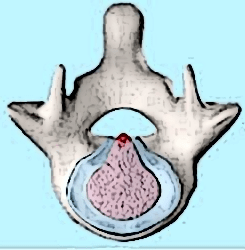
And it was in the rear of the intervertebral disc, just where any SBO might have left poor structural support. No one noticed SBO in my back when they were working me up, but they weren’t looking for it, nor even looking at the bones in particular. No one (including me) suspected any skeletal issue. And SBO can be very occult, and may present, conceivably, with only very minor, hard to notice changes.
I haven’t yet mentioned that one of the findings that can be associated with SBO is bed-wetting. I had trouble with that, in addition to my frequent and rather severe childhood leg aches, far later than my siblings…in fact, I never heard of either of them having that trouble at all.
It turns out that the correlation between congenital heart disease and SBO is quite high as such things go, more so than either condition’s correlation with autism spectrum disorders. Of course, most people with congenital heart problems do not have neural tube defects, and vice versa, but the existence of one involves a prevalence of the other that is quite a lot higher than in the general population.
So, though I cannot arrive at any firm conclusions, I know that I had congenital heart disease, I have lifelong neurological and psychological attributes that seem (to me) to be consistent with what would have been called Asperger’s Syndrome before about 2013, and I had symptoms (and signs) that could very well correlate with the presence of a minor form of Spina Bifida Occulta***.
Also, of course, my physical findings when my back was investigated for a resurgence of leg pain in mid-adulthood are consistent with a structural weakness in the posterior region of L5-S1, such that my disc damage or injury was markedly worse than most I’ve seen in patients with whom I’ve been associated, or in descriptions of disc disease.
Alas, I no longer have, nor have access to, my former radiographs of any kind, nor medical notes or surgical notes. I could be incorrect in this assessment of possibility, and I certainly don’t put my credence very close to 100%. But I think I’ve nudged myself at least past the 50% point.
Whatever the case, I have chronic pain now, and I’ve had surgery in my back and implanted matrix with bone growth factor there and a titanium cage, so it’s probably all too messy ever to discern if there used to be a very minor case of SBO in the past. Until and unless someone develops a means of scanning the past such as the Father invented in my book Son of Man, which uses complex time (and a phenomenon I made up) to be able to scan the past of quantum fields without running afoul of the uncertainty principle, I’m unlikely ever to know with anything close to certainty.
I’m convinced that our firm credences of any of the facts of reality can never actually be 100%‒I personally don’t even consider “I think therefore I am” to be completely valid, since even my consciousness might be part of some much greater mind’s imagination…though I suppose in that case, it would still be valid to say that “I am”, just that what I am would be different than what I seem to myself to be.
But for all practical purposes, it’s reasonable to go with Descartes, though. Most other aspects of reality are, as he pointed out, less certain than we often suspect them to be‒except when they are more certain than we expect them to be.
I hope I haven’t bored you too much with these thoughts. They seem interesting to me, of course, but I recognize that’s no guarantee that anyone else will find them anything but mind-numbing.
It would be nice if I could find a way to get better answers than I have on questions of personal neural tube defects or neurodevelopmental disorders, but even textbook findings of such disorders are somewhat misleading, because we don’t have MRIs (or similar) of everyone in a population and symptoms or signs to correlate with findings. Indeed, almost by definition, the MRIs and CTs and X-rays of people with such issues are going to be those with the most obvious and glaring findings.
Oh, well. Reality is often disappointing. But at least thinking about these things is momentarily engaging.
I won’t be writing a blog post tomorrow, barring the unforeseen, so I hope you all have as good a weekend as you can have‒which you will, since whatever happens will be what has happened, and will not be subject to change once it has (It’s always the best, and the worst, of all possible worlds, in a sense). So, I guess it might be worth it not to worry about it too much. But, of course, you also don’t have any choice about whether you worry about it or not, once you’re worrying about it****.
Even if there are “many words” a la Hugh Everett, you still only will experience one version of your life. The fact that another of you might have it better (or worse) has no bearing on your experience in any given Everettian branch, unless it’s possible for the wave function branches to interfere again after decoherence, which is, in principle, possible, but so vanishingly unlikely that it seems not worth considering.
Enough! Please have a good weekend.
*It was disappointing. My tastes seem to have changed over time, perhaps due to Covid or perhaps to other matters, but some things I used to like don’t seem to please me anymore. In this case, that’s probably just as well.
**Myo- for muscle and -pathy for “something wrong with”. It’s a fairly basic term that reveals almost nothing beyond its prima facie meaning, but it sounds impressive because of the Latin.
***I should note that leg pain is not part of the traditional symptom list of SBO, but intermittent leg weakness is definitely a part of it‒and my leg aches were associated with some radicular type symptoms, such as apparently being associated with notable temperature change in the affected extremities. At least, it was notable by our family dog, Ernie, who would often unerringly come and lie on my affected leg when I was in pain, just in the right place, as if to provide warmth and comfort. He was a good dog! Anyway, disorders rarely exactly follow the textbook descriptions. As I’ve often said, diseases don’t read the literature.
****Rush were simply wrong; you cannot choose free will. It either is or it isn’t, but that’s not up to you.

 Robert Elessar