Hello and good morning. It’s Thursday, and so: here’s another blog post—meaning another regular, weekly, Thursday morning blog post. Of course, people who receive notifications about my blog posts will have seen already that not only did I publish an impromptu entry on Monday, but also that, starting on Tuesday, I’ve been sharing a chapter at a time, three times a day, of Extra Body.
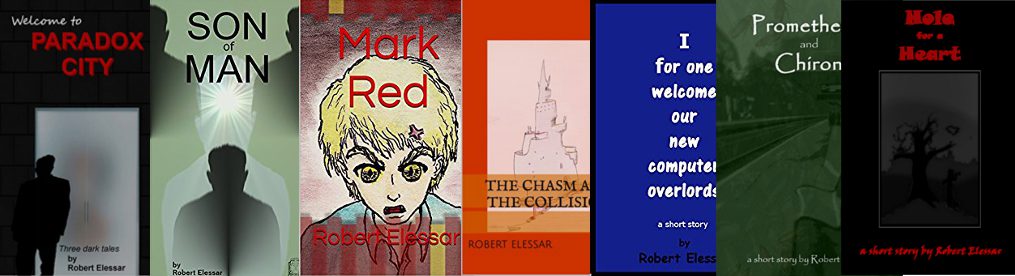
I finished the third editing run-through of that story by Tuesday morning, and I decided, “that’s good enough, I’m done with that, I’m tired of working on it, or on anything else”. I considered just publishing it through Amazon, but that would have involved designing a cover and getting the formatting right for the paperback and e-book versions, and even then it would have been far from likely that anyone (except my sister) would read any of it, ever. At least this way, maybe someone who is idly curious but wouldn’t go to the trouble of actually buying the book from Amazon (or other sources) might idly start reading it and even might read the whole thing.
Speaking of the whole thing, it will be completely published by Friday afternoon, which is when Chapter 12 is scheduled to go up.
I don’t know whether the story is any good or not. I suppose that would depend upon the criteria one uses to judge the “goodness” of a story, and no two people would probably have precisely the same implicit criteria. I say “implicit” because I doubt most people (or anyone, really) would actually apply any formal judgement criteria to such things. I think it’s a much more “analog” process, a weighted neural network/high-dimension vector addition (or possibly vector calculus) sort of problem. As such, it probably changes from day to day and even from moment to moment for every person.
It may be mathematically possible in principle for two people to have exactly the same judgment criteria about fiction*, but I suspect that there aren’t anything like enough people in all the universe—not just spatially but temporally, past and future—to have exactly the same mental state regarding how they judge and react to fiction at any given time, or even in their entire lifetimes (this discounts the potential “quilted multiverse”, if the universe is spatially infinite, in which all states would recur an infinite number of times).
I’m giving this more thought than it probably deserves. I tend to do that.
On to other matters, or at least, let’s move away from that subject.
This Sunday will be the day of the Autumnal Equinox, the official beginning of Autumn in the northern hemisphere. It’s also September 22nd (this is often the case with the Autumnal Equinox) and is thus the date of Bilbo and Frodo Baggins’s birthdays (according to Shire reckoning, anyway—I’m not sure precisely how that lines up with the Gregorian calendar, but I suspect Tolkien just kind of took them as roughly aligning, though the hobbits apparently took the 5 (and a quarter-ish) extra days of the year as a non-month in midsummer and had 30-day months for all the rest of the year). That was also the day on which Frodo left Bag End to begin his long and arduous and torturous path to destroy the One Ring.
So it is an auspicious day in more than one sense, a day on which momentous or portentous things may begin or end or begin to end.
Though Frodo survived, of course, he never was quite the same after his journey, having suffered from the stab of the Morgul blade on Weathertop, and the bite of Shelob, and—most of all—the terrible effects of the Ring itself when it was at its most perilous, its most awake, and its most desperate.
The voice-over near the end of the movie The Return of the King really expresses Frodo’s sense of enduring damage and suffering: “How do you pick up the threads of an old life? How do you go on when you begin to understand there is no going back? There are some things that time cannot mend. Some hurts that go too deep, that have taken hold.” How, indeed?
Nietzsche is famously quoted as having said that whatever doesn’t kill us makes us stronger. In response to that, I would simply say to him, “syphilis”**.
There are many things that do not kill us that nevertheless wear us down, leave scars and damage and dysfunction in their wake. Of course, one could reply that such things are killing us, they are merely doing it slowly, in a cumulative and collective fashion. But if one is going to reach for that linguistic/semantic escape clause from the dichotomy of Nietzsche’s statement, then one is merely engaging in tautology. If one says that anything that doesn’t make us stronger is, by our definition, killing us (even if only slowly), then saying that whatever doesn’t kill us makes us stronger is just saying the same thing. No insight is gained.
In any case, things wear out and fall apart no matter what. As far as we can see, that is a fundamental aspect of the nature of reality. New things do arise, lives are born, stars form, perhaps new “universes” are constantly emerging in an eternal inflationary universe. But mathematics dictates that all things eventually seek out the most entropic states—not out of any desire, any “telos”, just out of the tendency of the math of complex systems.
Things fall apart. The center cannot hold. And Darkness and Decay and the Second Law of Thermodynamics hold illimitable dominion over all***.
TTFN
*Though if the process is truly continuous, in the “real numbers” sense of continuous (quantum mechanics suggests this cannot be so), then there would be literally, uncountably infinite possible arrangements, and so it would be “infinitely improbable” for any two people ever to match exactly. That seems appropriate, given the story being discussed.
**Perhaps the real “Montezuma’s Revenge”.
***This is a mashup of and paraphrasing of separate literary works, so I’m not surrounding it with quotation marks, but: credit to Yeats and to Poe****.
****No, NOT the heroic pilot from the newer, Disney-Star-Wars films. You Philistines*****.
*****This is, ultimately, a reference to the fact that the Philistines, according to legend, stole the Ark of the Covenant from the Temple of Solomon, and thus their name is used as an epithet referring to those who show no respect for sacred or artistic or cultural worth.

 Robert Elessar