It’s Wednesday the 4th of February (02-04-2026 in the US). The best I can currently think of to say about today’s date is that it is composed entirely of even digits‒twos, zeroes, a four, a six‒which is at least uniform in a sense. But it’s rather boring, too.
Admittedly, most people probably find any such evaluation of dates with respect to numerical patterns boring. I would apologize, but it’s not as though anyone is forcing anyone else to read my blog. If someone were doing so (and I wouldn’t necessarily try to stop them), I’d like to think I would have a far larger circulation than I have.
As it is, my circulation is roughly 5 liters. Ha ha. That’s a (lame) joke regarding the volume of blood in a typical adult human body.
While I may not feel as though I am a member of the same species as most humans, I recognize that my gross physiology is basically the same, and so my blood volume should be comparable. My body just doesn’t seem to work quite as well as that of the average person, at least in some senses. For instance, my chronic pain has continued to attack me with exceptional aggression over the past several days; yesterday was particularly bad, and today is not shaping up well so far.
Not that this is anything new. I’ve been in chronic pain every day for a quarter of a century now (though I suppose when it had just begun one would not call it “chronic”), if my memory is accurate, which it usually is. That’s just a bit longer than my youngest has been alive. It’s not pleasant (though my youngest is), and at least partly in consequence of my chronic pain, neither am I.
I do think that my outlook and my personality would be much better if I did not have pain every day. I would probably sleep better, as well. I almost certainly would not have gotten involved in trying to treat other people’s chronic pain in less than ideal circumstances, and so would have avoided at least some catastrophes that happened because of that (apparently misguided) intention.
Still, I’ve been prone to depression since I was in my early teens, well before the onset of my chronic pain, so maybe I’ve always been unpleasant. And though I didn’t know it, I’ve had ASD all my life (even after the heart-based ASD I had was corrected through open-heart surgery when I was 18).
That’s a weird coincidence of acronyms, isn’t it, those two kinds of ASDs in one person*? It can be rather confusing when the same acronym signifies two quite different things. Still, there are only so many 3-letter acronyms available. The maximum number in English is 26 to the 3rd power, or 17,576.
You might think that ought to be more than enough for there to be no overlap, but of course, acronyms aren’t merely randomly chosen letters. They need to signify something specific in order for them to be useful, and far more words start with A or S or D, for instances, than start with X or Z or Q.
It’s a bit like dealing with words in general. In principle, a word of a particular length (let’s use the variable x to signify that length) in English could be any one of 26 to the xth power possibilities. But English is not a random cipher, and there are many possible orderings of letters than are not “allowed” in English, because they don’t produce any plausible sound. English is, of course, a written version of a spoken language. If a word can’t even be pronounced, it’s not much of a word.
One cannot, for instance, have a word that consists of all consonants (certainly none are coming to my** mind). One could produce strings of consonants that could be sounded out, I suppose; one could for instance pronounce the string “mrndl” pretty readily, I think. But that’s just generally unwieldy, and in some languages it cannot be done.
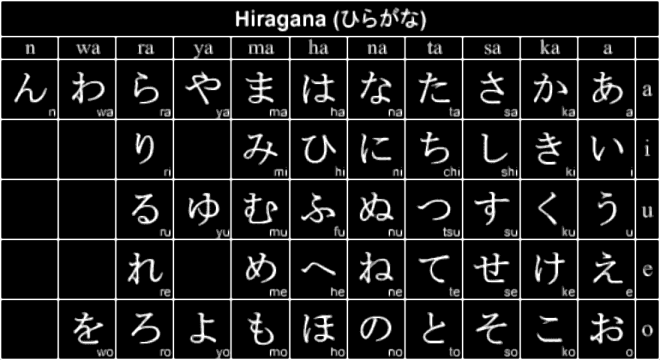
In Japanese, for instance, all but one pair of kana representing sounds/syllables (hiragana for native words, katakana for imported words) are of the “consonant-vowel” sound type (e.g., ha, ke, ni, su, to, etc.) or just vowels (e.g., a, i, u, e, o). Only the “n” syllable stands alone (sometimes pronounced as almost “m” depending on the context) and it occurs only at the ends of words. Thus, in the game of shiritori***, if a player says a word that ends with “n”, they lose, because the next person cannot possibly begin a subsequent word.
How did I go from discussing the uninteresting digits of today’s date to the game of shiritori? I suppose I’ll find out when I do my editing. It is strange, though, even to me. I can only imagine how bizarre and confusing it must be for others to read my blog posts. With that in mind, I’ll cease this particular crime against humanity or against logic or reason or whatever for now. Please accept my apologies, and hopefully you will have a good day.
[P.S. The above headline would be transliterated as “Doumo arigatou, Mister Robaato”, which can be meant as “Thank you very much, Mister Roboto” (as in the Styx song) or as “Thank you very much, Mister Robert.” Curious, ne?]
*Actually, there is a higher incidence of cardiac ASDs, as well as several other atypia that I have (such as a cavum septum pellucidum) in people with the neurodevelopmental version of ASD than in the neurotypical population. Interesting, isn’t it?
**Wait a moment‒the word “my” is superficially composed of two consonants, isn’t it? Well, in a sense that’s true, but this is one of those cases we were taught about in elementary school in which the letter “y” acts as a vowel.
***(しりとり) In this game, one person says a word, and the next person has then to say another word that begins with the same syllable with which the previous word ended. It goes on until one player cannot think of a word that hasn’t already been used or until someone uses a word ending with “n”.

 Robert Elessar