We skipped the light fandango…

Well, here I am, writing a blog post again on Tuesday, Batman* only knows why.  I don’t really have anything of substance to say.  Not that I had anything of substance to say yesterday.

Actually, come to think of it, I did encounter a neat fact last week.

One morning I decided to get in a bit of reading in one of the textbooks I keep in my office‒Classical Electrodynamics by John David Jackson.  I employed a technique I’ve often used for reviewing:  I flipped a coin to increasingly winnow down the textbook‒heads is first half, tails is second half, etc.‒and pick a random section to start reading.

I knew that much of the mathematical formalism and at least some of the technical matters in the book would be unfamiliar, so I didn’t expect to understand fully what I was reading.  But I also know that the stuff I do and don’t understand will linger in my brain, and as I’m exposed to other things that go with it or explain it or link up with it, the picture will form.  I don’t read or learn especially quickly, but I do learn deeply, and in a way that connects ideas and principles together in the end.

There was much of this brief section (which was about refraction and/or absorption of light** by water) that was slightly over my head.  Nevertheless, it was interesting, and the author introduced a graph (see below) showing at the top the refraction of light by water across wavelengths, and how it tends to vary.  I assume we’re all at least implicitly aware of the fact that different wavelengths are refracted by water differently‒thus the phenomenon of rainbows.
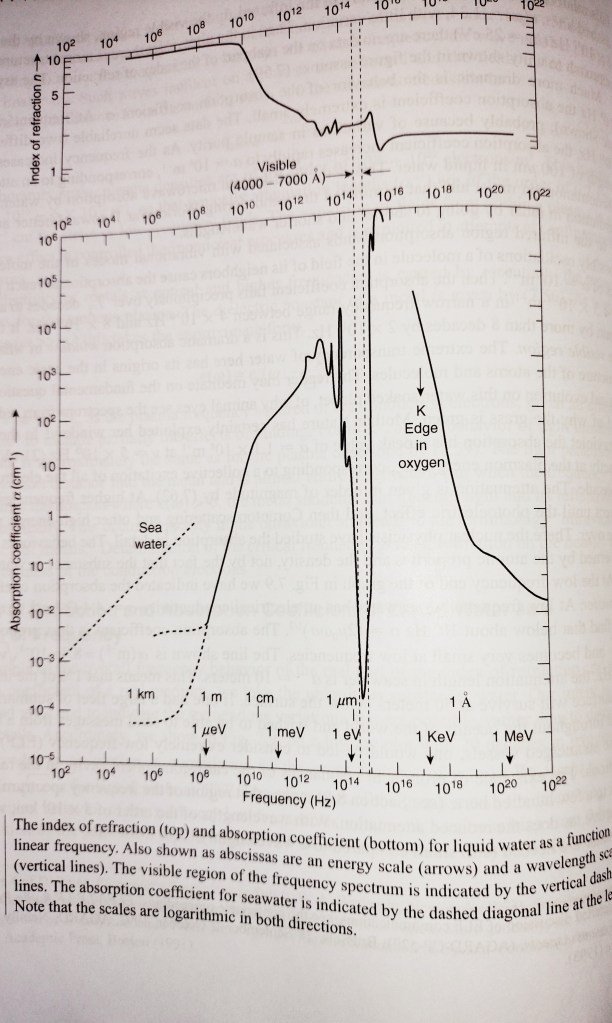
Below this is a table showing the absorption of electromagnetic radiation by water across frequencies.  Here there is a steep upward slope when coming in toward the center from highest and lowest frequencies.  It peaks at around the microwave/infrared wavelengths from the left and around the ultraviolet from the right.

Then a striking thing happens.  There is a sudden, precipitous drop in absorption down to very low levels in a fairly narrow range of frequencies in the “middle” of the graph, meaning that in this range, light passes through water with relatively little absorption.  This is the range we know as visible light.

The author took the time to point out that this fact about the nature of water‒that it is more or less transparent in this very narrow range of frequencies‒is exactly why we Earthlings tend to see only in that range.  It’s not an accident of evolution, some ancient, stochastic occurrence that is thenceforward cemented, unchangeable, into all descendants, like the DNA code and ribosomes and the chirality of biological molecules.  It is instead a fundamental fact of physics that determines where creatures will be able to see if they first developed vision while living in water and then developed eyes that, like the rest of them, were mainly made of water.

There’s no point in making retinal proteins that react to wavelengths of EM radiation that are almost entirely absorbed by water.

That simple fact‒simple in summary, at least‒is enough to explain a huge swath of the nature of our visual perception, and it doesn’t require any further explaining to understand why we see in the range of light we do.

That was just a randomly chosen section of a textbook that reputedly is extremely difficult.  I don’t disagree with that assessment of difficulty; it was a very dense bunch of material even in just 4 or 5 pages.  But to think that one can find such remarkable facts while just trying to read and learn in random order from a textbook!

So, that’s an interesting little tidbit that seems worth sharing, at least to me.  It’s far more interesting than anything going on in the human world right now.  What’s more, this is a fact that has existed as long as water itself has existed‒and implicitly, it existed even before that, lying there waiting in the fundamental laws of nature.  And it will be there long after everything but those fundamental laws is gone.

If you want to embrace eternity, and things like Hilbert’s Hotel and Cantor’s diagonal proof make you worry about your sanity (this happens to many of us, so don’t feel bad) then focus on this fact about visible light.  It’s there, it’s real, it’s quasi-eternal, and it’s concrete.

Though the absorption spectrum for concrete is…quite different.


*This harkens back to the reference from Batman Begins, when Flass says “I swear to God,” and Batman snarls “Swear to me!”  It seems fun to use Batman when one would normally say God.

**By “light” I mean all electromagnetic radiation, from radio waves to gamma rays.

Now is the summer of our discontent made glorious winter by this blog post

Hello, good Thursday to you.  A very Happy Winter Solstice to all, and to all the longest night of the year.  At first glance that may not seem like something one ought to celebrate, yet cultures all around the northern hemisphere have celebrated it for time out of mind.  Mainly, I think, we revel in the fact that “this is as bad as it’s going to get.”  It’s actually one of the most festive times of the year, and that festive spirit is both an act of defiance of the darkness and a celebration of the imminent return of greater light.

Of course, as someone who writes mainly dark fiction (even my sci fi and my attempts at humor are quite shadowy), it might seem odd that I should celebrate the return of longer days.  But even most of the darkest stories tend to be about the struggle against the (metaphorical) nighttime, and the triumph of the light.

In long stories, at least, it’s generally necessary to come to a conclusion wherein the light triumphs and/or holds back the darkness.  There are exceptions, of course, many of them found in more “realistic” fiction, but the vast majority of novels end with the good guys winning, or at least with the bad guys losing.  This is understandable.  It’s a hell of a thing to journey through a story that’s 120,000 words long (and often quite a bit longer, as my novels tend to be), only to find that in the end everything goes to shit.  It’s even more terrible if the story is a series of novels.

Just imagine, for instance, that you finish reading “Harry Potter and the Deathly Hallows,” only to find that in the end Harry dies, and Voldemort wins.  Not only would it be a bummer—even if you’re a fan of good bad guys, as I am—but it would also make you unlikely to read the books again, or to recommend them to a friend.  It’s just too hard to undertake a seven-book odyssey knowing that your beloved heroes lose.  Of course, you always consider the possibility that they might lose as you read the books for the first time, and J.K. Rowling pulls no punches in having terrible things happen to characters we have grown to love.  But you nevertheless read her books, and others, with the optimism born of experience, that in the end, even if things aren’t exactly “happily ever after,” at least the immediate evil will have been contained or destroyed.  Our heroes sometimes come to a peaceful, productive life at the far end of their trials, à la Harry Potter; sometimes, they pay what seems an unendurable price for the benefit of defeating evil (poor Roland Deschain!).  But we can be reasonably safe in the assumption that, though all may not be well, the immediate threat will have been overcome.

This is just one of the advantages fiction has over reality.

On the other hand, one of the great, fun things about short stories is that the good guys don’t necessarily win in the end.  Short stories don’t even have to end with the bad guys losing.  In fact, they may end with everything just about as bad as it can possibly be.  In this, short stories really are Forrest Gump’s box of chocolates, and sometimes it’s a box of chocolates made by Monty Python’s Whizzo Chocolate Company, where the best you can hope for is a Cherry Fondue that’s extremely nasty (but we can’t prosecute you for that), and you might just get a Crunchy Frog, a Cockroach Cluster, a Ram’s Bladder Cup, an Anthrax Ripple, or even a Spring Surprise (“covered in dark, velvety chocolate, the moment you pop it into your mouth, stainless steel bolts spring out and plunge straight through both cheeks”).

“Where’s the pleasure in that?” as Inspector Praline understandably exclaims, and you may well share his sentiments.  But…there is pleasure in that, at least in the metaphorical version of it that is the dark short story with no happy ending.  And I’m not quite sure why, but I really enjoy writing (short) stories that summon the shade of Jim Morrison, taunting, “No one here gets out alive.”

(Yes, we are mixing not merely metaphors and genres, but entire art forms here.  Don’t worry.  We can handle it.  We are large, we contain multitudes.)

Speaking of short stories:  I am almost ready to release “I for one welcome our new computer overlords,” on Kindle, in a newer, better version than the one I posted here.  I know it’s taking a long time, but as I’ve said before, this would go a lot faster if enough people bought my books that I could survive by writing full time (hint, hint).

For those who didn’t get the chance to read “Ifowonco” here on this blog, I’m going to make you wait and find out on your own whether the story is a lovely English Toffee or a Spring Surprise.  Either one can we wonderful.  Like Mr. Milton (the owner of the Whizzo Chocolate Company), I’m very proud of my creations, and like him I use no artificial additives or preservatives of any kind.  I will warn you, though, that even at my most sugary, I don’t tend to create purely light and sweet things; even my brightest creations use dark chocolate.

All right, enough with the frikking candy metaphors.  Jesus!

In closing, I want to once again put out a request for feedback on the possibility of creating “Author’s Notes” for my published works, and posting them—with clear identification—as “reviews” on Amazon, hopefully for the benefit of those considering buying the books.  As far as I can tell, this is allowable within Amazon’s guidelines.

Of course, an alternative to this would be posting my author’s notes here, on this very blog.  In a way, that’s what the blog is, after all:  A sort of weekly author’s note.  I’m fine with that idea, and I think it might be fun to write the notes and post them here, but they would really only be useful for those who already read the blog; they wouldn’t provide any benefit for someone shopping through Amazon.  So, I do think the idea of doing such a note/review might be good, but I’m leery of undertaking such a thing if people would consider it to be in very bad taste.  I’m willing to do things in bad taste, but very bad taste is worth avoiding, I think.  Which is why I recommend the Crunchy Frog over the Cherry Fondue.

Please take care when buying your sweeties, please do enjoy the advent of longer days to come, and please give me your opinion, if you have one, on the author’s note idea.

TTFN