Outlaw’s Mind – Part 12

Over the course of Thursday evening, and into Friday evening, Timothy spent at least a bit of his time online, trying to see what he could do to eke out his understanding and knowledge about Hinduism, Buddhism, Atheism, and Taoism—this last he had trouble spelling, but Google was quite helpful with such things, so he was able to correct his misunderstanding quickly.  He wondered with somewhat disgusted confusion why people had ever spelled Taoism with a “T” when they pronounced it with a “D”.  It wasn’t an English word originally, after all—it was a transliteration from what must have been a Chinese character or characters.  They could have just used a spelling that reproduced the original sound in English in as straightforward a way as possible.  Were they trying to be cryptic, or to sound impressive, or to convey the fact that it was a foreign word by not simply writing the name of the original book as “Dow Day Ching”?  All the reasons he could imagine left him feeling minor contempt.

At least the spelling of Hinduism, Buddhism, and atheism made a bit more sense. Continue reading

Plenty and peace blogs cowards; hardness ever of hardiness is mother.

Hello, everyone, and good morning, everyone.  It’s Thursday—it’s quite early in the morning, since I’m having a particularly noteworthy iteration of insomnia today—and so it’s time once again for my weekly blog post.  This is the first Thursday in May of 2022, which is mildly interesting, I guess.  It’s also Cinco de Mayo, so for those of you who celebrate that holiday:  Enjoy!

As those of you who pay attention to it will have noted, I posted the most recent part of Outlaw’s Mind here on Tuesday.  I hope those who are reading along steadily—if there are any such people—are enjoying it.  It’s a fairly dark tale, which is probably why I’ve had to keep stopping and starting it as I go along.  I like my main character, Timothy Outlaw, and I keep making crappy things happen to him, or at least having him experience crappy things.  So, I have to take a step back from time to time.  It’s strange that this story has such an effect on me, considering I’m the author; I don’t know what it might say about my own psychology, if anything, but it can be a bit frustrating.

On the other hand, The Dark Fairy and the Desperado—which is not entirely a light-hearted tale, either—is at least quite fanciful, it being a supernatural adventure across multiple universes, the main characters of which are an unerringly deadly gunman from the Old West of our world (or one very much like ours) and a very angry fairy from a completely different world, whose experiences with humans have filled her with an enduring wrath that earned her her sobriquet.  And, of course, they only meet because of the machinations of a wizard from yet another world who has become trapped in a universe of his own creation and needs help getting out of it.  So, while it’s heavier in some senses than Outlaw’s Mind—Omniversally heavy, one might say—it’s lighter in tone.

I’ve gotten quite a lot of writing done on it lately.  This is at least partly because I’ve been taking the train, and so I can write while I’m traveling to work.  Even though I didn’t accomplish anything at all last Friday, I’ve still written just shy of 8500 words since this time last week.  I haven’t even introduced the Dark Fairy yet, since it takes some time to bring a desperado out of the Old West into a trans-universal setting and explain to him what the heck is going on when it happens.  It helps that, at the time he is transported from his home, he is facing nearly certain death in the desert, without a horse and without water.  He figures almost anything would be preferable to that, so he’s able to go along with things.

Anyway, it’s a fun story, and one I’ve had in my mind for roughly as long as I had Mark Red.  Like Mark Red, it was originally thought up as a manga, and it’s now meant to be a series of books; I haven’t written any more of Mark’s story yet because, frankly, no one has expressed any interest.  I still may end up doing it, though—assuming I live that long—because Morgan, the vampire who saves Mark’s life by making him into a demi-vampire, is still my favorite character that I’ve written to date.  There are at least two more books waiting to be written about her and Mark.

The adventures of The Dark Fairy and the Desperado will probably take more books, because of the structure of the adventure they’re going to be having, but I don’t expect the books to be as long individually.  There will be more action and less soul-searching, so to speak, since neither of the main characters are teenagers, and in fact are quite hardened and cynical, each in his or her own way.  Neither one needs to try to avoid becoming a killer and/or a supernatural being, since it’s already too late to avoid such things.

They inhabit the same Omniverse as do the various characters in my other stories—after all, the Omniverse is infinite in infinite dimensions, and it contains all possible universes of any nature—but they will spend more time traveling from one realm to another than pretty much any of my other characters*.

And that’s pretty much a summary of everything that’s happening in my life or is likely to happen—I don’t really do anything for fun**, I don’t have any real friends***, I have no pets, no local family (none that want to see me, anyway), and no hobbies**.  I occasionally attempt to play guitar and sing, but that’s more my way of punishing the world, à la Welcome to the MachineI don’t know that it could be considered a worthwhile endeavor.

But I continue to write, both my books and this blog.  I hope you all enjoy reading it (and them, when and if it applies), and I hope you have a good holiday, if it is one for you, and that in general you have the best possible day, week, month, year, and life you can have, along with those you love and who love you.  And try to treat all the other people well, also, if you can.

Oh, and wish your mothers Happy Mother’s Day this coming Sunday, if you’re lucky enough still to be able to do so.  And to all you mothers**** out there—Happy (early) Mother’s Day from me!

TTFN

cinco dance


*With the possible exception of the eventual story Changeling in a Shadow World, which I’ve mentioned here previously.

**Other than writing, I guess.

***Does that surprise anyone at all?

****Rarely enough, for me, this is not intended as “half a word”.

Outlaw’s Mind – Part 11

Timothy didn’t tell his mother about what had happened, but he was all the more eager to hear word from Dr. Putnam about this mindfulness meditation person, hoping as fervently as he could allow

himself to hope that he or she would be available, affordable, and useful.  The very kindness of the police officer—and of the boy he had pulled out of traffic—was harder on Timothy’s conscience than would have been the most unfair abuse from the most hardened and cynical of lawmen.  He hardly felt that he merited the kindness; it felt to him like just one more debt that he owed to the universe.

He did not speak again to the boy he’d pulled out of the way of the errant car.  He never even learned his name.  In fact, for the next several weeks, he pointedly took a different route both to and from school and waited five extra minutes before leaving in the afternoon, just to avoid any possible encounters, any shows of gratitude, or—God help him—any wish that might be expressed by the boy to become his friend.  He felt a bit guilty about this, since he was quite sure that the boy would want to convey positive thoughts and feelings and would probably feel bad that he wasn’t able to give a formal thank-you to Timothy, but if he knew how self-hateful Timothy would feel in receiving such a thing, the boy would probably have been willing to let it go.  This avoidance might have hurt the boy’s feelings in some minor way, but that was just another bit of—relatively minor—damage that Timothy chalked up to himself.

Word from Dr. Putnam came late that Thursday evening, almost at a time that was unreasonable to call.  Timothy’s mother—home and already having finished dinner and, with Timothy’s help, having cleaned up—answered the landline in their apartment, saying the doctor’s name in greeting when she recognized who it was. Continue reading

Why, what is pomp, rule, reign, but earth and dust? And, blog we how we can, yet die we must.

Hello.  Good morning.  It’s Thursday, and so, whether anyone asked for it or not—whether anyone wants it or not—it’s time for my weekly blog post.

I can only apologize.

So far, this week has been marginally better than last week for me, which may not be saying very much, but at least it is better by some measures.  I got quite a bit of writing done this Monday through Wednesday on the train; I’ve been using my laptop, not my phone to do it, despite my thoughts that I just might stick with the former device.  Still, on each of those three days, I wrote roughly 2100 words in the morning, which is more than twice as many as I wrote last Friday, which was a very difficult day, continuing the pattern of the days that had preceded it.

Anyway, The Dark Fairy and the Desperado is moving along well.  Though we have not met the Dark Fairy yet, we have met the Desperado.  He is the first person we encounter, and he is soon to be sent to meet his fellow title character.  It won’t be a friendly encounter, I’m afraid, but if things all went easily, where would be the fun?  A story without the exchange of fireballs and bullets between protagonists can hardly be called a story at all.

I also remembered to post the next part of Outlaw’s Mind here this week, unlike last week, so to those of you who were pining for it, you’re welcome.  I tried to put in a “continue reading” tab, so that it wouldn’t take up as much screen space for scrolling purposes if you’re trying to go back to further entries, but I’m not sure I succeeded.  I didn’t try very hard to check, and I haven’t yet gone back to insert any in earlier posts.  Have I but world enough and time, I mean to do so.

I’ve considered perhaps interspersing some posting of parts of The Dark Fairy and the Desperado here, perhaps alternating with Outlaw’s Mind, perhaps posting them on another day of the week.  Let me know what you think, if you have any interest in the question at all.  It’s not a horror story, but is instead a trans-universal fantasy adventure, so be prepared.  I want to (and so I hereby do) remind everyone that these are stories in early draft form*, so they won’t be as polished and streamlined as something that’s been formally published would be.

In this, unfortunately, they may bear all too much resemblance to all too many of at least the online versions of publications from Scientific American to the various major newspapers, all of which seem to have fallen into the editorial hands of the pointy-haired boss from Dilbert, and many of the writers of which seem to have learned their trade via Twitter-mediated coursework.  Honestly, the state of much of the publishing industry is terribly dispiriting to note.

More than once within the last few months, in mainstream-published books about arguably serious subject matter, I’ve encountered the words “free reign” used instead of “free rein”.  That latter is an expression related to horseback riding, in which one essentially releases control of the horse to allow it to go where it will, presumably at high speed, but with outcomes that may be difficult to predict, and this is the source of the metaphor.  The former is…I don’t know, perhaps a reference to some form of particularly liberal monarchial regime**.

But, as they say, I digress.  I’m prone to do so often and grievously.  The point I meant to make was simply that I wouldn’t want you to mistake the form in which I might share parts of a story here for the way they might appear in “officially” published form, in case anyone were to consider buying one of my books.

One other thing I did at the end of last week was to record a video of me playing guitar and singing the David Bowie song, A Space Oddity.  I had downloaded the chords to the song from a site of which I am a member, and they sounded so good to me when I played them, even though they weren’t particularly difficult chords, that I couldn’t resist making a video.  I’ll embed it here, for anyone who is interested.  I make no promises regarding the quality of the playing or the singing; I just liked singing and playing the song.

And I think that’s pretty much what I have to share this week.  I hope you’ve all been feeling and doing better than I have been, and I do mean “all”.  I’ve been having a truly rough time, though at least I’ve kept on writing, and I don’t want any of you to feel like I do, no matter what Peter Frampton might say.  I would seriously like you to share (in the comments here, not on Facebook or Twitter, which I tend not to spend much time on for the sake of my already alarmingly tenuous mental health) whether you would be interested in reading sections of The Dark Fairy and the Desperado, and if so whether you would mind if I alternated them with Outlaw’s Mind, or if you would prefer to have me share them in another slot during the week.

Otherwise, as always, please try to be kind to each other and to yourselves, because goodness knows I’m not likely to do it.

TTFN

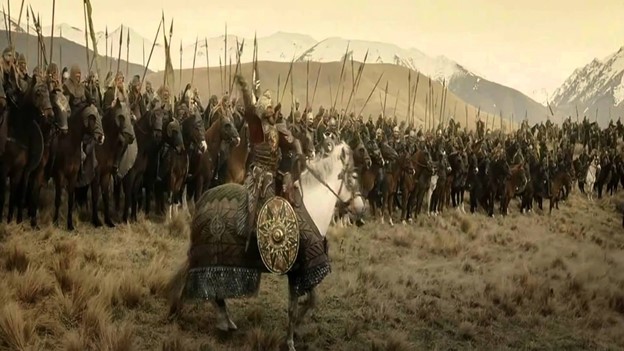
Theoden king


*It wouldn’t be quite accurate to say that they are first drafts, because I always reread what I’ve written the previous day before starting on any new writing, and I edit as I do so.  Often, I’ll have reread a portion and edited it more than once in this process, depending on how much I wrote the preceding day.

**A regime, by the way, is related to the rule of a person or dynasty over a nation, or something analogous.  A regimen is a “prescribed course of medical treatment, way of life, or diet for the promotion or restoration of health”, and related usages.  The words are obviously related, so it’s not such a big deal to conflate them***, but it is a bit sloppy, and—of course—it irritates me far beyond its level of importance.  One follows an exercise regimen, not an exercise regime, unless one is ruled over/governed by one’s workout routine in a more or less literal sense****.

*** “Reign”, on the other hand, comes from Latin via Old French and Middle English and so on, while “rein” is apparently derived from Old Norse, so though they are homophones, they are not closely related words.

****A “diet” is more complicated, since it can refer to a legislative body, thus making things ever more confusing, though I doubt that many people confuse regime with regimen for that specific reason.  There’s even a famous historical “Diet of Worms”, which had nothing to do with the eating habits of annelids, but instead referred to a body convened to address the heresy of Martin Luther.  Though I love it dearly, English is often muddled and can be confusing.  It’s both a technically “degenerate” code and also often not a very specific one.  Maybe I shouldn’t get so worked up by people mistaking a horseback metaphor for one related to monarchy and similar governmental situations.

Outlaw’s Mind – Part 10

His mother did, in fact, want to hear how the appointment had gone.  Timothy guessed, based on her body language and tone of voice as she asked, that she’d been somewhat worried that Dr. Putnam would disparage her unilateral ban on psychopharmacology.  When Timothy told her that the doctor had been entirely on her side with respect to that issue, she seemed so relieved that Timothy felt the time was ripe for him to share the notion of meditation.  He couldn’t recall the foreign word Dr. Putnam had used, but the concept of “mindfulness” seemed, at first glance, rather straightforward.  His mother appeared not skeptical but rather more at a loss when Timothy told her, as best he could, what Dr. Putnam had shared with him about mindfulness meditation.  She had, of course—like Timothy—heard of the term “meditation” before, but she had, if anything, less real awareness of it than he had.  It was not that she had anything against it in particular.  She was not religious, and so had no spiritual objections to the notion, though she would later tell Timothy in passing that she’d had an aunt who proclaimed with all seriousness that meditation and yoga were practices designed to leave one open for literal demonic possession.  She quite frankly simply had no basis on which to evaluate the usefulness of the practice.  So, in the end, she shrugged and told Timothy that she’d wait and see what Dr. Putnam said if and when he called.

While waiting for that call to come, Timothy had an episode that produced his first—though not too severe—run-in with the police. Continue reading

It is the bright day that brings forth the blogger, and that craves wary walking.

Hello and good morning.  It’s Thursday, as you probably know, and‒as you probably also know‒because it is Thursday, it’s time for my weekly blog post.

This may be a somewhat unusual post, not so much in content as in style, because I’m writing it on my cellphone/smartphone/mobile phone using the Google Docs app*.  Why am I doing that, you may ask? Well, it’s been a helluva week…

Through various misadventures, some due to my own failings, others due to the slings and arrows of truly outrageous fortune, I’ve been stuck commuting via various combinations of buses and trains (and a lot of walking), and though I do own a mini laptop, if I’m going to be walking around a lot, then having that little rectangle poking me right in my back surgery scar is just too much.  Maybe when I’ve gotten as fit for walking as I intend to become it won’t be a problem, but during a week in which I’m already quite stressed out, I prefer to avoid the amplification of my baseline back pain that such poking entails.

So, I’ve decided to try writing on my smartphone, and for creative writing at least, it’s been working fairly well.  The first day I did it, I wrote about 1700 words on The Dark Fairy and the Desperado even as I went through three bus transfers.  The next day I wrote 1400 words, on bus and train**, but I think the decrease was partly due to the fact that I was particularly stressed out that day.  As I said, it’s been a helluva week.

There is precedent for me writing books at least partially on my smartphone, of course.  I wrote a good chunk of the first draft of Son of Man on a much tinier and less advanced phone than I’m using now (while still on work release!), and I think that’s one of my best-written novels.  It’s one of the few for which I’ve received personal praise from a coworker who actually read the whole thing and enjoyed the twists and surprises in it.  So, I’m okay with writing first drafts on the smartphone.  It’s a lot easier to carry than a laptop, and I would have it with me anyway, whether I’m using it to write books or not.

In all this personal chaos, such as it has been and continues to be, I’m afraid I neglected*** to post the latest part of Outlaw’s Mind this week.  My sincere apologies to any and all of you who were looking forward to it.  I will return to sharing that story next week.  In the meantime, if you want to reread last week’s part, you can go here, and if you want to see all that I have posted of it so far, you can go here.  It will be listed there in reverse order I’m afraid, and for that I apologize.  I need to go back and at least add a “click here to read more” tag in those posts to save on scrolling.

There is a potential extra benefit to writing on my smartphone, whether I’m writing fiction or nonfiction:  I cannot write as quickly on my phone as I can on any normal keyboard, since I’ve been using those at least since I was eleven, and so it may force me to be more concise.  Maybe it doesn’t; perhaps there’s no appreciable difference whatsoever in my writing length and style from phone to laptop.  It feels that there is from the inside, of course, but as I had one of my characters say once, “The inside view is always the blurriest.”  I don’t unreservedly agree with that character’s statement‒it’s too absolute in two places for my taste‒but I think it’s a good reminder of how difficult it is to be objective about oneself.  In any case, I don’t think my stories will suffer.  I may even decide to keep writing this way when I don’t need to do so.

And…that’s about all that I think I have for right now.  I hope you all had/are having a good holiday, and that you got to spend time with your families and/or the (other) people you love.  The world continues to be unsane, but who could expect otherwise from a place absolutely riddled‒nay, infested‒with naked house apes?  Some of those apes are at least tolerable, though, and hopefully, being in the presence of those ones will make putting up with the rest of them likewise tolerable.  Maybe.

TTFN

hollywood train


*Which seems appropriate for me, since my nickname is Doc, and that’s the only name I go by at the office.

**I have been working to find the best route for me.  The three buses are not the ideal choice, though I enjoy being able to look at shops and stuff while on the bus.  I experienced a curious visual illusion while we were going north on 441 just before the Hard Rock casino the other day.  Up ahead I saw a lit store sign.  When we reached it, I think it was the quite ordinary display for a vape shop, but as we approached I could have sworn it read “Sliced Cod Live”.  I don’t know how my brain produced that illusion, but it sounds like the name of an indie band.  “Performing for one night only:  Sliced Cod, Live!”

***i.e., I forgot.

If all the year were playing holidays; To blog would be as tedious as to work.

Hello and good morning.  It’s Thursday again, and so, to your delight or your chagrin (or your apathy) it’s time for another edition of my weekly blog post.  We’re roughly midway through April already, which feels pretty remarkable, but as time goes by, every day is getting shorter, to quote and/or paraphrase two songs in one sentence.

I’m back on the train (yeah) today, but—thankfully—I am not back on the chain gang*.  For various reasons, I’m now more or less committed to taking either the train or the bus to work (and back) every day.  In some ways, I prefer it.  For one thing, I can do at least part of my daily writing while commuting when I’m on public transport.  It would be incredibly reckless, and likely wreckful, for me to try to write while taking some form of transportation that was under my direct control.  It’s better to sit back and let someone else take me where I’m going.

I’ve been writing a decent amount on The Dark Fairy and the Desperado this week, though not as much as I will probably write in future weeks, since I was in transition, and that makes things go a bit slowly sometimes.  Still, on Tuesday, especially, I wrote quite a bit:  over sixteen-hundred words in one morning.  Just think, if I did that five days out of every seven, it would come to eight thousand words a week!  At that rate, I could write a novel as long as Unanimity in just over a year, though I hope not to write a story that long again if I can help it.  My current tale is beginning reasonably well, though we’ve only met one of the title characters yet.  So far, it’s definitely more fun to write this than to write Outlaw’s Mind.  We’ll see if that lasts.

I did post the latest section of Outlaw’s Mind here this week—on Tuesday this time.  It’s a bit longer than most of the other parts have been, since I included two sections with a break in between.  The first one was just so short that I thought people might feel they weren’t getting their money’s worth, so to speak, if I only posted that section.  That surely wouldn’t do.  Even when you’re not paying, you’re spending your time reading my stuff when you might be reading something else, and I want you to get as good a return on your investment as I’m able to provide.

Given that, I’m going to have to wrestle a bit with whether or not to keep working on Outlaw’s Mind.  Your feedback, if you have any to offer, would provide me some useful input regarding that decision.  We’re not getting very close yet, but every week we draw nearer to the place in Outlaw’s Mind that I’ve reached so far, and eventually, we will catch up.  By then, I’m going to need either simply to suspend those posts—maybe I’ll start sharing some of my other stories—or resume writing the story so that there will be stuff for you guys to read.

Probably I’m worrying over nothing.  I’m not sure that anyone, except perhaps immediate family, truly reads the sections of Outlaw’s Mind that I post here.  Page views and even “likes” are hard to interpret unambiguously.  I’m probably overthinking everything right from the start.  And, who knows, maybe I’ll get hit by a truck (or a bus or a train?) in the meantime and I won’t have to worry about any of it, or anything else, after that.  A guy can dream, can’t he?

I don’t mean to imply that I don’t like writing, or that I don’t like sharing some of my stories here.  I’m just chronically tired and depressed, with very little in my life other than my writing.  With respect to my stories (and blog posts), I often just feel as if they are messages in bottles, cast out into some stormy sea from the extremely remote, peculiar, and rocky desert island that is my personality.  They are unlikely ever to reach anyone at all, let alone to entice someone to want to visit such a forbidding and unpleasant place.  I don’t even want to be here, myself.

I’m not very good at promoting tourism, am I?

Anyway, I think that’s just about all I have for this week.  It’s nice to keep it “short” once in a while.  That way I can write an entire first draft during a single half-an-hour-ish train ride.  I hope you’re all doing well, or at least that you’re doing as well as you possibly can, and that you’re being good to those you love and to those who love you and being polite at least to everyone else (unless they make that impossible, which can happen).  Oh, and Happy Passover and Happy Easter to those of you who will be celebrating those holidays!  I hope you get to be with your families and that you can enjoy your time together.  Don’t underestimate the value of such things.

TTFN

Passover mosaic with words

I think it’s particularly appropriate to share a Passover “mosaic”**

happy easter night


*That’s three songs in two sentences.

**Get it?  Get it?

Outlaw’s Mind – Part 9

That day at school was difficult for Timothy.  He was troubled by the disquieting thought that there was something hidden behind the façade of reality that seemed to be laid before him.  The real world felt hazy, thin, and grainy, like an old, faded photograph, such as he’d seen in a collection of stuff from his grandmother’s house after she’d died.  The real world, if that was a proper name for it, seemed stitched together from cobwebs, and if he simply reached his hand out and brushed it aside, the truth of reality would be revealed—a reality of moiling monstrosities that lurked in bedrooms to crouch atop sleepers at night…and a swarm of things far worse even than these.

Needless to say, he would never seriously consider moving those cobwebs aside.  Not really.  Not seriously.  If anything, there was just a tiny little morbid curiosity, a trace of self-destructive fancy, like the temptation to stick a knife into an active toaster to see if it really was as dangerous as people said.

It was just a weird figment of his imagination, anyway.  But if it was real, he still would never have tried to move it.

Would he?

Of course not…

Such bizarre thoughts were interrupted—and thankfully banished—by a sense of significant guilt and distress when Timothy saw the girl he had so berated a few days ago.  She too looked mildly stressed, as though perhaps she was still having trouble coping with the changing fortunes of her favorite music group.  Timothy realized that this probably wasn’t really the cause of any angst that she felt.  There were countless possible sources of disquiet for a teenage girl, some of which were probably similar to things that bothered Timothy himself, and others of which he probably would have never guessed.  It didn’t really matter.  The sight of her brought up memories of that event, only a few days before, but which felt like things that had happened to another person.  Timothy was horrified, not so much by what he had said then, but by what he had felt.  His words, the terrible things he’d said to the girl, had been the truth of his heart at that moment.

He didn’t recognize that heart now.

“Hey,” he said quietly to the girl as she sat down, her head bent slightly forward.

She glanced at him, but she didn’t seem to recognize that he was addressing her.

He couldn’t remember her name, which was shameful enough for him, since he saw her every school day and she sat diagonally next to him in class.  He was forced simply to repeat, “Hey.”

She looked up, seeming to recognize now that he was trying to get her attention.  She didn’t say anything, but she looked suspicious.  He could hardly blame her.

Timothy was much more embarrassed by this situation than he would have been about asking his mother if he could crawl into bed with her last night, but he was much more motivated to fight his embarrassment here.  He said, “Look, uh…I’m sorry about what I said the other day.”

The girl lifted an eyebrow, gazing at him warily.  “What do you mean?” she asked.

“I mean, what I said about…about what you said,” Timothy replied, knowing he was being vague, hoping that the fact of their limited interactions made it clear to what he must be referring.  “I mean…I mean, you were just…just talking to your friends and everything, and I was…well, I was really a dick.  I’m sorry about that.”

The girl looked at him with frank surprise, but the suspicion at least began to fade from her expression.

When she didn’t say anything, the awkwardness forced Timothy to speak a bit more, and he said, “I just…I mean, I want you to know that it…it wasn’t about you.  You know?  I mean, I know, it’s obvious it wasn’t about you.  How could it be, right?  But…anyway, I was really…I wasn’t feeling right that day, and…and that’s not an excuse or anything, I know, but…but anyways, I was a real asshole, and I wanted you to know I know that, and I’m sorry.”

The girl tilted her head, and her expression was difficult for Timothy to read.  Her face softened visibly, and there might have been the slightest hint of a smile there.  Maybe.

In some alternate future of that moment, it might have happened that the girl finally did smile and said that she didn’t mind, that it hadn’t bothered her all that much—though it had bothered her.  But she would say that it meant a lot to her that Timothy had made it a point to apologize.  Then, a bit jokily, she would reach her hand out to shake and declare that there were no hard feelings, and she would formally introduce herself.

And in some versions of that future, she and Timothy would first become friends—would start talking to each other in class on a regular basis, and eventually would decide to go out together, and would become a couple.  And in some versions of that future, they would stay together after high school, and would eventually get married, and have children, and live a long, mainly happy life together, occasionally reminiscing with amusement about their inauspicious first interaction.

In the world Timothy experienced, though, at that moment, when the girl opened her mouth to reply, she was interrupted by a sudden, minor crash from the front of the room.  Another student, who had just been walking into the room, had bumped into and knocked over a globe near the doorway, and the globe came loose from its base, rolling across the front of the class like a badly kicked ball.  Minor chaos, with laughter and confusion, followed, and the unlucky student was still trying to fix the globe when the teacher returned to the classroom, only a minute or so before the start of that lesson.  With good humor, the teacher reassured the student that it was fine, that there was time to fix the globe later, and the student went to his seat, embarrassed but smiling at himself, his friends ribbing him good-naturedly.

Timothy never expected to share another significant interaction with the girl in his class.  He expected never to know just how well they might have gotten along if they had just by chance come to know each other better.  Unfortunately, given the dark nature of what had led to their first shared words, he thought it was simply not acceptable to the universe for good to come of it.

***

Timothy was called in to see Dr. Putnam early the next week, since his mother reported to the doctor that she was not going to let him take any more antidepressants or anything like them.  That weekend, Timothy made it a point to go out and scrub the back wall of the building, to get as much of the burn markings off as he could.  The wasp nest had further disintegrated even in the few intervening days, and the surviving wasp was nowhere to be seen.  Timothy found himself hoping—weirdly enough, he had to admit—that it had found or would find another mate, or whatever, and built a new nest somewhere, and that it would have whatever passed for a successful life among wasps.  He knocked the remains of the burnt nest off the wall with a rake handle, scooping it into the garbage can with a dustpan, unwilling to look too closely at it.

The burn mark did not come off completely, but it was noticeably improved.  Weather and time would gradually wear it down, but as long as the building stood, there would be a faint residuum of the fire that Timothy had lit in the charcoal starter fluid along it.

His appointment with Dr. Putnam on Tuesday, which took him out of class again, was a long one.  At his age, it didn’t occur to him that the doctor was spending more time with him than he must spend with other patients, and that he often saw him in his proper office rather than an exam room, but he would think about it later.  Dr. Putnam asked him to tell him more about what had led his mother to flush his meds away and to declare categorically that no further such trials would be attempted.  Timothy, who had come to believe that his mother’s wisdom in this was unassailable, told Dr. Putnam about things his mother could not have known, including his interaction with the girl in school, and the thoughts that went through his head when he decided to burn the wasp’s nest.  He also told him about the general character of his mind on those few days, how dark but calm, how sinister—how evil, from his own point of view—it had been.  Dr. Putnam received this information with clear surprise and plain curiosity, as well as undisguised alarm.

When he asked if there had been anything else, Timothy hesitated.  It was stranger, more difficult, more worrisome to tell of what had happened the other night.  He didn’t honestly know whether it had anything to do with the medication—as far as he could tell, it had been completely real, not a state of mind.  But he felt that Dr. Putnam would want to know about it.

So, with hesitancy, with embarrassment, and with real, recollected fear, he did his best to describe what had happened when he had awakened to find the unearthly monstrosity lying atop him, and how he had felt afterwards.

Dr. Putnam watched him intently, not interrupting, allowing Timothy to tell the tale himself in his own words and his own time.  Timothy was good at such things, despite being a boy with few close friends.  Perhaps because his interactions had tended usually to be more with adults than with others his age, he was surprisingly more articulate than most of his peers, at least about matters such as this.  Though, to be honest with himself, his ability to convey that night’s experiences, thorough though he was, could never truly explain the profound terror he’d experienced, the fear that had undermined his very sense that he knew anything at all about what reality was.

When he finally came to an end, Dr. Putnam eyed him closely for a moment, then said, “Interesting.”

Something about the tone of that word surprised Timothy.  He would have expected the man to say something more along the lines of, “What the hell are you talking about?  Are you crazy?”  Though, to be fair, Dr. Putnam would probably have been more diplomatic, but the doctor’s lack of deep surprise was startling to Timothy.

“What’s interesting?” he asked, though he had to admit it was a silly question on its face.

“Well,” Dr. Putnam said, “it sounds to me like you experienced an episode of what’s called sleep paralysis.”

“Huh?” Timothy said, quite unable to articulate anything more intelligent.

“Well, it’s a phenomenon that happens to a surprising number of people, if only once or twice in their lives.  It’s…well, let me start at the beginning a little.  When we sleep, and particularly when we dream, our brains set up a kind of…interference, or interruption, in the signals that normally go from our brains to our bodies.  This seems to be a protection, so we don’t act out what we’re experiencing in our dreams.”

“Oh, okay,” Timothy said.  “I…guess that makes sense.”

“And you’ve probably heard of sleepwalkers, haven’t you?” Dr. Putnam asked.

Not sure where the man was going, but trusting his guidance, Timothy said, “Yeah, sure.  I mean…in cartoons and stuff, mainly.”

Dr. Putnam gave a tiny laugh, saying, “Well, yes.  It is something that’s played for comedy at times.  But it’s real.  It happens when there’s a kind of…slip-up in that movement-blocking system, and people move and behave as their dreaming minds lead them to.  There have even been…well, anyway, people do things they would never do in their regular waking lives, though usually it’s a more or less benign process.  The biggest risk is mostly that someone will injure themselves by tripping or falling, or falling downstairs, when sleep walking.  The official name is ‘somnambulism,’ which more or less literally means ‘sleep-walking,’ but we doctors can charge more for talking about it if we use Latin words.”

Timothy laughed, appreciating Dr. Putnam’s self-deprecating humor.  In his turn, Dr. Putnam smiled, and Timothy suspected that many of his adult patients wouldn’t be as quick to appreciate such jokes as he was.  Then he berated himself internally, if not all that harshly, for getting too full of himself.  If he was so clever, why was he the only one in his high school who had to see a doctor because he couldn’t control his rage?

Dr. Putnam went on, “Well, in any case, just as sometimes the sleep movement shutdown system can malfunction so as to let people move about while sleeping, sometimes it fails in what you could call the opposite way.  People become conscious—or semi-conscious—but their bodies are still in a state of paralysis, with their movement inhibited, even though they are becoming aware.  But generally, they aren’t fully conscious when this happens.  They’re still in a near-dream state.  After all, the reason their bodies are unable to move is because that system is there for dreaming.  But when they return to near-consciousness, and are unable to move, the brain, which is still more or less in dreaming mode, seems to…create or invent reasons for that lack of movement.  Often this involves the presence of something or someone sitting or lying upon the sleeper’s body.”

Timothy’s mouth dropped open as he recognized some of what Dr. Putnam was saying.  The doctor continued, “These images are often terrifying, because the…the victim of course finds the inability to move frightening and assigns its cause to some malevolent force.  It’s thought that, in ancient times, this is the source of many myths such as the succubus and incubus, and other nocturnal demons and spirits.  Some people used to see witches and so on.  In the modern era, it’s thought that many experiences of so-called ‘alien abductions’ are attributable to sleep paralysis.  I’ve even heard one neuroscientist describe her own experience of waking to find herself beset by a Cylon centurion from the old Battlestar Galactica program.”

Dr. Putnam smirked, but Timothy did not really know the reference.  He was too overwhelmed, in any case, by what Dr. Putnam was saying, for it described his own nocturnal experience so well, but in such normal, ordinary, real terms.  It was both reassuring and frightening in its own right.

Apparently recognizing Timothy’s disturbance, Dr. Putnam stopped smiling and said, “Anyway, one thing that seems almost universal is that these experiences are terrifying, and that they seem extraordinarily convincing.  The fear they engender can last for hours even after the victim wakes up…even when they recognize what’s happened for what it is.  For some people, even when they are told that there is a very clear, and reasonably well-understood, explanation for their experiences, they feel that what happened was real.  As witness, the many people who really continue to believe that they’ve been abducted by aliens.”

A pause followed, while Timothy struggled to absorb the doctor’s explanation.  Finally, he asked, “So you…you think that’s what happened to me?”

Dr. Putnam shrugged, but the gesture somehow conveyed certainty rather than indecision.  Timothy wondered how he pulled that off, even as he listened to the man say, “I’m pretty darn sure.  I could practically write your…experience up as a textbook description of the phenomenon, based on what you told me.

“Also, interestingly, I’m pretty sure that I’ve read case reports of people who’ve come off SSRIs—that’s the kind of medication that Paxil is, by the way.  The case reports might actually have been about people coming off Paxil, come to think of it.  Anyway, I’ve read of people who’ve abruptly come off this class of anti-depressants—which is not the recommended way to stop them for people who’ve been taking them for a long time—who’ve experienced sleep paralysis, among other symptoms.

“What’s odd in your case, though, is that you were taking the medications for, what, three days?  And at the very lowest dose.  To be honest, most adults wouldn’t have even noticed that they’d taken any medication at all one way or the other on the dose we started you on.  But it looks like I was right to be extremely cautious in your case.”

“Yeah,” Timothy said, certainly pleased about that caution in retrospect.  He couldn’t even imagine how he might have reacted when taking a larger dose, what sort of atrocity he might have committed.  And even more terrifying, if coming off three days’ worth of a tiny dose had made him see and feel what he’d seen and felt the other night…well, Jesus, he couldn’t even imagine what he might have felt suddenly stopping a larger dose.

Probably he would have simply gone insane with fear.  God knew, he’d felt close enough to that as it was.

“Of course,” Dr. Putnam went on, “this just convinces me even more that the source of your bouts of uncontrollable anger is something very much innate, something biological.  Anyone who’s had any real interaction with you for more than a few minutes, on anything but a superficial level, would know that it’s nothing about character.  I’ve known seventy-year-olds with less emotional maturity than you.  Though, to be fair to them, I don’t tend to see people at their best.”

Dr. Putnam smiled as he tried to rescue the reputations of what Timothy felt sure were real people of whom the doctor was thinking when he made these comments.  Timothy, however, found the statements oddly disquieting.  If he really was more mature even than people who had lived for seven decades, and if such people were common, then what did that say about the human race?  No wonder the world was such a mess, if Timothy, at his age, with his problems, was above average in maturity level.

Dr. Putnam sighed and said, “Unfortunately, as your mother has clearly recognized, this…this fact, this very powerful aspect to whatever triggers your bursts of anger, makes it extremely tricky to know how best to manage it.  If even that tiny dose of Paxil can make you become almost…sociopathic in your thoughts and actions, then I’m not sure how safe it is to try anything else, and I think your mother would make a categorical statement about that possibility.  And, unfortunately, I think she’s right.  No matter how much research has gone into making them, and how much data we ought to have about them given the huge number of people who take them, antidepressants, as well as the other psychotropics, are fantastically blunt instruments, and we’re dealing with the most complicated thing in the known universe.”

Timothy was trying to keep up with Dr. Putnam, who very much seemed to be speaking to himself out loud at the moment, but he thought he might have lost track somewhere.  He asked, “What is?”

“Sorry?” Dr. Putnam asked, reinforcing Timothy’s impression that the man had been merely speaking his thoughts as they arrived.

“What’s the most…complicated thing in the universe?” Timothy asked.

“Oh!” Dr. Putnam said, seeming almost embarrassed.  “Sorry.  I meant the human brain.  Or the human mind, if you prefer.  Of all the things we know about in the universe, it’s by far the most complicated thing, and we are a looong way from understanding it fully.  And we hardly put any effort into trying to understand it, at least relative to its importance.  Which is impressive and everything and gives us a nice excuse to pat ourselves on the back for how smart and how complicated we must be, but…it means that when we have troubles like yours, we have a really hard time finding the best way to deal with them.”

“Oh,” Timothy said.  He now understood what the doctor had been getting at, but it didn’t make him feel better, as understanding something usually did.  All it made him feel was that he had an issue that was so difficult—because of that fancy, complicated nature of the human brain, apparently—that there was no obvious way to fix it.  Except, of course, the option that he’d long ago decided to give himself if it looked impossible for him to avoid hurting other people.

Dr. Putnam appeared to recognize Timothy’s threatening despair, for he leaned forward and gave a bracing smile, saying, “Don’t get too discouraged.  I meant what I said about how sharp and how together you are, and that’s going to make a big difference here.  I think you’re capable of handling problems that other people might not be able to deal with.

“Just because we can’t use antidepressants to help your problem doesn’t mean we’re out of tricks.  Maybe we were trying to use artillery on a problem when we should have been thinking of using a scalpel.”

Timothy, far from completely reassured, was at least distracted by the fact that he didn’t follow Dr. Putnam’s metaphor.  “Huh?” he said, recognizing that he probably sounded stupid, but not really caring.

Dr. Putnam chuckled.  “Sorry,” he said.  “I just mean that, maybe we need to try something more subtle.  I’ve been thinking for a long time about this in your case, but I thought we’d try some more…well, conventional approaches first.  Still, there’s a growing body of data on some other things, and I thought maybe it would be worth giving something less traditional—or, well, in some ways more traditional—a try.”

Timothy thought the doctor was beating around the bush a little too much, possibly because of a personal sense of insecurity with something.  It was a little irritating, but he could handle it.  “What do you mean?” he asked.

“Well…have you ever heard of mindfulness meditation?” Dr. Putnam asked.

Timothy didn’t have to search his thoughts very hard before replying, “Well, I’ve heard of meditation…or read about it, or whatever.  But I don’t really know anything about it, other than that it’s people sitting around really still and like…humming or chanting or something.”

“Well,” Dr. Putnam said, “that’s not far from right.  Well, actually, to be fair to you, that does actually describe some types of meditation.  But mindfulness meditation is something rather specific.  I’m not an expert in it, and I wouldn’t presume to try to give you any real detail about the practice, but it’s really about training your mind to simply experience whatever you’re experiencing, to focus on it without expectation, without reacting to it emotionally.”

Timothy didn’t think this sounded any too fancy, despite the talk of the complexities of the mind.  Still, if it were possible, and if it was useful, then it might be worth a try.  “Okay,” he said.  “I guess that sounds good, and everything.  If it works.  I mean, it’s not just…like superstition or something, right?”

“No, no,” Dr. Putnam said.  “Not at all.  I suppose there are some people who think superstitious things about it, like the Transcendental Meditation people who thought they could influence world events or whatever just by meditating about them, but mindfulness meditation’s ability to produce changes in the actual, physical structure of the human brain—good changes, by the way—has begun to be demonstrated in some studies that I’ve seen, and more and more of these are coming along all the time.  No, its benefits seem to be very real.”

Timothy nodded, still quite unclear about any specifics.  After a moment, he asked a question he thought might be rude, but which he couldn’t resist.  “Have you tried it?” he said.

Dr. Putnam gave a smile that looked a bit like a wince, hunching his shoulders, and he replied, “I’ve…thought about it.  It sounds very intriguing.  But I’ve never taken the plunge.  However, if you’re willing to give it a try, and depending on what you find…well, I think I may give it a go as well.”

“Oh,” Timothy said.  He wasn’t sure how he felt about that answer.  It seemed to him that he was some kind of experimental subject here, being used to test out some process for the doctor’s own personal curiosity.  However, he also didn’t think Dr. Putnam would have recommended such a thing if he didn’t think it would help, even if it was also a matter of personal curiosity.  And Timothy supposed that being able to kill those two birds with one stone—helping himself and being helpful to Dr. Putnam at the same time—might be a pretty nice thing to do.  Who knew, maybe he could do something that would really make a difference to Dr. Putnam in some meaningful way, and it would change his own life as well.

Then, abruptly, a more adult sort of thought—unpleasantly more practical and mercenary—intruded, and he asked, “Is…is that sort of thing gonna be covered by my mom’s insurance?”

“Ah,” Dr. Putnam said, clearly impressed by Timothy’s recognition of this concern, though at least he didn’t seem put off by it.  “No, it’s not,” he said.

Timothy, rapidly feeling discouraged and recalcitrant, was stopped from making some nonspecific, hesitant comment by Dr. Putnam’s upraised palm, and the man said, “However, this is a big city.  Which has its disadvantages but also its advantages.  And I know of a vipassana center—‘vipassana’ is the original word for mindfulness meditation, in…Hindi or some other far eastern language, I’m not sure which one—that’s recently been opened by a friend of a friend of mine.  And, however spiritual and transcendental this person might be, he’s also, I think, shrewd enough to know that if he treats you—my patient—well and does you some good, that you won’t be the last person I’ll be sending his way.  And recommendations from a local doctor who has a pretty good reputation, if you don’t mind me saying so, it definitely not going to hurt his business.”

Timothy sort of got Dr. Putnam’s point, or he thought he did, but he wanted to be sure, so he asked, “Does that mean he’d, like…teach me for free?”

“Well…maybe not free,” Dr. Putnam said.  “He has to be at least somewhat practical about short-term costs.  But I think he could probably be convinced to give you a very good rate.  It might end up not being much more expensive than the copay on a prescription would be.  And the other good thing about it would be that you wouldn’t need to keep going over and over.  Once you’ve really learned how to do it—or so I understand, though I I’m not much more expert than you are—you don’t need anyone else to be around to do it.  It’s a bit like going to a class to learn how to do some kind of exercise properly, but once you’ve learned it, you could just do it yourself.”

“Oh,” Timothy said.  “Sort of like learning to play music or something, huh?”  This comment stemmed from a regret he held hidden deep inside him that he’d never learned how to play an instrument of any kind, and was unlikely to learn in the future, since his school had no band or orchestra program, and private lessons were expensive.  They were also nothing that would have occurred to his mother to seek out, she never having had a musical education nor any particular fondness for any version of the art form.

Dr. Putnam seemed surprised by the comparison, but the set of his face told Timothy that he took it seriously, though it seemed never to have occurred to him before.  “Well…maybe so,” he said.  “I hadn’t thought of it that way, but you may be exactly right.  Your mother certainly hasn’t raised any stupid kids, has she?”

Timothy, far from comfortable with what seemed to him an unmerited compliment, said, “I don’t know about that.”

Dr. Putnam’s face became more serious, and he said, “I do.  I know it very well.  Trust me, I’ve known a lot of bright people in my life.  I mean, I did go to a good undergraduate university, and then to medical school, internship, and residency.  I wouldn’t think any of those people would have IQs below a hundred—though there were some who couldn’t have been much above that, God knows—but you would easily fit in amongst some of the best of them.”

Rather distracted by this unexpected level of compliment, and feeling surprisingly gratified and hopeful about it, Timothy said, “Really?  You think so?”

“Absolutely,” Dr. Putnam replied.  “I’m not a fan of blowing smoke up people’s…rear ends.  Which, by the way, was once thought to a life-saving technique against drowning, apparently, and that’s where the saying comes from.”

Not distracted by this peculiar tidbit of information, Timothy asked, “So, you think I might be able to go to medical school, even?  That I might be able to be a doctor?”

Dr. Putnam looked surprised, almost completely thrown off his train of thought, but he recovered quickly and said, “Well…I don’t see why not.  If that’s the sort of thing you decide you want to do.”

Timothy honestly told him, “I’ve never really thought about what I want I do.  Mostly I’ve thought about what I don’t want to do.”

“What’s that?” Dr. Putnam asked.

“I don’t want to hurt people.  I don’t want to make my mom’s life harder than it is.  I don’t want to make her feel bad or sad.”

“Ah,” Dr. Putnam said, apparently thinking he should have known all that without asking.  “Well, that’s all very good, and I couldn’t disagree with you that those things are important.  But you also deserve to think about what you want to do with your life for your own sake, not just what you don’t want to do for other people’s sakes.”

“Maybe,” Timothy said.  “But you’ve gotta keep from starving before you start worrying about…about buying fancy clothes or…or getting a tattoo or something, I don’t know.”

Dr. Putnam grimaced, and he said, “Well…I guess that’s true, though I don’t like the notion that someone as young as you has to be troubled by it.  Which, I guess, means that we really do have to try and get this process going.  So, with that in mind…I’m going to call that friend and then that friend of a friend this evening, and I’m going to talk about my proposal.  And if that goes well, I’ll be getting in touch with your mother and seeing what she thinks about it.”

“Okay,” Timothy said.  Then, as the notion occurred to him, he asked, “Do you want me to hold off before talking to my mom about it?”

This thought seemed to surprise Dr. Putnam as much as it did Timothy, but he quickly replied, “No, no, there’s no need for that.  I mean, you can if you want to, but don’t feel like you need to.  I imagine she’ll want to know how the appointment went, particularly considering recent events.”

“Yeah,” Timothy said.  “I guess you’re right about that.”

Be not disturbed with my infirmity.  If you be pleased, retire into my blog.

Hello and good morning.  It’s Thursday, April 7th of 2022, the first Thursday in April this year unless I’m terribly confused and mistaken, and—of course—it’s time for my weekly blog post.

I haven’t been feeling well this last week, or at least for the past several days.  I’m not sure why.  I don’t have any obvious signs or symptoms of any acute respiratory or otherwise localized infection, but my body aches quite a lot.  That generalized soreness, as well as fatigue, is consistent with the experience of fighting some illness or other.  I described it to a coworker yesterday as feeling as if I’d spent the previous day playing tackle football with some of my friends from high school…but they were still high school aged, while I was my present self.

I stayed home from work Tuesday, which is why I didn’t post the next portion of Outlaw’s Mind until yesterday.  I just didn’t feel up to doing much.  I didn’t feel much better yesterday, nor do I today, but I know that staying away from work makes everything all that much more stressful when I come back to the office, since there is so much catching up to do after even one day.  When I have Saturday off—which is every other Saturday—I come in the following Monday and find that there is an inordinate amount of catching up to do.  It’s frustrating.

I’ve likewise done very little guitar playing; whole braces of days at a time have passed in which I didn’t so much as touch or pluck or pick a string.  That’s a fair indicator of how “low-energy” I’ve been.

Given that I haven’t been feeling well, I’ve gotten almost no new writing done, neither on Outlaw’s Mind nor on The Dark Fairy and the Desperado.  Hopefully none of you find that too disappointing.  In any case, this physical process shouldn’t last too much longer—either I’m going to feel better rather soon, or it will kill me, presumably.  I’m pretty much fine with either outcome, when it comes right down to it.  What I definitely don’t want is to continue to feel so rotten.

My walking and other exercise has suffered nearly as much as has my writing.  This may be useful for consolidating the healing of my old blisters, but I don’t want to lose the calluses that may have formed, because then I’ll just blister again when I go back to walking.

I was going to say “Sisyphus, eat your heart out,” after that last thought, but I realize that would be a gross and melodramatic exaggeration of my current situation.  It’s also more appropriate to say “Prometheus, eat your heart out…or your liver, anyway.”  That, unfortunately, would be an even greater hyperbole* regarding my current challenges, and rather pathetic, though at least the imagery is good.

That last little thought makes me stop to wonder, and to wonder what you all might think, about who had it worse in mythology, Sisyphus or Prometheus.  The former, of course, had to do a lot more work, always only to find that his work led to nothing, so he always had to start over rolling his boulder, supposedly forever.  Prometheus didn’t have to take active part in his punishment, but his was surely more painful, at least in the acute moments when he was being fed upon by Zeus’s eagle.

I’ve occasionally wondered why Sisyphus bothered with his task.  There must have been some force or drive operating that led him to need to push his boulder up the hill, lest he face some pain or stress or anxiety worse than the boulder-pushing itself.  If his body just moved on its own, then it could hardly be considered his effort, and then his punishment would be “just” the muscle aches and pains and the knowledge of the endlessness of his task.  Which would make it similar to Prometheus’s punishment.

All of this is pointless mental meandering, but I would be interested to know if any of you have thoughts about which fate you might prefer, remembering that Prometheus at least would have a form of respite, and of course, he was eventually freed.  Not that either figure actually existed, but you know what I mean, I think.

That’s pretty much all I have to say for today.  I don’t really have the energy to write much more for the moment.  I hope you’re all doing well, and hopefully next week I’ll have more productivity to report to you.  If you have any requests or suggestions for topics of my random, walk-in writing, please feel free to share them.  I can’t promise that I would follow any possible suggestion, but I well certainly read and consider any serious thoughts, and it would be pleasant to hear from…well, someone in the world.

I hope you’re all as well as it’s possible for you to be**, and that you are treating yourselves and your families and your friends and any other loved ones as well as you can possibly treat them***.

TTFN

sisy


*I’ve long found it at least mildly interesting that the word “hyperbolic” can mean “of or relating to hyperbole(s)” or “of or relating to hyperbolas”.

**That’s not as straightforward a notion as it might seem at first glance.

***Again, not in some simple-minded fashion like giving them all your money or something stupid like that.  Short-term and long-term outcomes and inputs must be weighed and continuously reassessed.  That’s life.  I can’t unreservedly recommend it.

Outlaw’s Mind – Part 8

Timothy hadn’t taken the Paxil long enough, nor at a high enough dose, to feel any sort of withdrawal syndrome from having stopped it.  In fact, he didn’t consciously recognize any difference at all at first from not having taken it the following morning.  The first inkling he had of a change was when, in the middle of the school day, he first saw the girl who had been bemoaning the split-up of the boy band she loved.  She glanced at him as she came into the room for that hour’s classes, and Timothy felt a curious little pang.  He felt as though he had done her wrong but couldn’t think what he might have done.  She didn’t look at him for longer than a second, and he was soon distracted by the beginning of class.  Even so, as they left almost an hour later, she with a small group of friends, Timothy continued to feel troubled.

That afternoon, as he walked toward the door to the apartment, his eyes were drawn to the side of the building, where he could see the hose wrapped around the spigot on the building’s side.  He felt a curious, almost guilty feeling when he saw it, but couldn’t figure out why.  He went inside before the neighbor arrived that day, but when he heard her go into her home, as he almost always could, he again felt a strange embarrassed, guilty feeling.  He didn’t dwell on it, though.

His mother said nothing noteworthy to him that evening, but he thought she eyed him a bit more pointedly than usual.  She stuck to her usual evening small talk, and the two ate a peaceful dinner and watched a sitcom together before Timothy went to his room to go to bed.

That night, Timothy had a bit of trouble falling asleep.  This was not unusual; he was somewhat high-strung, and he often found that relaxing in the evenings was a minor challenge.  He realized at that moment that he hadn’t had any trouble sleeping on those few days when he’d taken his half-Paxil.  That fact made him slightly regretful.  He wondered, idly, whether it was sleeplessness that caused his horrible temper, or at least contributed to it.

It wasn’t much of a wonder, but it distracted him enough to help him drop off to sleep.

An unclear amount of time later, he found himself swirling into a strange sense of half-wakefulness.  His head felt fuzzy, his thoughts were dim, and it took him a few seconds to realize two things:  first, that he needed to get up to use the bathroom; and second, that he couldn’t move.

His eyes flickered open.  The room around him seemed surprisingly bright given the depth of the night, yet it was also strangely fuzzy, as though he were looking at it through glass that had been smeared with Vaseline.

Then he saw why he couldn’t move, and every other consideration left him.

Half-sitting, half sprawling atop Timothy’s sleeping form was a hideous, unspeakable figure.  It was dark, dusky black, as if it had formed out the nighttime shadows themselves, and its rough shape was somewhere between that of a hulking dog—perhaps a giant-sized rottweiler or a pit bull—and a human.  But this similarity was only rough.  Its outline was covered with folds and wrinkles, undulating and pulsing as though serpents or worms moved about below the surface of its midnight skin.  It was so large that its haunches were across the lower part of Timothy’s legs, its lower body pressed against his thighs and his abdomen, and its partly raised chest supported above Timothy’s, its arms pressing down on Timothy’s shoulders.

Horrified and terrified, Timothy tried to scream in shock and fright, but he couldn’t so much as make a sound.  Even his breath felt paralyzed.

His attempt to make a noise, though, seemed to call the thing’s attention.  Its head had apparently been looking up and around the room, as though perusing Timothy’s various belongings.  Now it shifted down to look at him, realizing that he was awake.

The shape of the head was roughly humanoid, but it was much larger.  It was bald and elongated, with the same undulating wrinkles on its surface as on the rest of the body.  If it had a nose, it must have been as flat as a gorilla’s.  Its eyes were small relative to the size of its head, but they shone a piercing red, like the lasers in a supermarket scanner.  As the gaze turned to meet his, Timothy felt briefly blinded, the crimson light flashing into the back of his own eyes.  He saw that, when the creature moved its head, it seemed not to be moving solely through the normal dimensions of space.  It looked as though one portion of it disappeared into nowhere as another portion appeared abruptly in the real world, and this, rather than ordinary motion, was how it moved, as though what Timothy was seeing was merely a projection into normal space of some entity with a higher number of dimensions.

Its face, though, stayed consistent, even as the wormy, impossibly flowing rest of it turned the head to face him.

Timothy tried harder to scream.  He failed.

As if in answer to his own mouth’s opening to fight for breath against the weight on his chest, Timothy saw a mouth that must have been there all along open in the monster’s lower head.  It was huge, gaping, a gigantic, wide slit of a mouth that reached all the way around to what would have been the location of the thing’s ears if it had seemed to have any.  It cracked open in a gaping smile that could have encompassed Timothy’s whole head.

As the jaws parted, Timothy saw countless narrow, needle-sharp teeth.  A long, glistening, snakelike tongue came out and licked all along the creature’s upper lip.

In addition to the terror that set his heart racing and made him wish he could howl and shriek with terror, Timothy now felt a deep revulsion, a disgust as visceral as if he had stumbled upon a rotten corpse lying in his bed beside him.  Glistening black liquid oozed along the lips where the thing’s putrid pink tongue slathered it.

He wouldn’t notice until much later that—despite this nauseated, disgusted reaction—he didn’t notice any smell from the thing.

As it looked down at him, its wide mouth still split into a rictus of a grin, it’s laser-pointer eyes glaring at him, Timothy saw its tongue snake away from its face, moving as though it was, perhaps, another iteration of whatever it was that lived beneath the thing’s skin and made its undulating wrinkles.  It wove and bobbed through the air between its head and Timothy’s, and then the head began to bend forward.  Its tongue drew closer to Timothy, he could feel a feverish heat radiating from it, baking his cheeks and lips.

Timothy thought about how snakes and lizards tended to smell as well as taste with their tongues, that these were among their primary ways for testing their environment.  He thought that the thing must be about to taste him, to make sure he was palatable, before literally biting his head off.

He didn’t spare a single instant of thought to wonder how it could be possible for this thing, this impossible creature, to exist at all, let alone to be laying across him, holding him in place, in the middle of the night in his own home.  He merely recognized that he had to get free.  He could not let this horrible thing devour him.  He would not let this thing devour him.  He had to move.

He struggled to move his arms, his legs, his body.  He wanted to knee at it, to scratch, to punch, to do something, but his body would not comply with his commands.  It wasn’t just that he was held down.  Even in the portions of his arms where the thing did not lay, he couldn’t move.  He couldn’t clench his fists; he couldn’t wiggle his toes.  His body was not obeying his mind’s commands.

Had he been drugged?  Had he been poisoned?  Had this thing somehow shot him with some kind of venom, and that was why he couldn’t move, didn’t even feel that he could breathe?

The tongue waved and wiggled through the air, taking its time as though it were enjoying the scenery on the way to its destination.  It was clear, though, that it was coming closer to Timothy’s face, that it was going to caress him…to taste him.

Even his head wouldn’t move; he couldn’t turn from side to side to try to avoid the tongue.  Maybe he could close his eyes—he’d certainly been able to open them—but he had no desire to do that.  He knew, somewhere in his bones, that closing his eyes would not make this thing go away, would not conjure it out of existence.  It would simply make him blind to whatever it was about to do, more vulnerable rather than less.

His helplessness, his inability to act on his fear, frustrated him even more than it made the fear grow.  It was maddening not to be able to act, not to be able to try to flee.  This thing had him completely at its mercy, and it was playing with him.  Its tongue taunted him, drawing closer only slowly, teasing him before it came into contact.

Timothy had no way to read the creature’s expression; its face was too inhuman, too fixed into a permanent, insane slash of a grin, to draw any conclusions.  But he thought that it was laughing at him.

This didn’t exactly bring up the same rage that he’d always felt in waking hours when faced with such laughter, but it did make him angry.  He hated bullies, he hated tormentors, he hated the cruel ones who not only took advantage of those weaker than they, but who delighted in it.  He’d always felt that way, for as long as he could remember.  This hatred was stronger than his fear of any bully.  It was stronger than his desire to avoid pain.  It was stronger than his desire to live.

If he was going to die—if this inexplicable thing that lay across his body was going to eat him—then he was not going to do so without at least making a mark.

If it was going to bite him, then it was going to be bitten as well.

Somehow, Timothy’s rage empowered his own jaws and the front of his neck, or perhaps they were able to move for the same reason his eyes were able to open and to focus.  It was not easy.  The muscles of his neck and temples and cheeks did not want to be forced into wakefulness.  But Timothy had no patience for their laziness.  He was in charge of them, not the other way around.  A much clearer anger than his usual rage drove him, and with an insane effort of his own, as the tongue came nearer, he too imitated a snake, bringing his head forward with his jaws open.  He caught the tongue between his teeth, paying not the tiniest bit of attention to what its texture was or if it tasted bad or was caustic or poisonous or anything else.  Instead, he bit down on it as hard as he could, sinking his incisors and canines deeply into its thick, slimy flesh.

Did it scream?  Timothy thought it gave off a sound of some kind, but like the movements of its body, this noise seemed to happen in some other dimension, not completely intersecting with the world of Timothy’s bedroom.  Whatever the sound was, perhaps just a sound of the mind, it was both surprised and in pain, and the grim satisfaction of this truth drove Timothy to bite down harder.

The thing yanked backward, drawing its head and body upward.  Its tongue yanked out of Timothy’s mouth.

And all of a sudden, it wasn’t there, and Timothy was twitching and writhing in his bed, gasping for breath, throwing his blankets off and scrambling to stand up.  His body, out of nowhere, was doing what he wanted it to do, but it was clumsy, stiff and slow, as though he were just now waking up from sleep.

When he got his footing, he stared around the room.  It was dark, deep nighttime, and there were no lights in Timothy’s room, but a distant glow from the bathroom fixture leaked under the crack of the door.

Had that been there before?

He looked back and forth around his bedroom, trying to see where the monster might have gone.  Was it in the corner?  Had it darted impossibly under the bed?  Had it ducked into the closet?  It seemed too big for any of those possibilities.

Timothy’s heart raced and he breathed as though he’d been sprinting.  He wouldn’t really notice it until a few minutes later, but his tee-shirt was partly plastered to his sweaty skin.  It was a miracle that he didn’t scream out loud.  It was almost as great a miracle that he hadn’t wet the bed.

He couldn’t see well, not as well as he had a moment ago.  Despite the newly noticed dim glow under the door, the room seemed darker than it had.  Timothy scrambled for his bedside/desktop lamp, fumbling at it, almost knocking it over, as he turned the switch on the back of the lamp head.

The sudden light, though sometimes weak and pallid during the daytime, seemed blindingly bright, and Timothy had to squint at first when it came on.  His eyes quickly adapted, though, and he tore them around the room, seeking any trace—a trail of glistening slime, a few drops of blood from its injured tongue—of the creature that had lain atop him.  There was no visible trace that he could find.  Even his blankets, which he first kicked at and then grabbed and threw back on the bed to examine, showed no trace of any unnatural presence, no excretions, no stains, no markings.

It was almost as though the thing had not really been there.

Timothy’s fear, though, was as real as any fear could be.  Indeed, now that he could move, the sense of fear was greater than it was before, dominant over that outrage that had allowed him to break through his immobility and bite the thing.  He could feel his body trembling, could almost hear his heart beating, tripping along so fast that he could barely have kept count of it had he tried.  He jerked around in place several times, trying to catch sight of anything that might be lurking behind him even in his small bedroom, but nothing was present that hadn’t always been there during the day.

He glanced at his window, then fixed his gaze upon it.  The curtains were drawn, and it was night outside, so there was no sign of anything through it.  When the drapes were open, though, it looked out on the street.  There were no streetlamps in front of the duplex in which Timothy and his mother lived, so there was no sign of any light through the covered pane, but Timothy knew that, if he were to open those drapes, he should see the meager front yard and then the street and the surrounding neighborhood of similar dreary dwellings.

But if he were to yank aside those layers of fabric now, what would he see?  Would it be a normal nightscape, just the same place it was during the day thrown into darker shadow?  Or would he see something else?  Would he pull the drapes aside only to find the beast’s horrible face pressed against the pane, its slathering tongue licking at the surface, just waiting for Timothy to see it before it crashed through the glass to take revenge?

And behind the monster, would the city beyond still be there?  Or would Timothy find that his house had been transplanted into some new, alien realm, of which the thing that had lain atop him was only the least terrifying of inhabitants?  Would there be towering shapes with tripod legs and faceless heads, with long, swirling tentacles as thick as oak trees and as sinuous and threatening as moray eels?  Would there be eyeless, flying creatures crossing a bleak, starless sky, and distant mountains so high and jagged that one couldn’t even make out their peaks through cloudless air?  Would the stunted grass of the lawn be replaced by carnivorous weeds, with oozing acid and sharp fangs lining leaves that were shaped like jaws?

Timothy considered, for a mere instant, going to the window and throwing aside the drapes, proving to himself that the world beyond was just as it always had been, which he told himself must be the case.  But he thought that, even if it were so—as surely it must be—he would still scream if he yanked the curtains open.  Even if the world was normal, he would still shriek if he dared to look.  And he couldn’t stand that thought.  He couldn’t bear the possibility.  He felt that, if he were to face his fear that way, it would kill him.  He would give a howl of shock—shock at finding an alien landscape, or just as great a shock at finding everything normal—and drop to the floor, suffocating, paralyzed again, dying even before his mother—who would no doubt be awakened by his scream—could make her way into the room.

The thought of his mother distracted him.  She was just through the bedroom door, down the little hallway, her bedroom along the back of the apartment.  Only two doors separated them.  The apartment’s small size, a fact that was occasionally a source of dissatisfaction for Timothy, now seemed the purest of blessings.  He could yank his bedroom door aside, rush through it, the hallway weakly lit by the bathroom light that was always left on at night, and go into his mother’s room, awakening her.  He would tell her he’d had a bad dream, ask if he could sleep in her bed with her.  True, he was a teenager now, and an unusually self-sufficient one; it had been nearly a decade—maybe more than a decade—since he’d prevailed upon his mother to soothe nighttime fears.  That didn’t matter, though.  He was not ashamed to be afraid.  Not after what he’d just seen.

But then…if outside his window might be filled with a hellish new reality, might not even the rest of the apartment?  Might he not open his door to find the hallway already populated by things like the one that had lain atop him?  What if the whole space of the hallway floor was covered with the impossible, writhing shapes of creatures like that one and worse, their red laser eyes all swinging about to regard him in surprise as he opened the door, then bearing down on him in a mindless, chaotic mass that would devour him from the outside inward?

What if he found them already feasting on the remaining pieces of his mother’s body?  He could imagine seeing her head, torn off her body, her mouth and eyes agape, somehow still staring at him accusingly, blaming him for the horror…somehow still barely alive though decapitated, even as a horror made from the stuff of nighttime chewed at the stump of her neck.

And an even worse notion occurred to Timothy.  Maybe he would find his mother quite whole and well, standing amongst the red-eyed beasts, gently patting the head of the one that Timothy had bitten, soothing it, reassuring it.  He had the terrible thought that she would be saying—not to him but to the creature—that she had raised Timothy solely so that once he was old enough, plump enough, meaty enough, he could be fed to monster.  And then, of course, she would come to Timothy, holding a slaughtering knife in her hand, and she would slash his throat, dropping his bleeding body to the floor, where the creatures would start to eat him long before he was dead.

No.  That wasn’t possible.  None of that was possible.  Timothy shook his head, berating himself.  None of that was happening, none of that was going to be so.  If he opened the door—or if he opened the curtains—he would find the hallway, the apartment, the world outside to be just as it always had been.  His mother would be sleeping in her room, his best advocate and protector in all the world, not his butcher.

He would surely find that if he looked.

But he was not so sure—not so convinced—that he was willing to look.  After what he had awakened to find on his chest, he could not be sure enough of anything other than what was right before his eyes.  He could see his room, he could see his bed, his desk, his dresser.  These were normal as far as he could tell in the light of his desk lamp.  Anything else was unknown.  Anything else was up for grabs.  Anything else was not safe.

He was alone.  He was stuck in his room by himself, terrified, unable to process what had happened, unable to explain how the thing had been laying on top of him when he’d awakened, unable to understand where it had gone.  There was no one who could help him.  He was on his own.

What could he do?  Nothing.  Nothing but what he finally did, after an unmeasured interval passed, which was to crawl backward into his bed again, shuffling until he was seated against the small headboard and the wall behind it.  He grabbed the corner of his blanket, the part that was still on the bed, between his two outstretched ankles, pulling it toward him first with his legs, then with his hands when it was close enough.  Imagining that, just maybe, the part that hung onto the floor would come back with some monstrosity attached to it, a smaller relative of the thing that he’d bitten, like an alien fish on the end of a hook and line, he had to force himself to yank it up quickly, relieved almost to the point of a yelp when nothing but blanket came in response to his pull.

Timothy wrapped the blanket around himself, covering himself up to his neck, accepting the restriction of movement on his arms even as he tucked the material behind and underneath him.  Better to be protected than to be free to move.  Better to be warm.  He considered even covering his head, but then he would be trapped under the blanket, unable to pull it aside for fear that his room itself would have been taken away while he wasn’t looking.

No, better to keep looking, to armor the rest of him but to keep his head free, his eyes wide.  He wished he didn’t even have to blink.

He hated himself for being so afraid, ashamed that he was unable to face his fear.  But he was unable to do otherwise.  And it certainly didn’t occur to him that his fear might be unjustified, irrational.  Why would it?  He had seen the monster.  He had felt it lying atop him.

He couldn’t have said how long he sat there, propped against the back of his bed, against the solid, cinder-block wall behind it, staring into the familiar refuge of his room, unknowing what might lay beyond and unwilling, unable to force himself, to investigate.  If he dozed off at any point, he did so while still awake, and that sleep never became deep.  He didn’t know what time it might have been when he had awakened to find the otherworldly abomination all but smothering him.  It could have been an hour after he’d gone to bed.  It could have been an hour before his alarm clock was due to go off.  The time between was the eternal and instantaneous time of dreams, and he could never have given even a guess about its length.  If asked, he could not have guaranteed that it had not been far longer than eight hours in length.  He could not have sworn—not if he was honest—that it hadn’t been many days, or even years.

When the light of the returning day finally began to brighten the space behind his window curtains, it only came to Timothy’s attention gradually.  By the time he noticed it, dawn was well underway.  Enough time had passed that his acute fear had faded, but the sense of unreality was stubborn, and Timothy didn’t leave his bed, didn’t even dislodge his blankets from where they wrapped him up like a strait jacket, until his alarm clock forced the processes of habit into action.