
Well, here I am, writing a blog post again on Tuesday, Batman* only knows why. I don’t really have anything of substance to say. Not that I had anything of substance to say yesterday.
Actually, come to think of it, I did encounter a neat fact last week.
One morning I decided to get in a bit of reading in one of the textbooks I keep in my office‒Classical Electrodynamics by John David Jackson. I employed a technique I’ve often used for reviewing: I flipped a coin to increasingly winnow down the textbook‒heads is first half, tails is second half, etc.‒and pick a random section to start reading.
I knew that much of the mathematical formalism and at least some of the technical matters in the book would be unfamiliar, so I didn’t expect to understand fully what I was reading. But I also know that the stuff I do and don’t understand will linger in my brain, and as I’m exposed to other things that go with it or explain it or link up with it, the picture will form. I don’t read or learn especially quickly, but I do learn deeply, and in a way that connects ideas and principles together in the end.
There was much of this brief section (which was about refraction and/or absorption of light** by water) that was slightly over my head. Nevertheless, it was interesting, and the author introduced a graph (see below) showing at the top the refraction of light by water across wavelengths, and how it tends to vary. I assume we’re all at least implicitly aware of the fact that different wavelengths are refracted by water differently‒thus the phenomenon of rainbows.
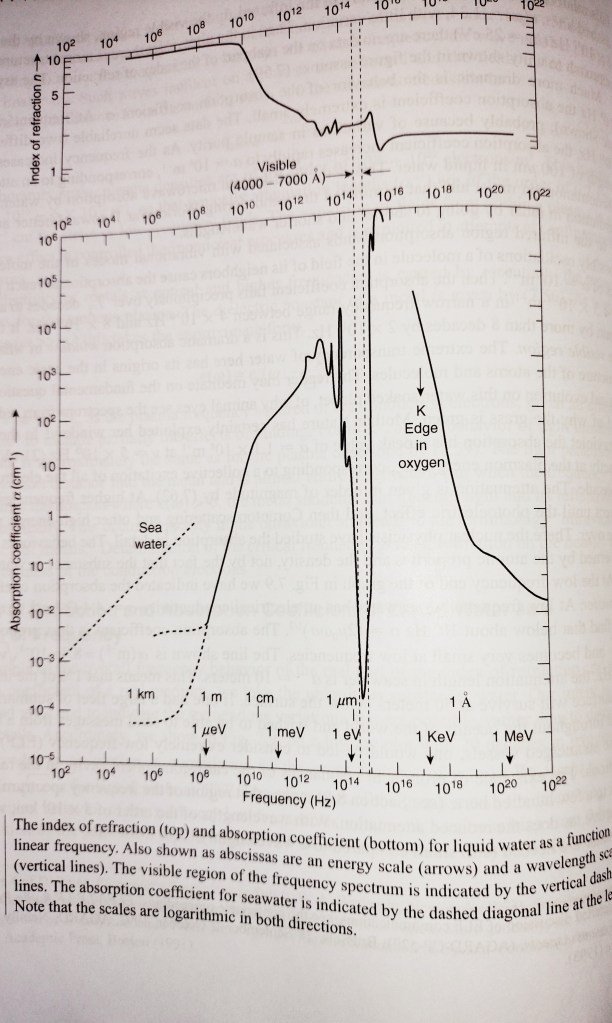
Below this is a table showing the absorption of electromagnetic radiation by water across frequencies. Here there is a steep upward slope when coming in toward the center from highest and lowest frequencies. It peaks at around the microwave/infrared wavelengths from the left and around the ultraviolet from the right.
Then a striking thing happens. There is a sudden, precipitous drop in absorption down to very low levels in a fairly narrow range of frequencies in the “middle” of the graph, meaning that in this range, light passes through water with relatively little absorption. This is the range we know as visible light.
The author took the time to point out that this fact about the nature of water‒that it is more or less transparent in this very narrow range of frequencies‒is exactly why we Earthlings tend to see only in that range. It’s not an accident of evolution, some ancient, stochastic occurrence that is thenceforward cemented, unchangeable, into all descendants, like the DNA code and ribosomes and the chirality of biological molecules. It is instead a fundamental fact of physics that determines where creatures will be able to see if they first developed vision while living in water and then developed eyes that, like the rest of them, were mainly made of water.
There’s no point in making retinal proteins that react to wavelengths of EM radiation that are almost entirely absorbed by water.
That simple fact‒simple in summary, at least‒is enough to explain a huge swath of the nature of our visual perception, and it doesn’t require any further explaining to understand why we see in the range of light we do.
That was just a randomly chosen section of a textbook that reputedly is extremely difficult. I don’t disagree with that assessment of difficulty; it was a very dense bunch of material even in just 4 or 5 pages. But to think that one can find such remarkable facts while just trying to read and learn in random order from a textbook!
So, that’s an interesting little tidbit that seems worth sharing, at least to me. It’s far more interesting than anything going on in the human world right now. What’s more, this is a fact that has existed as long as water itself has existed‒and implicitly, it existed even before that, lying there waiting in the fundamental laws of nature. And it will be there long after everything but those fundamental laws is gone.
If you want to embrace eternity, and things like Hilbert’s Hotel and Cantor’s diagonal proof make you worry about your sanity (this happens to many of us, so don’t feel bad) then focus on this fact about visible light. It’s there, it’s real, it’s quasi-eternal, and it’s concrete.
Though the absorption spectrum for concrete is…quite different.
*This harkens back to the reference from Batman Begins, when Flass says “I swear to God,” and Batman snarls “Swear to me!” It seems fun to use Batman when one would normally say God.
**By “light” I mean all electromagnetic radiation, from radio waves to gamma rays.

 Robert Elessar
I’m going to swear to Batman! (I wanted to be Batman when I was a kid.)
“I don’t read or learn especially quickly, but I do learn deeply… ” I love that. It’s a wonderful quality to recognize in oneself.