
Oooooh, it’s Friday the 13th! It’s so spooky!
Not really, of course. It’s just a day. I like Friday the 13ths, mostly just because so many people seem to imagine they are unlucky, though I think that superstition may be less prevalent now that it was in the past. Nowadays, the day is probably mostly associated with the slasher film “series” that uses that title. Not that even the original movie’s story ever had much to do with the day. It just was a catchy, well-known “scary” day, following in the footsteps of Halloween (although the latter at least had a theme that suited the day).
Of course, a major reason I like this day is that the number 13 is a prime number, and I like prime numbers. I like 13 especially, because 13 is possibly the most feared and reviled of the primes, associated with bad luck in much the way that 7 is associated with good luck.
Hmm. I know at least part of 7’s appeal probably has to do with the dice game “craps”. 7 is the most common total to achieve when rolling two six-sided dice, because there are more ways to get that total than any other number. Meanwhile, of course, there is no way to get a 13 on two (normally numbered) six-sided dice, but it is only just out of reach. It’s the first number that’s too high for such a pair o’ dice*.
Of course, you can’t roll a 1 on two six-sided dice either, but that feels more trivial.
I honestly don’t think the reason for 13’s association with bad luck probably has anything to do with dice; it wouldn’t make too much sense. But someone out there, please correct me if I’m wrong.
It’s interesting to think about probability regarding dice, not least because the very field of probability theory was first created by a guy who wanted to optimize his chances of winning at dice. According to what I’ve read, he succeeded, at least temporarily.
Nowadays, of course, that field has grown into a special subset of mathematics and physics and information theory and so on, affecting everything from thermodynamics and statistical mechanics to meteorology and quantum mechanics. In a certain sense‒given that Schrodinger’s equation describes wave functions that have to be squared (in a complex conjugate way) to get literal probabilities that, based on Bell’s Theorem, cannot be further simplified, as far as we know‒probability may be something truly fundamental to the universe, not merely a tool for situations in which we don’t have access to information. Based on Bell’s Theorem, which has been shown to apply in the Nobel Prize winning experiments of Aspect et al, it seems that, at root, as far as we can tell, the quantum mechanical operations are fundamentally indeterministic.
Of course, just because something is “random” at a lower level doesn’t imply that, at higher levels of organization, it can’t behave in ways that are very much deterministic in character. Lots of little things behaving in a locally random manner can combine to create inevitable larger-scale behavior. Perhaps the most straightforward and compelling such thing is the behavior of gases and the Ideal Gas Law***. The motion of any given molecule of gas is unpredictable‒at the very least it is stochastic and has so many degrees of freedom as to be unpredictable in practice, but since quantum mechanics is involved in intermolecular collisions, it may truly be random in its specifics.
And yet, when oodles and oodles of molecules of a gas come together****, their collective behavior can be so utterly consistent‒with very little depending on even what kinds of molecules comprise the gas‒as to produce a highly accurate “law” with only 4 variables, one constant, and no exponents!
If that doesn’t seem remarkable to you, either you’re jaded because you’ve known it since secondary school or I haven’t explained it very well (or both, of course).
It’s interesting to think about the probabilities of dice games using more than two dice and/or dice with more or fewer than six sides. Tabletop role-playing gamers will know that in addition to the 5 “perfect” Platonic solids*****, there are quite a few other symmetrical (but with sides not formed from “regular” polygons) solid shapes that can be turned into everything from ten-sided to thirty-sided dice.
But RPGs tend to involve rolling one die at a time, except when rolling up characters, at which time (in D and D and Gamma World, at least) one uses 3 six-sided dice (or 4 when applying a technique to yield better-than-average characters).
I wonder why there are no games of chance using more than 3 six-sided dice or using, say, multiple four-sided dice or eight- or twenty- or twelve-sided dice. The probabilities would be more trouble to work out, but they would not be harder in principle. If any of you out there either know of or want to invent a game of chance using more than 2 dice and/or other than six-sided dice, feel free to share below.
In the meantime, I’ll call this enough for today. I am supposed to work tomorrow as far as I know, though that’s always subject to change. If there’s no post here tomorrow, then it probably means I didn’t work. I probably will work, though I couldn’t give you a rigorous working out of the mathematics involved in determining that particular probability.
Have a good day if you’re able.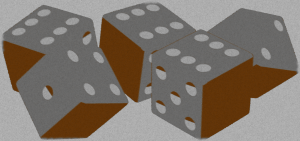
*You can sometimes see them by the dashboard lights.
**Unless superdeterminism is correct. However, this is a very hypothetical thing, and I’m not very familiar with what arguments are proposed to support it, so I won’t get into it.
***PV = nRT if memory serves. [Looks it up] Yep, that’s right. Four variables and one constant (R).
****Even if it’s not right now, over me.
*****These are, presumably, solids that really care about each other but in a non-romantic way.

 Robert Elessar