
It’s Friday today (as I write this, anyway‒it may be another day entirely as you read it), and I am in the process of heading to work. I will also be working tomorrow, barring (as ever) the unforeseen. And that doesn’t just include the foreseen unforeseen; the unforeseen unforeseen (especially that one) can also change what happens tomorrow, in ways that we do not expect, more or less by definition.
Of course, the Tao te Ching advises us to act without expectation, and I suppose that’s pretty good advice. The universe doesn’t make special deals, such that if you do some particular thing, it will definitely turn out the way you hope. The universe does what it has always done, and you are not the subject or the object of its action‒you are just one of the innumerable things the universe does. It did not have to ask your permission, and it will not apologize. It also does not make exceptions, not as far as anyone can see.
Since the beginning
not one unusual thing
has ever happened*.
You can imagine and draw a map that looks any way you want, that contains fairy lands and misty mountains and roads that are shorter in one direction than another**, but if your map doesn’t match the actual territory, it’s not going to be useful for traveling through that territory safely and successfully (by whatever reasonable criteria you might judge success). Likewise, blank spots on the map don’t imply blank spots in the territory, and writing “here be dragons” does not somehow conjure dragons into existence (alas).
Reality is that which actually exists, whether or not anyone “believes” it or “believes in it”, whether or not anyone has been, is now, or ever will be aware of it. Heck, if eternal inflation and a consequent inflationary multiverse following (for instance) the string landscape are true, then the vast majority of the stuff of reality will never, ever be known, because most of it‒the ever-expanding inflaton field and those bubble universes where local laws are such that complexity cannot exist, as well as those huge stretches of even our universe that precede (or follow) any existence of life‒will never be accessible to conscious experience.
That’s okay. Man is not the measure (nor the measurer) of all things. Man is the measure of almost nothing. Man‒indeed, all life of which we know‒is a tiny little epiphenomenon that exists in a tiny little sphere of nonzero thickness on and around the surface of the Earth. I’ll try to remember to do the math comparing that volume to the volume of the visible universe and put it in a footnote below. If it’s not there, I didn’t do it***.
One sometimes hears people say‒often they seem to be trying to make excuses for themselves to believe in some deity or other‒that the universe is exquisitely tuned for life, such that it requires explanation by some “supernatural” means.
When I hear or read such things, my reaction is, “What universe are you looking at?!?” Almost no place in the universe can be survived by life as we know it, let alone produce it. The fraction is so close to nonexistent that it is zero to a good first approximation, and a good second approximation, and a good third, and so on.
It may seem that time could possibly give us a bit more comfort than space does, since life on Earth has existed between roughly a fourth and a third of the time since our Big Bang. But the future of this universe gives every indication of being without end, whereas conditions for large scale matter to exist‒as far as we can tell‒will not last long (not compared to infinity, which to be fair, nothing is, not even TREE(3) or Graham’s number or any other huge but finite numbers).
By the time the last supermassive black holes finish evaporating due to Hawking radiation, which will be about a googol years, things will already have been impossible for any kind of life we would recognize for eons of eons.
Of course, it’s conceivable that life will grow to become cosmically important and able to engineer specific ways for the universe to avoid heat death (or whatever is coming), or to make new universes, or whatever. But that’s a mightily narrow course for the future to thread.
And the time until a straightforward Poincaré recurrence of the current state of our universe makes a googol years seem unnoticeably teensy by comparison.
Anyway, the main point I’m making, if there is one, is that the universe neither promises nor owes you anything. That doesn’t mean it’s not okay for things to be important to you. You matter (on the scales we’ve been considering) nearly as much as the whole Andromeda galaxy.
It’s fine for you to try to make your life what you want it to be. Why not? There’s no one else who has any legitimate claim to it (not counting children, friends, etc., all of whom could be considered part of “what you want it to be”). Just don’t expect other people, let alone the vastly bigger number of things that are not people, to be also trying to make your life the way you want it to be.
Okay, that’ll do, pig. I’m tired (What else is new?). I’ll most likely write a post tomorrow. I hope you have a good day.
*I got this haiku from Eliezer Yudkowsky’s Rationality: From AI to Zombies, though I am not sure if it originated with him.
**Actually, I’m not sure how you would draw that.
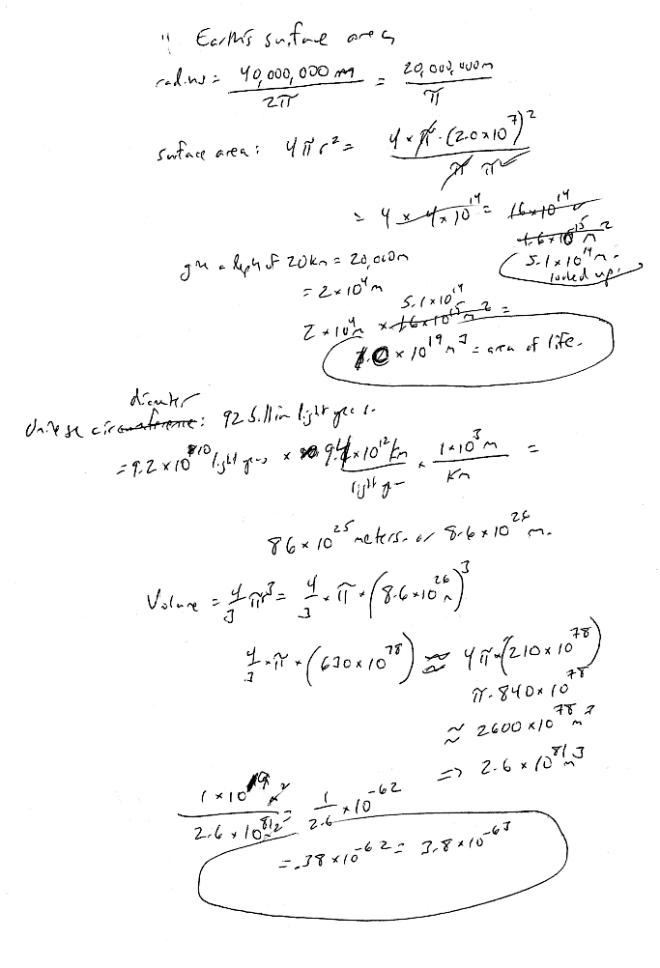
***I did it, though I initially made a mistake in calculating the surface area of the Earth, as you can see below if you look closely (I forgot to square pi in the denominator). Anyway, assuming that the depth-to-height range of life on Earth is about 20 km, then the volume for life as we know it is about 1 x 10^19 cubic meters. The volume of the visible universe on the other hand is 2.6 x 10^81 cubic meters (if my calculations are correct). That means that the fraction of the universe that is, to our knowledge, amenable to life is 3.8 x 10^(-63), or 0.0000000000000000000000000000000000000000000000000000000000000038 of the volume of the universe. By comparison, the fraction of your volume represented by one of your tens of trillions of cells is roughly 10^(-12), or .000000000001. You lose thousands of cells every proverbial time you scratch your nose. How much do you notice them? How much less would the universe notice if it scratched all life off?

 Robert Elessar
Who are you calling pig? 😀 Also not all of the earth’s surface is really very habitable (e.g. Antarctica) though that doesn’t really make a difference in the calculations.