No songs or pictures, just pathetic words of despite and destruction and despair

Well, it’s Tuesday.  I think my stunt (or whatever you might call it) yesterday has failed miserably.  I don’t know why I’m surprised, let alone disappointed.  I’m either just not good at that sort of thing, or I’m just not worthy of that sort of thing.

I don’t know if that quite made sense just now.  I’m apparently very bad at getting my feelings across, on top of the fact that, a lot of the time, I’m not quite sure specifically what I’m feeling.  They’re just a bunch of swirling, overpowering sensations that don’t ever seem to show on my face or in my voice.

Anyway, I have no subject on which to speak (so to speak) today, and it doesn’t really matter, because I seem incapable of conveying anything important to anyone for whom it could possibly matter.  It’s fine.  As Thomas Covenant said (before he ever went to the Land) this is what people are like:  futile.  He would change his point of view on that after many grueling and heartbreaking yet inspiring experiences, but I think he was onto something.

I’ve always had a bit of sympathy for Lord Foul in those books.  Part of this was just because he was so eloquent‒I’m a bit of a sucker for a good speaker‒but especially after I learned that he was trapped inside the arch of time, inside the Land, and he literally cannot possibly die or be permanently defeated while trapped there.  He hates everything in the Land and its world not just because it’s his nature to hate, but because he is trapped by and with everything there, potentially forever.  So if he is ever to be free to go anywhere else‒even to die‒he has to destroy the arch of time and thus that world.  It is personal to him, of course‒he’s not called the Despiser for nothing‒but it needn’t be.

Anyway, I am not trapped in the arch of time, or at least I’m not constrained from ever dying within it.  Or maybe my own arch of time is just that span of moments that began at birth (or conception) and will reach its other end at my death.  If that’s the case, I wouldn’t need to destroy the arch, just…complete it.

This is all metaphorical bullshit, I know.  Don’t misunderstand me.  I don’t have any misgiving that any of that could be real.  But the stories were good, at least the first two trilogies; I’ve never finished the last 4 books.  There is no denying that The Lord of the Rings is better, and much more inspiring and uplifting.  But the Thomas Covenant books do a better job of capturing the horror and despair and terror of not just fighting evil, but of being evil.

That’s probably why it appealed to me.  My innate tendency is to be, well, perhaps not evil, but destructive.  I feel terribly angry so much, so often, and I just want to break and burn this world, this life, that is so bloody uncomfortable.  But I know that I don’t have any business hurting other people, almost none of whom are ever deliberately hurting me.  So I bottle it up and try to calm it, and I don’t act on it.

But like I said in my reversal of Nebula’s last line to Drax in Guardians of the Galaxy Volume 3, I wasn’t born to be a dad, I was born to be a destroyer.  I’ve just always tried to fight against that, and I have in some small ways succeeded.  I even swung things in the other direction at times, becoming a doctor and a dad.  Of course, I eventually failed miserably at both of those things, as usual, but I did some good in the meantime.

And there is one being I have a proprietary right to destroy.  I just need to quit the foreplay.

Anyway, this has been weird, I suspect, but what else is new?  I hope you all have a good day.

I want this all to end

It’s Tuesday now, and I’m writing this blog post on my laptop computer (the little one, not the regular sized one).  The laptop is slightly more awkward for typing on when there are bumps and shakes in a vehicle, but the vastly greater speed with which I’m able to type on it more than makes up for that—though it does not assuage the frustration.

I’m already exhausted (mentally) after only one day of work.  I don’t think it’s the work per se that’s so exhausting, it’s the environment, the people, the noise, the frustrations, the fact that other people arrive late or not at all, so many little frustrations.  There’s so little predictability in their behavior, and what there is is so often illogical.

I have, in general, identified more with Melkor than with Sauron in Tolkien’s universe—largely because he’s the Big Boss—but sometimes I can understand Sauron’s desire for order, and for forcing other creatures to be more orderly.  Of course, the way he goes about that is pretty stupid, but whataya gonna do?  As Gandalf said, he is a “wise fool” (a great expression).

Anyway, I like Lord Foul better than either of those two, and I like Doctor Doom most of all.  Doctor Doom is the sort of character about whom Christopher Nolan could make a movie trilogy, presenting him in a more down-to-earth fashion in a nearly realistic story, as he did with Batman, because Doom is not the product of radioactive spider bites, nor is he the last survivor of a star faring people with powers because of his alien nature, nor is he otherwise enhanced.  He is a human, but with a brilliant, inventive intellect and an obsessive drive.

Why am I writing about this stuff right now?  I have now idea.  This is all stream of consciousness, and that stream flows faster when I’m typing.  I’ve written all this so far in less than ten minutes (first draft), and I’m already almost halfway to my target word count.  I have to set a target, not so that I don’t go below it, but so that I don’t go too far over it.  I could probably gabble on here interminably.

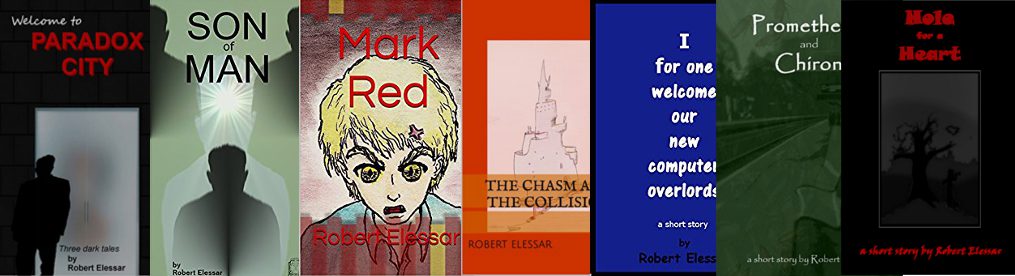
But I want it to end.  I’m so very, very tired, and I have very little joy in my life.  I mean, I’m pleased that The Chasm and the Collision is still an enjoyable read even now.  But of course, I’m probably one of two people in the world who has actually read it.  My mother died just days after it was published—I tried to read some of it to her in her hospice bed, from her own miniature Kindle, but it was clear she wasn’t even following.  That’s too bad.  I think she really would have liked it.  I think she had been looking forward to reading it.

It’s such a me fact that my most wholesome, family-friendly story involves a threat of destruction to two universes and a villain who is unknowingly in the thrall of a much greater, larger scale “villain” or destructive force that threatens all universes, potentially.  That’s my meta-level villain; its influence is felt in many of my other stories, though I don’t always make that explicit.  I have so many ideas for my large-scale omniverse (formerly thought of as a “metaverse” before Schmuckerberg stole my term), so much backstory and intersections and connections and so on, but none of that is ever going to happen or be revealed or anything.  It’s sad, but, as a character in my darkest ever story says, “Life’s like that, I suppose.”

I wish I could sleep for a really long time, just to rest and recreate myself, but that’s not an available option.  I don’t simply long for “suspended animation” because that’s just like pausing a game; you wake up in the same state you were in when you laid down.  The only point to that would be living to see a future you wouldn’t otherwise have seen.  It’s not any kind of a cocoon, a chrysalis, an Adam Warlock kind of thing, where you change and grow and heal.

I don’t know why I’m writing about comic books and other wildly fictional characters.  Perhaps it’s because the real world is not only so stressful but is also so stupid.  This emergent system that is the whole human race interacting with itself is just an astonishing example of idiocy on performance enhancers.  I really am sick of them.

If I were Doom, I would decide to commit myself to saving them, correcting them, trying to make the world as good as I know it could be.  But of course, that leads Doom to be thought of as a villain (he has other psychopathology that contributes to that, of course).

Okay, well, I’m approaching my target, and obviously I have nothing to say, but that doesn’t stop me.  I’m really tired and depressed and discouraged.  I cannot go on like this for long.  Right now, I’m trying to hold on until at least next Friday, when I’m finally getting an autism assessment, but I don’t even know if that’s enough to cling to even for so short a time.

We shall see.

My heroes have always been villains, Episode V: Tom Marvolo Riddle

I first read the Harry Potter books as an adult—I began them when book four was still only available in hardback—so my reaction to them and their characters might be expected to differ from how I responded to those tales that had first begun to grip me when I was younger, such as The Lord of the RingsYet, like so many millions of others, I was enthralled by Rowling’s work.  When the new volumes were published, I was one of the midnight-pickup pre-buyers, waiting in the bookstores in the wee hours for my copies the day they came out.

Unlike many of my earlier reactions to such sagas of good versus evil, I was not—at first—particularly interested in the bad guy, Lord Voldemort.  Based on the first three books, which only showed us Voldemort in fragmented or highly reduced form, he seemed a petty villain to me.  Racist and otherwise bigoted, he—if his followers were any indication—was simply a spoiled bully, a reflexive defender of ancient and unearned privilege raging against a more modern, rationalist, and egalitarian way of life, embodied most fully in Dumbledore.  I did enjoy the plays on words Rowling made with his name, but he himself didn’t seem very interesting.  He didn’t elicit a feeling of overwhelming threat and natural force like Sauron does, and I thought it a bit cheeky for anyone to call him “The Dark Lord,” a title I scarcely felt he merited.  He didn’t have the tragic sense of twisted, broken, could-have-been greatness embodied in the likes of Darth Vader and Doctor Doom.  And he certainly didn’t have the cool, detached intellect, that sense of an almost alien intelligence, that Hannibal Lecter possesses. Continue reading

My heroes have always been villains, Episode IV: Victor von Doom

Hello and good morning.  It’s time at last, after a month-long hiatus, to give you the latest iteration of “My heroes have always been villains.”  Today I discuss one of my personal favorite villains:  Dr. Doom.  The fact that he is a comic book villain may make him seem a less than respectable choice of character to discuss, but the popularity of movies depicting such villains—including situations in which these depictions have been critically acclaimed (e.g. Health Ledger’s role as The Joker in The Dark Knight), and the immense success of movies involving villains such as Loki and Thanos in the Marvel Cinematic Universe—makes me feel that Doom is a worthy subject of discussion.

Those of you whose only exposure to Doctor Doom comes from the theatrical versions in the Fantastic Four movies could be forgiven for thinking that he isn’t very interesting, but those movies did no justice whatsoever to the character.  I liked the casting choice in the first two movies (I didn’t see Joseph Culp’s version), but Julian McMahon was simply not given a good script with which to work to portray this most riveting (and riveted) of all comic book villains.

One difficulty in discussing a comic book villain is that the characters, especially long-standing ones, are written and interpreted by many different people over time, often with wildly varying quality and depth.  I will here focus primarily on Doom as portrayed by such greats as John Byrne (probably the best of them all) as well as such stand-outs as Jim’s Shooter’s Doom in Marvel Secret Wars, Chuck Dixon’s Doom, and, of course, the work of Doom’s creators, the inimitable Stan Lee and Jack Kirby.

Over the years, I’ve come to see Doom as a sort of anti-Batman.  The two have similar back stories.  Differences in their life courses seem dependent almost entirely upon specific details of the events which shaped them, but the events and outcomes are similar in many senses.  Doom’s parents, like those of Bruce Wayne, were killed when Victor was quite young, and at least one of them died in his presence.  Of course, Doom was a gypsy, and Bruce Wayne was born fantastically wealthy; perhaps these facts are fundamental to their different specific career choices.  Doom was a member of an oppressed and marginalized minority, his family hounded by, and his parents (at least his father) killed by, the “powers that be”.  Wayne, in contrast, was born into power, and his parents were killed by a low-level criminal.  So, perhaps predictably, Wayne became a protector of the order of society against elements of chaos.  Doom, on the other hand, grew to seek vengeance against those in power, to strive always to take that power for himself, and if possible, to assume control over fate, to become more powerful than anyone or anything else in the world.  Of course, in comic books, all things are possible, and Doom has achieved this goal on an occasion or two, only to lose it…largely through the tragic character flaws that made him a villain in the first place.

One central aspect of Doom’s mystique is the fact that his features are terribly scarred, certainly from his own point of view, and are always covered by his baleful gray armored mask.  But really, I don’t want to dwell too much on the issue of Doom’s visage.  As has been insightfully said about Bruce Wayne’s identity as Batman, the mask is the character’s true face.  The flesh and blood beneath is the façade.

One thing that’s always intrigued me about Doom is that, like Batman, he has no superpowers.  His “powers” are all self-created, the products of his incomparable mind and (apparently) unlimited will.  Yet, despite being an “ordinary” human in a universe populated by beings of almost unimaginable power, Doom remains one of the most potent forces in the Marvel universe, and he has challenged the good and the great on many occasions, defeating those who should be far beyond his power through cunning, intelligence, and nerve.  This is another trait he shares with Batman.

Also like Batman, Doom is pretty screwed up in the head.  It’s hard to see how he couldn’t be, given his childhood experiences, but at least some of Doom’s mental dysfunction seems to be inherent.  He is intensely egotistical, and this is probably congenital to at least some degree, though it’s perhaps also a learned defense mechanism against the chaos that he faced in his formative years.  It’s also somewhat justified, for Doom is a fantastically brilliant scientist and inventor.

One could be forgiven for speculating that Doom might have at least a mild case of Asperger’s Syndrome.  He certainly has difficulty connecting with other people emotionally, almost always preferring the company of his robots to that of any lieutenants, sycophants, or courtiers, let alone comrades or friends.  His only close human contact is with Boris, his father’s friend, who took care of Victor—to the degree such a notion has meaning—after Werner von Doom died.  Certainly, there is no one else in the world that Doom trusts, and he doesn’t even trust Boris in the sense of relying on him.  He also doesn’t connect well with his subordinates as real human beings with feelings and identities, killing some of them if they make even trivial mistakes, or if they accidentally question his genius and infallibility.  “Doom needs no one,” he says, quite typically, before destroying an errant robot, practically quoting “Another brick in the wall, Part 3.”

Also fitting the Asperger’s model, Doom definitely qualifies as having restricted and repetitive behaviors and interests.  His life centers almost completely around three basic goals:  1) to free his mother’s soul from Mephisto’s Hell; 2) to conquer and rule the world; and 3) to destroy the Fantastic Four, especially Reed Richards.  Even the possibility of restoring his own face is a distant afterthought—the mask, even to him, really is his true face.

Another interesting aspect to Doom’s character is that he’s not actually that terrible a villain in terms of what he does when he achieves power.  He’s willing to do almost anything to achieve his ends, and God help you if you get in his way (though he has a weird code of honor:  he misleads, deceives, tricks, and otherwise manipulates people in endless ways, but he seems allergic to telling any direct, blatant, knowing lie, at least a petty one, and he will never, ever break his word of honor; if Doom makes a promise, he’ll keep it or die trying).  Once he achieves power, however—as in his control of his native country of Latveria, and on those occasions when he’s achieved temporary dominion over the world—he treats his subjects well, and almost always makes things better than they were before.

I don’t know if this is an expression of benevolence on his part or is rather a function of his insatiable ego:  if he’s going to do something, then you’d better believe he’s going to do it better than anyone else ever could, and that includes running the world.  The average citizen in the Marvel universe could be forgiven, frankly, for hoping that Doom would triumph over all those stupid, wishy-washy heroes who keep everything messy and violent, under the control (if one can dignify the state of things with that word) of lesser minds.  Doom is not one of those villains who wants to watch the world burn.  He wants to put out the world’s fires; he just thinks he’s the only one good enough to do it.

He may be right.

Doom is a complicated character, certainly, and that’s one of the things I like about him.  Though insane, violent, and dangerous (certainly!), and with an arrogance that is only acceptable at all because he lives up to at least some of his own hype (eat your heart out Kanye West), he is very human, and very tragic.  Though certainly evil by most sensible definitions of the word, he is not Evil, if you take my meaning.  He is self-reliant to a fault, with absolute conviction in his own point of view and in his personal capacity to achieve any goal on which he sets his sights.  In focus, willpower, determination, and related synonyms, he is unmatched by any character except, again, Batman.  Like Batman, in Doom this attribute is central to his success, and is also not uniformly good, even for him.  It is, in a way, terrifying.  Doom makes the Terminator look like a vacillating dilettante.  He absolutely will not stop, and he will never, ever, give up.

This is not a good thing.  Sometimes the only sane, reasonable, logical thing to do is to call something a bad job and let it go.  Great deeds can be done by those who set their sights on their goals and never waver from them; also, terrible deeds.

The inhabitants of the Marvel universe might really be better off if Doom were in charge, but the cost of achieving that state would be gargantuan, not least to Doom himself.  But, of course, the nature of comic book villainy is such that Doom is never likely to be allowed to mellow out and settle down, get married, have kids, write his memoirs, and make unsurpassed scientific contributions along the way.  On behalf of the characters involved, we can call this a shame.  But for those of us reading—at least for me—we will be endlessly grateful.
My heroes have always been villains, Episode III: The psychiatrist, Dr. Hannibal Lecter

Today, for the third installment of “My heroes have always been villains,” I discuss one of my favorite modern, “realistic” villains:  Dr. Hannibal Lecter.  Dr. Lecter has been portrayed by at least three exceptional actors of whom I’m aware, the most noteworthy being Anthony Hopkins, who performed the character brilliantly in the movie “The Silence of the Lambs,” and also creditably in “Hannibal” and “Red Dragon.”  He was also played by the excellent Mads Mikkelsen in the TV series “Hannibal,” and (his first screen portrayal, to my knowledge) by the brilliant British actor Brian Cox (not to be confused with the rock star cum physicist, also brilliant in his own right).*

I am not, however, primarily interested in the portrayals of the good doctor on the large or small screen, though I have found them uniformly excellent.  Here I take my cue from Thomas Harris himself, the character’s creator.  He is reputed to have refused to see any of the movies based on his work, because he didn’t want his vision of his creation to be influenced by the interpretation of writers, directors, and actors who had visions of their own.  I deeply respect this attitude, and I think it’s warranted.  So, my discussions of Hannibal Lecter will focus, mainly or entirely, on his depiction in the books.  This is not a sacrifice; Thomas Harris is one of the finest authors I’ve encountered, and I consider Hannibal, specifically, to be among the greatest books I’ve ever read, on a par with The Godfather and The Lord of the Rings. Continue reading

My heroes have always been villains, Episode II: Sauron, lord of Mordor

It’s the second Thursday of the month and, as promised, this is the second installment of “My heroes have always been villains.”  Today, I discuss one of the greatest villains in modern fantasy literature:  Sauron of Mordor, the title character of The Lord of the Rings.

Peter Jackson’s amazing LotR movies (and the slightly less amazing The Hobbit movies) have brought Sauron to the attention of the population at large to a greater degree than ever before, but he was hardly a shrinking violet to begin with.  Millions upon millions of us met him in the books, after getting teased by him as the Necromancer in The Hobbit. Continue reading

My heroes have always been villains, Episode I: The Downfall and Redemption of Anakin Skywalker

Welcome to the first “official” entry in the “My heroes have always been villains” series.  I had trouble deciding with which villain to inaugurate the project.  Should I start with that quintessential Western villain, Satan, specifically as characterized in Milton’s Paradise Lost?  He’s certainly one of the grandest and most impressive of malevolent creations, and Milton’s epic is undeniably one of the greatest works in the English language.  But that might be rather rarefied as a beginning, and though Milton did a great job making Satan not only believable but even convincing and charismatic, there’s still a lack of depth to the character.

In the end, I decided to go for a “lower-brow” starting point and to begin with perhaps the most well-known of villains in all of modern literature*:  Darth Vader.

For those of us who experienced the Star Wars phenomenon from its beginning, our understanding of the character of Darth Vader underwent a very drawn-out process of discovery.  When we first met him, he seemed a superficially one-dimensional bad guy, but we quickly learned that he was not some essence of pure evil by nature, for early in the movie Obi-wan Kenobi says that Vader was once a Jedi knight, “before he turned to evil.”

If there is a pure and ultimate villain of the Star Wars saga, it is surely Emperor Palpatine, who seems to have been a bad seed right from the start.  This makes him a great villain in a sense—you certainly don’t have to feel bad about opposing him, or about how he meets his end.  But there’s also no deep humanity to him.  No one but a psychopath could truly empathize with him, and psychopaths just aren’t very good at doing that.

Darth Vader, however, as we learn his life story in the prequels and on back through the original three Star Wars movies, is on par with the great, tragic villains of classical literature.  His decline and fall and eventual redemption are arcs of character development worthy of Shakespeare (if nowhere near as well written).  In fact, the villain whose story I find most reminiscent of Vader’s is MacBeth.  He starts out truly heroic in character, brave and noble, serving the good of his society, as does MacBeth (Vader actually succeeds in being more complex than MacBeth, if only because he has six longish movies in which to explore his personal development, while MacBeth had only one relatively short play).  Vader’s descent is not born of some innate tendency to evil but is the product of many attributes that we would rightly call virtues, but which are twisted to become classic, tragic flaws.

Anakin Skywalker is earnest and brave from the first moment we meet him.  He is also loving and devoted, first to his mother, and then to Padme and Qui-gon Jinn, and even to Obi-wan.  He desires to do good, that much is clear.  Vader, despite his tendency to choke subordinates to death, never seems to be a sadist.  Palpatine may gloat and laugh while he torments his enemies with “force lightning”, but Vader lashes out in anger, and that anger seems, to me at least, to be born of frustration.  He’s trying to do “good”—to bring order to the galaxy, as he says—and his people keep screwing that up for him.

Anakin Skywalker’s tragic flaw is in that he loves too much; he can’t internalize the Jedi’s Buddhist-style ethos of non-attachment.  This surely has at least something to do with his early life as a slave.  A slave always lives in fear, as so wonderfully summarized by Roy Baty near the end of Blade Runner, because whatever a slave has or loses, including his life, is entirely out of his hands.  Anything a slave loves can be taken from him, arbitrarily and capriciously, not merely by the vicissitudes of impersonal nature, but by the human whims of his owner.  But even after Anakin gains freedom and great power as a Jedi, he cannot prevent the death of his mother, and that loss and frustration leads him to act out in rage, his first real act of darkness.  But this is not an act of sadistic destruction, indulged in out of a love of suffering and death, but is an expression of loss and horrible grief.  We can sympathize with Anakin’s feelings, even if we cannot condone his actions.

It is that very love and attachment—and the fear of loss that is such a strong part of it—that provides the opening for the true villain of the piece to manipulate Anakin, and to lead him to betray the Jedi.  This ironically causes him to lose everything that he loves, and to become, finally, “more machine than man…twisted and evil.”  In many ways, Anakin’s descent is more credible, and more sympathetic—as well as more tragic—than that of MacBeth.  Those very aspects of character that make Anakin a great hero are the means by which he loses his mooring and becomes a figure of terror and hatred.

Unlike MacBeth—again, partly because he just has more stage time with which to work—Vader is able to achieve, in the end, a redemption from evil through the love of his recently-discovered son.  At one point in Return of the Jedi, Vader says to Luke that Obi-wan was wise to hide from him the fact that Leia was his daughter, and presumably also that Luke was his son.  I have to wonder if that’s true.  Hiding the children from Palpatine was certainly wise, since he would have seen them as potential, powerful tools.  But Vader’s embrace of violence and darkness is surely at least partly because he believes he truly has lost everything that has ever mattered to him.  Thus, he surely sees the universe as a place of unmitigated shadow.  If he had known that his children had survived—rather than dying with their mother, as he apparently believed—I think he would might have turned against the Emperor much earlier than he finally did.  Maybe not.  Maybe he would have been just as tragically afraid of loss as he had been before and would have willfully committed just as great acts of evil to protect himself from ever losing them.  We can certainly imagine Palpatine deliberately engineering that loss for him, to draw him even more thoroughly into darkness, this time with no chance of redemption.  But it’s also possible to imagine Vader turning on and destroying the Emperor much earlier, recognizing the threat that Palpatine would always be to his children, and striving to make a peaceful and benevolent life for them.  Would he then have been able to escape the fearful attachment that led to his fall in the first place?  It’s impossible to say.

In any case, Vader’s story arc is what it is, constrained by the necessities of epic story-telling.  We would not be as satisfied with MacBeth if the title character had surrendered himself to MacDuff, shown repentance, and thrown himself on the mercy of his righteous avengers; he must be killed in battle, destroyed by the one to whom he has done the greatest harm.  Vader’s end is, in many ways, better than that of most fictional antagonists.  He gets to meet his lost children, and he finally turns on the real villain who has engineered much of his misery, helping to free the galaxy and then dying peacefully in the arms of his son.  It’s an ending worthy of a place of honor among those grand and melodramatic tales that have stood out in the history of story-telling.

Star Wars has its clunkiness, especially when it comes to dialogue—George Lucas is no William Shakespeare, but then again, who among us is?  But in that it revolves around the character development and descent—and then reclamation—of Anakin Skywalker/Darth Vader, it achieves a level of sophistication that belies the superficial lightness of its entertainment form.  There is real depth, pathos, and tragedy to the story of Darth Vader, the heart of the Star Wars saga, and this is probably why Vader is one of the most well-known and—dare I say it?—beloved villains in all of modern literature.


*in the definition of which I include not just written fiction, but also comic books, movies, and potentially, even video games