
Hello, and also, good morning.
What to write about, what to write about‒that is the question today. Of course, “to be or not to be” is always the question as well, as was recognized by Camus in The Myth of Sisyphus. If I recall, he arrives at the conclusion that the titular rock-rolling protagonist must be “happy” despite the patent and constant pointlessness and absurdity of his existence.
That goes along with the whole recognition of the absurdity of life itself that is central to the existentialism movement. Still, it’s hard for me to “imagine Sisyphus happy”, unless he was a true Bodhisattva or had been thoroughly lobotomized by Zeus (or whoever it was that had doomed him to his…well, his doom).
It can help, I guess, to think about the vast scale of the cosmos in space and time (and any other dimensionality that might apply) and also about the incredibly minute scale of the cosmos, the fundamental quantum fields (and whatever gravity ultimately is) interacting from the Planck scale on up. It helps keep things in perspective.
Of course, even given the scales of the cosmos*, there’s another, almost sort of Buddhist/Taoist notion that notes that each individual‒each particle even‒always exists at the nexus of two “light cones”, existing in an ever-moving now. These are 4-dimensional cones, by the way, but it’s okay to reduce things by one dimension if you will. It makes them easier to visualize.
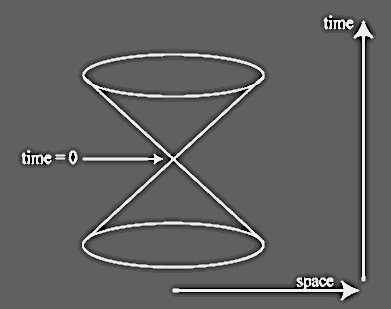
Your (or anyone’s) past light cone is the outer boundary of all influences that can possibly have had any effect upon you at the present moment‒those influences that could have reached you at the speed of light or more slowly. Similarly, one’s future light cone encompasses all those things that could possibly be influenced by things at the present location at or below the speed of light.
Any motion within the light cones‒the only motion that anything within spacetime can execute, as far as we know‒is called timelike motion. Any motion that would require going outside a light cone is considered “spacelike” motion, and is not allowed by relativity. This is not merely because of the speed of light, it’s because the speed of light is defined by the speed of causality. Causes cannot travel faster or have effects beyond the speed of causality. This is a bit tautological, I know, but it nevertheless simply must be true.
So each individual’s experience, each individual process, sits at the moving balance point of a future light cone and a past light cone, crossing at the moving present, tracing out a “timelike” path in spacetime. Of course, individual creatures are not individual particles, and so their overall spacetime path would resemble the final line produced by a sketcher going over and over a particular path to make the curve the artist desires.
If one could look at the structure of a human in spacetime, like the Tralfamadorians of Slaughterhouse Five, but one could also trace even the spacetime paths of individual “particles”**, a human life would be a sort of higher-dimensional braid in spacetime, surrounded by a haze of incoming and outgoing quantum entities, most of which will be locally bound and interacting, and so will be moving at a net velocity lower than the speed of light.
I’m assuming you don’t eat your food or drink your water or breathe your air or (shudder) sweat or excrete at near light speed.
Imagine what the inside of a mere proton or neutron might look like if one were able to see it as a rendered, four-dimensional model in fine detail! If you think it wouldn’t be that interesting because it’s so wee, think again.
Remember, only the tiniest fraction of the “rest mass” of a nucleon comes from the mass of the three “net” quarks in it (two up, one down or two down, one up depending on whether it’s a proton or neutron). Almost all the rest of its mass is the energy of the interactions between these three quarks: all the gluons exchanged, all the virtual quark/anti-quark pairs popping into existence, mediated by that famous strong force and its weird*** “asymptotic freedom”.
Bringing this back around, I guess my point was merely to note that everyone and everything is pointless from the perspective of the laws of nature and the spacetime scale of the cosmos, but when you learn about those things‒the cosmos at large and small levels‒you are at least familiarizing yourself with those vast workings, and you are in a sense taking part of them into yourself. That’s kind of a cool thought.
But don’t take too much of it into yourself! For, much as would happen to someone who stuffed all the information about Graham’s number into one head, if you do you will become a black hole. Now, it may be possible to survive becoming a black hole, but I don’t recommend betting on that pony.
TTFN
*I wrote a post on Iterations of Zero about how it might be useful for people to consider the cosmic perspective as contrasting with their prosaic concerns. I don’t remember how good it was, but here’s the link, in case you want to read it and give any feedback you like.
**I use this word for want of a better term that everyone would recognize and that would be succinct. I think we need such a different term, because a lot of the perceived so-called weirdness and mystery of quantum mechanics comes from trying to use inaccurate terms that originated in times before we understood things as well as we now do. Quanta are not little “particles” that sometimes act like waves, nor are they little waves that sometimes act like particles (though that’s slightly more accurate). They are entities unto themselves, and the ways they behave are all always consistent with that nature. They don’t sometimes act like one thing and at other times act like another. They all, always, act like what they are.
***Except it’s not weird, really. Those of us who are surprised by it? We are the weird ones. Quantum chromodynamics has always done exactly what it still does, since long before any life at all existed in this universe. To quote Yudkowsky again, “Since the beginning not one unusual thing has ever happened.”

 Robert Elessar
About Sisyphus, maybe Doctor Doom doomed him to his doom.
That cosmic perspective piece is great. However, sadly, some people don’t have the basic scientific knowledge to think on this grand scale. To this day there are people who seriously believe in a flat earth at the center of a small universe, created just 6000 years ago by an all-powerful creator being who loves only them, while hating anyone different from them (even though the creator made those other people too). Or at least, they act like they believe this.
Yeah. I know Dan Dennett used to say people believe in belief, or they profess belief, but it IS possible really to believe this stuff, and it’s like having a computer virus causing the programs all to run awry.
Oh, and thank you, by the way.
Oh, and I never thought about it before, but that IS the sort of thing Doctor Doom might do. He gets too hung up on having enduring vengeance on people, rather than just eliminating them. It’s one of his big weaknesses as I see it, though he shares it with many other bad guys such as Khan and Emperor Palpatine.
I’m assuming you mean Star Trek “Khhhaaaaaaaaan!!” not Genghis Khan, Kublai Khan, etc.
Yes, Khan Noonien Singh. I don’t know for sure, but I get the feeling that Genghis Khan didn’t waste time making his enemies suffer through death traps, I think he pretty much just killed them.