Well, it’s Saturday again, and for the second week in a row, I am writing a blog post. I warned you that I probably would: here, go take a look. See? I told you.
Of course, a blog post means I’m going to the office today. It’s not a full day, but it chews up so much of the middle part that there’s no possibility of getting any extra rest, at least not for me. For instance, I have awakened well before I would need to go to the office, but my anxiety or tension or whatever it might best be called does not let me sleep‒for fear of oversleeping, I guess. It’s some manner of fear, anyway. It’s not a fear of physical attack (I think) but it sort of feels like I have to watch my back, as though someone or something is out to get me.
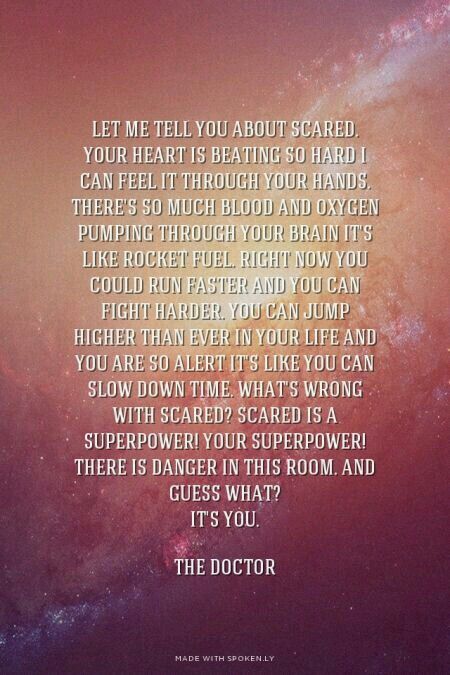
Fear is not the mind killer, of course, despite the popular mantra from Dune. Fear (up to a point) can sharpen the mind, if it’s not resisted inappropriately. I think the 12th Doctor’s take on being scared is far better than that from Dune. See below:
–
Obviously, too much fear is bad, but as Stephen Fry, playing the unscrupulous tobacconist points out (starting at roughly the 2:45 point here), that’s what the term too much means.
Too much of anything, more or less by definition, is bad. This is one of those somewhat rare circumstances in which one can say “by definition” and not be relaying a merely semantic point without substance.
This is in contrast to the silly old conundrum “If a tree falls in a forest and there’s no one to hear it, does it make a sound?” If you simply define your terms precisely, there is not going to be any ambiguity in the answer‒but you have to choose your “definitions”* of each word clearly, especially ones like “hear” and “sound”.
If you’re ever arguing about something (other than etymology and/or usage and/or diction) and you want to go to the dictionary to settle it, then you’ve probably been arguing about something without substance‒arguing past each other, as they say. I’ve heard such arguments, even between people with seemingly above-average intelligence.
Of course, if they’re arguing for fun, as a sort of mental sport and exercise, and if they both (or all) are enjoying the process, then I have no trouble with it. It probably sharpens their thinking skills, as long as they don’t let themselves forget that they’re just arguing over misaligned coding and the logical implications thereof. Even a skilled martial artist who trains purely for exhibitions may be in real trouble in a street fight against serious opponents.
But even the OED doesn’t decide or define what English words mean; it records what words have been used to mean, their origins, their etymology, all that good, interesting stuff.
How did I get on this subject? I guess I’ll see as I do the editing. I certainly do bounce and meander in my head, don’t I? And that process is often inextricably intertwined with writing.
That can be a good thing, sometimes, I suppose. I would think it’s at least related to the nature of creativity. But it’s also important to be able to focus and stay on point, to be disciplined, if one is truly to create anything of depth. One of my biggest problems in the past was that I would come up with, for instance, good story ideas, but I would soon get distracted by some new story idea and get diverted from the first.
One of the best things about having been to prison‒yeah, there were a few good things, though they were strongly overwhelmed by the bad‒was that I was in a situation in which I could discipline myself to write every morning, when lights came on (about 3 am) for 3 to 4 pages, and not go on to a new story until I finished the first. I mailed the pages out to my Mom, Dad, and sister as I went along, after rewriting them for a bit of legibility**.
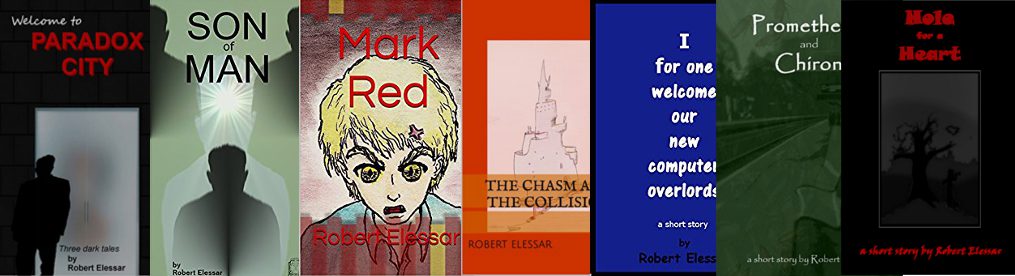
In this fashion, I wrote first Mark Red, then CatC, then Paradox City. Then, after I got out, I continued writing, finishing one story before starting the next, right up until I began Outlaw’s Mind. That was the last story I started in that pattern, though I’ve since written a bit on The Dark Fairy and the Desperado and even less on HELIOS.
Currently, I just write this every work day. I cannot explain why in any quick and simple fashion, but it is what it is, as the tautology goes.
I hope you have a good day. I should be back on Monday.
*I put that in scare quotes because in nearly all cases, words don’t have real, singular, exclusive definitions, but instead have usages. Now, as the person who coined various words in, for instance, The Chasm and the Collision, I can actually and literally define those words. I have actual authority over those words; I created those words and I created those worlds.
**I kept my first draft so I would be able to go back and check things if I needed to do so.

 Robert Elessar
Sheesh, you had to get up at 3 am in the “big house”?
Well, that’s when lights came on. You didn’t HAVE to get up then, but I was usually awake anyway.