Methought I read a blog cry, “Sleep no more!”

It’s Thursday again, and we’re in the middle of the first week of Autumn (in the Northern hemisphere).  For the next six months, the nights will be longer than the days.  As someone who tends to write about the darker side of possibility, I don’t think that’s so terrible…or it’s terrible in all the best ways.

My writing has been steady but rather slow this week, mainly because I’m struggling badly with insomnia.  I’m not referring here to the Stephen King book by that name (though coincidentally I’m in the middle of rereading it at this very time), but to the chronic, and occasionally incapacitating, sleep disorder.  Over the previous two nights (before last night) I slept for a rough total of three hours; this is, obviously, not adequate, and it has a noticeable impact on my ability to concentrate and to think clearly.

Nevertheless, the writing continues.  Hopefully, when I go back to rewrite and edit, I won’t be dismayed by how horrible my work product from these past few days is; I don’t honestly expect it to stand out as either better or worse than average.  As I’ve said previously, the way I feel when writing something is poorly correlated with how good the writing turns out to be.  Sometimes when I feel lofty and inspired and superhumanly gifted, I produce nothing but great, steaming piles of oozy excrement.  The converse is also occasionally true.  It’s unpredictable.  Thus, we will always need to edit and rewrite.

Today, for the first time in quite a while, I’m riding the train in to work, due to certain vehicles being in the shop and matters of that sort.  It’s nothing to worry about, just routine maintenance, despite an event I obliquely mention below.

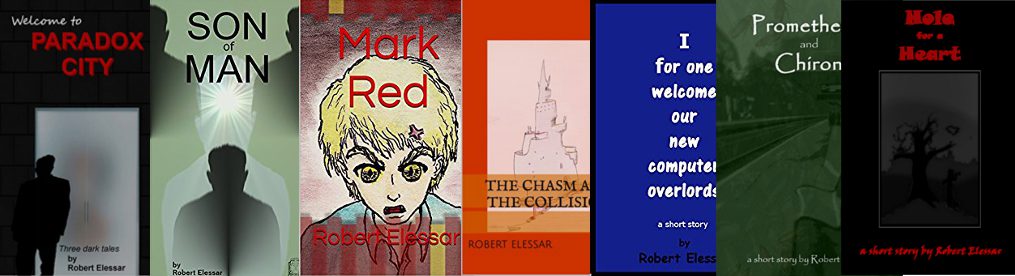
It’s curiously nostalgic to be taking the train, and not entirely unpleasant, though it’s far less efficient—time-wise, anyway—than driving.   I’ve been inspired to write at least one story (Prometheus and Chiron) while waiting for a train, and I see many interesting people when using mass transit.  Little of note happens on the Interstate, especially when one rides a vehicle that is fundamentally solo.  One can have occasional exciting, even life-threatening moments on the road, such as one I had three days ago, but they don’t make very good stories.  Not to me, anyway.  I suppose I could throw some details of such an occurrence into the midst of an action scene to add to the realism, drawing from my personal experience of feeling my right leg squeezed against the passenger door of some idiot’s car, which is changing lanes without the driver looking, but it happens quickly and—thanks to the fact that I don’t tend to rattle easily—is rapidly over, with no harm done.

I’m having a peculiarly good time working on three stories at once, as I mentioned in my previous post.  Of course, my primary work right now is still Unanimity, which is grudgingly proceeding toward its conclusion, but I’m enjoying both the writing of my new short story and the rewriting of the older, uncompleted story, In the Shade.  I remember when I wrote it originally, and more or less why I stopped—I just lost steam, I wasn’t inspired by what was happening, and I had other projects awaiting my attention, to which I turned (with good results, I think).  But rewriting it now, I have to say that I’m pleased with what I made then.  I think it could turn out to be quite good, even if it is just a gonzo horror story.  We shall see.

Skipping to a non-sequitur:  I must say, I’ve so far been consistently disappointed by the lack of response and feedback to the “My heroes have always been villains” episodes.  From my point of view—admittedly biased—I would think people would find such posts particularly interesting.  I wonder if my title for the series throws people off, making them wonder just what kind of horrible person I am, but it’s honestly just an ironic play on the title of an old Willie Nelson song, “My heroes have always been cowboys.”  I don’t actually idolize villains, in the sense of wanting to be like them, though they tend to have character traits that, in the right place, in the right amount, would be quite admirable.  That’s just the nature of the tragic character with the tragic flaw:  Much of what makes a villain a villain would, in proper measure and in the proper circumstances, make them admirable and even heroic.

Likewise, many attributes we admire in our heroes, real and imaginary, can be terrible drawbacks in the wrong circumstances or in different proportions.  Harry Potter, for instance, is one of the most admirable, inspiring, and pure-hearted heroes in modern literature.  Nevertheless, Professor Snape does occasionally have a point when he decries Harry’s reckless disregard for rules and his difficulty controlling his emotions (though I think he’s completely wrong when he calls Harry arrogant).

Oh, well.  I’ll continue to write those episodes roughly once a month, even if they find no readers other than myself, at least until I work my way through most of my most prominently beloved malefactors.  Hopefully there’s someone else out there who enjoys them, but since I think a writer must write primarily for him or herself, and only secondarily for the outer audience, it will only be a moderately devastating heartbreak if there isn’t.

Meanwhile, back at the ranch, I’ll continue to write my weekly postings in both of my blogs, and more importantly, I’ll keep writing my fiction.

TTFN

Life is as tedious as twice-told tale, vexing the dull ear of a drowsy blog.*

Good day, all.  It’s Thursday again, and time for another incarnation of my weekly blog post.  Rejoice!

It’s been a relatively eventful few weeks with respect to my writing.  As stated before, I’ve put the production of the audio chapters of CatC on indefinite hiatus.**  This is partly due to an apparent lack of public interest (if you are a counterexample to that, please let me know).  Mainly, however, it’s due to a combination of factors within me and my life.  Specifically, the production of the audio takes a lot of my spare time and mental energy, and without any obvious feedback, I’d rather put those resources into doing what I love most:  writing new things. Continue reading

My heroes have always been villains, Episode IV: Victor von Doom

Hello and good morning.  It’s time at last, after a month-long hiatus, to give you the latest iteration of “My heroes have always been villains.”  Today I discuss one of my personal favorite villains:  Dr. Doom.  The fact that he is a comic book villain may make him seem a less than respectable choice of character to discuss, but the popularity of movies depicting such villains—including situations in which these depictions have been critically acclaimed (e.g. Health Ledger’s role as The Joker in The Dark Knight), and the immense success of movies involving villains such as Loki and Thanos in the Marvel Cinematic Universe—makes me feel that Doom is a worthy subject of discussion.

Those of you whose only exposure to Doctor Doom comes from the theatrical versions in the Fantastic Four movies could be forgiven for thinking that he isn’t very interesting, but those movies did no justice whatsoever to the character.  I liked the casting choice in the first two movies (I didn’t see Joseph Culp’s version), but Julian McMahon was simply not given a good script with which to work to portray this most riveting (and riveted) of all comic book villains.

One difficulty in discussing a comic book villain is that the characters, especially long-standing ones, are written and interpreted by many different people over time, often with wildly varying quality and depth.  I will here focus primarily on Doom as portrayed by such greats as John Byrne (probably the best of them all) as well as such stand-outs as Jim’s Shooter’s Doom in Marvel Secret Wars, Chuck Dixon’s Doom, and, of course, the work of Doom’s creators, the inimitable Stan Lee and Jack Kirby.

Over the years, I’ve come to see Doom as a sort of anti-Batman.  The two have similar back stories.  Differences in their life courses seem dependent almost entirely upon specific details of the events which shaped them, but the events and outcomes are similar in many senses.  Doom’s parents, like those of Bruce Wayne, were killed when Victor was quite young, and at least one of them died in his presence.  Of course, Doom was a gypsy, and Bruce Wayne was born fantastically wealthy; perhaps these facts are fundamental to their different specific career choices.  Doom was a member of an oppressed and marginalized minority, his family hounded by, and his parents (at least his father) killed by, the “powers that be”.  Wayne, in contrast, was born into power, and his parents were killed by a low-level criminal.  So, perhaps predictably, Wayne became a protector of the order of society against elements of chaos.  Doom, on the other hand, grew to seek vengeance against those in power, to strive always to take that power for himself, and if possible, to assume control over fate, to become more powerful than anyone or anything else in the world.  Of course, in comic books, all things are possible, and Doom has achieved this goal on an occasion or two, only to lose it…largely through the tragic character flaws that made him a villain in the first place.

One central aspect of Doom’s mystique is the fact that his features are terribly scarred, certainly from his own point of view, and are always covered by his baleful gray armored mask.  But really, I don’t want to dwell too much on the issue of Doom’s visage.  As has been insightfully said about Bruce Wayne’s identity as Batman, the mask is the character’s true face.  The flesh and blood beneath is the façade.

One thing that’s always intrigued me about Doom is that, like Batman, he has no superpowers.  His “powers” are all self-created, the products of his incomparable mind and (apparently) unlimited will.  Yet, despite being an “ordinary” human in a universe populated by beings of almost unimaginable power, Doom remains one of the most potent forces in the Marvel universe, and he has challenged the good and the great on many occasions, defeating those who should be far beyond his power through cunning, intelligence, and nerve.  This is another trait he shares with Batman.

Also like Batman, Doom is pretty screwed up in the head.  It’s hard to see how he couldn’t be, given his childhood experiences, but at least some of Doom’s mental dysfunction seems to be inherent.  He is intensely egotistical, and this is probably congenital to at least some degree, though it’s perhaps also a learned defense mechanism against the chaos that he faced in his formative years.  It’s also somewhat justified, for Doom is a fantastically brilliant scientist and inventor.

One could be forgiven for speculating that Doom might have at least a mild case of Asperger’s Syndrome.  He certainly has difficulty connecting with other people emotionally, almost always preferring the company of his robots to that of any lieutenants, sycophants, or courtiers, let alone comrades or friends.  His only close human contact is with Boris, his father’s friend, who took care of Victor—to the degree such a notion has meaning—after Werner von Doom died.  Certainly, there is no one else in the world that Doom trusts, and he doesn’t even trust Boris in the sense of relying on him.  He also doesn’t connect well with his subordinates as real human beings with feelings and identities, killing some of them if they make even trivial mistakes, or if they accidentally question his genius and infallibility.  “Doom needs no one,” he says, quite typically, before destroying an errant robot, practically quoting “Another brick in the wall, Part 3.”

Also fitting the Asperger’s model, Doom definitely qualifies as having restricted and repetitive behaviors and interests.  His life centers almost completely around three basic goals:  1) to free his mother’s soul from Mephisto’s Hell; 2) to conquer and rule the world; and 3) to destroy the Fantastic Four, especially Reed Richards.  Even the possibility of restoring his own face is a distant afterthought—the mask, even to him, really is his true face.

Another interesting aspect to Doom’s character is that he’s not actually that terrible a villain in terms of what he does when he achieves power.  He’s willing to do almost anything to achieve his ends, and God help you if you get in his way (though he has a weird code of honor:  he misleads, deceives, tricks, and otherwise manipulates people in endless ways, but he seems allergic to telling any direct, blatant, knowing lie, at least a petty one, and he will never, ever break his word of honor; if Doom makes a promise, he’ll keep it or die trying).  Once he achieves power, however—as in his control of his native country of Latveria, and on those occasions when he’s achieved temporary dominion over the world—he treats his subjects well, and almost always makes things better than they were before.

I don’t know if this is an expression of benevolence on his part or is rather a function of his insatiable ego:  if he’s going to do something, then you’d better believe he’s going to do it better than anyone else ever could, and that includes running the world.  The average citizen in the Marvel universe could be forgiven, frankly, for hoping that Doom would triumph over all those stupid, wishy-washy heroes who keep everything messy and violent, under the control (if one can dignify the state of things with that word) of lesser minds.  Doom is not one of those villains who wants to watch the world burn.  He wants to put out the world’s fires; he just thinks he’s the only one good enough to do it.

He may be right.

Doom is a complicated character, certainly, and that’s one of the things I like about him.  Though insane, violent, and dangerous (certainly!), and with an arrogance that is only acceptable at all because he lives up to at least some of his own hype (eat your heart out Kanye West), he is very human, and very tragic.  Though certainly evil by most sensible definitions of the word, he is not Evil, if you take my meaning.  He is self-reliant to a fault, with absolute conviction in his own point of view and in his personal capacity to achieve any goal on which he sets his sights.  In focus, willpower, determination, and related synonyms, he is unmatched by any character except, again, Batman.  Like Batman, in Doom this attribute is central to his success, and is also not uniformly good, even for him.  It is, in a way, terrifying.  Doom makes the Terminator look like a vacillating dilettante.  He absolutely will not stop, and he will never, ever, give up.

This is not a good thing.  Sometimes the only sane, reasonable, logical thing to do is to call something a bad job and let it go.  Great deeds can be done by those who set their sights on their goals and never waver from them; also, terrible deeds.

The inhabitants of the Marvel universe might really be better off if Doom were in charge, but the cost of achieving that state would be gargantuan, not least to Doom himself.  But, of course, the nature of comic book villainy is such that Doom is never likely to be allowed to mellow out and settle down, get married, have kids, write his memoirs, and make unsurpassed scientific contributions along the way.  On behalf of the characters involved, we can call this a shame.  But for those of us reading—at least for me—we will be endlessly grateful.

I’ll blog to thee in silence.

It’s Thursday again, and time for another of my weekly blog posts about my writing.

There’s not much new to discuss today, but there are a few updates for the imaginary reader who cares about such things.  First, I think I’m going to take at least a temporary break from doing the audio for The Chasm and the Collision.  I had been toying with that possibility for a while but had decided (yesterday) just to go ahead and do the next chapter.  When I had finished the initial recording of the first portion of Chapter 10, though, I discovered that some technical problem had occurred during the recording.  I don’t know exactly what caused it, but the playback sounded echoey and tinny, with uneven volume.  I didn’t deviate in any obvious way from what I’ve done for the past two or three chapters (which were recorded by a different method from preceding chapters and audio stories), and I don’t see any way to salvage the recording and make it pleasant for the listener.

I’m not someone who thinks that the universe sends messages or omens to people in the real world, even though I write stories about the fantastical and the “supernatural,” but I nevertheless took this as a cue—accidental though it was—to take a break.

It’s not as though I think a lot of people have been listening to those stories or chapters, in any case.  I haven’t received a single comment or any other feedback, either here on the blog or on any of the YouTube versions of the audio stories, so I doubt that a hiatus is going to bring heartbreak to any human.  And I sincerely doubt that any non-human is listening to the stories or is capable of responding to them, so leaving the audio aside should obey the dictates of the Hippocratic Oath and do no harm.

I took two days off from writing this weekend, not for any deliberate reason, but the holiday here in America (Labor Day) contributed.  The occurrence of a tropical storm (mild for South Florida, but still rainy and dreary for a long stretch of time), also dampened my enthusiasm.  I guess, technically, I took three days off, now that I think about it, because I wrote the first draft of my latest post on Iterations of Zero last week, in response to something that I had seen.  I just did the editing and rewriting on Tuesday morning, after which I carried out the recording debacle described above.

Then, yesterday, I wrote again on Unanimity, which was productive.  I’m lucky enough to enter easily into a state of “flow” when I’m writing, especially when writing fiction, so even when I’m gloomy or tired, I’m at least able to produce something.  Whether that product is good or not is probably highly debatable, but the audience of one that consists of me at least always finds it tolerable so far.  So that’s good.

On a tangentially related matter, I recently started a trial of “promote mode” on Twitter, but I think I’m going to discontinue it.  The idea was to try to get word about my books and audio and podcasts out to a greater number of people through that venue, but unfortunately promote mode is not discriminating.  It “promotes” every tweet one twits, so one encounters such bizarre phenomena as when a tweet expressing a feeling of profound depression and discouragement becomes my most “liked” and “retweeted” post since I’ve been on the site.  That’s not the boost I’m looking for.  Also, to my surprise and disappointment, my number of followers on Twitter has dropped since I began the trial; I’m getting a net negative return on a not-insignificant investment.  It may be that I should give the experiment more time, but it’s not as though I have money and Twitter followers to burn.  I think I should probably just let things proceed and grow—if they in fact do—organically.

And with that, there’s not much else to say today.  My wittiness, limited at the best of times, is in the lower reaches of its curve, so I’ll wait for an upward swerve before trying to put out anything more entertaining.  I do hope you’re all well, and continue to be so, and if anything, that you get ever better over time.

TTFN